
Private placement life insurance (PPLI) is a privately offered variable universal life policy that holds hedge funds, private credit, and other tax-inefficient assets inside an insurance contract, so gains compound without annual income tax. Federal securities law limits it to buyers with at least $5,000,000 in investments.
A portfolio built on ordinary income and short-term gains loses a slice of its compounding every year, and the slice is larger than most balance sheets account for. Private credit paying cash interest, a quant strategy turning positions over weekly, a real estate book recapturing depreciation on a sale: each of these is taxed at rates reaching 37% federally before a state gets its turn. The manager reports a gross number. The investor keeps a different one. Over twenty years, the gap between those two numbers is not a rounding error. It is the largest single line item in the portfolio.
Private placement life insurance exists to remove that annual tax bill from one specific class of portfolio, and federal securities law makes it unavailable to almost everyone. To buy a PPLI policy you must qualify as a "qualified purchaser," which under Section 2(a)(51) of the Investment Company Act of 1940 means holding at least $5,000,000 in investments as an individual, or $25,000,000 as an entity. That is not a carrier preference or an underwriting guideline. It is a statutory line, and no agent can move it.
We do not sell PPLI. At BetterWealth we have structured more than 2,000 policies across all 50 states, all of it in the whole life and capital-strategy lane, which sits below the PPLI bar and serves a different balance sheet entirely. This guide exists because most of what ranks for this term was written by people selling the structure, and a reader trying to understand PPLI deserves the version written by someone with nothing to sell them.
What follows is the mechanical explanation: how a PPLI contract is built under the same Section 7702 definition and CVAT and GPT tests that govern every other life insurance policy, what can legally be held inside it, why you are not allowed to pick the investments, what the structure actually costs before it saves anyone anything, and the honest answer for the reader who runs the numbers and finds themselves below the line.
- PPLI is a life insurance contract used as a tax wrapper, holding hedge funds, private credit, and alternatives.
- Federal securities law restricts PPLI to qualified purchasers: at least $5,000,000 in investments individually, $25,000,000 for an entity.
- You cannot pick individual investments inside the policy. The investor control doctrine assigns that job to an independent manager.
- Policy costs come first. Tax savings typically need 7 to 10 or more years to exceed them.
- The death benefit passes income-tax-free under IRC 101(a), and trust ownership keeps it out of the taxable estate.
- If your balance sheet is under $5,000,000, PPLI is closed to you, and an overfunded whole life policy is not.
01 / The problemTax drag decides more than manager selection
Tax drag is the portion of a portfolio's growth that leaves every year as a tax bill, and on a book of alternatives it is usually the largest cost in the stack. Plain version: if a strategy returns a dollar of interest, the top federal rate can take 37 cents of it before a state takes more, and the 63 cents that survives is what compounds next year. Do that for two decades and the compounding curve you actually experience diverges sharply from the one in the pitch deck.
Fee compression gets all the attention. An investor will spend six months negotiating twenty basis points off a management fee while handing over a multiple of that every April without a conversation. The reason is structural: the fee is billed and visible, and the tax is withheld from an outcome nobody ever sees in its pre-tax form.
This is why the same asset behaves differently depending on the container it sits in. A municipal bond portfolio has almost no tax drag and gains very little from a wrapper. A private credit fund throwing off non-qualified interest has enormous tax drag and gains a great deal. PPLI is a container decision, and container decisions only pay when what goes inside them is tax-inefficient to begin with.
Putting a tax-efficient portfolio inside a PPLI policy is paying insurance costs to solve a problem you did not have.
02 / The definitionWhat is private placement life insurance?
Private placement life insurance is a variable universal life policy sold as an unregistered private offering rather than a registered retail product. Everything else follows from that one difference. Because it is not registered with the SEC, it can hold investments a retail policy cannot, it can be negotiated rather than bought off a rate sheet, and it can only be sold to a narrow class of buyer the securities laws consider sophisticated enough to go without registration protections.
Structurally, a PPLI contract has three parts. There is a death benefit, which is real insurance and which the law requires. There is a separate account, which is where the investments live and which is legally walled off from the carrier's general account and its general creditors. And there is a cost structure, which is unusually transparent compared to retail insurance and which is negotiated as an institutional item rather than embedded in an illustration.
The tax treatment is where PPLI gets interesting, and none of it is exotic. It runs on the same three code sections that govern the policy your grandfather bought. IRC 7702 defines what qualifies as a life insurance contract. IRC 72 governs how amounts received from the contract are taxed. IRC 101(a) excludes the death benefit from the beneficiary's gross income. Anyone who wants the full picture of how life insurance is taxed across premiums, cash value, loans, and death benefits will find that PPLI simply applies those rules to a bigger and stranger portfolio.
What makes it different from the policy most people know
Retail permanent insurance is designed around a maximum death benefit sustained by ongoing premiums. PPLI inverts that. The death benefit is held at the minimum the tax code will tolerate, because death benefit costs money and the point of the structure is the tax treatment of the investment account, not the payout. Premiums are large and front-weighted rather than level and lifelong. And the buyer is usually a trust rather than a person.
Retail buys death benefit. PPLI buys the wrapper.
03 / How it worksHow does a PPLI policy actually work, step by step?
A PPLI policy works through seven sequential decisions, and the order is not optional because each step constrains the next. This is the sequence a tax attorney, a CPA, and a carrier work through together.
- Clear the securities-law bar. The buyer must be an accredited investor under Regulation D and a qualified purchaser under Section 2(a)(51). The second test is the binding one. Nothing proceeds until it is met.
- Build the ownership structure. An irrevocable life insurance trust, a spousal lifetime access trust, or a dynasty trust applies for and owns the policy. The insured deliberately holds no ownership rights, which is what keeps the proceeds outside the taxable estate.
- Design to the corridor. The policy is designed to the Cash Value Accumulation Test under IRC 7702, which requires the death benefit to stay above a minimum multiple of cash value. That required gap is the corridor. Designers push the death benefit down to the floor the test allows, because every dollar of extra death benefit is a mortality charge, and a mortality charge is money the carrier takes to cover the risk of paying the claim.
- Fund across multiple premiums. Premiums are paid over several years rather than in one lump sum. A contract funded too quickly becomes a Modified Endowment Contract and loses the basis-first withdrawal treatment that makes lifetime access work, which would defeat one of the two reasons to build it.
- Allocate inside the separate account. Capital goes into insurance dedicated funds or a custom separately managed account, subject to the diversification limits of IRC 817(h) and the investor control doctrine. Inside the account, the manager trades, rebalances, and liquidates without generating a taxable event or a K-1 to the policyholder.
- Access capital during life. The owner withdraws up to cost basis first under the ordering rules of IRC 72(e), which is not taxable because it is a return of what was paid in. After basis runs out, the owner borrows against the remaining cash value, and a policy loan is not income while the contract stays in force.
- Transfer at death. The death benefit pays to the beneficiaries income-tax-free under IRC 101(a). If the trust was built and administered correctly, it also sits outside the gross estate.
Step six is where the most damage gets done in practice. A policy accessed carelessly, over-borrowed, and then allowed to lapse turns every dollar of untaxed gain into ordinary income in a single tax year, which is a worse outcome than never having built the structure. The tax treatment is contingent on the contract staying in force until death. That contingency is not a footnote.
The tax treatment survives only if the policy survives. A lapsed PPLI contract converts a career of deferred gain into one brutal tax year.
04 / Inside the wrapperWhat can you actually hold inside a PPLI policy?
You can hold almost any institutional strategy inside a PPLI policy, provided you do not choose it yourself and the account stays diversified under the rules. Those two constraints, the investor control doctrine and the IRC 817(h) diversification requirements, are what separate a working policy from an IRS reclassification.
The investor control doctrine, in plain English
The IRS position is straightforward: if you are the one actually making the investment decisions, you own the assets, and the insurance wrapper is ignored for tax purposes. So the policyowner cannot direct individual trades, select specific securities, or negotiate deal terms inside the account. What the owner can do is choose among allocation options offered by the carrier, the way an employee chooses among options in a retirement plan menu. An independent registered investment advisor makes the actual calls.
This is the part that surprises founders and active investors most, and it is the reason PPLI is a poor fit for the person whose edge is their own deal flow. If your returns come from picking the deals, a structure that legally forbids you from picking the deals is not a structure that fits you.
The 55/70/80/90 diversification test
Under IRC 817(h), a separate account must be diversified on a mechanical schedule: no single investment above 55% of the account, no two above 70%, no three above 80%, no four above 90%. Fail it, and the contract stops being treated as life insurance and the owner is taxed on the internal gains. A concentrated position in one fund is not a policy. It is a tax bill waiting to be assessed.
Because of both rules, assets are accessed through insurance dedicated funds, which are funds open only to insurance company separate accounts, or through a custom separately managed account run by a third-party manager. The strategies below are the ones the structure was built for, because they carry the heaviest annual tax cost outside of it.
| Asset class | What changes inside the wrapper | Tax friction removed |
|---|---|---|
| Private credit and direct lending | High cash-yield interest accrues inside the separate account instead of landing on the owner's return each year. | Interest taxed at ordinary rates reaching 37% federally, plus state income tax where it applies. |
| Hedge funds (long/short, quant, macro) | High-turnover trading and short-term gains compound continuously without an annual tax event. | Short-term capital gains taxed as ordinary income every year the strategy trades. |
| Private equity and venture capital | Capital calls, distributions, and secondary sales happen inside the fund structure rather than on the owner's return. | K-1 reporting complexity and taxation on lumpy liquidity events. |
| Real estate and hard assets | Rental income and depreciation recapture on sale stay inside the insurance envelope. | Current tax on yields, and the unrelated business taxable income problem leverage creates for tax-exempt owners. |
Nothing on that list is a return promise. Each row describes a tax outcome, and a tax outcome only exists if the strategy produces income to begin with. A fund that loses money inside a PPLI policy has simply lost money in a more expensive container.
PPLI fits a narrow balance sheet. Most readers are not on it.
PPLI may fit if
- You hold at least $5,000,000 in investments
- A large share of that is in alternatives taxed as ordinary income
- You have a 10-year-plus horizon and no need to touch it
- You already work with a tax attorney and a CPA
PPLI does not fit if
- You are below the qualified purchaser threshold
- Your edge is picking your own deals
- You need the capital working in your business
- Your portfolio is already tax-efficient
We do not sell PPLI, so there is nothing for us to steer you toward. What we can do on a discovery call is tell you honestly whether your balance sheet is anywhere near that bar, and what the right structure looks like if it is not.
Book a Discovery Call05 / The barWho qualifies for PPLI, and who does not?

Only accredited investors who are also qualified purchasers can buy PPLI, and the qualified purchaser test is the one that eliminates nearly everyone. Two separate securities rules stack here, and they are commonly confused because they sound similar.
The first is the accredited investor standard under Regulation D, the SEC rule that decides who is allowed to buy unregistered securities at all. A meaningful number of successful professionals clear it. The second is the qualified purchaser test under Section 2(a)(51) of the Investment Company Act of 1940, which requires at least $5,000,000 in investments for a natural person and $25,000,000 for an entity. Very few people clear that one, and the funds inside a PPLI policy generally rely on the exemption that requires it.
Investments, in that test, means the investment portfolio. It is not the value of a private business you operate, and it is not your home. A founder with a company worth $30,000,000 and $900,000 in a brokerage account is not a qualified purchaser. That distinction sends more people away from this structure than any other single fact about it.
Carrier minimums then stack on top of the statutory test. A carrier will set its own minimum premium commitment, and those commitments are typically large enough that the practical entry point sits meaningfully above the legal floor. Someone sitting at exactly $5,000,000 in investments has technically cleared the law and has not necessarily cleared the market.
The law does not negotiate. Neither does the number.
If an advisor tells you there is a way into PPLI below the qualified purchaser bar, the correct response is to end the conversation.
06 / The estate layerOwnership decides the estate outcome, not the policy
The policy itself does nothing for estate tax. The ownership structure does all of it. Under IRC 2042, life insurance proceeds are pulled into the insured's gross estate when the insured held incidents of ownership at death, meaning the power to change the beneficiary, borrow against the contract, surrender it, or assign it. Hold any of those, and a death benefit that is perfectly income-tax-free still gets counted against the estate and exposed to a top federal rate of 40%.
This is why PPLI is rarely owned by the person insured. An irrevocable life insurance trust, a spousal lifetime access trust, or a dynasty trust applies for the policy, owns it, pays the premiums, and receives the proceeds. The insured is the measuring life and nothing more. Done correctly, the income-tax exclusion and the estate exclusion stack. Done casually, only the first one survives, and the difference between an income-tax-free death benefit under IRC 101(a) and a benefit that is still counted in the taxable estate becomes the most expensive drafting error in the plan.
The same ownership logic runs through the far more common case of a company owning a policy on a founder or a key person. The entity, the buy-sell agreement, and the beneficiary designation have to agree with each other, and a transfer of an existing policy between owners can trigger tax consequences of its own. We wrote the full version of that for business owners weighing entity-owned policies, key person coverage, and buy-sell funding, and the discipline is identical at both ends of the wealth spectrum: whoever owns the policy determines the tax result.
Creditor and jurisdiction considerations
Separate account assets are legally segregated from the carrier's general account, so they are shielded from the carrier's own creditors in a way general account cash value is not. Beyond that, protection from the owner's personal creditors is a matter of state law and varies widely, which is why domestic PPLI policies are frequently domiciled in jurisdictions with favorable statutes such as South Dakota or Delaware, and why some structures use offshore carriers that have elected US tax treatment. Jurisdiction is a legal decision made by counsel. It is not a product feature to shop.
The frameworks behind 2,000+ policies, in one place.
The And Asset Vault holds the calculators, design frameworks, and structuring decisions we use when we evaluate whether a policy belongs in someone's capital structure at all. Free, email-gated, no spam.
Open the Vault07 / The costsWhat does PPLI actually cost before it saves anything?
PPLI carries four costs that come out first, every year, whether or not the portfolio produces a dollar of taxable income. Sales material tends to lead with the tax benefit and mention the costs in a footnote. Reversing that order is the only way to understand the structure.
The first is the cost of insurance, the annual charge for the death benefit the corridor requires you to carry. It rises with the insured's age, which means the same policy costs more to hold at 70 than at 50. The second is state premium tax, a percentage a state levies on every dollar of premium paid into the contract, charged on the way in regardless of what happens afterward. The third is the mortality and expense risk charge, usually called the M&E fee, an annual percentage the carrier charges against account assets for administering the contract and bearing the mortality risk. The fourth is the investment management fee on whatever sits inside, which the wrapper does not reduce.
Those costs are why the honest answer to "when does this pay off" is a range of years and not a number. The tax the portfolio never paid has to compound long enough to exceed everything the policy has charged, and for most designs that crossover lands somewhere in the 7 to 10 or more year window. A five-year horizon is not a shorter version of this strategy. It is a losing version of it.
One more constraint deserves saying out loud: the size of the benefit is entirely a function of what the underlying managers actually produce. The wrapper does not generate return. It changes who gets to keep the return that gets generated. A structure that saves 37% of nothing has saved nothing.
The wrapper is a tax structure. It is not a return.
08 / Where people get this wrongThe four failures we see in the market
PPLI fails in predictable ways, and every one of them is a design failure rather than a flaw in the concept. Four show up repeatedly.
The first is wrapping a portfolio that was already tax-efficient. Index equity held for decades generates very little annual tax, so putting it inside an insurance contract adds cost and removes flexibility in exchange for solving a problem that was not there. The second is treating the policy as an investment account rather than a contract, then over-borrowing against it and letting it lapse, which realizes every deferred dollar of gain at once.
The third is investor control drift. An owner who starts informally directing the manager, or who structures a fund so that they are effectively the only investor and effectively calling the shots, invites the IRS to disregard the wrapper entirely. The fourth is buying it too late in life, when the cost of insurance on the required corridor is high enough that the crossover point moves out past a realistic holding period.
PPLI is not a strategy you buy. It is a structure you maintain for a decade or more with a tax attorney watching it. If nobody is going to maintain it, do not build it.
09 / If you do not qualifyWhat fits a balance sheet under $5,000,000?
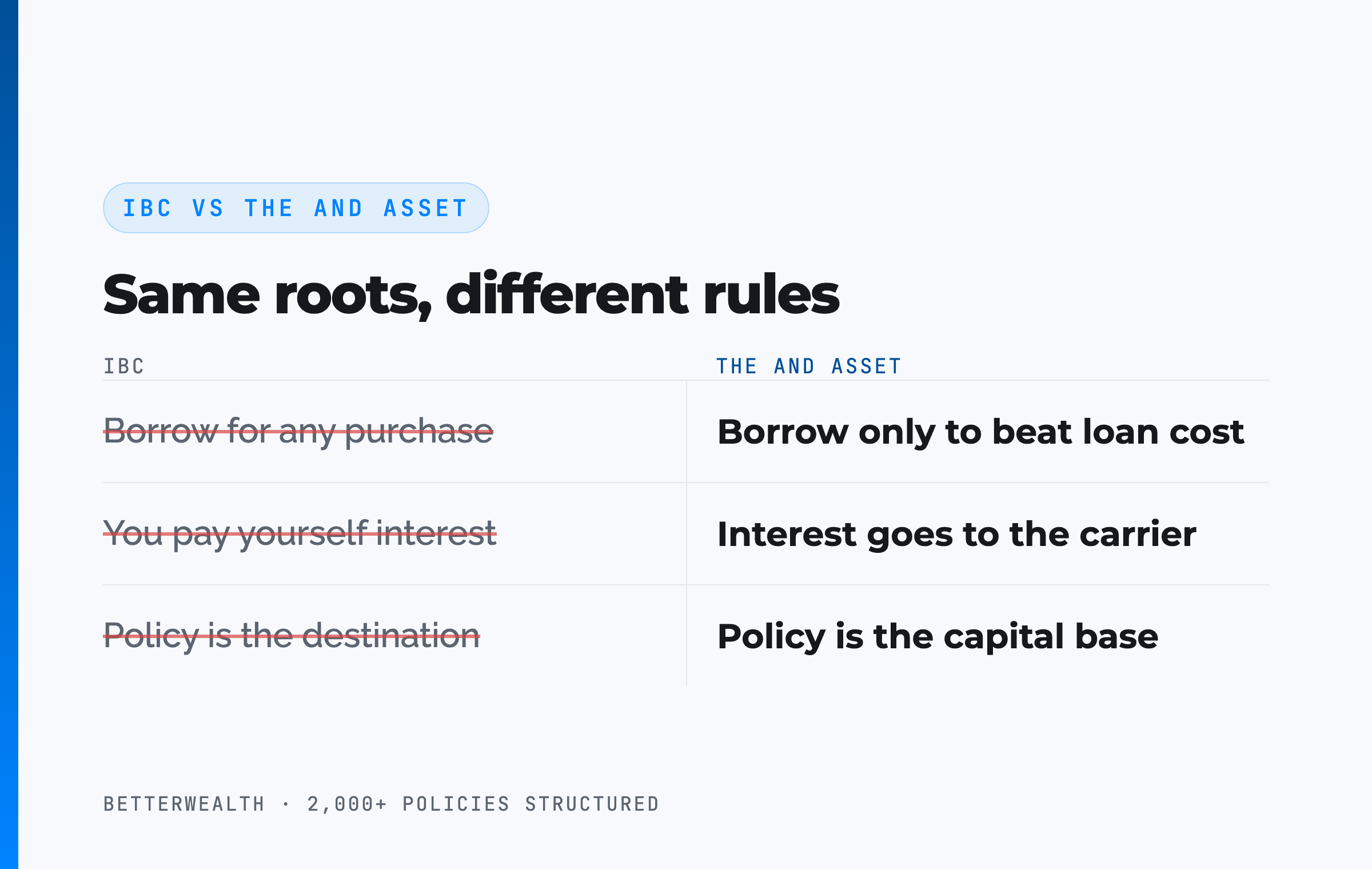
A properly structured, overfunded whole life policy is the tool that solves the adjacent problem for a balance sheet under the PPLI bar. It is not a smaller PPLI, and anyone who frames it that way is selling. The two structures do different jobs. PPLI removes annual tax from a portfolio of alternatives that someone else manages. An overfunded whole life policy creates a stable, liquid capital base you control and can borrow against while it keeps compounding.
The shared DNA is real: both are life insurance contracts, both grow without annual taxation on the inside buildup, both use the same IRC 101(a) death benefit exclusion, and both are built on the IRC 7702 definition. The differences are what matter for the decision. Whole life sits in the carrier's general account rather than a separate account, grows through dividends declared annually and never guaranteed, and compounds net of mortality and expense charges rather than at the headline dividend rate. It has no securities-law bar at all. A $63,000 annual premium is a normal design, and so is a $12,000 one.
For the high earner who is maxing every tax-advantaged account and looking at what comes next, the honest analysis of whether a permanent policy earns its place is a longer conversation than a paragraph. We wrote it out in full for the reader weighing whether whole life insurance is actually worth it on a high income, including the cases where the answer is no.
Where The And Asset comes in
The capital base is only half of it. What you do with the capital is the other half, and that is the framework we teach. The And Asset is BetterWealth's framework for using a properly structured whole life policy as a capital base you borrow against for an activity that returns more than the carrier charges you for the loan. Your dollars do two jobs at once. The policy keeps compounding on its full cash value while the deployed capital earns its own return. That is the AND.
Nelson Nash pioneered this territory in Becoming Your Own Banker, and his central insight holds up: you either lose money paying interest to outside lenders, or you lose it to the opportunity cost of capital sitting idle. We credit that foundation. The And Asset builds on it and operates on different principles. IBC says you can use a whole life policy as a personal banking system for any purchase. The And Asset says you only deploy capital when the borrowed dollars will produce a return greater than the carrier's loan cost, because anything less is an expensive way to spend money. Marketers have ruined the way this gets explained, most visibly with the claim that you are paying yourself interest. You are not. The interest goes to the carrier. Your return is what the deployed capital earns while the policy compounds.
The full mechanical explanation, including how the base premium and paid-up additions split drives early cash value and what the discipline actually requires, lives in our guide to what infinite banking is and how The And Asset differs from it. That is the strategy most readers of this page actually qualify for.
Different balance sheets. Different tools. Same discipline.
Two composites: one above the line, one below it
These are representative composites drawn from patterns we see, not named clients. The first is the profile PPLI was designed for. The second is the profile that calls us.
Composite A: the seller who qualified
A 52-year-old founder sells a company and lands with $11,300,000 in investable assets. About $4,600,000 of it is earmarked for private credit and a multi-strategy hedge fund, both of which throw off interest and short-term gains taxed as ordinary income. Held in a taxable account, that portion of the portfolio surrenders up to 37 cents of every such dollar to the federal government before the state takes its share.
Their attorney forms an irrevocable life insurance trust. The trust applies for and owns the policy. Premiums of $1,150,000 go in across four years, $4,600,000 total, spread out rather than paid at once so the contract does not become a Modified Endowment Contract. The death benefit is designed to the CVAT floor to hold the cost of insurance down. An independent manager runs the separate account, and the founder, who spent twenty years picking every investment personally, is now legally barred from picking any of them.
The policy's costs come out first and they are real: the cost of insurance on the corridor, a state premium tax on all $4,600,000 of premium, an annual M&E charge against assets, and the managers' own fees. In the early years those costs exceed the tax the family would otherwise have paid. Crossover, where the tax never paid has compounded past everything the policy has charged, generally lands around year 8 for a profile like this. We are not going to attach a return to it. What the structure saves is a function of what the managers actually produce, and nobody can promise that in advance.
Composite B: the owner who did not qualify
A 43-year-old owner of a regional service business researches PPLI, runs the qualified purchaser test against a $2,300,000 net worth and $740,000 of household income, and finds the door closed. Most of the net worth is the business itself, which the test does not count.
What fits instead is an overfunded whole life policy at $63,000 a year on a 30/70 base-to-PUA split, meaning $18,900 of base premium and $44,100 into the paid-up additions rider. Year one cash value comes in at $47,600 against $63,000 contributed, which is exactly what a real policy does. Cash value trails cumulative contributions through the first four years. At year five, $322,800 of cash value crosses $315,000 of cumulative premium. Any illustration showing break-even earlier than that is marketing fiction.
In year seven, with roughly $471,900 of accessible cash value against $441,000 contributed, the owner borrows $184,000 against the policy to buy a second service truck fleet and the equipment that goes on it. The added routes return an estimated 13.6% IRR against an illustrative loan cost near 6%, and loan rates vary by carrier and rate environment, so that 6% is a figure to verify rather than assume. The spread runs in the owner's favor by roughly seven and a half points. The policy compounds on its full cash value the entire time, net of mortality and expense charges. Repayment runs on a 44-month schedule funded by the new routes.
One dollar. Two jobs. That is the And.
10 / Head to headPPLI against the realistic alternatives
Against the two structures it gets compared to most, PPLI trades control and accessibility for the removal of annual tax on a portfolio of alternatives. The table sets it beside an overfunded whole life policy and an ordinary taxable account on the six dimensions that decide the question.
| Dimension | PPLI | Overfunded whole life (The And Asset) | Taxable portfolio |
|---|---|---|---|
| Who can buy it | Accredited investor and qualified purchaser: at least $5,000,000 in investments, or $25,000,000 for an entity | No securities-law bar. A $63,000 annual premium is a normal design; so is $12,000 | Anyone with a brokerage account |
| What is inside | Hedge funds, private credit, private equity, real estate, via insurance dedicated funds or an SMA | The carrier's general account. Dividends declared annually, never guaranteed | Anything you want to own |
| Annual tax on growth | None inside the contract under IRC 72 | None on cash value growth inside the contract | Interest and short-term gains taxed up to 37% federally, plus state |
| Who picks the investments | An independent manager. The owner is barred from selecting securities under the investor control doctrine | Nobody. The carrier manages the general account and declares a dividend | You do, with no constraints |
| Access to capital | Withdrawals to basis first under IRC 72(e), then policy loans | Policy loans against cash value, typically available 30 days after funding, cannot be called | Sell the position and pay the tax |
| Time before it makes sense | Generally 7 to 10 or more years to clear the policy's own costs | Break-even at year 5 or later for a healthy individual | Immediate, at the cost of annual taxation |
Who can buy it. This row settles the question for most readers before the others matter. The $5,000,000 investments test is federal securities law, not a sales guideline, and a business you own does not count toward it. An overfunded whole life policy has no equivalent gate.
Who picks the investments. PPLI hands selection to an independent manager because the investor control doctrine requires it. Whole life removes the question entirely by putting the money in the carrier's general account. If your advantage in life is your own judgment about where capital goes, note that neither structure lets you exercise it inside the policy. The And Asset resolves this differently: you borrow against the policy and exercise that judgment outside it.
Access to capital. PPLI access is a sequence, basis first and then loans, designed around a long hold. Whole life access is designed around active use, which is the entire point of borrowing against a policy to fund a deal while the cash value keeps compounding. A taxable account is the most liquid of the three and pays for that liquidity every April.
The honest 30 minutes about what actually fits your balance sheet.
We have structured 2,000+ policies across all 50 states. We do not sell PPLI, so on a discovery call there is nothing to steer you into. A practitioner looks at your situation and tells you whether a properly designed policy belongs in your capital structure, whether you should be talking to a tax attorney about something larger, or whether the answer is neither. If you would rather learn first, the The And Asset and BetterWealth YouTube channels go deep on the math.
Book a Discovery CallFAQPrivate placement life insurance questions
What is private placement life insurance (PPLI)?
Private placement life insurance is a privately offered variable universal life policy used as a tax wrapper around institutional investments. Hedge funds, private credit, private equity, and real estate strategies are held inside the policy's separate account, where gains are not taxed each year under IRC 72, and the death benefit passes income-tax-free under IRC 101(a).
Who qualifies for PPLI?
PPLI is limited to buyers who are both accredited investors under Regulation D and qualified purchasers under Section 2(a)(51) of the Investment Company Act of 1940. The qualified purchaser test is the binding one: at least $5,000,000 in investments for an individual, or $25,000,000 for an entity. Below that, PPLI is not available at any price.
How much money do you need for PPLI?
The statutory floor is $5,000,000 in investments for an individual qualified purchaser and $25,000,000 for an entity. Carriers set their own minimum premium commitments on top of the legal test, and those commitments are usually large enough that the practical entry point sits well above the statutory floor.
Is PPLI legal?
Yes. PPLI is ordinary life insurance under the Internal Revenue Code, sold as a private placement of unregistered securities under Regulation D. Its tax treatment comes from the same sections that govern retail policies: IRC 7702 for the definition of a life insurance contract, IRC 72 for the taxation of amounts received, and IRC 101(a) for the death benefit. The structure fails only when it is built wrong.
What is the investor control doctrine?
The investor control doctrine is the IRS position that a policyholder who directs the specific investments inside a policy is treated as the owner of those assets and taxed on them directly. In practice it means the PPLI owner cannot pick securities, direct individual trades, or negotiate deal terms. An independent manager makes those decisions, and the owner chooses only among allocation options.
What is the 55/70/80/90 diversification rule?
The 55/70/80/90 rule comes from the diversification requirements under IRC 817(h). No single investment may exceed 55% of the separate account, no two may exceed 70%, no three may exceed 80%, and no four may exceed 90%. A policy that fails the test loses its treatment as life insurance, and the owner is taxed on the internal gains.
Can you take money out of a PPLI policy tax-free?
Yes, when the contract is not a Modified Endowment Contract. Under the ordering rules of IRC 72(e), withdrawals come out of cost basis first and are not taxable until the owner has withdrawn everything paid in. After basis is exhausted, the owner borrows against the remaining cash value, and a policy loan is not taxable income while the contract stays in force.
Is the PPLI death benefit taxable?
The death benefit is excluded from the beneficiary's gross income under IRC 101(a), the same provision that governs a retail policy. Income tax and estate tax are separate questions. A death benefit can be income-tax-free and still be counted in the taxable estate if the insured held incidents of ownership at death under IRC 2042.
Does PPLI avoid estate tax?
PPLI does not avoid estate tax on its own. The ownership structure does the work. When an irrevocable life insurance trust, a spousal lifetime access trust, or a dynasty trust applies for and owns the policy, and the insured holds no incidents of ownership, the proceeds sit outside the gross estate under IRC 2042 and away from the top federal estate tax rate of 40%.
How long do you need to hold a PPLI policy for it to make sense?
Typically 7 to 10 or more years. The policy's own costs, which include the cost of insurance on the death benefit, state premium taxes on every dollar of premium, and an annual mortality and expense charge on assets, come out first. The tax the portfolio never paid has to compound long enough to exceed them.
PPLI versus overfunded whole life insurance: which one?
They solve different problems for different balance sheets. PPLI removes annual tax from a portfolio of alternatives and requires at least $5,000,000 in investments. An overfunded whole life policy has no securities-law bar, grows in the carrier's general account, and is built to be borrowed against so the same dollar can back a deal while it keeps compounding. The second one is available to nearly everyone reading this. The first one is not.
What is The And Asset?
The And Asset is BetterWealth's framework for using a properly structured whole life policy as a capital base. You only borrow against it for an activity that produces a return greater than the carrier's loan cost, so your dollars do two jobs at once: the policy keeps compounding net of mortality and expense charges while the deployed capital earns its own return.
How is The And Asset different from infinite banking?
Infinite banking, as Nelson Nash taught it, frames a whole life policy as a personal banking system for any purchase. The And Asset says you only deploy borrowed capital when the return clears the carrier's loan cost, because anything less is an expensive way to spend money. The policy is the capital base, not the destination. It shares roots with IBC and operates on different principles.
- IRC Section 7702 (Cornell Law). The definition of a life insurance contract, including the Cash Value Accumulation Test used in PPLI design.
- IRC Section 72 (Cornell Law). How amounts received from an annuity or life insurance contract are taxed, including the basis-first ordering rules.
- IRC Section 101 (Cornell Law). The exclusion of death benefit proceeds from the beneficiary's gross income.
- IRC Section 817 (Cornell Law). Variable contract rules, including the 817(h) diversification requirements behind the 55/70/80/90 test.
- IRC Section 2042 (Cornell Law). When life insurance proceeds are included in the gross estate, and what counts as an incident of ownership.
- Investment Company Act of 1940, Section 2(a)(51) (Cornell Law). The qualified purchaser definition and the $5,000,000 and $25,000,000 thresholds.
- U.S. Securities and Exchange Commission. Assessing accredited investors under Regulation D.
- Loeb & Loeb LLP. Private Placement Life Insurance: An Overview, a practitioner-level survey of the structure.
- Nelson Nash, Becoming Your Own Banker. The origin of the infinite banking concept.
- BetterWealth resources: The And Asset book, the The And Asset YouTube channel, and the BetterWealth YouTube channel.
I founded BetterWealth to treat life insurance as the wealth and capital tool it actually is, not the product most people get sold. Our team has structured more than 2,000 policies across all 50 states. I wrote The And Asset and host the BetterWealth and The And Asset YouTube channels. We do not sell PPLI. If you want an honest read on what does fit your balance sheet, book a discovery call. We will tell you if the answer is nothing.