
Whole life insurance for high earners is worth it when you have already maxed your tax-advantaged accounts and can deploy borrowed capital above the carrier's loan cost. It carries no income limits and no contribution ceiling beyond the MEC line, with tax-exempt access under Section 7702. It is not a savings account or a 401(k) replacement.
High earners run out of tax-advantaged room long before they run out of capital. The 401(k) caps at a number set by Congress. The Roth IRA phases out entirely once your income crosses a threshold, so a physician earning $600,000 cannot contribute directly at all. The backdoor Roth has a ceiling. The HSA is small. Once those are full, the next dollar of after-tax income lands in a taxable brokerage account and gets taxed on its gains every year it grows.
For a high earner, the question is rarely "how do I save more," it is "where does the capital go after the efficient options are exhausted." That is the precise gap where a properly structured whole life policy earns a place in the conversation. No income limit. No statutory contribution cap. Tax-exempt access through policy loans. A capital base that keeps compounding while you borrow against it.
That is also where most of the bad advice lives. Whole life is oversold to people who should never own it and dismissed by people who have never seen it structured correctly. At BetterWealth, we have structured more than 2,000 policies across all 50 states, and a large share of them sit with exactly this buyer: the entrepreneur, the business owner, the physician, the executive who has maxed everything else.
This piece covers what whole life actually solves for a high earner, why the income-limit and tax-access features matter, the math that decides whether borrowing against the policy makes sense, the honest tradeoffs, and who should walk away. We introduce The And Asset framework along the way, because the strategy only works under one specific discipline.
- Whole life has no income limits and no contribution ceiling beyond the MEC line, unlike the Roth IRA and 401(k).
- Policy loans are not taxable income under Section 7702, giving high earners tax-exempt access to their capital.
- The policy compounds on its full cash value net of charges, even while you borrow against it.
- The And Asset rule governs: only borrow when the deployed return clears the carrier's loan cost.
- Cash value does not exceed contributions before year 4, so it rewards a 10-plus-year horizon, not a quick win.
- Max your 401(k), HSA, and backdoor Roth first. This is the next step, not a replacement for them.
01 / The problemWhat high earners run out of (and it isn't money)
High earners run out of tax efficiency long before they run out of income, and that is the structural problem whole life can address. The traditional toolkit was built with contribution limits because it was designed for the median saver, not for someone clearing several hundred thousand a year. Once the limits bind, the high earner is left choosing between a taxable account that bleeds returns to annual taxation and a wall of conventional advice that says "just invest the difference."
The hidden cost in that default is twofold. There is the tax drag on a brokerage account, where gains and dividends are taxed as they accrue. And there is the lost opportunity cost of capital that has to be liquidated, and taxed, every time a real opportunity appears. A business owner who wants to fund an acquisition, or a physician who wants to invest in a surgery center, has to unwind something and trigger a tax event to do it.
The problem for a high earner is not a shortage of capital. It is that every dollar is either fully taxed or fully spoken for. Whole life solves a liquidity-and-tax problem, not a savings problem.
02 / The frameworkWhat does whole life actually do for a high earner?
Whole life gives a high earner a capital base that compounds with favorable tax treatment and that can be borrowed against without being liquidated. That is the mechanical answer. The discipline layered on top of it is what we call The And Asset, and it is the difference between a strategy that creates value and an expensive place to park money.
Nelson Nash pioneered the idea of using whole life insurance as a personal banking system in Becoming Your Own Banker. His insight holds: you either lose money paying interest to outside lenders, or you lose money to the opportunity cost of capital sitting idle. We respect that foundation. The And Asset builds on it with one rule Nash's broader teaching does not enforce.
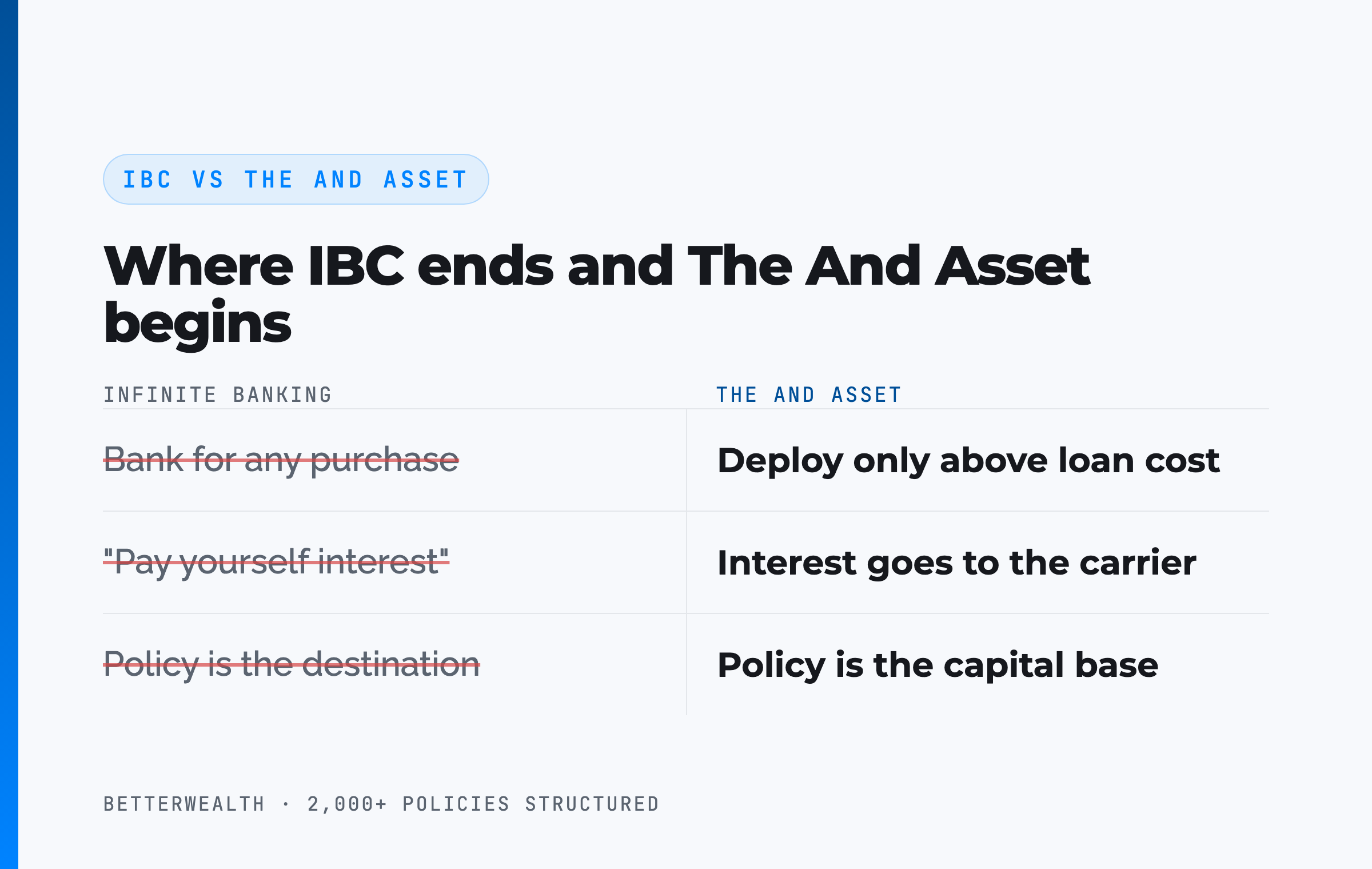
Where IBC ends and The And Asset begins
IBC says you can use a whole life policy as a personal banking system for any purchase. The And Asset says you only deploy capital from the policy when the borrowed dollars will produce a return greater than the carrier's loan cost. Anything less is an expensive way to spend money. Many infinite banking marketers say you are paying yourself interest. You are not. The interest goes to the insurance company. Your return is what your deployed capital earns elsewhere while the policy compounds uninterrupted.
For a high earner with real capital and real opportunities, this distinction is the whole game. The policy is the capital base. The value is created in what you deploy that capital into. It is built on Nash's foundation, but it operates on different principles.
The math has to work. Every time.
Marketers have ruined how this strategy gets explained. It is not a product. It is a strategy. And it is for value creators, not savers.
03 / No income limitsWhy does the "no income limit" feature matter so much?
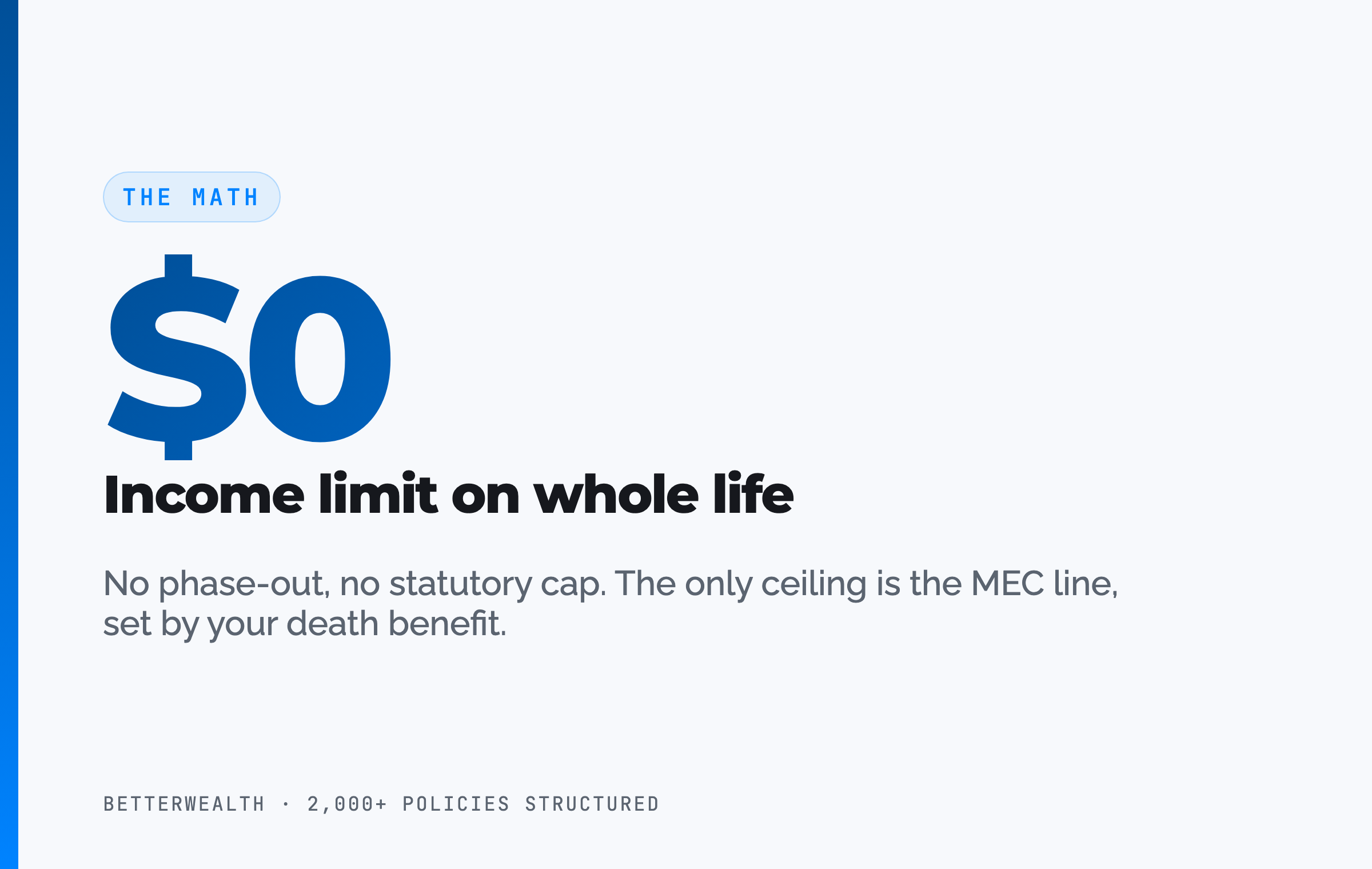
The no-income-limit feature matters because it is the one structural advantage a high earner cannot get from the retirement system. A Roth IRA phases out and then disappears entirely at higher incomes. A 401(k) caps employee deferrals at a fixed annual number. Even after the backdoor Roth and the mega-backdoor Roth, a high earner with significant after-tax income hits a ceiling on tax-advantaged room.
A whole life policy has no income limit and no statutory contribution cap. The only ceiling is the MEC limit, the line set by the Internal Revenue Code that determines how much premium a given death benefit can absorb before the policy is reclassified as a Modified Endowment Contract and loses its favorable loan treatment. That ceiling is a function of the death benefit you qualify for and choose to carry, not your income. Structure the policy with a larger death benefit and the room to fund it grows with you.
This is why the high earner is the natural buyer. The feature that frustrates most savers, that you have to fund it substantially for it to work, is exactly what a high earner has the capacity to do.
04 / Tax-exempt accessHow do high earners pull cash out without a tax bill?
High earners access their capital tax-free through policy loans, which are not treated as taxable income under Section 7702. A loan is borrowed money, not a distribution, so it does not trigger income tax the way a withdrawal from a traditional 401(k) or IRA would. The cash value stays inside the policy and continues to compound on its full balance while the loan is outstanding.
The permanent life insurance tax treatment behind this predates the Roth account. It is not a loophole that appeared recently, and it is not "tax-free returns" in the loose sense marketers use. The structure is what creates the treatment. As long as the policy stays in force and is not a MEC, loans against cash value are not taxable events, and the death benefit passes income-tax-free to heirs under current law.
Compare that to the alternatives a high earner faces. A traditional retirement account defers tax now and taxes every dollar later as ordinary income, at whatever future rates apply. A taxable brokerage account taxes gains and dividends along the way. The policy lets the same capital compound and be accessed without an annual or access-triggered tax drag.
A 401(k) is not "government-controlled" money. It is tax-deferred and access-restricted under rules Congress sets. The accurate framing is sharper than the inflammatory one: you trade control and access for the deferral.
05 / How it worksHow a high earner puts a policy to work, step by step
A high earner turns a whole life policy into an And Asset through five steps, and the order is not negotiable. The product is an overfunded whole life policy, designed for maximum cash value rather than maximum death benefit. Here is the sequence we use.
- Max the tax-advantaged accounts first. Fund the 401(k), the HSA, and the backdoor Roth before a dollar goes into whole life. The policy is for capital that has nowhere tax-efficient left to go. It complements those accounts. It does not replace them.
- Structure for cash value. Minimize the base premium and load the paid-up additions rider as heavily as the IRS allows. The base/PUA split is the single design decision that determines early cash value. Get it wrong and you have bought an expensive death benefit. How the policy is structured matters far more than which carrier you choose.
- Fund consistently with after-tax dollars. Choose a level premium or a front-load schedule. There is no income cap and no contribution ceiling beyond the MEC limit your death benefit supports, so the funding scales with your capacity.
- Let the early years capitalize. Cash value will trail your contributions for the first few years. Break-even arrives at year 5 or later for a healthy individual. Any illustration that shows day-one break-even is fiction.
- Borrow and deploy. Take a policy loan collateralized by your cash value, put it into an activity that beats the carrier's loan cost, and repay from the cash flow that activity generates. The policy compounds on its full value the entire time.
The capitalization point, where a dollar of premium adds more than a dollar of cash value, typically arrives around year three on a well-designed policy. Break-even, where total cash value catches total contributions, lands at year five for a healthy individual. Not before year four. That timeline is the price of admission, and it is why this is a tool for a long capital horizon.
Whole life fits a specific high earner doing specific things.
It fits you if
- You have already maxed your 401(k), HSA, and backdoor Roth
- You have after-tax capital and a 10-plus-year horizon
- You can name a use for capital that beats the loan cost
- You value tax treatment, control, and flexibility
It does not fit you if
- You have not maxed your tax-advantaged accounts yet
- You need maximum liquidity in year one
- You want a savings account, not a life insurance strategy
- You cannot identify a productive use for borrowed dollars
If you are in the first column, a 30-minute conversation will tell you whether a policy fits your situation and how it should be designed. If you are in the second, we will tell you that too.
Book a Discovery Call06 / The mathDoes the return clear the carrier's loan cost?
The return on whatever you deploy must exceed the carrier's loan cost, or you should not borrow. That is the entire test, and it is the line that separates The And Asset from generic infinite banking. Policy loan rates vary by carrier and rate environment. At the time of writing, many carriers fall in the 5 to 6% range, but treat the specific number as a variable to verify, not a constant to plan around.
Here is the structure of the decision. You borrow at the carrier's loan rate. Your policy keeps compounding on its full cash value, net of mortality and expense charges, including the borrowed portion. Your deployed capital earns its own return. If that return is higher than the loan cost, you are ahead on the spread, and the policy has done two jobs with one dollar. If it is lower, you have borrowed money to lose money slowly.
For a high earner this changes the calculus on opportunities they already pursue. The capital that funds a real estate deal, a business expansion, or a partnership buy-in can come from the policy loan, and the policy keeps compounding as if the money never left. The honest constraint stated up front: if you cannot identify a use that beats the loan cost, do not borrow. The discipline is the strategy.
If the deal does not clear the loan rate, do not borrow.
07 / Asset protectionThe liability angle most high earners overlook
Cash value and death benefit receive creditor protection in many states, which is a live concern for high earners with liability exposure. Physicians, attorneys, and business owners carry malpractice and litigation risk that a salaried employee does not. In a number of states, the cash value inside a life insurance policy is shielded from creditors, sometimes in full, sometimes up to a statutory cap.
The honest version of this claim is that protection varies widely by state. Some states protect the entire cash value. Others cap it at a fixed dollar amount. A few offer limited protection. This is a real reason high earners with exposure look at whole life, but it is not a feature to assume. It must be verified against the law of your specific state before it factors into a decision.
Protection is real. It is also state-specific. Verify it.
The frameworks behind 2,000+ policies, in one place.
The And Asset Vault holds the calculators, design frameworks, and structuring decisions we use when we build policies for entrepreneurs, physicians, and high-income earners. Free, email-gated, no spam.
Open the Vault08 / The tradeoffsBenefits and the honest tradeoffs for high earners
Whole life's advantages for a high earner come with tradeoffs that disqualify it for some buyers, and pretending otherwise is how agents lose trust. Here they are, plainly.
First, the timeline. Cash value does not exceed cumulative contributions before year 4, with break-even at year 5 or later for a healthy individual. If you need immediate liquidity, this is the wrong tool. Second, it demands discipline. The funding has to be consistent, and the repayment of any loan has to be deliberate, because the strategy compounds advantages over time rather than solving an immediate cash crunch. Third, and most important, the policy only creates value if you actually deploy borrowed capital above the loan cost. Left idle, an overfunded policy is an expensive place to store money with a modest internal return.
Against those tradeoffs sit the features that make it worth it for the right high earner: no income limit, tax-exempt access under 7702, uninterrupted compounding net of charges, potential creditor protection, and a capital base that does not have to be liquidated to be used. The question of whether the whole package is worth it is the same one we put to every prospective buyer in our honest answer on whether whole life insurance is worth it, and for a high earner the answer turns entirely on horizon and discipline.
Long horizon. Real discipline. Or skip it.
This is not for everyone. If you have not maxed your retirement accounts, or you cannot name a use for borrowed capital that beats the loan cost, a whole life policy is not your next move.
09 / The fitWho is this right for, and who isn't it?
Whole life is right for the high earner who has exhausted tax-advantaged accounts, holds after-tax capital with a long horizon, and can deploy borrowed dollars above the carrier's loan cost. That describes the entrepreneur scaling a business, the physician or attorney with liability exposure and maxed retirement plans, and the executive sitting on after-tax cash with nowhere tax-efficient to put it. For that person, the no-income-limit and tax-access features are not marketing points. They are the entire reason the tool exists.
It is the wrong tool for the high earner who has not yet maxed the 401(k), HSA, and backdoor Roth, who needs maximum liquidity in the next year or two, or who wants a savings vehicle rather than a capital base. If you cannot name an activity that beats the loan cost, no policy design fixes that. The discipline has to come from you.
10 / Head to headWhole life against the high earner's other options
Against the capital tools a high earner already uses, an overfunded whole life policy trades day-one liquidity and raw market upside for tax treatment, control, and uninterrupted compounding. The table sets it against a taxable brokerage, a 401(k), and a HELOC on the four dimensions that matter for life insurance strategy.
| Dimension | Overfunded Whole Life | Taxable Brokerage | 401(k) | HELOC |
|---|---|---|---|---|
| Income limits | None; capped only by the MEC limit on your death benefit | None | Annual deferral cap set by Congress | Based on home equity, not income |
| Tax on access | Policy loans not taxable income under IRC 7702 | Gains and dividends taxed annually | Taxed as ordinary income on withdrawal | Loan proceeds not taxed; interest rarely deductible |
| Growth while borrowing | Compounds on full cash value, net of internal costs, even while borrowed against | Must sell to access; sold dollars stop compounding | Restricted before 59½ (penalty plus tax) | None; it is a credit line, not an asset |
| Control | Loan cannot be called; you set repayment terms | Full control; no leverage feature built in | Access rules set by Congress, not you | Lender controls terms and can freeze access |
Income limits. This is the high earner's headline. The Roth disappears and the 401(k) caps out, while whole life has no income limit at all. The only ceiling is the MEC line, which scales with the death benefit you carry.
Tax and growth. A taxable brokerage taxes gains every year and forces you to sell, and stop compounding, to access capital. A whole life policy keeps the full balance compounding net of charges while you borrow against it, and the loan is not a taxable event under Section 7702.
Control. A HELOC is faster on paper, but a HELOC can be frozen exactly when you need it, as thousands of investors learned in 2020. A 401(k) restricts access until 59½ under rules Congress sets. The policy loan cannot be called, and you set the repayment terms.
A composite: the surgeon who deployed at year eight
Consider a 43-year-old surgeon, preferred non-tobacco, earning roughly $640,000 a year, with the 401(k), HSA, and backdoor Roth already maxed. She funds an overfunded whole life policy at $84,000 per year with after-tax dollars on a level design. This is a representative composite, not a single named client.
Through the first three years, cash value trails cumulative contributions, exactly as a real policy should. By year three, each premium dollar adds more than a dollar of cash value. At year five, total cash value crosses total contributions. No earlier. Any illustration showing year-two break-even is marketing fiction.
In year eight, with roughly $743,000 of accessible cash value, she borrows $312,500 against the policy to take an equity stake in an ambulatory surgery center. The distributions and appreciation return an estimated 13.6% IRR. The loan cost is illustrative at around 6%, so the spread works in her favor by more than seven points. The policy keeps compounding on its full value the entire time. Repayment runs on a 47-month schedule funded by the center's distributions, not by squeezing her household cash flow.
One dollar. Two jobs. That is the And.
The honest 30 minutes about whether this fits you.
We have structured more than 2,000 policies across all 50 states. On a discovery call, a practitioner looks at your specific situation, where your income lands, what you have already maxed, and what you would do with the capital, and tells you whether a policy belongs in your plan, or whether it does not. If you would rather learn first, the The And Asset and BetterWealth YouTube channels go deep on the math.
Book a Discovery CallFAQHigh earner whole life questions
Is whole life insurance worth it for high-income earners?
Whole life insurance can be worth it for high-income earners who have already maxed their tax-advantaged accounts and can deploy borrowed capital into returns that beat the carrier's loan cost. It has no income limits, no contribution ceiling beyond the MEC line, and tax-exempt access under Section 7702. It is not worth it as a savings account or a 401(k) replacement.
Are there income limits on whole life insurance?
No. Unlike a Roth IRA, which phases out at higher incomes, and a 401(k), which caps annual contributions, whole life insurance has no income limit and no statutory contribution cap. The practical ceiling is the MEC limit, which is set by the size of the death benefit you qualify for and choose to carry.
How do high earners access cash from whole life tax-free?
Policy loans against cash value are not treated as taxable income under IRC Section 7702, because a loan is borrowed money, not a distribution. The cash value continues to compound on its full balance while the loan is outstanding. This treatment holds as long as the policy stays in force and is not a Modified Endowment Contract.
What is The And Asset?
The And Asset is BetterWealth's framework for using a properly structured whole life policy as a capital base. You only borrow against it for an activity that produces a return greater than the carrier's loan cost, so your dollars do two jobs at once: the policy keeps compounding while the deployed capital earns its own return.
How is The And Asset different from infinite banking?
Infinite banking, as Nelson Nash taught it, frames a whole life policy as a personal banking system for any purchase. The And Asset adds a discipline: you only deploy borrowed capital when the return clears the carrier's loan cost. The policy is the capital base, not the destination. It is built on Nash's foundation but operates on different principles.
Is whole life insurance a good investment for physicians?
Whole life is not an investment, it is a life insurance strategy. For a physician who has maxed retirement accounts, faces high liability exposure, and has after-tax cash with nowhere efficient to go, a properly structured policy can offer tax-exempt access, creditor protection that varies by state, and a stable capital base. It only makes sense with a clear use for borrowed capital that beats the loan cost.
Should I buy whole life insurance after maxing my 401(k)?
Maxing your 401(k), HSA, and backdoor Roth comes first. Whole life is for the high earner who has exhausted those vehicles and still has after-tax capital looking for tax efficiency and flexibility. It complements those accounts, it does not replace them. If you have not maxed them, start there.
How much should a high earner put into whole life insurance?
A common range we see across 2,000+ policies is 10 to 20% of annual income directed into an overfunded policy, funded with after-tax dollars and capped by the MEC limit. The right number depends on liquidity needs, the capital you can commit for 10 or more years, and what else competes for those dollars. There is no one-size figure.
Does whole life insurance offer asset protection?
Cash value and death benefit receive creditor protection in many states, though the amount protected varies widely by state law. Some states protect the full cash value, others cap it. For high earners with liability exposure, this is a real consideration, but it must be verified against the law of your specific state, not assumed.
What is the downside of whole life insurance for high earners?
The honest downsides: cash value does not exceed cumulative contributions before year 4, with break-even at year 5 or later for healthy individuals, so it rewards a long horizon. It requires consistent funding and repayment discipline. And it only creates value if you actually deploy borrowed capital above the loan cost. Idle, it is an expensive place to store money.
Whole life insurance vs taxable brokerage for high earners?
A taxable brokerage offers full liquidity and market upside but taxes gains and dividends annually. A whole life policy compounds net of internal costs, allows tax-exempt access through loans under Section 7702, and lets the same dollar stay invested while you borrow against it. The brokerage wins on raw growth potential; the policy wins on tax treatment, control, and capital efficiency. Many high earners use both.
- Nelson Nash, Becoming Your Own Banker, the origin of the infinite banking concept.
- IRC Section 7702 (Cornell Law), the tax code provision behind the tax treatment of life insurance cash value and loans.
- IRS Roth IRA contribution phase-out, the income limits that disappear for high earners.
- LIMRA, life insurance industry data, including persistency and ownership benchmarks.
- BetterWealth resources: The And Asset book, the The And Asset YouTube channel, and the BetterWealth YouTube channel.
I founded BetterWealth to treat life insurance as the wealth and capital tool it actually is, not the product most people get sold. Our team has structured more than 2,000 policies across all 50 states, many of them for entrepreneurs, physicians, and high-income earners who had already maxed everything else. I wrote The And Asset and host the BetterWealth and The And Asset YouTube channels. If you want an honest read on whether a policy fits your plan, book a discovery call. We will tell you if it does not.