
I founded BetterWealth nearly a decade ago to treat life insurance as a wealth and capital strategy for entrepreneurs, business owners, and high-income earners. Our team has structured more than 2,000 policies across all 50 states. I wrote The And Asset and host the BetterWealth and The And Asset YouTube channels.
Designed this client's policy and built the projection calculator that compares the life insurance strategy against investing the full inheritance.
Whole life insurance for inheritance planning works by converting part of a lump sum into a level, permanent death benefit while the rest stays invested. In our client's case, $960,000 became a projected $5.7 million estate at year 20, versus $3.71 million fully invested at 7%.
An inheritance arrives as a single number, and most of the advice that follows treats it as a single decision: hand it to a money manager, pick an allocation, and let the market do the rest. That framing hides two costs. The first is sequence risk, since a lump sum fully exposed to the market can lose a third of its value in the year it matters most. The second is opportunity cost of a quieter kind: capital that sits in one bucket does one job, and an heir who wants both growth and certainty ends up trading one for the other.
For an heir whose goal is multiplying the inheritance for the next generation, the deciding question is which structure locks in the most of the outcome you actually want. Which investment earns the most is a different question, and it leads to a different answer.
At BetterWealth, we have structured more than 2,000 policies, and most of them are built for maximum cash value. This one was not. Austin, one of our wealth coaches, worked with a middle-aged client who had recently inherited $960,000 from his parents, had been burned by volatile markets before, and wanted to turn that inheritance into four to five times as much for his children with as little risk as possible. The design he landed on prioritized a permanent, level death benefit, and the math behind it is worth walking through line by line.
This piece covers the four design decisions that shaped the policy, how the integrated strategy compares to investing every dollar at a steady 7%, the break-even return the market would need to match it, where The And Asset discipline applies to the cash value, and the honest tradeoffs, including the year the all-market plan pulls ahead.
- A $960,000 inheritance, split between a whole life policy and an investment account, projected to a $5.7 million estate at year 20.
- Fully invested at a 7% compound annual return, the same inheritance projects to $3.71 million after 20 years.
- Matching the policy strategy at year 20 requires about a 9.3% compound annual return, and volatility pushes the average year higher.
- At a steady 7%, the all-market plan does not catch the integrated strategy until around year 26 to 27.
- The And Asset rule still applies: borrow against the cash value only when the deployed return clears the loan cost.
Austin shares the actual projection calculator on screen in the full conversation, including how the estate lines move as he changes the market rate and the time horizon from 20 to 30 years:
01 / The ProblemWhy Does a Lump-Sum Inheritance Carry More Risk Than It Looks?
A lump-sum inheritance carries more risk than it looks because the entire legacy depends on one return path, and nobody gets to pick their path. A 20-year projection at 7% assumes 20 consecutive years of 7%. Real markets deliver an average with drawdowns inside it, and a 35% decline in year three of a legacy plan does more damage than the same decline in year eighteen.
Austin's client had lived this. Through circumstances outside his control, he had lost a large amount of money in stocks and other volatile assets earlier in life. He came to the conversation with a clear brief: he knew nothing is literally guaranteed, but he wanted his parents' legacy to be as close to guaranteed as it could get, and he wanted it multiplied for his kids.
He was also talking to other advisors, including a money manager who would simply invest the full amount. That gave us an honest baseline to compare against. The real question was whether a structure with a contractual floor could deliver his specific goal better than a structure with none.
The right policy for this client gave up cash value on purpose. Its job was a death benefit that stays level for life.
02 / The FrameworkWhat Is The And Asset, and Where Does It Differ From IBC?
The And Asset is BetterWealth's framework for using a properly structured whole life policy as a capital base, and it differs from most infinite banking teaching on one rule: borrowed dollars must out-earn the loan cost, or you do not borrow. This case is a legacy design, but the cash value inside it still falls under that rule.
Nelson Nash pioneered the idea of using whole life insurance as a personal banking system in Becoming Your Own Banker. His core insight holds: you either lose money paying interest to outside lenders, or you lose money to the opportunity cost of idle capital. The And Asset shares roots with IBC but operates on different principles.
Where IBC Ends and The And Asset Begins
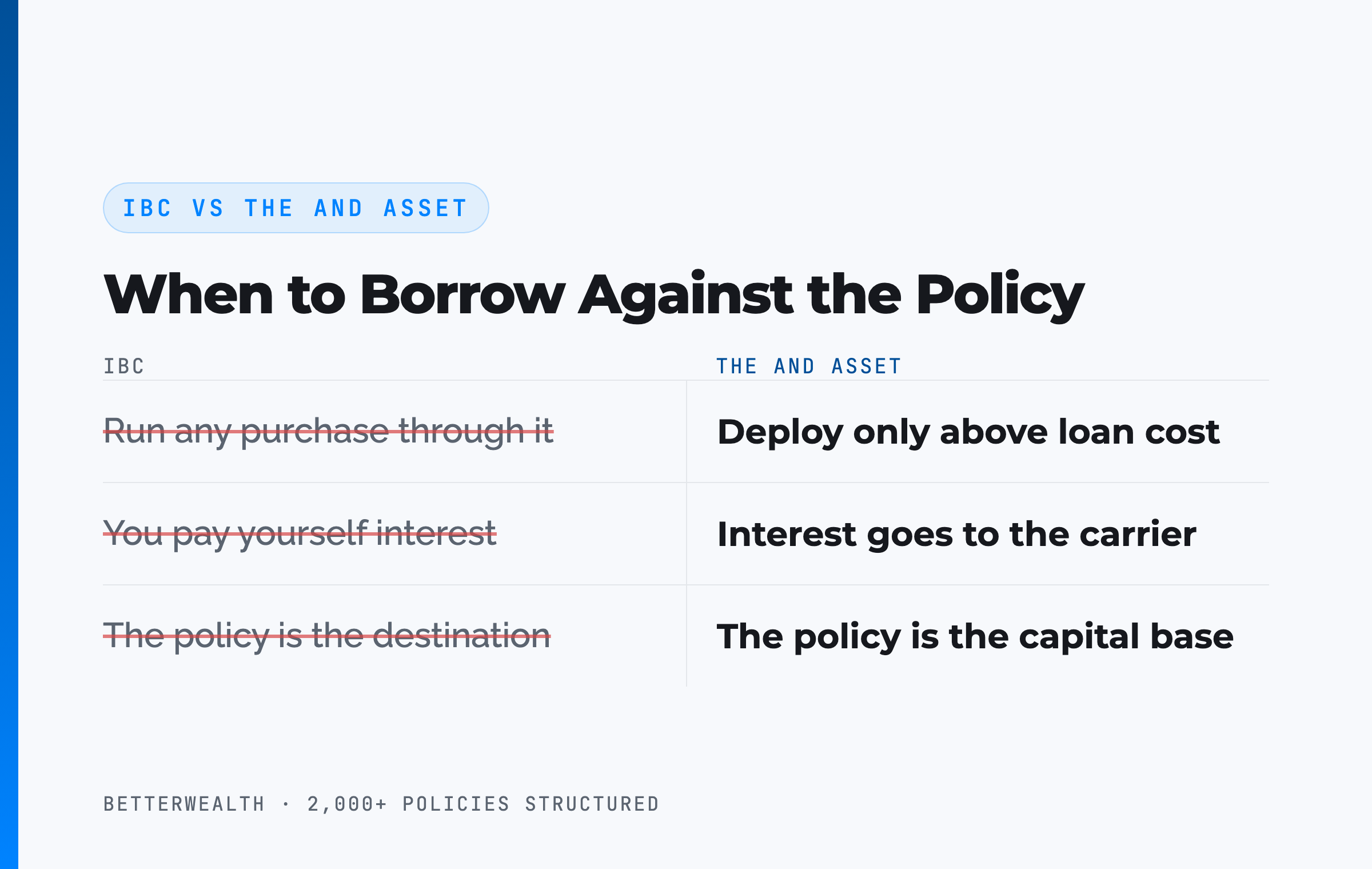
IBC says you can run any purchase through the policy as your personal bank. The And Asset says you only deploy capital from the policy when the borrowed dollars will produce a return greater than the carrier's loan cost, because anything less is an expensive way to spend money. Many IBC marketers also say you are paying yourself interest when you repay a policy loan. You are not. The interest goes to the carrier. Your return is what the deployed capital earns elsewhere while the policy keeps compounding net of its mortality and expense charges.
IBC content often frames the whole life policy as the destination. In this case, the policy is a floor under the legacy and a pool of capital beside it. The value comes from what that floor allows the client to do with everything else.
The math has to work, with margin.
03 / The ClientWhich Design Decisions Shaped This Policy?
Four decisions shaped this policy, and each one traded a feature most buyers want for a feature this client needed. Every one of them came from his goals, not from a product sheet.
Single Life, Not Survivorship
Austin raised a survivorship policy first. Insuring both spouses on one contract buys more death benefit per premium dollar. The client declined, because a survivorship policy pays nothing until the second spouse dies. It protects the legacy, but it does not protect a widow. His first priority was his wife.
A Level Death Benefit, No Term Rider
Some designs bolt a term rider onto the whole life base to add coverage cheaply for 20 or 30 years. When the rider expires, the death benefit drops. He did not want a design where his family's protection shrinks on a schedule, so the death benefit stays level across the life of the policy.
A 20-Year Funding Window
He wanted to fund for about 20 years and then stop. After he received a specific health offer from the carrier, the premium settled at $52,751 a year, roughly $1,055,020 over 20 years. From year 21, the illustration shows part of the dividends paying the policy's remaining required cost, a premium offset, so no further premiums come out of pocket.
A Carrier With a Long Dividend Record
The premium offset depends on dividends, and dividends are not guaranteed. The client chose MassMutual, a mutual carrier with a dividend history of more than 150 years and availability in all 50 states. Dividends will almost certainly not land exactly on projection. They may run higher or lower. Given the carrier's record, an offset around year 20 is a reasonable assumption, and we told him plainly that it is an assumption.
04 / How It WorksHow Do You Build an Integrated Legacy Strategy?
You build an integrated legacy strategy by funding a level, permanent death benefit from part of the inheritance and keeping the rest invested, then modeling the combined estate against an all-market baseline. Here is the sequence Austin followed.
- Define the legacy goal. Name the target in dollars and the people it must protect. Here: four to five times the $960,000 for the children, with the spouse protected first.
- Choose single life or survivorship. Survivorship buys more death benefit but pays only at the second death. A spouse-first goal points to a single-life policy.
- Keep the death benefit level. Avoid riders that expire. A legacy design should hold its death benefit for life.
- Size the premium to the funding window. $52,751 a year for 20 years, with a premium offset illustrated from year 21 on current dividend projections.
- Invest the remainder. At 7%, the side account earns about $67,200 in its first year, more than the $52,751 premium it funds, so it grows to roughly $1.4 million by year 20 even while paying every premium.
- Model against a baseline. Compare total estate value (death benefit plus investments) against investing 100% of the inheritance, and solve for the break-even return.
- Deploy cash value with discipline. Borrow only when the deployed return clears the carrier's loan cost with margin, and repay to restore the death benefit.
A Legacy Design Fits a Specific Person With a Specific Goal.
It Fits You If
- You hold a lump sum you want to pass on multiplied
- A guaranteed floor under the legacy matters more than the top-end return
- You can fund consistently for 15 to 20 years
- You want to take more risk elsewhere once the legacy is covered
It Does Not Fit You If
- You need maximum cash value in the early years
- You are confident in 26+ years of uninterrupted market returns
- You are carrying high-interest debt
- You want a savings account, not a capital structure
If you are in the first column, we will run your numbers against an all-market baseline the same way Austin did. If you are in the second, we will tell you that too.
Book a Discovery Call05 / The MathWhat Return Would the Market Need to Beat the Policy?
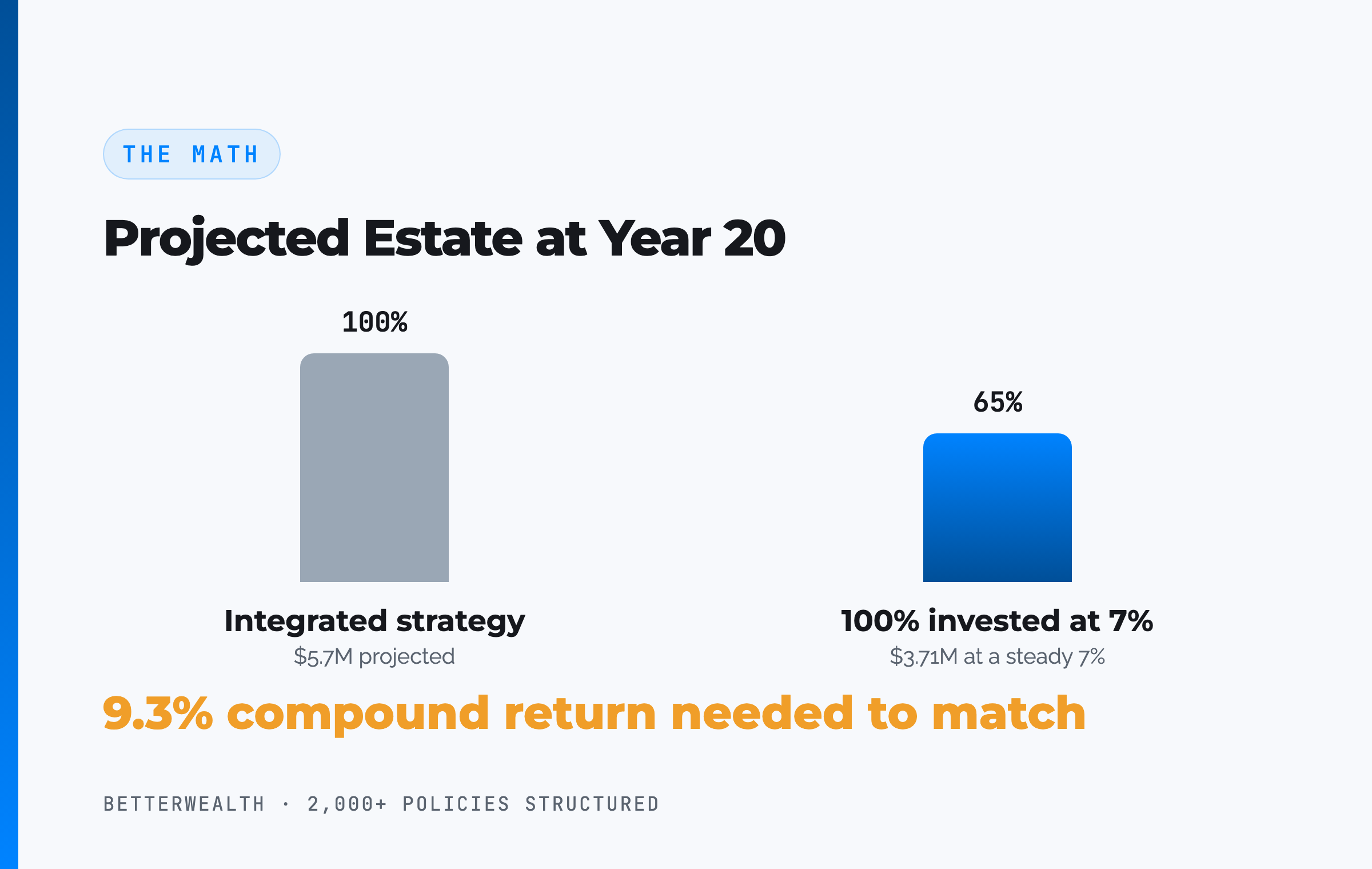
The fully invested plan would need about a 9.3% compound annual return to match the integrated strategy at year 20. That is the break-even return, and it is the most useful single number in the analysis. With real-world volatility, earning a 9.3% compound return requires a higher average year, because losses cost more than equal-sized gains recover.
The calculator in the video shows different break-even figures (12% at 20 years and 8.21% at 25). We recomputed them here on a plain lump-sum basis, $960,000 growing to the projected estate value, so the numbers in this article reconcile with each other.
The baseline is simple. Invest all $960,000 at a static 7%, a figure the client chose himself as a conservative long-run expectation, and the account reaches about $3.71 million after 20 years. The integrated strategy's total estate value is the policy's death benefit plus the side account, which grows from just under $960,000 to roughly $1.4 million over the same period. Together they come to a projected $5.7 million.
Run the baseline at a static 9.3% and $960,000 compounds to about $5.7 million at year 20, level with the integrated strategy. That is how high the bar sits over a 20-year horizon. In Austin's words, this time frame is where life insurance looks best, and we say that up front.
The Horizon Changes the Answer
Extend the window and compounding starts working for the market. At 25 years, the integrated strategy projects to about $5.9 million against $5.2 million fully invested, and the break-even return drops to about 7.5%. Around year 26 to 27, a steady 7% market return overtakes the integrated strategy. From there, the all-market plan holds more on paper.
The catch is in the word steady. Reaching that crossover requires a 7% compound annual return for roughly 27 years, and with real-world volatility that means a higher average year. No market promises that. The client had already been burned once. He was unwilling to carry that risk to win a race that only starts paying off after year 26.
Twenty-seven years of 7% compounding is a bet.
If you are confident in a 7% compound return for three decades, invest it all. The policy wins on certainty.
06 / Where People Get This WrongWhy Is Borrowing at 6% to Earn 7% the Wrong Move?
Borrowing at 6% to earn 7% is the wrong move because the spread is too thin to survive a single down year. I raised it on camera as the obvious way to juice the projection: borrow against the cash value at a loan rate that often runs 5 to 6% at the time of writing, put it into the 7% assumption, and watch the estate line climb. I would not recommend it, and our team would not either.
This is where marketers have ruined the way the strategy gets explained. A one-point spread on paper becomes a loss in the first year the market falls, and the loan interest still goes to the carrier. MassMutual uses non-direct recognition with a variable loan rate that changes year to year, so the cost side of that spread is not fixed either. For a legacy design, an outstanding loan also reduces the death benefit dollar for dollar until it is repaid, which works directly against the reason the policy exists.
The And Asset rule is that the deployed return must beat the loan cost. In practice, that means beating it with enough margin to absorb a bad year. If you cannot name a use that clears that bar, do not borrow.
A one-point spread is a bet with borrowed money and a thin margin.
07 / The TradeoffsWhat Does the Integrated Strategy Cost You?
The integrated strategy buys certainty and a head start on the legacy, and it pays for both with long-run upside and early liquidity. Here is the full ledger.
On the benefit side, the estate value is front-loaded. From the first year the policy is in force, the death benefit is in place, so the legacy exists immediately instead of being built over 25 years. The cash value does not fall with the market, since the guaranteed values rise every year by contract and declared dividends, once credited, are not taken back. And the side account keeps growing, because the 7% assumption out-earns the premium draw.
On the cost side, the design is not built for maximum cash value, so early liquidity is lower than a cash-focused policy would offer. The premium offset rests on dividends that are not guaranteed. The client commits to roughly $1,055,020 of premium over two decades. And past year 26 or 27, a 7% compound market return projects to more than the integrated strategy.
Tax treatment is not apples to apples either. Money spent from a brokerage account during life can trigger capital gains, while assets passed at death may receive a step-up in basis. Life insurance death benefits are generally received income-tax-free under IRC Section 101(a). Estate tax and your specific situation vary, so confirm the details with a tax advisor.
The Frameworks Behind 2,000+ Policies, in One Place.
The And Asset Vault holds the calculators and design frameworks we use when we compare a legacy-focused design against a cash-focused one, or against investing the full amount. Free, email-gated, no spam.
Open the Vault08 / The Bigger PictureHow Does a Legacy Policy Fit a Broader Capital Strategy?
A legacy policy fits a broader capital strategy by covering the inheritance goal first, which frees every other asset to do its own job. I call this permission to spend. Once the family's legacy is covered by a level death benefit, the client can afford to be more aggressive with his side account and other holdings, because a bad decade no longer threatens his children's inheritance.
That cuts against the assumption that this design is only for the ultra-conservative. An heir who invests everything is, in effect, locking the whole sum into a 25-year project to build the legacy. An heir with the policy has the legacy on day one and can take more risk with everything else.
The cash value adds a second job. The old Golden Rule often quoted in IBC circles says he who has the gold makes the rules. When the market falls 35%, an investor who is fully invested can only wait for it to recover. An investor with accessible cash value can buy, provided the purchase clears the loan cost with margin. For more on using a policy during life, see How To Use Life Insurance While You're Still Alive.
Not everyone thinks in estate terms. Many clients care first about not running out of money, and that is a different design and a different conversation. Our analysis of sequence of returns risk covers that side, and our whole life insurance vs investing review runs the longer-horizon math.
The Heir Who Wanted a Floor Under the Legacy
A middle-aged client inherits $960,000. After a specific health offer from MassMutual, he funds a single-life, level-death-benefit whole life policy at $52,751 a year for 20 years, about $1,055,020 in total. The remaining principal stays invested at the 7% rate he chose himself.
The side account earns about $67,200 in year one at 7%, which more than covers the $52,751 premium. It never shrinks. By year 20 it holds roughly $1.4 million, and the policy's level death benefit sits on top of it. Total projected estate: $5.7 million, close to six times the original inheritance. To match that by investing everything, the market would need about a 9.3% compound annual return for 20 years.
At 25 years, the projection is $5.9 million against $5.2 million fully invested, with a break-even return of about 7.5%. Around year 26 to 27, a 7% compound market return overtakes the policy strategy. The client chose the policy anyway, knowing that number, because the guaranteed floor was worth more to him than the upside past that point.
He bought certainty, and he knew its price.
A Composite: Using Legacy Cash Value in a Downturn
This is a representative composite, not a single client. It shows how the cash value inside a death-benefit-weighted design can do a second job without breaking The And Asset rule. A 47-year-old business owner, preferred non-tobacco, funds $41,750 a year with a 60/40 base/PUA split: $25,050 to base premium and $16,700 to paid-up additions. The heavy base keeps the death benefit high and the early cash value modest.
Cash value trails cumulative contributions for the first seven years, which is normal for a base-heavy design and later than a maximum-cash-value policy would break even. By year 10, contributions total $417,500 and cash value sits at $451,860, growing net of mortality and expense charges.
In year 10, a downturn brings a motivated seller. The owner borrows $118,350 against the policy as the down payment on a duplex producing $13,374 a year in net cash flow, an 11.3% cash-on-cash return. At an illustrative 6% loan rate, the loan costs about $7,101 in its first year. He repays on a 43-month schedule of $3,066 a month, funded by the duplex's cash flow plus surplus business income. Total loan interest over the schedule: about $13,488, paid to the carrier. Net cash flow from the duplex over the same 43 months: about $47,920.
While the loan is outstanding, the death benefit is reduced by the loan balance. Once repaid, the full death benefit is restored, and because this composite uses a non-direct-recognition carrier, the policy kept compounding on its full cash value the entire time. A direct-recognition carrier adjusts the dividend on the borrowed portion instead.
09 / Head to HeadIntegrated Strategy vs Investing the Whole Inheritance
Compared with investing every dollar or buying a survivorship policy, the integrated strategy trades long-run upside for a guaranteed floor and a legacy that exists from year one. The table sets the three options side by side on the dimensions this client weighed.
| Dimension | Integrated Strategy | 100% Invested at 7% | Survivorship Policy |
|---|---|---|---|
| Estate at Year 20 | ~$5.7M projected (death benefit + ~$1.4M side account) | ~$3.71M at a steady 7% | Larger death benefit per premium dollar, paid only at second death |
| Estate at Year 25 | ~$5.9M projected | ~$5.2M at a steady 7% | Same structure: nothing paid until both spouses die |
| Return Needed to Match | Baseline for comparison | ~9.3% compound annual return for 20 years, or ~7.5% for 25 | Not modeled for this client |
| Market Risk | Death benefit and guaranteed values unaffected by markets | Full exposure; a 35% drop hits the whole $960,000 | Death benefit unaffected by markets |
| Who It Protects First | Spouse and children | Whoever inherits the account balance | Children; no payout to a surviving spouse |
Estate value. At year 20, the integrated strategy projects roughly $2 million more than investing everything at 7%. At year 25 the gap narrows to about $700,000, and around year 26 to 27 the all-market plan overtakes it, assuming a 7% compound return the whole way.
Return needed to match. The break-even return is the honest scorecard. Over 20 years the market needs about a 9.3% compound annual return to catch up; over 25 years, about 7.5%. Volatility raises the average year needed to hit either figure, and the longer the horizon you assume, the better the market looks.
Risk and protection. A survivorship policy would have bought more death benefit for the same $52,751 premium, but it pays nothing while either spouse is alive. For a client whose first goal was protecting his wife, that ruled it out regardless of the larger number.
Run Your Inheritance Against the Baseline.
We have structured more than 2,000 policies. We have seen this strategy work exactly as designed, and we have seen it fail. If you want a real conversation about whether a legacy design or The And Asset fits your situation, book a discovery call and we will give you the honest answer either way. If you would rather learn first, The And Asset YouTube channel and the BetterWealth YouTube channel go deep on the math.
Book a Discovery CallFAQWhole Life Insurance for Inheritance Questions
Can whole life insurance multiply an inheritance?
Yes, when part of the inheritance funds a level, permanent death benefit and the rest stays invested. In this case, a $960,000 inheritance funded a $52,751 annual premium for 20 years, producing a projected $5.7 million estate at year 20 versus $3.71 million fully invested at a steady 7%. Dividends are not guaranteed, so projections can move.
What is The And Asset?
The And Asset is BetterWealth's framework for using a properly structured whole life policy as a capital base. You only borrow against it for an activity that produces a return greater than the carrier's loan cost, so your dollars do two jobs at once: the policy keeps compounding net of its internal charges while the deployed capital earns its own return.
How is The And Asset different from infinite banking?
Infinite banking, as Nelson Nash taught it, frames a whole life policy as a personal banking system for any purchase. The And Asset shares those roots but operates on different principles: you only deploy borrowed capital when the return clears the carrier's loan cost, and the policy is the capital base, not the destination.
Why not just invest the whole inheritance at 7%?
Investing the full $960,000 at a steady 7% projects to $3.71 million after 20 years, about $2 million less than the integrated strategy's projected $5.7 million. The all-market plan only pulls ahead around year 26 to 27, and only if it delivers a 7% compound annual return the whole way, which with real-world volatility requires a higher average year.
What return would the market need to match the life insurance strategy?
At 20 years, the fully invested plan would need about a 9.3% compound annual return to match the projected $5.7 million estate, which with real-world volatility requires a higher average year. At 25 years, the required return falls to about 7.5%, because compounding works in the market's favor over longer horizons.
Why did the client turn down a survivorship policy?
He turned it down because a survivorship policy pays nothing until the second spouse dies, so it protects the legacy but not his wife. A survivorship design buys more death benefit per premium dollar, but his first goal was protecting his spouse if he died first.
What is a premium offset?
A premium offset is a design where, after a set funding period, part of the policy's dividends pays the remaining required cost so no further premiums come out of pocket. In this case the client funded for 20 years, with the offset illustrated from year 21 based on current dividend projections, which are not guaranteed.
Why avoid a term rider in a legacy-focused policy?
A term rider adds death benefit cheaply for a set period, often 20 or 30 years, then drops off. That defeats the goal of a level, permanent legacy.
Are whole life dividends guaranteed?
No. Dividends are declared each year by the carrier's board and are not guaranteed. MassMutual, the carrier used here, has paid dividends for more than 150 years, which is why a dividend-supported premium offset is a reasonable assumption, but it remains an assumption.
Does a legacy-focused policy still build cash value?
Yes. A design optimized for permanent death benefit still builds cash value that compounds net of mortality and expense charges and can be borrowed against. It builds more slowly than a maximum-cash-value design, and an outstanding loan reduces the death benefit until it is repaid.
Should you borrow against the policy to invest at 7%?
Usually not. Borrowing at a loan rate that often runs 5 to 6% at the time of writing to chase a 7% market return leaves a one- to two-point spread that a single down year can erase. The And Asset rule requires the deployed return to clear the loan cost with margin, not by a sliver.
Is this strategy only for conservative investors?
No. Locking in a projected estate value can let an aggressive investor take more risk with the rest of their assets, because the family's inheritance is already covered by the policy's death benefit. We call this permission to spend.
- Nelson Nash, Becoming Your Own Banker: the origin of the infinite banking concept.
- IRC Section 101 (Cornell Law): the income tax treatment of life insurance death benefits.
- IRC Section 7702 (Cornell Law): the definition of life insurance for tax purposes.
- IRC Section 1014 (Cornell Law): the basis of property acquired from a decedent (step-up in basis).
- MassMutual: dividend history and whole life product information.
- BetterWealth resources: The And Asset book, the The And Asset YouTube channel, the BetterWealth YouTube channel, and the source video for this case.
I founded BetterWealth to treat life insurance as the capital tool it actually is. Our team has structured more than 2,000 policies, and I wrote The And Asset. If you are weighing what to do with an inheritance, book a discovery call. We will run it against the baseline and tell you if a policy does not belong in your plan.