
Be your own bank with life insurance by funding a specially designed whole life policy at a mutual carrier, then borrowing against its cash value as collateral instead of withdrawing it, so the balance keeps compounding while you use the money and you repay on your own schedule.
Being your own bank with life insurance means funding a specially designed high-early-cash-value whole life policy at a mutual carrier, then borrowing against that cash value as collateral instead of withdrawing it. The full balance keeps compounding net of the policy's internal charges while you use the money elsewhere. You repay on your own schedule, and the capital is there for the next use. That is the whole mechanism. Everything after this is design, cost, and discipline.
The mechanism is simple. The design is where this goes right or wrong, and the design is the part almost nobody shows you before you sign.
If you are reading this, you have probably already heard the pitch from someone who earns a commission when you say yes. That is a reasonable thing to be suspicious of. So this page is written the other way around: the mechanics in plain English, the costs stated as costs, the failure modes named, and a section on the four kinds of people who should not do this at all.
We have structured more than 2,000 policies at BetterWealth across all 50 states. We have watched this work exactly as designed, and we have watched it fail. It fails in predictable ways, and every one of them is covered below: what makes a policy specially designed, why the carrier has to be a mutual company, the difference between a policy loan and a withdrawal, what the loan interest actually is, the repayment discipline it demands, the MEC limit, and what happens if a policy lapses with a loan outstanding.
- Being your own bank means borrowing against policy cash value as collateral. It never means withdrawing it.
- A base-heavy policy design pays the agent more and leaves you with far less cash value in the early years.
- The loan interest goes to the carrier. You are not paying yourself interest, and anyone who says so is wrong.
- Cash value does not pass total premiums paid until roughly year five in a healthy, well-designed policy.
- Fund past the seven-pay limit and the policy becomes a MEC, which taxes every loan as ordinary income.
- If a policy lapses with a loan outstanding, the gain becomes taxable income you owe in cash you already spent.
01 / The phraseWhat does "be your own bank with life insurance" actually mean?
It means you stop asking a lender for permission to access your own capital. You build a pool of money inside a whole life policy, and when you need that money you borrow against it from the carrier rather than pulling it out. The pool stays intact. The loan is collateralized by it.
You are not chartering a bank. You are not lending money to yourself. What you are actually doing is replacing the function a bank performs for you, which is holding capital and lending against it, with a contract you control. The phrase is marketing shorthand for a strategy Nelson Nash named and taught in Becoming Your Own Banker. If you want the full history and the framework behind it, start with our guide to what infinite banking actually is, which covers the origin and where the industry took it.
The capital you borrow against is the policy's cash value, and cash value is not a side account the carrier keeps for you. It is the contractual value your premium builds inside the policy over time, growing at a guaranteed rate plus any dividend the carrier declares, net of the mortality and expense charges the policy costs to run. How whole life cash value works walks through where that number comes from year by year.
Where IBC ends and The And Asset begins
Nash's insight holds up: you either pay interest to outside lenders or you give up the opportunity cost of capital sitting idle, and most people do both. We credit that foundation. The And Asset is what we built on top of it, and it operates on a different principle.
IBC says you can use a whole life policy as a personal banking system for any purchase, including a car, a vacation, or a kitchen remodel. The And Asset says you only deploy capital from the policy when the borrowed dollars will produce a return greater than the carrier's loan cost, because anything less is an expensive way to spend money. The policy is the capital base. The value gets created in what you deploy the capital into.
The discipline is the strategy.
02 / The designWhat makes a policy "specially designed"?
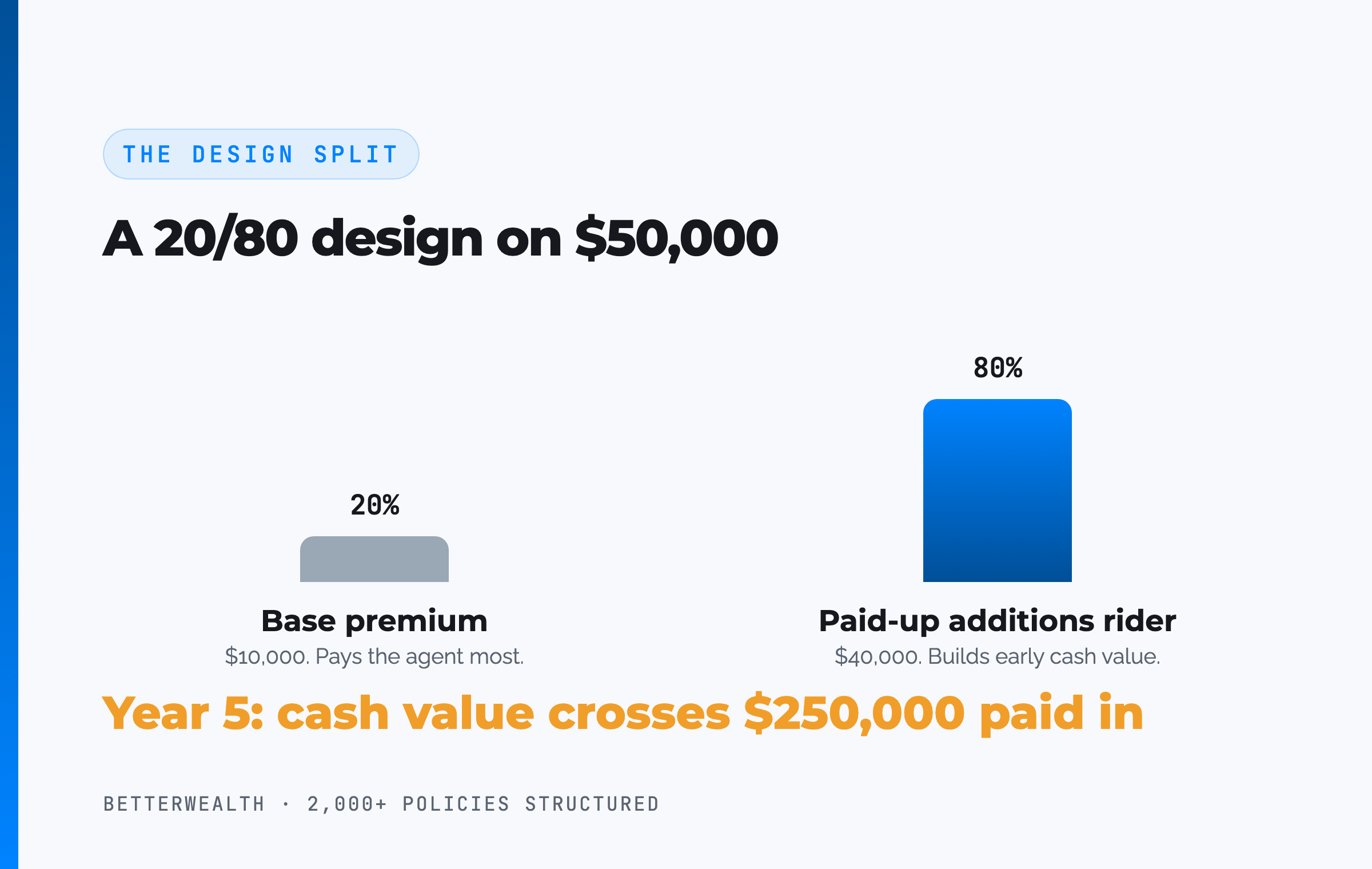
The split between base premium and the paid-up additions rider is what makes a policy specially designed. Everything else is secondary. Two policies at the same carrier, same age, same health class, same $50,000 annual premium, can produce wildly different amounts of usable cash value in year three depending on nothing but that split.
Base premium is the traditional whole life premium. It buys a death benefit and it builds cash value slowly, because a large share of the first year goes to acquisition costs. The paid-up additions rider is different. It buys small chunks of fully paid-up insurance, and because it carries a much lower load, most of what you put into it shows up as cash value quickly. The rider is the engine. Paid-up additions explained covers the mechanics of the rider in detail.
A policy built for this strategy keeps base premium as low as the carrier will allow and pushes as much of the annual payment as Section 7702A permits into the rider. Common designs land somewhere around 20/80 or 30/70 base to PUA. A traditional policy sold for death benefit might be 100/0.
Why a base-heavy design keeps showing up anyway
Agent compensation is paid primarily on base premium. The paid-up additions rider pays a small fraction of what base premium pays, sometimes close to nothing. An agent who writes your $50,000 premium as $50,000 of base earns multiples of what the same agent earns writing $10,000 base and $40,000 into the rider.
We are not accusing anyone of fraud. Most agents are trained on death benefit sales and have never designed a cash value policy, so they build what they know. The result is the same for you either way: a policy that will take a decade to become useful as capital. Ask for the base and PUA numbers in dollars before you sign anything. If the person selling it cannot produce that split in ten seconds, they did not design it. Our breakdown of policy structure shows what a properly built design looks like line by line.
Ask for the split. In dollars.
The design that pays the agent the most is the design that gives you the least usable capital in the first five years. That is not a conspiracy. It is a default, and defaults are what you get when nobody asks.
03 / The carrierWhy the carrier has to be a mutual company
A mutual insurance company is owned by its policyholders rather than by outside shareholders, which means the surplus it generates is shared back with the people who own the policies. That sharing happens through the annual dividend, and the dividend is a large part of what makes long-term cash value work.
A stock carrier answers to shareholders. When surplus gets divided, shareholders have a claim on it that policyholders do not. That is a structural difference in who the company works for, not a claim that stock carriers behave badly. Both structures are legal and heavily regulated. For a contract you intend to hold for forty years and borrow against repeatedly, we want the ownership pointed at us.
Two things to keep straight. Dividends are declared annually by the board and are not guaranteed, whatever any illustration shows. Some carriers also operate under mutual holding company structures that sit somewhere between the two models, so read the actual corporate structure rather than trusting the word "mutual" in a brochure.
04 / The stepsHow to be your own bank with life insurance, step by step
Six steps take a policy from application to functioning capital base, and the order is not optional. This is the sequence we run when we design one.
- Decide what the capital is for. Name the specific uses you expect to fund with borrowed capital over the next decade. Inventory, equipment, a property down payment, an acquisition, a seasonal cash gap. If you cannot name one that produces a return greater than the carrier's loan cost, stop at step one. You do not need this.
- Size the premium to surplus cash flow. Set the annual premium at a level you can sustain out of surplus for ten or more years, not at the highest number this year's profit could technically cover. The most common cause of failure in this strategy is overfunding relative to real cash flow, then surrendering in year three.
- Design the base premium and PUA split. Minimize base premium, maximize the paid-up additions rider, stay under the seven-pay limit. This step is where the money is made or lost.
- Fund it and let the early years capitalize. Pay the premium and accept that cash value trails cumulative premiums at first. In a healthy design, cash value crosses total premiums paid around year five. How soon you can actually borrow against a whole life policy covers the realistic timeline, which is shorter than the break-even year and longer than the pitch implies.
- Borrow against the cash value. Request a policy loan from the carrier, collateralized by cash value. The money comes from the carrier's general account. Your cash value stays in the policy and keeps compounding net of mortality and expense charges.
- Repay so the capital is there next time. Pay the loan back out of the cash flow the deployed capital produces. Unpaid interest gets added to the balance, so a loan you ignore quietly grows against the policy.
Nothing in that list is exotic. The difficulty is entirely in steps one, two, and six, which are behavioral rather than technical.
This works for a specific person doing specific things with capital.
It fits you if
- You have reliable surplus cash flow you can commit for a decade
- You already deploy capital and think in terms of return on it
- You can name a use that beats the carrier's loan cost
- You will actually repay what you borrow
It does not fit you if
- You need the money back inside three to five years
- Your income is unpredictable or already fully committed
- You are looking for the highest possible rate of return
- You are carrying high-interest debt you need to clear first
If you are in the left column, a 30-minute conversation will tell you whether the design you are being shown is any good. If you are in the right column, we will tell you that instead, and it costs you nothing to find out.
Book a Discovery Call05 / The mechanismWhat is the difference between a policy loan and a withdrawal?
A withdrawal takes money out of the policy and permanently reduces the cash value. A policy loan does not. When you take a policy loan, the carrier lends you money from its own general account and holds your cash value as collateral. Your balance stays where it is and keeps earning.
That distinction is the entire mechanism. It is the reason this strategy exists at all. Withdraw $100,000 and you now have $100,000 less compounding for you. Borrow $100,000 against the same policy and the full balance keeps working while you use the money. The carrier is comfortable lending against it because the collateral is a contractual value it controls, so there is no underwriting and no approval committee. The loan cannot be called.
What uninterrupted compounding does and does not mean
It means the cash value inside the policy continues to earn its contractual interest plus any declared dividend, net of mortality and expense charges, while a loan is outstanding against it. That is real, and it is the structural feature that lets one dollar do two jobs.
Here is what it does not mean. It does not mean the money is free. It does not mean the policy pays you a return on the borrowed dollars a second time. And under a direct recognition carrier, the dividend credited on the borrowed portion of your cash value may be set at a different rate than the dividend on the unborrowed portion, sometimes lower and sometimes higher depending on the rate environment. Non-direct recognition carriers credit the same dividend regardless of loans. Ask which one you are dealing with and get the spread in writing before you assume the whole balance is treated identically.
One more thing people find out too late: any loan balance outstanding at death is subtracted from the death benefit your beneficiaries receive. The loan does not disappear.
Borrow against it. Never out of it.
Marketers have ruined the way this gets explained. You are not paying yourself interest. You are paying the insurance company, and your return comes from what you deploy the money into.
06 / The costIs the loan interest a real cost, or is there a trick to it?
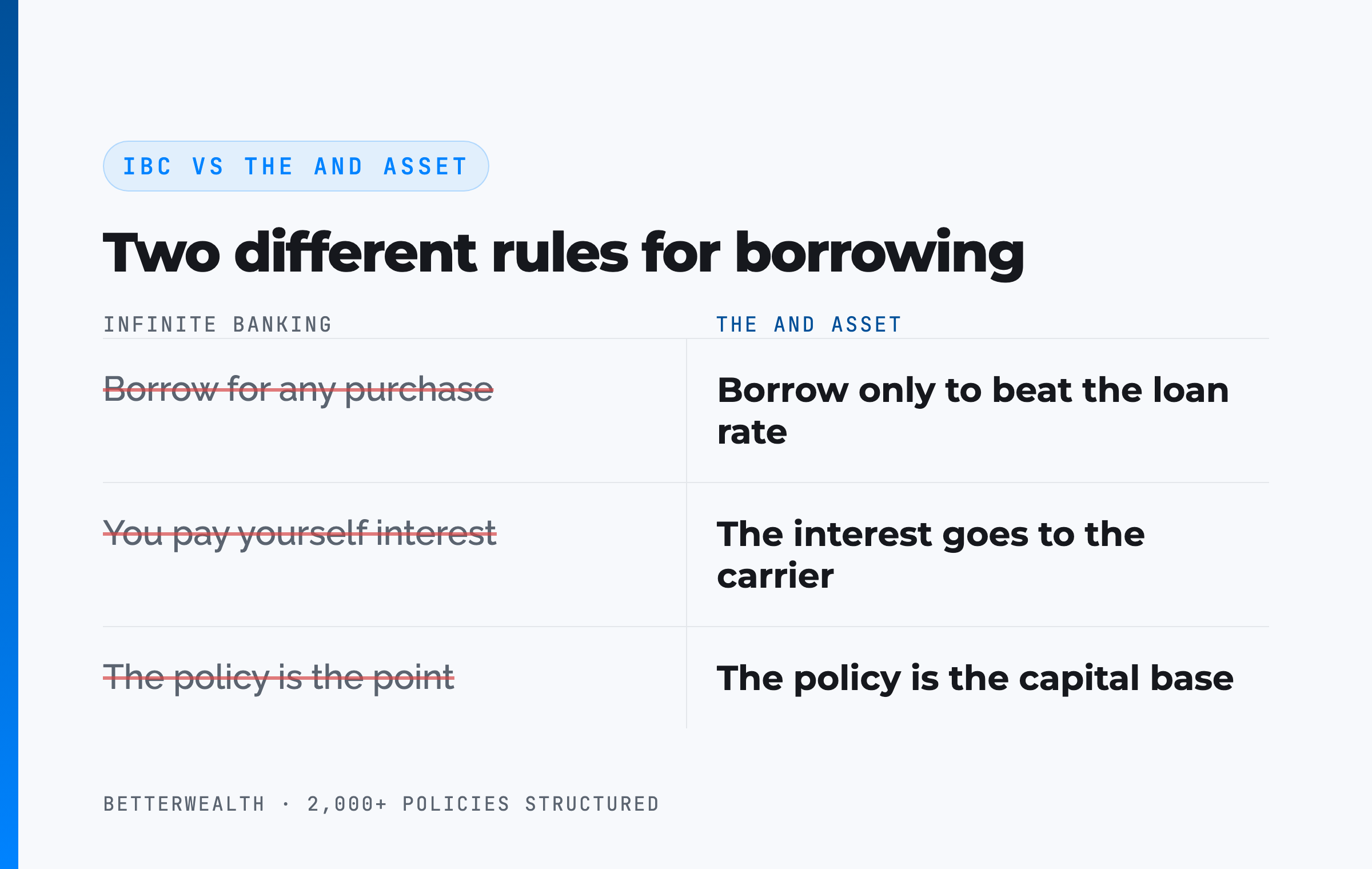
It is a real cost, and it is paid to the carrier. There is no trick. Anyone telling you that you "pay yourself back with interest" is describing something that does not happen inside the contract. Loan rates vary by carrier and rate environment, and at the time of writing many fall in the 5% to 6% range. Treat that as a number to verify against a specific contract, not a constant.
So the arithmetic is simple and it is the only test that matters. You borrow at the carrier's rate. Your cash value keeps compounding. Your deployed capital earns whatever it earns. If what the deployed capital produces is greater than the loan cost, you are ahead, and the same dollar did two jobs. If it produces less, you borrowed money at 6% to earn 4%, and the fact that the policy is still compounding does not rescue that trade.
This is exactly where The And Asset parts ways with how infinite banking usually gets taught. IBC says use the policy as your bank for whatever you were going to buy anyway. The And Asset says the dollars have to beat the loan rate or you do not borrow, because a policy loan used to buy a depreciating consumer purchase is just a more complicated way to spend money you already had.
If you cannot name an activity that will outperform the carrier's loan cost, do not borrow. The policy is still doing its job. You just do not have a use for the leverage yet.
07 / The disciplineRepayment is flexible, which is the hard part
There is no required repayment schedule on a policy loan. No amortization table, no monthly minimum, no late fee, no credit reporting. You can pay it back over three years, over ten, or never. That flexibility is genuinely useful when a deal takes longer than planned to produce cash flow.
It is also the trap. Interest accrues whether or not you pay it, and unpaid interest is added to the loan balance, which then accrues interest of its own. A $100,000 loan you ignore is a larger loan every year, sitting against a cash value that is growing more slowly than the debt if the loan rate exceeds the net crediting rate. Left alone long enough, the balance approaches the cash value, and the section below covers what happens then.
The people who do well with this treat the loan like a bank loan even though nobody is making them. They set their own schedule, usually funded by the cash flow the deployed capital throws off, and they hold to it. The discipline of repayment is the whole strategy, and it is the reason we ask about cash flow habits before we ask about premium.
The design frameworks behind 2,000+ policies, in one place.
The And Asset Vault holds the calculators, design frameworks, and structuring checklists we use when we build and review these policies. Free and email-gated.
Open the Vault08 / The ceilingThe MEC limit and what happens if you overfund past it
The MEC limit is the maximum you are allowed to fund into a policy before the tax code stops treating it as life insurance for distribution purposes. It comes from the seven-pay test under Section 7702A, which compares what you actually pay in the first seven years against what it would take to pay the policy up over seven level annual premiums. Cross that line and the policy becomes a Modified Endowment Contract.
A MEC is still life insurance. The death benefit still pays out income-tax-free to beneficiaries. What changes is the tax treatment of getting money out while you are alive. Loans and withdrawals from a MEC are taxed as ordinary income to the extent of gain, on a last-in-first-out basis, plus a 10% additional tax if you are under 59 and a half. For a strategy whose entire point is borrowing without triggering tax, that is the end of it.
Two facts worth holding onto. Once a policy becomes a MEC it stays one permanently, and no amount of stopping premium later undoes it. And carriers monitor this closely: if a premium payment would push the policy over the line, the carrier will typically flag it and return the excess rather than let it happen. The risk is real but it is well-policed, which is also why a properly designed policy is funded right up to that line and no further. The MEC limit is the ceiling every cash-value design is built against.
09 / The failureWhat happens if a policy lapses with a loan outstanding?
You get a tax bill for money you already spent. This is the worst outcome in the strategy, and it is worth understanding in detail because it is the thing that actually hurts people.
The sequence goes like this. A loan sits unpaid, interest accrues and compounds into the balance, and eventually the loan balance grows large enough to consume the cash value. The policy lapses. At that moment the IRS treats the outstanding loan as a distribution, and everything above your cost basis, which is roughly the premiums you paid, becomes ordinary income in that tax year. You receive a 1099 for a gain you never saw in cash, because the cash left years ago when you borrowed it.
People in this situation are frequently older, on a fixed income, and holding a tax bill in the tens of thousands with no policy left and no liquidity to pay it. That is the failure mode. It is not an obscure edge case, and it is almost always the end result of treating loan flexibility as permission to never repay.
Avoiding it is not complicated. Track the loan balance against the cash value at least annually, which the carrier will show you in the annual statement. Watch for lapse notices and take them seriously. If a loan is getting away from you, options exist while the policy is still in force, including partial repayment, reducing the death benefit, or converting to a reduced paid-up policy. Every one of those options disappears the day it lapses.
A policy that lapses with a large loan outstanding turns a wealth strategy into a tax bill on money you spent a decade ago. Any page that sells you this without explaining that is selling.
10 / The disqualifiersWho this is wrong for
Four kinds of people should not do this, and saying so is more useful to you than another paragraph about compounding.
Someone without reliable surplus cash flow. This requires paying the same premium every year for a long time. If your income is lumpy, already committed, or you would have to strain to make the payment in a slow year, the policy will get surrendered early, and an early surrender is the surest way to lose money here. Flexible funding designs help. They do not fix an income problem.
Someone who needs the money inside three to five years. The early years lag. Cash value trails cumulative premiums paid at first, and in a healthy, well-designed policy it does not cross total premiums until roughly year five. If your horizon is shorter than that, a savings account or a short-duration instrument will serve you better and you will keep more of your money.
Someone chasing the highest possible return. The policy is not built to outperform equities and we will not pretend otherwise. It is built to be a stable, liquid, tax-advantaged capital base you can borrow against without asking anyone. If maximum return is the goal, this is the wrong tool and there is no clever framing that changes that.
Someone who will not repay the loans. Repayment is optional in the contract and mandatory in practice. If you know yourself well enough to know you will borrow and not pay it back, the honest move is to skip this entirely rather than to build a slow-motion tax problem.
Being specific about who should walk away is the only version of this worth reading.
A composite: the contractor who bought the equipment he was renting
A 43-year-old owner of a commercial landscaping company, preferred non-tobacco, funds a policy at $50,000 per year, split $10,000 base premium and $40,000 into the paid-up additions rider. This is a composite drawn from patterns across the policies we have designed, not a single named client. The numbers below are round on purpose, because they are here to make the arithmetic checkable, and they are not a projection of what any specific policy will do.
Years one through four look unimpressive, and that is what an honest policy looks like. First-year cash value lands under the $50,000 paid in. By the end of year four he has paid $200,000 in premium and the cash value is still short of it. During year five, cash value crosses the $250,000 he has contributed. No sooner. Any illustration showing him ahead in year two is describing a policy that does not exist.
In year six he stops renting. He had been paying $3,000 a month, $36,000 a year, to a rental company for equipment his crews used most of the season. He borrows $120,000 against the policy to buy that equipment outright. At an illustrative 6% loan rate, the first year of interest runs about $7,200. Ownership brings its own costs: call it $9,000 a year for maintenance, storage, and insurance he was not paying before. So the annual math is $36,000 of rent avoided against $9,000 of ownership cost and $7,200 of interest, leaving him roughly $19,800 ahead in year one, plus an asset he now owns.
He repays the loan at $3,000 a month, the same money that used to go to the rental company, which retires the balance in about 45 months. Through all of it the cash value stays in the policy and keeps compounding net of mortality and expense charges, and he keeps paying the $50,000 premium. When the loan is clear, the capital is available again for the next purchase.
One dollar. Two jobs. That is the And.
11 / Head to headHow this compares to the other ways to get $100,000
A policy loan trades speed of setup for control, and the tradeoff only makes sense once the policy is funded. The table sets a policy loan against the three sources of capital business owners actually reach for, using the same $100,000 in each row so the costs are comparable.
| Dimension | Policy loan | HELOC | 401(k) loan | Cash from savings |
|---|---|---|---|---|
| Cost of $100,000 | About $6,000 in year one at an illustrative 6% loan rate, paid to the carrier | About $8,000 at 8%, and a move to 10% makes it $10,000 next year | Interest paid back into your own account, but the loan is capped at $50,000 or half the vested balance | No interest cost at all |
| What the capital behind it does | Full cash value stays in the policy and keeps compounding net of internal charges | Home equity is not compounding either way, so nothing is given up | The borrowed portion leaves the market and stops earning until repaid | The $100,000 is gone and stops compounding permanently |
| Who controls access | You. No credit check, and the loan cannot be called | The lender. Lines have been frozen or reduced with no warning | Plan rules, and the balance can come due quickly if you leave the employer | You, entirely |
| Repayment | Your schedule. Unpaid interest is added to the balance | Contractual monthly payment, and default risks the house | Typically five years by payroll deduction | Nothing to repay, and nothing to rebuild it automatically |
| Tax treatment | Loan is not taxable income while the policy stays in force and is not a MEC | Interest may be deductible in limited cases, subject to current rules | Not taxable if repaid on schedule, taxable as a distribution if it defaults | Any gains were already taxed as you earned them |
Cost. A policy loan is not the cheapest money on this table. Cash from savings costs nothing in interest, and that is a fair point against this strategy. What savings costs you is the compounding you gave up, which never shows on a statement.
Control. The reason business owners end up here is not rate. It is that a HELOC can be frozen in exactly the market conditions where you need it, and a 401(k) loan comes due when you change jobs. A policy loan is a contractual right against collateral the carrier already holds.
Honest limits. A policy loan is slow to become available, because you have to fund the policy first. Nothing about this competes with a line of credit you can open next month. It competes with where you keep capital over the next thirty years.
12 / The decisionWho designs the policy matters more than which carrier you pick
Carrier selection is a real decision and it is not the one that determines your outcome. Design is. The same premium at the same carrier can produce two policies that behave nothing alike, and the difference comes entirely from who built it and what they optimized for.
So the question in front of you is not really "which company." It is whether the person designing this is building for your capital efficiency or for their compensation, and you can usually tell within one conversation by asking three things: what is the base premium in dollars, what is going into the paid-up additions rider in dollars, and what does the cash value look like against cumulative premiums in years one through five. How to find and vet an advisor for this covers the rest of the questions and the answers that should end the conversation.
If you already have an illustration in hand, including one designed by someone else, bring it to a policy review. We will read the base and PUA split, show you what it does to your cash value in the early years, and tell you plainly whether it was built well. Sometimes the answer is that the design in front of you is fine and you should sign it.
Being your own bank with life insurance is not a product you buy. It is a design you fund and a discipline you keep, and the second half is the part that decides how this ends.
Bring the design. We will read it honestly.
Book a 30-minute discovery call. A practitioner looks at your cash flow, your actual uses for capital, and any illustration you already have, then tells you whether a properly designed policy belongs in your plan or whether you should skip it. We have structured more than 2,000 policies across all 50 states, and we say no to people regularly. If you would rather learn first, the The And Asset and BetterWealth YouTube channels go deep on the math.
Book a Discovery CallFAQBe your own bank with life insurance: common questions
What does it mean to be your own bank with life insurance?
Being your own bank with life insurance means funding a specially designed whole life policy at a mutual carrier and then borrowing against its cash value as collateral instead of withdrawing it. The cash value stays in the policy and keeps compounding net of the policy's internal charges while you use the borrowed money elsewhere. You control the repayment schedule.
What makes a whole life policy specially designed for this?
The split between base premium and the paid-up additions rider. A policy built for this strategy keeps base premium low and pushes as much of the annual payment as the tax code allows into the paid-up additions rider, which is what builds early cash value. A base-heavy design pays the agent more and leaves you with less usable capital in the first several years.
How long before you can borrow against the policy?
Most carriers allow a loan inside the first policy year, often within 30 to 60 days of the first premium. The question that decides whether it is worth doing is how much is there to borrow. How much is available in year one depends entirely on the base and paid-up-additions split, so the number to ask any advisor for is the year-one cash value on your own illustration. Even in a well-designed policy, cash value does not pass total premiums paid until around year five.
Is a policy loan taxable income?
No, as long as the policy stays in force and is not a Modified Endowment Contract. A policy loan is a loan from the carrier collateralized by your cash value, not a distribution of it. If the policy lapses or is surrendered with a loan outstanding, the gain above your cost basis becomes ordinary income in that year.
Do you pay yourself interest on a policy loan?
No. The interest goes to the insurance carrier, not to you. This is the single most common thing marketers get wrong about this strategy. Your return comes from what the borrowed capital does elsewhere, while the cash value keeps compounding inside the policy.
What is The And Asset?
The And Asset is BetterWealth's framework for using a properly structured whole life policy as a capital base. You only borrow against it for an activity that produces a return greater than the carrier's loan cost, so your dollars do two jobs at once: the policy keeps compounding while the deployed capital earns its own return.
How is The And Asset different from infinite banking?
Infinite banking, as Nelson Nash taught it, frames a whole life policy as a personal banking system you can use for any purchase. The And Asset says you only deploy borrowed capital when the return clears the carrier's loan cost, because anything less is an expensive way to spend money. It is built on Nash's foundation and operates on different principles.
Does the policy keep growing while a loan is outstanding?
Yes. The cash value stays in the policy and continues to earn contractual interest plus any dividend, net of mortality and expense charges, because you borrowed against it rather than out of it. Under a direct recognition carrier the dividend credited on the borrowed portion may be set at a different rate, so ask how the carrier treats loaned funds before you assume the whole balance is credited identically.
What happens if you never repay a policy loan?
The balance grows as unpaid interest is added to it, and whatever is outstanding is subtracted from the death benefit paid to your beneficiaries. If the balance ever grows past the cash value, the policy lapses, and the gain above your cost basis becomes ordinary income in that year with no cash left to pay the bill. That is the worst outcome in this strategy and it is avoidable.
What is a MEC and why does it matter?
A Modified Endowment Contract is a life insurance policy funded faster than the seven-pay test under Section 7702A allows. Once a policy becomes a MEC it stays one, and loans and withdrawals are then taxed as ordinary income to the extent of gain, with a 10% additional tax before age 59 and a half. The MEC limit is the reason a cash-value design is funded right up to a line and no further.
Can you do this with term life or indexed universal life?
Term life has no cash value, so there is nothing to borrow against. Indexed universal life has cash value and loan provisions, but its crediting is tied to an index with caps and participation rates the carrier can change, and its internal insurance cost rises with age. Whole life at a mutual carrier gives you a contractual guarantee on the cash value plus a dividend that is declared annually and is not guaranteed.
Who should not do this?
Anyone without reliable surplus cash flow, anyone who needs the money back within three to five years, anyone chasing the highest possible return, and anyone who will not actually repay the loans. A policy funded with money you need for something else is a policy you will surrender at a loss.
- Nelson Nash, Becoming Your Own Banker. The origin of the concept the phrase "be your own bank" refers to.
- IRC Section 7702 (Cornell Law). The definition of a life insurance contract for federal tax purposes, added in 1984.
- IRC Section 7702A (Cornell Law). The seven-pay test and the Modified Endowment Contract rules.
- IRS Publication 525, Taxable and Nontaxable Income. How life insurance proceeds and distributions are treated.
- National Association of Insurance Commissioners. State regulation of carriers, including mutual and stock company structures.
- BetterWealth resources: The And Asset book, the The And Asset YouTube channel, and the BetterWealth YouTube channel.
I founded BetterWealth to treat life insurance as the capital tool it actually is rather than the product most people get sold. Our team has structured more than 2,000 policies across all 50 states. I wrote The And Asset and host the BetterWealth and The And Asset YouTube channels. If you want an honest read on a design you are considering, book a discovery call and bring the illustration.