
To find an infinite banking advisor, evaluate candidates on their published design work rather than credentials alone, then vet each one on three answers: how they are compensated, who they turn away, and the base premium and paid-up additions split in dollars on a sample illustration.
One note on the word. Most people search for an "infinite banking advisor," so that is the phrase used above. The accurate word is agent. The people who design and place these policies, including everyone at BetterWealth, are licensed life insurance agents, not investment advisors. The rest of this guide uses the accurate word.
The person you use to design this policy has more influence over the outcome than the carrier you choose, the dividend rate you are quoted, or the market conditions over the next decade. A whole life policy built for maximum cash value and a whole life policy built for maximum commission use the same product, the same carrier, and the same illustration software. They produce different results for thirty years.
The design decision that determines how much of your premium becomes usable capital is made in about four minutes, by the agent, before you ever see a number. That decision is the split between base premium and the paid-up additions rider. It is also the decision that determines what the agent earns. Those two facts sit in tension, and almost nobody explains the tension to the buyer.
At BetterWealth we have structured more than 2,000 policies across all 50 states, and we spend a meaningful share of our week reviewing policies designed by other agents. Some are built well. Some were built to pay the writer. The buyer usually cannot tell the difference, because the illustration looks equally official either way.
This guide covers how life insurance compensation actually works and why it pushes designs in a specific direction, the vetting questions to ask with the answers a good agent gives, the red flags that should end a conversation, what credentials do and do not prove, how to read a sample illustration, and a dollar-for-dollar comparison of a client-first design against a commission-first design over the first five years.
- Agent commission is calculated primarily on base premium, so base-heavy designs pay more and build less early cash value.
- Ask for the base premium and paid-up additions rider in dollars. A designer answers immediately. A salesperson reframes.
- A practitioner listing proves someone took a course and paid a listing fee. It does not prove design quality.
- Any illustration showing cash value above cumulative premium in year one or two is a presentation problem.
- The And Asset rule governs the whole decision: the borrowed dollars must beat the carrier's loan cost.
- Bring any design, including one from another agent, to a second practitioner before you sign it.
01 / The problemWhy choosing the agent is the hardest part of this strategy
Choosing is the hardest part because the buyer cannot evaluate the product until years after the decision is made. A policy is not a car. You cannot drive it before you buy it, and the difference between a good design and a poor one does not become obvious until year five or later, by which point the money has already been committed and the commission has already been paid.
Compare that to almost anything else an entrepreneur buys. A bad contractor shows up in the drywall within weeks. A bad hire shows up in output within a quarter. A poorly designed whole life policy shows up as a number that is smaller than it should have been, on a statement, seven years later, next to a number you have nothing to compare it against.
That information gap is why this market runs hot in both directions. Some readers arrive here having been sold hard by someone promising something close to free money. Others arrive convinced the entire category is a con. If you are in the second group, we wrote a direct answer to that question in our honest look at whether infinite banking is a scam, and the short version is that the strategy is real, the math is checkable, and most of the damage comes from how it is sold and designed rather than from the underlying tool.
The failure mode in this category is almost never the product. It is a properly licensed person building a policy that serves their compensation better than it serves your capital.
02 / Ground rulesWhat are you actually asking this person to do?
You are using an agent to make three technical decisions and one strategic one, and you should know what they are before the first call. The technical decisions are the split between base premium and the paid-up additions rider, the death benefit sizing that keeps the policy under the Modified Endowment Contract limit while leaving room for the funding you plan, and the carrier and product selection that fits your health, age, and time horizon.
The strategic decision is whether you should do this at all. That one gets skipped constantly.
If the mechanics of the strategy are still fuzzy, start with the foundation: our guide to what infinite banking actually is lays out how a cash value policy functions as a capital base before anyone tries to sell you one. Using an agent before you understand what you are asking them to build puts you in the weakest possible negotiating position.
Where The And Asset diverges from generic IBC
Nelson Nash pioneered using whole life insurance as a personal banking system in Becoming Your Own Banker, and his insight about lost opportunity cost is the foundation everything here sits on. We credit that. The And Asset shares roots with IBC and operates on different principles.
IBC says you can use the policy as a personal bank for any purchase, from a car to a vacation. The And Asset says you only deploy capital from the policy when the borrowed dollars produce a return greater than the carrier's loan cost, because anything less is an expensive way to spend money. That single rule changes who should use an agent in the first place. If you cannot name a use for borrowed capital that clears the loan rate, the right agent tells you to keep your money and walk away.
Many IBC marketers tell you that you are paying yourself interest when you take a policy loan. You are not. The interest goes to the carrier. Your return is what the deployed capital earns elsewhere while the policy keeps compounding net of mortality and expense charges. An agent who repeats the "pay yourself interest" line without correcting it has told you exactly how deep their understanding goes.
The math has to work. Every time.
03 / CompensationHow do infinite banking advisors actually get paid?
Life insurance agents are paid a commission by the carrier, and that commission is calculated primarily on the base premium of the policy. Dollars routed into the paid-up additions rider generate a small fraction of the compensation that the same dollars generate as base premium. Exact schedules vary by carrier, product, and the agent's contract level, and no agent gets to change them. The structure is set by the insurance company.
Follow that to its conclusion. Two policies, same client, same carrier, same $37,000 annual premium. Design A puts $30,000 into base premium and $7,000 into the PUA rider. Design B puts $9,000 into base and $28,000 into PUA, roughly a 25/75 split. Design A pays the writing agent several times what Design B pays. Design B puts substantially more of your money to work as cash value in the first five years.
Nothing about Design A is illegal, hidden, or even unusual. It is what a default illustration looks like when nobody deliberately restructures it. The PUA rider has to be added and loaded on purpose.
Why this is not a conspiracy, and why it still matters
Most agents who write base-heavy policies are not scheming. They were trained on death benefit sales, they run the software the way they were taught, and a base-heavy design is the path of least resistance. The incentive does not need to be corrupt to be an incentive. It just has to point one direction while your interest points the other, quietly, on every case, for an entire career.
The fix is not to find an agent with no financial interest. That person does not exist, and an agent who claims to work for free is hiding the compensation rather than removing it. The fix is to use someone who will state the compensation structure plainly, show you the split in dollars, and explain the tradeoff they chose on purpose.
Base-heavy pays the agent more and builds you less early cash value. Any agent who will not say that sentence out loud is not the one to use.
04 / The processHow do you vet an infinite banking advisor, step by step?
Vetting an agent takes six steps, and the first three happen before anyone runs an illustration for you. The order matters, because each step filters out a different failure mode.
- Source from published work, not directories. Look for practitioners whose explanations you can actually evaluate: written breakdowns of policy design, recorded walkthroughs of real illustrations, and honest treatment of where the strategy fails. Someone who has published a hundred hours of teaching has left a record you can audit. A name on a list has left nothing.
- Ask how they get paid. Ask directly how they are compensated on your policy and how that compensation changes as the PUA rider grows relative to base premium. A designer explains the structure in under a minute. A salesperson tells you the carrier pays them and moves on.
- Ask them to disqualify you. Ask who this strategy is wrong for, and whether you fit that description. Then ask how many people they turned away in the last year. An agent with no disqualification criteria has one product and one answer.
- Ask for the base and PUA split in dollars. Before you evaluate any projected number, get the annual premium broken into base premium and PUA rider as dollar figures. Then ask why that split and not a different one. The reasoning is the test, not the ratio itself.
- Read the illustration's early years, not the year-30 number. Find the guaranteed column. Find the year cumulative cash value first exceeds cumulative premium. Confirm that year is five or later for a healthy applicant. Check the MEC headroom.
- Get a second read before you sign. Send the exact illustration to a second practitioner and ask what they would change and why. Any agent confident in their design expects this and often suggests it.
Steps two and three cost you ten minutes and eliminate most of the field. Step four eliminates most of what is left.
05 / The questionsThe five questions and the answers a good agent gives
Five questions will tell you almost everything, and each one has a recognizable good answer and a recognizable bad one. Ask them in this order, on the first call, before any design work begins.
Question five is the one most people skip and the one that most often exposes a salesperson. Early termination is where the real losses in this category happen, and an agent who will not walk you through that scenario before you sign is not planning to walk you through it after.
Ask the uncomfortable question first.
Before you choose anyone, confirm you should be buying at all.
Work with an agent if
- You can name a use for capital that beats the loan cost
- You can fund consistently for 10+ years
- You already deploy capital and think in IRR
- You want a capital base, not a savings account
Do not start yet if
- You cannot identify a productive use for borrowed dollars
- You are carrying high-interest debt you need solved now
- You are early in building wealth
- You are looking for a 401(k) alternative
If you are in the second column, the honest answer is to wait. On a discovery call we will tell you that directly rather than design around it.
Book a Discovery Call06 / Red flagsWhat should end the conversation immediately?
Seven things should end the conversation on the spot, and none of them require technical knowledge to spot. These are not preferences. Each one indicates either a misunderstanding of the mechanics or a willingness to misrepresent them.
- A promised total rate of return. The guaranteed column does carry a contractual guaranteed rate, and that floor is real. What is not guaranteed is the dividend on top of it, which the carrier's board declares annually. Anyone quoting you a single fixed future return on the cash value is quoting the projection as though it were the guarantee.
- "You pay yourself interest." Stated without correction, this is the single clearest signal. Policy loan interest is paid to the carrier.
- An illustration with break-even in year one or two. For a healthy applicant, cumulative cash value does not exceed cumulative premium that early. If the presentation implies otherwise, either the numbers or the framing is wrong.
- Refusal to show the base and PUA split in dollars. The information is on the illustration. Withholding it is a choice.
- "Replace your 401(k)." Different tools, different tax treatment, different purposes. This line is a marketing hook, not an analysis.
- Pressure to sign before you have read the guaranteed column. Nothing about this strategy is time sensitive. Urgency is manufactured.
- Discouraging a second opinion. An agent who resists another practitioner reading the same illustration is telling you what they expect that reading to find.
One more that is subtler. If an agent leads with a carrier name before asking a single question about your situation, cash flow, or time horizon, the order is backward. Carrier selection is downstream of design intent. We covered how that selection should actually work in our breakdown of the carriers well-designed policies typically use, and the consistent finding is that design quality separates outcomes more than carrier choice does.
Urgency in this category is always manufactured. The policy will still be available next month, and so will the agent who deserves the case.
07 / CredentialsWhat do credentials actually prove?
Credentials prove someone completed a course or holds a license, and neither of those tells you whether they design good policies. This is worth being precise about, because credential-checking is the default vetting instinct and it produces false confidence.
What a practitioner listing does and does not tell you
A listing on an infinite banking practitioner directory means the person completed a course on the concept and pays to maintain the listing. That is genuinely useful information. It means they have studied the framework rather than stumbling into it. It is a reasonable first filter.
What it does not tell you: how many policies they have designed, how those policies have performed against their illustrations, what their typical base-to-PUA split looks like, whether they have ever turned a client away, or whether they can explain the MEC limit without reading from a slide. Course completion and design skill are different things. Use the listing to build a candidate list. Use the five questions to narrow it.
A listing is a filter. It is not a verdict.
Licenses, designations, and years in business
A state life insurance license is a floor, not a signal. Everyone selling you a policy has one, including everyone who ever designed a bad one. Designations like CLU or ChFC indicate real coursework in insurance and financial planning, which is meaningful and still not specific to cash value design. Years in business cut both ways: two decades of writing base-heavy death benefit policies is two decades of practice at the thing you are trying to avoid.
The most useful proxy is volume and specificity in this exact niche. Ask how many overfunded cash value policies they personally designed last year, what the typical premium range was, and what the most common design mistake is that they see in policies from other agents. Specific answers come from practice. Vague answers come from a brochure.
The design frameworks behind 2,000+ policies.
The And Asset Vault holds the calculators, design frameworks, and structuring decisions we use on every case, including the illustration checklist behind this article. Free, email-gated, no spam.
Open the Vault08 / The illustrationHow do you judge a sample illustration?
Judge an illustration on four things, in this order: the base and PUA split, the early-year cash value against cumulative premium, the MEC headroom, and the loan provisions. Everything else on the page is secondary, and the year-30 projected number that most presentations lead with is the least reliable figure in the document because it compounds every assumption above it.
Start with the split. Cash-value-focused designs typically run heavily toward paid-up additions, often somewhere between 40/60 and 10/90 base to PUA depending on the carrier, your age, and how long you intend to fund. There is no universally correct ratio, and an agent who quotes one without asking about your funding horizon is applying a template. What you want is the reasoning. We laid out the full mechanics of that decision in our guide to how to structure a whole life policy, and reading it before your first design meeting will change the quality of the conversation.
Next, the early years. Find the column showing cumulative premium paid and the column showing net cash surrender value. Track the year the second exceeds the first. For a healthy applicant, expect year five or later. Cash value does not exceed cumulative contributions before year four, and a presentation implying otherwise is either using non-guaranteed assumptions aggressively or describing something other than what you will experience.
Guaranteed column first, projected column second
Every illustration has two sets of numbers. The guaranteed column shows what the carrier is contractually obligated to deliver. The projected or non-guaranteed column shows what happens if the current dividend scale continues indefinitely, which no carrier promises and history says will vary. Read the guaranteed column first and decide whether you are comfortable with that floor. Then look at the projection as upside, not as a plan.
Ask one follow-up: "what does this look like at a dividend scale one point lower?" A practitioner who runs cash value designs regularly can answer or re-run it on the spot. The answer tells you how much of the pitch depends on the projection holding.
MEC headroom and loan provisions
Confirm the design stays under the Modified Endowment Contract limit with room to spare for the funding you actually plan to do. A policy that becomes a MEC loses the tax treatment that makes policy loans work the way this strategy requires, and it cannot be undone. This is one of the few places in the design where "critical" is the accurate word.
Then read the loan provisions: the loan rate, whether it is fixed or variable, and whether the carrier uses direct or non-direct recognition. Both recognition types can work. What matters is that your agent can explain which one this carrier uses and what it means for your dividend while a loan is outstanding. If that question produces hesitation, you have learned something.
Same premium, same carrier, two designs: the five-year gap
Consider a 43-year-old business owner, preferred non-tobacco, committing $37,000 per year to a whole life policy. Two agents design it. Same carrier, same product, same health class, same dollars in. This is a representative composite drawn from designs we review, not a single named client.
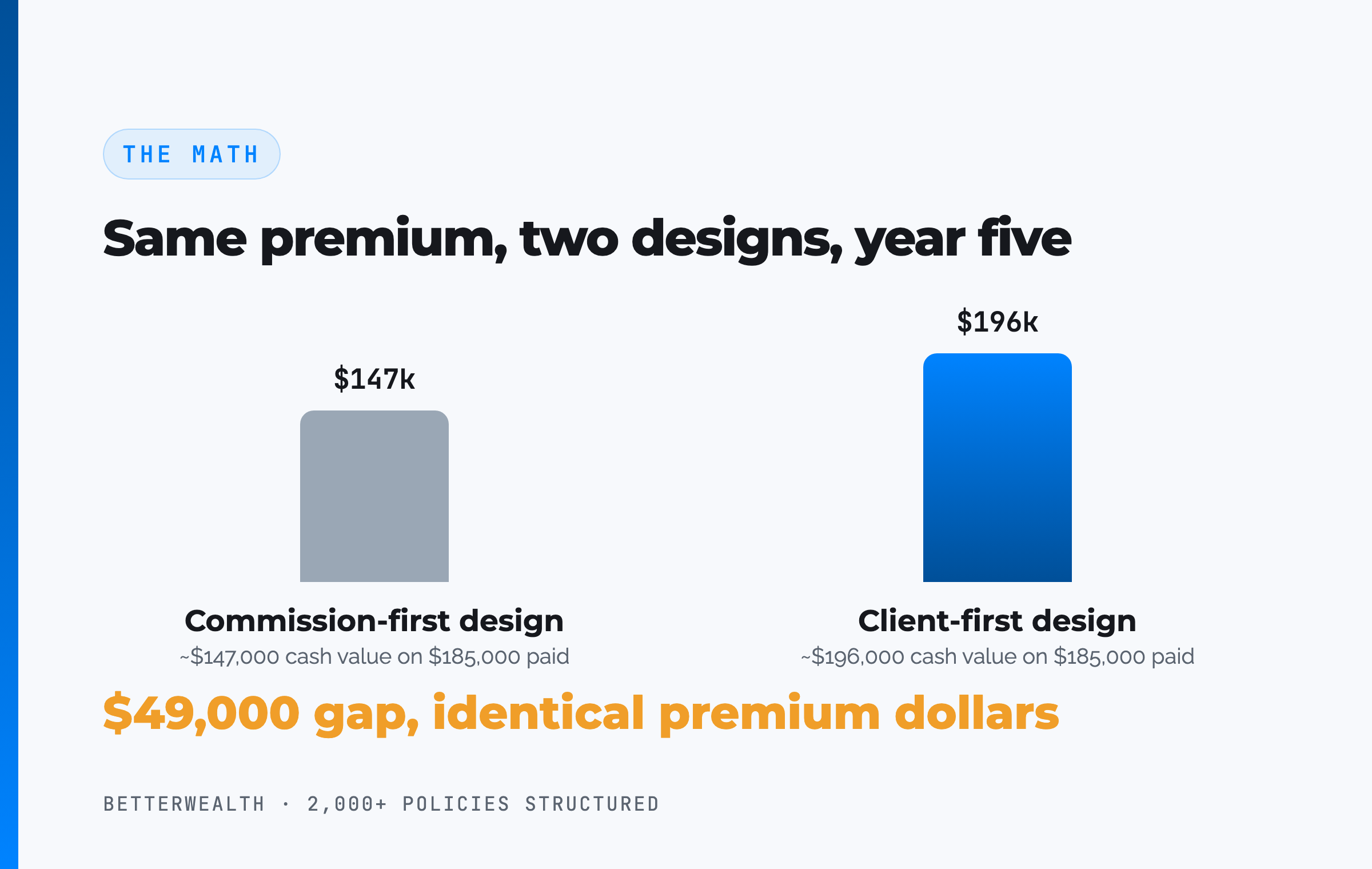
Design A, the commission-first build. Year-one net cash surrender value lands near $10,000 against $37,000 paid. By year five, with $185,000 contributed, cash value sits around $147,000. Cumulative cash value has still not caught cumulative premium. Break-even arrives somewhere around year eight or nine. Most of the $37,000 is base premium, the portion commissions are calculated on, so this is also the design that pays the writing agent the most.
Design B, the client-first build. Year-one net cash surrender value lands near $25,000 against the same $37,000 paid, still below what was contributed, exactly as a real policy behaves. By year five, with the same $185,000 contributed, cash value sits around $196,000. That is the year cumulative cash value crosses cumulative premium. Only a quarter of the premium is base here, so the writing agent earns a fraction of what Design A pays.
The agent earns several times more on Design A. The owner ends year five with $49,000 more accessible capital on Design B, on identical premium dollars, into the identical carrier. Exact commission schedules are set by each carrier and vary by product and contract level, which is why the honest version of this comparison stays directional.
Now the deployment math, with easy numbers. In year six, the owner in Design B borrows $100,000 against the policy to buy equipment for the business. At a policy loan rate of about 6%, that loan costs about $6,000 a year. If the equipment earns the business more than $6,000 a year, the spread is profit. And the whole time, the policy keeps compounding on its full cash value as if the loan never happened. That is the entire play in one sentence: borrow at about 6%, put the money to work at more than 6%, keep the difference while the policy grows underneath.
Design A's owner could run the same play. They would just be doing it with $49,000 less capital available, three to four years later.
One dollar. Two jobs. That is the And.
09 / The mathDoes the return clear the carrier's loan cost?
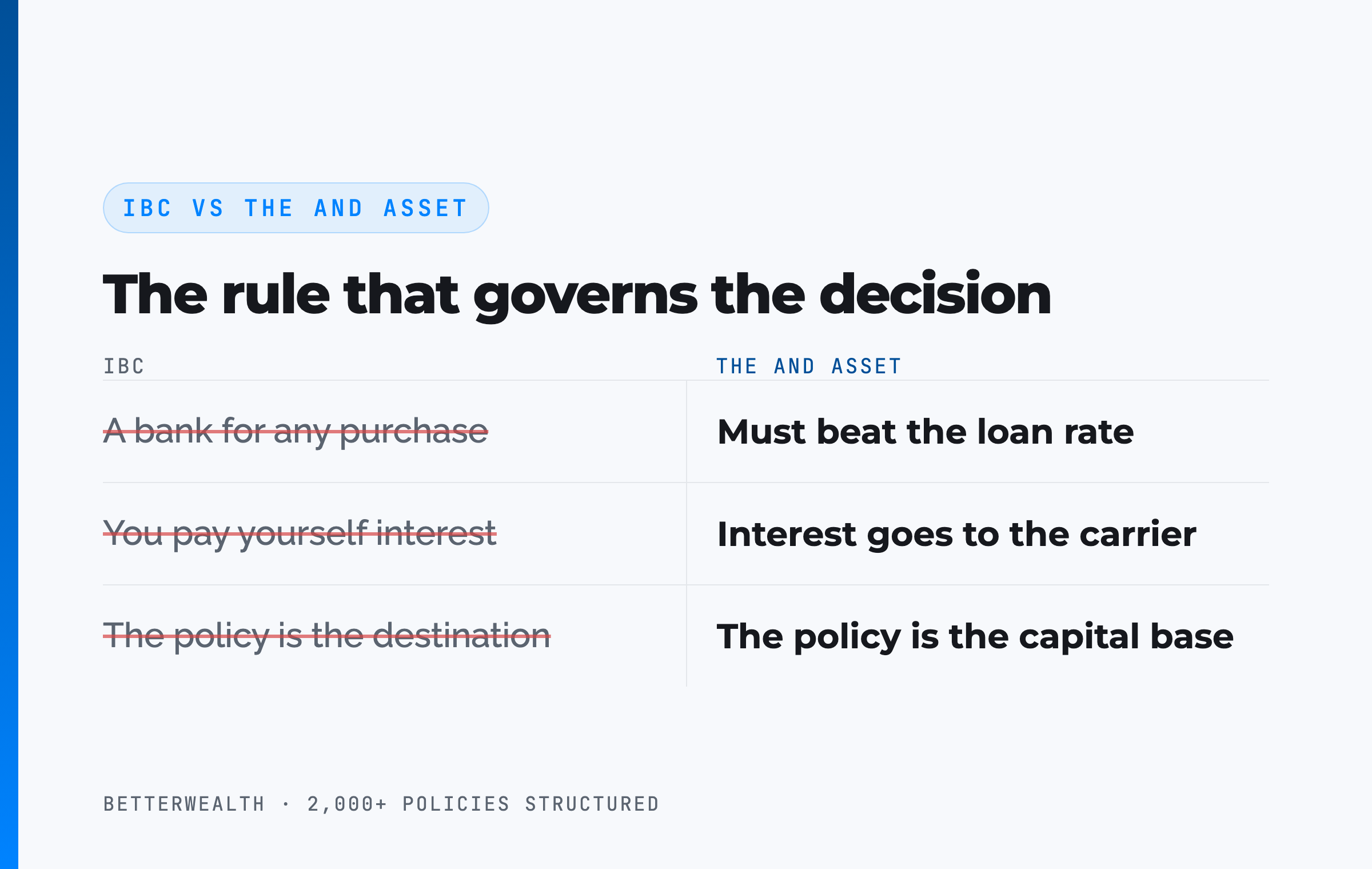
The return on whatever you deploy must exceed the carrier's loan cost, and this is the test that should govern the agent conversation from the first minute. Policy loan rates vary by carrier and rate environment. At the time of writing many carriers fall in the 5 to 6% range, and you should treat any specific figure as a variable to verify with the carrier rather than a constant.
Here is why it belongs in a guide about choosing an agent. An agent's willingness to apply this test to your situation, out loud, before designing anything, is the fastest read on whether they are building a strategy or selling a product. The question is simple: what specifically will you do with borrowed capital, and does it clear the loan rate? If you do not have an answer, the correct professional response is to tell you not to buy.
We have watched this strategy fail, and the failure almost always traces to one of two things. The owner could not identify a deployment that beat the loan cost and borrowed anyway. Or the owner stopped funding in year two or three, before the design had time to work. Neither failure is a product defect. Both are selection and discipline problems.
If the deal does not clear the loan rate, do not borrow.
10 / Head to headClient-first design versus commission-first design
The two designs use identical premium dollars and produce materially different capital positions, and the table makes the divergence concrete. Figures follow the composite in the case study above: a 43-year-old preferred non-tobacco applicant funding $37,000 per year into the same carrier and product.
| Dimension | Client-first design | Commission-first design |
|---|---|---|
| Base / PUA split | $9,000 base / $28,000 PUA (25/75) | $30,000 base / $7,000 PUA |
| Year 1 cash value | ~$25,000 on $37,000 paid | ~$10,000 on $37,000 paid |
| Year 5 cash value | ~$196,000 on $185,000 paid | ~$147,000 on $185,000 paid |
| Break-even year | Year 5 | Year 8 to 9 |
| First-year commission | A fraction, since only a quarter of the premium is base | Several times higher, since most of the premium is base |
| Death benefit at issue | Lower, sized to stay under the MEC limit | Higher, which some buyers prefer |
The split. Every other row on this table follows from the first one. Loading the PUA rider moves dollars from the compensation-bearing portion of the policy to the cash-value-bearing portion. That is the entire mechanism, and it is not complicated once someone shows it to you.
The capital position. A $49,000 difference at year five is the difference between funding a deployment in year six and waiting until year nine. For an entrepreneur, three years of delayed access to $49,000 of capital is the real cost of the design decision, not the commission itself.
The honest caveat. The commission-first design is not fraudulent, and higher death benefit is a legitimate goal for a buyer who wants it. The problem is that most buyers of this strategy are not told which goal their policy was built for. Ask, and the tradeoff becomes a choice instead of an accident.
11 / Already have a policyWhat if you were already sold a bad design?
A poorly designed in-force policy usually has more options than people assume, and surrendering it is typically the most expensive one. The early years carry the highest internal costs, which means you have already paid for the part that hurts. Walking away converts a recoverable position into a realized loss.
Depending on the carrier, the policy age, and the riders in place, there are usually three paths. Adjust the existing policy going forward, which can mean increasing PUA funding where the rider allows it or reducing base premium in future years. Keep the policy as is and build a second, properly structured policy alongside it, using the first for its death benefit and long-term value. Or keep it exactly as it stands, because sometimes the design is fine and the explanation was the only thing that was broken.
What determines which path applies is the contract language, not opinion. Bring the policy documents and the original illustration to someone who will read both.
Bring us any design, including one from another agent.
We have structured more than 2,000 policies across all 50 states, and we review designs from other agents every week. On a 30-minute discovery call, bring an illustration you were given or a policy you already own. We will walk the base and PUA split, the break-even year, the MEC headroom, and the loan provisions, and tell you plainly whether the design serves you. If it is already well built, we will say so and you will owe us nothing. If you would rather learn first, the The And Asset and BetterWealth YouTube channels go deep on the design math.
Book a Discovery CallFAQFinding and vetting an agent
How do I find an infinite banking advisor?
Find candidates through their published work rather than a referral alone: written explanations of policy design, recorded illustration walkthroughs, and honest discussion of the downsides. Then vet each one on three things: how they are paid, whether they will disqualify you, and whether they will show you the base premium and paid-up additions split in dollars.
How do infinite banking advisors get paid?
Life insurance agents are paid a commission by the carrier, calculated primarily on the base premium of the policy. Dollars routed into the paid-up additions rider generate far less compensation than the same dollars in base premium. That is why a base-heavy design pays the agent more while building less early cash value for you. Exact schedules vary by carrier, product, and contract level.
What questions should I ask an infinite banking agent?
Ask five: How are you compensated on this policy, and how does that change with the base and PUA split? Who is this strategy wrong for? What is the base premium and PUA rider in dollars? In what year does cash value exceed cumulative premium, and why that year? What happens if I stop funding in year three? All five can be asked before any illustration is run.
What are the red flags of a bad infinite banking advisor?
The clearest red flags are a promised total rate of return that treats the non-guaranteed dividend as if it were the contractual guarantee, the phrase "pay yourself interest" stated without correction, an illustration showing cash value above cumulative premium in year one or two, refusal to show the base and PUA split, and pressure to sign before you have read the guaranteed column. Discouraging a second opinion belongs on the same list.
Does being a listed IBC practitioner mean an agent is good?
No. A practitioner listing shows someone completed a course on the concept and pays to be listed. It says nothing about how many policies they have designed, how those policies performed, or whether their designs favor cash value or commission. Treat it as a starting filter and vet the design work separately.
What is a good base to PUA ratio for a cash value policy?
Cash-value-focused designs typically run heavily toward paid-up additions, often in the range of 40/60 to 10/90 base to PUA depending on the carrier, the client's age, and how long the policy will be funded. There is no universally correct ratio. The right question is whether the agent can explain why they chose the split they did for your situation.
How do I judge a whole life illustration?
Read the guaranteed column before the projected column, find the year cumulative cash value first exceeds cumulative premium, confirm that year is five or later for a healthy applicant, and check that the design stays under the MEC limit with room for the funding you plan. Then ask what the design assumes about how long you keep funding it.
Should I get a second opinion on a policy design?
Yes. Have a second practitioner review the exact illustration you were given and explain what they would change and why. A design that holds up under a second read is worth signing. An agent who discourages the second read is telling you something about the design.
Can I fix a policy that was designed badly?
Sometimes. Options depend on the carrier, the policy age, and the riders in place. Some policies can be adjusted by increasing paid-up additions funding or reducing base premium going forward, some are best kept and supplemented with a second properly structured policy, and some are worth keeping exactly as they are. Surrendering an in-force policy is usually the most expensive option.
Which carriers do well-designed policies usually use?
Well-designed cash value policies are usually written with mutual carriers that have long dividend histories, strong financial strength ratings, and flexible paid-up additions riders. Carrier choice matters less than design, and any agent who leads with a carrier name before understanding your situation has the order backward.
What is The And Asset?
The And Asset is BetterWealth's framework for using a properly structured whole life policy as a capital base. You only borrow against it for an activity that produces a return greater than the carrier's loan cost, so your dollars do two jobs at once: the policy keeps compounding net of internal charges while the deployed capital earns its own return.
How is The And Asset different from infinite banking?
Infinite banking, as Nelson Nash taught it, frames a whole life policy as a personal banking system you can use for any purchase. The And Asset adds a rule: you only deploy borrowed capital when the return clears the carrier's loan cost, because otherwise the loan is an expensive way to spend money. The policy is the capital base, not the destination. It is built on Nash's foundation and operates on different principles.
Will BetterWealth review a policy designed by another agent?
Yes. Bring any illustration, including one from another agent or an in-force policy you already own, and we will walk through the base and PUA split, the break-even year, the MEC headroom, and the loan provisions, then tell you plainly whether the design serves you. If it is already well built, we will say so.
- Nelson Nash, Becoming Your Own Banker, the origin of the infinite banking concept and the foundation The And Asset builds on.
- IRC Section 7702 (Cornell Law), the tax code provision defining life insurance contracts and the treatment of cash value.
- IRC Section 7702A (Cornell Law), the Modified Endowment Contract rules that govern how much a policy can be funded.
- NAIC, state-by-state insurance regulation, license lookup, and the life insurance illustration model regulation.
- LIMRA, life insurance industry data, including persistency and lapse benchmarks.
- AM Best, carrier financial strength ratings, for checking any company an agent recommends.
- BetterWealth resources: The And Asset book, the The And Asset YouTube channel, and the BetterWealth YouTube channel.
I founded BetterWealth to treat life insurance as the wealth and capital tool it actually is, rather than the product most people get sold. Our team has structured more than 2,000 policies across all 50 states, and we review designs written by other agents every week. I wrote The And Asset and host the BetterWealth and The And Asset YouTube channels. If you want a straight read on a design you were handed, book a discovery call. We will tell you if it is already good.