
Whole life insurance rate of return has three layers on every dollar: the internal rate the policy earns on its own, net of mortality and expense charges; the external rate earned by capital borrowed against the policy and deployed elsewhere; and the eternal rate, what the death benefit and your discipline leave behind.
The standard objection to whole life insurance is a rate-of-return objection. An entrepreneur looks at an illustration, sees a long-term internal rate in the 4 to 4.5% range, compares it to what the same dollars earn in a business or a building, and concludes the policy is a poor use of capital. On the narrow terms of that comparison, the entrepreneur is right. A whole life policy, held as a standalone investment and never touched, underperforms a well-run business by a wide margin.
The comparison fails because it measures one rate of return where there are three. The illustration shows what the policy earns internally. It cannot show what happens when the cash value is used as collateral for a loan that funds a real estate purchase or an equity stake, while the policy keeps compounding on its full value. It cannot show what an income-tax-free death benefit and a family's financial discipline are worth to the people who inherit them.
A whole life policy is a poor investment and a strong capital base, and the entire debate turns on which one you are measuring. That distinction is the substance of a conversation between Caleb Guilliams and Phil Bodine, a financial advisor who entered the business in 1989, met Nelson Nash in the late 1990s, and has borrowed against his own policies to buy real estate and fund business equity for decades.
At BetterWealth, we have structured more than 2,000 policies across all 50 states, and the rate-of-return objection is the first one we hear from nearly every entrepreneur who calls. We think it deserves a real answer rather than a sales response. This article covers the three rates of return, the capitalization phase that makes the early years look worse than they are, the step-by-step mechanics of capturing an external return, the math that decides whether a policy loan makes sense, and the version of infinite banking that Phil correctly calls voodoo math.
- Every dollar in a whole life policy has three rates of return: internal, external, and eternal. The illustration shows only the first.
- A well-designed policy's long-term internal rate runs roughly 4 to 4.5%, net of mortality and expense charges. It is not the point.
- The external rate is what borrowed capital earns elsewhere while the policy keeps compounding, and it only counts above the loan cost.
- You do not pay yourself interest on a policy loan. The interest goes to the carrier. Claims otherwise are marketing errors.
- Cash value trails cumulative premium for the first three to four years. Break-even arrives at year five or later for healthy individuals.
- The And Asset rule governs every loan: if the deployed capital cannot beat the carrier's loan rate, do not borrow.
Phil tells the breakfast story with the attorney in full, walks through the house he and his wife bought with a policy loan and sold 90 days later, and explains the eternal rate of return in a way that does not fit in prose:
01 / The problemWhy does the internal rate of return undersell whole life insurance?
The internal rate of return undersells whole life insurance because it measures the policy as a closed box, and the policy is not designed to be a closed box. It is designed to be borrowed against. An internal rate in the 4 to 4.5% range describes what the cash value earns if you deposit premium for forty years and never use it. Almost nobody who owns a properly designed policy uses it that way.
Phil's breakfast with an attorney more than 20 years ago is the cleanest version of the problem. The attorney's son had bought a policy. The father called a meeting, told Phil that life insurance was the worst investment possible, and asked why Phil had sold it to his son. Phil agreed with him. By itself, held as an investment and never touched, a whole life policy is a poor investment, and Phil said so to the man's face.
Then the conversation turned to what the attorney considered the best investment: commercial real estate. He owned the building his firm sat in. Phil's response was that he had access to $1.2 million of policy equity that day, on demand, and could buy as much commercial real estate as he wanted with it. The attorney's next question was "how do you do that?" The objection was never really about the rate of return. It was about a man who did not know the policy could be used while he was alive.
"By itself, I would agree with you. It is a very poor investment." Phil Bodine, to an attorney who called whole life the worst investment possible. The value is in what the policy lets you do, not in what it earns alone.
Control and liquidity are the two words Phil's mentor, an estate planning attorney and CPA, used with every business owner. A business owner wants both, and the conventional capital stack gives neither. Bank credit lines are controlled by the bank. Retirement accounts are liquid only inside rules set by Congress. A properly structured policy is one of the few assets that gives an entrepreneur capital on demand without a lender's approval, while the underlying asset keeps growing. That is what the internal rate of return cannot measure.
02 / The frameworkWhat are the three rates of return of whole life insurance?
The three rates of return of whole life insurance are the internal rate, the external rate, and the eternal rate, and Phil's point is that every dollar you deposit carries all three at once. The internal rate is what the policy earns on its own. The external rate is what capital borrowed against the policy earns when it is deployed into something else. The eternal rate is what the death benefit, and the discipline behind it, leave for the people who come after you.
The first is the only one an illustration can show. The second is where the money is made. The third is the one Phil says has the greatest effect, because it has a multiplier that outlasts every asset on the balance sheet.
Where infinite banking ends and The And Asset begins
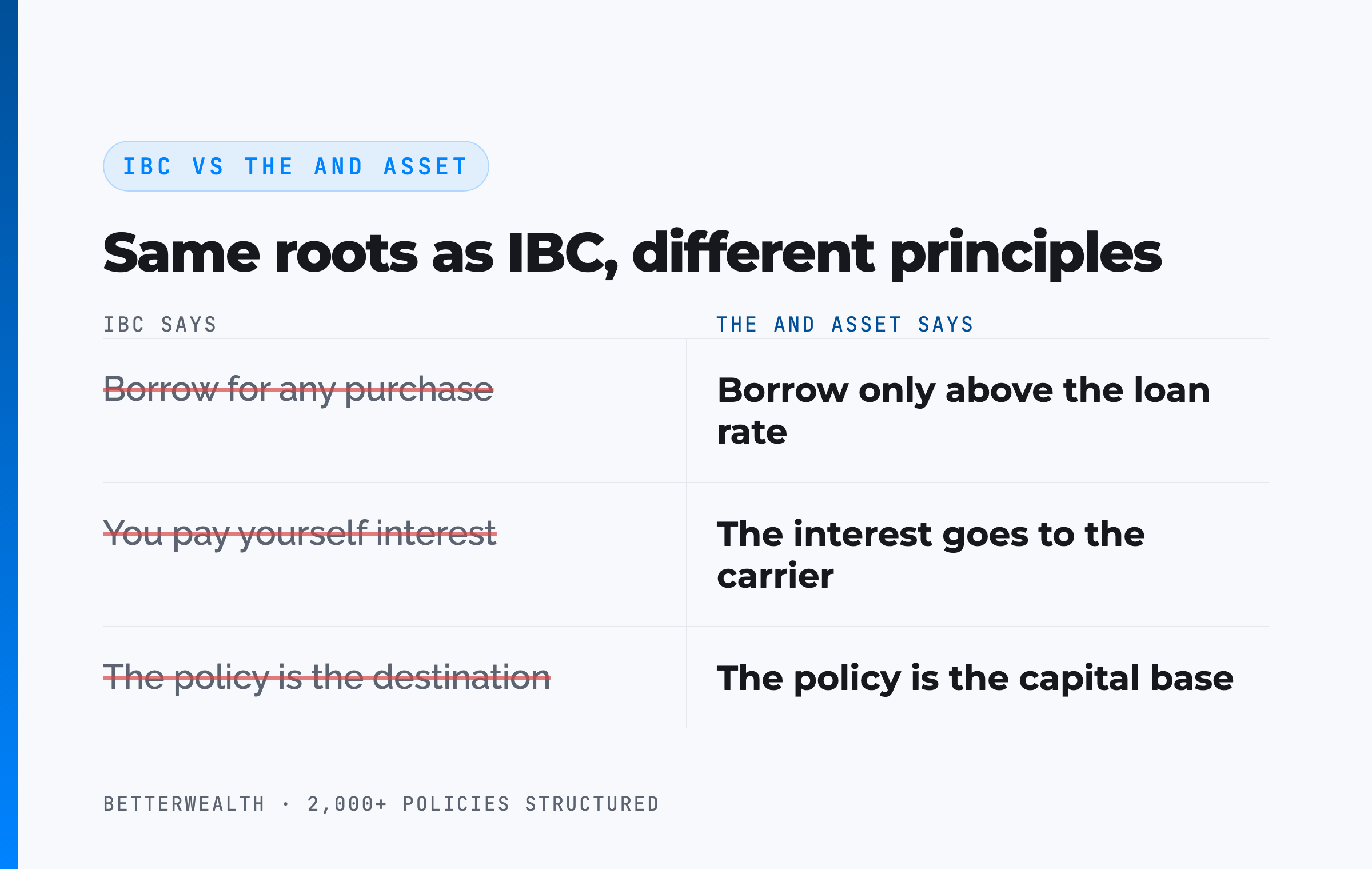
The external rate of return is the territory of infinite banking, and it is where BetterWealth parts ways with how the concept is usually taught. Nelson Nash pioneered the use of whole life insurance as a personal banking system. His insight in Becoming Your Own Banker holds: you either pay interest to an outside lender, or you pay the opportunity cost of capital sitting idle. We respect that foundation. The And Asset, our own framework, builds on it and operates on different principles.
IBC says you can use a whole life policy as a personal banking system for any purchase. The And Asset says you only deploy capital from the policy when the borrowed dollars will produce a return greater than the carrier's loan cost. Anything less is an expensive way to spend money. Phil's house and Phil's equity stake in a healthcare business clear that bar. A car does not.
Many IBC marketers also say you pay yourself interest when you borrow. The And Asset says no. The interest goes to the carrier, because the carrier is the one lending you money against your cash value. Your return is the external rate: what the deployed capital earns while the policy keeps compounding, net of mortality and expense charges, on its full value.
Your dollars doing two jobs at once. That is the And.
03 / Internal rateWhat the policy earns on its own, and why year one looks bad
The internal rate of return is the growth of the cash value itself: guaranteed accumulation plus dividends, net of the carrier's mortality and expense charges. Over a long horizon on a policy from a strong mutual carrier, that number lands around 4 to 4.5% on current projections. Dividends are declared annually and are not guaranteed, so treat the figure as illustrative. The guaranteed cash value does not decline with markets, which is the "safe" answer in Phil's five-way test, with one caveat covered below.
The capitalization phase
In the early years, the surrender value trails cumulative premium. Phil's explanation is the one we use as well: your deposits are credited to the contract in full, but the carrier limits how much you can access while the policy capitalizes. On a $100,000 annual premium, the carrier will not let you touch the whole $100,000 in year one, even though the whole $100,000 is working inside the contract.
For a healthy individual on a policy designed for cash value, total cash value first exceeds total premium at year five or later. Not year one. Not year two. Any illustration or agent that promises otherwise is selling something other than a whole life policy. Phil's own answer is that he would not write a policy for anyone planning to cancel it inside five years, and he would say the same of thirty. A policy is a long-term purchase, in the same category as a building or an equity stake, and the only way to lose money in it is to surrender early.
Surrender early and you lose. Hold and you do not.
You will have less accessible cash in years one through four than you put in. That is not a defect. It is the capitalization phase, and nobody who understands the asset plans to cash out inside it.
04 / How it worksHow do you capture the external rate of return, step by step?
You capture the external rate of return by structuring the policy for cash value, funding it through the capitalization phase, and borrowing against it only for an activity that beats the carrier's loan cost. Phil's own examples run from a house he and his wife bought for cash to an equity stake in a behavioral healthcare business, both funded by loans against his policy. Here is the sequence we use.
- Structure for cash value. A low base premium and a heavy paid-up additions rider, for example a 30/70 base/PUA split, funded to the limit without triggering a Modified Endowment Contract. The PUA rider is what pulls early cash value forward. We cover the design decision in detail in our guide to how to structure a whole life policy.
- Fund through the capitalization phase. Expect surrender value to trail cumulative premium for three to four years, with break-even at year five or later. Do not plan any surrender inside that window. Loans are available much earlier, typically within the first year, but the base has to be built first.
- Identify a deployment that beats the loan cost. Run Phil's five-way test on the opportunity, not just on the policy. Is it liquid? Is it safe? What is the rate of return? What are the tax benefits? What is the exit? If the expected return does not clear the carrier's loan rate with room to spare, stop here.
- Borrow against the policy. The carrier lends you money collateralized by your cash value. You do not withdraw the cash value. It stays in the contract and keeps compounding, net of charges, subject to the carrier's recognition method. The interest goes to the carrier. Phil's phrase is that the loan is a permission slip, available on demand, with no underwriting and no bank.
- Deploy and repay. Put the capital to work and repay the loan from the cash flow or the exit the activity produces. Phil paid cash for a house, avoided closing costs on financing, put $20,000 to $30,000 into it, and sold it in under 90 days for roughly $180,000 of profit. The sale repaid the loan. The discipline of repayment is the whole strategy.
- Keep the capital base intact. Leave the policy in force. The death benefit was covering Phil's family the entire time the house was being renovated. When the loan is repaid, the cash value is available again for the next deployment. The cycle is repeatable because the base never left.
The interval between funding and first loan is shorter than most people assume. We walk through the timing in our article on how soon you can borrow against a whole life policy.
The external rate of return requires a specific person.
It fits you if
- You own a business or invest in real estate and regularly deploy capital
- You can name a use for borrowed dollars that beats the loan cost
- You have a ten-year-plus horizon and will fund through the capitalization phase
- You want capital on demand without a lender's approval
It does not fit you if
- You want a savings account with a higher yield
- You are in the early stages of building wealth
- You might need to surrender inside five years
- You cannot identify a productive use for borrowed capital
If you are in the first column, a 30-minute conversation will tell you whether the math works for your situation. If you are in the second, we will tell you that too, and it will save you a policy you would have regretted.
Book a Discovery Call05 / The mathDoes the deployed capital clear the loan cost?
The deployed capital must earn more than the carrier's loan rate, or the external rate of return is negative and you should not borrow. This is the whole test. Policy loan rates vary by carrier and rate environment. At the time of writing, many carriers fall in the 5 to 6% range, but treat any specific number as a variable to verify with your carrier, not a constant.
The structure of the decision has three parts. You borrow at the carrier's loan rate. Your policy keeps compounding on its full cash value, net of charges, with the borrowed portion treated according to the carrier's recognition method. Your deployed capital earns its own return. If that return exceeds the loan rate, the same dollar has produced two returns. If it does not, you have borrowed money to lose it slowly, and the uninterrupted compounding of the policy does not rescue the decision.
Phil frames the loan itself against a margin loan on a brokerage portfolio, which his firm arranges for clients regularly. The two are mechanically the same: a loan collateralized by an asset you still own. The margin loan carries a higher rate and a real risk of being called and liquidated in a downturn. The policy loan cannot be called, the guaranteed cash value does not fall with markets, and you set the repayment terms. Same mechanism, lower cost, no forced liquidation.
If the deal does not clear the loan rate, do not borrow.
"There is a lost opportunity cost on that." Phil Bodine on borrowing against a policy. Access to capital is real, and so is the interest. The strategy only works when the deployed dollars out-earn both.
06 / Where people get it wrongWhy "pay yourself interest" is voodoo math
You do not pay yourself interest on a policy loan, and the belief that you do is the single most damaging error in how infinite banking gets sold. Phil met Nelson Nash in the late 1990s and found much of what Nash said persuasive. What never added up, when he ran the numbers, was the claim that the interest he paid on a loan went back into his own account. It does not. The carrier lends the money against the cash value, and the carrier collects the interest.
Phil's phrase for the version of the concept that circulates online is voodoo math: double dipping in one place, double dipping in another, percentages that do not reconcile. The mechanics that got lost in translation are simple. If the carrier charges an illustrative 6% and you choose to pay 8% into the loan, the extra 2% accelerates repayment. If you keep paying after the loan is gone, the surplus can fund paid-up additions. That is real, and it is a discipline worth having. It is not the same as the interest coming back to you, and almost nobody selling the concept explains the difference.
Nash, to his credit, was trying to make the idea simple. Simplicity opened the door to marketers who turned a capital discipline into a promise about buying cars and boats through your policy and coming out ahead. Marketers have ruined the way this should be explained, which is why Phil's framing of "sound advice versus sounds-good advice" is the right filter. Infinite banking sounds good. The question is whether the specific version you are being sold is sound.
"They always said the interest I was paying went back into my account. I don't believe that to be true. That's going to the insurance company." Phil Bodine on infinite banking as it is usually taught.
The honest version, which is the one The And Asset teaches, is that the interest is a cost. The return is the external rate: what the borrowed capital earns somewhere else, while the policy keeps compounding. Anyone who has to hide the cost to make the strategy attractive is not describing the strategy. They are describing a sale. Our full assessment of where the concept holds and where it fails is in our infinite banking pros and cons review.
07 / The five-way testWhy choose whole life over a 5% savings account?
A whole life policy beats a 5% savings account over a long horizon on tax treatment, safety, and the benefits attached to the contract, even though the savings account wins the first four years on raw liquidity. Caleb put the hypothetical to Phil directly: a fully liquid account paying 5%, taxable, with no capitalization phase. On the math alone, in isolation, that account is attractive. The five-way test is how Phil answers it.
Liquidity, safety, rate of return, tax, exit
On liquidity, the policy loses the early years and matches or beats the account afterward, because a policy loan is available on demand without a bank. On safety, the guaranteed cash value does not decline with markets, and the only loss scenario is early surrender. On rate of return, the policy's internal rate is modest, but the carrier is also taking mortality risk off your balance sheet, which the savings account does not do. On tax treatment, savings interest is taxed as ordinary income every year. Policy growth is tax-deferred, policy loans are not taxable income, and the death benefit passes to heirs income-tax-free under IRC Section 7702. In a high-tax state, that gap widens every year. On exit, the policy's exit is the death benefit, which the savings account does not have at all.
Add the items the savings account cannot carry: an income-tax-free death benefit, potential creditor protection depending on your state, and optional chronic illness or long-term care riders. A 5% account earning ordinary income for a 37% bracket earner nets roughly 3.15%. A policy earning an illustrative 4.25% net of charges, tax-deferred, with a death benefit attached, is a different asset class. The comparison is not close once the horizon is long enough, and the horizon is the whole point.
Higher yield is not the same as better capital.
The frameworks behind 2,000+ policies, in one place.
The And Asset Vault holds the calculators, design frameworks, and loan-versus-return worksheets we use to decide whether a policy loan clears its cost. Free, email-gated, no spam.
Open the Vault08 / The tradeoffsBenefits and the honest tradeoffs
The benefits of treating a whole life policy as a capital base are real and so are the costs, and any presentation that shows only one side is a presentation you should walk out of. The benefits: capital on demand without a lender, uninterrupted compounding on the full cash value while borrowed against, tax-deferred growth with loans that are not taxable income, a death benefit that covers your family while the capital is at work, and a loan that cannot be called in a downturn.
The tradeoffs are four. First, the capitalization phase: surrender value trails premium for three to four years, and surrender inside that window loses money. Second, the internal rate of return is modest, and the policy will never compete with a good business on that metric alone. Third, the loan carries real interest paid to the carrier, and the external return has to clear it every time. Fourth, the strategy requires discipline, because the same access that funds a building can fund consumption, and nothing in the contract stops you.
Phil's own accounting of the house deal captures both sides. The loan cost was real, and low at the time. The policy kept earning dividends on the borrowed money because it was a participating loan. The death benefit covered his family the entire time. The house carried its own risk, as every real estate deal does. What carried no market risk was the capital base underneath it. That is the trade: a modest internal return in exchange for a base that does not move when everything else does.
Modest inside. Uncalled, uninterrupted, and yours.
09 / The eternal rateHow the third rate of return fits a capital strategy
The eternal rate of return is what the policy and the discipline behind it leave for the next generation, and Phil argues it has the greatest effect of the three. Financially, it is the death benefit passing to heirs income-tax-free, at a multiple of what was paid in, regardless of whether the entrepreneur died at 52 or 92. Every other asset on the balance sheet, in Phil's words, will eventually burn out. The death benefit is the one designed to arrive on time.
Phil takes the idea past the money. The eternal rate, as he describes it, is also the wisdom a family inherits about capital: how to hold it, how to deploy it, when not to. His book opens with the question of how to tell sound advice from advice that merely sounds good, includes a ten-question true-or-false quiz to gauge the reader's financial mindset, and closes on forgiveness, which he calls the currency that outlasts every balance sheet. We are not in the business of telling readers what to believe. We are in the business of pointing out that an asset which protects a family, funds a business, and passes a tax-free benefit to grandchildren is doing three jobs, and that the third one has no rate on the illustration.
In a broader capital strategy, the policy sits underneath the two investments Phil ranks highest for an entrepreneur: their own business first, real estate second. It does not compete with either. It feeds both. The internal rate keeps the base growing, the external rate is captured by what the base funds, and the eternal rate is what remains when the entrepreneur is gone. That is the integrated structure Phil has been describing for more than 25 years, and it is the reason we call the framework The And Asset rather than an investment.
"Everybody just focuses on the internal rate of return. The external rate of return of that contract is second to nothing." Phil Bodine, the week before funding an equity stake in a healthcare business with a policy loan.
10 / Head to headPolicy loan against the alternatives, on $100,000 deployed
Compared with the other ways an entrepreneur can access $100,000 for a deal, a policy loan trades early-year access for a lower cost of capital, no risk of the loan being called, and an asset that keeps growing while the money is out. The table sets it against a high-yield savings account, a margin loan, and a home equity line of credit on the dimensions that decide the external rate of return. Rates are illustrative and vary by carrier, lender, and rate environment.
| Dimension | Policy loan (And Asset) | High-yield savings | Margin loan | HELOC |
|---|---|---|---|---|
| Cost to use $100,000 for one year | About $5,750 at an illustrative 5.75% loan rate, paid to the carrier | $0 in interest, but the $100,000 leaves the account and stops earning roughly $4,500 | About $8,000 to $9,500 at typical broker rates | About $8,500 at typical variable rates, plus origination and appraisal |
| Does the underlying asset keep growing? | Yes. Cash value compounds on the full balance, net of charges, subject to recognition method | No. The money is gone | Yes, but the portfolio can fall and trigger a call | Home equity stays, but earns no yield |
| Can the lender call it? | No. Repayment schedule is yours | Not applicable | Yes. Margin call and forced liquidation in a downturn | Yes. Lines were frozen and reduced in 2008 and 2020 |
| Tax on growth | Tax-deferred; loans are not taxable income under IRC 7702 | Ordinary income every year: about $1,665 of tax on $4,500 at 37% | Capital gains on the portfolio; margin interest deductible only in limited cases | Interest deductible only if used to improve the home |
| Accessible in year one? | Partially. On an $87,000 premium, roughly $71,300 of cash value is available to borrow against | Fully. $87,000 plus interest | Depends on portfolio value and broker limits | Only after underwriting, appraisal, and approval |
Cost. The policy loan is the cheapest borrowed capital on the table after the savings account, and the savings account is not borrowing. It is spending your reserve. Once the $100,000 leaves the account, it earns nothing, which is the lost opportunity cost Nash identified and the reason the comparison is not free.
Growth while deployed. The policy is the only option where the collateral keeps compounding on its full balance while the capital is at work, which is the mechanism that produces two returns on one dollar. The margin loan's portfolio also keeps growing, until it falls and the broker liquidates it at the worst moment.
Control. A policy loan cannot be called. A HELOC can be frozen, as thousands of investors learned twice in fifteen years. A margin loan can be called with a day's notice. For an entrepreneur whose deal depends on the capital staying put, that difference matters more than a point of interest. We cover the HELOC comparison in depth in our infinite banking vs HELOC analysis.
A composite: the business owner who captured an external return in year six
Consider a 44-year-old business owner, preferred non-tobacco, funding a whole life policy at $87,000 per year on a 30/70 base/PUA split: $26,100 of base premium and $60,900 into the paid-up additions rider. This is a representative composite built from patterns across our book, not a single named client.
Through year four, cash value trails cumulative premium, exactly as a real policy should. Year one closes at $71,300 of cash value on $87,000 paid. Year three closes at roughly $237,400 on $261,000 paid. At year five, total cash value crosses total contributions at $438,700 against $435,000. No earlier. This is the capitalization phase Phil describes, and the owner made no surrender plans inside it.
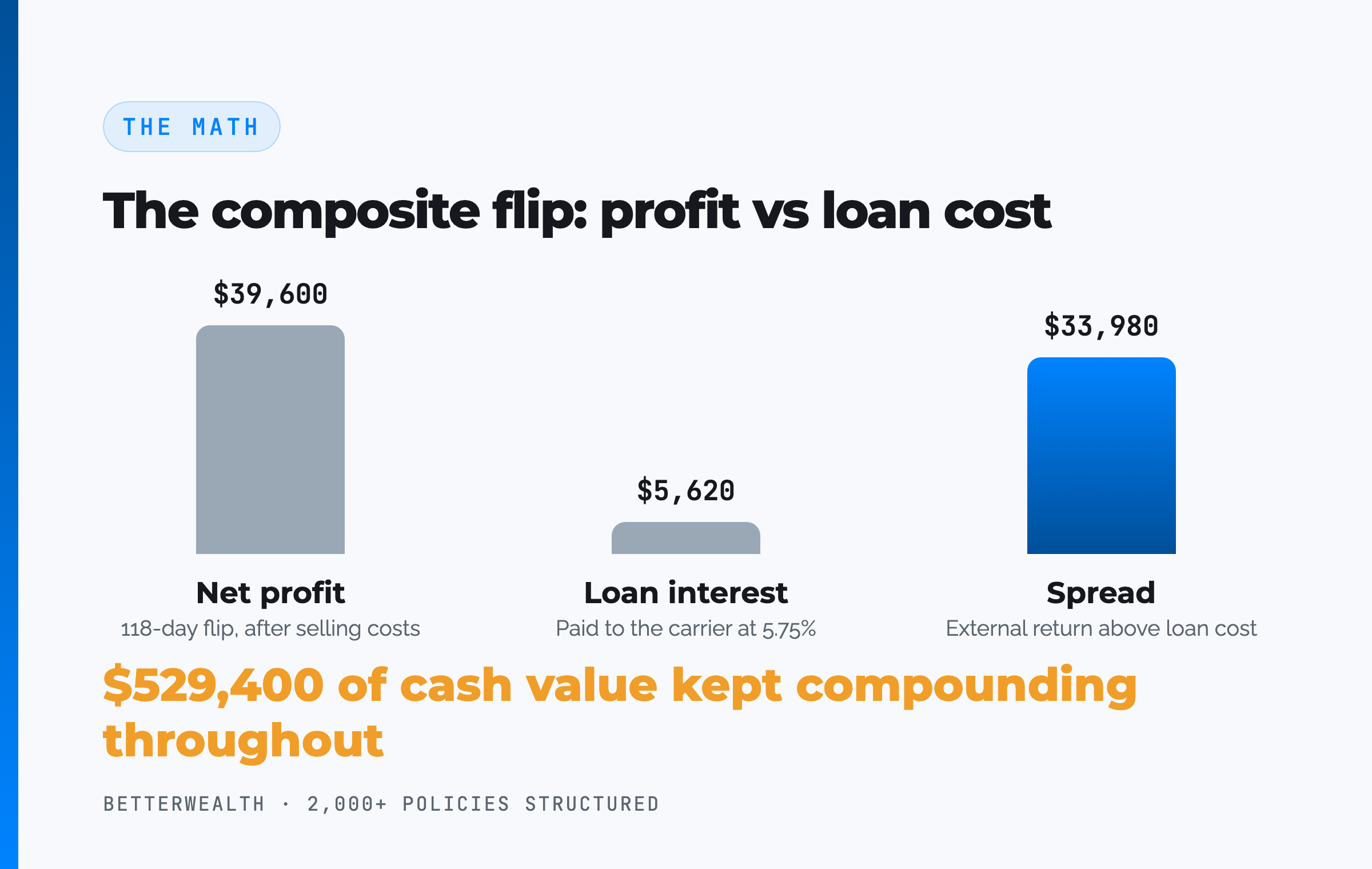
In year six, with about $529,400 of cash value, the owner borrows $302,500 against the policy to buy a distressed property for $271,000 cash and fund $31,500 of renovation, the same play Phil and his wife ran. The property sells 118 days later for $362,000. After $19,900 of selling costs, the net profit is $39,600. The loan cost over 118 days, at an illustrative 5.75% rate, is $5,620, paid to the carrier. The spread on the deployed capital is $33,980 in dollars. The policy kept compounding on its full $529,400 the entire time, net of charges, and the death benefit covered the owner's family throughout. The sale proceeds repaid the loan in full at closing.
Had the owner instead borrowed the same $302,500 to buy a boat, the loan cost would have been identical and the external return would have been zero. Same policy, same loan, opposite result. The asset did not change. The discipline did.
One dollar. Two returns. That is the And.
The honest 30 minutes about whether this fits you.
We have structured more than 2,000 policies. We have seen the external rate of return work exactly as designed, and we have seen it fail when the owner could not name a use for the capital. If you want a real conversation about whether The And Asset fits your situation, book a discovery call. We will give you the honest answer either way. If you would rather learn first, the The And Asset and BetterWealth YouTube channels go deep on the math.
Book a Discovery CallFAQWhole life insurance rate of return questions
What are the three rates of return of whole life insurance?
The three rates of return are the internal rate, the external rate, and the eternal rate. The internal rate is what the policy earns on its own through guaranteed cash value growth and dividends, net of mortality and expense charges. The external rate is what capital borrowed against the policy earns when deployed into a business, real estate, or another activity. The eternal rate is what the death benefit and your financial discipline leave behind for the people who come after you.
What is the internal rate of return of whole life insurance?
The long-term internal rate of return of a well-designed whole life policy from a strong mutual carrier typically lands in the 4 to 4.5% range on current dividend projections, net of mortality and expense charges. That figure is not guaranteed, it varies by carrier, and it is lower in the early years because of the capitalization phase. It is not the number to judge the asset on by itself.
What is the external rate of return of whole life insurance?
The external rate of return is the return earned by capital you borrow against the policy and deploy somewhere else, such as an equity stake in a business, a real estate purchase, or a piece of revenue-producing equipment. The policy keeps compounding on its full cash value while the loan is outstanding, so the same dollar produces two returns. The external return only counts if it exceeds the carrier's loan cost.
What is the eternal rate of return?
The eternal rate of return is Phil Bodine's term for what a policy and the discipline behind it leave for the next generation. Financially, that is the income-tax-free death benefit passing to heirs. Beyond the money, it is the values and wisdom about capital that a family inherits, which Phil argues has a multiplier effect that outlasts every other asset on the balance sheet.
What is The And Asset?
The And Asset is BetterWealth's framework for using a properly structured whole life policy as a capital base. You only borrow against it for an activity that produces a return greater than the carrier's loan cost, so your dollars do two jobs at once: the policy keeps compounding while the deployed capital earns its own return.
How is The And Asset different from infinite banking?
Infinite banking, as Nelson Nash taught it, frames a whole life policy as a personal banking system for any purchase. The And Asset adds a discipline: you only deploy borrowed capital when the return clears the carrier's loan cost. It also corrects the claim that you pay yourself interest. You do not. The interest goes to the carrier, and your return is what the deployed capital earns. The And Asset shares roots with IBC but operates on different principles.
Do you pay yourself interest when you borrow against a whole life policy?
No. The interest on a policy loan goes to the insurance company that lent you the money against your cash value. Paying more than the required interest does accelerate repayment, and any surplus can fund paid-up additions, but the interest itself is a cost. The return on the strategy comes from what the borrowed capital earns elsewhere while the policy keeps compounding.
Why is my cash value less than what I paid in during the first years?
Because a whole life policy has a capitalization phase. In the early years, the carrier's expenses and the cost of the death benefit are front-loaded, so the surrender value trails cumulative premium. For a healthy individual with a policy designed for cash value, break-even typically arrives at year five or later. The only way to lose money is to surrender inside that window.
Is whole life insurance a bad investment?
Judged purely as a standalone investment on its internal rate of return, whole life insurance underperforms a business or real estate, and Phil Bodine says so directly. It is not an investment. It is a capital base with guarantees, tax treatment under IRC Section 7702, a death benefit, and the ability to borrow against it without interrupting compounding. Its value shows up in what it lets you do with other assets.
Whole life insurance vs a high-yield savings account: which is better?
A high-yield savings account wins in the first four years on raw liquidity and has no capitalization phase. Over a long horizon, the policy wins on tax treatment, because savings interest is taxed as ordinary income every year while policy growth is tax-deferred and loans are not taxable income. The policy also carries a death benefit, potential creditor protection depending on state, and optional chronic illness riders the savings account cannot offer.
Is a policy loan the same as a margin loan?
Mechanically they are similar: both are loans collateralized by an asset you continue to own. The differences are cost and risk. A margin loan typically carries a higher rate, and the broker can issue a margin call and liquidate your positions if the portfolio falls. A policy loan cannot be called, the guaranteed cash value does not fall with markets, and you set the repayment schedule.
When should you not borrow against a whole life policy?
Do not borrow when you cannot name a use for the capital that will produce a return greater than the carrier's loan cost. Do not borrow to fund consumption, and do not borrow in the capitalization phase if repayment depends on income you do not yet have. If the math does not clear the loan rate, the borrowed dollars are an expensive way to spend money.
What is the five-way test?
The five-way test is Phil Bodine's checklist for any capital decision: Is it liquid? Is it safe? What is the rate of return? What are the tax benefits? What is the exit strategy? A whole life policy scores well on liquidity after the capitalization phase, safety, and tax treatment. Its internal rate of return is modest. The test applies with equal force to whatever you deploy borrowed capital into.
- Caleb Guilliams and Phil Bodine, The 3 Rates Of Return Of Whole Life Insurance: the source conversation for this article, on the BetterWealth YouTube channel.
- Nelson Nash, Becoming Your Own Banker: the origin of the infinite banking concept and the lost-opportunity-cost argument.
- IRC Section 7702 (Cornell Law): the tax code provision that defines life insurance for tax purposes and underlies the treatment of cash value and policy loans.
- IRS: Life Insurance and Disability Insurance Proceeds: the IRS guidance on the income-tax treatment of death benefits paid to beneficiaries.
- FINRA: Purchasing on Margin: how margin loans and margin calls work, the comparison Phil draws to policy loans.
- LIMRA: life insurance industry data, including persistency and lapse benchmarks.
- BetterWealth resources: The And Asset book, the The And Asset YouTube channel, and the BetterWealth YouTube channel.
Entered the financial services business in 1989 under an estate planning attorney and CPA, met Nelson Nash in the late 1990s, and has advised business owners for more than 35 years. He has borrowed against his own policies to buy real estate and fund private business equity, and is the author of a book on distinguishing sound financial advice from advice that merely sounds good. His views are his own and are cited here as his experience and analysis.
I founded BetterWealth to treat life insurance as the wealth and capital tool it actually is, not the product most people get sold. Our team has structured more than 2,000 policies across all 50 states. I wrote The And Asset and host the BetterWealth and The And Asset YouTube channels. If you have read this far and the math interests you, book a discovery call. We will run the numbers on your situation and tell you honestly whether The And Asset belongs in your capital structure. We will also tell you if it does not.