
Infinite banking pros include uninterrupted compounding, a non-callable line of capital, favorable tax treatment under IRC 7702, and creditor protection in many states. The cons are low early cash value, a long horizon to break-even, required funding discipline, and zero benefit unless you deploy borrowed capital above the loan cost.
The honest case for and against infinite banking has been buried under a decade of marketing. On one side, agents sell it as free money with no downside. On the other, finance personalities dismiss the entire category in a single sentence. Both are selling a conclusion. Neither helps an entrepreneur decide whether the strategy belongs in their capital structure.
Infinite banking is a real strategy with real tradeoffs, and whether the pros outweigh the cons depends entirely on who you are and what you do with capital. The mechanics work. A properly structured whole life policy lets you borrow against cash value while the policy keeps compounding. What changes the answer is your time horizon, your funding discipline, and whether you can name a use for borrowed dollars that beats the carrier's loan cost.
At BetterWealth, we have structured more than 2,000 policies across all 50 states. We have watched this strategy work exactly as designed, and we have watched it fail. This assessment lays out the genuine pros, the genuine cons, the math that decides the question, and the specific profiles this fits and does not fit. We practice a disciplined version of this strategy we call The And Asset, and we will be clear throughout about where it diverges from how infinite banking is usually taught.
- The core pro is uninterrupted compounding: the policy grows on its full value even while you borrow against it.
- The core con is low early cash value and a break-even that arrives at year five or later for a healthy individual.
- Policy loan interest goes to the carrier, not back to you. "Paying yourself interest" is a marketing myth, not a benefit.
- The And Asset rule decides it: only borrow when the deployed return clears the carrier's loan cost.
- The strategy fits a long horizon and disciplined funding. It fails as a savings account or a quick liquidity fix.
- If you cannot name a productive use for borrowed capital, the cons outweigh the pros for you.
01 / The problemWhat infinite banking is actually trying to solve
Infinite banking exists to solve a structural problem most capital strategies ignore: every dollar you have is doing only one job at a time. When capital sits in a savings account, it earns a low return and waits. When you deploy it into a deal, it stops earning anywhere else. When you borrow from a bank, you pay interest to an outside lender and surrender control of the terms. Nelson Nash framed this as the choice between losing money to interest you pay others, or losing money to the opportunity cost of capital that sits idle.
The promise of the strategy is that one dollar can do two jobs. The policy keeps compounding while you borrow against it and deploy the borrowed capital elsewhere. That is the structural appeal, and it is real. The question this article answers is what you give up to get it, and whether the trade is worth it for you specifically.
The strategy was never supposed to be a product you buy. It is a discipline you practice. Marketers have ruined how this gets explained by selling the policy instead of the behavior.
02 / The frameworkWhat is infinite banking, and where does The And Asset diverge?
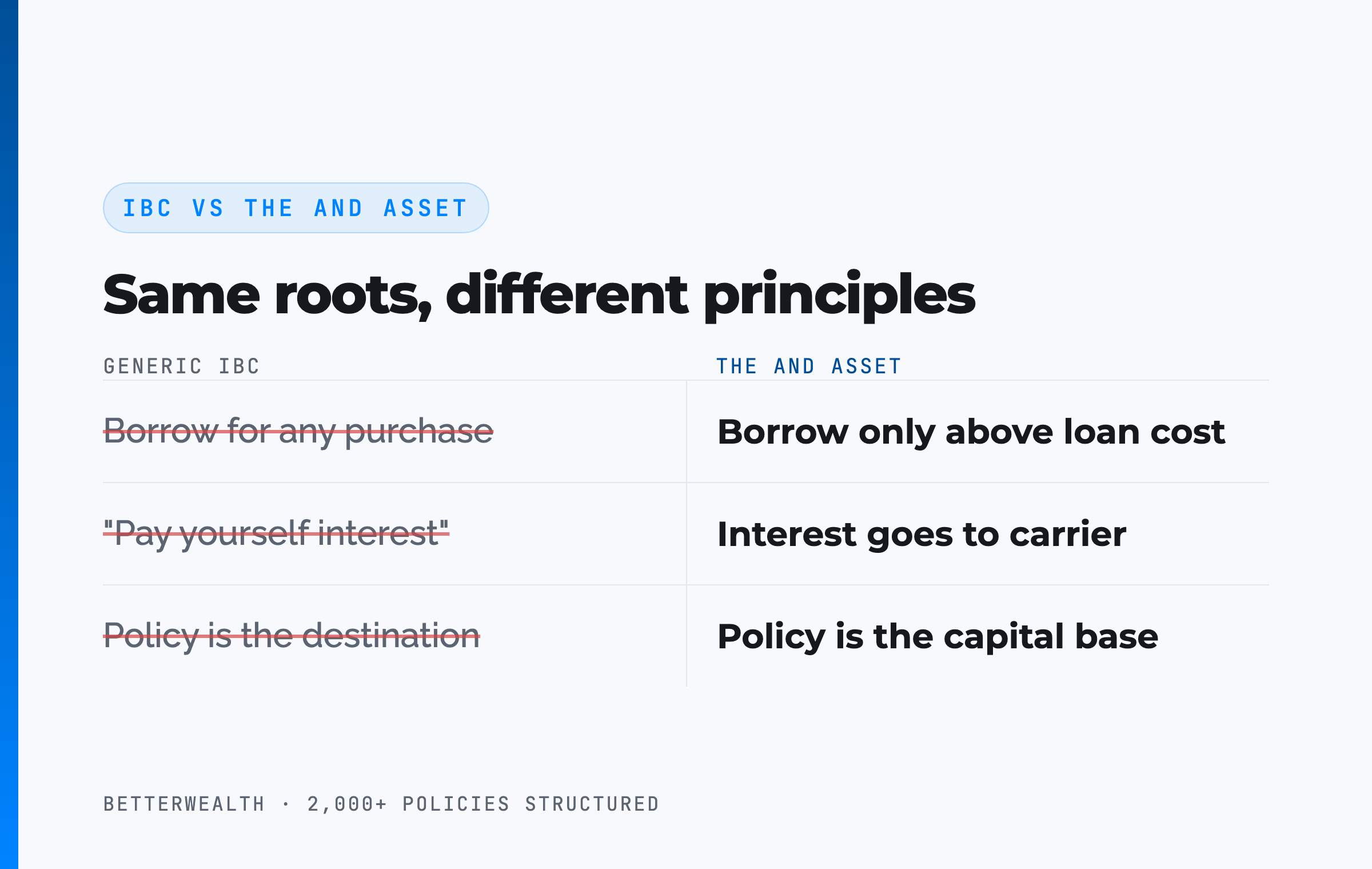
Infinite banking is the practice of using a properly structured whole life policy as a personal banking system you borrow against, while the policy continues to compound on its full value. That is the mechanical definition, and it traces directly to Nelson Nash, who pioneered the concept in Becoming Your Own Banker. His insight about lost opportunity cost and the structural cost of paying interest to outside lenders is the foundation everything here is built on. If the framework is new to you, our pillar explainer, What Is Infinite Banking? The And Asset Guide, walks through the mechanics from the ground up.
What we practice operates on a different principle. IBC says you can use a whole life policy as a personal banking system for any purchase. The And Asset says you only deploy capital from the policy when the borrowed dollars will produce a return greater than the carrier's loan cost. Anything less is an expensive way to spend money. That single rule changes how every pro and con in this article reads, because most of the cons only bite when the discipline is missing.
Why the distinction decides the pros and cons
The most repeated "pro" of infinite banking is that you are paying yourself interest. You are not. When you take a policy loan, the interest goes to the carrier. The return that justifies the strategy is what your deployed capital earns elsewhere while the policy compounds uninterrupted. The And Asset frames the policy as the capital base, not the destination. The value is created in what you deploy into, which is why the strategy collapses for anyone who borrows without a productive use for the money.
The math has to work. Every time.
The And Asset shares roots with IBC but operates on different principles. It is not IBC for everyone. It is a tool for a specific person doing specific things with capital.
03 / The prosWhat are the real advantages of infinite banking?
The real advantages of infinite banking are structural, not promotional, and four of them hold up under scrutiny. These are the features that survive an honest audit, stated without the inflation a sales deck adds.
Uninterrupted compounding
The policy grows on its full cash value even while you borrow against it. A policy loan is collateralized by your cash value, not withdrawn from it, so the money keeps compounding at the dividend rate net of mortality and expense charges. This is the one feature a HELOC or a brokerage margin line cannot replicate, because a credit line is not an asset that grows. It is the structural core of the entire strategy.
Control over a non-callable line of capital
A policy loan cannot be called, frozen, or re-underwritten. You set the repayment schedule. Thousands of investors learned in 2020 how fast a bank can freeze a HELOC exactly when capital is needed most. The policy loan does not behave that way. You control the timing, the amount within your available cash value, and the pace of repayment.
Tax treatment and creditor protection
Policy loans are not taxable income under IRC Section 7702, and the cash value grows tax-deferred. Many states also extend creditor protection to life insurance cash value, though the amount varies by state and is not universal. For a high-income earner with liability exposure, that combination is a genuine advantage, stated with the constraint attached rather than as a blanket promise.
These advantages are real and they are also conditional. They only matter to someone who values control, tax treatment, and long-term compounding more than maximum liquidity on day one.
04 / The consWhat are the real downsides nobody puts in the pitch?
The real downsides of infinite banking are front-loaded, and pretending otherwise is how agents lose trust. Four of them are serious enough to disqualify the strategy for the wrong person.
First, low early cash value. A properly designed policy still trails cumulative contributions through the first few years. First-year cash value on a well-structured overfunded policy commonly lands in the 75 to 85% range of premium, and it climbs from there. You do not break even on day one, and any illustration that shows it is fiction. Second, the long time horizon. Break-even, where total cash value catches total contributions, typically arrives at year five or later for a healthy individual. The strategy compounds its advantages slowly. Third, funding discipline. A policy starved of premium becomes an expensive death benefit instead of a capital base, and the base/PUA split that drives early cash value only works if you actually fund it. Fourth, and most important, the strategy produces nothing on its own. Without a use for borrowed capital that beats the loan cost, you have built a slow, expensive savings account.
Low early. Slow to start. Useless without deployment.
If you cannot identify an activity that outperforms the loan rate, do not borrow, and frankly, do not start. The discipline of repayment and deployment is the whole strategy.
05 / The mathDoes the return clear the loan cost?
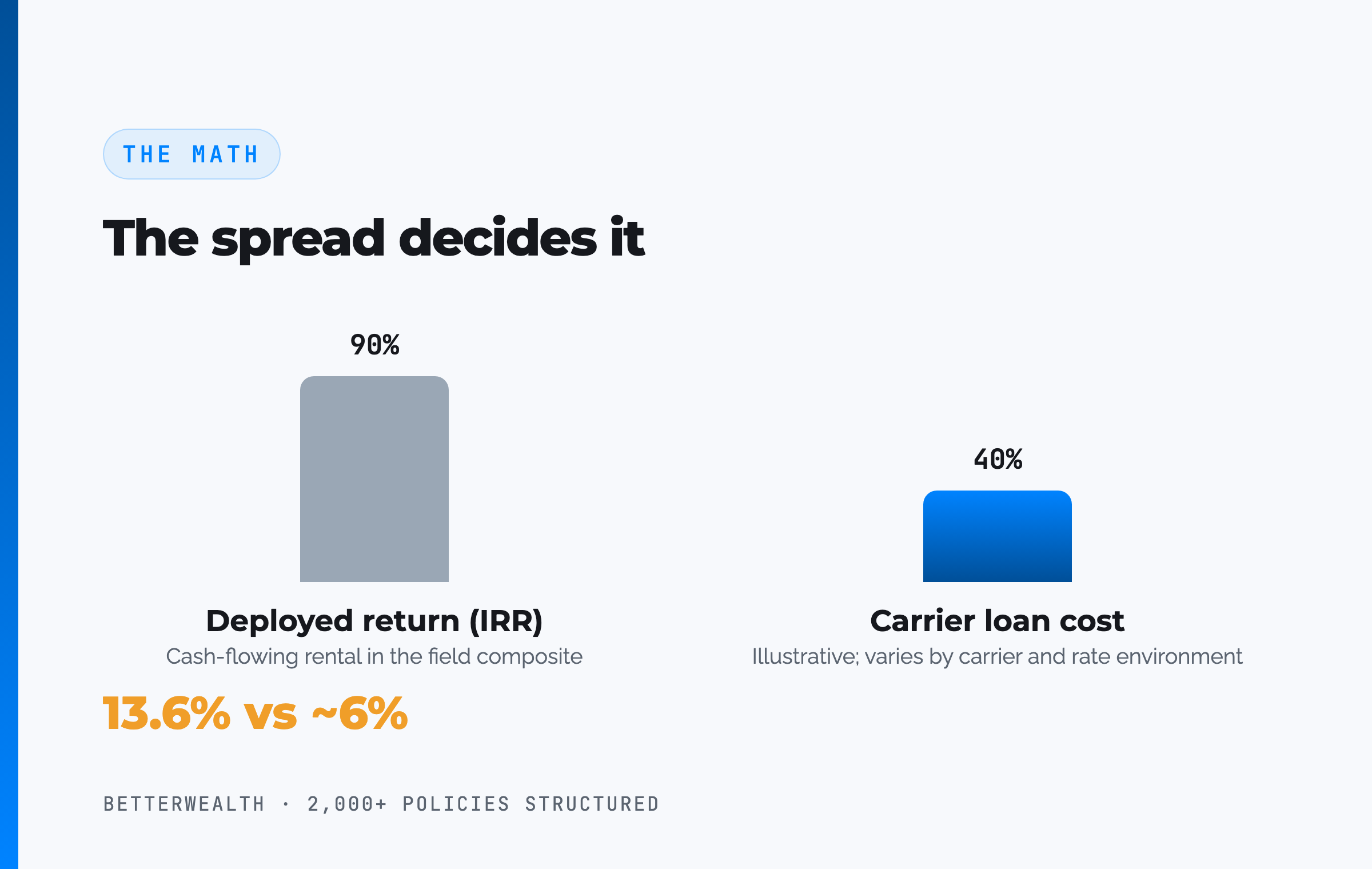
The deciding question is whether what you deploy the borrowed capital into produces a return greater than the carrier's loan cost. This is the test that separates a working strategy from an expensive one. Policy loan rates vary by carrier and rate environment. At the time of writing, many carriers fall in the 5 to 6% range, but treat the specific number as a variable to verify, not a constant.
Here is the structure of the decision. You borrow at the carrier's loan rate. Your policy keeps compounding on its full cash value, including the borrowed portion. Your deployed capital earns its own return. If that return is higher than the loan cost, you are ahead on the spread, and the same dollar has done two jobs. If the return is lower than the loan cost, you have borrowed money to lose money slowly. That is the entire calculus, and it is why the pros and cons resolve differently for a real estate investor with deals in hand than for someone with nowhere to put the capital.
If the deal does not clear the loan rate, do not borrow.
Infinite banking fits a specific person, not everyone.
The pros win if
- You have a long capital horizon (10+ years)
- You can fund a policy consistently
- You can name a use for capital that beats the loan cost
- You value control and tax treatment over day-one liquidity
The cons win if
- You need maximum cash in year one
- You are early in building wealth
- You want a savings account or 401(k) alternative
- You cannot identify a productive use for borrowed dollars
If you are in the first column, a 30-minute conversation will tell you whether the strategy actually fits your capital structure. If you are in the second, we will tell you that too.
Book a Discovery Call06 / The mythsWhere do people get the pros and cons wrong?
People get this wrong in two opposite directions, and both come from skipping the math. The oversellers inflate the pros into promises the strategy never made. The dismissers attack a version of the strategy no serious practitioner uses.
The three oversold "pros"
The first myth is that you are paying yourself interest. The interest goes to the insurance company. The second is that infinite banking beats the stock market. It does not, and comparing a whole life dividend to equity returns is a category error, because the policy is a capital base, not a growth vehicle. The third is that everyone should have one. The strategy is for entrepreneurs, business owners, real estate investors, and high-income earners who already deploy capital, not for savers and not as a retirement account replacement.
The two unfair "cons"
The most common attack is that whole life is a bad investment because of low early cash value. That is true if you treat the policy as an investment and judge it on year-one returns. It is the wrong frame. The second is that policy loans are a gimmick. They are a contractual feature of permanent life insurance with tax treatment defined under Section 7702, not a loophole. The honest read sits between the hype and the dismissal.
Whole life is a poor investment and an effective capital base. Those are different jobs. Most arguments about infinite banking are really arguments about which job you expected it to do.
The frameworks behind 2,000+ policies, in one place.
The And Asset Vault holds the calculators, design frameworks, and structuring decisions we use to pressure-test whether the pros outweigh the cons for a specific situation. Free, email-gated, no spam.
Open the Vault07 / The fitWho should use infinite banking, and who should walk away?
Infinite banking is right for the entrepreneur or high-income earner with a long capital horizon who can fund consistently and can name a use for borrowed capital that beats the loan cost. It fits the value creator who already deploys capital across deals, a business, or real estate and feels the constant tension between liquidity and opportunity. For that person, the uninterrupted compounding, the non-callable access, and the tax treatment add something real to an existing capital structure.
It is the wrong fit for several people, and we say so directly. If you are early in building wealth, this is not where to start. If you want a savings account alternative, this is not it. If you are in high-interest debt looking for a quick fix, the strategy compounds advantages slowly and will not solve an immediate liquidity crunch. And if you cannot identify a productive use for borrowed dollars, no policy design and no carrier will change the answer. The discipline is the strategy, and without it the cons win.
08 / The decisionHow to weigh the pros and cons for your own situation
You weigh the pros and cons of infinite banking by running your situation through five checks in order, and stopping the moment one of them fails. This is the same sequence we use on a discovery call before recommending the strategy to anyone.
- Confirm the time horizon. Be honest about whether you can leave capital to capitalize for ten years or more. The strategy rewards a long horizon and punishes a short one.
- Identify the use of capital. Name a specific activity for borrowed dollars that produces a return greater than the carrier's loan cost. If you cannot, stop here. The cons already outweigh the pros.
- Stress-test the early years. Accept that cash value will trail cumulative contributions through the first few years, with break-even at year five or later. If that timeline does not fit your plan, the strategy is the wrong tool.
- Check the funding discipline. Confirm you can fund the policy consistently. A policy starved of premium becomes an expensive death benefit, not a capital base.
- Decide against the alternatives. Compare it honestly to a HELOC, a margin line, and simply holding cash. Choose infinite banking only when control, tax treatment, and uninterrupted compounding matter more than maximum day-one liquidity.
Clear all five and the pros genuinely outweigh the cons. Fail any one and the answer is no, regardless of how attractive the strategy looks in a marketing illustration.
09 / Head to headInfinite banking against the alternatives
Compared to the capital tools entrepreneurs actually use, an infinite banking policy trades day-one access for control, tax treatment, and uninterrupted compounding. The table sets it against a HELOC, a 401(k), and a taxable brokerage account on the four dimensions that decide a life insurance strategy.
| Dimension | Infinite Banking (And Asset) | HELOC | 401(k) | Taxable Brokerage |
|---|---|---|---|---|
| Growth | Compounds on full cash value, net of internal costs, even while borrowed against | None (it is a credit line, not an asset) | Market growth, tax-deferred | Market growth, taxed annually on gains |
| Liquidity | Low in early years; loans against cash value cannot be called once available | Fast once approved, but can be frozen or called | Restricted before 59½ (penalty plus tax) | Fully liquid, settles in days |
| Tax treatment | Policy loans are not taxable income under IRC 7702 | Interest may be deductible in limited cases | Deferred now, taxed as ordinary income later | Capital gains and dividends taxed yearly |
| Control | Loan cannot be called; you set repayment terms | Lender controls terms and can revoke access | Access rules set by Congress, not you | Full control, but no leverage feature built in |
Growth. A policy keeps compounding on its full value while you borrow, which a HELOC cannot do because a credit line is not an asset. That uninterrupted compounding is the structural pro that makes the same dollar do two jobs.
Liquidity. This is the clearest con. A HELOC and a brokerage account both beat a policy on day-one access, and a new policy has little to lend against in year one. The policy wins only later, once cash value has built and the access becomes non-callable.
Tax and control. Policy loans are not taxable income under Section 7702, and the loan cannot be called. A 401(k) defers tax but restricts access until 59½ under rules set by Congress. The strategy trades the highest possible early liquidity for control and tax treatment you keep.
A composite: when the pros won, and when they would not have
Consider a 43-year-old real estate investor, preferred non-tobacco, funding an overfunded whole life policy at $48,000 per year on a cashflow design. This is a representative composite, not a single named client.
Through the first three years, cash value trails cumulative contributions, exactly as a real policy should. By year three, each premium dollar adds more than a dollar of cash value. At year five, total cash value crosses total contributions. No earlier. Any illustration showing year-two break-even is marketing fiction.
In year six, with roughly $312,000 of accessible cash value, the investor borrows $164,000 against the policy to fund the down payment on a cash-flowing rental. The property returns an estimated 13.6% IRR. The loan cost is illustrative at around 6%, so the spread works in the investor's favor by more than seven points. The policy keeps compounding on its full value the entire time. Repayment runs on a 47-month schedule funded by the property's own cash flow.
The same numbers would have failed a different person. Had this investor borrowed the $164,000 with no deal in hand, or to cover personal spending, the loan cost would have been a pure drag and the policy would have functioned as nothing more than a slow savings account. The pros did not come from the policy. They came from the deployment.
One dollar. Two jobs. That is the And.
The honest 30 minutes about whether this fits you.
We have structured more than 2,000 policies across all 50 states. We have seen this strategy work exactly as designed, and we have seen it fail. On a discovery call, a practitioner looks at your specific situation and tells you honestly whether the pros outweigh the cons for you, or whether they do not. If you would rather learn first, the The And Asset and BetterWealth YouTube channels go deep on the math.
Book a Discovery CallFAQInfinite banking pros and cons questions
What are the main pros and cons of infinite banking?
The main pros of infinite banking are uninterrupted compounding, control over a non-callable line of capital, favorable tax treatment of policy loans under IRC 7702, and creditor protection in many states. The main cons are low early cash value, a long time horizon to break-even, required funding discipline, and the fact that the strategy fails without a productive use for borrowed capital.
Is infinite banking a scam?
Infinite banking is not a scam, but it is frequently oversold. The mechanics are real: a properly structured whole life policy lets you borrow against cash value while the policy keeps compounding. The scam-like behavior comes from marketers who promise you are paying yourself interest or that the strategy fits everyone. Neither is true.
Who should not use infinite banking?
Infinite banking is the wrong fit for anyone early in building wealth, anyone looking for a savings account alternative, anyone in high-interest debt needing a quick fix, and anyone who cannot name a use for borrowed capital that beats the carrier's loan cost. The strategy compounds advantages over a long horizon and does not solve immediate liquidity problems.
What is The And Asset?
The And Asset is BetterWealth's framework for using a properly structured whole life policy as a capital base. You only borrow against it for an activity that produces a return greater than the carrier's loan cost, so your dollars do two jobs at once: the policy keeps compounding while the deployed capital earns its own return.
How is The And Asset different from infinite banking?
Infinite banking, as Nelson Nash taught it, frames a whole life policy as a personal banking system for any purchase. The And Asset adds a discipline: you only deploy borrowed capital when the return clears the carrier's loan cost. The policy is the capital base, not the destination. It is built on Nash's foundation but operates on different principles.
Do you really pay yourself interest with infinite banking?
No. This is the most common myth. When you take a policy loan, the interest goes to the insurance carrier, not back to you. Your return comes from what you deploy the borrowed capital into while the policy continues to compound on its full value. Any marketer who says you are paying yourself interest is wrong.
When does an infinite banking policy break even?
A well-designed, overfunded whole life policy reaches break-even, where cash value catches cumulative contributions, at year five or later for a healthy individual. Cash value does not exceed contributions in the first few years. Any illustration showing year-one or year-two break-even is fiction.
Is infinite banking worth it for real estate investors?
Infinite banking can be worth it for real estate investors who borrow against the policy to fund deals that return more than the carrier's loan cost. The policy keeps compounding while the capital is deployed, so the same dollar works in two places. It is not worth it for an investor who needs maximum liquidity on day one or cannot wait through the early capitalization years.
What is the biggest downside of infinite banking?
The biggest downside is low early cash value combined with a long time horizon. You commit to funding a policy for years before it functions efficiently as a capital base, and the money is not meant to be touched for a quick return. For someone who needs liquidity now or lacks funding discipline, this is disqualifying.
How is infinite banking different from a HELOC?
A HELOC is a credit line against home equity that a lender can freeze, reduce, or call, and the underlying equity does not compound. An infinite banking policy loan cannot be called, the cash value keeps compounding while borrowed against, and the loan does not require re-approval. The HELOC is often faster to access but far less stable.
Does borrowing against the policy stop it from growing?
No. A policy loan is collateralized by your cash value, not withdrawn from it, so the policy continues to compound on its full value at the dividend rate net of mortality and expense charges while the loan is outstanding. This uninterrupted compounding is the structural feature that makes the strategy work.
- Nelson Nash, Becoming Your Own Banker, the origin of the infinite banking concept.
- IRC Section 7702 (Cornell Law), the tax code provision behind the treatment of life insurance cash value and policy loans.
- LIMRA, life insurance industry data, including persistency and policy-performance benchmarks.
- NAIC, state-by-state regulation and consumer guidance on life insurance.
- BetterWealth resources: The And Asset book, the The And Asset YouTube channel, and the BetterWealth YouTube channel.
I founded BetterWealth to treat life insurance as the wealth and capital tool it actually is, not the product most people get sold. Our team has structured more than 2,000 policies across all 50 states, and we are honest about the cases where this strategy is the wrong fit. I wrote The And Asset and host the BetterWealth and The And Asset YouTube channels. If you want a straight read on whether the pros outweigh the cons for you, book a discovery call. We will tell you if they do not.