
An executive bonus plan under Section 162 lets an employer fund a permanent life insurance policy for selected key employees, outside ERISA's coverage rules, to reward and retain them. Five related non-qualified plans (restricted executive bonus, loan regime split dollar, economic benefit split dollar, retention bonus, and SERP or salary deferral) trade tax deduction against employer control and cost recovery.
The most expensive employee a business owner has is the one who leaves. A director who runs a division, a vice president who holds the client relationships, an executive who knows where every dollar of margin comes from: replacing that person costs a recruiting fee, a year of ramp, and whatever institutional knowledge walks out the door with them. The conventional answer is a raise. A raise is deductible the day you pay it, and it buys nothing after that. The executive banks it, resets their expectations, and remains exactly as free to leave as they were the day before.
The second problem sits on the executive's side of the table. A highly compensated employee who maxes a 401(k) cannot get enough money into it to fund the retirement their income implies. The contribution limits are set by statute and do not scale with salary. So the employer is paying more, the executive is under-saved relative to their lifestyle, and neither side has a structure that ties the two together.
A non-qualified life insurance plan converts compensation the employer was going to pay anyway into an asset the executive has to stay to keep. That is the whole idea behind the family of plans built around IRC Section 162 and the split dollar rules. The employer selects who participates, sets the benefit, and decides how much control to retain. The executive gets a permanent policy with a death benefit from day one and a cash value that compounds, net of mortality and expense charges, for as long as they stay.
At BetterWealth we have structured more than 2,000 policies across all 50 states, and a growing share of our business-owner conversations are about exactly this. Alden Armstrong, Senior Product Specialist on our team, walked through the six structures in the source video with real illustration numbers on screen. This article rebuilds that walkthrough: what a non-qualified plan is, the six decision factors that pick the right one, how the executive bonus and restricted executive bonus plans work with a $63,125 bonus on the page, how the two split dollar regimes and the deferred compensation plans differ, the cost recovery math, and where these plans fit inside a broader capital strategy, including how The And Asset discipline applies to whoever ends up controlling the cash value.
- Non-qualified plans sit outside ERISA, so an employer can select which executives participate and set benefit levels without contribution limits.
- A Section 162 executive bonus is deductible like payroll, but the employee owns the policy and can leave with it.
- A restricted executive bonus adds a vesting schedule and collateral assignment, so an early departure returns unvested cash value to the employer.
- Split dollar plans give the employer the strongest cost recovery, at the price of no immediate tax deduction.
- In the illustration, a $63,125 double bonus nets a $50,500 premium and costs the employer $37,875 after tax.
- The And Asset rule applies to whoever controls the cash value: only borrow when the deployed dollars out-earn the carrier's loan rate.
Alden walks through the executive bonus illustration on screen page by page, including the vesting overlay and the drop in death benefit when the policy goes reduced paid-up after year seven, which prose can describe but not show:
01 / The problemWhy a raise does not keep a key employee
A raise keeps nobody, because the day it hits payroll it becomes the executive's new baseline and carries no condition attached to staying. The business gets a deduction for the added compensation, which is the same deduction it would get for any payroll. Then the money is gone, and the executive is exactly as recruitable as before.
Alden framed the alternative with a simple example. An employee earning $150,000 wants $200,000. The employer can pay the $50,000 raise, or it can fund $70,000 through an incentive plan that vests over time. The employee stays the same. The relationship changes, because now a portion of the executive's compensation only becomes theirs if they are still there in year five, year ten, or year sixteen. Sports fans know the structure as golden handcuffs. The most publicized example is football coach Jim Harbaugh, whose compensation package included a loan regime split dollar arrangement that pays off only if he stays.
The second half of the problem is the executive's own retirement math. Qualified plans cap what a highly compensated employee can defer, and the cap does not rise with income. An executive earning $400,000 who maxes a 401(k) is saving a smaller fraction of income than a $90,000 employee doing the same thing. Non-qualified plans exist to fill that gap for the people the business most needs to keep.
A raise is deductible the day you pay it. That is also the day its retention value expires.
02 / The frameworkWhat is a non-qualified benefit plan?
A non-qualified benefit plan is an employer-sponsored arrangement that sits outside ERISA, so the employer can choose the participants, set the benefit levels, and skip the contribution limits and annual filings that govern a 401(k), a pension, or a cash balance plan. Qualified plans are, in effect, a partnership with the IRS: the deduction is immediate and plan assets are protected from creditors, but every eligible employee must be included and the compliance calendar is heavy. Non-qualified plans give up some of that protection in exchange for selectivity.
Selectivity has limits. An employer can define a class, such as executives, directors, or managers, that is reasonable in light of the company's goals. It cannot single out one cashier because she is the owner's cousin and ignore everyone else in the same role. We lean on the advanced planning teams at the carriers we work with to structure the class so it holds up.
| Dimension | Qualified plan (401(k), pension, cash balance) | Non-qualified plan (executive bonus, split dollar, deferred comp) |
|---|---|---|
| Governing rules | ERISA participation, non-discrimination, and filing rules | Outside ERISA; Section 409A applies to deferred compensation |
| Who participates | All eligible employees | A class the employer selects, within reason |
| Contribution limits | Set by statute | None |
| Employer deduction | Immediate | Immediate for bonus plans; none or deferred for split dollar and deferred comp |
| Creditor protection | Plan assets protected | Plan assets may be reachable by the employer's creditors |
| Reporting | Annual filings | Minimal |
| Who benefits most | The employer's tax position, in a cash balance plan | The employer's retention; most of the monetary value goes to the employee |
Three families of plans live under the non-qualified label. Bonus plans are the simplest. Split dollar plans share a policy between employer and employee under a written agreement. Non-qualified deferred compensation plans are promises of future payment, funded by a policy the employer owns. The rest of this article walks through all six in order of complexity.
03 / The decisionWhat are the six factors that decide which plan fits?
Six factors decide which non-qualified plan fits a business: tax deduction, employer control, cost recovery, employee tax deferral, ease of administration, and employee participation. Alden arrived at this list from years of sitting across from employers, and every plan below scores differently on each one.
- Tax deduction. Can the business deduct the contribution while doing something for the employee? Bonus plans, yes, immediately. Split dollar and deferred compensation, no, or not yet.
- Employer control. The golden handcuff question. Does the structure give the executive a financial reason to stay, and does the employer keep a claim on the money if they do not?
- Cost recovery. If the business dedicates $500,000 to an executive over ten years and gets that money back at the end, that is a different decision than spending it. Split dollar plans have the strongest recovery.
- Employee tax deferral and minimization. Gain inside a life insurance policy is tax-deferred. When the plan allows it, the executive can access the cash value later through withdrawals to basis and policy loans without current income tax, provided the policy stays in force and is not a modified endowment contract.
- Ease of administration. Everything here is lighter than ERISA. Bonus plans are the lightest. Deferred compensation plans pick up Section 409A rules and real administrative work.
- Employee participation. Some structures let the executive put their own compensation into the plan. That gives them ownership of the outcome and makes the plan a joint project rather than a gift.
Before any of the mechanics, an employer should rank these six. Control, simplicity, or tax deferral for the executive: which one matters most? The ranking usually points at one plan family before a single illustration is run.
04 / How it worksHow does a Section 162 executive bonus plan work, step by step?
A Section 162 executive bonus plan works by paying the executive a bonus that is deductible to the employer as compensation, taxable to the executive as income, and directed into a permanent life insurance policy the executive owns. The name comes from the tax code section under which the bonus is deducted. Whether the business pays the money as a raise or as a bonus into a policy, the net effect is the same: it has given the dollars to the employee. The difference is what the dollars become. Here is the sequence we use, including the restriction that turns a plain bonus into a retention tool.
- Define the participating class. Executives, directors, or managers, defined in a way that is reasonable to the company's long-term goals. Different classes can get different plans. A CEO on one structure and a director on another is fine, because the regulations do not force uniformity.
- Set the bonus and decide on a double bonus. A $50,000 bonus is a taxable event for the executive. The employer can pay just the $50,000 and let the executive cover the tax, or add enough to cover the tax as well. That second version is a double bonus. In the illustration, the gross bonus is $63,125. At an assumed 20% employee bracket, $12,625 goes to tax and $50,500 goes to premium. At an assumed 40% employer bracket, the business's after-tax cost is $37,875. Those brackets were chosen to make the math easy, not as a forecast of anyone's return.
- Design the policy for cash value. Minimize base premium and load the paid-up additions rider as heavily as the modified endowment contract limit allows. The employer's commitment and the policy's capacity do not have to match. If the policy can absorb $100,000 a year and the employer wants to pay a bonus of $30,000, the employer is effectively covering the minimum required cost of insurance and the executive can overfund the rest.
- Attach the restriction. This is the step that turns an executive bonus into a restricted executive bonus arrangement, or REBA. A formal agreement, a security rider, and a collateral assignment give the employer a claim on the unvested share of the cash value, and that claim declines on a schedule. The illustration vests 0% in years one through three, then 20%, 40%, 80%, and 100% at year 7. The executive gets most of the death benefit from day one, and the cash value on the schedule.
- Fund the commitment, then go reduced paid-up. The employer in the illustration did not want to commit to premiums for decades, so the design funds for seven years, the shortest window that keeps this premium level under the 7-pay test. At year seven the policy is switched to reduced paid-up: the carrier shrinks the death benefit to what the existing cash value supports, no further premium is due, and the cash value keeps compounding net of mortality and expense charges. That is why the illustration shows a large drop in death benefit after year seven. The executive owns the contract and can keep funding it if there is room, or fund longer.
- Handle departure or death. An executive who leaves at 20% vesting has two options: take a loan or withdrawal from the policy, pay the employer the collateralized amount, and keep the policy, or surrender it and let the carrier pay the employer directly under the assignment. The employer has a third option: buy the policy by paying the executive the vested share, then keep funding it, because a life insurance policy is an asset on a balance sheet and assets can be sold. If the executive dies during vesting, the employer's collateral comes off the top of the death benefit and the rest goes to the family.
The bonus is payroll. The restriction is the handcuff.
Executive bonus versus restricted executive bonus
A plain executive bonus plan scores well on two of the six factors and poorly on two others. The deduction is immediate and the administration is trivial. The cost recovery is zero and the employer control is minimal, because the executive owns the policy outright and can leave with it the week after the first premium clears. The restricted version keeps the same money flow and the same deduction, and adds the vesting agreement. That single addition moves employer control and cost recovery from the bottom of the scale to the middle.
One detail from the video that business owners tend to miss: the restriction does not stop the executive from using the policy. In year four of the illustration, the executive is 20% vested on roughly $170,000 of cash value, which means about $34,000 is theirs to borrow against. The employer's collateral sits on the remainder. An executive who has learned how a cash-value policy works can run that vested share under The And Asset rule from year four onward, and most of the ones we have watched keep funding the policy after the employer's seven years end, because by that point a dollar of paid-up additions adds close to a dollar or more of cash value in the same year.
Non-qualified plans fit a specific business doing a specific thing.
It fits you if
- You have one or more executives you would be hurt to lose
- You are already prepared to pay them more
- You want that money to build an asset instead of a higher baseline
- You can fund a defined commitment, such as seven years, without strain
It does not fit you if
- You own a pass-through entity and want to do this on yourself
- You want the tax deduction more than you want the executive
- You do not actually want to pass value to your employees
- The business needs this cash back in the next three years
If you are in the first column, a 30-minute conversation will tell you which of the six plans fits your entity, your headcount, and your priorities. If you are in the second, we will tell you that too.
Book a Discovery Call05 / Split dollarHow do loan regime and economic benefit split dollar differ?
Loan regime split dollar treats the employer's premium as a loan to the executive, who owns the policy, while economic benefit split dollar has the employer own the policy and endorse part of the death benefit to the executive. Both give the employer far stronger cost recovery than a bonus plan. Neither gives the employer an immediate deduction, because in neither case has the business given the dollars away.
Loan regime split dollar
In a loan regime arrangement the executive owns the policy, exactly as in a REBA, but there is no vesting schedule. The employer pays the premium as a loan to the executive, and the loan flows into the policy. A bona fide loan is not income, so the executive has no tax on the funding as it happens. The executive owes interest at the applicable federal rate, which can be paid out of pocket or carried inside the arrangement and added to the balance. The loan balance secures a limited collateral assignment against the policy. Limited means the employer's claim equals the loan balance at any given moment, no more, and it does not step down on a schedule the way a REBA's does.
At the end, the employer has two paths. It can forgive the loan, which is a taxable event to the executive and a compensation deduction to the business at that point. Or the loan is repaid, from the executive's other assets or directly out of the policy's cash value. That is the Harbaugh structure. It delivers high cost recovery and control for the employer, and a tax-free funding period for the executive, at the price of no deduction while the plan is being built.
A variant worth naming so you recognize it when it is pitched: premium finance loan regime split dollar, where the employer borrows from a third-party lender to fund the loan to the executive. It is sold as retention with no money out of pocket. It is also a loan on top of a loan on top of a policy, and every layer has a rate and a term. The pitch can look good on paper. Read every line of it before you sign.
Leverage stacked on leverage needs a reason.
Economic benefit split dollar
In an economic benefit arrangement the employer buys and owns the policy on the executive's life and endorses a portion of the death benefit to the executive's beneficiaries. The employer keeps the rest of the death benefit and owns the entire cash value. The executive's only tax is on the economic benefit: the value of the death benefit protection they are receiving each year, computed from IRS-published term rates. Because the statistical chance of dying in any single year is low, that one-year term cost is small, especially at younger ages.
This is the structure for a business that wants control of the capital. If an owner wants to build a capital base across ten executives and have access to the cash value, this is how it is done, because the business owns the contracts. It can double as key person coverage, with a larger share of the death benefit protecting the company and a smaller share endorsed to the family. Cost recovery is the highest of the six: the employer gets the cash value on surrender or the death benefit at death. There is no deduction, because the employer never relinquished the dollars.
At separation, the employer chooses. It can keep and continue funding the policy if the executive agrees, transfer the policy to the executive as compensation (deductible to the business, taxable to the executive), or use the cash value to fund an ad hoc retirement benefit such as an annuity. A vesting schedule on the cash value can be layered in, but any cash that becomes the executive's is a taxable event at ordinary income rates, and that is a conversation for the executive's tax advisor before the plan is signed.
Control and deduction move in opposite directions.
You can have the deduction or you can keep the cash value. No structure in this family gives you both at the same time.
06 / Deferred compensationRetention bonus plans, SERPs, and salary deferral
Deferred compensation plans are promises: the employer commits to a future payment contingent on the executive staying, and funds that promise with a policy the employer owns. Three versions cover most of what we see. All three keep the cash value with the employer, give the employer cost recovery, and give the executive a tax deferral until the benefit is paid. None of them produce an immediate deduction, because no one has realized the compensation yet.
A retention bonus plan is the simplest. Stay a defined number of years, or hit defined metrics, and a bonus is paid. The policy sits on the employer's balance sheet to fund the promise. Because the plan is deferred compensation, Section 409A applies, which adds moderate administration.
A supplemental executive retirement plan, or SERP, promises a retirement benefit rather than a lump-sum bonus. The employer controls everything, the executive defers tax until payment, and the administration is heavier than any other plan here. A SERP fits a career executive with a short runway to retirement. Promising a 34-year-old a benefit at 65 does not create enough near-term value to change their behavior, which is the whole point of the exercise.
A salary deferral plan is more common in the corporate world. The executive elects to defer part of their own salary, often because their current tax burden is high and they have exhausted other options. The deferred amount is the employer's until it is paid, the employer controls the cash value in the funding policy, and the executive can participate as heavily as they choose, understanding the money is not accessible until the plan says so.
All three carry more administrative weight than a bonus plan. All three are still lighter than an ERISA-governed defined benefit plan.
The frameworks behind 2,000+ policies, in one place.
The And Asset Vault holds the calculators, design frameworks, and structuring decisions we use when we build cash-value policies, whether the owner is an individual, an executive, or the business itself. Free, email-gated, no spam.
Open the Vault07 / The mathDoes the plan pay for itself?
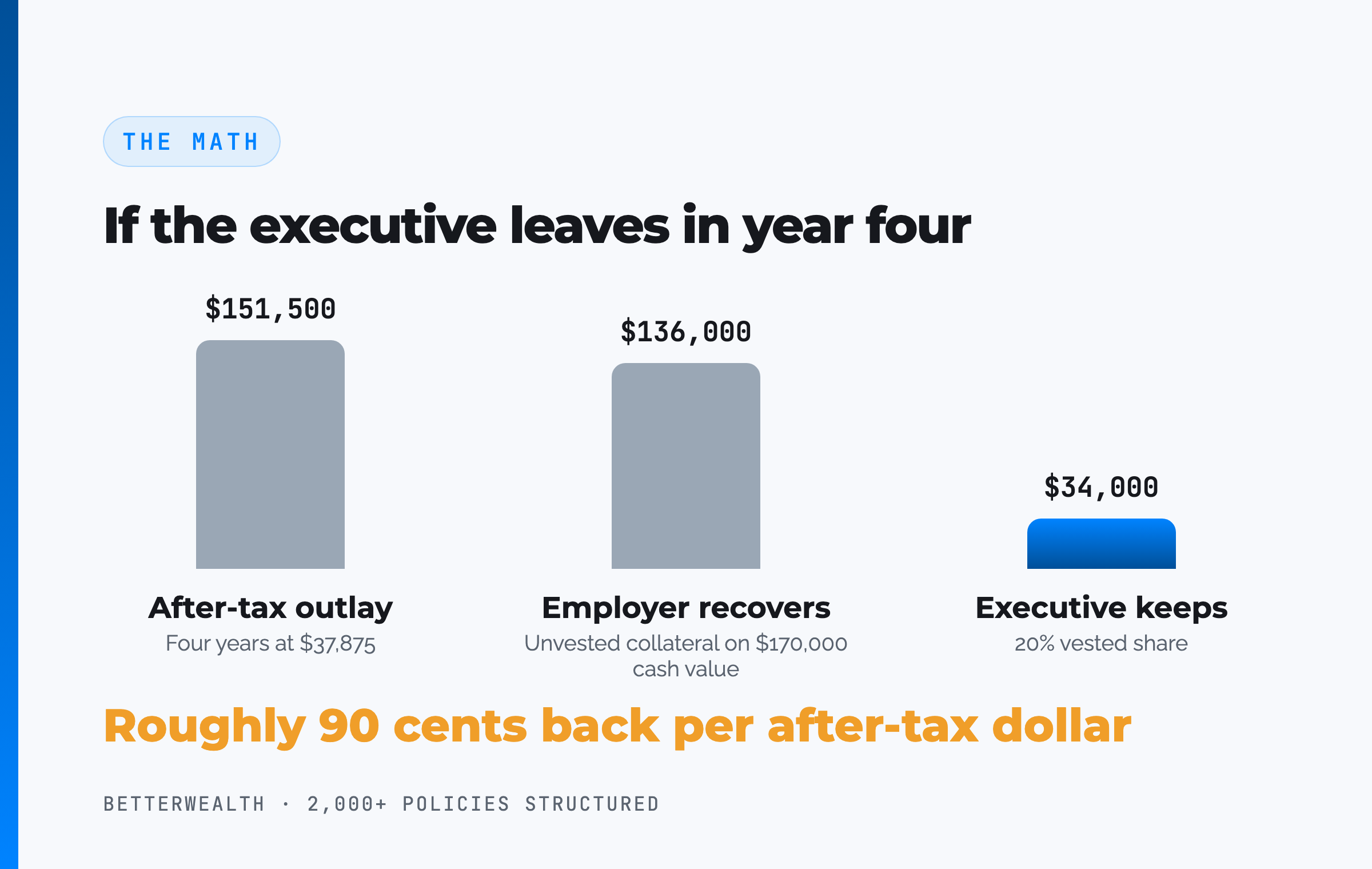
Whether the plan pays for itself depends on which of the six structures you choose, because cost recovery and tax deduction pull in opposite directions. A plain executive bonus recovers nothing and deducts everything. A REBA deducts everything and recovers the unvested share if the executive leaves early. Split dollar and deferred compensation recover most or all of the outlay and deduct nothing until the executive is paid.
Put the REBA in dollars. The employer pays $63,125 a year and, after its own deduction at an assumed 40% bracket, is out $37,875. Over the seven-year commitment that is $265,125 after tax. If the executive leaves in year four, at 20% vesting on roughly $170,000 of cash value, the employer's collateral is about $136,000 against a four-year after-tax outlay of $151,500. The business recovers roughly 90 cents of every after-tax dollar it spent and the executive walks away with about $34,000. If the executive stays to year 7, the business has spent $265,125 after tax and kept a key person for seven years. A $50,000 raise over the same seven years costs $350,000 before the deduction and recovers nothing on the day the executive resigns.
Ninety cents back if they leave. Seven years if they stay.
The And Asset test inside the plan
Whoever controls the cash value in any of these plans, the executive in a bonus or loan regime plan or the employer in an economic benefit or deferred compensation plan, is holding a compounding asset that can be borrowed against. Policy loan rates vary by carrier and by rate environment. At the time of writing many carriers fall in the 5 to 6% range, but treat the specific number as a variable to verify with the carrier, not a constant. The test never changes: the return on whatever the borrowed capital goes into must exceed that loan rate. If it does, the policy has done two jobs with one dollar. If it does not, you have borrowed money to lose it slowly, and the fact that the loan came from a retention plan does not change the arithmetic.
If the deal does not clear the loan rate, do not borrow. Even inside a plan.
08 / Where it goes wrongWhere people get non-qualified plans wrong
The mistakes with non-qualified plans come from treating a retention tool as a tax strategy, or a tax strategy as a retention tool. A cash balance plan is a tax strategy first. Every plan covered here is a retention strategy first, and an employer who forgets that ends up with the wrong structure.
The first mistake is the 401(k) replacement pitch. Some producers sell these plans as a wholesale substitute for a company's qualified plan. It can be done. It is rarely the best outcome for the employees or the business, and the honest framing is a supplement for the people who have outgrown the qualified plan's limits.
The second is the owner who sets up a REBA on themselves inside an S corporation. There is no tax benefit, because the bonus and the deduction land on the same return. The owner should take the money and own the policy personally. The one exception is underwriting: with ten or more employees enrolled, certain carriers offer guaranteed issue coverage, and an owner with health issues can be included in that group without a medical exam. That is a real reason to participate. The deduction is not.
The third is the leverage stack described above, where a lender funds the employer who funds the executive. The fourth is selecting participants by name instead of by class, which invites a challenge to the whole arrangement. The fifth is the one Alden closed the video with, and it disqualifies more employers than any technical issue.
This is an employee retention benefit first. If you do not actually want to pass value to your employees, then even a plan where you control every dollar of cash value is the wrong strategy for you.
09 / The tradeoffsBenefits and the honest tradeoffs
The benefits are selectivity, a retention condition attached to real money, and an asset the executive keeps if they stay. The tradeoffs are that deduction and control cannot both be maximized, that plan assets in employer-owned structures may be reachable by the employer's creditors, and that the executive in a bonus plan pays tax on money they cannot fully touch for years.
Take the executive's side of the REBA illustration seriously. In year one the executive reports $63,125 of income, pays $12,625 of tax out of it, and has 0% access to the cash value for three years. What they hold in that window is the death benefit, roughly $4.18 million in year three on the illustration, less the employer's $126,000 collateral. That is a real benefit to a family. It is not spendable, and an executive who does not value the death benefit will feel the tax without feeling the reward until year four.
Take the employer's side just as seriously. A seven-year funding commitment is a seven-year commitment. In an economic benefit plan the cash value sits on the company's balance sheet, which is the point, and which also means it is exposed to whatever the company is exposed to. Deferred compensation plans add Section 409A administration and leave the executive holding an unsecured promise rather than an owned asset. None of that argues against the plans. It argues for choosing the one whose tradeoffs you can live with.
Every plan here gives something up. Pick the thing you can afford to give.
10 / The fitHow does a non-qualified plan fit a broader capital strategy?
A non-qualified plan fits a capital strategy when the business already intends to pay an executive more and wants that money to do two jobs: retain the person and build an asset. Three inputs decide which plan. The first is entity structure. A C corporation sees the full benefit of the deduction on a bonus plan. A pass-through entity sees it only for employees who are not the owner. The second is headcount, because ten or more lives opens guaranteed issue underwriting at certain carriers and changes who can participate. The third is the employer's ranking of the six factors: control, simplicity, or deferral for the executive.
For the executive on the receiving end, the policy is one more piece of a capital structure that probably already includes a maxed 401(k), a brokerage account, and real estate. The policy's tax treatment under Section 7702 is what makes it useful as a supplemental retirement asset and a volatility buffer for the rest of that portfolio. The design questions are the same ones we cover in how to structure a whole life policy, with one addition: a short funding window like the seven-year design here behaves like a limited-pay policy, and it needs more base premium than a continuous-pay design to stay under the 7-pay test.
This is not for the owner of a pass-through entity looking for a personal deduction. It is not for a business that needs the cash back in the next three years. It is not for an employer who resents paying for the benefit. It is for a business owner with people who are hard to replace, who was going to pay them more anyway, and who would rather that money build something both sides can see.
11 / Head to headThe six plans, side by side
From the employer's chair, the six plans sort along the six decision factors, and the dollar column shows what each one costs in year one on the same $50,500 premium from the illustration. Deduction, control, and recovery never all line up in the same row.
| Plan | Employer deduction | Who controls cash value | Cost recovery | Employee tax during funding | Administration | Year-one employer cost on a $50,500 premium |
|---|---|---|---|---|---|---|
| Executive bonus (Section 162) | Immediate | Executive | None | Bonus taxed as income; a double bonus can cover it | Simplest | $63,125 gross; $37,875 after deduction |
| Restricted executive bonus (REBA) | Immediate | Executive, subject to a declining collateral assignment | Partial: unvested share returns to employer | Bonus taxed as income | Simple, plus the vesting agreement | $63,125 gross; $37,875 after deduction |
| Loan regime split dollar | None during funding | Executive, subject to loan collateral | High: loan balance repaid or forgiven | None; interest owed at the applicable federal rate | Moderate | $50,500 loaned; no deduction |
| Economic benefit split dollar | None | Employer owns the policy and all cash value | Highest: cash on surrender, death benefit at death | Small annual tax on the endorsed death benefit | Moderate | $50,500 premium; no deduction |
| Retention bonus plan | None immediately | Employer | High | Deferred until paid | Moderate (Section 409A) | $50,500 premium; no deduction |
| SERP / salary deferral | None immediately | Employer | High | Deferred until paid | Highest | $50,500 premium or deferred salary; no deduction |
Bonus plans. The executive bonus and the REBA are the only two rows with an immediate deduction, and they are the two easiest to run. The price is that the executive owns the asset. The REBA's vesting schedule is the only lever the employer has, which is why we rarely recommend the unrestricted version for retention.
Split dollar. Loan regime keeps the executive as owner but secures the employer's outlay with a loan. Economic benefit flips ownership to the employer entirely. Both recover cost. Neither deducts. The choice between them is a question of whether the business or the executive should hold the cash value.
Deferred compensation. The retention bonus, SERP, and salary deferral rows all keep the cash value with the employer and defer the executive's tax until payment. They cost the most to administer and fit a narrower executive: high-earning, close to retirement, and already committed for the long run.
A composite: the $63,125 bonus, the seven-year commitment, and the executive who stayed
Consider a 45-year-old executive, preferred non-tobacco, at a company that has decided to keep him. The employer's assumed bracket is 40%, the executive's is 20%, and he plans to retire at 66. The employer funds a restricted executive bonus plan for seven years. This is a representative composite built on the illustration Alden shows in the video, not a single named client, and the base/PUA split, cash-value path, break-even year, and year-10 deployment are our additions.
Each year the executive receives a $63,125 double bonus, pays $12,625 of tax on it, and $50,500 goes to premium: $20,200 of base and $30,300 of paid-up additions, a 40/60 split that carries more base than a continuous-pay design because a seven-year funding window needs the death benefit to stay under the 7-pay test. Vesting runs 0% for years one through three, then 20%, 40%, 80%, and 100% at year 7.
Year one ends with $38,400 of cash value on $50,500 contributed. By year three, cash value is $126,000 against $151,500 in, and the employer's collateral covers all of it. The death benefit that year is roughly $4.18 million; had the executive died, about $126,000 would have gone to the employer and the rest to his family. In year four, cash value reaches $170,000 against $202,000 contributed, and he is 20% vested. Had he resigned that year, he would have kept about $34,000 and the employer would have recovered about $136,000 of the $151,500 it had spent after tax. He did not resign.
The seventh and final premium brings total contributions to $353,500 and cash value to $338,000. Cash value trails contributions through every funding year, exactly as a real policy should. In year eight the policy goes reduced paid-up, the death benefit steps down to what the cash value supports, and cash value crosses $356,000. Break-even lands in year eight. Any illustration that shows it in year two is fiction.
In year ten, with $393,000 of cash value and 80% vesting, $314,400 is his to borrow against. He takes a $87,500 policy loan to buy a stake in a small commercial property partnership that models an 11.3% IRR, against an illustrative 5.5% loan rate that varies by carrier. On $87,500 that is about $9,888 a year of return against $4,813 of loan interest, a spread of roughly $5,075 a year in his favor while the policy keeps compounding on its full value. Distributions repay the loan on a 43-month schedule. Had the partnership modeled 4%, the right move would have been to leave the cash value alone.
At year 7 the collateral assignment releases and the policy, now roughly $528,000 of cash value, is entirely his. At 66 he holds an asset near $675,000 that he can draw on through withdrawals to basis and policy loans without current income tax, as long as the policy stays in force and is not a MEC. The employer spent $265,125 after tax over seven years and kept its executive for seven.
One dollar. Two jobs. Even with a handcuff on it.
The honest 30 minutes about which plan fits your business.
We have structured more than 2,000 policies across all 50 states. On a discovery call, a practitioner looks at your entity, your headcount, and the people you cannot afford to lose, and tells you which of the six plans fits, or whether none of them does. If you would rather learn first, the The And Asset and BetterWealth YouTube channels go deep on the math.
Book a Discovery CallFAQExecutive bonus and non-qualified plan questions
What is a Section 162 executive bonus plan?
A Section 162 executive bonus plan is an arrangement in which an employer pays a selected employee a bonus, deductible to the business as compensation and taxable to the employee as income, that funds a permanent life insurance policy the employee owns. The name comes from the tax code section under which the bonus is deducted. The employer chooses who participates and how much to pay, and can add a double bonus to cover the employee's tax on the bonus.
What is a restricted executive bonus arrangement (REBA)?
A REBA is an executive bonus plan with a vesting schedule attached. The money flows the same way, but a formal agreement and a collateral assignment give the employer a claim on the unvested share of cash value, which declines over time. In the illustration in the source video, vesting runs 0% for years one through three, then 20%, 40%, 80%, and 100% at year 7.
What is split dollar life insurance?
Split dollar is an arrangement in which an employer and an employee share the premiums, cash value, or death benefit of a life insurance policy under a written agreement. There are two regimes. In loan regime split dollar the employee owns the policy and the employer's premiums are loans. In economic benefit split dollar the employer owns the policy and endorses part of the death benefit to the employee.
What is the difference between loan regime and economic benefit split dollar?
Ownership and taxation. In loan regime split dollar the executive owns the policy, the employer's premiums are loans secured by a collateral assignment equal to the loan balance, and the executive pays interest at the applicable federal rate, either out of pocket or accrued inside the arrangement. In economic benefit split dollar the employer owns the policy and all of its cash value, and the executive is taxed each year on the value of the death benefit protection endorsed to them, which is a small amount based on IRS-published term rates.
Are non-qualified plans subject to ERISA?
No, and that is the reason they exist. Qualified plans such as 401(k)s, pensions, and cash balance plans are governed by the Employee Retirement Income Security Act of 1974, which sets participation, non-discrimination, contribution limit, and annual filing rules. Non-qualified plans sit outside those rules, so the employer can select participants and set benefits without contribution limits and with minimal reporting. The trade is that the employer does not always get a deduction and plan assets may be reachable by the employer's creditors.
Can an employer choose which employees get a non-qualified plan?
Yes, within reason. The clean approach is to define a class, such as executives, directors, or managers, that is reasonable in light of the company's goals. An employer cannot single out one individual for a personal reason and ignore everyone in the same role. Carrier advanced planning teams can help structure the class so it holds up.
Is the executive bonus tax-deductible for the employer?
Yes. An executive bonus, including a double bonus that covers the employee's tax, is deductible to the business as compensation in the same way payroll is. The employee reports it as income. Split dollar and deferred compensation plans do not produce an immediate deduction because the employer has not given up control of the dollars.
What happens if the employee leaves before the vesting schedule ends?
The unvested share of the cash value goes back to the employer under the collateral assignment. The departing executive can take a loan or withdrawal from the policy, pay the employer the collateralized amount, and keep the policy, or surrender the policy and let the carrier pay the employer directly. The employer can also buy the policy by paying the executive the vested share and keep funding it. If the executive dies during the vesting period, the employer's collateral comes off the top of the death benefit and the rest goes to the executive's beneficiaries.
Can the employee keep funding the policy after the employer's commitment ends?
Yes, in an executive bonus or restricted executive bonus plan, because the employee owns the contract. The employer commits to a defined period, seven years in the illustration, and the employee can keep adding paid-up additions within the policy's limits or fund for longer if they choose.
Does a non-qualified plan replace a 401(k)?
Usually not. Non-qualified plans are traditionally used to supplement existing retirement plans for executives who cannot get enough into a 401(k) to fund the retirement their income implies. Some producers pitch them as a full replacement. That can be done, but it is rarely the best outcome for the employees or the business, and it should be evaluated case by case.
Can a business owner set up an executive bonus plan on themselves?
They can, but in a pass-through entity such as an S corporation there is no tax benefit to doing so, because the bonus and the deduction land on the same return. The owner is better off taking the money and owning the policy personally. One exception is underwriting: when ten or more employees are enrolled, certain carriers offer guaranteed issue coverage, and an owner with health issues can be included in that group.
What is The And Asset?
The And Asset is BetterWealth's framework for using a properly structured whole life policy as a capital base. You only borrow against it for an activity that produces a return greater than the carrier's loan cost, so your dollars do two jobs at once: the policy keeps compounding, net of mortality and expense charges, while the deployed capital earns its own return. In a non-qualified plan, that discipline applies to whoever controls the cash value, the executive or the employer.
How is The And Asset different from infinite banking?
Infinite banking, as Nelson Nash taught it, frames a whole life policy as a personal banking system you can use for any purchase. The And Asset shares those roots but operates on a different principle: you only deploy borrowed capital when the return clears the carrier's loan cost, and you recognize that loan interest goes to the carrier, not to yourself. The policy is the capital base. The value is created by what you deploy it into.
What is a SERP?
A SERP, or supplemental executive retirement plan, is a non-qualified deferred compensation arrangement in which the employer promises a future retirement benefit to a selected executive, contingent on the executive staying, and typically funds that promise with a life insurance policy the employer owns. The employer controls the cash value, the executive defers tax until the benefit is paid, and the plan carries Section 409A administration. It fits a career executive with a short runway to retirement, not a thirty-year-old.
- Nelson Nash, Becoming Your Own Banker. The origin of the infinite banking concept and the foundation The And Asset builds on.
- IRC Section 162 (Cornell Law). The trade or business expense provision under which executive bonuses are deducted as compensation.
- IRC Section 7702 (Cornell Law). The definition of life insurance for tax purposes, behind the treatment of cash value and policy loans.
- IRC Section 409A (Cornell Law). The rules governing non-qualified deferred compensation plans, including retention bonus plans, SERPs, and salary deferral.
- U.S. Department of Labor: ERISA. The Employee Retirement Income Security Act of 1974, which governs qualified plans and which non-qualified plans sit outside.
- IRS Applicable Federal Rates. The published rates that set the interest owed in a loan regime split dollar arrangement.
- BetterWealth resources: The And Asset book, the The And Asset YouTube channel, and the BetterWealth YouTube channel.
Specializes in policy structure, carrier comparisons, and advanced business planning, and walks through the executive bonus illustration and all six plan structures in the source video.
I founded BetterWealth to treat life insurance as the wealth and capital tool it actually is, not the product most people get sold. Our team has structured more than 2,000 policies across all 50 states. I wrote The And Asset and host the BetterWealth and The And Asset YouTube channels. If you have people in your business you cannot afford to lose and want an honest read on which of these plans fits, book a discovery call. We will tell you if none of them does.