
The history of life insurance runs from Roman burial clubs around 300 BC through Edmond Halley's 1693 mortality table, the mutual companies of the 1840s, and the tax rules Congress wrote in 1984. Every feature entrepreneurs use today, cash value, policy loans, and paid-up additions, was built to solve a specific problem.
Most arguments about whole life insurance are arguments about the last forty years. Buy term and invest the difference went national in 1977. Universal life arrived in 1979. Internal Revenue Code Section 7702 was written in 1984. Almost everything a financial commentator says about this contract is a reaction to a rulebook drafted inside one human lifetime.
The contract is older than that by roughly 2,300 years, and the features that make it useful as a capital base are each a scar from a specific failure. Cash value became your property because policies used to lapse and the carrier kept the reserve. The death benefit has to grow as cash value grows because Congress found people parking lump sums inside policies to shelter estates. The policy loan exists as a contractual right because New York forced carriers to write it in after a corruption scandal gutted public trust in the industry.
Every feature that makes a whole life policy work as a capital base was built to fix a failure, and knowing which failure tells you exactly when the strategy works and when it does not.
At BetterWealth we have structured more than 2,000 policies across all 50 states, and the pattern holds across every one of them. The entrepreneurs who use this well understand the mechanism. The ones who get burned bought a pitch. The framework we practice is The And Asset, built on the foundation Nelson Nash laid and operating on its own rules.
This article walks the full record: the Roman collegia and the contract of honor that became the modern trust, the Italian merchants who invented risk pricing to get around a ban on interest, the mortality math that turned a wager into a contract, the American mutual era that handed ownership to policyholders, the tax code that granted this asset its treatment and then capped it, and how the resulting contract functions today as an And Asset.
- Life insurance began as Roman burial clubs around 300 BC, pooling dues so working families avoided a pauper's grave.
- Edmond Halley built the first mortality table in 1693, the moment death stopped being a guess and became math.
- Cash value became the policyholder's property through non-forfeiture laws starting in Massachusetts in 1861, not through marketing.
- Congress added IRC Section 7702 in 1984 and the MEC rules in 1988 to cap how much cash a policy holds.
- The 2021 update to Section 7702 lowered the benchmark rate, letting more cash value sit behind the same death benefit.
- The And Asset rule stands regardless of history: borrow only when the deployed return clears the carrier's loan cost.
The full video walks the timeline act by act with the dates, names, and primary events on screen, including the pieces this article compresses: the Zong case, the tontines, and the 1693 Smyrna collapse that nearly took the London market with it.
01 / The problemWhy does anyone need a private capital base?
Because capital costs you whether you use it or not. Money borrowed from an outside lender costs interest. Money paid in cash costs the return those dollars would have earned for the rest of your life. Nelson Nash called that second cost lost opportunity cost, and it is the reason this problem never goes away no matter which century you are standing in.
A Roman stonemason in 100 BC faced the identical constraint in a cruder form. He could not personally fund a proper burial. If he died without one, his body went into the puticuli outside the city walls, the pits that shared a root with the English word putrid, and his family lost its standing along with him. He could not solve that alone. Pooled with 200 other tradesmen, he could.
The entrepreneur reading this has a better version of the same problem. Capital is always spoken for. The deal shows up when the money is committed elsewhere. A line of credit exists until the lender decides it does not. The structural question has never changed: who controls access to your capital at the moment you need it?
Every time working people pooled money to protect each other, someone in charge tried to ban it. Augustus in 22 BC. Charlemagne, four separate times across twenty years. The pooling won every time.
02 / The originWhere did life insurance actually come from?
Life insurance came from Roman burial clubs, not from a bank or an actuary. Around 300 BC, voluntary associations called collegia began forming across the empire. Some were trade groups, some were religious, and some became something specific: burial clubs. Members paid an entry cost of roughly a month's wages plus small ongoing dues, and the group guaranteed a proper funeral, professional mourners, and a niche for the remains in a columbarium.
Those clubs shared risk without pricing it. There was no actuarial science and no word for risk yet. Membership guaranteed the event of a burial, not a financial hedge against the cost of dying early. That distinction matters, because it is the same distinction that separates a modern policy from a wager.
In 22 BC, Augustus banned most private associations to head off political organizing, and he carved out burial clubs specifically because they served public welfare. That exemption is the tell. These were working-class necessities, and the state knew it.
The contract of honor that became the trust
Running alongside the collegia was the fideicommissum, a gentleman's agreement among the Roman elite. A citizen would leave assets to a legal heir with a request of honor to pass them to someone the law barred from inheriting, often a woman or a non-citizen. For roughly 350 years it was enforceable only by reputation. Break the promise and you broke your word, not the law. Then an emperor intervened personally in a disputed case, the practice was codified, and an office was created to hear further disputes. The contract of honor became enforceable.
That structure did not stay in Rome. When landowners left for the Crusades starting in 1095, they faced a problem: land ownership depended on physical possession and feudal duty, and they might be gone for years or never return. So they transferred legal title to a trusted friend, the trustee, to hold for the benefit of the family, the beneficiaries, until they came back. The trust was born out of the Roman contract of honor, and today it is still the structure that owns most large policies.
Same problem. Same answer. Two thousand years apart.
03 / Pricing deathWhen did life insurance stop being a bet and start being math?
Life insurance stopped being a bet in 1693, when Edmond Halley built the first life expectancy and mortality table from systematically analyzed death records. Before that table, insurers had no way to charge a 20-year-old differently from a 60-year-old. Underwriting was a group of merchants in a London coffee house arguing about whether a particular man would see Christmas.
The record is blunt about how that worked. In 1583 a London alderman named Richard Martin approached investors about the life of his friend William Gibbons. Sixteen underwriters at the Royal Exchange took the deal: Martin paid a premium of 30 pounds, and if Gibbons died within the year they owed 384 pounds. Gibbons died inside the calendar year. The contract paid, though the courts had to get involved. That policy is generally cited as the first recorded life insurance policy, and it was a wager on one man's mortality.
The first life insurance policy on record was a bet with a 12-to-1 payout, settled in court. It took another 110 years of mathematics to turn that into a contract you could actually rely on.
Why merchants invented risk before actuaries did
Pricing came from the water before it came from mortality. By 1156 the Latin word resicum appears in the notary contracts of Italian marine merchants, the distant ancestor of the English word risk, which entered English as "risk" by 1621. Investors funded a voyage and took a share of the profit if the ship returned. Before that structure existed, the captain and crew carried the entire loss alone.
Then in 1179 the Catholic Church extended its ban on usury to all members, which made charging extra interest to cover risk a violation of church teaching. Italian merchants read the doctrine carefully and found the distinction: the church separated profit from a loan, which was banned, from indemnity for a loss, which was not. They stopped calling it interest and started calling it a risk premium. The argument was that they were not charging for the use of money. They were charging to cover a loss they might suffer if the ship went down.
Risk pricing was born as a workaround. That is not a knock on it. It is a reminder that when a financial need is real, the structure gets built one way or another.
The flaw that bankrupted the guilds
By the 1500s the medieval guilds had grown wealthy enough to lend out the money in their common box at interest, which is the missing link between a burial club and an insurance company. They still had one fatal flaw: they charged every member the same amount. Flat rate pricing collapses. Young and healthy people stop joining, the pool ages, claims outrun premiums, and the money runs out. This is why Halley's table mattered so much. Humans do not die randomly. Mortality follows statistical laws, and once you can see the pattern you can price it.
James Dodson finished the job in 1756. He was refused membership in an existing society for being 46 years old, one year past its flat cutoff, so he used Halley's tables to design a better model. His paper established three things: that death is certain rather than merely probable within a window, that the annual premium must account for the probability of death at each age, and that reserves have to be funded to meet the rising claims that mortality guarantees as the insured ages. That is the foundation of every whole life contract issued since.
Dodson died before the company opened. His successor, Edward Rowe Mores, launched the Equitable Life Assurance Society in 1762 on three pillars: level premiums for life, no expiration date as long as premiums are paid, and science-based underwriting. Mores was also the first person to call himself an actuary.
Level premiums. No expiration. Priced risk. That is whole life, and it is 264 years old.
04 / The mutual eraHow the policyholder became the owner
The policyholder became the owner in the 1840s, when the mutual model replaced the stock model for American life insurers. Under the old structure, outside stockholders took the profits. Under the mutual structure, policyholders own the company and a portion of surplus returns to them as dividends. New York Life was founded in 1841, Penn Mutual in 1847, MassMutual in 1851, Guardian in 1860, and OneAmerica in 1877. Those companies are still paying dividends today.
Ownership alone did not protect anyone. Three legal fights did.
1840: the asset becomes creditor-resistant
Before 1840, dying in debt could mean creditors seized the death benefit and left the widow with nothing, which made the whole product untrustworthy for anyone without money. New York's Married Women's Property Act of 1840 stated that a policy a woman took out on her husband's life was exempt from his creditors' claims. Most states followed with their own exemption statutes through the late 1800s. Creditor protection for life insurance still varies by state today and is not absolute anywhere, so this is a state-law question to verify rather than a blanket feature. The direction of travel is what matters: this became one of the few assets in America with statutory protection in most states, which is a large part of why it became the base layer of dynastic family structures.
1861: cash value becomes yours
Elizur Wright is the reason your cash value belongs to you. A mathematician and abolitionist, he investigated the London market and found newspaper advertisements from elderly policyholders auctioning off policies they had funded faithfully for decades. They were too old to work, could not afford the premiums, and could not collect a death benefit while alive. So they invited investors to bet against their remaining lifetimes. Wright found that unconscionable and campaigned for reform.
Massachusetts passed the first non-forfeiture law in 1861. If a policyholder stopped paying, the carrier was required to use the reserve to provide a paid-up policy or extended term coverage rather than keeping it. Cash value moved from the company's balance sheet to the policyholder's. Other states followed to keep selling in Massachusetts, and by the 1880s nearly every major company printed non-forfeiture tables in its contracts. If you want the mechanics of what that reserve does today, we covered it in how whole life insurance cash value works.
1906: the loan becomes a contractual right
The 1905 Armstrong investigation found the head of a major insurer using company reserves to fund a lavish personal life. The fallout pushed several large carriers to buy out their shareholders and mutualize, because a mutual has no shares for a raider to buy. It also produced the 1906 revision to New York insurance law, which forced carriers to let policyholders borrow up to the cash value of the policy, choose their dividend option, use the policy itself as collateral for that loan, and take non-forfeiture options instead of letting a missed premium destroy the contract.
Read that list again. Dividends, cash value, policy loans, and non-forfeiture options were all in place by 1906. Every mechanical feature The And Asset depends on existed before the federal income tax did.
Nobody sold these features into existence. Regulators forced them into the contract after the industry abused policyholders. That is why they are contractual rights and not marketing promises.
05 / The frameworkWhat The And Asset is, and where it parts ways with infinite banking
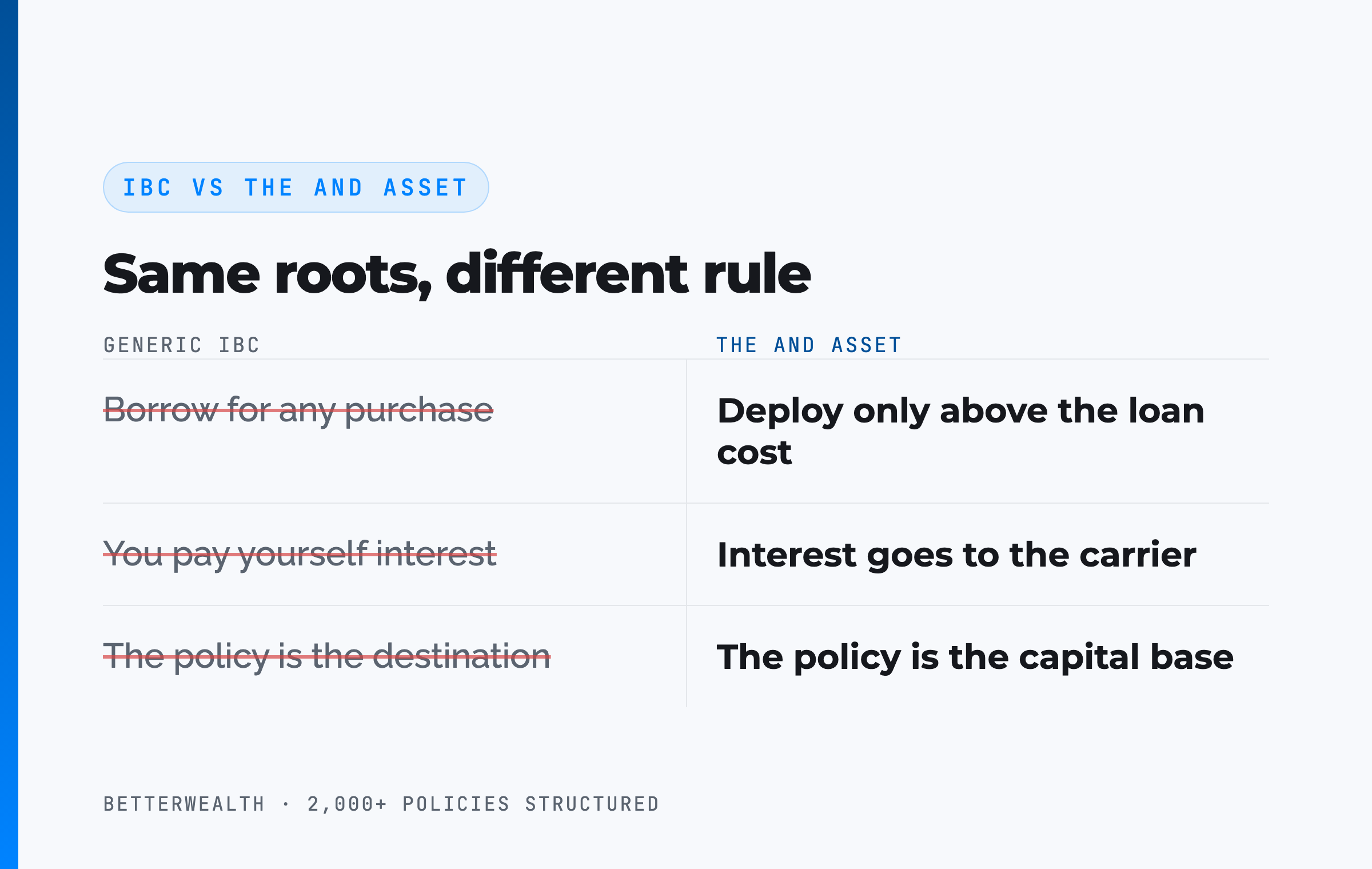
The And Asset is BetterWealth's framework for treating a properly structured whole life policy as a capital base rather than a destination. Nelson Nash, a forestry consultant and pilot with a background in Austrian economics, published Becoming Your Own Banker in 2000 and built the movement that made this mainstream. His core insight holds up: you finance everything you buy, either by paying interest to a lender or by giving up the interest those dollars would have earned. We credit that foundation in every piece we write on this topic.
IBC says a whole life policy can serve as a personal banking system for any purchase. The And Asset says you deploy capital from the policy only when the borrowed dollars will produce a return greater than the carrier's loan cost, because anything less is an expensive way to spend money. That threshold is the difference, and it is not a stylistic one. It changes who should own one of these and what they should do with it.
The second divergence is about where the interest goes. Many IBC marketers say you are paying yourself interest. You are not. The interest goes to the insurance company. Your return is what the deployed capital earns elsewhere while the policy keeps compounding at the dividend rate net of mortality and expense charges. Getting this wrong is not a rounding error. It is the entire basis of the objection that skeptics raise, and they are right to raise it against the version they were sold. If the framework itself is new to you, start with the pillar guide to infinite banking and The And Asset.
The And Asset shares roots with IBC and operates on different principles. It is a distinct framework built on Nash's foundation, not a rebrand of his work.
The discipline of repayment is the whole strategy.
06 / How it worksHow an And Asset policy works today, step by step
A modern And Asset policy runs on five mechanical steps, and each one exists because of a specific historical rule. The sequence matters more than the carrier logo on the contract.
- Structure for cash value. Minimize the base premium and load the paid-up additions rider as heavily as the tax rules allow. Major mutuals began offering paid-up additions as a dividend option in 1860, but the pivotal date is 1968, when Northwestern Mutual introduced the PUA rider. That was the first time an owner could fund above the base premium with their own cash to accelerate growth instead of waiting on a declared dividend. Design ratios get written with a slash, so a policy might run 25/75 or 40/60 base to PUA. The mechanics are in our breakdown of paid-up additions.
- Fund past the seven-pay line. Contribute for at least the first seven policy years without breaching the seven-pay premium limit created by TAMRA in 1988. Breach it and the contract becomes a Modified Endowment Contract, which keeps its death benefit but loses the ordinary tax treatment of distributions, with gains coming out first. The MEC limit is a genuinely critical constraint and the one number a designer cannot fudge.
- Let the early years capitalize. Cash value trails cumulative contributions in the early years of a healthy, well-designed policy. Break-even lands at year five or later. Non-forfeiture law is why that trailing reserve is your asset and not the company's, and any illustration showing you whole in year one or two is fiction.
- Borrow against the policy. Take a policy loan collateralized by cash value, under the loan provisions New York forced into insurance law in 1906. The cash value stays inside the contract, which is the structural feature that lets it keep compounding on its full value while you use the money. The carrier's recognition method determines how the dividend is treated on the borrowed portion.
- Deploy and repay. Put the borrowed capital into an activity that produces a return above the carrier's loan cost, then repay from the cash flow that activity generates. Walt Disney did exactly this in 1953 when his board and outside bankers refused to fund a theme park. Ray Kroc did it in 1955 to make payroll for his key people while McDonald's franchise fees ramped.
Nothing in that sequence is new. Steps three and four were law by 1906. Step one became possible in 1968. Step two became mandatory in 1988. The only thing The And Asset adds is the rule governing step five.
The history is interesting. The fit is the actual question.
It fits you if
- You already deploy capital and think in IRR
- You can name a use for borrowed dollars that beats the loan cost
- You have a funding horizon measured in decades
- You want capital access that a lender cannot revoke
It does not fit you if
- You are early in building wealth
- You are carrying high-interest debt and need a fast fix
- You want a savings account with better branding
- You have no specific plan for the borrowed capital
If you are in the first column, a 30-minute conversation will tell you whether the math works in your situation. If you are in the second, we will say so directly.
Book a Discovery Call07 / The mathDoes the deployed capital clear the loan rate?
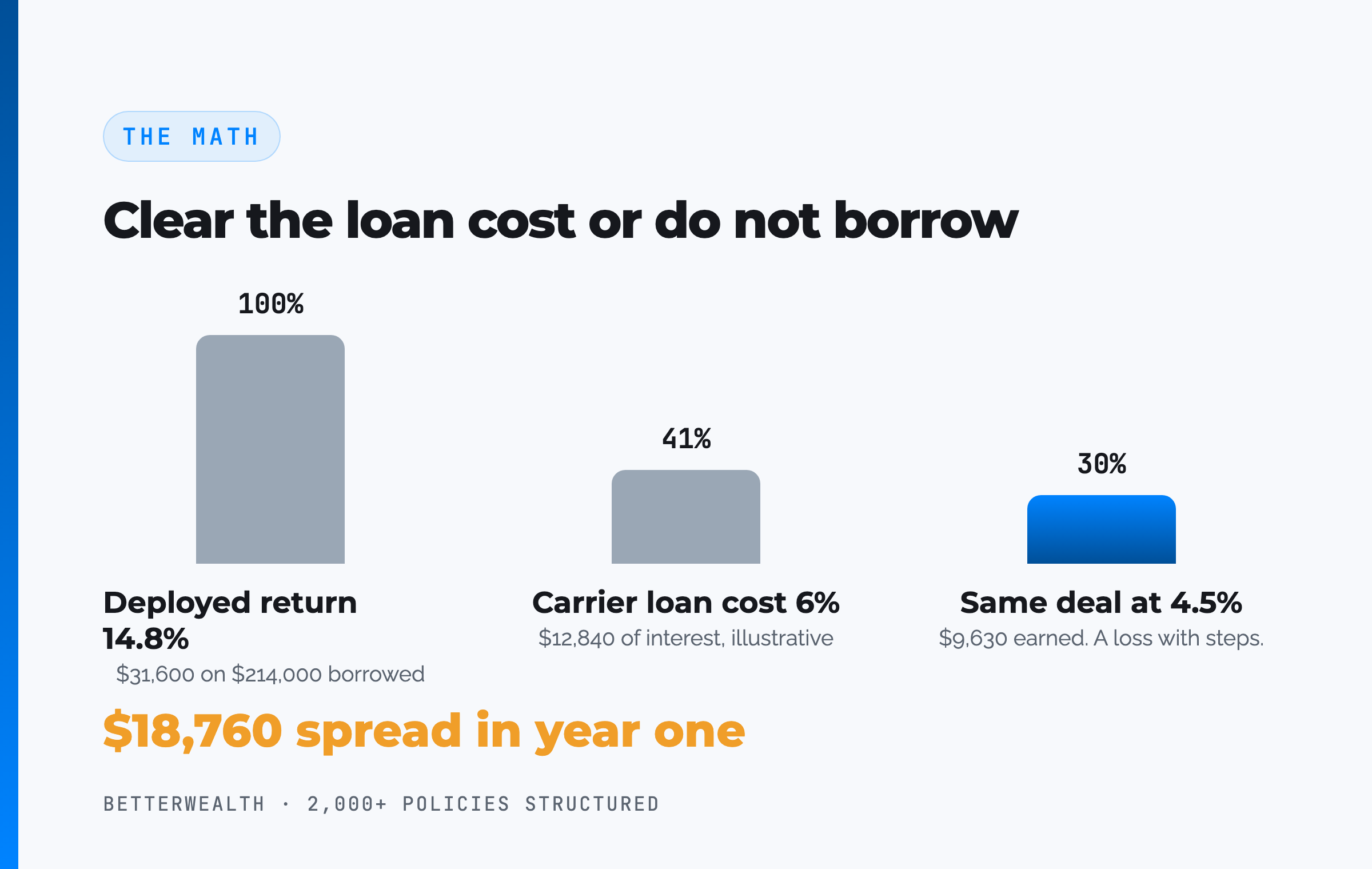
The return on whatever you deploy has to exceed the carrier's loan cost, and if it does not, you should not borrow. That single test governs the entire framework. Loan rates vary by carrier and by rate environment. At the time of writing many carriers sit in the 5 to 6% range, so treat any specific figure as a variable to verify with the carrier rather than a constant to plan around.
The structure of the decision is simple. You borrow at the carrier's rate. The policy keeps compounding on its full cash value net of internal costs, adjusted by whether the carrier uses direct or non-direct recognition. Your deployed capital earns its own return. If that return clears the loan cost, one dollar has done two jobs. If it does not, you have borrowed money to lose money on a delay.
This is also the honest answer to the 1979 objection. When inflation hit double digits and peaked at 14.8% in 1980, a guaranteed 4% inside a policy felt like watching your money melt, and the entire financial planning industry shifted from guarantees toward market exposure. The response was not to defend the 4%. The response is that the policy was never supposed to be the return. It is the capital base. The return comes from what you deploy into.
If the deal does not clear the loan rate, do not borrow.
A composite: the industrial deal funded at year nine
Consider a 43-year-old commercial real estate investor, preferred non-tobacco, funding an overfunded whole life policy at $63,400 per year on a level cashflow design. This is a representative composite drawn from patterns across our book, not a single named client.
The premium splits 25/75 base to paid-up additions: $15,850 of base premium and $47,550 into the PUA rider. Year one cash value comes in at $51,900 against $63,400 contributed. By year three, cumulative contributions total $190,200 and cash value sits at $171,800, still behind. That is what a real policy does. Any illustration showing break-even in year two is a sales document, not a contract.
Break-even arrives in year six, with $387,300 of cash value against $380,400 of cumulative premium. By year nine, cumulative contributions total $570,600 and accessible cash value reaches $611,700.
In year nine he borrows $214,000 against the policy to fund the equity slice of a small industrial building. At an illustrative loan cost of roughly 6%, that loan carries about $12,840 of interest in the first year. The building distributes $31,600 to him in its first year of ownership, a 14.8% cash-on-cash return on the deployed $214,000. The dollar spread in year one is $18,760 in his favor, and the policy's full cash value keeps compounding net of mortality and expense charges the entire time the loan is outstanding. He repays on a 43-month schedule funded by the building's own distributions.
Change one input and the whole thing inverts. If the building had returned 4.5%, he would have paid $12,840 to earn $9,630 and manufactured a loss with extra steps. The threshold is not a guideline.
One dollar. Two jobs. That is the And.
08 / The tax codeWhat the tax code actually says, and when it said it
Life insurance received its federal tax treatment in 1913 and had that treatment capped in 1984, and those two dates are constantly conflated. When the modern federal income tax was created by the Revenue Act of 1913, life insurance proceeds were specifically excluded from gross income, largely because of the asset's role as a private safety net for surviving families. That exclusion has been in the code ever since.
The Revenue Act of 1921 addressed the second question: what happens to growth that stays inside the contract. Congress determined that as long as the money remains in the policy, it is not constructively received by the owner and therefore is not currently taxed. Families could compound without an annual tax drag, which is why life insurance moved into trusts at scale. Assets held in life insurance inside trusts went from roughly $50 million in 1923 to over $2.5 billion by 1929.
1984 and 1988: the ceiling and the funnel
By the early 1980s, people were dropping large single premiums into policies to move money outside a taxable estate permanently. Congress responded with IRC Section 7702 in the Tax Reform Act of 1984, which defines what qualifies as life insurance for federal tax purposes. It establishes a required corridor between cash value and death benefit, which is why a policy's death benefit has to increase as cash value grows toward it. Under the cash value accumulation test, the cash value cannot exceed the net single premium needed to fund the future death benefit. In plain terms, Section 7702 sets how big the bucket can be. We go deeper on that in our Section 7702 breakdown.
Four years later, the Technical and Miscellaneous Revenue Act of 1988 answered the other half: how fast money can go into the bucket. TAMRA created the seven-pay test and the Modified Endowment Contract designation. Fund faster than the test allows and the contract becomes a MEC, keeping its death benefit but losing the ordinary tax treatment of distributions.
2021: the collision that got resolved
The 2021 change is the one almost nobody outside the industry knows about, and it is the reason today's designs are more efficient than the ones sold in 2015. State non-forfeiture law sets a minimum cash value carriers must provide, and that minimum rises as interest rates fall. Section 7702 set a maximum, and its language was pegged to a fixed 4%. When market rates collapsed toward zero in 2020, the state floor was rising while the federal ceiling stayed frozen, and the math pointed toward a year in which the minimum cash value required by the states would exceed the maximum allowed by the IRS. A policy would have been impossible to design as both legal to sell and tax-advantaged.
Congress updated the benchmark interest rates in the Section 7702 tests in 2021, replacing the fixed 4% with a floating rate initially set at 2%. Lower assumed growth means more cash value is required to fund the same future death benefit, which raised the ceiling and gave the floor room. The practical result for entrepreneurs is that more cash can sit behind the same death benefit without breaching the limit, so high cash value designs got measurably more efficient.
Section 7702 is not an ancient loophole. Congress wrote it in 1984 to put a ceiling on this contract. The favorable treatment is older than the code section that limits it, and both facts are worth stating accurately.
09 / The fallWhy did whole life fall out of favor after 1980?
Whole life fell out of favor because inflation made its guarantees look like a losing trade and because a very effective sales force spent two decades saying so. Inflation hit double digits in 1974, again in 1979, and peaked at 14.8% in 1980. Against that, a guaranteed 4% inside a policy felt like watching money melt.
Arthur L. Williams built the crusade. Motivated by the small payout from a whole life policy his father owned, he came to believe permanent insurance left families underinsured and cash-poor, and in 1977 he launched the buy-term-and-invest-the-difference sales force that became Primerica. The pitch was clean and had a real point inside it: for a family that needs $2,000,000 of protection and cannot fund a permanent contract, term is the honest answer. We laid out that comparison in whole life versus term.
The industry answered with product engineering rather than clarity. Universal life arrived in 1979 with adjustable death benefits and skippable premiums. Variable universal life followed in 1986, tying performance to market indexes. Indexed universal life came in 1997, promising market-linked gains with a floor. By 2015 the projections had gotten optimistic enough that the National Association of Insurance Commissioners issued Actuarial Guideline 49 to stop carriers from illustrating returns that were not going to happen.
Guarantees were traded for growth, certainty was traded for market exposure, and the contract became a maze. In that confusion, the thing whole life is genuinely good at got buried. Not the return. The control.
10 / The failure modeWhere people get this wrong
People get this wrong in three predictable ways, and marketers have ruined the way this should be explained. The first is the pay-yourself-interest claim. The interest on a policy loan goes to the carrier, and any agent who tells you otherwise either does not understand the contract or is hoping you will not check. The correct version is still compelling: your cash value keeps compounding on its full amount while the borrowed dollars go to work elsewhere.
The second is treating the policy as the investment. The historical record is unambiguous on this point. Walt Disney did not get rich on a dividend rate. He borrowed against cash value to buy land in Anaheim when the board and the bankers said no. J.C. Penney borrowed against his policies during the Depression to meet payroll and keep the company alive while his stock was worthless. In every case the policy was the source of capital and the deployment created the value.
The third is buying it without a use. If you cannot identify an activity that will outperform the loan cost, this is an expensive place to store money. We say that on the first call, and it costs us business. It is also the reason people trust the answer when we say the math does work.
You are not paying yourself interest. You are paying the insurance company. If that sentence changes how attractive this looks to you, you were sold the wrong version of it.
The frameworks behind 2,000+ policies, in one place.
The And Asset Vault holds the calculators, design frameworks, and structuring decisions we use when we build these policies, including the base and PUA split math and the deployment threshold. Free, email-gated, no spam.
Open the Vault11 / The tradeoffsWhat the history proves, and what it does not
The record proves durability and access, and it proves nothing about returns. Those are different claims and they get blurred constantly.
What it proves: the contract survives. Southern stock insurers went bankrupt after the Civil War because they held the losing government's debt, while the northern mutuals paid claims. More than 9,000 American banks failed between 1929 and 1933, and policyholders pulled roughly $3 billion out of their cash values in 1930s dollars while bank accounts sat frozen. Life insurance has kept its special status in the tax code through every rewrite since 1913. When access to capital disappears everywhere else, this contract has repeatedly stayed open.
What it does not prove: that the internal growth rate competes with equity markets over a long horizon. It does not. Anyone comparing a policy's dividend to the S&P is comparing the wrong two things, and the honest answer is that the policy is the capital base and the market is one of the places you might deploy from it.
The real tradeoffs are concrete. Early cash value trails contributions for the first several years, so this rewards patience and punishes short horizons. The funding commitment is real, and the seven-pay test means you cannot simply dump money in when convenient. The loan cost is a live number that you have to beat. And the strategy fails cleanly for anyone in high-interest debt looking for a fast fix, because this compounds advantages over years rather than solving a liquidity crunch this quarter.
Durable and accessible. Not high-yield. Know which one you are buying.
12 / Head to headThe same dollars, four different homes
Compared with the capital tools entrepreneurs actually use, an And Asset policy trades day-one liquidity and headline growth for control, tax treatment, and uninterrupted compounding. The table sets $63,400 a year against the three most common alternatives. Figures are illustrative for a healthy 43-year-old and vary by carrier, lender, and state.
| Dimension | And Asset whole life | Term plus brokerage | HELOC | High-yield savings |
|---|---|---|---|---|
| Annual cost or contribution | $63,400 premium, split 25/75 base to PUA. About $51,900 shows up as year-one cash value. | About $1,150/yr for $2,000,000 of 20-year term, leaving roughly $62,250 to invest. | $0 to hold in most cases, plus interest on any drawn balance at the lender's rate. | $63,400 deposited, no cost to hold. |
| Access to capital | Policy loan after the carrier's initial waiting period. Contractual, and the loan cannot be called. | Sell positions and settle in days, at whatever the market pays that week. | Fast once approved, but the line can be frozen or reduced by the lender. | Immediate, in full. |
| Growth while capital is deployed | Full cash value keeps compounding at the dividend rate net of mortality and expense charges, adjusted by the carrier's recognition method. | Sold shares stop compounding entirely. | None. A credit line is not an asset. | Withdrawn dollars stop earning. |
| Tax treatment | Death proceeds excluded from gross income. Policy loans are generally not taxable income while the contract stays in force and is not a MEC. | Capital gains and dividends taxed as realized. | Interest may be deductible in limited cases. | Interest taxed as ordinary income annually. |
| Who controls access | You do. You set the repayment schedule. | You do, though the market sets the price on the day you need cash. | The lender does, and can revoke. | You do, with no borrowing feature attached. |
Cost. Term plus brokerage puts far more capital to work in year one, and for someone who needs $2,000,000 of protection on a tight budget it is the right call. The comparison changes when the question shifts from protection to capital structure, because the brokerage dollars have to be sold to be used.
Access. A HELOC is faster on paper and it is also the tool that disappeared for thousands of investors in 2020 when lenders froze lines. The policy loan is a contractual right written into insurance law in 1906 and cannot be called. That difference only matters on the day it matters, which is exactly the day you cannot plan for.
Growth and control. The structural feature is that the cash value never leaves the contract when you borrow, so it keeps compounding on its full value. Selling shares or draining savings ends the compounding on those dollars. That is the mechanism behind the And, and no other tool on this table has it.
The honest 30 minutes about whether this fits you.
We have structured more than 2,000 policies across all 50 states. We have seen this strategy work exactly as designed, and we have seen it fail. On a discovery call, a practitioner looks at your situation, runs the numbers, and tells you honestly whether The And Asset belongs in your capital structure. We will tell you if it does not. No pressure, no pitch. If you would rather learn first, the The And Asset and BetterWealth YouTube channels go deep on the math.
Book a Discovery CallFAQHistory of life insurance questions
When was life insurance invented?
Organized death benefits date to Roman burial clubs called collegia, which formed around 300 BC and charged members roughly a month's wages to join plus small ongoing dues. Those clubs pooled risk without pricing it. Priced life insurance did not exist until mortality data arrived in the 1690s.
What is the oldest recorded life insurance policy?
The policy written on William Gibbons in 1583 is generally cited as the first recorded life insurance policy. Sixteen underwriters at the Royal Exchange in London accepted a premium of 30 pounds against a payout of 384 pounds if Gibbons died within the year. He did, the claim paid, and the courts had to get involved.
Who invented actuarial science?
Edmond Halley built the first life expectancy and mortality table in 1693 using death records from Breslau, which let insurers charge a 20-year-old less than a 60-year-old for the first time. James Dodson extended the work in 1756 by proving that level premiums require funded reserves, and that combination is the foundation of actuarial science.
When did mutual life insurance companies start in the United States?
The American mutual era began in the 1840s, when policyholders became the owners of the company instead of outside stockholders and received a share of surplus as dividends. New York Life was founded in 1841, Penn Mutual in 1847, MassMutual in 1851, Guardian in 1860, and OneAmerica in 1877.
How did cash value become the policyholder's property?
Non-forfeiture law made cash value the policyholder's asset, beginning with the Massachusetts statute of 1861 that Elizur Wright campaigned for. Before that, a lapsed policy meant the company kept the reserve. After it, the carrier had to convert the reserve into paid-up insurance, extended term coverage, or a surrender value.
What is IRC Section 7702 and when was it created?
IRC Section 7702 is the definition of life insurance for federal tax purposes, and Congress added it in the Tax Reform Act of 1984. It caps how much cash value a contract can hold relative to its death benefit, which is why a policy's death benefit has to increase as cash value grows toward it.
What is a MEC and when did the rules start?
A Modified Endowment Contract is a life insurance policy funded faster than the seven-pay test allows, and the designation was created by the Technical and Miscellaneous Revenue Act of 1988. A MEC keeps its death benefit but loses the ordinary tax treatment of distributions, with gains coming out first.
When were paid-up additions invented?
Major mutual carriers began offering paid-up additions as a dividend option in 1860, and Northwestern Mutual introduced the paid-up additions rider in 1968. The 1968 rider is the pivotal date, because it was the first time an owner could fund above the base premium with their own cash to accelerate cash value.
What is The And Asset?
The And Asset is BetterWealth's framework for using a properly structured whole life policy as a capital base. You only borrow against it for an activity that produces a return greater than the carrier's loan cost, so your dollars do two jobs at once: the policy keeps compounding net of mortality and expense charges while the deployed capital earns its own return.
How is The And Asset different from infinite banking?
Infinite banking, as Nelson Nash taught it in Becoming Your Own Banker, frames a whole life policy as a personal banking system for any purchase. The And Asset adds a threshold: you deploy borrowed capital only when the return clears the carrier's loan cost. The policy is the capital base, not the destination. It shares roots with IBC but operates on different principles.
Did Walt Disney really use life insurance to fund Disneyland?
Yes. When his own board and outside bankers refused to fund the park, Walt Disney borrowed against the cash value of his life insurance policies to help buy and develop the Anaheim land in 1953. Ray Kroc did something similar in 1955, borrowing against two policies to make payroll for his key people while McDonald's franchise fees were still ramping.
Why is life insurance treated favorably in the federal tax code?
Because of its role as a private safety net for surviving families, life insurance received specific treatment as soon as the modern income tax arrived. The Revenue Act of 1913 excluded death proceeds from gross income, and the Revenue Act of 1921 clarified that growth left inside the contract is not constructively received and therefore not currently taxed.
What changed with Section 7702 in 2021?
Congress replaced the fixed 4% benchmark interest rate in the Section 7702 tests with a floating rate, initially set at 2%. Lower assumed growth means more cash value is required to fund the same future death benefit, so more cash can sit behind the same death benefit without breaching the federal ceiling. Overfunded designs became more efficient as a result.
Is whole life insurance outdated?
No, though it is frequently mis-sold, which is a different problem. The contract has survived the Civil War, the Great Depression, double-digit inflation, and four decades of buy-term-and-invest-the-difference marketing. It is the wrong tool for someone in early wealth-building, in high-interest debt, or without a productive use for borrowed capital.
The history of life insurance is a 2,300-year record of people solving the same problem with better and better tools. Roman tradesmen pooled dues so their families would not be erased. Italian merchants invented risk pricing to move capital across water. English mathematicians made death calculable. American regulators forced the reserve into the policyholder's hands. Congress granted the tax treatment and then drew the lines around it. Today's contract is the accumulated output of all of it.
What you do with it is still the open question, and the answer has not changed since Nash wrote it down. Only borrow when the deployed capital beats the loan cost. Everything else is history.
- Nelson Nash, Becoming Your Own Banker. The origin of the infinite banking concept and the foundation The And Asset builds on.
- IRC Section 7702 (Cornell Law). The statutory definition of life insurance for federal tax purposes, added in 1984.
- IRC Section 7702A (Cornell Law). The seven-pay test and the Modified Endowment Contract rules created in 1988.
- IRC Section 101 (Cornell Law). The exclusion of life insurance death proceeds from gross income.
- Philosophical Transactions of the Royal Society. Where Edmond Halley published the 1693 Breslau mortality table.
- LIMRA. Life insurance industry data, ownership rates, and persistency benchmarks.
- National Association of Insurance Commissioners. Actuarial Guideline 49 and state non-forfeiture standards.
- BetterWealth resources: The And Asset book, the The And Asset YouTube channel, and the BetterWealth YouTube channel.
I founded BetterWealth to treat life insurance as the wealth and capital tool it actually is, not the product most people get sold. Our team has structured more than 2,000 policies across all 50 states. I wrote The And Asset and host the BetterWealth and The And Asset YouTube channels. If you want an honest read on whether this belongs in your capital structure, book a discovery call. We will tell you if it does not.