
Became a life insurance agent the Monday after his college graduation, trained in macroeconomics and protection through LEAP Systems, and built Currents, a cash flow platform that connects households with their financial professionals.
A cash flow strategy for high-income earners controls the gap between income and spending, rather than chasing a higher rate of return. Routing every paycheck into a separate reservoir account and growing lifestyle spending at half the rate of income can roughly quadruple 30-year retained wealth without adding investment risk.
Most financial advice aimed at high-income earners concentrates on the wrong variable. Advisors compete on rate of return, insurance illustrations compete on dividend scales, and budgeting apps compete on how precisely they can report last month's spending. None of them addresses the variable that decides how much capital a household keeps: the gap between what comes in and what goes out, and how that gap behaves as income rises.
For most high-income earners, controlling how fast spending grows relative to income produces more 30-year wealth than any realistic increase in investment return. In a model walked through by Dave Mozeika, creator of the cash flow platform Currents, a household with $120,000 of net income that slows its lifestyle growth from 3% to 1.5% a year keeps roughly four times the capital it would have kept otherwise. That is about two and a half times what the same household would keep by earning 9% instead of 6%. No added risk. No lower standard of living today.
The capital that structure produces still needs a job. At BetterWealth, we have structured more than 2,000 whole life policies, and the households that get the most from them share one trait: they run their cash flow on purpose before they fund a policy. The And Asset, our framework for using a properly structured whole life policy as a capital base, sits downstream of that discipline.
What follows covers where a high earner's capital leaks, the three-scenario math that shows why return is the smallest lever, how a cash flow reservoir separates spending from income, how The And Asset decides when captured capital gets deployed, and the real tradeoffs of taking policy dividends in cash.
- Most earners do not have a savings rate problem. They have a flow of funds problem, because spending tracks income.
- At $120,000 of net income rising 3% a year and a 6% return, about $13.7 million flows through a household in 30 years.
- Earning 9% instead of 6% for 30 straight years adds only about $450,000 for a household saving 5%.
- Growing lifestyle spending 1.5% a year instead of 3% lifts 30-year retained wealth from about $684,000 to $2.8 million.
- The And Asset deploys captured capital through a policy loan only when the funded activity out-earns the carrier's loan cost.
- Taking whole life dividends in cash gives up internal compounding, so it only makes sense when that dollar has a better job.
The full conversation includes Dave's hand-drawn walkthrough of inflows, outflows, and capital flows, plus the unscripted moment where he and Caleb work through the dividend tax basis question in real time.
01 / The problemWhy do high earners with rising incomes keep so little of it?
High earners keep little because their spending is wired to their income, so each raise is absorbed by lifestyle before it becomes capital. Dave Mozeika started selling life insurance the Monday after he graduated from college and later built Currents to fix this exact pattern. He cites research putting the U.S. saving rate near 4% of income, and he treats that number as a symptom, not the disease.
"Americans don't have a savings rate problem. What we found is they have a flow of funds problem."
The flow of funds problem starts with where income lands. Most households send every paycheck to checking, and checking is an expense account. It exists to pay bills and fund daily life. When new money arrives in the account built for spending, spending rises to meet it. Some call this a money version of Parkinson's law: lifestyle expands to fill the capital available. Most people just call it lifestyle creep.
The paycheck is under heavy pressure before it lands. Earned income is taxed at ordinary rates, which top out at 37% federally, and it carries payroll tax on top. Then come health premiums, voluntary benefits, and retirement plan contributions. Dave is careful here. A 401(k) contribution is not a mistake, but it reduces present cash flow, and it may not be the first place every dollar belongs. What remains covers housing, fixed costs, and the variable expenses of a family.
Consumer finance technology widens the leak. Nearly every recent advance makes spending easier, down to installment plans on a food delivery order. Very little of it helps a household keep capital for later.
Money leaves by default. Keeping it takes structure.
02 / The mathHow much wealth flows through a $120,000 income over 30 years?
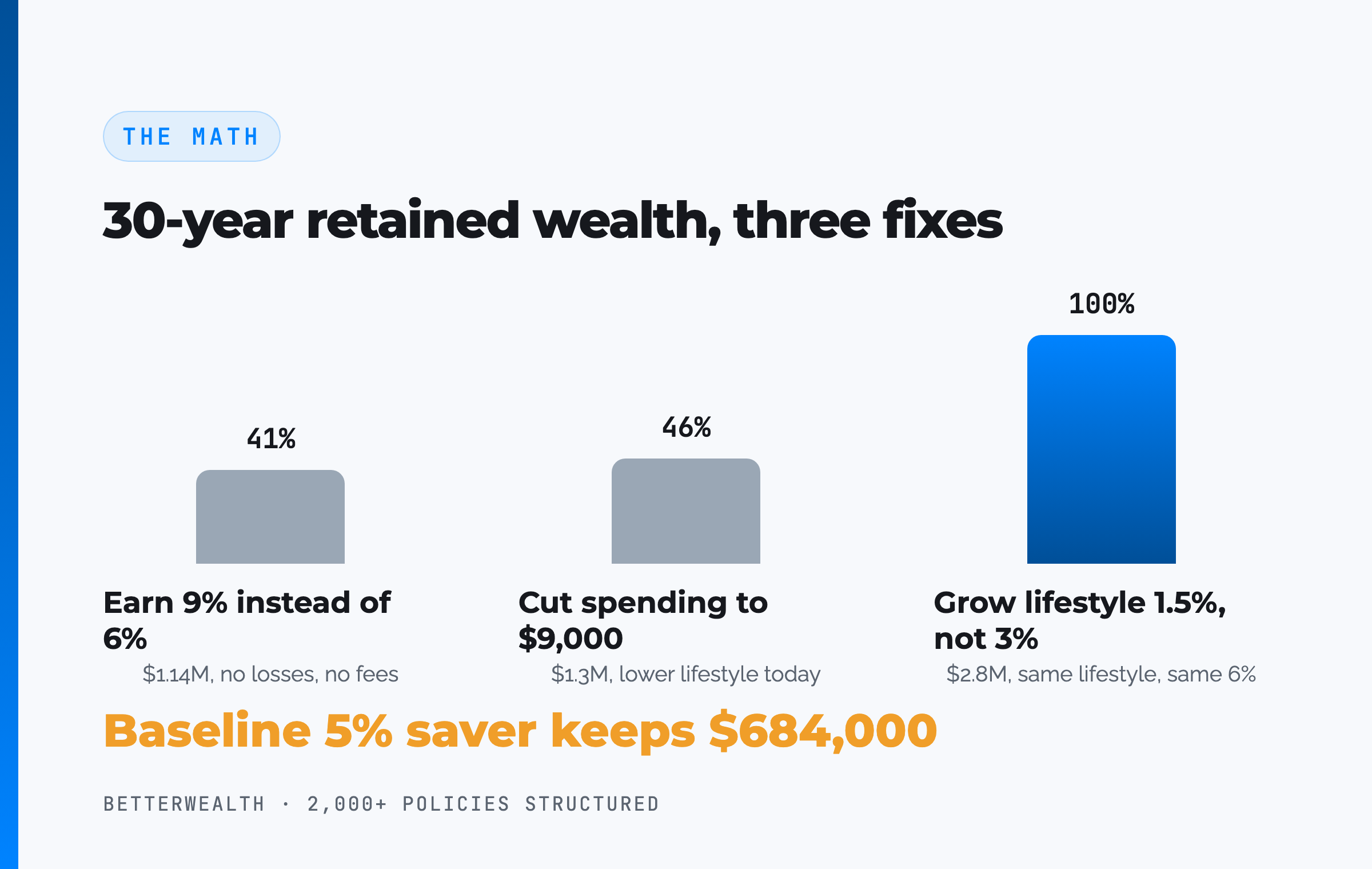
About $13.7 million flows through a household earning $120,000 a year over 30 years in the model Dave walks through, and a typical saver keeps about 5% of it. The assumptions are deliberately ordinary: $10,000 a month of net income, 3% annual raises, and a 6% return on whatever the household keeps. The $13.7 million figure is the full income stream compounded at that rate. It is the wealth the household stewards, whether it keeps it or not.
A household saving 5%, spending $9,500 of every $10,000, retains about $684,000 after 30 years. That savings rate is above the national average. It is also a modest sum three decades from now, once inflation has worked on it. Against that baseline, the financial industry offers two standard fixes.
Fix one: the rate of return chase
The first fix is a better product with a higher return. Dave modeled the same 5% saver earning 9% instead of 6%, every year for 30 years, with no losses, no fees, and no down years. Caleb's reaction on camera was that modeling a return like that for a client would border on malpractice. Even granting the assumption, retained wealth rises from about $684,000 to about $1.14 million.
A 50% increase in return, held for three decades without a single loss, buys roughly $450,000. The risk required to pursue 9% is real, and the model assumes none of it ever shows up.
Return is the smallest lever in the model.
Fix two: the budget
The second fix is spending less. If the household cuts from $9,500 to $9,000 a month, it doubles its savings rate and retains about $1.3 million. Getting there means deciding what goes: the vacation, the childcare arrangement, the things a family has built its routine around. Budgeting also runs on backward-looking data. Most apps report last month's spending after it already happened, which turns money management into a monthly review of regret.
Fix three: unconscious savings
Dave's alternative changes one input. The household keeps its $9,500 lifestyle and its 6% return. The only change is that lifestyle costs grow 1.5% a year instead of 3%. Income still rises 3%. Spending still rises every year. It simply stops rising in lockstep with pay.
The result is about $2.8 million, roughly four times the baseline and about two and a half times the 9% scenario. Lifestyle spending still climbs from $114,000 in year one to about $175,600 in year 30, a 54% increase. For many households, part of that slower growth is already built in. Dave's largest outflow is a mortgage payment that stays the same for the next 24 years, so the rest of his spending can rise faster than 1.5% while his total spending still grows slower than his income.
Same life today. Four times the capital later.
The rate of return is not the problem. People take on risk they do not need because they are trying to out-earn a cash flow structure that was never built.
03 / The frameworkWhat does The And Asset add to a cash flow strategy?
The And Asset adds a deployment rule to the capital a cash flow strategy captures: that capital builds inside a properly structured whole life policy, and it only leaves as a policy loan when the activity it funds out-earns the carrier's loan cost. A reservoir decides how much capital you create. The And Asset decides what that capital is allowed to do.
Dave describes three movements of money. Inflows are new dollars that did not exist before, such as paychecks, bonuses, distributions, and interest. Outflows are dollars that leave and never come back, which covers every lifestyle cost. Capital flows are the choices you make with what remains: funding a business, buying real estate, moving money into a brokerage account, or paying premiums on permanent life insurance. The space between inflows and outflows is the only place capital gets created.
From that gap, Dave builds what he calls cash flow engines. These are assets that produce income beyond what your labor earns, ideally taxed more efficiently than a paycheck. Each engine's income flows back into the reservoir, which widens the gap, which funds the next engine. He calls the result compound cash flow.
"I care more about compound cash flow than I do about compound interest."
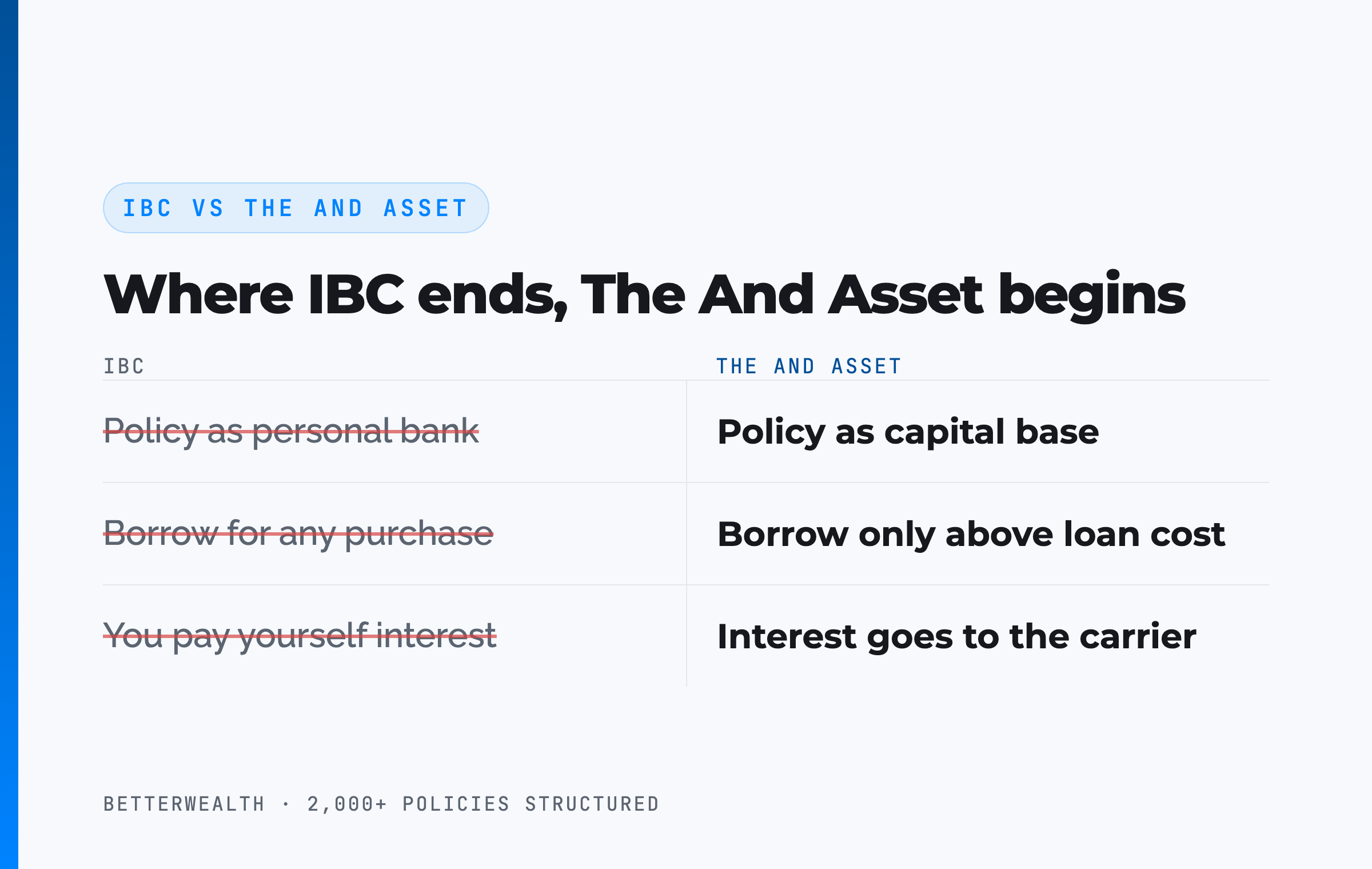
Where IBC ends and The And Asset begins
Nelson Nash pioneered the idea of using whole life insurance as a personal banking system in Becoming Your Own Banker. His insight holds: you either lose money paying interest to outside lenders, or you lose it to the opportunity cost of capital sitting idle. We credit that foundation. The And Asset shares roots with IBC but operates on different principles.
IBC says to run your purchases through the policy as a personal bank. The And Asset says only deploy capital from the policy when the borrowed dollars will out-earn the carrier's loan cost, because anything less is an expensive way to spend money. IBC content often frames whole life as the destination. The And Asset frames the policy as the capital base, and the value gets created in what that capital is deployed into. Dave's question to his clients, spend this money or build another engine, is the question The And Asset asks before every policy loan, with a hard test attached: does the engine beat the loan rate?
The interest point matters too. Many IBC marketers tell you that you pay yourself interest. You do not. Policy loan interest goes to the carrier. Your return is what the deployed capital earns elsewhere while the policy keeps compounding, net of mortality and expense charges. For the full framework, start with What Is Infinite Banking? The And Asset Guide.
The policy is the base. The engine is the return.
04 / How it worksHow to build a cash flow reservoir that feeds The And Asset
A cash flow reservoir works by receiving all income first and releasing only a set spending baseline to checking, which separates what you earn from what you spend. Dave built Currents to automate this and give households and their advisors the same live metrics, but the structure is what produces the result. Here is the sequence.
- Map your three flows. List every inflow (paychecks, distributions, bonuses, interest), every outflow (lifestyle costs that leave and never return), and every capital flow (money moved into assets such as a business, real estate, a brokerage account, or permanent life insurance).
- Open a reservoir account. Open a separate account that receives all income before any money reaches checking, and redirect paychecks and business distributions into it.
- Set a spending baseline. Connect the reservoir to checking and send checking a fixed monthly spending baseline, so spending no longer rises automatically with income.
- Set a target balance. Choose the balance the reservoir should always hold as part of your emergency funds. Only money above that balance is available for a decision.
- Grow the baseline slower than income. Raise the spending baseline on purpose and at a slower rate than income, such as 1.5% a year against 3% income growth.
- Deploy surplus through The And Asset test. Sweep surplus above the target balance into capital flows such as a properly structured whole life policy. Borrow against the policy only for an engine whose return clears the carrier's loan cost, and route that engine's cash flow back into the reservoir.
The moment income lands in the reservoir instead of checking, every future raise defaults to capital. You can still spend it. You just have to choose to.
The target balance and the spend-or-build decision
The target balance is the number that lets the system run without constant attention. Money below it is reserve. Money above it triggers one conversation, which Dave frames the same way every time: spend this, or build another engine? Choose the engine, and its income flows back into the reservoir, so the next surplus arrives sooner. Choose to spend, and you do it consciously, with the rest of your capital untouched. Dave describes each new engine as shifting the household into a higher gear, with capital showing up faster each cycle.
Caleb described the effect in his own household after a year-end business distribution that was large relative to what the family lives on. Spending did not change, apart from two deliberate one-time decisions. He also became less controlling about day-to-day money, because a checking account that runs down to zero each month stops being alarming when capital sits elsewhere. The household lives on a set amount without the stress of actually living paycheck to paycheck.
Every raise defaults to capital unless you decide otherwise.
The And Asset fits a specific person doing specific things with capital.
It fits you if
- Your income is rising faster than you want your lifestyle to
- You deploy capital into a business, real estate, or other engines
- You can name a use for capital that beats the loan cost
- You have a capital horizon of 10 years or more
It does not fit you if
- You need a fix for high-interest debt right now
- You want a savings account alternative
- You need every dollar liquid in year one
- You cannot identify a productive use for borrowed dollars
If you are in the first column, a 30-minute conversation will show whether your cash flow is ready for a policy and how it should be designed. If you are in the second, we will tell you that too.
Book a Discovery Call05 / The math that decides itDoes the engine's return clear the loan cost?
The return on any engine you fund with a policy loan must exceed the carrier's loan cost, or you should not borrow. Loan rates vary by carrier and rate environment. At the time of writing many carriers fall in the 5 to 6% range, but treat any specific number as a variable to verify with the carrier, not a constant.
The structure of the decision is simple. You borrow against the policy at the carrier's rate. The policy keeps compounding on its cash value, net of mortality and expense charges and subject to how the carrier treats loaned values in its dividend calculation. The engine earns its own return. If that return beats the loan cost, the same dollar is doing two jobs. If it does not, you have borrowed money to lose money slowly. Our breakdown of how soon you can borrow against whole life covers when that capital becomes available.
Tax drag is part of the return
Dave evaluates engines on after-tax cash flow, not headline yield, and that is the right lens. Wages are taxed at ordinary rates. Business owners deduct ordinary and necessary expenses before taxable income is calculated. Real estate investors can shelter much of their rental income through depreciation, and a 1031 exchange can defer the gain on a sale. Qualified dividends and long-term capital gains carry lower rates than wages, and municipal bond interest is generally exempt from federal income tax.
Permanent life insurance has its own treatment under Section 7702. Dividends are generally not taxable while they stay below the premiums you have paid, and policy loans are not taxable income while the policy stays in force and is not a modified endowment contract. That treatment has conditions. A policy that lapses with a loan outstanding can create a taxable gain, which is one more reason the discipline of repayment is the whole strategy.
If the engine does not clear the loan rate, do not borrow.
06 / DividendsShould you take whole life dividends in cash or buy paid-up additions?
Buy paid-up additions when you want the dollar to keep compounding inside the policy, and take dividends in cash only when that dollar has a specific job outside the policy worth more than the growth you give up. Most of the policies we structure default dividends into paid-up additions, which add cash value close to dollar for dollar and raise the base that future dividends are paid on.
Dave argues the other side, and his case is about utility. A dividend is the policy's earnings, and your money has many jobs. Sending every dividend back into more paid-up coverage is a choice, not a rule. If the dividend can seed an engine that produces income, he would rather do that and buy more coverage later while he remains insurable.
His example is a young couple, a teacher and a police officer, whose incomes climbed quickly through step raises. They prioritized permanent life insurance as their cash flow grew. Years later their extended family outgrew a shared ski condo in Vermont, and a condo of their own cost around $150,000. They had about $78,000 in dividends. Dave redirected those dividends into the couple's reservoir to help finance the purchase. When the family is not using the condo, it rents, and the rent flows back into the reservoir, where it can return to the policy or fund another engine.
The tradeoff nobody mentions
Taking dividends in cash removes those dollars from the policy for good, which lowers the cash value base that future dividends are paid on. A policy loan is the third path. It leaves cash value in place to keep compounding, but it carries interest owed to the carrier and a repayment obligation. The And Asset test decides between them: which path leaves you with more once the engine's return and the lost internal growth are both measured against the cost of the capital?
The conversation also raised a tax basis question: whether dividends applied to paid-up additions inside the policy affect your cost basis differently from dividends paid to you in cash and then contributed back as premium. Caleb flagged it as unresolved on camera, and we are not going to guess. Confirm the treatment with a CPA before you choose a dividend option for tax reasons.
Every dividend option is a decision about where the dollar works next.
Term is an expense. Permanent coverage is a capital flow.
Dave draws a clean line between the two. Term premiums protect income for a period and then they are gone, so they count as outflows paid from checking. Premiums on permanent coverage that builds cash value are capital flows. Many households sensibly start with term to protect income early, then convert or add permanent coverage as cash flow improves. Our comparison of whole life vs term insurance runs the numbers.
His case for permanent coverage is about redundancy. A lawsuit, a disability, a premature death, a tax law change, or a rate shock can each slow the velocity of a household's cash flow. Permanent life insurance hedges several of those at once. The death benefit replaces income, cash value does not move with the stock market, and depending on state law, cash value may carry some protection from creditors.
"This is all about redundancy first and then velocity second."
The frameworks behind 2,000+ policies, in one place.
The And Asset Vault holds the calculators, design frameworks, and structuring decisions we use when we decide whether a household's cash flow is ready for a policy and how that policy should be built. Free, email-gated, no spam.
Open the Vault07 / Where it goes wrongWhere does the marketing get this wrong?
The marketing gets it wrong by selling the product before the structure. Dave calls the dominant pitch the sales and marketing solution: my product beats your product because it earns more. The three-scenario math shows why that pitch is weak. A household that cannot hold the gap between income and spending will not be rescued by three extra points of return, and it will take on risk trying.
Whole life marketing has its own version of the same mistake. Agents compare dividend scales as if the highest number wins, quote gross dividend rates as if they were growth rates, and tell prospects they will pay themselves interest. Cash value grows at the dividend net of mortality and expense charges. Loan interest goes to the carrier. A policy funded by a household with no control over its spending becomes an expensive savings account.
The other mistake is universality. Whole life is a strong capital base for the right person. It is not required for everyone, and a policy cannot create discipline that does not already exist. Dave's own summary of Currents applies here: it is a structural solution, not a product solution. The And Asset works the same way. It is not a product. It is a strategy.
You are not paying yourself interest. You are paying the carrier. Your return comes from what the borrowed capital earns, and if it cannot beat the loan cost, the loan should not happen.
08 / The tradeoffsBenefits and the real tradeoffs
The benefit is capital that accumulates without added investment risk and without cutting today's lifestyle. The tradeoffs are just as concrete, and a few of them disqualify some households.
First, the model is a model. It assumes a steady 6% return and steady 3% raises, and it ignores taxes on growth and the effect of inflation. Real incomes jump and stall, and business income is lumpy. The direction of the result holds up. The exact dollar figures will not.
Second, the whole life layer is slow early. Cash value runs below cumulative premiums through the first several years and typically crosses break-even around year 5 for a healthy insured. A household that needs every dollar liquid in year one should build the reservoir first and the policy second. Our guide to how whole life cash value works shows the realistic timeline.
Third, borrowing has a cost. The carrier's loan rate is real, and depending on the carrier's recognition method, loaned cash value may be credited differently from unloaned value. Dividends are declared annually and are not guaranteed. A loan that grows past the cash value can lapse the policy.
Fourth, the hardest part is the household. A spending baseline only works if everyone living on it agrees to it. Caleb admitted on camera that the conversation about raising the baseline, even by 1%, is the one he needs to get better at.
The structure is simple. Living inside it is the work.
09 / The fitHow does a cash flow strategy for high-income earners fit a broader capital plan?
A cash flow strategy for high-income earners sits at the entry point of the personal balance sheet, ahead of every other account, and it coordinates those accounts rather than replacing them. Retirement plans, brokerage accounts, real estate, a business, and a whole life policy all keep their jobs. The reservoir decides the order in which dollars reach them.
It also reshapes emergency funds. Dave treats the reservoir's target balance as one part of his emergency funds, alongside other bank accounts and life insurance cash value. That layering only works once a policy has built accessible value, which is why a new policy should not be anyone's only reserve. For the high-income earner who has already filled tax-advantaged accounts and wants more control over capital, the combination is direct: the reservoir creates capital on purpose, and The And Asset holds it as a base until an engine clears the loan rate.
Real estate shows how the pieces connect. Dave's rule is redundancy before velocity, so a property should not depend on a tenant to make its payment. If policy dividends or reservoir surplus can carry the mortgage, rental income becomes additional cash flow rather than the thing holding the deal together.
10 / Head to headChasing returns vs budgeting vs controlling the gap
Side by side, the four approaches differ most in what they demand from you and how much capital they leave behind. Figures use the model from the source conversation: $120,000 of net income rising 3% a year, a 5% starting savings rate, and a 6% return unless noted.
| Dimension | Rate of return chase | Budgeting | Unconscious savings | Unconscious savings + The And Asset |
|---|---|---|---|---|
| 30-year retained wealth | $1.14M (9% every year) | $1.3M | $2.8M | $2.8M modeled base, plus any spread earned on deployed capital |
| Year-1 monthly lifestyle | $9,500 | $9,000 | $9,500 | $9,500 |
| Year-30 annual lifestyle | $268,600 | $254,500 | $175,600 | $175,600, with loan interest paid from engine cash flow |
| Added investment risk | High: assumes 9% with no losses | None | None | Engine risk only, taken only when the return clears the loan cost |
| What it demands | Accepting market risk and hoping the return arrives | Cutting today's lifestyle and tracking every transaction | A reservoir account and a slower-growing baseline | The same discipline, plus a policy loan only when the spread is positive |
Retained wealth. The rate chase and the budget both land between $1.1 million and $1.3 million, while slowing lifestyle growth reaches $2.8 million. Layering The And Asset on top does not change the modeled base. It adds whatever spread the deployed capital earns above the loan cost.
Year-one lifestyle. Budgeting is the only approach that asks the household to live on less today, $500 a month less in this model. The other three keep the $9,500 lifestyle intact from the first month.
Year-30 lifestyle. The 3% path ends near $268,600 a year in spending, which is why so little is left. The 1.5% path still grows lifestyle to $175,600, a 54% raise in living standard over three decades.
Risk. Only the rate chase adds market risk to the whole balance sheet. The And Asset adds risk only at the engine level, and only when the engine clears the carrier's loan cost.
Demands. The budget asks for daily vigilance. The reservoir asks for one structural decision and a periodic conversation about the surplus.
A composite: the household that built its first engine in year seven
Consider a 43-year-old business owner and spouse, both preferred non-tobacco, with household net income of $26,000 a month. This is a representative composite, not a single named client.
They route all income into a reservoir, set a spending baseline of $21,400 a month, and hold a target balance of $64,200, three months of baseline. That leaves $4,600 a month of surplus in year one, or $55,200 a year, and the surplus widens as income grows faster than the baseline. From it they fund a whole life policy at $38,000 a year with a 35/65 base/PUA split: $13,300 of base premium and $24,700 of paid-up additions.
Cash value trails contributions early, as a real policy should. It sits at $27,900 after year one against $38,000 paid, and at $147,600 after year four against $152,000 paid. At year five it reaches $191,300 against $190,000 paid. No earlier.
By year seven, with $294,300 of cash value against $266,000 paid, they find an engine: a $389,000 duplex. They borrow $113,500 against the policy to cover the 25% down payment of $97,250 plus $16,250 of closing and make-ready costs. After the mortgage, property taxes, insurance, vacancy, and reserves, the duplex nets $14,730 a year, a 13% cash-on-cash return. Including principal paydown and modest appreciation, the estimated IRR is 14.3%.
At an illustrative 5.5% loan rate, the loan costs $6,243 in its first year, which leaves a first-year cash spread of $8,487. They repay $1,977.50 a month, funded by the duplex's $14,730 of net cash flow plus $9,000 a year of reservoir surplus, which retires the loan on a 67-month schedule. Meanwhile the policy keeps compounding on its cash value, subject to the carrier's recognition method, and the rent keeps arriving after the loan is gone.
One dollar. Two jobs. That is the And.
An honest 30 minutes on whether your cash flow is ready for this.
We have structured more than 2,000 policies. We have seen this strategy work exactly as designed, and we have seen it fail when there was no plan for the capital. On a discovery call, we look at your cash flow, run the numbers, and tell you whether The And Asset belongs in your plan. We will give you the honest answer either way. No pressure, no pitch. If you would rather learn first, The And Asset and BetterWealth YouTube channels go deep on the math.
Book a Discovery CallFAQCash flow strategy questions
What is a cash flow strategy for high-income earners?
A cash flow strategy for high-income earners is a structure that controls the gap between income and spending so that raises become capital instead of lifestyle. It routes all income into a separate reservoir account and deploys the surplus above a set spending baseline into assets that produce more cash flow.
What is a cash flow reservoir account?
A cash flow reservoir account is a separate account that receives every paycheck or business distribution before any money reaches checking. It feeds checking a set spending baseline, holds a target balance as part of your emergency funds, and flags any surplus above that balance for a decision: spend it, or build an asset that produces cash flow.
How do you stop lifestyle creep without a strict budget?
You stop lifestyle creep by separating income from spending and growing your spending baseline slower than your income, rather than cutting what you spend today. In the model Dave Mozeika walks through, letting lifestyle costs rise 1.5% a year instead of 3% lifts 30-year retained wealth from about $684,000 to about $2.8 million at the same 6% return.
Does a higher rate of return fix a low savings rate?
A higher rate of return does far less than most people expect when the savings rate stays low. In the same model, earning 9% instead of 6% every year for 30 years, with no losses and no fees, raises retained wealth from about $684,000 to about $1.14 million, while slowing lifestyle growth reaches about $2.8 million with no added investment risk.
What is compound cash flow?
Compound cash flow is the practice of capturing surplus cash, deploying it into an asset that produces additional income, and routing that income back into the reservoir so the next surplus is larger. Compound interest grows one balance in one account, while compound cash flow adds income streams over time.
What is The And Asset?
The And Asset is BetterWealth's framework for using a properly structured whole life policy as a capital base. You only borrow against it for an activity that produces a return greater than the carrier's loan cost, so your dollars do two jobs at once: the policy keeps compounding, net of mortality and expense charges, while the deployed capital earns its own return.
How is The And Asset different from infinite banking?
Infinite banking, as Nelson Nash taught it, frames a whole life policy as a personal banking system you can use for any purchase. The And Asset shares those roots but operates on different principles: you only deploy borrowed capital when the return clears the carrier's loan cost, and the policy is the capital base, not the destination.
Should you take whole life dividends in cash or use them to buy paid-up additions?
Use dividends to buy paid-up additions when you want the dollar to keep compounding inside the policy, and take them in cash only when that dollar has a specific job outside the policy that justifies giving up the internal growth. A policy loan is a third option that leaves cash value in place but carries interest owed to the carrier.
Are whole life insurance dividends taxable?
Whole life dividends are generally not taxable income as long as total dividends received do not exceed the premiums you have paid, because the IRS treats them as a return of premium. Dividends above that amount, or distributions from a policy classified as a modified endowment contract, can be taxable, so confirm your situation with a tax professional.
Is term life insurance an expense or a capital flow?
Term life insurance is an expense: the premium protects income for a set period and does not build cash value you can later deploy. Permanent life insurance premiums that build cash value are a capital flow, which is why many households start with term to protect income and convert or add permanent coverage as cash flow improves.
Can whole life cash value be part of your emergency funds?
Whole life cash value can be one layer of your emergency funds once the policy has built accessible value, alongside bank reserves such as a reservoir target balance. Cash value runs below cumulative premiums until roughly year 5 for a healthy insured, so a new policy should not be your only reserve.
Who is this strategy not for?
The whole life layer of this strategy is not for anyone who cannot name an activity that out-earns the carrier's loan cost, and it is not a fix for high-interest debt. The reservoir discipline helps almost any earner, while the policy fits entrepreneurs, business owners, and high-income earners with a long horizon and a clear use for capital.
- Nelson Nash, Becoming Your Own Banker: the origin of the infinite banking concept.
- U.S. Bureau of Economic Analysis, Personal Saving Rate: the national data behind the savings rate discussion.
- IRS Publication 525, Taxable and Nontaxable Income: the treatment of life insurance dividends as a return of premium.
- IRC Section 7702 (Cornell Law): the definition of life insurance behind the tax treatment of cash value and policy loans.
- IRC Section 7702A (Cornell Law): the modified endowment contract rules that change how distributions are taxed.
- BetterWealth resources: The And Asset book, the The And Asset YouTube channel, and the BetterWealth YouTube channel.
I founded BetterWealth to treat life insurance as the capital tool it is, not the product most people get sold. Our team has structured more than 2,000 policies across all 50 states. I wrote The And Asset and host the BetterWealth and The And Asset YouTube channels. If you want an honest read on whether your cash flow strategy is ready for a policy, book a discovery call. We will tell you if it is not.