
A whole life insurance policy loan makes sense when the capital you deploy earns more than the carrier's loan rate, because the policy keeps compounding on its full cash value while the borrowed dollars work elsewhere. Borrowing with no productive use and no interest payments makes it a losing trade.
The most common objection to borrowing against a whole life policy is also the most reasonable one. If the contract grows at roughly 4% over the long run and the carrier charges 5% to access the money, the arithmetic looks settled before the conversation starts. Pay more than you earn, lose the spread, move on.
That comparison is the wrong one. It measures the loan rate against the policy's internal growth rate, when the number that decides the outcome is what the borrowed capital does after it leaves the carrier. A policy loan is collateralized rather than withdrawn, so the cash value never leaves the contract. The full balance keeps compounding, net of mortality and expense charges, while the loaned dollars go to work somewhere else.
The question is never whether the loan rate beats the policy's growth rate. It is whether the activity you fund beats the loan rate. When it does, one dollar does two jobs. When it does not, you have borrowed money to lose money slowly.
At BetterWealth we have structured more than 2,000 policies across all 50 states, and the failure mode we see is consistent. It is rarely the carrier, the design, or the loan rate. It is an entrepreneur who borrows to the maximum, never services the interest, and treats a capital tool as a checking account.
This piece walks the dollar math on a front-loaded policy: what a $100,000 loan costs and produces, what a $400,000 loan costs and produces, why the second one still comes out ahead despite a negative internal spread, and the specific conditions under which we tell people not to borrow at all.
- The comparison that matters is the loan rate against the return on deployed capital, never against the policy's internal growth rate.
- A policy loan is collateralized by cash value, so the full balance stays in the contract and keeps compounding.
- Pay the loan interest annually. Unpaid interest capitalizes into the balance and starts compounding against you.
- Borrowing the maximum available, indefinitely, with no repayment is the single most common way this strategy fails.
- Most carriers cap policy loans near 95% of net cash value so the contract does not lapse.
- If you cannot name an activity that clears the carrier's loan cost, the correct move is to not borrow.
The full walkthrough puts the actual illustration on screen, column by column, so you can watch the cash value change year over year against what was contributed. The numbers are easier to trust when you see the ledger:
01 / The problemIdle capital and borrowed capital both carry a cost
Every dollar an entrepreneur holds is already paying for something, and most people only count one side of it. Cash parked in a business account earns close to nothing while inflation works against it. Cash deployed into a deal is unavailable when the next deal shows up. Capital pulled from a brokerage account triggers tax and stops compounding permanently.
Nelson Nash framed this as the core structural problem in Becoming Your Own Banker: you either lose money paying interest to outside lenders, or you lose it to the opportunity cost of capital sitting idle. There is no third option where money is both liquid and productive by default.
A properly structured whole life policy is one answer to that problem, and it is a partial answer. It keeps the base compounding while you access a collateralized loan against it. What it does not do is manufacture a return out of nothing. The borrowed money still has to go somewhere useful.
If you spend the $400,000 instead of deploying it, that money is gone for the rest of your life. Inside the policy, the same $400,000 of collateral never leaves and keeps compounding.
02 / The frameworkWhat does borrowing at 5% to earn 4% actually mean?
It means the carrier charges you a loan rate to access capital you have already funded, while the policy continues to credit growth on the full cash value. Those are two separate rates doing two separate jobs, and reading them as a single spread is where the confusion begins. The 4% figure is an illustrative long-run internal rate of return on the contract itself, already net of mortality and expense charges. The 5% is the carrier's cost to lend against your collateral. Both vary by carrier, by design, by age, and by rate environment.
Here is what the 4% versus 5% comparison quietly assumes: that the borrowed money does nothing. Sits in an account. Buys a boat. Under that assumption, the objection is correct and the loan is a bad idea. That is precisely the discipline The And Asset is built to enforce.
Where IBC ends and The And Asset begins
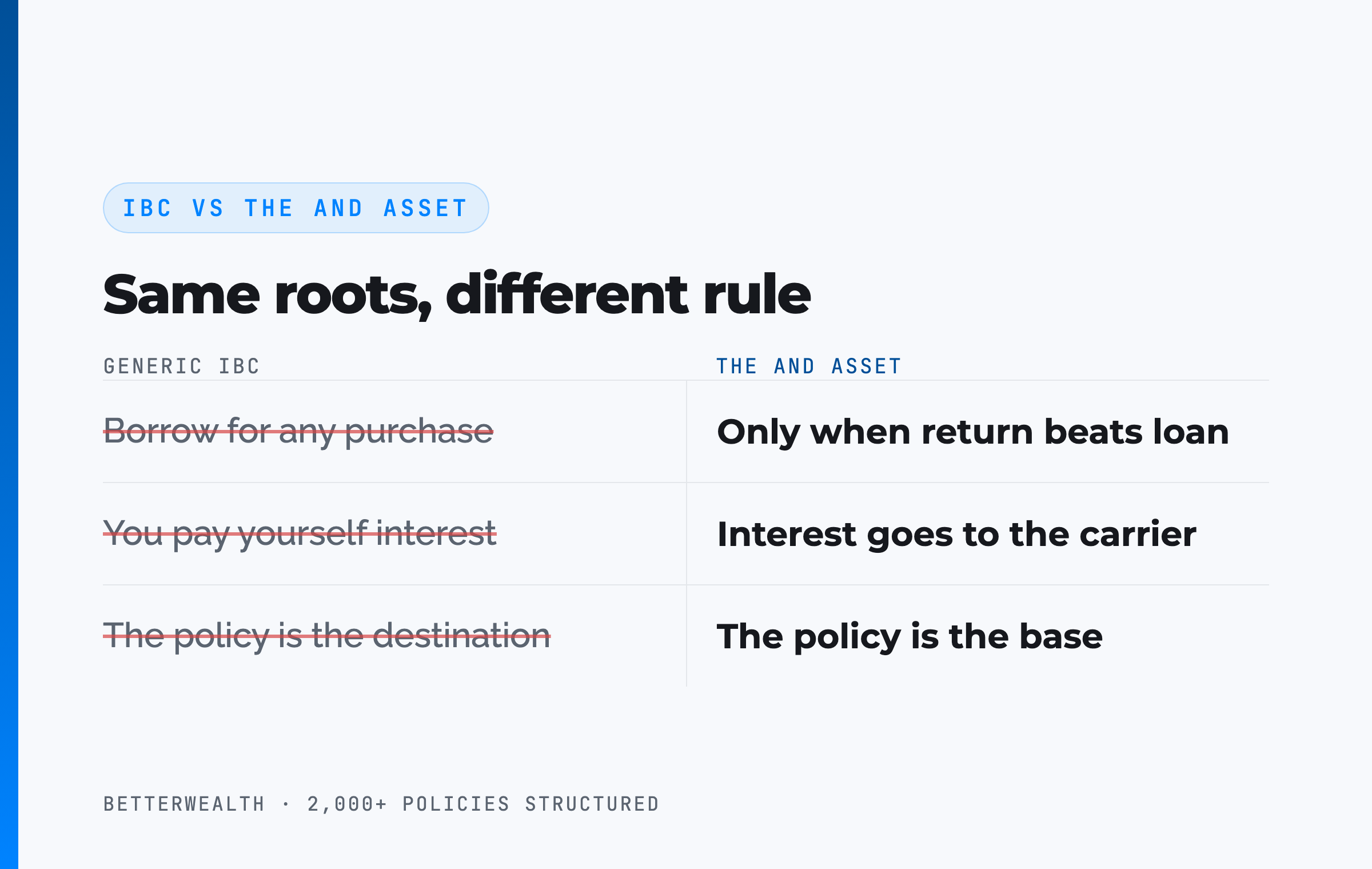
Nash pioneered the idea of using whole life as a personal banking system, and we credit that foundation every time we teach this. IBC says you can use the policy as a personal bank for any purchase. The And Asset says you only deploy capital from the policy when the borrowed dollars will produce a return greater than the carrier's loan cost, because the loan rate is a real expense paid to a real counterparty. Anything less is an expensive way to spend money.
Many IBC marketers say you are paying yourself interest. You are not. The interest goes to the insurance company. Your return is what the deployed capital earns elsewhere while the policy keeps compounding net of internal charges. The And Asset shares roots with IBC and operates on different principles.
The math has to work. Every time.
Marketers have ruined the way this should be explained. You are not paying yourself interest. You are paying the carrier, and your return comes from what you deploy into.
03 / The conditionsWhen does a whole life policy loan make sense?
A policy loan makes sense under three conditions, and all three have to hold at once. Miss any one of them and the arithmetic turns against you no matter how well the policy is designed.
One: the deployed capital clears the loan rate. If the carrier charges 5% and the activity returns 7%, 9%, or 20%, the spread is yours. The size of the spread determines how much the strategy is worth doing, and the sign of the spread determines whether to do it at all.
Two: you service the interest annually. Loan interest that goes unpaid capitalizes into the balance and then accrues interest of its own. Paid annually out of the activity's cash flow, the cost stays linear. This one decision separates a working strategy from a slow-motion failure.
Three: you borrow a slice, not the maximum. Taking $100,000 or $200,000 against a large cash value leaves headroom for the next opportunity and keeps the loan balance far away from the carrier's lapse threshold. Borrowing everything available, permanently, is the failure case.
Real estate investors are the clearest example of all three holding together. Capital gets deployed into an acquisition or a value-add project, the property throws off cash flow, the cash flow services the loan interest, and the policy compounds the entire time on a balance that never left.
04 / How it worksHow to take a policy loan that creates value, step by step
A policy loan that creates value follows six steps in a specific order, and the order is what makes it work. Most people start at step three.
- Confirm the use of capital first. Name the activity and estimate its return before you call the carrier. If the projected return does not clear the loan rate, stop here. The discipline of not borrowing is part of the strategy.
- Check available cash value and the carrier's limit. Most carriers cap loans near 95% of net cash value so the contract does not lapse. On $467,300 of cash value, that ceiling sits near $443,900. Treat it as the edge of the map, not the destination.
- Request the loan. Many carriers allow a first loan roughly 30 days after initial funding clears. Smaller loans are often requested by phone or through your agent, larger loans through a signed loan form.
- Borrow a slice, not the maximum. Take what the deal requires. Borrowing in tranches of $100,000 or $200,000 keeps the rest of the cash value uncollateralized and available for the next opportunity.
- Deploy the capital. Move the money into the activity you identified. The policy keeps compounding on its full cash value, net of mortality and expense charges, the entire time the loan is outstanding.
- Pay the interest annually, then repay principal. Service the interest out of the activity's cash flow so it stays simple rather than capitalizing. Then repay principal on a defined schedule, which restores borrowing capacity for the next deal.
Steps five and six are where the strategy either compounds or unravels. Everything before them is mechanics. For a deeper look at the funding side that makes any of this possible, we broke down policy structure in how to structure a whole life policy and the rider that drives early cash value in paid-up additions explained.
Policy loans work for a specific person doing specific things.
It fits you if
- You already deploy capital into deals, acquisitions, or your business
- You can name an activity that clears the carrier's loan rate
- You will service the loan interest annually from real cash flow
- Your horizon is 10 years or longer
It does not fit you if
- You want a place to store money you will spend
- You plan to borrow the maximum and never repay it
- You are carrying high-interest debt and need a quick fix
- You have no identified use for borrowed capital
If you are in the first column, 30 minutes will tell you whether the numbers work in your situation. If you are in the second, we will tell you that instead.
Book a Discovery Call05 / The mathThe $100,000 loan and the $400,000 loan, in dollars
The clearest way to see when a policy loan works is to run the same year twice at two different loan sizes. Start with a front-loaded design: $500,000 funded in year one, roughly $467,000 of net cash value at the end of that year, then $100,000 per year after. In year two, the $100,000 contribution pairs with a cash value increase of about $107,000, which is roughly $7,000 of growth above what was contributed.
Scenario A: borrow $100,000
At an illustrative 5% loan rate, $100,000 costs $5,000 for the year. The policy grew about $7,000 that year on its full balance. On the internal comparison alone, the position is $2,000 ahead before the borrowed money does anything at all. Deploy that $100,000 into a real estate opportunity returning 20%, and $20,000 of outside return lands on top. Total for the year: $27,000 of gain against $5,000 of cost. The interest gets paid out of the property's cash flow, the loan stays simple, and the borrowing capacity resets.
One dollar. Two jobs. That is the And.
Scenario B: borrow $400,000
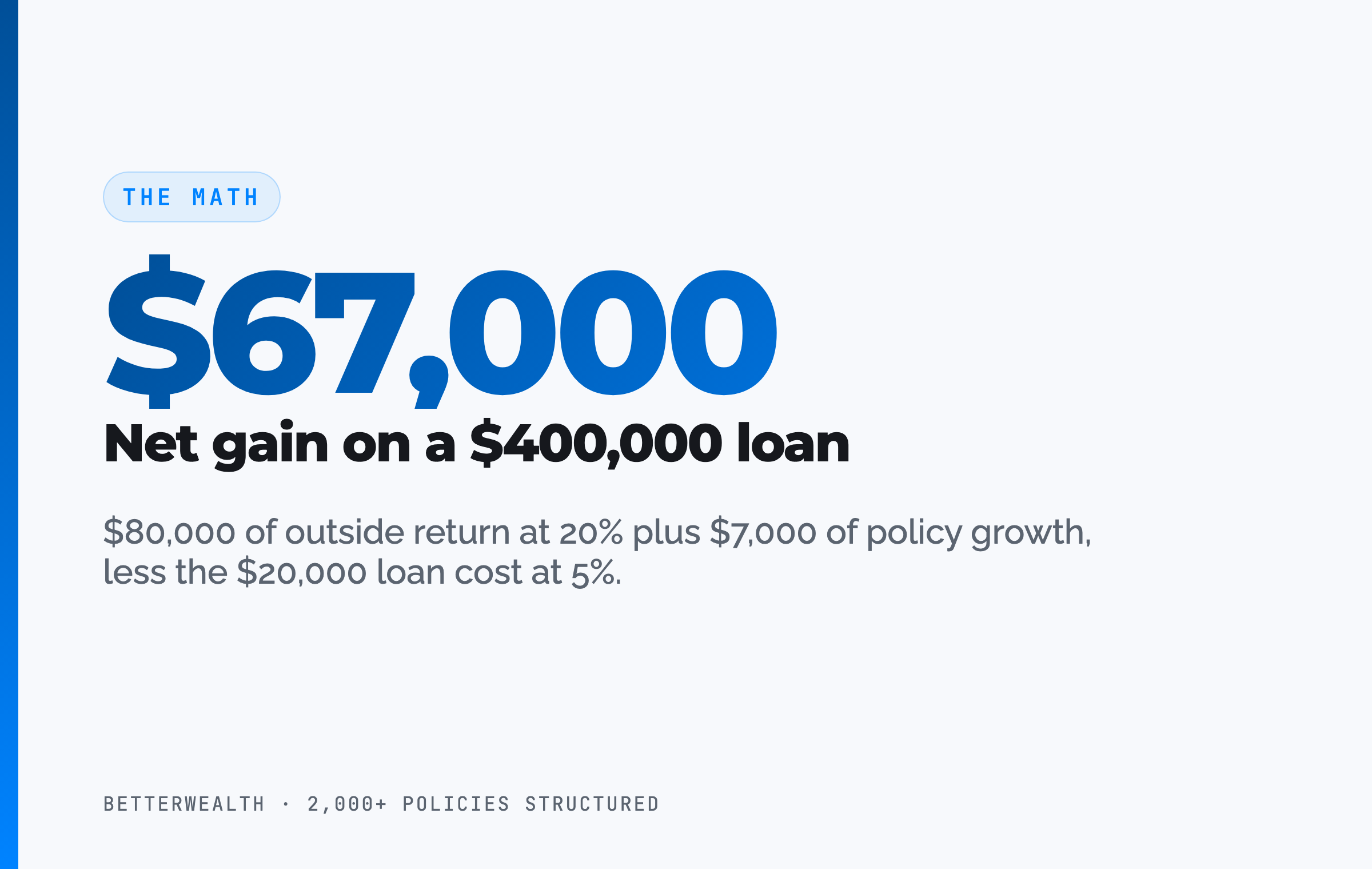
Same year, same 5% rate, four times the loan. The cost is now $20,000 against roughly $7,000 of policy growth, so the internal spread is negative by $13,000. This is the number critics stop at, and on its own it looks like a loss. Deploy the $400,000 at 20% and it returns $80,000. Add the $7,000 of policy growth, subtract the $20,000 loan cost, and the year nets $67,000 in the entrepreneur's favor. The $467,000 of collateral never left the contract, and the death benefit stayed in force the entire time.
The internal spread being negative is not the verdict. It is one line in a larger calculation, and the line that decides the outcome is what the deployed capital produced. Anything above the loan rate works. It does not have to be 20%. Seven, eight, or nine percent clears a 5% cost and the strategy holds.
Arbitrage is the wrong headline. The tool is only as good as the person holding it, and the question is what you do with the capital, not what spread you captured inside the contract.
06 / The mechanicWhy does paying the loan interest matter so much?
Paying the interest annually keeps the cost simple instead of compounding, which is the difference between a manageable expense and a balance that runs away from you. Unpaid interest does not disappear. It capitalizes into the loan balance, and next year the carrier charges interest on the larger number. Repeat that for twenty years and the compounding works against you at the same rate it was supposed to work for you.
Serviced annually, a $400,000 loan at 5% costs $20,000 a year, every year, in a straight line. Left unserviced, that same loan grows past $650,000 in a decade, and the collateral requirement grows with it. Carriers cap borrowing near 95% of cash value precisely because a loan balance that catches the cash value puts the contract at risk of lapsing.
Compounding is a direction, not a virtue.
We want compounding on the asset side and simple interest on the liability side. That is the whole mechanic. An entrepreneur who pays $20,000 of interest out of $80,000 of property cash flow has a working system. An entrepreneur who lets it ride has a countdown.
07 / Where people get this wrongOver-leveraging is the failure mode, not the strategy
The most common way this fails is over-leveraging: borrowing to the ceiling, indefinitely, with no repayment and no serviced interest. In our experience, that describes the vast majority of people who try to use a policy this way without a defined use for the capital. They treat the cash value as spendable money rather than as collateral behind a productive activity.
Marketers created this problem. The pitch says the policy is a bank you own, that you pay yourself interest, that the money is free to use. Every one of those claims removes the discipline that makes the math work. A contract sold on those terms will underperform, and the buyer will blame whole life insurance rather than the way it was sold.
The second failure is subtler. An entrepreneur borrows for something that has no return at all, then points to the policy's internal growth as justification. A vehicle, a vacation, a personal expense. The policy did not create value in that transaction, it financed a purchase at 5%. Honest accounting calls that what it is.
If you are going to max-lever the policy forever and never pay any of the loan interest back, this is not a good tool for you. Mathematically you will be underwater, and no carrier or design fixes that.
The frameworks behind 2,000+ policies, in one place.
The And Asset Vault holds the calculators and design frameworks we use to run this exact math before a client borrows a dollar, including the loan-cost-versus-deployment worksheet. Free, email-gated, no spam.
Open the Vault08 / The tradeoffsWhat you gain and what you give up
Policy loans buy control, continuity of compounding, and predictable access, at the cost of years of funding discipline and a real interest expense. Both halves are true and most content only publishes one of them.
On the gain side: the loan cannot be called by the carrier the way a bank can freeze a line of credit, the cash value keeps compounding on its full balance while borrowed against, the death benefit stays in force, and access does not require credit approval or a new underwriting cycle. Under the tax treatment of life insurance in IRC Section 7702, loans from a contract that is not a Modified Endowment Contract are generally not treated as taxable income.
On the cost side: a policy takes years to fund before it holds meaningful capital, cash value does not exceed cumulative contributions until roughly year five for a healthy individual, and the loan rate is a real payment to a real counterparty. The strategy also requires you to keep finding uses for capital that clear the loan cost. If you stop finding them, the correct move is to stop borrowing, and a lot of people find that harder than it sounds.
We have laid out the full ledger, including the cases where this does not work, in infinite banking pros and cons.
A composite: the investor who borrowed $184,000 in year two
Consider a 43-year-old real estate investor, preferred non-tobacco, funding a front-loaded design: $500,000 in year one, then $100,000 annually. Year one splits 15/85 between base premium and the paid-up additions rider, roughly $75,000 of base and $425,000 of PUA. Ongoing years run $15,000 base and $85,000 PUA. This is a representative composite, not a single named client.
The first four years run behind. Cash value reads $467,300 at the end of year one against $500,000 contributed, $571,400 against $600,000 in year two, $681,900 against $700,000 in year three, and $798,200 against $800,000 in year four. Total cash value does not catch total contributions until year five, at $922,600 against $900,000 funded. Any illustration promising break-even in year one or two is fiction.
What changes earlier than break-even is the marginal math. The year-two contribution of $100,000 produces a $104,100 increase in cash value. Every incremental dollar in is now worth more than a dollar of accessible value, which is the point at which borrowing becomes worth considering.
In year two, with $571,400 of cash value on the books, the investor borrows $184,000 against the policy at an illustrative 5.25% loan rate, a cost of $9,660 for the year. The capital funds the down payment and renovation budget on a value-add rental. The property returns 14.8% on the deployed capital, or $27,232 in year one of ownership. Net of the $9,660 loan cost, that is $17,572 of spread, on top of the $104,100 the policy added that same year on a balance that never left the contract.
The interest gets paid annually out of the property's net operating income, so it stays simple. Principal comes back on a 38-month schedule funded by the same cash flow, which restores the borrowing capacity for the next acquisition. Death benefit in force throughout: $4,265,000.
Borrow the slice. Pay the interest. Repeat.
09 / The bigger pictureHow does this fit into a broader capital strategy?
A policy functions as the patient reserve inside a capital structure, and it earns its keep in the years when nothing is happening. There will be stretches of four, five, or six years where an entrepreneur has no reason to touch the money. Through those years the contract compounds quietly: roughly $7,000 of gain above contributions in one year, $13,000 in the next, $19,000 in the one after, with the increments widening as the base grows. By a later policy year, a $100,000 contribution can pair with a $226,000 increase in cash value.
Then the market dislocates. A seller needs to close in three weeks. A competitor becomes acquirable. The entrepreneur with a funded policy has a large pool of collateralized capital available without a credit application, and the entrepreneur who left the money in a business account has a balance that has been eroding against inflation the whole time.
Held cash keeps optionality and loses purchasing power. Deployed cash produces returns and loses optionality. The policy is one of the few structures that holds a version of both, with the loan cost as the toll for the privilege.
For where this sits relative to a line of credit against your home, we ran the comparison in infinite banking versus a HELOC, and the mechanics of how cash value builds in the first place are covered in how whole life insurance cash value works.
10 / Head to headA $184,000 policy loan against the alternatives
Against the other ways an entrepreneur can raise $184,000, a policy loan trades a modest interest cost for control and uninterrupted compounding. The table prices the same draw four ways, with illustrative rates at time of writing.
| Dimension | Policy loan | HELOC | Margin loan | Sell $184,000 of stock |
|---|---|---|---|---|
| Annual cost on $184,000 | $9,660 at an illustrative 5.25% | $15,640 at an illustrative 8.5% variable | $12,880 at an illustrative 7.0% | $0 interest, but roughly $9,000 of tax on $60,000 of long-term gains at 15% |
| What happens to the base | Stays in the policy and keeps compounding on the full $571,400 | Home equity is untouched but produces nothing | Shares stay invested and keep compounding | The $184,000 is gone and stops compounding permanently |
| Access risk | Cannot be called or frozen by the carrier | Can be frozen, reduced, or not renewed by the lender | Subject to margin call if the portfolio drops | None, though you may be selling into a down market |
| Approval | No credit check; often funded in days | Underwriting, appraisal, and weeks of process | Instant within the brokerage | Instant, settles in days |
Cost. At $9,660 a year, the policy loan is the cheapest borrowing option in the table, and the gap widens against a HELOC in a rising-rate environment because the policy loan rate is set by the carrier rather than by a floating index.
Continuity. Selling stock has no interest cost at all, which is why people default to it. The hidden price is that $184,000 stops compounding forever, and the roughly $9,000 tax bill lands in the same year. The policy loan keeps the entire $571,400 working.
Access risk. A HELOC is the closest functional substitute, and it is the one that disappears in a credit contraction. Thousands of investors found their lines frozen in 2020. A policy loan cannot be called, which is what makes it usable as planned capital rather than hoped-for capital.
The honest 30 minutes about whether the numbers work for you.
We have structured more than 2,000 policies across all 50 states. We have seen this strategy work exactly as designed, and we have seen it fail when the borrowing had no purpose behind it. On a discovery call we will run your actual numbers and tell you honestly whether The And Asset belongs in your capital structure. If it does not, we will say so. No pressure, no pitch. If you would rather learn first, the The And Asset and BetterWealth YouTube channels go deep on the math.
Book a Discovery CallFAQWhole life policy loan questions
When does a whole life insurance policy loan make sense?
A policy loan makes sense when the borrowed dollars fund an activity that returns more than the carrier's loan rate and you pay the loan interest annually. The policy keeps compounding on its full cash value while the deployed capital earns its own return. Without a productive use for the money, borrowing is an expensive way to spend.
Does it make sense to borrow at 5% if the policy only earns 4%?
Yes, when the borrowed capital earns more than the 5% loan cost somewhere else. The comparison that matters is the loan rate against the return on the deployed activity, not the loan rate against the policy's internal growth rate. If the only thing the borrowed money does is sit there, a 5% loan against 4% growth is a guaranteed loss.
What is The And Asset?
The And Asset is BetterWealth's framework for using a properly structured whole life policy as a capital base. You only borrow against it for an activity that produces a return greater than the carrier's loan cost, so your dollars do two jobs at once: the policy keeps compounding while the deployed capital earns its own return.
How is The And Asset different from infinite banking?
Infinite banking, as Nelson Nash taught it, frames a whole life policy as a personal banking system you can use for any purchase. The And Asset says you only deploy borrowed capital when the return clears the carrier's loan cost. The policy is the capital base, not the destination. It shares roots with IBC but operates on different principles.
Do you pay yourself interest on a policy loan?
No. The interest on a policy loan goes to the insurance carrier, not to you. Your return comes from what the borrowed capital earns elsewhere while the policy continues to compound net of mortality and expense charges. Any agent telling you that you pay yourself interest is describing something that does not happen.
What happens if you never pay the policy loan interest?
Unpaid interest capitalizes into the loan balance and then accrues interest of its own, so the debt compounds against you. Paying the interest annually keeps the cost linear. Over a long horizon, a loan you never service can grow toward the policy's cash value and put the contract at risk of lapsing.
How much can you borrow against a whole life policy?
Most carriers allow policy loans up to roughly 95% of available net cash value, holding back a margin so the contract does not lapse. On a policy with $467,300 of net cash value, that is roughly $443,900 of theoretical borrowing capacity. Borrowing the maximum is a design flaw, not a feature.
How soon can you borrow against a new whole life policy?
Many carriers allow a first policy loan roughly 30 days after the initial funding clears, and a heavily front-loaded design can make a large share of first-year cash value accessible in that window. The specific waiting period and the accessible percentage vary by carrier and by policy design.
Are whole life policy loans taxable?
Policy loans from a non-MEC life insurance contract are generally treated as loans rather than taxable income under the tax treatment of life insurance in IRC Section 7702. That treatment depends on the contract staying in force and not being classified as a Modified Endowment Contract. Confirm your situation with your tax advisor.
What is over-leveraging a policy?
Over-leveraging means borrowing near the maximum against your cash value, indefinitely, without repaying principal or servicing interest. It is the most common way this strategy fails. The loan balance compounds, the unpaid interest capitalizes, and the contract can eventually be at risk of lapsing.
Why does the policy keep growing while you borrow against it?
A policy loan is collateralized by the cash value rather than withdrawn from it, so the full cash value stays in the contract and keeps compounding net of mortality and expense charges. Under direct recognition, the carrier adjusts the dividend on the borrowed portion, and under non-direct recognition it does not. Either way, the money does not leave the policy.
Is a policy loan better than a HELOC for a real estate investor?
A policy loan usually carries a lower and more predictable cost than a HELOC and cannot be frozen or called by the lender, which matters most in a credit contraction. A HELOC requires no premium funding and can be opened against equity you already have. The policy loan wins on control and continuity of compounding, and it requires years of funding first.
- Nelson Nash, Becoming Your Own Banker, the origin of the infinite banking concept and the lost opportunity cost argument.
- IRC Section 7702 (Cornell Law), the definition of a life insurance contract for federal tax purposes.
- IRC Section 7702A (Cornell Law), the Modified Endowment Contract rules that govern how loans from a contract are taxed.
- IRS Publication 525, taxable and nontaxable income, including the treatment of life insurance proceeds and distributions.
- LIMRA, life insurance industry data on ownership, premium, and persistency.
- BetterWealth resources: The And Asset book, the The And Asset YouTube channel, and the BetterWealth YouTube channel.
I founded BetterWealth to treat life insurance as the wealth and capital tool it actually is, not the product most people get sold. Our team has structured more than 2,000 policies across all 50 states. I wrote The And Asset and host the BetterWealth and The And Asset YouTube channels. If you want an honest read on whether borrowing against a policy makes sense in your situation, book a discovery call. We will tell you if it does not.