
A tax-free retirement strategy moves savings out of accounts that will be taxed later and into vehicles that will not, primarily Roth accounts and permanent life insurance. The goal is tax risk diversification, so a future rate increase cannot decide how much of your money you actually keep.
A retirement account statement reports a balance. It does not report ownership. Inside every traditional IRA and pre-tax 401(k) sits a liability that has not been calculated yet, and the size of that liability will be set by a tax rate nobody has voted on. Building a tax-free retirement starts with pricing that liability instead of ignoring it.
Ed Slott has spent four decades on this single question. He is a CPA who staked his practice on retirement account tax rules after the 1986 tax act, spent 15 years on PBS, and now trains financial advisors through a two-day program and a long-running advisor membership group. When we sat down with him after he came off stage, he compressed the whole problem into one sentence: the IRA grows and erodes at the same time.
The balance is not the number that matters. What matters is the after-tax cash flow you can actually deploy, and how much of that is decided by a tax rate you do not control.
At BetterWealth, we have structured more than 2,000 policies across all 50 states, and this conversation lands on the same math we run with entrepreneurs every week. Slott approaches it from tax planning. We approach it from capital strategy through The And Asset. The two meet in the same place: a dollar sitting in one tax bucket, waiting on a future rate, is doing less work than it could be.
This piece covers why a seven-figure IRA behaves like a liability, what "forever taxed to never taxed" means in code-accurate terms, the seven-step sequence for repositioning money, the return math that decides whether borrowing against a policy makes sense, and where the marketing around all of this goes wrong.
- A pre-tax IRA grows and erodes at once: every dollar of growth adds a dollar that gets taxed as ordinary income later.
- Slott's single rule is to pay tax when your rate is low, even if that means paying it earlier than required.
- Under the SECURE Act, most non-spouse beneficiaries must empty an inherited IRA within 10 years of death.
- Distributions before age 59 and a half generally carry a 10% additional tax, which is why repositioning timing matters.
- The And Asset adds one rule to all of this: borrow against the policy only when the return clears the carrier's loan cost.
- Tax risk diversification is the point. Holding every retirement dollar in one tax treatment concentrates the risk.
The full interview has the parts a blog cannot carry: Slott's client stories, the exact language he uses with skeptical advisors, and the pushback he gets for telling people to pay tax before they have to.
01 / The problemWhy is a large IRA a problem instead of a win?
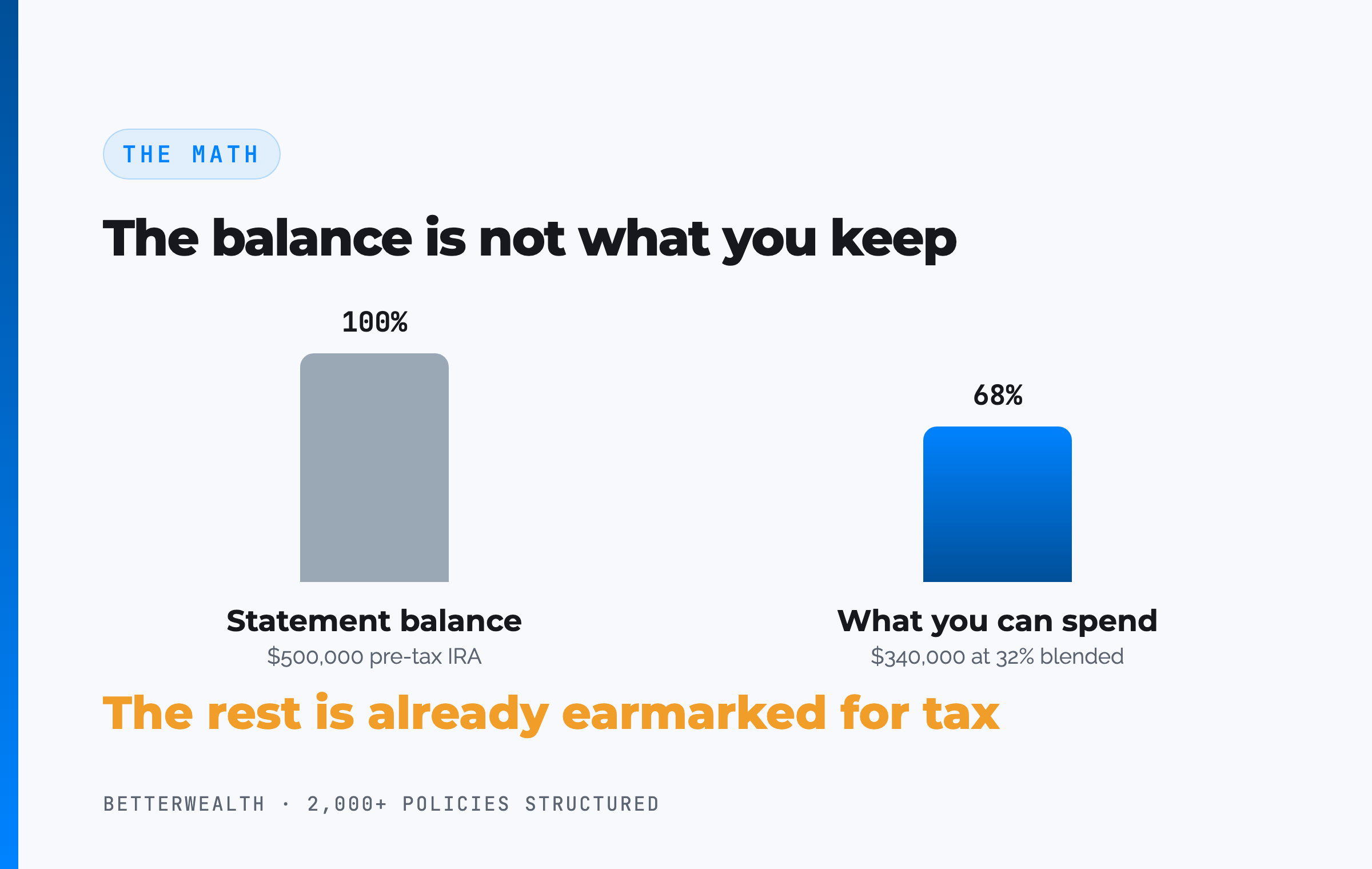
A large pre-tax IRA is a problem because the account and the tax bill compound together. Growth is not free in a tax-deferred account. Every additional dollar of value adds a dollar that will be taxed as ordinary income on the way out, and a bigger balance forces bigger required distributions, which can push the whole withdrawal into a higher bracket. Slott's word for it is paradox. The account goes up and goes down at the same time.
The second problem is timing, and it is the one people underestimate. Required minimum distributions begin at 73 under current law. By then a balance that looked comfortable at 60 can be substantially larger, and so can the tax. Waiting does not make the liability go away. It hands the sizing decision to a schedule you do not write.
The third problem lands on the next generation. Under the SECURE Act, most non-spouse beneficiaries have to empty an inherited IRA within 10 years of death. Adult children often inherit in their forties and fifties, which are their highest earning years, so the account gets liquidated at their top marginal rate rather than spread over a lifetime. Slott's blunt assessment is that a large IRA has become a costly vehicle for wealth transfer.
"It's like a paradox, because it grows and erodes at the same time. As it grows, so does the tax." (Ed Slott, CPA)
02 / The frameworkWhat does moving from forever taxed to never taxed actually mean?
Moving from forever taxed to never taxed means relocating dollars out of accounts taxed on the way out and into vehicles that are not, which in practice means Roth accounts and permanent life insurance. Slott has used that phrase for years. It is a description of tax treatment, not a promise of returns, and the distinction matters because most of the damage in this category comes from people hearing the second thing when the speaker said the first.
Two provisions do the work. IRC Section 101(a) generally excludes a life insurance death benefit from the beneficiary's gross income. IRC Section 7702, added to the code in 1984, defines what qualifies as life insurance for tax purposes and limits how much premium a policy of a given size can absorb. Cash value inside a qualifying policy accumulates without annual taxation, and a policy loan is not a distribution, so it is generally not treated as taxable income while the policy stays in force and is not a modified endowment contract. Those conditions are the whole ballgame. Strip them out and "tax-free" is marketing.
Where IBC ends and The And Asset begins
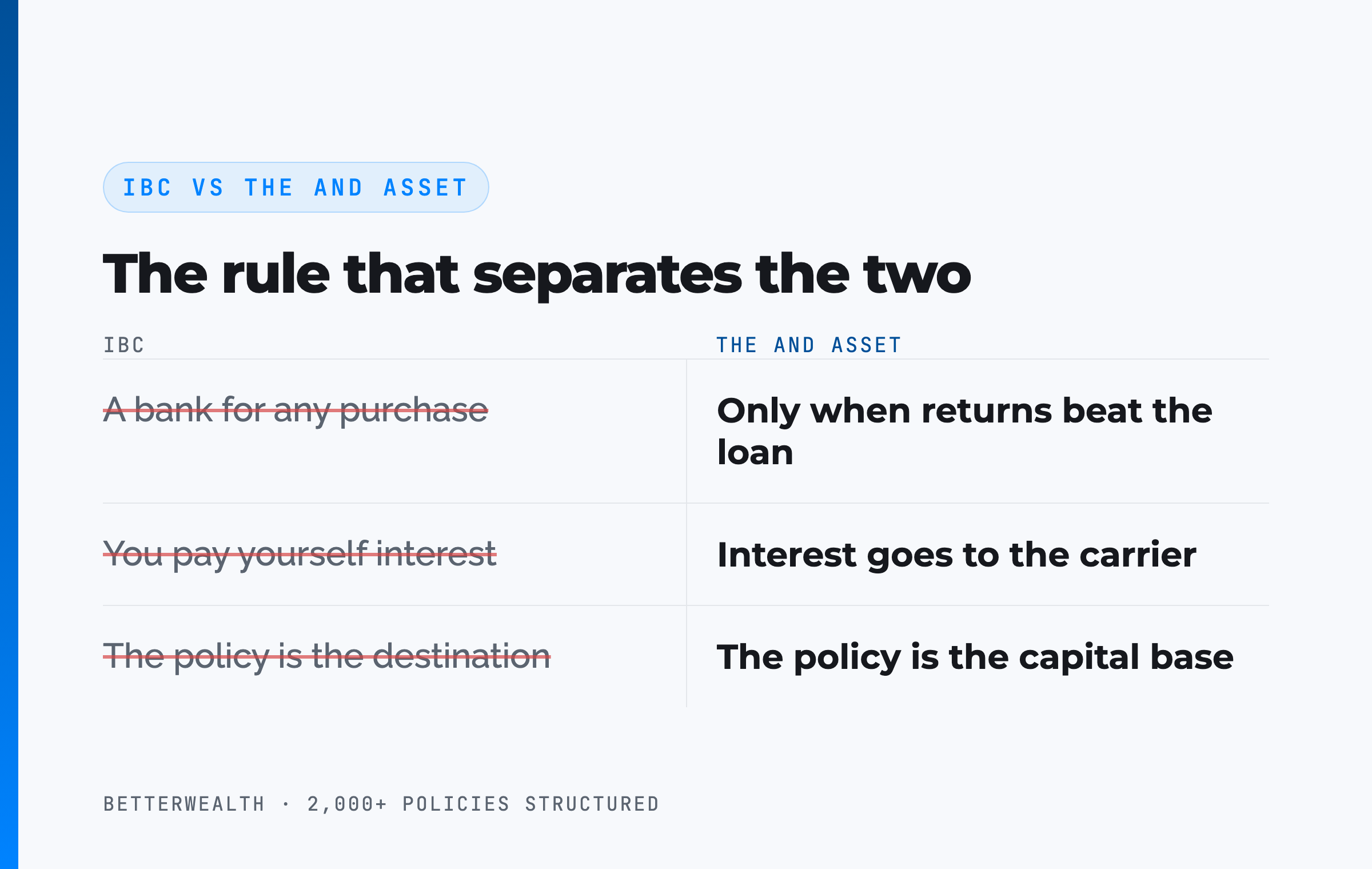
Nelson Nash pioneered the idea of using a whole life policy as a personal banking system, and his insight about lost opportunity cost is the foundation everything here is built on. IBC says you can use the policy as a personal bank for any purchase. The And Asset says you only deploy capital from the policy when the borrowed dollars will produce a return greater than the carrier's loan cost, because anything less is an expensive way to spend money. The policy is the capital base. The value gets created in what you deploy into.
That distinction changes how this article's tax argument lands. A tax-advantaged bucket that just sits there is a savings account with an insurance charge attached. A tax-advantaged bucket you can borrow against to fund a deal that clears the loan rate is a capital base doing two jobs. Slott is solving for tax treatment. We are solving for tax treatment and deployment.
One dollar. Two jobs. That is the And.
You are not paying yourself interest on a policy loan. The interest goes to the carrier. Your return is what the deployed capital earns while the policy keeps compounding net of internal costs.
03 / How it worksHow do you move money from forever taxed to never taxed?
You move money from forever taxed to never taxed in a deliberate sequence, and the order determines the cost. Doing the right steps out of order is how people trigger penalties, overpay tax, or fund a policy that cannot do the job. Here is the sequence we use.
- Price the tax you have not paid yet. Take the pre-tax balance, apply a projected future rate, and write down the result. On a $1,200,000 IRA at a 32% blended future rate, roughly $384,000 of that statement belongs to a future tax bill. Plan from the net number.
- Use the low-bracket years deliberately. Convert or distribute in the years your marginal rate is lowest, filling a bracket on purpose. Slott repeats one rule more than any other: pay tax when the rate is low, even if that means paying before you are required to. A gap year between selling a business and drawing income is the most valuable planning window most entrepreneurs waste.
- Respect the age 59 and a half line. Distributions from a traditional IRA before 59 and a half generally carry a 10% additional tax on top of ordinary income tax unless an exception applies. That is why Slott tells people to fund policies with IRA dollars later in life. Funding from ordinary cash flow at 35 is a different decision, and he says he wishes he had started earlier himself.
- Structure the policy for cash value. Minimize base premium, maximize the paid-up additions rider, and push cash value toward the limit without crossing into a modified endowment contract. The base-to-PUA split, often 25/75 or 10/90 on a design like this, is the decision that determines how much capital is accessible in the early years.
- Let the early years capitalize. Cash value trails cumulative contributions at the start. Break-even lands at year five or later for a healthy individual. Any illustration showing a year-two break-even is fiction, and an agent showing you one is telling you something about themselves.
- Borrow only when the return clears the loan cost. Take a policy loan when you have identified an activity that produces more than the carrier charges. The policy continues compounding on its full value, net of mortality and expense charges, while the loan is outstanding.
- Repay from the activity's own cash flow. The deal that justified the loan should fund the repayment, which restores capacity for the next one. The discipline of repayment is the whole strategy.
Steps one through three are Slott's territory and belong with a CPA or tax advisor. Steps four through seven are ours. Neither half works alone, which is exactly the point he makes about life insurance sold outside of a plan.
This strategy fits a specific person doing specific things.
It fits you if
- You have a seven-figure pre-tax balance and a decade or more of horizon
- You have low-bracket years you can use on purpose
- You can name a use for capital that beats the loan cost
- You want more than one tax treatment working at once
It does not fit you if
- You are early in building wealth and need every dollar liquid
- You are carrying high-interest debt that needs solving first
- You want a savings account with a better label
- You cannot identify a productive use for borrowed dollars
If you are in the first column, 30 minutes will tell you whether this belongs in your plan and at what size. If you are in the second, we will say that instead.
Book a Discovery Call04 / The mathThe return has to clear the carrier's loan cost
The capital you deploy must out-earn what the carrier charges on the loan, or you should not borrow. This is the test that separates The And Asset from a tax-advantaged savings account. Policy loan rates vary by carrier and rate environment. At time of writing many carriers fall in the 5 to 6% range, and the specific number is something to verify with the carrier rather than a constant to plan around.
The structure of the decision is simple to state and easy to skip. You borrow at the carrier's rate. The policy keeps compounding on its full cash value, adjusted by the carrier's recognition treatment. The deployed capital earns its own return. When that return exceeds the loan cost, the spread is yours and the same dollar did two jobs. When it does not, you borrowed money to lose money slowly, and the tax treatment on the front end does not save you.
This is also where the tax argument and the capital argument meet. A Roth conversion improves your tax treatment. It does not give you a pool of capital you can lend against without liquidating the position. A properly structured policy does both, and that is the entire reason it earns a seat next to the Roth rather than instead of it.
If the deal does not clear the loan rate, do not borrow.
05 / The audienceWhy entrepreneurs and high-income earners run two tax buckets
Entrepreneurs and high-income earners run more than one tax bucket for the same reason they would never hold one stock: concentration is the risk they can actually control. Slott makes this comparison directly. An investor who would object immediately to a single-position portfolio will hold every retirement dollar in one tax treatment and call it diversified because the underlying funds differ.
The second reason is control of timing. A business owner with variable income has years where their marginal rate drops, and those years are an asset. The person on a fixed W2 with no flexibility has fewer levers. A value creator with a gap year, a loss carryforward, or a low-income transition window can move a large amount of money at a rate they will never see again.
The third reason is what happens at the end. A large IRA left to adult children gets compressed into 10 years at their top rate. The same dollars repositioned through a policy pass to beneficiaries excluded from income under Section 101(a). For a family with a $2,000,000-plus pre-tax balance and no intention of spending it all, that difference is the largest single number in the plan.
"It's not for everybody. Not saying everything." Slott repeats that qualifier constantly, and it is the reason advisors trust him. The people who leave it out are selling.
06 / The failure modeWhere people get this wrong
Life insurance earned its reputation because it gets sold as a product instead of built into a plan, and Slott says so without softening it. His phrasing is that in a vacuum it is just a sales pitch. The policy is not the strategy. The tax plan is the strategy, and the policy is one instrument inside it. Sold in isolation, even a well-designed contract ends up owned by someone who cannot explain why they have it, which is precisely how the bad rap forms.
The second failure is shorthand that gets clipped. In the enthusiasm of a live conversation, even a careful CPA reaches for a line like "the only way to print money." Life insurance does not print money. It relocates dollars into different tax treatment, adds leverage at death, and creates a capital base you can borrow against. Every one of those is real and each has a cost attached. Marketers keep the leverage and delete the cost.
The third failure is the phrase this industry cannot seem to stop saying: that you pay yourself interest on a policy loan. You do not. The interest goes to the carrier. Your return comes from what the deployed capital earns while the policy compounds net of mortality and expense charges. Anyone still using that line is either careless with language or counting on you not checking.
The fourth is timeline fiction. Cash value does not exceed cumulative contributions in the first three years of a properly designed policy, and break-even at year five or later is the honest expectation for a healthy individual. We have watched more relationships break over an oversold early illustration than over any dividend result.
In a vacuum, it is a pitch. In a plan, it is a tool.
The frameworks behind 2,000+ policies, in one place.
The And Asset Vault holds the calculators and design frameworks we use when we run this math with entrepreneurs, including the funding, structure, and deployment decisions this article walks through. Free, email-gated, no spam.
Open the Vault07 / The tradeoffsThe benefits and the costs nobody puts in the deck
The benefits of repositioning into a policy come with four costs that disqualify plenty of people.
- Conversion and distribution cost real tax today. Slott's argument is that paying at a known low rate beats paying at an unknown higher one, and that is a judgment about the future, not a certainty.
- A permanent policy carries mortality and expense charges. Those charges are what buy the death benefit and the tax treatment, and they are why the first several years look worse on paper than a brokerage account.
- This takes time. A policy designed for cash value needs a decade or more of consistent funding to do what it is built to do, and the optimal funding window generally runs 10 to 25 years. Someone who needs the money in three years should not be here.
- It requires underwriting. Health and age determine cost and, in some cases, availability, which is a constraint no amount of planning enthusiasm removes.
Against those sits what you get: a second tax treatment, a death benefit from day one, a capital base you can borrow against without liquidating a position, and, at death, an income-tax-free transfer to beneficiaries under Section 101(a) instead of a 10-year taxable compression. Whether that trade is worth it depends entirely on the size of the pre-tax balance and what you intend to do with the capital.
08 / The stackWhere does a tax-free retirement plan fit alongside Roth conversions and annuities?
A tax-free retirement plan uses more than one vehicle, and Slott's own balance sheet is the clearest example of what that looks like. He holds Roth IRAs, cash value life insurance, stock accounts, cash, and annuities. His stated reason for the annuity piece is guaranteed income covering basic living expenses, a preference he traces to watching his mother stay financially independent through her final years on income she could not outlive.
Each instrument does one job. The Roth handles tax treatment on invested assets with a contribution limit tied to earned income. The annuity handles income floor. The policy handles tax treatment, transfer, and access to capital during life. The brokerage handles liquidity and step-up in basis at death. Stacking them is not indecision. It is refusing to let a single rule change decide the outcome.
Our addition to this is the deployment layer. Once the policy exists as a capital base, the question stops being "which bucket" and becomes "what can this capital fund that beats the loan cost." That is where an entrepreneur's version of this plan diverges from a retiree's, and it is covered in depth in our breakdown of how this compares to a 401(k) and in the Section 7702 tax strategy guide.
09 / Head to headWhat $500,000 looks like in four different buckets
The same $500,000 produces different spendable outcomes depending on which tax treatment holds it. The table below uses illustrative federal rates to make the comparison concrete. Individual results depend on your bracket, your state, and your timing, and the numbers here exist to show the shape of the difference rather than to predict yours.
| Dimension | Traditional IRA (left alone) | Roth (after conversion) | And Asset policy | Taxable brokerage |
|---|---|---|---|---|
| Tax cost today | $0 now | Roughly $120,000 to convert $500,000 at an illustrative 24% rate, ideally paid from outside funds | Same conversion-style tax cost if funded from IRA dollars, spread across several years to control the bracket | $0 now (already after-tax dollars) |
| What $500,000 is worth to you | Roughly $340,000 spendable at an illustrative 32% blended rate | $500,000, with qualified distributions excluded from income | Cash value below contributions in years 1 to 4, crossing at year 5+, accessible by loan | $500,000 less tax on gains as they are realized |
| Growth taxation | Deferred, then taxed as ordinary income | No annual tax; qualified distributions excluded | Accumulates without annual tax, net of mortality and expense charges | Dividends and realized gains taxed annually |
| Access before 59½ | 10% additional tax plus ordinary income tax, absent an exception | Contributions accessible; earnings rules apply | Policy loans available at any age, generally not taxable while in force | Fully liquid, settles in days |
| What heirs receive | Full balance, taxable, emptied within 10 years for most non-spouse heirs | Balance passes income-tax-free, still subject to the 10-year emptying rule | Death benefit excluded from income under Section 101(a), no 10-year clock | Step-up in basis at death on appreciated positions |
Tax cost today. The traditional IRA wins the first column and loses the last two. Every strategy on this page is a decision to pay a known amount now instead of an unknown amount later, which is the entire disagreement people have with Slott when he tells them to convert.
Access. The brokerage is the most liquid and the policy is the most durable. A brokerage position has to be sold to be used, which means market timing decides your access. A policy loan is collateralized by cash value and cannot be called, so a downturn does not close the door.
What heirs receive. This is the row that moves the most dollars for families with large pre-tax balances. A $2,000,000 IRA compressed into 10 taxable years for adult children in their peak earning years is a materially different outcome than a death benefit excluded from income under Section 101(a).
A composite: the 61-year-old owner with a $1,340,000 IRA
Consider a 61-year-old business owner, preferred non-tobacco, sitting on a $1,340,000 traditional IRA she does not expect to spend and two adult children she does not want to hand a 10-year tax bill. This is a representative composite built from patterns across our book, not a single named client. Figures are illustrative.
She is past 59 and a half, so the 10% additional tax is off the table. She takes $147,000 per year out of the IRA for seven years, sized to fill a target bracket rather than to empty the account. At an illustrative 27% blended federal and state rate, that leaves roughly $107,300 net per year, and $107,000 of it funds the policy.
Year one cash value is $84,600 against $107,000 contributed. Year three cash value is $291,400 against $321,000 contributed, still behind, exactly as a real policy behaves. At year five, cash value of $541,800 crosses cumulative contributions of $535,000. By year seven she has contributed $749,000, holds roughly $812,600 of cash value, and carries a death benefit near $1,730,000 that passes to her children excluded from income rather than compressed into a decade of taxable distributions.
In year eight she borrows $214,000 against the policy to buy out a retiring partner's equipment package inside her business. At an illustrative 6% loan rate, the first year of interest runs about $12,840. The equipment generates $25,250 of additional net cash flow in that same year, an 11.8% return on the deployed capital against a 6% cost of funds. She repays the loan over 44 months from the equipment's own cash flow, and the policy compounds on its full value throughout, net of mortality and expense charges.
Forever taxed became never taxed. Then it went to work.
We have structured 2,000+ policies. We have also seen this fail.
If you have a large pre-tax balance and this math interests you, the next step is a discovery call. We will look at your specific situation, run the numbers, and tell you honestly whether The And Asset belongs in your capital structure. We will also tell you if it does not. No pressure, no pitch. If you would rather learn first, the The And Asset and BetterWealth YouTube channels go deeper on the math.
Book a Discovery CallFAQTax-free retirement and large IRA questions
Why is a large IRA considered a tax problem?
A large pre-tax IRA is a tax problem because the account and the tax liability grow together. Every dollar of growth adds a dollar that will be taxed as ordinary income when it comes out, and a larger balance can push distributions into higher brackets. Ed Slott's phrasing is that the account grows and erodes at the same time.
What does forever taxed to never taxed mean?
Forever taxed to never taxed is Ed Slott's phrase for repositioning money out of accounts that will be taxed on the way out and into vehicles that will not be. The two he names most often are Roth accounts and permanent life insurance. Each has its own rules, costs, and qualification requirements.
What is The And Asset?
The And Asset is BetterWealth's framework for using a properly structured whole life policy as a capital base. You only borrow against it for an activity that produces a return greater than the carrier's loan cost, so your dollars do two jobs at once: the policy keeps compounding net of mortality and expense charges while the deployed capital earns its own return.
How is The And Asset different from infinite banking?
Infinite banking, as Nelson Nash taught it, frames a whole life policy as a personal banking system for any purchase. The And Asset adds a rule: you only deploy borrowed capital when the return clears the carrier's loan cost. The policy is the capital base, not the destination. The And Asset shares roots with IBC but operates on different principles.
Are life insurance policy loans taxable income?
Policy loans from a whole life policy are generally not treated as taxable income, because a loan is not a distribution. That treatment depends on the contract qualifying as life insurance under IRC Section 7702, on the policy not being a modified endowment contract, and on the policy staying in force. A policy that lapses with a large loan outstanding can trigger a taxable event.
Is the life insurance death benefit really income-tax-free?
Death benefits paid to a beneficiary are generally excluded from gross income under IRC Section 101(a). Income tax and estate tax are separate questions, and a policy owned inside a taxable estate can still be counted for estate tax purposes, which is one reason ownership structure matters.
Should I convert my IRA to a Roth?
A Roth conversion makes sense when your rate today is lower than the rate you expect to pay later, which is the single test Ed Slott repeats. It costs tax now, so the conversion works best when the tax can be paid from outside funds and when you have years of growth ahead of the money. It is a case-by-case calculation, not a universal answer.
Why did Ed Slott say to wait until your 60s to fund life insurance with IRA money?
Because pulling money out of a traditional IRA before age 59 and a half generally triggers a 10% additional tax on top of ordinary income tax unless an exception applies. That penalty makes IRA dollars an expensive funding source early. Funding a policy from ordinary cash flow at a younger age is a different question, and Slott says he wishes he had started earlier.
What is the 10-year rule for inherited IRAs?
Under the SECURE Act, most non-spouse beneficiaries must empty an inherited IRA within 10 years of the original owner's death. The tax lands on adult children during what are often their highest earning years, which is why a large IRA is a costly asset to leave behind.
What is tax risk diversification?
Tax risk diversification means holding assets across more than one tax treatment: taxable, tax-deferred, and tax-advantaged. Ed Slott's argument is that an investor who would never hold a single stock will hold every retirement dollar in one tax bucket, which concentrates the risk that a future rate change decides their outcome.
Can Congress take away the tax treatment of life insurance?
Any tax provision can be changed by legislation, so no treatment is permanent. Slott's view is that the exclusion is durable because the policy encourages families to self-fund protection. The practical answer is to design for the rules as they are written today and to hold more than one tax treatment so a change in any single rule does not decide your retirement.
Is permanent life insurance better than a Roth IRA?
Neither one replaces the other, and Slott holds both himself. A Roth has contribution limits and income phase-outs but no insurance cost. A permanent policy has no contribution limit tied to earned income, adds a death benefit from day one, and carries mortality and expense charges that make early years look worse than a Roth. The right answer is usually a mix.
- Ed Slott and Company. Ed Slott's retirement account training programs, advisor group, and consumer resources.
- IRC Section 101 (Cornell Law). The exclusion of life insurance death benefits from gross income.
- IRC Section 7702 (Cornell Law). The definition of a life insurance contract for federal tax purposes.
- IRS: Required Minimum Distributions FAQs. Current RMD ages and rules for IRAs and employer plans.
- The SECURE Act (Congress.gov). The legislation behind the 10-year rule for most non-spouse beneficiaries.
- Nelson Nash, Becoming Your Own Banker. The origin of the infinite banking concept.
- BetterWealth resources: The And Asset book, the The And Asset YouTube channel, and the BetterWealth YouTube channel.
Retirement account tax specialist, author, and longtime public television contributor. He trains financial advisors through a two-day IRA tax planning program and Ed Slott's Elite IRA Advisor Group, and he writes about life insurance as a tax planning instrument in a chapter titled The Power of Life Insurance. He does not sell insurance or investment products.
I founded BetterWealth to treat life insurance as the wealth and capital tool it actually is, not the product most people get sold. Our team has structured more than 2,000 policies across all 50 states. I wrote The And Asset and host the BetterWealth and The And Asset YouTube channels. If you have a large pre-tax balance and want an honest read on whether a tax-free retirement strategy fits your plan, book a discovery call. We will tell you if it does not.