
Whole life living benefits are riders that let you access part of your death benefit while you are alive if you become terminally or chronically ill. Most cost no extra premium to carry, but using one permanently reduces the death benefit by more than the amount you receive.
Every permanent life insurance policy sold today carries some version of a living benefit, and almost nobody reads the provision until the week they need it. That is the wrong week to learn how it works. The rider language is dense, the payout is calculated by a formula the brochure does not print, and the person filing the claim is usually in the middle of a health crisis.
A living benefit rider is free to hold and expensive to use, and the gap between those two facts is where most of the misunderstanding lives. Agents lead with "it comes at no additional cost," which is true, and then stop talking. The cost shows up at claim time, in the death benefit your family does not receive.
At BetterWealth we have structured more than 2,000 policies across all 50 states, and we field this question constantly from people who already own coverage. This article covers what the three rider types are, the three methods carriers use to pay them, a worked example showing a $156,950 acceleration reducing a death benefit by $278,000, how Penn Mutual, Lafayette Life, Guardian, MassMutual, and OneAmerica each handle it, and the policy loan comparison that changes the answer for short-duration needs.
What they get right
- Terminal and chronic riders usually carry no additional premium
- Payments are generally income tax free under IRC Section 101(g)
- No restriction on how the money is spent
- Real optionality when no other care funding exists
What they cost
- Acceleration can cost roughly $1.77 of death benefit per $1 received
- Capped by your death benefit, so coverage is finite
- Chronic rider availability depends on underwriting class
- Activation charges commonly run $100 to $500 per claim
- Terminal and chronic illness riders are typically included at no cost. Using them reduces the death benefit permanently.
- In one carrier illustration, accelerating $156,950 cut the total death benefit by $278,000, a $121,050 cost.
- Carriers pay by one of three methods: a discounted acceleration, an accruing lien, or a defined care benefit.
- A policy loan often costs far less than acceleration for a need lasting under roughly ten years.
- A chronic illness rider is not long-term care insurance and delivers less care coverage per premium dollar.
- None of the carrier differences on these riders are large enough to drive the carrier decision itself.
The full conversation walks through the actual Penn Mutual and Lafayette Life illustration pages on screen, so you can see where the numbers sit inside a real policy ledger instead of reading them summarized:
01 / The problemWhat living benefits are actually solving
Living benefits solve a liquidity problem that arrives at the worst possible moment, when a health event stops income and starts care costs at the same time. The death benefit sitting on the policy is the household's largest single asset in that scenario, and it is completely inaccessible under the base contract until the insured dies.
Accelerated death benefit riders exist to break that lock. They let a portion of the death benefit come forward while the insured is alive, on the theory that a claim the carrier already expects to pay can be paid early at a discount. The discount is the entire subject of this article. Everything else is detail.
What makes the topic difficult is that the person filing the claim is rarely in a position to evaluate the math. Justin, one of our policy coaches, put it directly in the source conversation: if you are having to use one of these riders, you are probably not in a good place to remember how it all works. The evaluation belongs on the front end, years before the claim.
It is a free rider for the most part. It is not a free benefit. When you activate it, you are paying for it one way or another.
02 / The definitionsWhat is a chronic illness rider on a whole life policy?
A chronic illness rider lets you accelerate part of your death benefit when a physician certifies that you cannot perform two of six activities of daily living, or that you have a qualifying cognitive impairment. It sits alongside two other rider types, and the three get conflated constantly.
The three living benefits, separated
Terminal illness rider. Nearly every permanent policy carries one. The trigger is a physician's diagnosis that life expectancy is under twelve months. You cannot self-certify, and the carrier can send the file to a third-party physician for review. Terminal riders are generally issued regardless of underwriting class.
Chronic illness rider. The trigger is functional rather than fatal. You are not expected to die soon, and you need care, whether in your home, in a facility, short term or long term. Each carrier words the trigger slightly differently. Availability depends on underwriting: a substandard rating or an advanced issue age can remove this rider from the policy entirely.
Long-term care rider. This one is a different animal. It is a paid rider with a defined benefit, typically a stated monthly amount, and it is the only one of the three built to actually fund extended care. Ameritas is the one whole life carrier offering all three accelerated death benefit riders through its Care4Life suite. OneAmerica and Guardian offer long-term care as a separate priced rider, and OneAmerica's Asset Care and Annuity Care products go further into true hybrid territory.
Three riders. Three completely different jobs.
03 / The mechanicsHow do carriers actually pay a living benefit?
Carriers pay a living benefit one of three ways, and the method determines what the benefit costs you. Knowing which method your carrier uses tells you more than any brochure comparison of maximum benefit amounts.
Method one: the discount
The carrier pays you less than the death benefit it removes. You request $200,000 and the death benefit falls by $250,000 or $300,000, because the carrier is discounting the present value of a claim it expected to pay later. Penn Mutual uses this method. Everything shows up on the ledger the moment you accelerate: lower death benefit, lower cash value, lower ongoing premium, because you are no longer funding as much coverage. Nothing is hidden, and nothing accrues afterward. The people who lose here are the beneficiaries.
Method two: the lien
The carrier advances the money and charges interest on it. Your death benefit drops by exactly the amount advanced on day one, and then a balance accrues against the remaining death benefit at a rate set when you take the advance. Lafayette Life, Guardian, and OneAmerica all use this structure. It reads more cleanly at the moment of claim, which is why most policyholders find it easier to follow. It is not automatically cheaper. A lien outstanding for a decade can cost more than an outright discount, and we run that comparison below.
Method three: pay as you go
This is the true long-term care rider. You pay for it in premium, and in exchange you know the benefit schedule in advance, typically a defined monthly amount such as $5,000. There is no guessing about what a claim will cost you, because the benefit and the price were both set at issue. This is the only one of the three designed as care coverage rather than as an early death benefit.
04 / How it worksHow do you actually use an accelerated death benefit?
Using a living benefit runs through six steps, and the fourth one is the step almost nobody takes. Here is the sequence we walk clients through.
- Confirm which riders are on the contract. Pull the schedule pages. Terminal, chronic, and long-term care riders vary by carrier, by issue year, and by the class you were approved at. Owning a policy does not guarantee you own the chronic rider.
- Get the physician certification. Terminal requires a statement that life expectancy is under twelve months. Chronic requires certification on two of six activities of daily living or cognitive impairment. Expect the carrier to verify independently.
- Request the in-force acceleration quote. Ask for the exact figures on your contract: maximum benefit available, resulting death benefit, resulting cash value, revised premium, activation charge. The brochure will not tell you what your policy does.
- Compare acceleration against a policy loan. Put both columns side by side before you sign anything. This is the step that saves real money, and it is covered in full in the next section.
- Choose the payout form. Lump sum or periodic. Periodic payments are constrained by the per diem limitation on tax-free benefits and by the rider's annual acceleration percentage. A maximum lump sum leaves the smallest residual death benefit.
- File and confirm the residual policy. Pay the activation charge and get written confirmation of the remaining death benefit, remaining cash value, and revised premium. Ask specifically whether the rider can be used again in later years, because some contracts allow repeat chronic claims and some do not.
Carriers that use the discount method typically permit repeat chronic claims year over year, with each acceleration shrinking the death benefit further until a small residual floor remains so that something still pays out at death. Ten years of claims will grind that death benefit down to very little.
Living benefits belong in the plan as a backstop, not as the plan.
The rider fits you if
- You already own or are designing permanent coverage
- You want optionality without paying extra premium for it
- You have no care funding in place and want something
- You understand the death benefit cost before you use it
It does not fit you if
- Care coverage is your actual objective
- You need a guaranteed, unlimited care benefit
- You are picking a carrier based on rider language
- You expect to fund a decade of care from a $1M death benefit
If you already own a policy and have never had the rider provisions read to you in plain language, that is a 30-minute conversation. We will tell you what you own and what it would cost you to use.
Book a Discovery Call05 / The mathWhat does accelerating actually cost you?
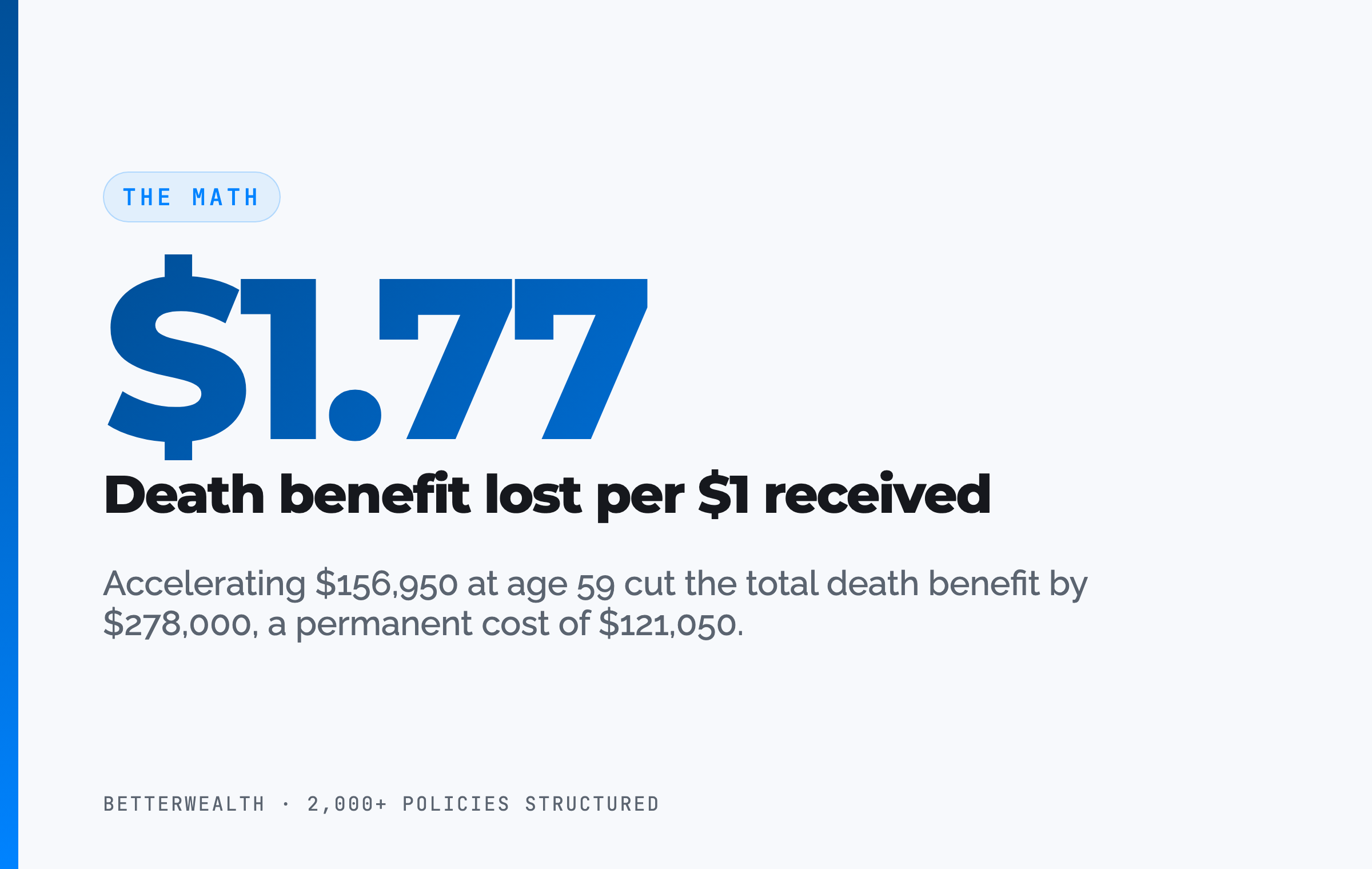
Accelerating cost $1.77 of death benefit for every $1.00 received in the illustration we reviewed, and that ratio is the number to hold onto. The example runs on a policy issued at age 40 and accelerated at age 59, on a $10,000 annual premium.
The available chronic illness benefit was $156,950 for the year, which works out to roughly $430 a day. That figure is not arbitrary. It tracks the per diem limitation on tax-free periodic payments under the tax code, which indexes annually, so the specific dollar amount will move. Benefits above the limitation can become taxable unless they reimburse actual incurred care costs.
Here is what changed on the ledger the moment the acceleration processed. The total death benefit dropped by $278,000. The cash value dropped, because cash value and death benefit move together inside the contract. The ongoing premium dropped, because the policy was no longer funding as much coverage. Net cost of receiving $156,950: $121,050 of death benefit that will never be paid.
Why age changes the answer
The discount narrows as the insured ages, because the carrier is discounting a payment it now expects to make sooner. At 59, a chronic claim is statistically early, so the carrier discounts hard. At 78, the same acceleration costs meaningfully less in surrendered death benefit, because the gap between today and expected payout has closed. A death benefit is a liability on the carrier's balance sheet, and the price of pulling it forward is a function of how long the carrier expected to hold it. The rider gets cheaper to use as it gets more likely you will need it.
06 / The alternativeIs a policy loan cheaper than accelerating?
For a need lasting under roughly ten years, a policy loan is usually cheaper than acceleration, and most policyholders never run the comparison. The loan is collateralized by cash value, it does not require a physician's certification, it can be repaid, and the death benefit stays intact except for the outstanding balance.
Run the same $156,950 both ways. Accelerating costs $121,050 of death benefit immediately and permanently. Borrowing $156,950 at an illustrative 6% and carrying it three years accrues roughly $29,980 of interest, and the death benefit reduction at that point is the balance owed, not a penny more. That is a $91,000 difference in favor of the loan, and the loan can be paid back.
The math does flip. Interest compounds and a care event can run long. At 6%, a $156,950 loan grows to about $281,060 after ten years, which is the point it passes the $278,000 that the acceleration cost outright. Loan rates vary by carrier and rate environment, so verify the current rate on your contract rather than assuming 6%.
Short need, borrow. Long need, run the crossover.
One more constraint on the loan side. Early in a policy there is not much cash value relative to death benefit, so a young policyholder facing a chronic event may simply not have enough collateral to borrow against. Acceleration reaches the death benefit directly, which is exactly why it exists. Cash value timing matters here, and we covered that timeline in detail in how soon you can borrow against a whole life policy.
Nobody in their right mind should plan to fund care from an accelerated death benefit. It is an option, and in some cases it is the only option, which is different from being the plan.
07 / Head to headHow the major whole life carriers compare
The carriers differ on method, on annual acceleration caps, and on whether underwriting can strip the chronic rider, and none of those differences are large enough to decide a carrier for you. The table sets out how five carriers we work with handle living benefits.
| Carrier | Payout method | Chronic rider cost | Notable detail |
|---|---|---|---|
| Penn Mutual | Discount. Death benefit falls by more than the amount paid | No additional premium | Terminal and chronic are separate riders. Illustration reviewed: $156,950 paid, $278,000 of death benefit removed. Annual acceleration capped near 25% of death benefit under current rider provisions |
| Lafayette Life | Lien. Advance reduces death benefit dollar for dollar, then accrues interest | No additional premium | Terminal and chronic combined in one Accelerated Benefit Plus rider. Up to $300,000 in periodic payments in the case reviewed. Annual acceleration percentage runs higher than Penn Mutual, near 40% under current provisions |
| Guardian | Lien | No additional premium for the accelerated benefit rider | Enhanced Accelerated Benefit Rider is separate from its priced long-term care rider. A substandard rating commonly removes the accelerated benefit rider |
| MassMutual | Terminal included; chronic and care benefits are priced riders | Terminal free. Chronic and long-term care access carry a charge | Most policies do not include a chronic rider unless it is specifically added. The paid version buys a more defined benefit |
| OneAmerica | Lien | No additional premium for terminal and chronic | Chronic rider availability depends on underwriting class and issue age. Asset Care and Annuity Care are the industry-leading hybrid care products if care is the actual goal |
Penn Mutual. The discount method puts the entire cost on the table at claim time with nothing accruing afterward, which some families prefer and some find brutal to look at. Penn Mutual is a direct recognition carrier with a guaranteed 0.65% loan-to-dividend spread in years 1 through 10 and 0% from year 11, which makes the loan alternative unusually predictable to model against acceleration. Our full Penn Mutual carrier review covers the rest of the product.
Lafayette Life, Guardian, and OneAmerica. All three use the lien, and all three are easier to read at the moment of claim because the arithmetic is subtraction rather than a discount formula. In the Lafayette Life case reviewed, a 67-year-old with an $837,000 death benefit could take a maximum lump sum leaving roughly $172,000 of residual death benefit on the chronic side, or about $115,000 on the terminal side where the advance runs larger. Interest starts accruing against the remainder from that day forward.
MassMutual. Pricing the chronic benefit is a defensible choice, and it produces a more clearly defined benefit than a free rider does. It also means the majority of MassMutual whole life policyholders do not have a chronic illness rider unless someone deliberately added one. Check your schedule pages.
None of these rider differences should decide your carrier. They are small. The dramatic difference shows up when you buy actual long-term care coverage instead, and get far more care per dollar with a smaller death benefit.
The frameworks behind 2,000+ policies, in one place.
The And Asset Vault holds the design frameworks, calculators, and carrier comparison work we use when we structure a policy and evaluate its riders. Free, email-gated, no spam.
Open the Vault08 / The frameworkWhere The And Asset framework fits
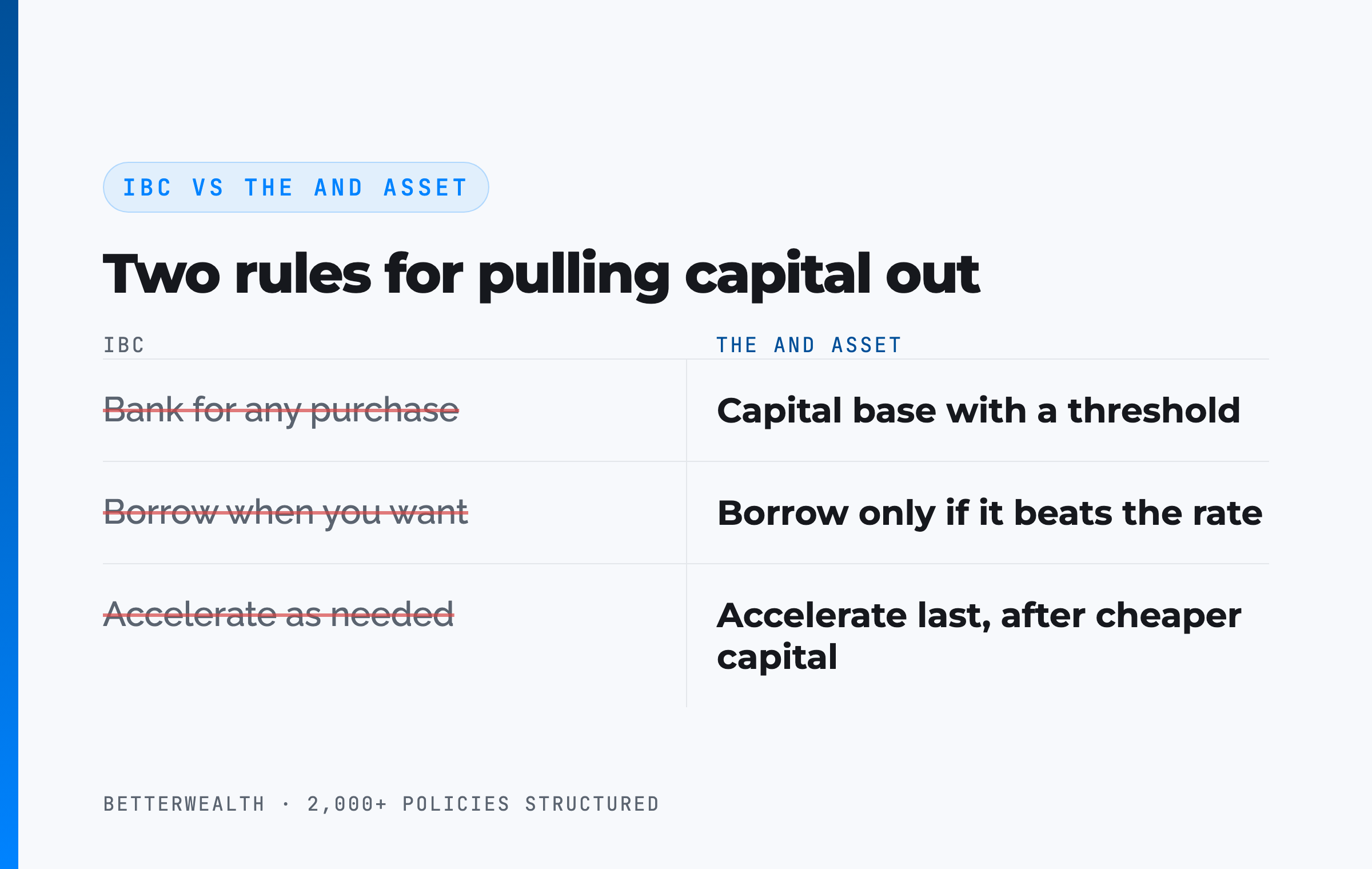
The And Asset treats the policy as a capital base, which means every dollar you pull out of it, by loan or by acceleration, has to clear a threshold before you pull it. Nelson Nash pioneered the idea of using whole life insurance as a personal banking system in Becoming Your Own Banker, and his insight about lost opportunity cost is the foundation we build on.
IBC says the policy is a personal banking system you can use for any purchase, care costs included. The And Asset says the policy is the capital base and the withdrawal has to justify itself, because the dollars have to beat what they cost. On a policy loan, that means the deployed capital produces a return greater than the carrier's loan rate. On an acceleration, it means you have already priced every cheaper source of capital you hold and this one still wins. It shares roots with IBC and operates on different principles.
Applied to living benefits, the discipline produces a specific order of operations. Other liquid assets first if the math favors them. Policy loan next, for a short-duration need, because it preserves the death benefit and can be repaid. Acceleration last, when the need is long, the loan would compound past the acceleration cost, or there is not enough cash value to borrow against.
The discipline is the strategy. Every time.
Marketers have ruined the way this gets explained, in both directions. One side sells living benefits as free long-term care, which they are not. The other side dismisses whole life as a product with no lifetime utility, which ignores that a properly structured policy is a capital base with several exits. The honest position is that the rider is worth having, worth understanding, and worth being the last door you open.
A composite: the business owner who used the loan and kept the rider
Consider a 44-year-old business owner, preferred non-tobacco, funding an overfunded whole life policy at $37,500 a year. This is a representative composite drawn from patterns across our book, not a single named client.
The design splits the $37,500 into $9,400 of base premium and $28,100 into the paid-up additions rider, a 25/75 ratio. Year one cash value comes in at $30,700, well below the $37,500 contributed, which is exactly what a real policy does. Cash value trails cumulative contributions through year four. At year five, $190,300 of cash value crosses $187,500 of cumulative premium. Any illustration promising break-even sooner is marketing fiction.
By year eight the policy holds $324,600 of cash value against $300,000 contributed, with a death benefit near $1,046,000. The owner borrows $146,000 against it to buy revenue-producing equipment. Over the following 44 months the equipment throws off $71,200 of additional net margin, against roughly $19,100 of accrued loan interest at an illustrative 6% on a declining balance. Net gain: $52,100, with the policy compounding on its full cash value net of mortality and expense charges the entire time.
The living benefit never entered that decision, and that is the point. The rider sat behind the policy as a backstop the whole way, costing nothing to hold, available if a health event ever made it the cheapest remaining door. The capital work got done with a loan that was repaid on schedule.
One dollar. Two jobs. Death benefit intact.
09 / Where people get this wrongThe four mistakes we see most
The most common mistake is treating a chronic illness rider as long-term care coverage, and it leads people to buy the wrong product entirely. Justin described a prospect who came in asking for chronic illness protection and turned out to already hold a large death benefit. What she actually wanted was care coverage. The right answer was a hybrid product built for that job, not another policy with a free rider on it.
The second mistake is selecting a carrier on rider language. Rider differences across the top mutuals are small. Policy design, funding flexibility, and long-term performance are large. Choosing a weaker product because its accelerated benefit provision reads better is optimizing the wrong variable, and we walk through what actually matters in how to structure a whole life policy.
The third is assuming the rider is on the contract. Underwriting class controls chronic rider availability at several carriers, and a substandard rating can remove it. Read the schedule pages before you count on it.
The fourth is accelerating without pricing the loan alternative. A three-year need funded by acceleration instead of a loan cost the family in our example roughly $91,000 of death benefit for no reason.
10 / The tradeoffsBenefits and the honest limits
Living benefits deliver real optionality at no carrying cost, and they come with four limits worth stating plainly. On the benefit side: no additional premium at most carriers, no restriction on how the money is spent, payments generally received income tax free for a terminally or chronically ill insured under IRC Section 101(g), and the simple fact that a household with no other care funding has something instead of nothing.
The limits. First, the benefit is capped by your death benefit, so it is finite by construction and cannot deliver the unlimited or lifetime benefit periods available on dedicated care policies. Second, it is not designed to maximize care coverage per premium dollar, and it does not. Third, repeated chronic claims grind the death benefit toward a small residual floor. Fourth, the acceleration cost is permanent, and no repayment mechanism exists to restore what you gave up.
Set against those limits is the reason we still want the rider on every policy we structure. It costs nothing to hold. We have seen it matter enormously for the people who ended up needing it, and their situations were not the ones anyone planned for.
Free to own. Expensive to use. Worth having anyway.
11 / The fitWho should count on living benefits, and who should not?
Living benefits belong in the plan of anyone who already holds permanent coverage, and they belong nowhere near the center of a care plan. If you are an entrepreneur or high-income earner using a policy as a capital base, the rider is a free option attached to an asset you own for other reasons. Hold it, understand it, and hope it stays unused.
If your actual objective is care coverage, buy care coverage. A dedicated long-term care policy or a hybrid such as OneAmerica's Asset Care produces far more benefit for the same dollars, with a smaller death benefit as the tradeoff. The tax planning around hybrid products can also be favorable, since qualified money can sometimes be repositioned into an annuity-based care product with care benefits coming out tax advantaged. Confirm the specifics with a tax advisor before acting on it.
Each tool has a job. Confusing the two is how people end up with the wrong asset and a surprise at claim time.
We will read your rider provisions to you in plain language.
We have structured more than 2,000 policies across all 50 states. We have seen this strategy work exactly as designed and we have seen it fail. On a discovery call, a practitioner looks at what you actually own, tells you what the riders would cost you to use, and tells you honestly whether anything should change. If you would rather learn first, the The And Asset and BetterWealth YouTube channels go deep on the mechanics.
Book a Discovery CallFAQWhole life living benefits questions
What are living benefits on a whole life insurance policy?
Living benefits are riders that let you access part of your death benefit while you are alive if a qualifying health event occurs. The three common forms are a terminal illness rider, a chronic illness rider, and a long-term care rider. The first two are usually included at no additional premium. The third is normally a paid rider with a defined benefit.
What is a chronic illness rider?
A chronic illness rider lets you accelerate part of your death benefit when a physician certifies you cannot perform two of six activities of daily living, or that you have a qualifying cognitive impairment. The money can pay for in-home care, facility care, or anything else. The wording of the trigger varies by carrier.
Does a chronic illness rider cost extra?
At most carriers the chronic illness rider carries no additional premium, so the rider is free to hold. The benefit is not free to use. When you accelerate, you pay through a reduced death benefit, an accruing lien, or both, plus a one-time activation charge that commonly runs $100 to $500.
How much does accelerating a death benefit actually cost?
In one carrier illustration, accelerating $156,950 at age 59 reduced the total death benefit by $278,000. That is a cost of $121,050, or roughly $1.77 of death benefit surrendered for every $1 received. The discount narrows as the insured gets older because the carrier is discounting a payment it expects to make sooner.
Is a chronic illness rider the same as long-term care insurance?
No. A chronic illness rider can pay for care, but it is capped by your death benefit and is not designed to deliver the most care coverage per dollar of premium. A dedicated long-term care policy or a hybrid product such as OneAmerica Asset Care produces far more care coverage for the same dollars, with a smaller death benefit.
Which whole life company has the best living benefits?
No carrier is far enough ahead on living benefits to justify choosing it for that reason alone. Lafayette Life, Guardian, and OneAmerica use the lien method, which is easier to read and does not cut the death benefit at claim beyond the amount advanced. Penn Mutual uses the discount method, which shows the full cost immediately. Ameritas is the one whole life carrier offering all three accelerated death benefit riders through its Care4Life suite. Choose a carrier on policy design, funding flexibility, and long-term performance.
Are accelerated death benefit payments taxable?
Accelerated death benefit payments for a terminally or chronically ill insured are generally received income tax free under IRC Section 101(g), and chronic illness payments made on a per diem basis are subject to an annual per diem limitation that indexes each year. Amounts above that limitation can be taxable unless they reimburse actual care costs. Confirm your specific situation with a tax advisor.
Should I take a policy loan or accelerate the death benefit?
For a short need, a policy loan is usually cheaper. Borrowing $156,950 at an illustrative 6% for three years accrues roughly $30,000 of interest and leaves the death benefit intact, against a $121,050 permanent cost to accelerate the same amount. The math flips over a long care event: at 6%, the loan balance passes the $278,000 acceleration cost somewhere around year 10.
What triggers a chronic illness rider?
The standard trigger is a licensed physician certifying that the insured cannot perform two of six activities of daily living: bathing, dressing, eating, toileting, transferring, and continence. Severe cognitive impairment is the alternative trigger at most carriers. Self-reporting is not accepted, and the carrier can require a third-party physician review.
Can I be denied a chronic illness rider?
Yes. Availability of the chronic illness rider depends on underwriting at the time of application. At OneAmerica and Guardian, a substandard rating commonly removes the chronic illness or accelerated benefit rider from the policy, and age limits apply at some carriers. Terminal illness riders are typically issued regardless of class.
What is The And Asset?
The And Asset is BetterWealth's framework for using a properly structured whole life policy as a capital base. You only borrow against it for an activity that produces a return greater than the carrier's loan cost, so your dollars do two jobs at once: the policy keeps compounding net of mortality and expense charges while the deployed capital earns its own return.
How is The And Asset different from infinite banking?
Infinite banking, as Nelson Nash taught it, frames a whole life policy as a personal banking system for any purchase. The And Asset says the policy is the capital base and every withdrawal of value has to clear a threshold: a loan has to fund something that beats the carrier's loan cost, and an acceleration has to beat every cheaper source of capital you hold. It is built on Nash's foundation and operates on different principles.
- IRC Section 101(g) (Cornell Law) gives the tax treatment of accelerated death benefits for terminally and chronically ill insureds.
- IRC Section 7702B (Cornell Law) defines qualified long-term care insurance contracts, the activities-of-daily-living trigger, and the per diem limitation.
- IRS Publication 525 covers the taxability of accelerated death benefits and per diem payments.
- NAIC publishes the model regulation governing accelerated benefit riders and carrier disclosure requirements.
- Nelson Nash, Becoming Your Own Banker, the origin of the infinite banking concept.
- AM Best for carrier financial strength ratings referenced in the comparison.
- BetterWealth resources: The And Asset book, the The And Asset YouTube channel, and the BetterWealth YouTube channel.
Works with clients across the country on policy design and in-force policy reviews, and walked through the Penn Mutual and Lafayette Life acceleration illustrations in the source video.
I founded BetterWealth to treat life insurance as the wealth and capital tool it actually is, rather than the product most people get sold. Our team has structured more than 2,000 policies across all 50 states. I wrote The And Asset and host the BetterWealth and The And Asset YouTube channels. If you own a policy and have never had the rider provisions explained to you honestly, book a discovery call. We will tell you what you own.