
I founded BetterWealth nearly a decade ago to treat life insurance as a wealth and capital strategy for entrepreneurs, business owners, and high-income earners. Our team has structured more than 2,000 policies across all 50 states. I wrote The And Asset and host the BetterWealth and The And Asset YouTube channels, where I sat down with Registered Social Security Analyst Thomas Drapala for this conversation.
Works with advisors and consumers through RSSA, the Registered Social Security Analyst designation program, running claiming analyses on spousal, survivor, dependent, and retirement benefits. He presented the "Understanding and Optimizing Your Social Security Benefits" framework in the source video.
Social Security optimization means claiming at the time that fits your full financial picture, not the time that produces the largest lifetime check. Roughly 96% of claimants leave money behind, an average of $140,000, because they decide without knowing which benefits they qualify for.
Most retirement planning attention goes to the assets that fluctuate, such as the 401(k) and the brokerage account. Social Security receives a fraction of that analysis, even though for many households it is the largest source of income in retirement and the only one that is backed by the federal government, adjusted for inflation, and paid for as long as you live. The claiming decision is usually made once, often in a single appointment, and it can be reversed only once, within the first year.
The Social Security claiming decision sets the size of a guaranteed income stream for two lifetimes, and 96% of people make it without running the numbers. According to Thomas Drapala, a Registered Social Security Analyst who works with advisors and consumers on exactly this decision, the average cost of that gap is $140,000 across a retirement.
For the entrepreneurs and high-income earners we work with at BetterWealth, this matters for a second reason. Social Security optimization is a capital allocation problem. Whether you can afford to wait for a larger benefit depends on what other capital you control and what that capital costs to access. That is where The And Asset, our framework for using a properly structured whole life policy as a capital base, enters the conversation.
This piece covers what the $140,000 figure represents, whether Social Security is actually running out of money, a seven-step process for making the claiming decision, the benefits people most often fail to claim, the honest math on delaying to 70, and where capital you control changes the answer.
- Roughly 96% of claimants leave money behind, an average of $140,000 across a retirement, mostly from unclaimed benefit types.
- Social Security is not disappearing. Payroll taxes would still cover about 80% of scheduled benefits after the 2033 projection.
- Waiting past full retirement age adds 8% a year until 70, and cost of living adjustments compound on top.
- An 8% larger check is not an 8% return. Break-even on delaying typically lands in the early 80s.
- Spousal and survivor benefits stop growing at full retirement age, so waiting until 70 to claim them loses money.
- Social Security leaves heirs nothing beyond a one-time $255 death payment. Capital you control is what you direct.
In the full conversation, Thomas walks through the actual benefit slides, including the dual entitlement math and the earnings test timeline, and answers my questions on the generalizations most people rely on:
01 / The ProblemWhy the Claiming Decision Deserves More Analysis Than Your Portfolio
The claiming decision deserves more analysis than most portfolio decisions because it is permanent, and it sets an income stream for two lifetimes that you cannot replicate on your own. A portfolio can be rebalanced every quarter. A Social Security claim can be withdrawn only once, only within the first 12 months, and only if you repay every dollar received.
Thomas frames the goal as optimizing rather than maximizing. Maximizing chases the largest possible lifetime check, and for some people that is the right answer. Optimizing asks a different question: given your other income, your fixed expenses, your spouse, your dependents, your health, and what you want to leave behind, which claiming date and which combination of benefits produces the best outcome for the whole household?
The distinction matters because the common advice collapses into three ages. Claim at 62, claim at full retirement age, or wait until 70. Every month between 62 and 70 is a legitimate option, and the right month often has nothing to do with the benefit amount on your own record.
"You can't take advice from your neighbor or a family member because their situation might not be yours." Thomas Drapala, RSSA
02 / The GapWhat Does the $140,000 Mistake Actually Represent?
The $140,000 figure represents the average lifetime benefit a household forgoes by claiming without analysis, and it applies to roughly 96% of claimants. It is an average, so some households lose far less and some lose far more. The dependent benefit example later in this piece exceeds $500,000 on its own.
Thomas attributes most of the gap to one cause: people do not know which questions to ask. They claim early because a headline said the program is going broke. They wait until 70 on a spousal benefit that stopped growing years earlier. They never file for a survivor or dependent benefit because they did not know it existed. Some receive conflicting answers from the Social Security Administration itself, which by law is not permitted to give advice. Call three times and you can get three different answers to the same question.
High-income households are not exempt. They paid the maximum into the system for decades, and a larger primary insurance amount means every claiming error is measured in larger dollars.
Bigger benefit, bigger mistake.
03 / The HeadlinesIs Social Security Running Out of Money?
No, Social Security is not running out of money, but it does face a projected shortfall that could reduce benefits by roughly 20% if Congress does not act. The distinction between those two statements is where a large share of the $140,000 gets lost, because people who believe the program is disappearing claim at 62 to get what they can while it lasts.
Social Security is a pay-as-you-go system. Workers pay 6.2% of wages up to the annual taxable maximum, employers match it, and the self-employed pay both halves. Those payroll taxes fund roughly 80% of scheduled benefits today. The remaining 20% comes from the trust fund reserve, which the SSA trustees project will be depleted around 2033. If nothing changes, ongoing payroll taxes still cover about 80% of scheduled benefits after that date.
The pressure is demographic. There are now fewer than three workers paying in for every beneficiary, down from five in 1960. A 65-year-old today can expect to live into their mid-80s on average, and many will collect benefits for 20 to 30 years.
Why Claiming Early Does Not Protect You From a Cut
A projected cut would apply across the board, to people already collecting and people who have not yet claimed. Claiming at 62 to lock in a benefit before a cut does not exempt you from the cut. It just locks in a smaller base for it to apply to. Eighty percent of $4,000 is still more than eighty percent of $2,800.
The program has been here before. The 1983 amendments addressed a similar projected shortfall and extended the reserve for decades. People who claimed early in the early 1980s out of fear made a permanent decision based on a temporary headline. My own read, shared on the show, is that benefits for current retirees and those near claiming age are politically very difficult to cut, and that any changes are more likely to land on younger workers. That is a judgment, not a guarantee, and it is not a reason to skip the math.
Plan for 80%. Do not panic-claim.
04 / How It WorksHow to Run the Social Security Claiming Decision, Step by Step
The claiming decision follows seven steps, and skipping any one of them is how households end up in the 96%. This is the sequence Thomas uses with clients, expanded with the checks we would run for an entrepreneur or high-income earner.
- Pull your full earnings record. Download your earnings history from your my Social Security account. Benefits are based on your highest 35 years of earnings, and any year short of 35 counts as a zero. Check every year for errors, especially self-employment years.
- Calculate your primary insurance amount. Your primary insurance amount, or PIA, is the monthly benefit at full retirement age. Earnings through age 59 are indexed for wage growth (a $2,831 year in 1974 counted as $18,382 in Thomas's example), and earnings from 60 on count at face value. The indexed average runs through a three-step formula. The statement estimate rests on assumptions and can miss by $500 a month or more.
- Map every benefit your household can claim. List retirement, spousal, ex-spousal, survivor, and dependent benefits for every person in the household. Check each against the family maximum, which caps total benefits paid on one worker's record.
- Separate fixed expenses from variable expenses. Fixed expenses (mortgage, insurance, food, utilities) should be covered by dependable income. Variable expenses (travel, hobbies) can be covered by income that carries market risk. Social Security belongs in the dependable column.
- Test claiming ages against both lifespans. Model 62, full retirement age, 70, and the months in between. Test each against the break-even age and against the expected lifespan of the spouse who will inherit the larger benefit as a survivor.
- Check the earnings test. If you will earn wages or self-employment income before full retirement age, compare your expected earnings to the annual limits before you claim.
- Decide, document why, and file every benefit. Choose a date, write down the reason, and file for every benefit type the household qualifies for. Dependent benefits are not paid automatically.
Full Retirement Age Is Not 65
Full retirement age depends on your birth year. It is 66 for anyone born from 1943 through 1954, rises by two months per birth year after that, and reaches 67 for anyone born in 1960 or later. Many people anchor on 65 because that is when Medicare eligibility begins. The two ages are unrelated, and confusing them is expensive, because the earnings test, the spousal cap, and the survivor cap are all tied to full retirement age.
Some confuse Social Security with required minimum distributions, which begin at 73. Thomas has had clients arrive at 71 believing they could wait until 73 to claim. Delayed retirement credits stop at 70, so every month past 70 is a month of benefits forgone with nothing added in return.
After 70, waiting only costs you.
Cost of Living Adjustments Apply Before You Claim
Cost of living adjustments apply to your primary insurance amount from age 62 whether or not you are collecting. In 2022 the adjustment was 5.9%, and in 2023 it was 8.7%. Many people rushed to claim after those announcements, believing they had to be collecting to receive the increase. They did not. The adjustment compounds onto the PIA either way, and every claiming-age benefit is calculated from the PIA. A person who turned 68 in 2023 while deferring received the 8% delayed credit plus the 8.7% adjustment.
05 / The Benefits People MissWhich Social Security Benefits Do People Fail to Claim?
The benefits people most often fail to claim are spousal, ex-spousal, survivor, and dependent benefits, and together they drive most of the $140,000 gap. Social Security is widely understood as a retirement benefit. It also functions as disability coverage, survivor income, and support for minor children, and each has its own eligibility rules and timing.
Spousal and Ex-Spousal Benefits
A spouse can claim up to 50% of the worker's primary insurance amount at full retirement age, even with no work history of their own. The marriage must have lasted at least one year. An ex-spouse qualifies after a marriage of at least 10 years, and Social Security enforces that line strictly: nine years and ten months is a denial. A current spouse cannot claim until the worker has filed for their own benefit, so the higher earner's claiming date controls when the spousal benefit can start. An ex-spouse divorced at least two years can claim without waiting for the worker to file.
The spousal benefit stops growing at full retirement age. It does not earn delayed retirement credits. On a $3,000 PIA, the full spousal benefit is $1,500 at full retirement age and still $1,500 at 70. Thomas has seen couples wait until 70 believing it was still growing and lose $60,000 over three years that they will never recover.
Spousal benefits stop growing at FRA.
Dual Entitlement
When a spouse has a work record of their own but a smaller benefit, Social Security pays their own benefit first and adds a spousal top-off. With a $1,500 spousal maximum and a $1,000 own benefit, the spouse receives $1,000 on their own record plus a $500 top-off. These are two separate benefits, so either or both can be reduced for claiming early depending on when each begins.
Survivor Benefits and the Switching Strategy
Survivor benefits can begin as early as 60, or 50 for a disabled survivor, and pay up to 100% of the deceased worker's benefit at the survivor's full retirement age. The marriage must have lasted nine months, or 10 years for a divorced spouse. Like spousal benefits, survivor benefits stop growing at full retirement age.
The Bipartisan Budget Act of 2015 closed the strategy that let people claim one of their own benefits while delaying the other. Many people still believe it works, often because older relatives who were grandfathered in passed the advice along. The switching option still exists for survivor benefits. A widow or widower can take the survivor benefit at 60 and let their own retirement benefit grow to 70, or take their own benefit at 62 and switch to the full survivor benefit at full retirement age. The higher benefit should generally be the one taken later. Missing this one strategy can cost thousands of dollars a month.
Social Security has no beneficiary. It pays a surviving spouse and minor children, then it stops. The one-time death payment is $255.
Dependent Benefits
Minor children of a retired, disabled, or deceased worker can qualify for benefits, including biological, adopted, and stepchildren, and in some cases dependent grandchildren. Thomas described a 35-year-old widow with children aged three and five. All three qualified for survivor benefits decades before anyone in the household was near retirement age.
In a second case, a 62-year-old client came in asking only whether to claim now or wait. Through questioning, Thomas learned he had three-year-old twins. Each qualified for $1,400 a month, $2,800 combined, for roughly 15 years. That is more than $500,000 the family had no idea existed. Dependent benefits are subject to the family maximum, which generally caps total benefits on one worker's record at 150% to 188% of the worker's PIA, so the real figure depends on the worker's own benefit. The benefit must be filed for. It is never paid automatically.
WEP and GPO Are Gone
The Social Security Fairness Act, signed in January 2025, repealed the Windfall Elimination Provision and the Government Pension Offset for benefits payable from January 2024 forward. Those rules reduced benefits for teachers, police officers, firefighters, and other public workers with pensions from jobs that did not pay into Social Security. The Government Pension Offset could cut a spousal or survivor benefit by two-thirds of the pension amount. People who never filed because they assumed the reduction would leave them with nothing may now be owed benefits, and eligible recipients were due retroactive lump-sum payments.
The Claiming Decision Changes When You Control Other Capital
A Conversation Fits If
- You are 55 or older with capital outside retirement accounts
- Your spouse is younger or healthier and will depend on a survivor benefit
- You are self-employed and unsure what you have paid into the system
- You can name a use for borrowed capital that clears the loan cost
It Does Not Fit If
- Social Security is your only retirement income
- You need the check at 62 to cover fixed expenses
- You want a savings account, not a capital base
- You want a rule of thumb instead of a calculation
If you are in the first column, a 30-minute conversation will show whether a properly structured policy has a role in your retirement income plan. If you are in the second, we will tell you that too.
Book a Discovery Call06 / The MathIs Delaying Social Security Really a Guaranteed 8% Return?
No, delaying Social Security is not a guaranteed 8% return, even though the 8% annual increase itself is guaranteed. The increase is 8% for each year you wait past full retirement age, up to 70, on a benefit that is backed by the federal government and adjusted for inflation. That is a strong feature. It is a larger check, and a larger check only becomes a return if someone collects it long enough.
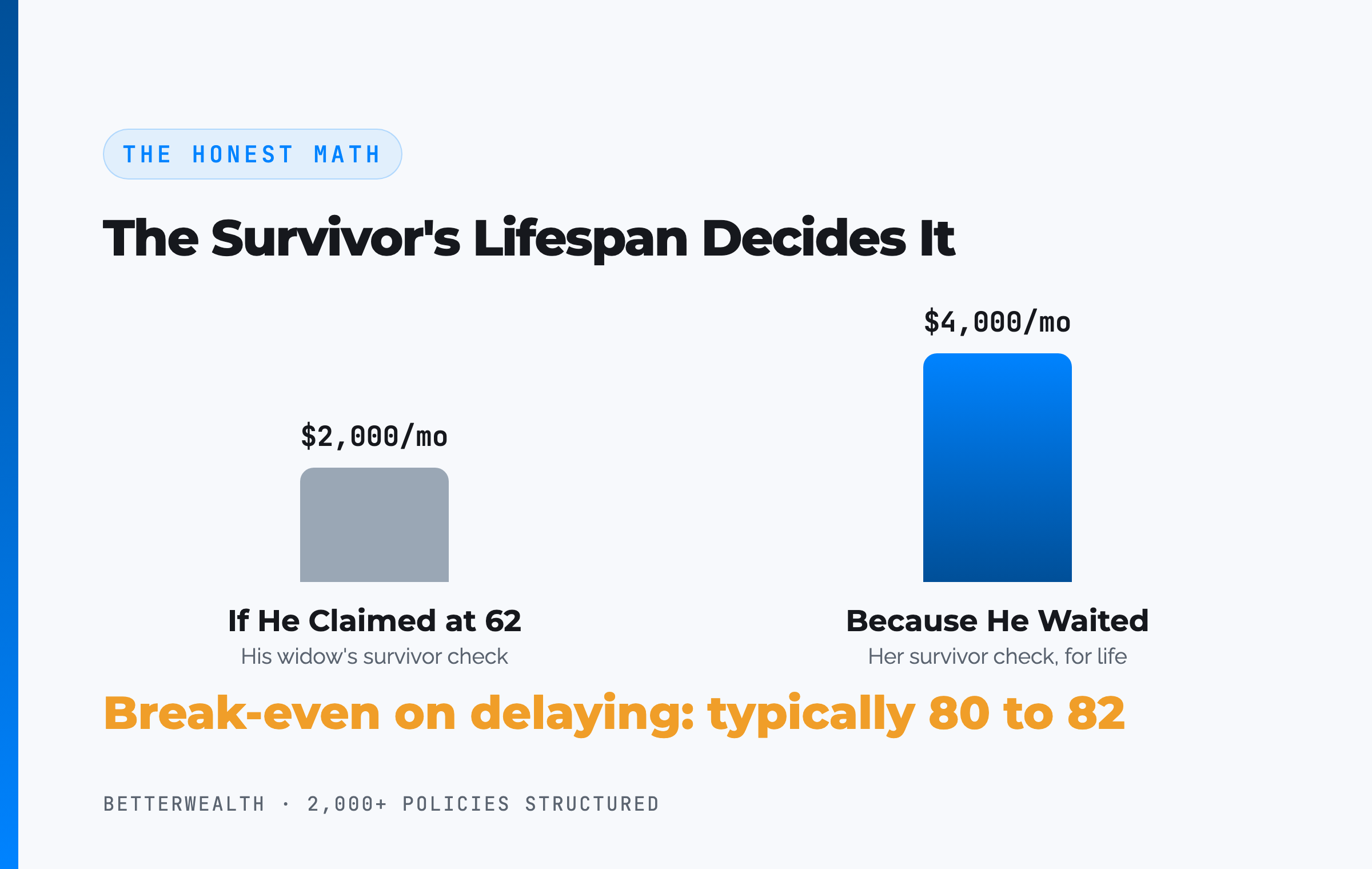
On the show, I floated the generalization that a healthy person with other assets should defer, because a guaranteed 8% plus inflation adjustments is hard to find anywhere else. The first half holds for many people. The second half needs tightening. Every year you wait, you give up a full year of benefits in exchange for a check that is 8% larger for the rest of your life. The typical break-even age for delaying falls between 80 and 82. Die before then and waiting cost you money. Live past it and waiting paid.
An 8% larger check is not an 8% return on your money. It becomes a return only if you, or your surviving spouse, live past the break-even.
Why the Survivor's Lifespan Usually Decides It
For married couples, the lifespan that matters most is often not the claimant's. When the higher earner dies, the surviving spouse steps up to the higher of the two benefits. The higher earner's claiming date sets the size of that survivor benefit for as long as the survivor lives.
Thomas shared his own family's case. His father-in-law was in poor health at 62 and wanted to claim immediately. Thomas asked whether it mattered that his wife, six years younger and in good health, had a strong survivor benefit. It did. He waited. He passed away a few years later, and his wife now collects $4,000 a month for life instead of $2,000. His own break-even never arrived. Hers will, many times over.
Claim for the longer lifespan.
When Claiming Early Is the Right Call
Thomas does not believe in generalizations, and the exceptions prove why. If leaving assets to children or grandchildren is a priority, claiming Social Security earlier can let you spend less of the assets that carry a beneficiary designation, because Social Security leaves nothing behind. The father of the twins claimed at 62 because the dependent benefits produced more total household income up front and he had other assets to rely on. If he had depended solely on Social Security, waiting would likely have been the better answer.
The "claim early and invest the difference" argument deserves scrutiny. For someone in their 60s, it swaps a guaranteed, inflation-adjusted income stream for market exposure at the point in life with the least time to recover. The more common version is worse: claiming at 62 and parking the money in a bank account that earns almost nothing, while the benefit that would have grown by 8% a year stays locked at its reduced level.
07 / The FrameworkWhere Capital You Control Changes the Claiming Decision
Capital you control changes the claiming decision because the main reason people claim early is that they need the income, and controlled capital can bridge that gap. Delaying from 67 to 70 means three years of living expenses must come from somewhere else. For most households, that somewhere is a 401(k) or IRA, where every withdrawal is ordinary income, or a brokerage account, which may have to be sold in a down market. A properly structured whole life policy is a third source, and it works differently.
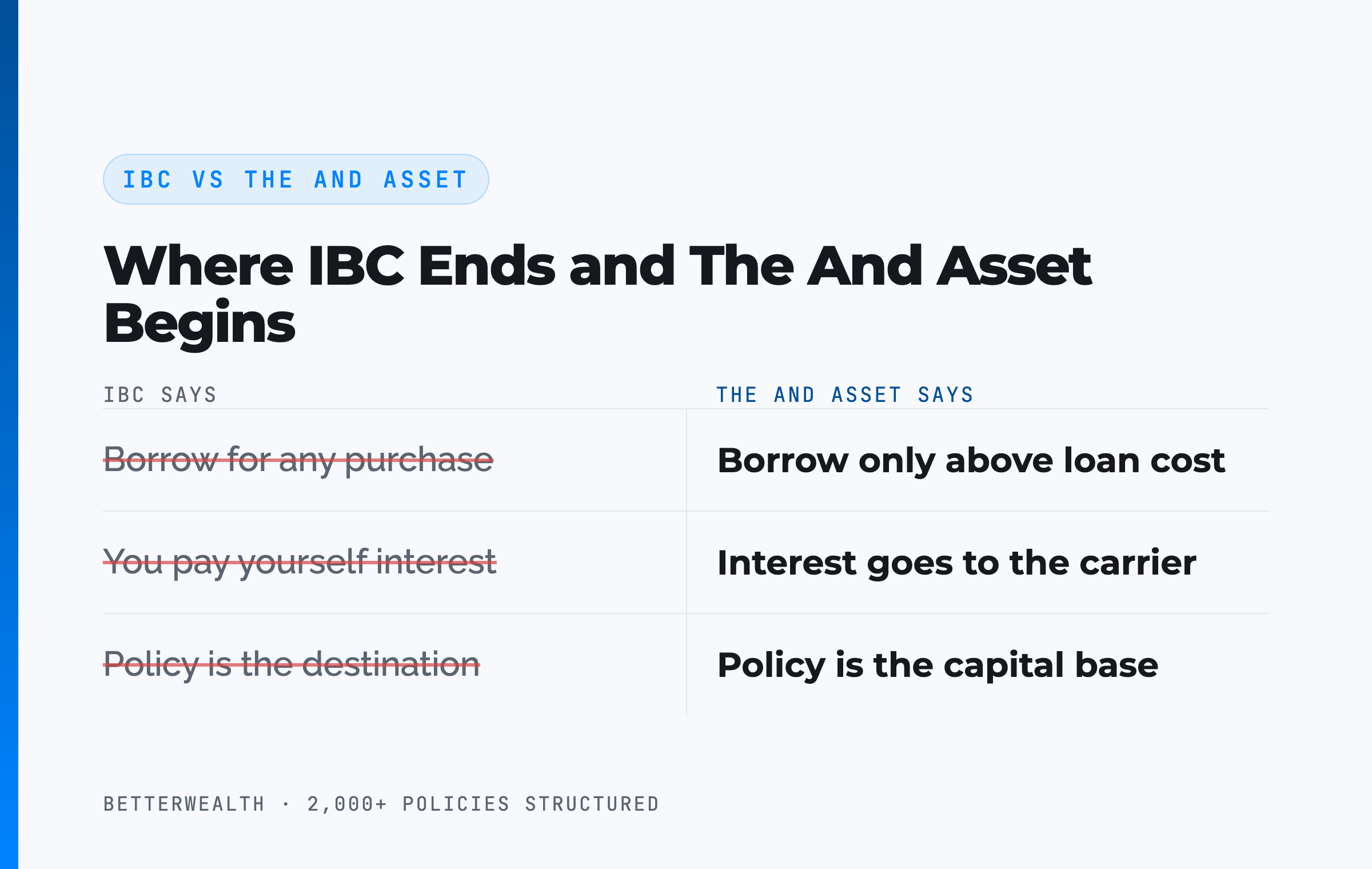
Nelson Nash pioneered using whole life insurance as a personal banking system in Becoming Your Own Banker. His core insight holds: you either lose money paying interest to outside lenders or lose money to the opportunity cost of capital sitting idle. We build on that foundation. The And Asset shares roots with IBC but operates on different principles.
Where IBC Ends and The And Asset Begins
IBC says you can use the policy as a personal bank for any purchase. The And Asset says you only deploy capital from the policy when the borrowed dollars produce a return greater than the carrier's loan cost. Anything less is an expensive way to spend money. Bridging to a larger Social Security benefit is one of the few uses where that test can be run in advance with defined numbers: the size of the benefit increase is fixed by law, the loan rate is known, and the break-even can be modeled against both spouses' lifespans before a dollar moves.
The test is not automatic. Delaying Social Security with a policy loan only clears the bar if the larger lifetime benefit, including the survivor benefit, is worth more than the loan interest plus the benefits you gave up. For a healthy couple with a younger spouse, it often is. For a single person in poor health, it often is not. Loan rates vary by carrier and rate environment. Many carriers fall in the 5 to 6% range at the time of writing, but treat any figure as a variable to verify.
You are not paying yourself interest on a policy loan. The interest goes to the carrier. Your return is what the borrowed capital accomplishes while the policy keeps compounding.
While the loan is outstanding, the policy continues to compound on its cash value at the dividend rate net of mortality and expense charges. That is the structural feature that separates a policy loan from a 401(k) withdrawal: the capital base is not reduced to fund the bridge. It is used as collateral. We cover the timing mechanics in How Soon Can You Borrow Against Whole Life Insurance.
A Composite: The Business Owner Who Bridged From 67 to 70
Consider a business owner who began funding a whole life policy at 49, preferred non-tobacco, at $63,000 a year on a 30/70 base/PUA design: $18,900 of base premium and $44,100 of paid-up additions. His full retirement age is 67 and his primary insurance amount is $3,412 a month. His wife is six years younger and in good health. This is a representative composite, not a single named client.
Through year four, cash value trails cumulative contributions: $247,800 against $252,000 paid in, exactly as a real policy should. At year five it crosses. By 67, after 18 years of funding and $1,134,000 contributed, the policy holds $1,412,600 of cash value.
Instead of claiming $3,412 a month at 67, he borrows $40,944 a year for three years, $122,832 in total, which replaces the benefit he is deferring. At an illustrative 6% loan rate, the balance reaches $138,171 at 70, and he repays it from business distributions on a 41-month schedule. Total loan interest across the bridge and the repayment comes to roughly $30,300. The policy compounds on its full cash value the entire time.
Here is the honest math. He gave up $122,832 of benefits and paid about $30,300 in interest, a total cost of roughly $153,100. In return his check is $819 a month larger, $9,828 a year before cost of living adjustments. On his own lifespan alone, the loan cost pushes break-even to about 83, later than the early-80s figure for delaying without borrowing. The decision clears the bar on his wife's lifespan. If he dies at 78, he has collected $78,624 more from 70 to 78. If she lives to 91, she collects $819 a month more for 19 years as a survivor, another $186,732. The household receives $265,356 more, before adjustments, for a cost of roughly $153,100.
His lifespan is the risk. Hers is the return.
The Frameworks Behind 2,000+ Policies, in One Place
The And Asset Vault holds the calculators, design frameworks, and structuring decisions we use when a client is weighing a policy loan against other sources of capital, including bridging retirement income. Free, email-gated, no spam.
Open the Vault08 / The TrapsWhat Happens If You Get the Claiming Decision Wrong?
If you get the claiming decision wrong, you either lock in a permanently smaller benefit or, in the worst cases, receive an overpayment notice demanding money back years later. More than a million Americans receive an overpayment notice each year, with balances ranging from $50 to $250,000. There is no statute of limitations on recovery. Social Security can take years to identify an overpayment, and the notice arrives after the money has been spent on a fixed budget.
The options at that point are limited. Repay in a lump sum, which most recipients cannot do, or have part of each monthly check withheld until the balance is recovered. Thomas cites withholding of 50% of the check, and recipients can request a lower rate. Contesting the notice often costs more than the amount owed.
How Overpayments Happen
Overpayments come from claiming a benefit you were not eligible for, failing to report a change, or following bad guidance. Common triggers include claiming an ex-spousal benefit without meeting the criteria, a divorce that is never reported while a spousal benefit continues, working while collecting before full retirement age and exceeding the earnings test, and disability benefit reporting errors. Some come directly from incorrect information given by Social Security representatives.
By the time the notice arrives, it is too late.
The Earnings Test
The earnings test limits how much you can earn from work while collecting benefits before full retirement age. Only wages and net self-employment income count. Pensions, annuities, rental income, and investment income do not. The video cites two limits: $24,480 for the years from 62 through December of the year before you reach full retirement age, and $65,160 in the calendar year you reach it, counted only through the month before your full retirement age. The limits adjust annually, so verify the current year's figures on ssa.gov. Once you reach full retirement age, the limit disappears.
For entrepreneurs still drawing a salary in their early 60s, this alone often moves the realistic claiming window from 62-to-70 to full retirement age-to-70.
The One-Year Withdrawal Rule
If you claim and regret it, you can withdraw your application once, within 12 months of first claiming. You must repay every benefit received. Nine months into a $3,000 monthly benefit, that is $27,000 owed back to the Social Security Administration. After the first year, the decision is effectively set.
09 / The FitWhere Social Security Fits in a Broader Capital Strategy
Social Security fits into a broader capital strategy as the dependable floor under your fixed expenses, and the rest of your capital should be arranged around that floor. Thomas's framework pairs dependable income with fixed expenses and variable income with discretionary spending. If the market cuts a 401(k) in half, the mortgage, insurance, and groceries are still covered by income that does not move with the market.
Timing matters as much as structure. Thomas recommends wage earners start planning by 55, and self-employed business owners by 45 to 50. Business owners who have paid themselves through distributions rather than salary may have paid in less than they assume, and they need years, not months, to correct it. Working two or three more years at a current salary can replace zero or low years in the 35-year calculation and raise a benefit by $300 to $400 a month for life.
For the entrepreneurs and high-income earners we work with, the claiming decision sits alongside decisions about which accounts to draw from first and in what order. We compare those accounts directly in Infinite Banking vs 401(k), and cover how high earners use policies alongside maxed retirement accounts in Whole Life Insurance for High-Income Earners.
10 / Head to HeadSocial Security Against the Other Retirement Income Sources
Compared to the other income sources in a retirement plan, Social Security wins on guarantees and inflation protection and loses on control, access, and legacy. The table compares it to a 401(k), a properly structured And Asset policy, and a taxable brokerage account on the dimensions that decide how they work together.
| Dimension | Social Security | 401(k) / IRA | And Asset Policy | Taxable Brokerage |
|---|---|---|---|---|
| Reward for Waiting | 8% a year past FRA to 70: $3,412/mo at 67 becomes $4,231/mo at 70 | Market dependent; no guaranteed increase | Compounds at the dividend rate net of mortality and expense charges, even while borrowed against | Market dependent; no guaranteed increase |
| Access | No earlier than 62 (60 for survivors); one withdrawal within 12 months | 10% penalty plus ordinary income tax before 59½, with exceptions | Policy loans against cash value, typically 30 days after funding | Fully liquid, settles in days |
| Tax on Income | Up to 85% of benefits taxable, depending on other income | Traditional account withdrawals taxed as ordinary income | Policy loans are not taxable income when the policy is structured under IRC 7702 and kept in force | Capital gains and dividends taxed each year |
| Control | Rules set by Congress; claiming date is effectively permanent | Contribution and withdrawal rules set by Congress | You set the loan amount and repayment schedule | Full control, no guarantees |
| What Heirs Receive | $255 one-time payment; survivor income ends at the survivor's death | Remaining balance; most non-spouse heirs must empty it within 10 years, and traditional balances are taxed as ordinary income | Death benefit, generally received income tax free | Remaining balance with a step-up in cost basis |
Reward for waiting. Social Security's 8% delayed credit is guaranteed and defined by law, which no market account can match. The catch is that the reward is a larger check, not a larger balance, so it is only worth what you collect.
Access and tax. Funding a three-year bridge from a 401(k) means taking ordinary income withdrawals that can also push more of your eventual Social Security benefit into taxable territory. A policy loan against a properly structured policy is not taxable income while the policy stays in force, which keeps the bridge from inflating your taxable income in those years.
Legacy. Social Security is the only source in the table that leaves nothing to children or grandchildren. That is why claiming decisions and legacy decisions have to be made together, and why the asset that carries a beneficiary designation should be the one you protect.
An Honest 30 Minutes on How Your Capital Fits Around Social Security
We have structured more than 2,000 policies across all 50 states. We have seen policies bridge retirement income exactly as designed, and we have seen people borrow against a policy for uses that never cleared the loan cost. On a discovery call, we look at your situation, run the numbers, and tell you honestly whether The And Asset belongs in your plan. No pressure, no pitch. If you would rather learn first, the The And Asset and BetterWealth YouTube channels go deep on the math.
Book a Discovery CallFAQSocial Security Optimization Questions
What Is Social Security Optimization?
Social Security optimization means choosing the claiming date and benefit types that fit your whole financial picture, including your spouse, dependents, health, other income, and goals for heirs. It is different from maximizing, which only chases the largest lifetime check.
How Much Money Do People Leave on the Table by Claiming Wrong?
Registered Social Security Analyst Thomas Drapala puts the average at $140,000 across a retirement, and says it applies to about 96% of claimants. Most of it comes from benefit types people never file for and from claiming ages chosen without analysis.
Is It Better to Claim Social Security at 62, 67, or 70?
No single age is correct for everyone, and the answer can be any month between 62 and 70. Health, a spouse's age and survivor needs, whether you are still working, dependent children, and your other income all move the decision.
Is Delaying Social Security a Guaranteed 8% Return?
No. Waiting past full retirement age guarantees a benefit 8% larger for each year of delay up to 70, but that larger check only becomes a return if you or a surviving spouse live past the break-even, which typically lands in the early 80s.
Is Social Security Running Out of Money?
No. The trustees project the retirement trust fund reserve will be depleted around 2033, but ongoing payroll taxes would still cover roughly 80% of scheduled benefits. Without action from Congress, the risk is a cut of about 20% across the board, not an end to the program.
Can I Undo My Social Security Claiming Decision?
Yes, once, and only within 12 months of first claiming. You can withdraw your application, but you must repay every dollar received, so someone nine months into a $3,000 monthly benefit would owe $27,000 back.
What Benefits Do People Forget to Claim?
The most commonly missed benefits are spousal and ex-spousal benefits, survivor benefits for younger widows and widowers, and dependent benefits for minor children of a retired, disabled, or deceased worker. Dependent benefits must be filed for, and they are subject to a family maximum.
How Much Can I Earn While Collecting Social Security?
Before full retirement age, the earnings test applies to wages and net self-employment income, with limits quoted in the video of $24,480 for the years before your full retirement age year and $65,160 in the year you reach it. The limits adjust annually, and they disappear once you reach full retirement age.
What Happened to WEP and GPO?
The Social Security Fairness Act, signed in January 2025, repealed the Windfall Elimination Provision and the Government Pension Offset for benefits payable from January 2024 forward. Teachers, police officers, firefighters, and other public workers with non-covered pensions who never filed may now be eligible.
What Is The And Asset?
The And Asset is BetterWealth's framework for using a properly structured whole life policy as a capital base. You only borrow against it for an activity that produces a return greater than the carrier's loan cost, so your dollars do two jobs at once: the policy keeps compounding while the deployed capital earns its own return.
How Is The And Asset Different From Infinite Banking?
Infinite banking, as Nelson Nash taught it, frames a whole life policy as a personal banking system for any purchase. The And Asset shares those roots but operates on a different principle: you only deploy borrowed capital when the return clears the carrier's loan cost. The policy is the capital base, not the destination.
Can a Whole Life Policy Help Me Delay Social Security?
It can, if the numbers clear. A policy loan can cover living expenses between full retirement age and 70 while the benefit grows, but the loan cost has to be weighed against the larger benefit and the break-even age, and the survivor's lifespan usually decides whether it pays.
Does Social Security Pass to My Heirs?
No. Social Security pays eligible survivors such as a spouse or minor children, plus a one-time $255 death payment, and then it stops. Nothing is left for children or grandchildren as an inheritance, which is why assets with a named beneficiary play a different role in the plan.
- Social Security Administration: Retirement Age and Benefit Reduction. Full retirement age by birth year and reductions for claiming early.
- Social Security Administration: Receiving Benefits While Working. The current earnings test limits and which income counts.
- Social Security Administration: Survivor Benefits. Eligibility for widows, widowers, divorced spouses, and children, and the lump-sum death payment.
- Social Security Trustees Reports. Trust fund depletion projections and the share of benefits payable from ongoing payroll taxes.
- Social Security Fairness Act (H.R. 82, 118th Congress). The repeal of the Windfall Elimination Provision and Government Pension Offset.
- Nelson Nash, Becoming Your Own Banker. The origin of the infinite banking concept.
- IRC Section 7702 (Cornell Law). The tax code provision behind the tax treatment of life insurance cash value and loans.
- BetterWealth resources: The And Asset book, the The And Asset YouTube channel, and the BetterWealth YouTube channel.
I founded BetterWealth to treat life insurance as the wealth and capital tool it actually is. Our team has structured more than 2,000 policies across all 50 states. I wrote The And Asset and host the BetterWealth and The And Asset YouTube channels. If you want an honest read on how your capital fits around your Social Security decision, book a discovery call. We will tell you if a policy does not belong in your plan.