I founded BetterWealth nearly a decade ago to treat life insurance as a wealth and capital strategy for entrepreneurs, business owners, and high-income earners. Our team has structured 2,000+ policies. I wrote The And Asset and host the BetterWealth and The And Asset YouTube channels.
David has trained financial advisors for 25 years and presented the Mr. and Mrs. Jones example in this article at a recent BetterWealth event.
Retiring in the 0% tax bracket means drawing income from Roth accounts and properly structured life insurance, which do not count as provisional income, while keeping traditional IRA withdrawals under the standard deduction and the Social Security provisional income thresholds. David McKnight's example moves a 50-year-old couple there by repositioning $40,000 per year over 15 years.
Most retirement plans are built to maximize a balance. Few are built to manage the rate at which that balance gets taxed on the way out. A couple who defers every available dollar into a traditional IRA and a 401(k) for thirty years ends up with an account that carries a deferred tax bill on every withdrawal, at whatever rate applies in the year they take the money.
The size of a tax-deferred account matters less than the tax bracket it forces you into once distributions begin. A $1.6 million IRA sounds like a win. Required minimum distributions on that balance can push a retired couple into higher marginal brackets and make their Social Security benefits taxable for the rest of their lives.
David McKnight, author of The Power of Zero, presented a worked example of this problem at a recent BetterWealth event. His answer is a plan to retire in the 0% tax bracket: shrink the tax-deferred bucket, fill the tax-free bucket, and keep taxable income under the standard deduction. One of his tax-free buckets is cash value life insurance, which is the tool we have structured 2,000+ times.
We agree with most of his math and disagree with some of his shorthand. What follows is his example in full dollars, the eight steps in order, the tradeoffs a sales presentation tends to skip, and how The And Asset, our framework for using a whole life policy as a capital base, treats the same policy differently during your working years.
- A $500,000 traditional IRA growing at 8% reaches roughly $1.6 million in 15 years, all of it taxable on withdrawal.
- Converting $500,000 to a Roth in one year at a 40% rate creates a $200,000 tax bill.
- A 72(t) distribution lets a 50-year-old couple move about $25,000 per year out of an IRA without the 10% penalty.
- Roth withdrawals and properly taken life insurance distributions do not count as provisional income for Social Security taxation.
- IRA withdrawals up to the standard deduction, projected at $50,166 for this couple at 65, owe no federal income tax.
- The And Asset adds one rule: borrow against the policy only when the deployed dollars beat the carrier's loan cost.
David builds this plan one bucket at a time on screen, and hearing him walk the room through each number makes the sequence easier to follow than any table:
01 / The ProblemWhy Is a Large Tax-Deferred Balance a Problem?
A large tax-deferred balance is a problem because the IRS sets a minimum you must withdraw each year, and that forced income is taxed at ordinary rates on top of everything else you earn. McKnight's example couple, Mr. and Mrs. Jones, are both 50, earn $150,000 a year, and hold $500,000 in a traditional IRA. They want to retire at 65.
At 8% growth, the rule of 72 doubles that IRA to $1 million in nine years. Six years later, at 65, it sits near $1.6 million. Their current advisor would congratulate them and offer to manage it for one more point of return. McKnight sees a liability growing alongside the asset: required minimum distributions land the couple in higher marginal brackets and count as provisional income, which is the measure the IRS uses to decide whether Social Security benefits are taxed. Under current law those distributions begin in the early-to-mid 70s, so the squeeze comes from a $1.6 million balance that keeps growing between 65 and the start age.
The conventional conversation never asks the tax question. It asks whether 7% can become 8%.
"I'm not so much concerned with what's in that IRA today. What keeps me awake at night is what that IRA is going to be worth 15 years from now." David McKnight
02 / The FrameworkWhat Does Retiring in the 0% Tax Bracket Actually Mean?
Retiring in the 0% tax bracket means every dollar you spend in retirement arrives without federal income tax, because each source either is not taxable income or fits under your standard deduction. McKnight sorts every asset into three buckets: taxable (brokerage and savings accounts), tax-deferred (traditional IRAs and 401(k)s), and tax-free (Roth accounts and properly structured life insurance).
The plan has four income streams, and each one has to clear the same test:
- Roth accounts. Qualified withdrawals after 59½ are not taxed and do not count as provisional income.
- Cash value life insurance. McKnight calls it a LIRP, a life insurance retirement plan. Distributions taken the right way from a policy that is not a Modified Endowment Contract do not show up as reportable income.
- The traditional IRA. Withdrawals are taxable, so the plan caps them at the standard deduction. Income up to that amount owes no federal tax.
- Social Security. If the first three streams keep provisional income under the thresholds, the benefit is not taxed either. IRA withdrawals count toward that test, and the thresholds are lower than the standard deduction and are not indexed, so a full $50,166 withdrawal can still expose part of the benefit to tax.
McKnight's case for aiming at zero is a forecast: if tax rates rise, a retiree at 0% is unaffected, because double zero is still zero. Treat that as his projection about future law. The arithmetic of the four streams holds either way.
Zero is a design target, and it has to be built.
03 / How It WorksHow Do You Move $500,000 Toward the 0% Tax Bracket?
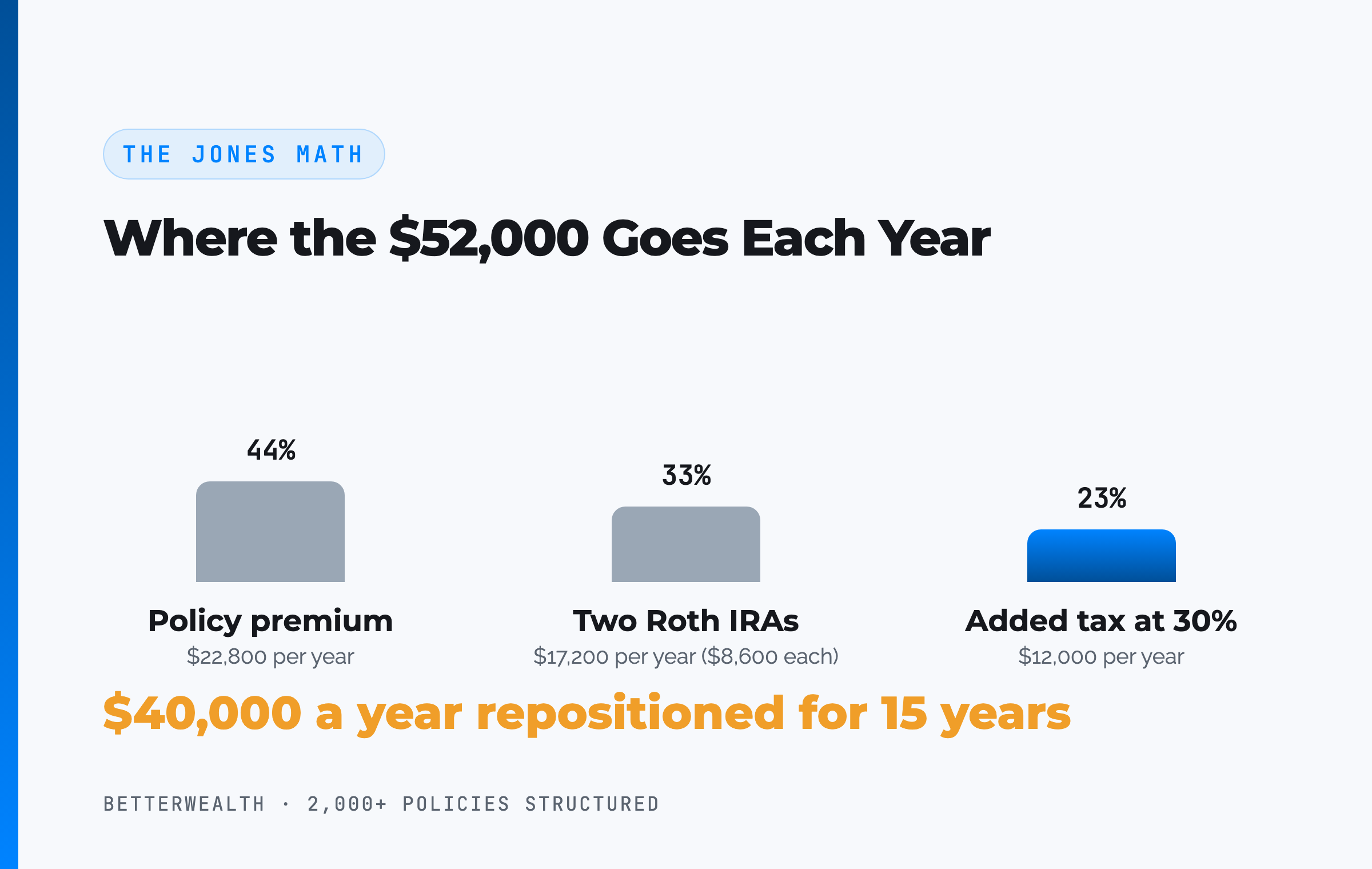
You move toward the 0% tax bracket by freeing up cash flow that currently feeds the wrong buckets and redirecting it, in a fixed order, to the tax-free ones. For the Joneses, that is eight steps over 15 years.
- Project the tax-deferred balance. Start with where the IRA is headed. $500,000 at 8% is about $1.6 million at 65. That projection is the number the rest of the plan is built to prevent.
- Start a 72(t) distribution. A full Roth conversion in one year would cost $200,000 at a 40% rate, and paying that tax from the IRA before 59½ adds a 10% penalty. Section 72(t) allows penalty-free withdrawals before 59½ as long as they are substantially equal yearly payments lasting at least five years or until 59½, whichever is longer. For two 50-year-olds, McKnight uses about 5%, or $25,000 per year.
- Right-size the emergency fund. The couple holds $150,000 in taxable mutual funds as an emergency fund. On $150,000 of income, McKnight puts the right number near $75,000. Shifting $6,000 per year of growth and principal gets them there by 65.
- Redirect unmatched 401(k) contributions. They put 10% of income into a 401(k) with no employer match. His rule: contribute up to the match and not one dollar beyond it. With no match, the full $15,000 per year is redirected, because adding to tax-deferred accounts while draining the IRA is a conflicted strategy.
- Recapture insurance premiums. They pay $2,000 per year for term life and $4,000 for long-term care insurance. Both risks still need covering. The plan covers them inside the policy in step 7, which frees $6,000 per year. Never cancel existing coverage until the replacement is approved and in force.
- Pay the added tax from the freed-up dollars. The total freed is $52,000 per year. The 72(t) distribution and the lost 401(k) deduction add about $40,000 of taxable income. At 30%, which is McKnight's combined federal and state assumption and not the federal bracket for $150,000 of joint income, that is $12,000 of tax, paid from the $52,000 so the couple's lifestyle does not change. That leaves $40,000 per year.
- Fund the Roth IRAs, then the policy. Two 50-year-olds can contribute $8,600 each to a Roth IRA in 2026, or $17,200. The remaining $22,800 per year funds a cash value life insurance policy with a rider that can advance the death benefit for long-term care.
- Draw the IRA under the standard deduction. At 65, the couple takes IRA withdrawals only up to the standard deduction, projected at $50,166, and fills the rest of their spending from the Roth accounts and the policy. Social Security stays untaxed provided the withdrawal plus half of Social Security also stays under the provisional income thresholds, which are lower than the standard deduction and are not indexed.
One caveat on step 2. McKnight says the goal of the 72(t) is to hold the IRA near $500,000 until 65. A $25,000 distribution alone does not offset 8% growth on $500,000, which is $40,000 in the first year. In practice the balance still needs additional Roth conversions after 59½, when the penalty no longer applies. The presentation simplifies this, and a real plan has to model it year by year.
A Tax-Free Bucket Fits a Specific Person.
It Fits You If
- Most of your savings sit in tax-deferred accounts
- You can fund a policy for 10+ years without touching it early
- You earn too much to contribute to a Roth IRA directly
- You can name a use for capital that beats the loan cost
It Does Not Fit You If
- You cannot cover the added tax during the transition
- You need the money back inside five years
- You want a savings account, not a capital strategy
- You are carrying high-interest debt
If you are in the first column, a 30-minute conversation will show whether a policy belongs in your plan. If you are in the second, we will tell you that too. No pressure, no pitch.
Book a Discovery Call04 / The Insurance BucketWhat Is a LIRP, and What Are Its Real Limits?
A LIRP is a cash value life insurance policy funded for tax-advantaged accumulation and retirement income, and its limits are tighter than the stage version suggests. McKnight uses the label for whole life, universal life, variable universal life, and indexed universal life. At BetterWealth we work with overfunded whole life, so that is the lens here.
McKnight lists five features of the bucket. Each is real, and three need tightening.
Access Before 59½ Without Penalty
Accurate. Life insurance cash value is governed by a different part of the tax code than IRAs and 401(k)s, and there is no age-based penalty on policy loans.
No Tax on Growth, No Reportable Income on Distributions
Accurate, with structure. Cash value grows without annual 1099s. Withdrawals up to what you paid in and loans against the policy are generally not reportable income, provided the policy is not a Modified Endowment Contract and stays in force. If a policy with a large loan lapses, the gain can become taxable. "If you take it out the right way" is carrying real weight in his sentence.
"No Contribution Limits"
Loose. There is no fixed annual dollar cap like the Roth IRA's $8,600. There is a ceiling tied to the death benefit: fund a policy past the MEC limit and loans and withdrawals lose their favorable tax treatment. Every design we build is funded up to that limit and not past it.
No Income Limits
Accurate. Per McKnight, a married couple above roughly $252,000 of modified adjusted gross income can no longer contribute to a Roth IRA directly. A policy has no income test, which is why high earners look at it once the Roth door closes.
"No Legislative Risk"
Loose. McKnight notes Congress changed the rules on these policies in 1982, 1984, and 1988, and each time existing policies kept the old rules. That is a favorable history. It is not a guarantee about any future change.
The cost of admission is the insurance itself. The cost of insurance and expenses are built into the premium and the dividend, which is why early cash value trails what you pay in. For the Joneses, that cost replaces the $6,000 they already spend on term and long-term care coverage. In McKnight's example, a $400,000 death benefit with a chronic illness rider could pay about $100,000 per year for four years if one of them could no longer perform basic activities of daily living, and if they never need care, the death benefit still goes to their heirs. Rider terms, discounts, and availability vary by carrier and product.
"No contribution limits" is how this gets sold. The MEC limit is the limit, and the early years cost you liquidity. A policy is a long-horizon tool or it is the wrong tool.
05 / Our FrameworkWhere a LIRP Ends and The And Asset Begins
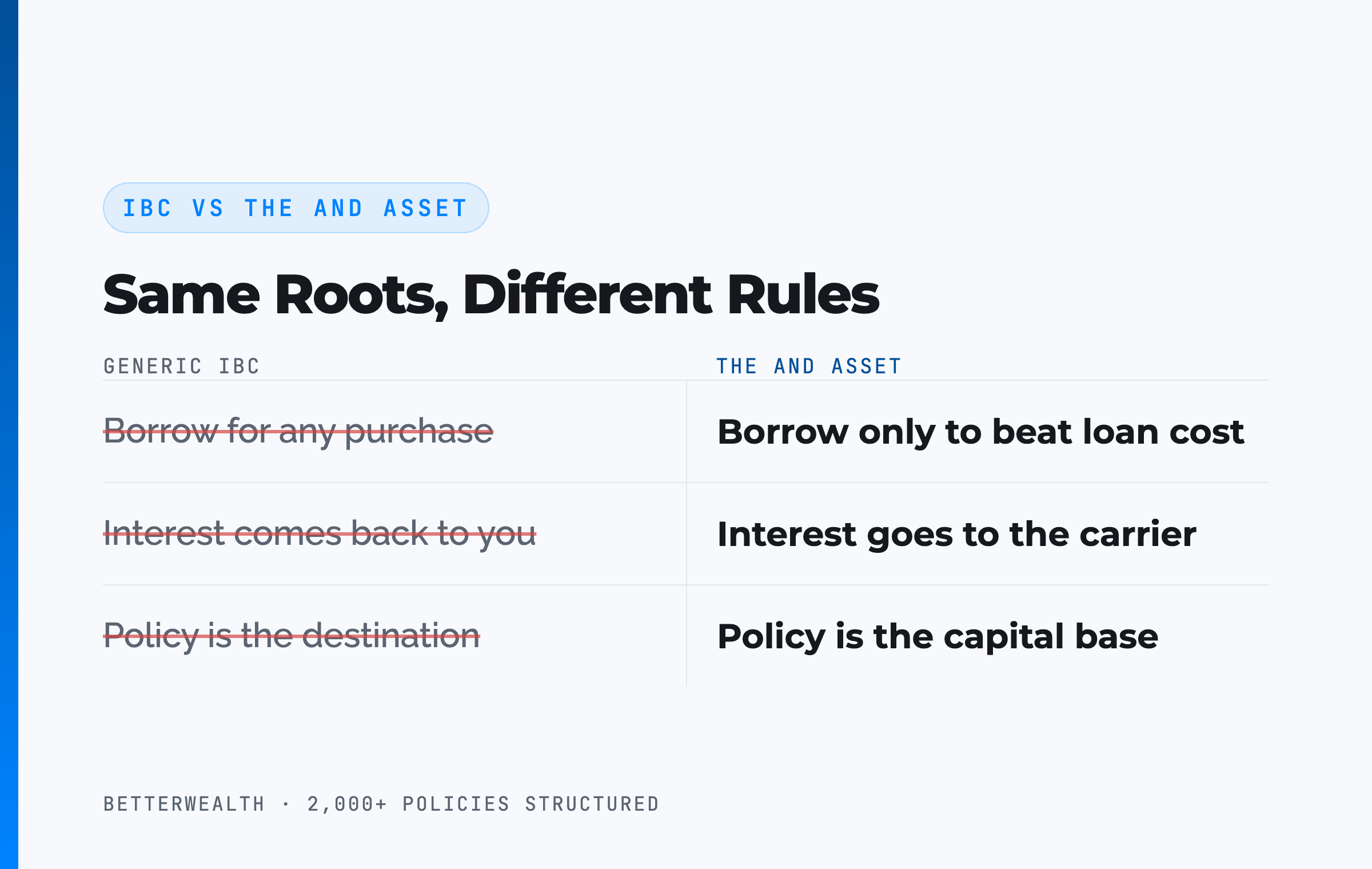
A LIRP treats the policy as a retirement income bucket, and The And Asset treats the same policy as a capital base you can put to work for the 15 or 20 years before retirement. Both rely on the same tax treatment. They differ on what the policy is for while you are still earning.
The idea of borrowing against a whole life policy traces to Nelson Nash, who pioneered the infinite banking concept in Becoming Your Own Banker. His insight holds: you either pay interest to outside lenders or you give up what your own capital could have earned. We respect that foundation. The And Asset shares roots with IBC but operates on different principles.
IBC says you can use a whole life policy as a personal banking system for any purchase. The And Asset says you only deploy capital from the policy when the borrowed dollars will out-earn the carrier's loan cost, because anything less is an expensive way to spend money. Many IBC marketers say you are paying yourself interest. You are not. The interest goes to the carrier. Your return is what the deployed capital earns elsewhere while the policy keeps compounding net of mortality and expense charges.
IBC content also tends to frame whole life as the destination. The And Asset frames the policy as the capital base, and the value is created in what you deploy that capital into. For a business owner or real estate investor in their peak earning years, the Jones plan leaves a second job on the table: the cash value that will fund tax-free income at 65 can also back a business or real estate investment at 55, as long as the math clears.
The math has to work. Every time.
Loan rates vary by carrier and time period, often 5 to 6% at the time of writing. Treat any specific number as something to verify, not a constant. If you cannot identify a use for borrowed capital that beats that cost, do not borrow. The policy still does its retirement job untouched.
A Composite: The Practice Owner Who Used the Bucket Twice
Consider a 47-year-old dentist with a practice, in good health, who earns too much for a direct Roth IRA contribution. This is a representative composite, not a single named client. She funds an overfunded whole life policy at $46,800 per year on a 30/70 base/PUA design: $14,040 of base premium and $32,760 of paid-up additions.
Through year four, cash value trails what she has paid in: $184,300 against $187,200 contributed. That is how a real policy behaves. At year five, cash value crosses contributions for the first time.
In year eight, with $403,900 of cash value against $374,400 contributed, she borrows $137,500 from the carrier against the policy to equip a second location. The new chairs produce $19,800 of net income per year, a 14.4% return on the borrowed dollars. At an illustrative 5.5% loan rate, first-year interest is about $7,563, paid to the carrier. The net spread is roughly $12,237 in year one, and the full $403,900 keeps compounding net of mortality and expense charges while the loan is outstanding. How dividends are credited on the borrowed portion depends on the carrier (direct or non-direct recognition). She repays the loan over 43 months, about $3,530 per month, from the second location's cash flow plus practice income.
At 65, in policy year 18, the loan is long repaid and the policy does the job McKnight describes: a source of retirement income that does not count as provisional income. Same policy, two jobs, 10 years apart.
One dollar. Two jobs. That is the And.
06 / The MathDoes the 0% Tax Bracket Math Hold Up?
The math holds if the assumptions hold, and McKnight is clear about what he assumed. His before-and-after comparison for the Joneses runs two columns.
In the first column, the couple changes nothing and taxes stay at 30% for life. They spend just under $4.4 million after tax and run out of money at 85. In the second, they follow the plan, reach the 0% bracket and, in McKnight's projection, keep their Social Security untaxed and still hold $1.4 million at age 100.
The gap comes from 15 years of redirected dollars compounding without a tax drag for another 35. McKnight adds a second argument: if tax rates double, the first column shrinks and the second does not change. He cites David Walker's view that rates may need to double to keep the country solvent, and he runs the next-best bracket from 10% federal plus 6% state, 16% combined, up to 32%.
Four inputs drive the result: 8% growth, a 30% lifetime tax rate in the baseline, a standard deduction that rises 3% per year from $32,200 to $50,166, and tax rates that go up. Change any one and the columns move. A plan this sensitive should be run on your own numbers by a tax advisor before a single 72(t) payment is taken.
Nobody knows what tax rates will be in 2041. The plan is worth doing when it wins under today's rates and wins bigger under higher ones. If it only wins when rates double, it is a bet.
The Frameworks Behind 2,000+ Policies, in One Place.
The Life Insurance Vault holds the calculators, design frameworks, and structuring decisions we use when we build a policy as a capital base and a tax-free bucket. Free, and yours to work through at your own pace.
Open the Vault07 / The TradeoffsBenefits and the Five Honest Tradeoffs
The plan trades tax paid now for tax avoided later, and that trade has five costs a stage presentation moves past quickly.
First, you pay tax early. The Joneses pay about $12,000 of added tax every year for 15 years, $180,000 in total, to buy the tax-free result. That is the price of the strategy, and it is paid in advance.
Second, a 72(t) schedule is rigid. Once payments start, they must continue for the longer of five years or until 59½. For a 50-year-old, that is nine and a half years. Changing the schedule early can bring the 10% penalty back on prior payments.
Third, the policy is slow at the start. On $22,800 per year, cash value sits below total premiums for the first four years and breaks even at year five or later for a healthy individual. Anyone who may need that money inside five years should not put it here.
Fourth, the insurance has to be issued. The plan redirects the term and long-term care premiums into the policy, so both spouses need to qualify medically. A health issue changes the cost or closes the option, and existing coverage should stay in force until the new policy is approved.
Fifth, the IRA math interacts with Social Security. IRA withdrawals count toward provisional income, so the standard deduction and the Social Security thresholds have to be modeled together. A withdrawal that owes no income tax by itself can still expose part of a benefit to tax.
Against those costs sits the benefit: income streams that do not depend on what Congress does with rates, and in the policy's case, capital you can reach before 59½.
Pay now, on purpose, at a known rate.
Marketers have ruined the way this should be explained. "Tax-free" is the result of structure: a non-MEC design, the right distribution method, and a policy that stays in force. Skip any one and the label stops being true.
08 / Head to HeadThe Four Buckets in the Jones Plan, Compared
Each bucket in the Jones plan has a different tax result, a different dollar ceiling, and a different access rule, and the plan works by using each one for what it does best. The table uses the dollars from McKnight's example.
| Dimension | Cash Value Life Insurance | Roth IRA | Traditional IRA / 401(k) | Taxable Mutual Funds |
|---|---|---|---|---|
| Dollars in the Jones Plan | $22,800 per year going in | $17,200 per year going in ($8,600 each) | $500,000 today; $25,000 per year coming out; $15,000 per year no longer going in | $150,000 today, drawn down $6,000 per year toward $75,000 |
| Annual Dollar Ceiling | No fixed cap; limited by the MEC limit relative to death benefit | $8,600 per person age 50+ in 2026; phased out near $252,000 of joint income | Set by law each year; reduced value with no match | None |
| Tax on Retirement Income | Not reportable income when taken correctly from a non-MEC policy in force | None on qualified withdrawals | Ordinary income; $0 only up to the standard deduction ($50,166 projected at 65) | Capital gains and dividends taxed along the way |
| Counts as Provisional Income | No | No | Yes | Yes, for the taxable portion |
| Access Before 59½ | Policy loans with no age penalty; cash value below premiums paid until year 5+ | Restricted for earnings | 10% penalty unless a 72(t) schedule is followed | Fully liquid |
Dollars and ceilings. The Roth IRA is filled first because it has the lowest cost: $17,200 a year with no insurance charges. It is also the smallest bucket, and it closes entirely for a couple near $252,000 of income. The policy takes the remaining $22,800 because nothing else tax-free is left to take it.
Tax and provisional income. The first two columns produce income that does not count toward Social Security taxation. The third column does, which is why the plan caps IRA withdrawals near the standard deduction and stops feeding the 401(k) once there is no match.
Access. A 50-year-old can reach policy cash value by loan without an age penalty, which the IRA cannot offer without a rigid 72(t) schedule. The cost is the first five years, when cash value runs below premiums paid. Under The And Asset, that loan is taken only when the deployed dollars beat the carrier's loan cost.
09 / The FitWho Should Build Toward the 0% Tax Bracket, and Who Should Not?
A household with steady cash flow, $500,000 or more in tax-deferred accounts, and 10 to 15 years of runway should build toward the 0% tax bracket; a household that cannot fund the transition tax or the policy every year should not. Three profiles fit.
- The heavy deferrer in their late 40s or 50s. Household income of $150,000 to $400,000, $500,000 or more in tax-deferred accounts, 10 to 15 years to retirement, and stable cash flow. The reason to act: enough runway to shift buckets gradually at known rates.
- The high-income professional past the Roth limit. A physician, attorney, or executive earning above roughly $252,000 jointly, with every qualified plan already full. The reason to act: the policy is the one tax-free bucket with no income test.
- The business owner or real estate investor with deal flow. Net worth of $1 million or more, comfortable with a 10-year horizon, and regularly looking at investments that return more than a 5 to 6% loan cost. The reason to act: the policy serves as a capital base now and a tax-free income source later.
Take two couples with the same $500,000 IRA. The first has steady income and $40,000 a year they can redirect without touching their lifestyle. The plan works as drawn. The second has uneven commission income and no cushion beyond the IRA itself. A missed premium year or a broken 72(t) schedule costs them penalties and policy performance, and the plan fails. The tool did not change. The household did.
10 / The Bigger PictureHow the Tax-Free Bucket Fits a Broader Capital Strategy
The tax-free bucket fits as one layer of a capital structure, sitting beside the retirement accounts and investments you already own. McKnight makes the same point from the stage: it is never a good idea to put everything in one basket, and his own plan keeps money in all three buckets.
For the entrepreneurs and high-income earners we work with, the order of operations is usually this. Take any employer match first. Fill Roth accounts if you qualify. Fund a whole life policy up to the MEC limit with dollars you will not need for five years. Keep investing in the business and real estate that drive your actual returns. The policy does not compete with those investments. Under The And Asset, it finances them when the return clears the loan cost, and at retirement it becomes one of the income streams that keeps you at or near the 0% tax bracket.
If you are an entrepreneur or investor who is already deploying capital and want to understand whether The And Asset adds anything to what you are doing, book a discovery call. We will look at your situation and tell you honestly whether this makes sense.
The Honest 30 Minutes About Whether This Fits You.
We have structured 2,000+ policies across all 50 states. We have seen this strategy work exactly as designed, and we have seen it fail. On a discovery call, we look at your tax-deferred balances, your cash flow, and your uses for capital, and we give you the honest answer either way. No pressure, no pitch. If you would rather learn first, the The And Asset and BetterWealth YouTube channels go deep on the math.
Book a Discovery CallFAQ0% Tax Bracket Retirement Questions
What does it mean to retire in the 0% tax bracket?
Retiring in the 0% tax bracket means your taxable income in retirement is at or below your standard deduction, so you owe no federal income tax. The rest of your spending comes from sources that do not count as taxable or provisional income, such as Roth accounts and properly structured life insurance.
How do you retire in the 0% tax bracket?
You retire in the 0% tax bracket by shrinking tax-deferred balances before retirement and building tax-free ones. In David McKnight's example, a couple repositions $40,000 per year for 15 years into Roth IRAs and a life insurance retirement plan, then limits IRA withdrawals to the standard deduction.
What is a LIRP?
A LIRP is a life insurance retirement plan, David McKnight's term for a cash value life insurance policy funded to build tax-advantaged retirement income. The cash value grows without annual 1099s, and distributions taken correctly from a policy that is not a Modified Endowment Contract do not show up as reportable income.
What is a 72(t) distribution?
A 72(t) distribution is a series of substantially equal yearly payments from an IRA that avoids the 10% early withdrawal penalty before age 59 and a half. The payments must continue for at least five years or until 59 and a half, whichever is longer, and each payment is still taxable income.
Why not convert the whole IRA to a Roth in one year?
Converting everything in one year stacks the full balance on top of your income and taxes it at the highest brackets. In McKnight's example, a $500,000 conversion at a 40% rate creates a $200,000 tax bill, and paying that bill from the IRA before 59 and a half adds a 10% penalty.
Do Roth IRA withdrawals count as provisional income?
No. Qualified Roth IRA withdrawals do not count as provisional income, so they do not push Social Security benefits into taxation. Traditional IRA withdrawals do count, so they have to be modeled against the Social Security thresholds as well as the standard deduction.
Are there contribution limits on a life insurance retirement plan?
There is no fixed annual dollar cap like the Roth IRA limit, but there is a ceiling. Premiums are limited relative to the death benefit, and funding past the Modified Endowment Contract limit changes how loans and withdrawals are taxed. The design has to stay under that limit.
Should you stop contributing to a 401(k) with no match?
McKnight's rule is to contribute up to the employer match and not a dollar beyond it. With no match, every contribution adds to the tax-deferred balance the plan is trying to shrink. Redirecting it raises your taxable income today, so run the numbers with a tax advisor first.
Can life insurance pay for long-term care?
Some policies include a rider that advances part of the death benefit while you are alive if you can no longer perform basic activities of daily living. In McKnight's example, a $400,000 death benefit pays about $100,000 per year for four years. Rider terms, discounts, and availability vary by carrier and product.
What is The And Asset?
The And Asset is BetterWealth's framework for using a properly structured whole life policy as a capital base. You borrow against it only for an activity that returns more than the carrier's loan cost, so your dollars do two jobs at once: the policy keeps compounding net of mortality and expense charges while the deployed capital earns its own return.
How is The And Asset different from infinite banking?
Infinite banking, as Nelson Nash pioneered it, frames a whole life policy as a personal banking system for any purchase. The And Asset says you only deploy borrowed capital when the return beats the carrier's loan cost, and if you cannot find that use, you do not borrow. It shares roots with IBC but operates on different principles.
Who is the 0% tax bracket strategy not for?
It is not for someone who cannot cover the added tax during the transition, who needs the repositioned dollars within the first five years, or who cannot qualify for life insurance. It also depends on forecasts about growth and future tax rates that may not hold.
- David McKnight, The Power of Zero. The source of the three-bucket framework and the Mr. and Mrs. Jones example presented at the BetterWealth event.
- IRC Section 72 (Cornell Law). Includes subsection (t), the early distribution penalty and the substantially equal periodic payment exception.
- IRS: Substantially Equal Periodic Payments. The IRS guidance on how 72(t) schedules work and what happens when one is modified.
- IRS: Roth IRAs. Contribution limits, income limits, and qualified distribution rules.
- IRC Section 7702 and Section 7702A (Cornell Law). The definition of life insurance for tax purposes and the Modified Endowment Contract rules.
- Social Security Administration: Income Taxes and Your Benefits. How combined income determines whether benefits are taxed.
- Nelson Nash, Becoming Your Own Banker. The origin of the infinite banking concept.
- BetterWealth resources: The And Asset book, the The And Asset YouTube channel, and the BetterWealth YouTube channel.
I founded BetterWealth to treat life insurance as the wealth and capital tool it is. Our team has structured 2,000+ policies across all 50 states. I wrote The And Asset and host the BetterWealth and The And Asset YouTube channels. If you want an honest read on whether a policy belongs in your plan to retire in the 0% tax bracket, book a discovery call. We will tell you if it does not.