
Catholic Order of Foresters is a fraternal benefit society founded in 1883 that sells whole life and term insurance exclusively to Catholic members in 46 states. Its whole life contract carries a policy loan rate fixed at 5% for life and premium flexibility that no major mutual carrier matches.
A values-aligned carrier with real structural advantages for a Catholic entrepreneur who prizes flexibility and a known borrowing cost, held back by growth that trails the top mutuals and by ratings that sit a tier below them.
Pros
- Policy loan rate fixed at 5% at issue, for the life of the contract
- One whole life product covers a single pay, 10-pay, 20-pay, or any custom duration
- Premium can be raised, lowered, or accelerated in almost any year
- Free Fraternal Legacy Rider adds 5% of the death benefit to a named Catholic charity
- Term product built on a chassis with no premium load and no per-thousand expense
Cons
- Roughly 3.8% projected 30-year cash value IRR on a 40/60 design, behind the top mutuals
- AM Best B++ and KBRA A-, with no COMDEX score and about $1.2 billion in assets
- Paid-up additions rider terminates permanently after one missed scheduled payment
- Catholic membership required, with a narrow limited-membership exception
- Not licensed in New York, New Jersey, Utah, or Alaska
Most carrier comparisons in the infinite banking world run through the same eight or nine mutual companies, ranked by dividend interest rate, as if the highest number wins. That comparison misses two things that decide whether a policy functions as a capital base: what it costs you to borrow against it, and whether the contract survives a year when your income drops.
A policy is only a capital base if you can still fund it in a bad year and still price the cost of borrowing from it in advance. Catholic Order of Foresters, a fraternal benefit society headquartered in Naperville, Illinois, is built around exactly those two variables. It fixes the policy loan rate at 5% on the day the contract is issued, and it lets a policyholder move premium up, down, or forward in almost any year without rewriting the policy.
Almost nobody has heard of them. That is partly by design, because full membership requires being Catholic, and partly because a $1.2 billion fraternal does not buy the ad inventory a Big Four mutual does. At BetterWealth we have structured more than 2,000 policies across all 50 states, and this is the first fraternal carrier we have reviewed where the flexibility mechanics changed how we think about designing for variable income.
This review covers who the company is, how the whole life contract functions as an And Asset, the real illustrated numbers from the source conversation, the Fraternal Legacy Rider that costs nothing and pays a Catholic charity 5% of the death benefit, the term product that behaves unlike any term policy on the market, and the four tradeoffs that will disqualify this carrier for some readers.
- The policy loan rate is fixed at 5% at issue, so your And Asset hurdle rate never moves for the life of the contract.
- One whole life product and one term product cover every pay duration, customizable to any number of years.
- On a 40/60 base to PUA design, the illustrations shown broke even at year 8 with roughly 3.8% IRR at 30 years.
- The free Fraternal Legacy Rider pays an extra 5% of the death benefit to a Catholic charity you name.
- Miss one scheduled paid-up additions payment and the rider terminates permanently. That is the one rigid rule.
- AM Best rates the company B++ and KBRA rates it A-, below the mutuals we use most often.
Matthew ran the actual illustration software on screen for this conversation, so if you want to see the premium being dropped, restarted, and dumped in year by year rather than read about it, the walkthrough is worth the time:
01 / The problemWhat carrier choice actually decides for a capital strategy
Carrier choice decides three things that matter: what it costs you to access your own capital, whether the contract tolerates a bad year, and how much of your premium compounds over decades. The dividend interest rate everyone leads with is a marketing number, and this company does not even publish one.
That is not evasion. Dividends are a function of portfolio yield, mortality experience, and expenses, and a carrier can advertise a high gross rate while internal charges eat the difference. Matthew put it bluntly on camera: a company can say its universal life product credits 20% interest and forget to mention the 50% premium load. The number that survives that problem is illustrated internal rate of return on cash value, because it already reflects the dividend net of mortality and expense charges.
A dividend interest rate tells you what a carrier wants you to compare. Illustrated IRR tells you what the contract actually does with your dollar.
02 / The companyWho is Catholic Order of Foresters, and why has nobody heard of them?
Catholic Order of Foresters is a fraternal benefit society, which means it is owned by and operated for its members rather than by shareholders or by policyholders of a mutual insurance company. Forty-two men met at Holy Family Parish in Chicago in 1883, each put in $1, and built a death benefit fund at a time when insurance was uncommon and a death fell on the parish to cover. By 1900 the society had 80,000 members and had paid $3.5 million in claims against an average death benefit near $1,000.
The headquarters moved from Chicago to Naperville, Illinois around 1983. The company is licensed in 46 states, holds roughly $1.2 billion in assets, and carries a B++ rating from AM Best and an A- from KBRA. It has no COMDEX score because it is too small to be scored, which is a size artifact rather than a verdict.
The membership requirement, and the exception
Full membership requires being Catholic, and non-Catholics cannot buy the products or represent the company. Two categories qualify for limited membership: the non-Catholic spouse of a member, and employees of Catholic organizations. Limited members get the same product access and the same contract functionality. The difference is scholarship eligibility. If you are not in one of those categories, this review is useful for what it teaches about flexibility mechanics, and the carrier itself is off the table for you.
Values alignment is real. It is not an excuse for weaker math.
If you profess a faith, the standard on your work should go up, not down. A shared belief system is not a reason to accept an inferior contract, and this company should be graded on the same math as everyone else.
03 / The frameworkWhat does The And Asset mean with a carrier like this?
The And Asset means using a properly structured whole life policy as a capital base you borrow against for activities that out-earn the carrier's loan cost, while the policy keeps compounding net of mortality and expense charges. With Catholic Order of Foresters, that framework gets unusually concrete, because the loan cost is not a moving target.
Nelson Nash pioneered the use of whole life insurance as a personal banking system in Becoming Your Own Banker. His central observation holds: you either pay interest to outside lenders or you give up the return on capital sitting idle. We credit that foundation in every piece we publish. The And Asset builds on it and adds a rule Nash's broader teaching does not enforce.
Where IBC ends and The And Asset begins
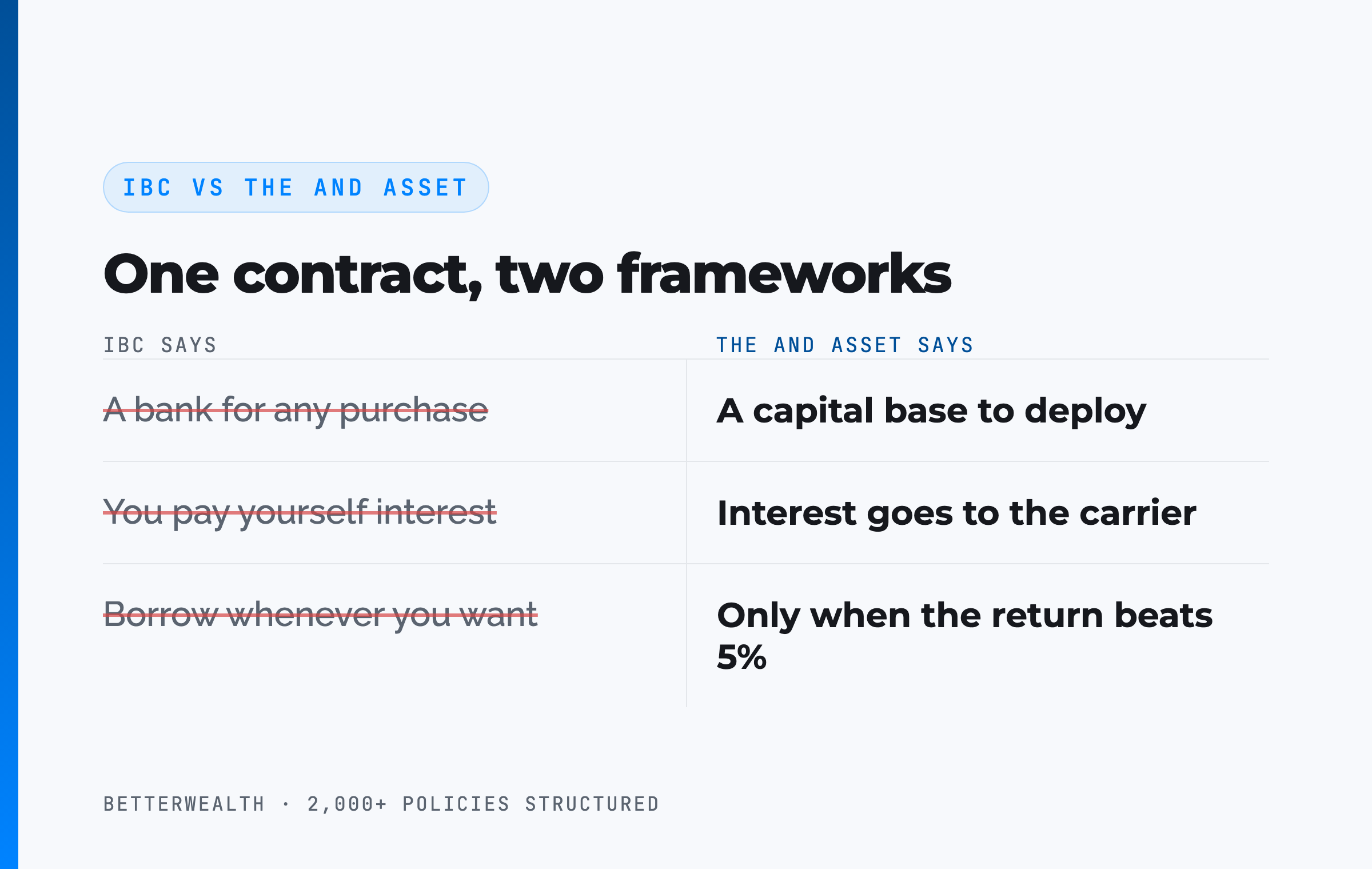
IBC says you can use a whole life policy as a personal banking system for any purchase. The And Asset says you deploy capital only when the borrowed dollars produce a return greater than the carrier's loan cost, because anything less is an expensive way to spend money. Many IBC marketers say you are paying yourself interest. You are not. The interest goes to Catholic Order of Foresters at 5%. Your return is what the deployed capital earns somewhere else while the policy keeps compounding.
Here that discipline has a hard number attached. Your hurdle rate is 5%, locked at issue, for as long as you own the contract. Most carriers give you a variable rate and a moving threshold. This one gives you a fixed one, which makes the go or no-go decision on a deal simpler than almost anywhere else in the market.
A fixed hurdle rate is worth more than a high dividend.
04 / How it worksHow does the whole life policy actually function as an And Asset?
The policy functions as an And Asset through five steps, and the third one is where most people would break the contract. The whole life product runs on universal life premium mechanics inside a whole life chassis, which is the source of both its flexibility and its one rigid rule.
- Confirm eligibility and elect the free rider. Establish full or limited membership, then elect the Fraternal Legacy Rider on the application. It costs nothing and it cannot be added by wishing later. There is no reason not to elect it.
- Structure for cash value. Push the design toward the paid-up additions rider. On the illustrations in the source conversation, a 35-year-old male paying $10,000 a year in an all-base design showed effectively no first-year cash value and just over $1 million of death benefit. The same premium at a 40/60 base to PUA split showed nearly $5,950 of first-year cash value against $447,000 of death benefit.
- Pay the required premium every year. The base contract has a required premium that keeps the policy in force. Separately, the scheduled PUA rider premium has to be paid in full each year. Miss the rider payment once and the rider is gone permanently.
- Let the early years capitalize. On the 40/60 design, cash value crossed cumulative contributions at year 8. On the all-base design it took until year 13. Neither number is a flaw. Any illustration promising break-even in year two is fiction.
- Borrow at 5% and deploy. Request a loan online or by phone, put the capital into an activity that clears 5%, and repay from the cash flow that activity produces. The company is direct recognition, and the dividend credited on loaned values is currently also 5%, so the borrowing decision is close to a wash on the policy side and turns entirely on what the money does outside it.
The flexibility, in real numbers
The premium mechanics are where this contract separates from every mutual we have reviewed. Three examples from the illustrations shown on camera, all on a 35-year-old male at $10,000 a year.
First, the dump-in. In year 11 the policyholder paid $255,685 in a single deposit and the policy went contractually paid up. Nothing was owed after that. Break-even moved from year 13 to year 11, and the 30-year IRR moved to 3.93%. Second, the pull-back. On a 20-pay design, the policyholder in year six dropped from $10,000 to the minimum required premium of roughly $4,600, then resumed. The consequence was a paid-up date pushed from year 20 to year 21 at $7,600. Third, the rider consequence. On a $4,000 base and $6,000 PUA structure, the rider terminated when the scheduled payment was missed, but the policyholder could still pay the extra $6,000 into the base. That money buys paid-up insurance, which shortens the funding runway rather than extending it. In that illustration the policy went fully paid up at the end of year 30, after which no further contributions were possible.
Every flexibility has a price. Here the price is disclosed.
This carrier fits a specific person doing specific things.
It fits you if
- You are Catholic or qualify for limited membership
- Your income is variable and you need premium that can move with it
- You want a borrowing cost you can price years in advance
- You can name a use for capital that clears 5%
It does not fit you if
- You are optimizing purely for long-term IRR
- You require an A+ or A++ financial strength rating
- You live in New York, New Jersey, Utah, or Alaska
- You cannot identify a productive use for borrowed dollars
If you are in the first column, a 30-minute conversation will tell you whether this carrier or another one fits your design. If you are in the second, we will tell you that too.
Book a Discovery Call05 / The mathDoes the deployed capital clear the 5% loan rate?
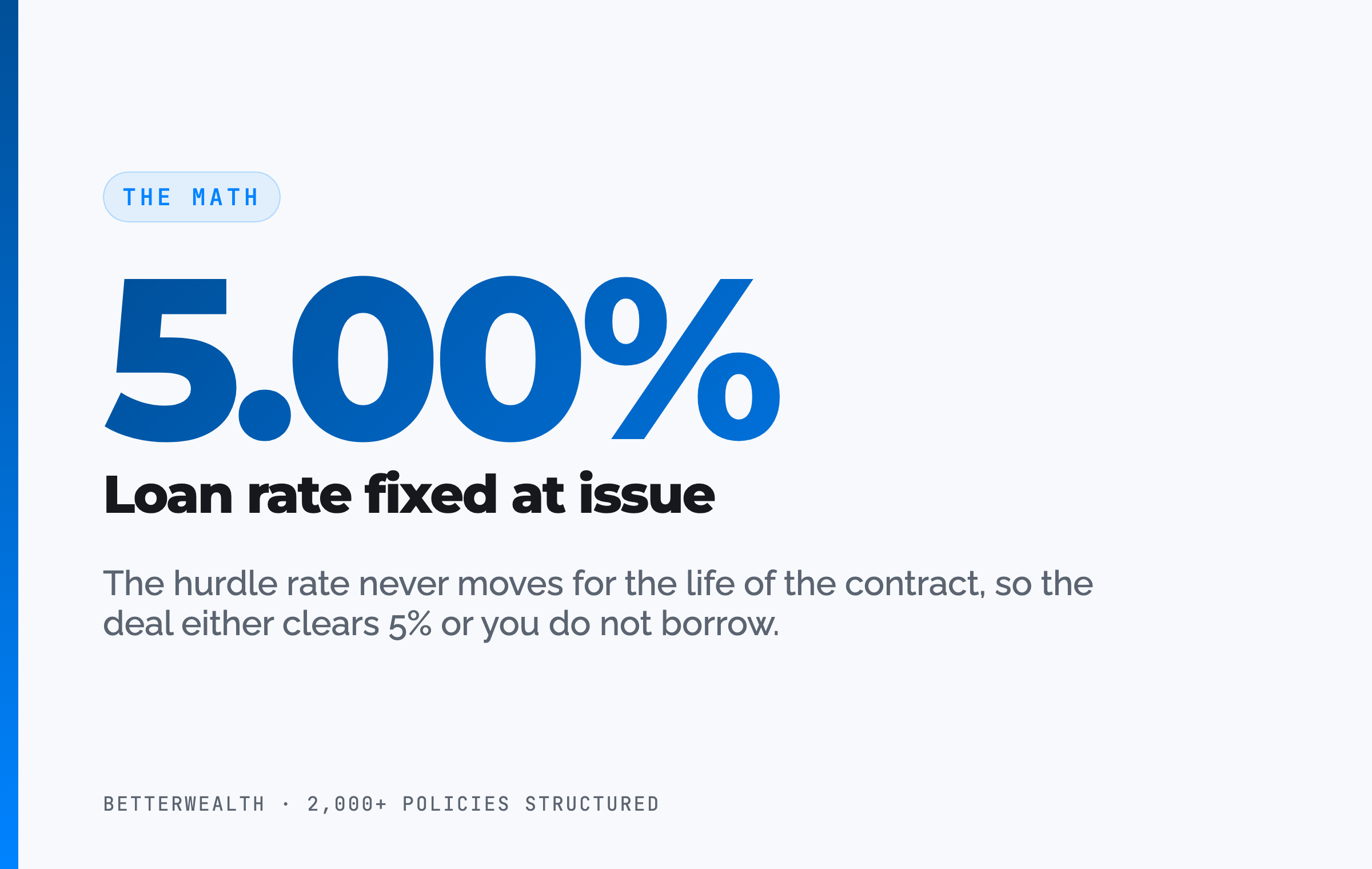
The return on whatever you deploy has to exceed 5%, or you should not borrow. That is the whole test, and this carrier makes it unusually clean because the rate is contractual rather than declared annually. Policy loan rates at most carriers vary by company and rate environment, and many sit in the 5 to 6% range at the time of writing. Here the number is set once, at issue, and does not move.
Run the structure of the decision. You borrow at 5%. The policy continues to compound on its full cash value net of internal charges, with the direct recognition adjustment applied to the loaned portion, which currently credits at the same 5%. Your deployed capital earns its own return. If that return is 11%, you are ahead by six points on borrowed dollars that were already working inside the policy. If the return is 4%, you have paid for the privilege of losing ground.
The reason a fixed rate matters more than it sounds: with a variable loan rate, a deal you underwrite today at a 3-point spread can compress to nothing if rates move against you mid-project. Underwriting a 44-month repayment against a contractual 5% removes that variable entirely. For an entrepreneur pricing a multi-year deployment, a known cost of capital is worth giving up some yield to get.
If the deal does not clear 5%, do not borrow.
06 / The numbersWhere the growth lands, honestly
Long-term cash value growth on this contract is average, and the company does not pretend otherwise. On the 40/60 design at $10,000 of annual premium for a healthy 35-year-old male, illustrated IRR ran just under 3% at 15 years and roughly 3.8% at 30 years. The all-base design landed near 3% at 30 years. For context, the strongest mutual designs we work with project in the 4.2 to 5.3% range over comparable periods, on current dividend scales that are not guaranteed.
Death benefit performance tells a better story. On the 40/60 design the initial death benefit of $447,000 grew to about $1.1 million by age 65, which works out to roughly 7% IRR on the death benefit over 30 years. For a member whose goal includes a legacy transfer alongside a capital base, that number carries weight the cash value IRR does not.
One more figure worth holding onto. In year 30 of the illustration shown, a $10,000 contribution increased cash value by about $28,000, because at that stage the payment is buying paid-up insurance rather than funding a rider. Late-stage dollars in a well-funded contract behave differently than early ones, which is exactly why the funding runway question matters as much as the rate.
Roughly 3.8% over 30 years is average. If long-term IRR is the metric you optimize for, this carrier is not your answer, and no rider changes that arithmetic.
07 / The riderWhat is the Fraternal Legacy Rider worth?
The Fraternal Legacy Rider adds 5% of the policy's death benefit as a payment to a 501(c)(3) Catholic charity the member names, at zero cost. On a $100,000 policy, beneficiaries receive $100,000 and the named charity receives $5,000. It has to be elected on the application, which means people forget it. The company reported more than $127 million earmarked to Catholic charities through the end of the first quarter.
The example Matthew gave lands better than the number. A member in Kentucky who had been disabled died with a rider benefit of $37,500 attached. His parish needed $30,000 to build an accessibility ramp. His widow walked the check over. That is not a financial argument, and it is not meant to be one.
The rest of the fraternal benefits follow the same pattern. The society sponsored more than 1,100 events last year, roughly three a day, from food drives to homeless shelter work, run through local jurisdictions the organization calls courts. Scholarships of up to $5,000 require membership plus participation in a qualifying service event. These are real member benefits. None of them should decide a capital strategy.
The frameworks behind 2,000+ policies, in one place.
The And Asset Vault holds the calculators, design frameworks, and structuring decisions we use when we compare carriers, including the base to PUA split math that drives every number in this review. Free, email-gated, no spam.
Open the Vault08 / The term productThe most unusual contract in the lineup
The term product is the piece of this company's lineup that has no real analogue elsewhere, and it is built on a universal life chassis rather than a traditional term policy. According to the company, the product carries no premium load and no per-thousand expense, and the current and guaranteed illustration columns are identical. Those two absent charges are what make the mechanics below possible.
One product replaces the usual menu. A member can run annual renewable term, a 10-year, a 22-year, a term to age 62, or a return-of-premium structure, and can switch between those strategies later without new underwriting. In the illustration for a 40-year-old, annual renewable term started at $220 in year one and stepped to $303 and $350. A 22-year level structure priced at $887 a year. Five years of annual renewable term followed by a switch to term to age 62 leveled off near $1,100 a year for years six through 22. Coverage is convertible to age 85, and the maximum death benefit is $10 million. Underwriting is fully fluid-based, with blood and urine required.
Skipping a term premium
Because accumulated value builds inside the chassis, a policyholder can skip a premium and keep the coverage. In the example shown, skipping the year-11 payment on a term-to-62 structure shortened the coverage to age 60. One skipped year cost two years on the back end, and the policyholder could later pay more to restore the original end date or layer an additional five years on top. The cost of insurance rises with age, so at some point extending stops being economical, and the company does not pretend there is a way to game that. The pricing target across the lineup is the top quartile on the cheaper side, not the cheapest in market.
Skip a year, lose two. Disclosed up front, which is the point.
A term policy that tolerates a lost job without a lapse notice solves a real problem. Most carriers answer that problem with a grace period and a cancellation.
09 / The tradeoffsThe four honest reasons to walk away
Four constraints will disqualify this carrier for a meaningful share of readers, and naming them is the only way this review is worth anything. First, the growth gap. Roughly 3.8% projected over 30 years puts the contract below the mutual designs we deploy most often, and over a multi-decade horizon that difference compounds into real dollars.
Second, the ratings and the size. AM Best B++ and KBRA A- are below the A+ and A++ marks carried by the large mutuals, and $1.2 billion in assets is small for a life carrier. Company management points to conservative mortality experience, including better than industry results through the COVID period, and the absence of a COMDEX score reflects size rather than weakness. Some buyers will accept that. Some should not.
Third, the paid-up additions rider. One missed scheduled payment terminates it permanently, with no backfill and no reinstatement. In a contract otherwise built on flexibility, that is the sharpest edge in the document, and it punishes exactly the variable-income buyer the rest of the product is designed for. Company leadership indicated on camera that this is under review.
Fourth, eligibility. Catholic membership is required, with the limited-membership exception for non-Catholic spouses and employees of Catholic organizations, and the company does not operate in New York, New Jersey, Utah, or Alaska.
A composite: the contractor who priced his capital eight years in advance
Consider a 38-year-old Catholic general contractor in Ohio, preferred non-tobacco, funding $23,500 a year at a 40/60 base to PUA split. That is $9,400 of base premium and $14,100 into the paid-up additions rider. This is a representative composite built from patterns across our book, not a single named client.
Through the first seven years, cash value trails cumulative contributions, exactly as a real policy behaves. At year 8 the $189,700 of cash value crosses the $188,000 he has put in. No earlier. He funds the rider in full every year, including the year his largest client paid 90 days late, because he understands that missing it once ends the rider for good.
In year 9, with $218,400 of accessible cash value, he borrows $126,500 at the contractual 5% to buy two service trucks and a compact excavator outright instead of financing them at 9.4% through the dealer. The equipment adds enough billable capacity to return an estimated 13.8% IRR, roughly $17,457 in the first year against $6,325 of loan interest. Net first-year spread: about $11,132. He repays on a 44-month schedule funded by the equipment's own billings, and the policy compounds on its full value net of internal charges the entire time.
The reason he chose this carrier over a higher-IRR mutual was not the charity rider. It was that he could underwrite the equipment purchase eight years before he made it, because his cost of capital was printed in the contract on day one.
One dollar. Two jobs. That is the And.
10 / Head to headCatholic Order of Foresters against the alternatives
Against the alternatives a Catholic entrepreneur actually weighs, this contract trades long-term growth for a fixed borrowing cost and premium mechanics nothing else matches. The table runs a $10,000 annual premium at a 40/60 design for a healthy 35-year-old against a top-IRR mutual design and against a level term plus taxable brokerage approach.
| Dimension | Catholic Order of Foresters | Top-IRR mutual (e.g. Penn Mutual) | 20-yr level term + brokerage |
|---|---|---|---|
| Year 1 cash value on $10,000 premium | About $5,950 (roughly 60%) | $7,700 to $8,700 (77 to 87%) | $0 in the policy; about $9,400 invested after a ~$600 term premium |
| Break-even year | Year 8 on a 40/60 design; year 13 all base | Typically year 5 or later | Not applicable; brokerage is marked to market daily |
| Projected 30-year IRR on cash value | About 3.8% | 4.2% to 5.3% on current scales, not guaranteed | Market rate, taxed annually on gains and dividends |
| Cost to access capital | 5.00% fixed at issue, for life | Variable by carrier and rate environment, often 5 to 6% at time of writing | No borrowing feature; you sell and trigger tax |
| Premium flexibility | Raise, lower, accelerate, or pay up in almost any year; PUA rider is all-or-nothing | Strong PUA flexibility at the best carriers; base premium is fixed | Term premium is fixed; brokerage contributions are fully discretionary |
| Financial strength | AM Best B++, KBRA A-, no COMDEX, $1.2B assets | AM Best A+ or A++, COMDEX 93 to 100 | Carrier risk on term only; brokerage carries market risk |
Early cash value and growth. A top-IRR mutual puts roughly $2,000 more to work in year one on the same $10,000 premium and compounds ahead of this contract for the next three decades. That gap is the price of everything in the next two rows.
Cost of capital. A fixed 5% for life is the single strongest feature here. Nobody else on this table gives you a borrowing cost you can underwrite a project against eight years out, and the brokerage column has no borrowing feature at all without margin risk or a taxable sale.
Flexibility and strength. The premium mechanics are best in class and the ratings are not. A B++ carrier holding $1.2 billion is solvent and conservative, but it is a tier below the mutuals. Weigh that against the fact that the And Asset math runs on the loan rate and your deployment, not on the carrier's logo.
The honest 30 minutes about whether this fits you.
We have structured more than 2,000 policies across all 50 states. We have seen this strategy work exactly as designed, and we have seen it fail when the borrowed dollars had nowhere productive to go. If you want a real conversation about whether The And Asset fits your situation, book a discovery call. We will give you the honest answer either way, including whether a different carrier fits you better. If you would rather learn first, the The And Asset and BetterWealth YouTube channels go deep on the math.
Book a Discovery CallFAQCatholic Order of Foresters questions
Is Catholic Order of Foresters good for infinite banking?
Catholic Order of Foresters works for a disciplined And Asset strategy if you are Catholic and you value flexibility and a fixed borrowing cost over maximum growth. Long-term IRR on the designs shown lands near 3.8% over 30 years, below the top mutual carriers, and the policy loan rate is fixed at 5% for the life of the contract.
Do you have to be Catholic to buy a Catholic Order of Foresters policy?
Yes, with two exceptions. Catholic Order of Foresters is a fraternal benefit society, so full membership requires being Catholic. A non-Catholic spouse of a member and employees of Catholic organizations qualify for limited membership, which carries the same access to products and differs mainly in scholarship eligibility.
What is the Fraternal Legacy Rider?
The Fraternal Legacy Rider adds 5% of the policy's death benefit as a payment to a 501(c)(3) Catholic charity the member names, at no cost. On a $100,000 policy, beneficiaries receive $100,000 and the named charity receives $5,000. It has to be elected on the application. The company reported more than $127 million earmarked to Catholic charities through the first quarter.
What states is Catholic Order of Foresters licensed in?
Catholic Order of Foresters is licensed in 46 states. It does not operate in New York, New Jersey, Utah, or Alaska. Residents of those four states need a different carrier.
What is Catholic Order of Foresters' financial strength rating?
Catholic Order of Foresters carries a B++ rating from AM Best and an A- rating from KBRA, with roughly $1.2 billion in assets. It is too small to receive a COMDEX score. Those ratings sit below the A+ and A++ marks carried by the large mutuals BetterWealth uses most often.
What is the policy loan rate at Catholic Order of Foresters?
The policy loan rate is 5%, fixed at issue for the life of the contract. Catholic Order of Foresters is a direct recognition carrier, and the company states the dividend credited on loaned cash value is currently also 5%, so borrowing is close to a wash at present. Loans can be requested online or by phone.
How flexible is the Catholic Order of Foresters whole life policy?
It is the most premium-flexible whole life contract we have reviewed. The whole life product runs on universal life premium mechanics inside a whole life chassis, so one product covers a single pay, a 10-pay, a 20-pay, or any custom duration, and a policyholder can raise, lower, or accelerate premium later. The one hard rule is that the required premium must be paid every year.
Is the Catholic Order of Foresters paid-up additions rider flexible?
No. The paid-up additions rider is the least flexible part of the contract. The scheduled rider premium must be paid in full each year, and missing it once terminates the rider permanently. After termination the policyholder can still overfund into the base policy, which accelerates the paid-up date rather than buying additional rider coverage.
What is the IRR on a Catholic Order of Foresters whole life policy?
On the illustrations reviewed in the source video, a 40/60 base to PUA design at $10,000 of annual premium for a healthy 35-year-old male projected roughly 3.8% cash value IRR over 30 years and broke even at year 8. An all-base design projected about 3% over 30 years and broke even at year 13. Death benefit IRR on the 40/60 design ran near 7% over 30 years.
Does Catholic Order of Foresters publish a dividend interest rate?
No. Catholic Order of Foresters publishes the total dollar amount of dividends paid rather than a dividend interest rate. Cash value growth should be evaluated on illustrated IRR, which already reflects the dividend net of mortality and expense charges, instead of a headline dividend rate.
Can you skip a premium payment on the Catholic Order of Foresters term policy?
Yes, and it is the most unusual feature in the product line. The term solution is built on a universal life chassis with no premium load and no per-thousand expense, so accumulated value can absorb a skipped year. In the illustration shown, skipping one premium in year 11 shortened coverage from age 62 to age 60. Coverage can be extended again later without new underwriting.
What is The And Asset?
The And Asset is BetterWealth's framework for using a properly structured whole life policy as a capital base. You only borrow against it for an activity that produces a return greater than the carrier's loan cost, so your dollars do two jobs at once: the policy keeps compounding net of internal charges while the deployed capital earns its own return.
How is The And Asset different from infinite banking?
Infinite banking, as Nelson Nash taught it, frames a whole life policy as a personal banking system for any purchase. The And Asset adds a rule: you only deploy borrowed capital when the return clears the carrier's loan cost. The policy is the capital base, not the destination. It shares roots with IBC but operates on different principles.
- Nelson Nash, Becoming Your Own Banker, the origin of the infinite banking concept.
- IRC Section 7702 (Cornell Law), the tax code provision behind the treatment of life insurance cash value and policy loans.
- AM Best, the source of the B++ financial strength rating referenced here.
- KBRA, the source of the A- insurance financial strength rating referenced here.
- Catholic Order of Foresters, membership requirements, product details, and the Fraternal Legacy Rider.
- LIMRA, life insurance industry data including persistency benchmarks.
- BetterWealth resources: The And Asset book, the The And Asset YouTube channel, and the BetterWealth YouTube channel.
Ten years with Catholic Order of Foresters and the company's product authority on its term and whole life contracts. He ran the live illustrations behind every number in this review during the source conversation.
I founded BetterWealth to treat life insurance as the wealth and capital tool it actually is, not the product most people get sold. Our team has structured more than 2,000 policies across all 50 states. I wrote The And Asset and host the BetterWealth and The And Asset YouTube channels. If you want an honest read on whether a policy with this carrier or any other fits your plan, book a discovery call. We will tell you if it does not.