
A cash balance plan with life insurance lets a high-income business owner deduct several hundred thousand dollars of pre-tax income each year while a whole life policy is purchased inside the plan, then bought out personally at a discounted IRS valuation so the policy is funded with dollars never taxed.
A business owner clearing $1 million in California, New York, or New Jersey can send 40 to 50% of that number to federal and state governments before a single dollar reaches an investment account. The standard advice for that problem is a solo 401(k) or a SEP IRA. Both cap total contributions near $70,000, which on seven-figure income moves the tax bill by a couple of points and leaves the rest of the problem untouched.
The gap between what those accounts can absorb and what a high earner actually pays is where most business owners quietly lose the largest share of their lifetime wealth. Money paid in tax is money that never compounds. Every dollar sent out the door in April is a dollar that will not be working in year ten.
A cash balance plan changes the size of the deduction by an order of magnitude, and adding a life insurance contract inside the plan changes what you own when the plan winds down. At BetterWealth we have structured more than 2,000 policies across all 50 states, and this structure has become a frequent conversation with solopreneurs and small-team owners who are pushing into the top brackets.
It is also the most constrained strategy we work with. Access to the money is restricted for years. The funding is a commitment, not an option you toggle each spring. If liquidity is what you are after, stop reading and go look at overfunded whole life instead, which is built for the opposite outcome.
This article covers what a cash balance plan is, who qualifies and who does not, the seven-step sequence we run, why the policy inside the plan is deliberately built with suppressed cash value, how the policy gets out of the plan without triggering tax, the compliance rules that keep the whole thing legal, and where this sits next to The And Asset.
- A cash balance plan is first and foremost a tax strategy. Life insurance inside it makes the plan better, not the reason to do it.
- Annual deductions commonly run $100,000 to $500,000-plus, against roughly $70,000 for a solo 401(k) or SEP IRA.
- The policy inside the plan is all-base with suppressed cash value, the exact opposite of an And Asset design.
- Suppressed valuation does two jobs: more contribution room now, and a heavily discounted personal buyout at exit.
- Plan money is restricted for three to five years at minimum. Anyone needing near-term liquidity should not do this.
- Less than half of cumulative plan contributions can go to whole life premium under the incidental benefit rule.
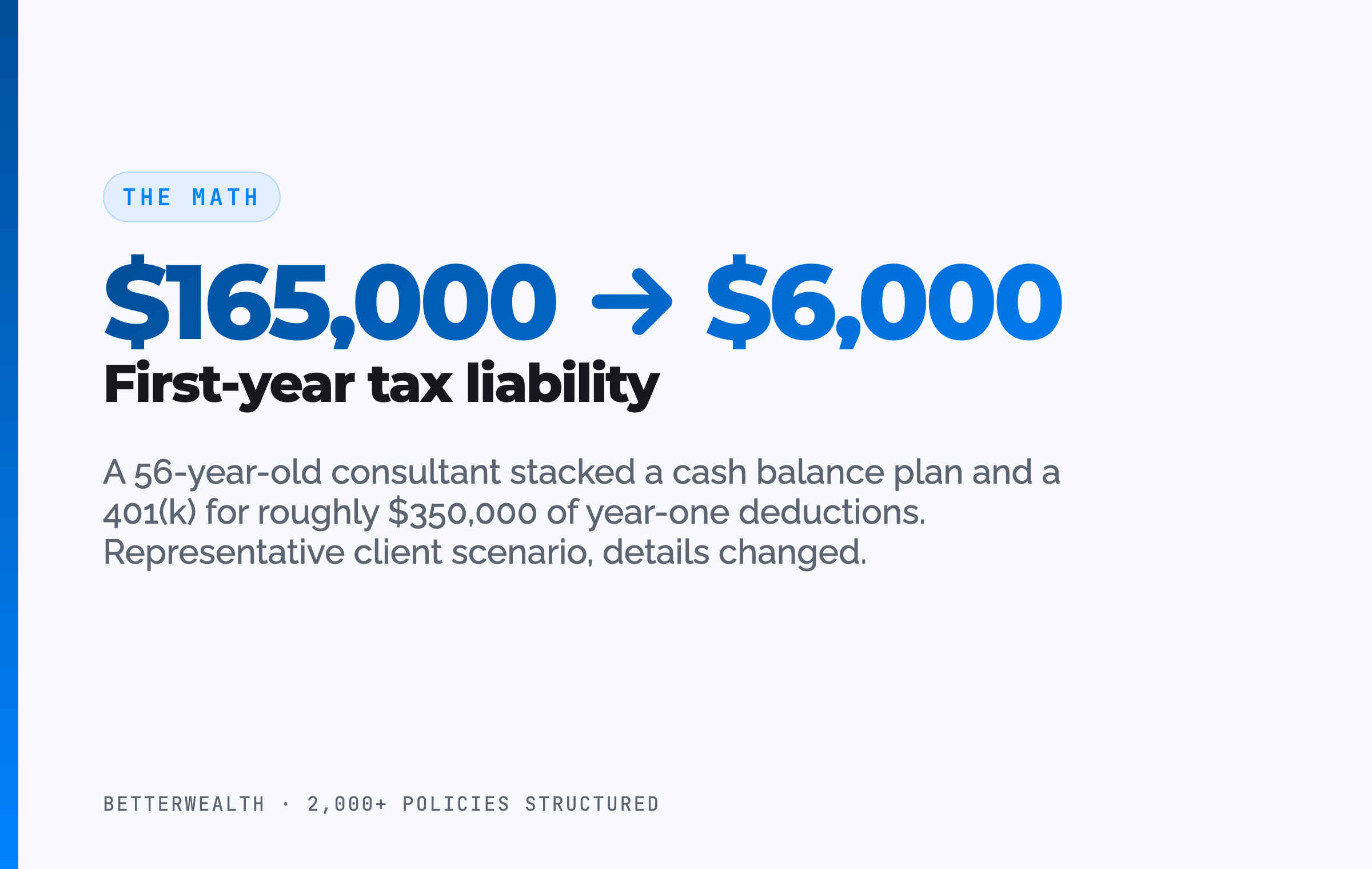
Alden Armstrong builds both case studies on screen, including the slide where a $165,000 tax liability drops to $6,000 line by line. The illustrations are worth seeing if you want to check the arithmetic yourself:
01 / The problemWhy does traditional retirement advice fail high-income business owners?
Traditional retirement advice fails high-income business owners because the accounts it recommends were designed for employees, not owners. A 401(k) exists so that a company like Cisco or Wells Fargo can offer a benefit to thousands of staff. The employee deferral limit sits in the low $20,000s, with an additional catch-up amount once you turn 50, and total additions including the employer side land near $70,000. Those figures are indexed annually and worth confirming for the current year.
A SEP IRA is the common upgrade for a business owner and it caps at a similar number. Both are useful. Neither one is a serious answer for someone whose taxable income starts with a 5, 6, or 7.
Run the arithmetic. An owner netting $1 million who wants to save $400,000 a year, in a jurisdiction where the combined effective rate is around 45%, has roughly $234,000 left after tax to actually invest. The missing $166,000 is not a one-time loss. It is the compounding that money would have produced over the next twenty years, gone on the day it was paid.
Taxation is the largest wealth-eroding factor most owners face.
A 401(k) and a SEP are employee-level accounts. What a high-earning owner needs is an institutional pre-tax house for capital, sized to the actual problem.
02 / The mechanismWhat is a cash balance plan, and how does life insurance fit inside it?
A cash balance plan is a defined benefit retirement plan that credits each participant a stated account balance, funded by the business with pre-tax dollars, with the annual contribution calculated by an enrolled actuary. It is a tax strategy that happens to be a retirement plan, and it gets better when a life insurance contract is purchased inside it.
The ceiling is not arbitrary. It flows from IRC Section 415(b), which governs the maximum benefit a defined benefit plan can promise. Translated into a lifetime savings figure, the bucket sits near $3.6 million, targeted to be filled somewhere between ages 62 and 65.
That target is why age drives everything. A 35-year-old has thirty years of runway, so the actuary spreads the funding thin. A 60-year-old with no prior plan has five years, so the same target permits contributions that can approach half a million dollars a year. Younger participants sit in the slow lane. Older participants get the fire hose.
The actuary is the speed limit
Every cash balance plan runs with a third-party administrator handling documents and filings, and an enrolled actuary setting the number. The actuary calculates, based on your age and target retirement date, exactly how much can go in each year without overfunding the plan. You do not get to pick the contribution. You get to pick whether to make it. That constraint is also the protection: the number is defensible because a credentialed third party computed it against the code.
"This is not a sports car you can whip around a parking lot. This is a tax train." Alden Armstrong on why flexibility is not what a cash balance plan sells.
03 / The fitWho is a cash balance plan actually for?
A cash balance plan fits a solopreneur or small-team business owner netting roughly $500,000 or more, with stable revenue, who is pushing into the upper brackets and has a multi-year horizon. The professions we see most often are physicians and dentists, attorneys, accountants and CPAs, consultants, high-commission sales professionals, and financial advisors. What they share is control: they make the final call on their own financial planning.
Two other profiles come up repeatedly. The owner preparing for an exit, whose active income will fall sharply after the sale, gets the deduction in a high bracket and takes distributions in a lower one. And the ultra-high earner inside a compressed window, a founder or a specialist whose peak years are known to be finite.
Age is the third variable. The sweet spot runs 45 to 60, though it is not a rule. We are currently working with a 31-year-old NFL athlete whose family limited partnership employs his parents and his wife, which lets the actuary use their ages in the computation and open funding room that his age alone would not support. We also have a client at 74.
Who this is wrong for
Five profiles should walk away. Businesses with a cash flow roller coaster cannot meet the funding requirements, and the plan assumes stable or rising revenue. Employee-heavy organizations usually fail on economics: one of the first cash balance plans we ever attempted was for a recruiting firm with high turnover and a large staff behind a single founder, and the numbers never worked. Anyone looking for a one-year tax fix is in the wrong place, because this is a layered multi-year approach. Lower and middle-bracket owners will not clear the cost of administration with the savings produced. And anyone who needs the money inside the next three to five years should not lock it up, because qualified plan status means deferred access is the price of the deduction.
If you need the capital soon, this is the wrong tool.
04 / How it worksThe seven-step sequence, start to exit
The strategy runs in seven steps, and the order is not optional. Here is the sequence we use when we structure one.
- Qualify the business. Confirm net income around $500,000 or higher, revenue that is stable or growing, and few or no non-owner employees. Before anything else, look at entity structure. One owner in the video came in as an LLC paying the highest available rate; moving him to an S corp improved his tax position before a cash balance plan was ever presented.
- Engage a third-party administrator and an enrolled actuary. The TPA drafts plan documents and handles annual filings. The actuary certifies the contribution. This is the same architecture as a corporate 401(k) administered by a Fidelity or a Transamerica, scaled to one owner.
- Set the annual contribution. The actuary works backward from the Section 415(b) ceiling and your target retirement age. This produces the maximum deductible number for the year.
- Fund the plan with pre-tax dollars. The contribution is a top-line deduction against business income. Under the SECURE Act, an employer plan can be adopted after the close of a tax year, up to the business filing deadline including extensions, and take the employer contribution deduction for that prior year. Almost no other tax strategy looks backward.
- Purchase an all-base whole life policy inside the plan. The plan owns the contract. Premium must stay inside the incidental benefit limit. Design is covered in the next section.
- Let the plan run. Assets grow at a conservative crediting rate, often modeled around 4%. The growth is capped while the money sits in the plan, which is the trade for the size of the deduction.
- Exit. Terminate the plan, buy the policy out personally at an IRS-approved valuation using outside assets, and roll the remaining balance into an IRA where the investment restrictions lift.
Most of the plans we design run five to seven years, not twenty. The deduction is captured in the highest-income years, then the structure unwinds into an IRA and a personally owned policy.
This strategy has a narrow door.
It fits you if
- You net $500,000+ with predictable revenue
- You are 45 to 60, or approaching a business exit
- You run solo or with a very small team
- You can leave the capital alone for 5+ years
It does not fit you if
- Your revenue swings hard year to year
- You carry a large non-owner payroll
- You want liquidity in the next 3 years
- You have a one-year tax problem, not a pattern
If you are in the left column, one conversation will tell you whether the actuarial math supports a plan for your age and income. If you are in the right column, we will say so and point you somewhere better.
Book a Discovery Call05 / Policy designWhy is the policy built all-base instead of overfunded?
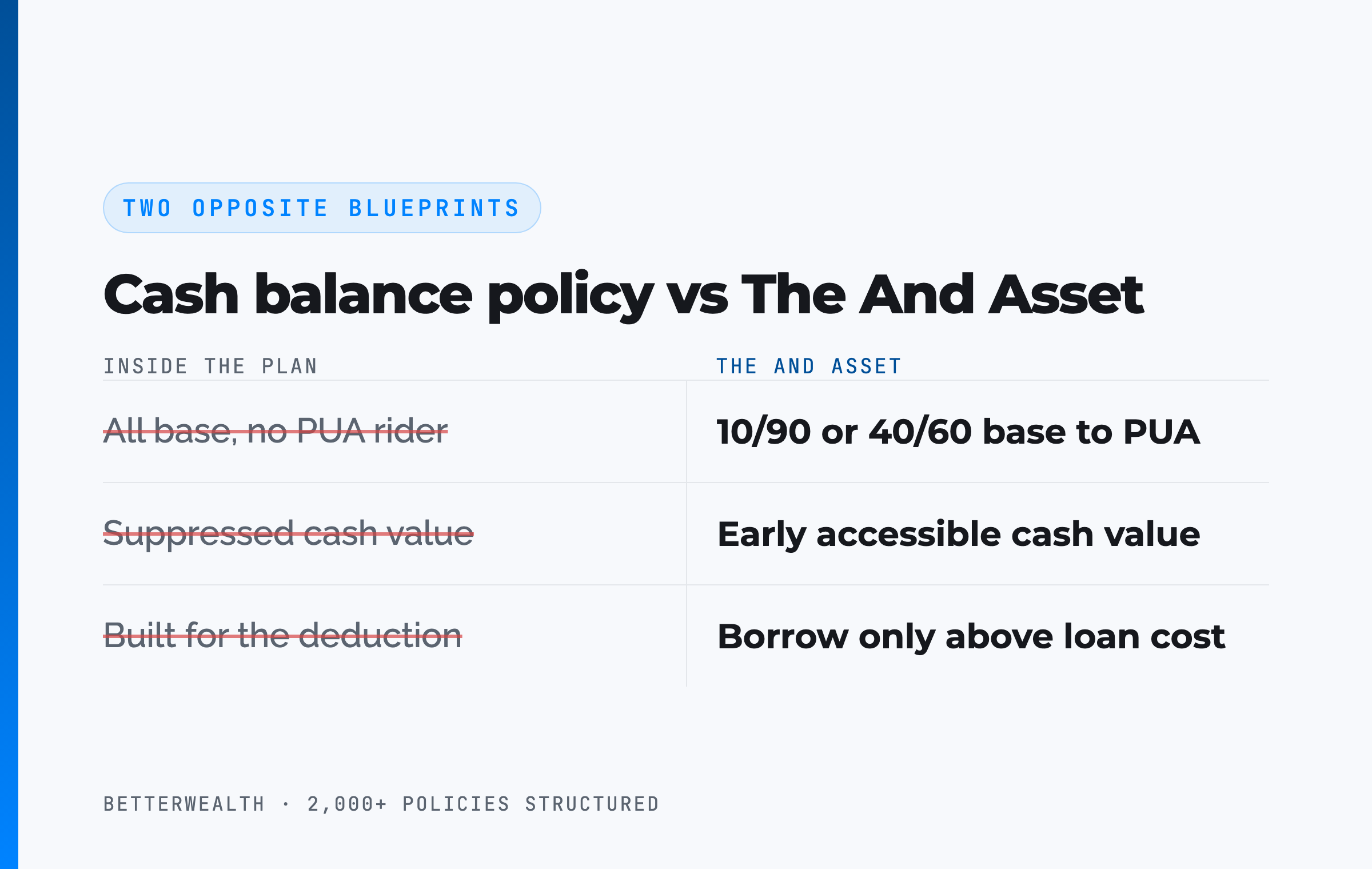
The policy inside a cash balance plan is built all-base, with no paid-up additions rider, because suppressed cash value is the feature. That sentence contradicts everything we normally say about policy design, so it needs the full explanation.
Suppose the actuary sets your limit at $200,000. If you contribute $300,000 and $100,000 of it buys an asset whose first-year value is close to zero, the measured value of the plan does not jump by $100,000. You got more money into the plan, you took the deduction on all of it, and you did not overfund against the corridor. At a 45% effective rate, that extra $100,000 of deduction is about $45,000 of tax you did not pay.
The same suppressed valuation pays a second time at the exit. When you buy the policy out of the plan, the IRS requires you to use an approved valuation. A contract with low measured value produces a low purchase price. You end up personally owning a policy that was funded entirely with pre-tax dollars, acquired for a fraction of the premium that went into it.
High early cash value inside a cash balance plan is usually a tactical mistake. Depressing the value is what creates both the extra deduction and the discounted buyout.
How this differs from an And Asset policy
These two designs solve opposite problems, and conflating them is the fastest way to build the wrong policy. An And Asset policy is engineered for early liquidity: minimum base premium, a heavy paid-up additions rider, a base/PUA split closer to 10/90 or 40/60 depending on the design, and cash value you can borrow against as soon as the contract allows. A cash balance plan policy is engineered for suppressed value and sits locked inside a qualified plan where you cannot touch it at all.
Nelson Nash pioneered the idea of using whole life as a personal banking system in Becoming Your Own Banker, and his insight about lost opportunity cost is the foundation we build on. IBC says the policy is the personal banking system and any purchase can run through it. The And Asset says you only deploy capital from the policy when the borrowed dollars produce a return greater than the carrier's loan cost, because the interest goes to the carrier, not to you. That single rule is what separates the frameworks, and it is why an all-base policy inside a qualified plan is not an And Asset at all until the day you own it personally.
A policy compounds at the dividend rate net of mortality and expense charges, and an all-base contract carries proportionally more of those charges early. Over time it targets returns in the range of a bond allocation. Nobody should buy this design expecting the cash value curve of an overfunded policy.
Same product. Opposite blueprint.
06 / The exitHow does the life insurance policy get out of the plan?
You buy the policy out of the plan personally, using assets from outside the plan, at an IRS-approved valuation. The reason you have to is simple: an IRA cannot own life insurance, and when the cash balance plan terminates the remaining assets roll into an IRA. The policy has to leave first, either by purchase or by surrender.
The purchase is a swap, not a distribution. Cash from a brokerage account goes into the plan, the policy comes out, and the total value of the plan is unchanged. Because the exchange is at equal value under the definitions the IRS provides, there is no taxable event and no check written to the IRS.
The valuation is not simply the cash surrender value. The IRS specifies formulas that account for premiums paid, earnings, and the reasonable cost of insurance. In practice that means the PERC value or the terminal reserve, sometimes called the ITR value, calculated as of the date of purchase. Any CPA reviewing the transaction will look for exactly this.
Why the rulebook exists
Ten to fifteen years ago, advisors would place a policy inside a plan, wait until it showed a $0 cash value, value it at zero, and pull it out for free. Pay $100,000 of premium, take the deduction, remove the asset for nothing. The IRS caught on quickly and closed it. The approved-valuation regime is the direct result. Anyone still pitching a zero-dollar buyout is describing a strategy that stopped working a decade ago.
The rulebook is strict. Play inside it.
07 / ComplianceThe three checkpoints that keep the plan qualified
Three compliance tests govern life insurance inside a qualified plan, and breaking any of them can unwind the entire structure. ERISA and the IRS both have jurisdiction here, which is why a TPA and an actuary are not optional overhead.
The incidental benefit rule. The death benefit has to stay incidental to the plan's retirement purpose. Less than half of cumulative plan contributions can be spent on whole life premium. For indexed or universal life the threshold is tighter, closer to 40%. You cannot route the whole contribution into insurance and buy it out later, which is the first thing most people try to do once they understand the mechanic.
The 100-times rule. Total death benefit cannot exceed 100 times the anticipated monthly retirement benefit the plan is designed to pay. It works as an alternative test alongside the percentage limit. Exceed it and you have broken the incidental requirement the same way.
Approved valuations. When the policy comes out, the price must be set using an IRS-sanctioned method, the PERC value or the terminal reserve value. Nothing else survives review.
The frameworks behind 2,000+ policies, in one place.
The And Asset Vault holds the calculators and design frameworks we use when we decide whether a policy should be built for liquidity or for a qualified plan. Free, email-gated, no spam.
Open the VaultThe 56-year-old consultant: $165,000 of tax down to $6,000
A 56-year-old consultant runs her practice through an S corp producing about $650,000 of profit. She takes $200,000 as W-2 salary and receives the balance as a K-1 distribution. She lives in California, so federal and state stack.
What went into the plan. The cash balance contribution came to just over $300,000 for year one, which included $75,000 of all-base whole life premium purchased by the plan. On top of that, because she takes a W-2 salary, she stacked a 401(k): a $32,000 catch-up-eligible deferral plus a 6% profit share contribution of roughly $12,000. Total deduction for year one, about $350,000.
What it did to the return. Adjusted gross income dropped to roughly $300,000. The tax liability she was facing, around $165,000, came down to $6,000. She was in the middle of filing an extension when we started, and the SECURE Act adoption window is what made the prior year reachable at all.
Where it goes over seven years. She plans to wind down the practice over the next seven years. If income holds, total deductions run to roughly $2.5 million against the $3.6 million lifetime bucket. Her business funds about $525,000 of whole life premium, $75,000 a year, entirely with pre-tax dollars.
The policy math at exit. After seven years of $75,000 premiums, the projected cash value lands near $410,000 to $415,000 depending on dividends, against $525,000 of cumulative premium. Cash value trails contributions for the entire holding period, which is what an all-base contract should do. Death benefit starts around $2.5 million and grows to roughly $2.7 million by year seven. She buys the contract out of the plan using brokerage assets at the approved valuation. Same value in, same value out, no tax due. Purchasing an identical policy with after-tax dollars over that period would have required roughly $1,000,000 of gross income.
What she owns on the other side. A personally owned whole life policy funded with dollars that were never taxed, an IRA holding the rest of the plan balance, and full optionality on the policy: keep funding it, elect reduced paid-up so no further premium is due, or borrow against it. Once it is hers, the And Asset rule applies. Borrow against it only when the deployed capital clears the carrier's loan cost.
Pre-tax in. Discounted out. Personally owned.
08 / The tradeoffsWhat you give up to get the deduction
Every advantage in this structure is purchased with a real constraint, and there are six worth naming. Most of the pitches you will hear online mention none of them.
The first is illiquidity. Money inside a qualified plan is restricted, typically three to five years at minimum and often longer. You cannot reach it without paying tax on the values or buying out the insurance. For an owner who prizes capital access, this is disqualifying on its own.
The second is capped growth. Plan assets are commonly modeled around 4%, well below what the same money might do in a brokerage account. The trade is explicit: a 401(k) limits how much goes in and leaves growth uncapped, while a cash balance plan lets far more go in and caps the growth while it sits there.
The third is commitment. The funding is a multi-year obligation supported by actuarial assumptions about your revenue. This is not a strategy you turn on and off.
The fourth is cost. TPA fees, actuarial certification, and annual filings are real expenses, which is exactly why the strategy does not clear its own overhead at lower income levels.
The fifth is deferral risk. You are betting your bracket will be lower when the money comes out. Over a five to seven year window with a business winding down, that is a defensible bet. Over forty years it is a guess, and we do not recommend making it.
The sixth is the buyout requirement. You need liquid assets outside the plan to purchase the policy at exit. An owner with everything committed elsewhere can be forced to surrender the contract instead, which forfeits the entire point.
Even in the worst case, where the future bracket matches today's, the tax outcome is roughly a wash. You would be doing this for the insurance asset, not the arbitrage.
09 / The bigger pictureWhere does this sit next to The And Asset?
A cash balance plan solves a tax problem, and The And Asset solves a capital problem. They are separate tools that happen to use the same product, and the most common mistake we see is treating one as a substitute for the other.
An And Asset policy exists to give an entrepreneur a capital base with uninterrupted compounding, structured so that a policy loan can be taken and deployed into something that out-earns the carrier's loan rate. Loan rates vary by carrier and rate environment, and many sit in the 5 to 6% range at the time of writing, but the number is a variable to verify rather than a constant. If you cannot name an activity that beats that rate, do not borrow. The discipline is the strategy.
A cash balance plan policy does none of that while it lives inside the plan. It has no accessible cash value, no loan capability available to you, and no role in your capital structure. It is a deduction-enhancing asset sitting in a qualified wrapper.
The two connect on the day of the buyout. Once the contract is personally owned, it becomes an asset you can borrow against, and the And Asset rule takes over. Some clients run both at once: an overfunded policy outside the plan for liquidity and an all-base policy inside the plan for the deduction. Different jobs, different designs, one product.
If you want the capital-strategy side of this, start with the pillar explainer on The And Asset and then read how a policy compares to a 401(k), which covers the same tax-treatment questions from the other direction.
10 / Head to headCash balance plan against the alternatives
Against the other places a high-earning owner can put $400,000, a cash balance plan wins on deduction size and loses on access. The table sets it against a solo 401(k), a SEP IRA, and a taxable brokerage account, using an owner netting about $1 million at a 45% combined effective rate.
| Dimension | Cash Balance + Life Insurance | Solo 401(k) | SEP IRA | Taxable Brokerage |
|---|---|---|---|---|
| Year-one deduction | $300,000+ for a 56-year-old, about $350,000 with a 401(k) stacked on top | Near $70,000 total additions, indexed annually | Near $70,000, and capped at 25% of compensation | $0 |
| What survives to invest | $400,000 of the $400,000, because nothing is taxed first | $70,000 pre-tax, then $181,500 of the remaining $330,000 after 45% tax | Same shape as the solo 401(k) | $234,000 of $400,000 after a 45% effective rate |
| Growth while held | Capped, commonly modeled near 4%, then roughly 8% once rolled to an IRA | Uncapped, tax-deferred | Uncapped, tax-deferred | Uncapped, taxed annually on gains and dividends |
| Access | Restricted 3 to 5 years minimum; policy must be bought out at exit | Restricted before 59½ (penalty plus tax), loan provisions possible | Restricted before 59½ (penalty plus tax) | Fully liquid, settles in days |
| Prior-year funding | Yes, under the SECURE Act, up to the filing deadline with extensions | Employer contributions only | Yes, up to the filing deadline with extensions | Not applicable |
Deduction size. This is the whole reason the strategy exists. A solo 401(k) or SEP moves roughly $70,000 off the top; a cash balance plan for someone in their mid-fifties moves four to five times that. On $400,000 of intended savings, the difference between deducting all of it and deducting $70,000 of it is about $148,500 of tax in a 45% environment.
Access. The brokerage account is the only one of the four you can touch tomorrow. That is not a small thing, and it is the reason we tell owners with volatile cash flow to stay away. Qualified plan status is what buys the deduction, and restricted access is what qualified status costs.
Growth. The 401(k) trade is a small deduction with uncapped growth. The cash balance trade is the inverse: a large deduction with capped growth for a defined window. Neither is universally better. The right answer depends on how much tax you are actually paying today.
The honest 30 minutes about whether the math works for you.
We have structured more than 2,000 policies across all 50 states. On a discovery call, a practitioner looks at your income, your entity, your age, and your timeline and tells you whether a cash balance plan clears its own cost. Plenty of the time it does not, and we say so. If you would rather learn first, the The And Asset and BetterWealth YouTube channels go deep on the math.
Book a Discovery CallFAQCash balance plan and life insurance questions
What is a cash balance plan?
A cash balance plan is a defined benefit retirement plan that gives each participant a stated account balance, funded by the business with pre-tax dollars. It is first and foremost a tax strategy. An enrolled actuary sets the maximum annual contribution based on age and target retirement age, and the contribution is deducted against business income.
How much can you contribute to a cash balance plan?
Annual contributions are set by an actuary and commonly run from roughly $100,000 to more than $500,000 per year, far above a 401(k) or SEP IRA. The lifetime ceiling flows from IRC Section 415(b) limits and lands near $3.6 million funded by ages 62 to 65. A 60-year-old with no prior plan can fund that bucket in a handful of years. A 35-year-old cannot.
Can a cash balance plan own life insurance?
Yes. A qualified plan can own a life insurance contract as long as the death benefit stays incidental to the plan's retirement purpose. For whole life, less than 50% of cumulative plan contributions can go to premium. For indexed or universal life the limit is closer to 40%.
Why use an all-base whole life policy inside a cash balance plan?
An all-base policy has deliberately suppressed early cash value, and that is the point. Because the policy is worth very little in the early years, it lowers the measured value of the plan, which frees additional room to contribute and deduct. The same suppressed valuation later produces a heavily discounted personal buyout at exit.
How do you get the life insurance policy out of a cash balance plan?
You buy it personally from the plan using outside assets, at an IRS-approved valuation such as the PERC value or the terminal reserve (ITR) value. An IRA cannot own life insurance, so the policy has to be purchased out or surrendered before the remaining plan assets roll into an IRA.
Is the policy buyout taxable?
A buyout at the correct IRS-approved valuation is an equal-value swap and is not a taxable distribution. Cash goes into the plan and the policy comes out at the same stated value, so nothing is distributed. Valuing a policy at zero to pull it out for free was shut down by the IRS years ago.
Can you set up a cash balance plan for a prior tax year?
Yes, in most cases. The SECURE Act allows an employer retirement plan to be adopted after the close of the tax year, up to the business tax filing deadline including extensions, and take the employer contribution deduction for that prior year. Employee elective deferrals do not get the same retroactive treatment.
Who is a cash balance plan not for?
A cash balance plan is wrong for anyone with unpredictable revenue, an employee-heavy payroll, a one-year-only tax problem, income in the lower or middle brackets, or a need for liquidity in the next three to five years. Plan assets are restricted until the plan terminates. If capital access is the priority, this is the wrong tool.
What is the incidental benefit rule?
The incidental benefit rule requires that life insurance inside a qualified plan stay secondary to the plan's retirement purpose. Less than half of cumulative plan contributions can be spent on whole life premium, and closer to 40% for indexed or universal life. Break it and the plan can be disqualified.
What is the 100-times rule?
The 100-times rule caps the death benefit of a policy inside a qualified plan at 100 times the participant's anticipated monthly retirement benefit. It functions as an alternative test to the percentage-of-contributions limit. Exceeding it puts the plan's qualified status at risk.
Is a cash balance plan the same as infinite banking?
No. They are near opposites in design. Infinite banking and The And Asset use an overfunded policy with a heavy paid-up additions rider to build accessible cash value early. A cash balance plan policy is all-base with suppressed cash value and no access while it sits inside the plan. One is built for liquidity, the other for deduction.
What is The And Asset?
The And Asset is BetterWealth's framework for using a properly structured whole life policy as a capital base. You only borrow against it for an activity that produces a return greater than the carrier's loan cost, so your dollars do two jobs at once: the policy keeps compounding net of mortality and expense charges while the deployed capital earns its own return.
How is The And Asset different from infinite banking?
Infinite banking, as Nelson Nash taught it, frames a whole life policy as a personal banking system for any purchase. The And Asset adds a rule Nash's broader teaching does not enforce: you only deploy borrowed capital when the return clears the carrier's loan cost. The policy is the capital base, not the destination. It shares roots with IBC and operates on different principles.
- IRC Section 415 (Cornell Law), the limitation on benefits and contributions that sets the defined benefit ceiling.
- IRS: Choosing a Retirement Plan, Defined Benefit Plan, the agency's own overview of how these plans work.
- U.S. Department of Labor: ERISA, the framework governing qualified plan administration and fiduciary duty.
- IRC Section 7702 (Cornell Law), the provision behind the tax treatment of life insurance cash value and death benefit.
- Nelson Nash, Becoming Your Own Banker, the origin of the infinite banking concept.
- BetterWealth resources: The And Asset book, the The And Asset YouTube channel, and the BetterWealth YouTube channel.
Specializes in policy structure and advanced plan design, and leads the cash balance plan work at BetterWealth. He built and presented both case studies in the source video.
I founded BetterWealth to treat life insurance as the wealth and capital tool it actually is, not the product most people get sold. Our team has structured more than 2,000 policies across all 50 states. I wrote The And Asset and host the BetterWealth and The And Asset YouTube channels. If you are paying six figures in tax and want an honest read on whether a cash balance plan is worth the constraints, book a discovery call. We will tell you if it is not.