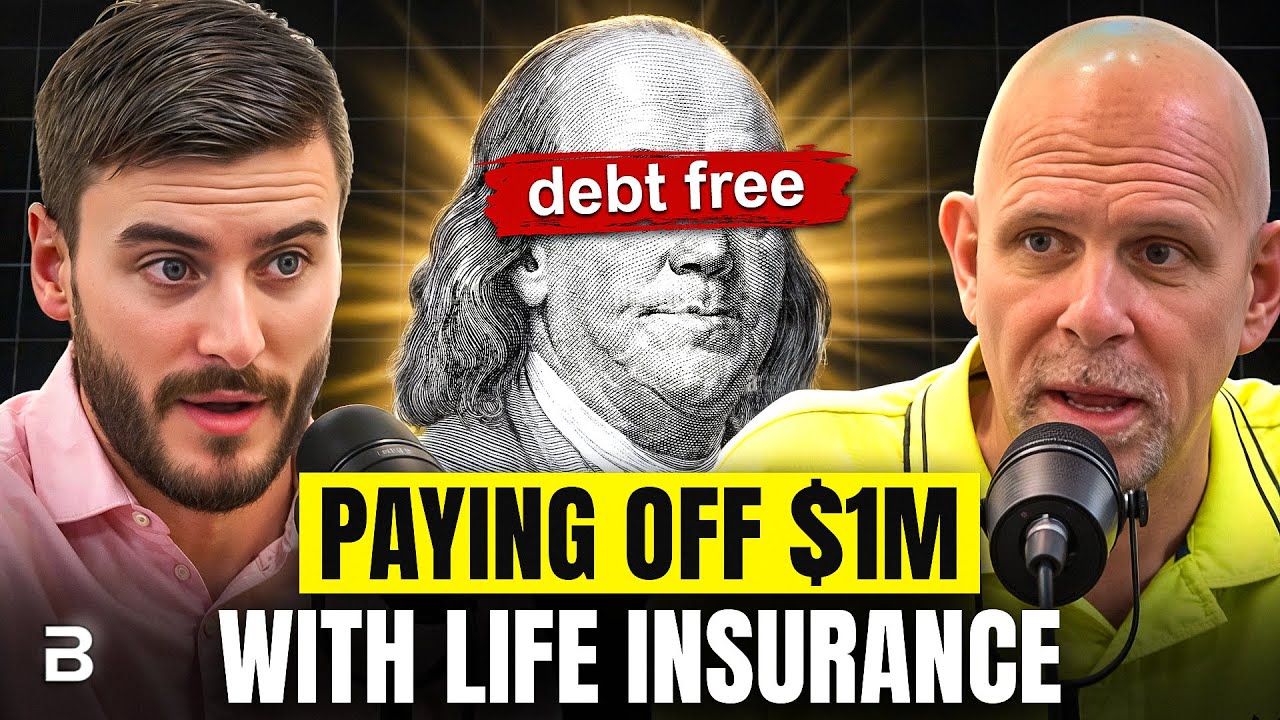
How Did Brent Kesler Pay Off Nearly $1M of Debt in 39 Months?
October 21, 2024·70 min
Watching on BetterWealth
Brent Kesler owed almost a million dollars to outside lenders in February 2008 and paid it off in 39 months. The step he added was sending money into whole life policies first, then taking policy loans to pay his creditors. Caleb pushes back that a savings account could have cleared the debt faster, because the real change was Brent's decision to save. The difference, Caleb argues, is that Brent still owns the policies afterward, with a death benefit and cash value that keeps growing.
Caleb Guilliams interviews Brent, a former chiropractor and the founder of Money Multiplier, about how he learned infinite banking and why he waited two years to start. Brent explains paying loan interest every year at the policy anniversary, borrowing from his policies to make real estate loans in first position, and his plan for his children to keep paying premiums. Caleb raises the risk that a large premium commitment turns into a liability if income stops. Brent closes with his regrets and why he puts health first.

Full transcriptAuto-generated from the video. Punctuation added, and filler and repeated words removed.
And it was at that time, February of '08, we were $984,7 in third party debt, and I was able to pay that debt off in 39 months, and I just had to add one step in my financial life. "You could have done the same thing with the savings account, and you could have actually gotten debt free faster." Just hear me out here, right? Life insurance is not going to be the magic bullet that solves all your issues. No. Yeah, the thing we were doing is building wealth without working any harder, without taking any additional risk, without changing your cash flow.
Anything that you regret about this space that you taught, that you wish you toned down or you change your tune when you first got in? Because I waited, I cost my family so much money, so let me explain. Brent, welcome to the BetterWealth Show. Awesome, Caleb, happy to be here, thanks for inviting me. I've had my show for over five years on the podcast, I've only started on YouTube a few years ago, and I can't believe that you have never been a guest. I'm trying, I don't believe you have, and which is crazy because we've know, like I've known you the moment I, like, got into learn more about infinite banking and Russ and Joey with Wealth Without Wall Street, right?
And so I want to open up with this. So I had the opportunity to interview Chris Naugle, and probably a lot of people on YouTube know Chris's name more than yours. Oh, wait, yeah, absolutely. And he shared the story, he shared the story that he is indebted, indebted just to you and your kindness, and he said, you know, when early on when he was making no money, you would just give him checks, you just give him checks, say, hey, like, just pay me back when you can, like, I believe in you. And he's like, I've never asked him, like, why he did that, but I am here because of Brent's belief. For those of you that know who Mr. Brrrr is, Chris Naugle, Hannah Kessler and the Jonah, the Dues, the bank bros, all of them are result of the founder of Money Multiplier, which is yourself.
So we're going to dive into that story, but I just want to, like, open up with, like, acknowledging that you're an amazing human, but you also have loved on people that are making a difference, and I don't think you get as much credit as maybe you deserve from a standpoint of, even though you speak at a lot of places, you're the person that's made a lot of people, which is a level five leader. A level five leader, like, I'm okay with other people being more known and sharing this message. So I know I'm buttering you up here, but welcome to the show, man. No, man, absolutely, that's great. I'm humbled to hear that, I'm humbled to hear Chris, you know.
Yeah, just to talk about that, so it's kind of emotional, you know, because, yeah, so Chris and I go back a long way, and yeah, he went through some troubling times, but he's amazing, he's an amazing human being, he's very loyal. There's no one on this planet that's more loyal than Chris Naugle. I always tease, you know, I could leave, so I can go on a trip and I can leave, okay, so on my counter I can leave $1 million in all $1 bills, and I would come back and there would be 10 extra there because Chris would be afraid that he lost a few, you know, just because of whatever, you know, they blew out, okay, so of the door or whatever. That's just the type of person he is, very honest, very loyal, full of integrity. And, yeah, I mean, he's just an awesome individual, and I'm so glad that he came into my life.
Yep. Why did you, like, give him checks and, like, finance him early on? Like, what did you see in him that you maybe didn't see? Yeah, I mean, so, like, knew he had gone through some times that were troubling, and, you know, he had gone through some downfalls in his life, and I don't really think he had a lot of people there for him that were standing in his corner. And to be quite honest, I mean, I didn't even know at the beginning, but I just knew of his passion and his desire and his drive, and he never quits, he just never ever quits.
I just had a conversation with him the other day because he wanted to take on some more responsibilities in our organization, and I said, Chris, I said, dude, I said, you're going to burn yourself out, you got to slow down, you got to have, like, quality time with your family, with your wife, with your daughter. I said, there's a lot of tasks that other people can help you do, there's no way you can do all of this yourself and take on all the problems, the challenges and the issues. We have to rely on others on our team. And I think he's starting, you know, more and more to see that, but every now and then he reverts back to where, okay, if it's going to get done, I have to do it. And he doesn't care what time of day it is, you know, if it's on the weekend, if it's on a holiday, he's just go, go, go.
So I just kind of make it a point to try to not bother him. Like, if I got something on my mind, I don't want to, like, okay, call him or text him, so like, for example, at 7 or 8 in the evening or on a Saturday or Sunday, because I know he will drop everything that he's doing, and those things that he's doing at that time are important things that are off the job stuff, of course, you know. So the thing is, Caleb, so, okay, just, okay, as far as all of us being owners of businesses, the thing you know is that it's hard to turn this off at any time. Totally. And it's a 24/7 deal.
But, and, but, okay, but there comes a time where you need to recharge, and the way my daughter puts it is she says, Dad, my social battery is dead, right? My social battery is dead, I need to go and recharge my social battery. And just in this business, you know, it's a 24/7 deal, it's never 9 to 5 Monday through Friday. So we always have to be there and show up for our clients and for the people that are counting on us. So we're going to get into, I mean, Chris literally said the 90 minute webinar that he watched from
You and change his life and all, and we're going to talk about that, but want to zoom out. I want to understand how you learned about this, and how everyone articulates things differently, and so I want to be able to get your backstory. And then I also want to hear, like, okay, knowing where you're at today, what are things that you regret? What are things you regret teaching at 2014 that you would have changed, or do you have no regrets? What are some of the success stories that you see of the clients that are really crushing it using whole life insurance? And then what are the clients on paper should be doing well, but they're not getting it?
So we're going to talk about all of that. But before we get into the nuts and bolts and exciting life insurance topic, which our people love to listen to, I want to understand more of your backstory, because you didn't come out of the womb talking about life insurance. In fact, you were in the medical space, and so I want to just get a little bit of your backstory of, like, how you came from being a chiropractor to doing this.
Yeah, well, I'll just take it back to the time that I was a chiropractor. And so anyway, I was at a chiropractic conference and I heard this speaker talk about infinite banking concept, how to become your own banker, right? And so that was back in 2006, and I was in the audience in a chair, the chiropractic conference, and I heard this guy talking about this concept and I thought, wow, that looks really, really good, right? But it just seems too good to be true, right? So anyway, I took in all the information and I went back home to my normal chiropractic life, and I did nothing with the information right that I got. As a matter of fact, I even bought the book Becoming Your Own Banker by R. Nelson Nash, put the book on the shelf, never read it.
So I go back to another conference about two years later. Okay, it was either in late '07 or early '08, and about 10 or 12 of my chiropractic colleagues that had been at the previous conference a couple years earlier were at this conference, and they were coming up to me and they were raving, and they were like, Brent, isn't that banking concept the most powerful thing ever to build, keep and create wealth? You know? And so, all by, okay, the thing is, the thing we were doing is building wealth without working any harder, without taking any additional risk, without changing your cash flow, all by adding one step in your financial life, right? So all these guys were going on and on about this.
And so the only difference between them and me is back when they first heard about it in '06, they implemented it and they put it into action, and I didn't. So they were basically throwing up all over me with all this information, and I thought to myself, there has to be something to this, right? There's no way that 10 or 12 of my colleagues are lying to me. Maybe one or two, but not 10 or 12. So I went home and I told my wife, and it was in February of 2008, I said, honey, we're going to start implementing this in our life.
And it was at that time, February of '08, we were $984,700 in third party debt. That's what we owe to the third party creditors. Now, how do I know that number? Because that was part of the exercise. I had to know what that debt number was. And again, I know what you're thinking. You're thinking, well, how does a guy from Kansas get to be almost a million dollars in debt, right? I know if you live in California, that buys a really, really small house, but in Kansas it buys you a lot, right?
Well, I had my student loans from chiropractic school, I had my chiropractic clinic, I had the house that I lived in, I also had another home in the Ozarks, the Lake of the Ozarks, between St. Louis and Kansas City. And obviously, if you have just a place on the lake, you have to have a boat and the wave runner, right? I mean, you can't have a place on the lake without a boat and a wave runner. I'm also an airplane pilot, so I had to have my own airplane. Well, it didn't take me a lot to become almost a million dollars in debt.
Well, I was able just to take this process and I was able to apply it into my life, and I was able to pay that debt off in 39 months, three years and three months. And again, I just had to add one step in my financial life. I didn't have to work harder, change my cash flow, take any additional risk, or lose control of my money. Add that one step. So I became excited about this concept.
Can I ask you a question before, so before you get excited, so you added one step. Were you investing in, like, 401ks and SEP IRAs, or, like, what were you doing previously to this? Were you just, like, what was your financial strategy before implementing this?
Yeah, well, let's see, back then I didn't have a lot of extra dollars, you know, because everything was going towards the clinic, so I didn't have a lot of extra money. But so anyway, so with my wife, had a job, and she had a 401k, and she was maxing out that 401k. Okay, so for me, I came out of school, out of chiropractic college, and then I got in to, yes, let's see, that was in '04, I got into chiropractic.
Okay, and then, you know, this was a few years, so you're learning about this. And what was the, do you remember, like, the initial pitch of, like, oh, that makes sense? Was it the add whole life insurance and become your own bank and pay yourself first? Was that, like, what was the epiphany for you that you were like, this is amazing?
Yeah, well, back in '06 I thought it was amazing, but I just didn't believe it. I thought it was too good to be true, so I did nothing. And then it was after getting that third party social proof of those 10, 12 colleagues of mine, you know, that were doing this in their life, and they were going on and on about how it was working for them, how they were building and keeping and creating wealth, then
I thought, okay, I had to do... okay, so like, again, I had to do this. I had to implement this in my life.
So you implemented, and where did you come up with cash flow?
Yeah, I really didn't have the cash flow. As a matter of fact, I remember coming home and telling my wife, I said, honey, we're going to put in $2,000 a month and do a whole life policy, because I didn't have all 24,000 to pay in one lump sum. And honestly, I really didn't have 2,000 extra per month to do it, but I knew that I had to do something. I knew I had to start. Why I picked the number 2,000, I don't know, but I told my wife that, and my wife was like, what? We're going to do what? And she was not having it. She was not really on board 100%.
Now, the thing you got to know about my wife is she's very analytical, she's very detailed. Her background is in nuclear engineering. She helped design, you know, the nuclear reactor for the submarine for the US Navy. So every I is dotted and every T is crossed.
Yeah, right.
And so when I came home and told her that we were going to start putting money into the policy, the conversation did not go well. I'll tell you how it went. So anyway, okay, so my wife is the type of individual that does not believe in divorce, but we came really close to talking about going to an attorney to talk about divorce, because we were on total different ends of the spectrum. But she believed in me, and you know, through the testimonials and the success stories of those other colleagues in the chiropractic field that were doing this, she said okay.
And so now today, what she tells me is, she says, hey, here's the way I looked at it. So, like, my husband Brent, he is a spender. He likes to spend money.
Glad you're talking about this.
He likes to spend money. Yeah. And so anyway, okay, back then, and okay, so all this was without... okay, just her telling me. But what she said to me down the road later, and what she said to others, is that this was a way to make me stop spending, to actually force savings. And that's the way a lot of our clients have to look at this. Is it is a forced savings vehicle. That's all it is. It's like putting a deposit into your own bank account that you can control instead of somebody else.
Here's the difference, and I think this is going to make sense for a lot of our listeners. Is you got inspired by a process. Yes, life insurance and the process of becoming your own banker, amazing, we'll talk about that in a second. But at the end of the day, you made a decision, and that decision created $24,000 a year that you were going to save that you weren't already saving. Right? So the problem that a lot of people have is they don't want to change their behavior at all, and then they're just like, well, see, this life insurance sucks as an investment. And they're not wrong. The product itself is not going to radically change your life, but you decided to.
And maybe the epiphany was like, hey, like, was it the golden rule, I don't know, it's like the whole concept of like, I need to start saving. And after a couple years, and it was less than... what was it, less than three years? Yeah, you're debt free, which means three years and three months, which means you had to... there's no magic bullet here. You had to have saved a lot of money over, like, am I not... like, you started with $2,000?
Yeah, I started with 2,000 a month, and then I quickly said, man, this is working really good. I added another policy for 2,000 a month, then one for 4,000, then one for 4,000. And all it was, Caleb, is it was just, okay, so like, all the dollars that were coming in, I was redirecting that money. All that money was coming in, okay, because I was in the chiropractic office and the money was coming in, and previously I would take that money and I would pay all of the debts and all of the expenses first. So it would come in, I would take the money and it would go into the conventional bank account, and then I would pay all those expenses and those debts out of the conventional bank account, and I would hope there was some left over for me at the end.
So all I did was add that one step in my financial life. Instead of it going into my bank account and then paying that debt, I would just send it to the policy first in policy premium. Yeah, because if you really think about it, policy premium, yes, it's a payment, I get it, it's a payment, right? So every time you go to the mailbox, you open up the mail and it says insurance premium due, our mind goes right to that as a payment.
Yeah, totally.
But if you change your paradigm and you start thinking of it a little different, if you think of it as a deposit that's going into an account that you control, it's totally different. So that's how I had to look at it. Policy premium was no longer a payment. It was a deposit that was going into my bank account that I controlled. So I added that one step, and then of course from the policy I would now take a loan from the general fund of the insurance company to pay those third party debts against the death benefit.
Yeah, against the cash value.
But against the death benefit as well. So the death benefit allows it to be an unflexible loan, meaning we're in control. Yeah, and that... yeah, oh yeah. But yes, you're exactly right, against the cash value. I like to think of it as a policy loan is a prepayment of the death benefit, because no matter what happens in life, both you and me are going to die, pass, or graduate, you use whatever word you want to use, mature. It's not an if, it's a when, right?
Yeah, that's right. So now all we're doing is we're putting this money into the policy, we're taking a loan from the general fund of insurance company, so all of our money is still continuing to grow and we're using it at the same time. And yes, it's a good habit to pay back the insurance company for the loan that you take, just like if you borrowed money to buy a car.
...or a house from a conventional bank, you would, okay? You would pay them back. So you should pay yourself back the same way, because if you don't, what you're saying is your money is not as valuable as the bank's money. But the insurance company will never come knocking on your door and saying, "Hey, how come you're taking this loan? Are you going to pay it back?" They don't really care in the big scheme of things, because they know they're never going to lose, because the cash value of any policy is always lower than the death benefit. The insurance company knows that you are going to die, or graduate, so even if you didn't pay back the policy loan, even if you didn't, they're going to get paid back every dime upon your death.
Yeah, the insurance companies are one of the only companies that are hedging interest rates and maturity of your life. And at the end of the day, if you have an outstanding loan, they just deduct that from their actual liability that are on their books today. And so it really is, if you think of the companies that you can partner with to weather the storm, yeah, like you can't think of a better company that's more safe than that.
Let me go back to your scenario, because I think this is going to be a really good analogy. You could have done the same thing with the savings account. Yes. And you could have actually gotten debt free faster. Just hear me out here, right? You could have done the same, because you are literally, the big epiphany is like, I need to pay myself. And what you did is, whoever you were working with got you freaking motivated to say, I'm going to get out of debt. And so what you essentially did is you just took all the money that you're making extra, you're putting aside and you're knocking out that debt.
The difference is, do you still have those policies today? Absolutely, 28 of them as we sit here today. The difference is, assume out, you now have an asset that earns greater internal rate of return than a savings account does, has a death benefit that's growing, the death benefit. With those policies early on, what would the, because that's not your total death benefit, but like, what were those death benefits equaling, if you had to guess? Oh, I mean, you know, I started my first policy, I was 40 years old, and the policy was 2,000 a month, so 24,000 a year. I don't know, probably three quarters of a million, a million dollars? Fair to say the first 36 months you've had three, four million on your, because you bought multiple policies? Oh, absolutely.
So now those are probably even greater, probably five, six, seven million. Well, yeah, because it goes up with time. Today's better than yesterday, tomorrow's better than today. You have a lot of other living benefits. So the point that I'm making is, short term, yeah, if all we care about is being debt free, a savings account is actually a more efficient vehicle for the 36 months. The problem is, the more you zoom out, this gives you one benefit and it gets less and less valuable, versus the life insurance is more foundational, maybe looks worse in the first, but now it's like, now you've built a massive, massive asset.
Anything you want to add to that? Like, I want people to understand that there's nothing magic. Like, I think sometimes when people hear becoming your own banker, infinite banking, there's like this magical thing. There isn't. But we're going to talk about in a second, like, life insurance is an amazing long-term way of thinking, it's foundational, but you need to understand the process. Most people, we have a savings crisis on our hands, most people don't want to save, period. And if you don't have that, life insurance is not going to be the magic bullet that solves all your issues.
No. And just like, out of all the events that I travel around the country and speak at, you know, I tell people in the audience all the time, and so like, a lot of these people are high net worth individuals and they do a great job of making money, but they suck at keeping it. And that's exactly what I tell them. I say, you do a great job of making money, but you totally suck at keeping your money. And this vehicle, this concept, this system, allows you to keep that money inside of your family. So yeah, just to add what you're saying.
Of course. Okay, so from that book, Becoming Your Own Banker by R. Nelson Nash, which is the book that totally changed my life, I got to give Nelson Nash all the credit in the world. I would never be doing this, right? Okay, like, if it wasn't for that book, that book completely changed my life. And just to kind of go by what you said, is, hey, it would actually work quicker and faster early on, short term, in a savings account. And in that book, Becoming Your Own Banker, on page 45, I call it the car example, where basically what Nelson is doing is he's comparing twin sisters, we call them the twin sister analogy.
Where, okay, of course, twin sisters, they're exactly the same age, they're taking the same amount of money and they're putting it away into savings. Well, one sister is putting it in a CD, and the other person is, okay, and then the other twin sister is putting it in the infinite banking design policy, right, the whole life policy. So they both are doing exactly the same thing and they're buying a car every four years and they're paying themselves back. So actually, I think in the first 16 or 17 years, the CD sister is actually ahead of the infinite banking sister.
So this is not a short term play. This is not something to do if you only want to do it for a very short time. As a matter of fact, I have a slide on my presentation that says, this is a marathon, it's not a sprint, it's not a get-rich quick. So if you think you just want to try this out, kick the tires for a very short term time, then you should run, run, run away from this. This would not be for you, you would not like this. I tell people, if you like your money being controlled by the government, this is not for you. If you like government control, right, practicing the infinite banking concept is not for you. So it's the long-term play. Now, I tend to think of it a little different than what you stated, because...
I think from the get-go, from day one, even though you have more cash in your savings account than you would have in a policy to use, the thing that you don't have in your savings account or with a bank, like a CD, is you don't have the death benefit. I agree. So immediately when you buy the policy, and I know what we talk about all the time, we put all of this hype on cash value, borrowing loans, right, of the policy, and we talk very little about the death benefit. I agree. But you are going to use that death benefit. It's not an if, it is a when.
Yeah, so okay, so the thing I like to tell people is if you have anybody in your life that you care about at all, a child, a niece, a nephew, even a charitable organization, if you have anything at all that you care about and would like to maybe help them be better in their life, then there's no reason that you would never want to do this. Because even if you bought a policy, let's just say for example that you bought a policy, you put $1,000 into this policy, well, okay, so the thing, I'll use $10,000, and the thing you do is you put $10,000 into this policy and you have 5,000 that you can use pretty quickly, like in 30 days, and now all of a sudden you die in that first year. Now, okay, so now probably a lot of you are thinking, oh my gosh, I screwed up, I put $10,000 into a policy, I was only able to use $5,000 of the cash. No, no, no, you were able to use 5,000 of the cash, but when you die, when you die, that death benefit, which is multiple, multiple, multiple times more than the 10,000 that you just put in, that money all goes to your beneficiaries tax-free.
So in my mind, even from day one, life insurance is way better than a savings vehicle, way better than a CD, because there's always somebody out there that you're going to care about. Very few people have I met in my career that had absolutely nobody in their life that they cared about or no organization.
Well, and I'm glad you mentioned that, because that's the point that I'm trying to make. Is if you only care about one thing, and if that's just the cash and the rate of return, yeah, I think Nelson's example is perfect, it's probably going to be 17 plus years, depending, you know. But if you value other things like creditor protection, your death benefit, chronic illness riders, the value of tax advantages, tax going to be in the future, like when you start adding those things up from day one, you have, imagine a savings account, you have one benefit over here, you literally have a wrapper of all these benefits. But the problem is we don't always do a great job sharing, or a lot of times our clients don't fully get the value of these.
And so that's what I'm trying to do. It's like I would love to figure out a calculator to show people what is the value of creditor protection in your state, what is the value of actual tax deferred, potential tax-free use, potential passing on income tax free, like what's the value of that to your estate? And start quantifying, what's the value of potentially not having long-term care because you have a ton of death benefit with a chronic illness rider, which gives you the potential option to be able to use that in the future? There's a lot of things, like we talk about buy term and invest the difference. Well, buy term and invest the difference is very simple. It's like, well, if I have enough death benefit over here, I don't need to pay money for a term. So people get it, it's like I can take that and it can be working over here.
And Chris talked about, he's working on a calculator to really flesh that out, which I'm excited to dive into that when that's finished. But like that times 10, all these other benefits. And so I appreciate you mentioning that, because if people get it, amazing, but if the people that are into crypto and the people that are into get rich quick, I honestly don't think they should do this at all, because I think they're just going to be frustrated.
Agree. And again, I'll be the first one to admit that I need to do a better job of educating our clients and the community of the death benefit portion of this. Yeah, and I don't even do a good enough job. And right, because so the thing is is that if you go speak on stage, you only have so much time and you're really pumping up the cash value and the cash of the policy, and I tend to glaze over the death benefit portion, but it is so important. And just to have a discussion like this, kind of offline, off the main stage, the death benefit is so important.
Now the one thing you mentioned is rate of return, and I'm sure your clients, my clients all the time, they're bringing up, what is the rate of return? I could get a better rate if I do this, a better rate of return. Well, on page 69 of Nelson's book, he talks about rate of return, and because right, because all the time that's the noise that he always heard, rate of return, rate of return. And I would encourage you to read that book, Becoming Your Own Banker by R. Nelson Nash. On page 69, he talks about, but I can get a higher rate of return. Well, it's not about the rate of return inside of a policy, it's about the volume of interest that you have been paying to someone else.
Even if you pay cash for something, you still pay interest, because you give up that interest that you could have earned, because you're giving up that opportunity cost. For example, if you pay cash for a car, people are proud of it, they bump up their chest, and I paid cash for a car, and they're very proud when they say they pay cash. But all they're doing is really hurting themselves by paying cash, because in their mind they're thinking that I paid cash for two reasons: number one, I don't want no payments, and number one, I don't want to pay any interest. Well, that car that they just bought is eventually going to wear out, right? So let's just say it's a $25,000 car, and they're thinking, why, I paid cash, I don't have any payments. Well, you do have a payment, you had that one payment of 25,000, and
If that car wears out, which it eventually will, you're going to have another payment of $25,000, right? And then they're saying, why pay no interest? Well, when you pay cash for something, that money is gone. Where, for example, if you pay cash for a new car, or a $25,000 car, that money is gone. It's left your family forever. When you run that money through a policy first and use the cash value in your policy to buy a car, now that money you're able to recycle and recapture that money, just like Nelson talks about on page 54, 59, 60, 61, and 62 in his book, when he goes over the equipment financing examples.
You're able to recapture the money, so not only do you get the car, but that money stays in your family. It is in a closed system, and instead of other people, for example the bankers, the profit holders and the shareholders of the bank, making all that money on your money, you are now making that money, because that money stays in the family. There's no money being leaked out of the family whatsoever. So it's so powerful to keep control of that money. So could you imagine, Caleb, if all of us could just keep most, if not all, of what we made, how much better we would be financially, instead of having to give all that money away to other people such as taxes and interest that we're paying out all the time, or even the interest we give up by paying cash?
No, and Dan, I love how well you know Nelson's book. Do you have memorized every word? I've read that book so many times, and the book's changed my, it's changed my financial life. The way that I explain it is internal, external. You have your internal return and the benefit of life insurance, and then the external is what you do, the activities that you do. And yes, the infinite banking, the AND Asset, or whatever you want to call it, it creates, gives your dollars more than one job, and in the end I believe that more jobs on a dollar gives you better, better off than less jobs on a dollar.
And so I have a couple questions for you, but however, I love that more jobs on a dollar. And you mentioned earlier Devin Burr. He's a real estate investor. So Devin creates all these videos of how he invests in his real estate, and he's using the same dollars over and over and over again to buy these multiple properties that he's buying. Yeah, it's crazy. And again, it's not like you could do the same thing with the savings account, but again, the savings account only gives you one benefit, and over time the rate of return that a savings account does worse from what you could. So it's like if you zoom out, there is a no-brainer.
But again, there's nothing magical about life insurance. It's not like life insurance is like this sexy investment that's going to go to the moon. It's not. And I use this example, Dan, but like the foundation, we're in this beautiful building and we can't see the foundation, but this building, think about how deep the foundation needs to be to keep this thing out. Yeah, I mean, how, and that's essentially what, you know, people that build their house on a rock. Yeah, and I very much see life insurance as that.
I want to ask you a question, because this is probably the thing that was the toughest thing for me to understand, and to this day, even hearing you talk, I'm like, oh, like I got to ask you this. So you're early on, you're saving a bunch of money, you're like continuing to save, save, save, you're putting your money into life insurance, and then you're taking a loan against it to pay off debt. Yeah, okay. How the, my, the only way that system works is if you continue to make more money, right? Because it's like you're saving a bunch over here, you're putting into life insurance, you're taking a loan against that, paying off debt. So I get that your cash is collateralized over here, you're getting all the benefits of life insurance, you're paying off your debt, you're potentially making a loan rate payment. But like, how do you continue, like the only, if you stopped making money over here, I look at this system as being potentially problematic.
So it's like, have you gotten like, has anyone gotten in trouble where they get really aggressive, they're funding a lot of these policies, but then something happens to their job or something, and then they're over, not overleveraged, but they're leveraged here, now they're trying to figure out how we keep the foundation afloat? Like that was the thing that for me was like, when Nelson would say like your premium needs to equal your income, and that's a long time, but like, still I'm like, how does that work? I get that you can die without outstanding loans, but he also teaches that you should pay yourself back. Yeah, well, if your income, like if your income, me, like, you understand, like for me, like from an analytical standpoint, I'm just a little less comfortable telling people to aggressively fund life insurance, because I don't want the source, their ability to create, to ultimately potentially blow up the foundation.
Sure. But I will say the downfall of what I get myself into is we start a little bit smaller, and so it's like, yeah, over time. But at the end of the day, we're like, I bet some people that are really able to go all in, it's life-changing. But then I get a little anxious for them, if I'm being honest. So I don't know if my question made sense.
Well, I think it did, and let me kind of answer it this way. You know, I think people need to start at their comfort level. Yeah, we have never, ever told over 13,000 clients that we have, we have never told one person how much money to put into your policy. So it's on that, you make the decision of what you want to make. Here's the way I like to put it. I like to ask somebody, like, Caleb, are you worth $250 an hour? Well, of course you are. You know, you're worth way more than 250 an hour. Yeah, yeah, I know you are, but at least $250 an hour. And yes, you say yes. Well, how much is 250 an hour? Okay, let's say you work 40 hours a week. 250 an hour times 40 is going to be 100 bucks a week. It's 400 a month. It's 5,000 a year.
So are you worth paying yourself first 5,000 a year, 250 an hour? And now I say that, people say, "Well, I don't know, maybe I'm not worth 250 an hour." Okay, what about a buck 25? A buck 25 an hour is $100 a week. You know, it's, or again, I'm sorry, okay, a buck 25 an hour is 50 bucks a week, 200 bucks a month, $2,500 a year. Okay, are you worth 2500 a year, paying yourself $2500 a year? And if a person says, "No, that's still too much," then I usually say, "Well, this is probably not a good fit for you. Come back when you think you're worth at least a buck 25 an hour," which means paying yourself a $1.25 an hour.
Now, I never tell anybody how much to put in. We have people that put in all different kind of amounts, and the cool thing about what we do is it, right? So the premiums can be paid monthly, quarterly, twice a year, annually. You can always change the mode, you can always reduce and lower the amount you're putting in by at least 60% or even greater. As time gets on, you can even lower the premiums.
So a person will get in trouble, however, if they are going to quit early on, and that's why we always say unless you're going to do this for the long term, and I like to say a minimum of four years, that's not even the right answer, should be longer, but a minimum of four years, then you shouldn't do this at all. But if you can make it through the first two years of paying premium, you will never ever ever stop paying premium. And here's why: because as the years go on, the policy gets more efficient. Today is better than yesterday, tomorrow is better than today. That's not me telling you that, that is in your policy contract.
So before you ever accept, sign, or pay for that policy, look at the numbers on the guaranteed side of the illustration. It's okay to look at non-guaranteed too, because honestly that's really how the policy is probably going to perform. But if you really really want to be cautious, look at the guaranteed side, because that's the worst at all that that policy can perform. And as we start getting into those years, years three, four, especially five and after, the dollars you're now putting into the policy, you're able to use more than you put in.
So why on Earth, Caleb, every time you gave me a dollar, if I give you back a $1.10, would you ever want to quit that? You would never never ever want me to stop that. And next year you give me a dollar, I give you back a $1.20. It just keeps getting better year after year after year. Yeah. So the people that tend to quit, the people that tend to quit is early on within the first two years, because there's a financial catastrophe or disaster.
Now, another reason that people can get in trouble is because they're not disciplined. All right, I would like to see every single client pay back policy loans when they borrow the money. I'll be the first to tell you, I do not, I do not pay back my policy loans. Now, I do pay them back, I pay them back sometime, but I generally don't. As a matter of fact, for me personally, I don't like cash value sitting in my policy, because if it's sitting in my policy, that money is not out there in the workforce.
So I'll give you an example. I like to do like projects where I lend money or I invest into properties or real estate. Let's just use lending. Let's just say that I'm going to loan somebody money at 10%. Now, I'll never loan money to somebody with just their signature. I want hard collateral, I want to be in first position. I actually have a shirt that says if you're not first, you're last, right? I like that. So I don't like second position, I like first position. So if I can borrow from the general fund of the insurance company for five or six or even 7% and go put that money out into another vehicle that's making me, say, 10%, why would I not do that? I'm just using the money. The money is in motion, it's staying in motion.
Now let me be clear. Every single year at your policy anniversary date you must, must, must, must, must pay back policy loan interest. You cannot let that interest compound and capitalize. So if you borrow, say, $10,000 from your policy, and say your interest is 6%, that means you're going to owe the insurance company $600 for keeping that money for the 12 months, right? So you have to have to have to always pay back the loan interest. But the loan balance, as long as you're using that money and as long as you're disciplined with how you're using it, for example, if you're going out and you're investing or you're putting it into good quality first position loans, I say continue to do it.
Right now some people would argue with me and say no, but I say, I say do it, keep the money in motion. But again, okay, there's two types of people in the world. Well, there's more than two, let's just go on each spectrum. There's people that are extremely, extremely disciplined with their money. Yeah, this would be a good scenario for them, the same thing that I do. But then there's other people that they think just because there's checks left, there's still money in the bank. Those would not be the people that would do this because they're not disciplined. So it's all what's between the ears and how disciplined.
You talk about discipline, you still have to factor in the premium payments that you're paying. You do. Sometimes like that gets, that gets forgotten about. I'll tell you this, this is probably the biggest difference between you and I, is you are a lot more comfortable having a lot more outstanding money in motion. For me, I like the cushion, because again, like I make less on my cash value than you, if we take the portfolio, and I'm actually okay with that. Not long term, but like for me, like in business and all, like I like having a year's worth of, like, everything hits the fan, like we can keep the lights on linking from my insurance policy.
What, two, you don't have to answer this question if you want to answer, I would love to know what your outstanding loans are for. That would just be interesting. Number two is what type of emergency fund you have of like dead money, because I know it's like mathematically it's like, oh, this is bad, but it's like one thing I think sometimes we
Overlook is like risk. We think being in first position is like risk-free. There's still unknowns out there that are, you know, you're a lot less, you're taking less risk than putting your money maybe in the stock market and like rolling the dice. But it's like there's still, for me, it's like, man, potentially if there's a Black Swan moment, you might be in first position, but what if you're not getting that money soon? What if you take a hit in business? Now you have your financial foundation that potentially could be fractured if you didn't have cash value or something to be able to at least pay the base. I don't know if that question makes sense.
Yeah, it does. And again, there's a lot there to unwrap. If I don't answer it, I'll ask again. Okay. But it's completely fine that both you and I are different. That totally doesn't make us right or wrong. We just kind of, right, like comfort level is just at a different state in life, but also both of us are 20 years, no, we're 30 years apart in age, right? You would think I would want to take more risk now with like 30 years apart, but see, I don't look at it as taking risk, because here's the deal.
If I make a loan on something, I'm in first position, right? And the first position loan is, if okay, for some reason if something goes bad, all I do is I foreclose on that property just like a bank would foreclose. I'll give you an example. I loaned a guy last year a million dollars to buy a $1.5 million house that was appraised at 1.7. Okay, and I didn't even want to lend him the money, and I told him, I said, Joe, I said, you are not going to like the terms, and the terms are interest only, 16%. So on a million dollars, it's $13,333 a month that's coming in as interest. I'm in first position. He put up a half a million on the $1.5 million property.
Okay, so if he stops paying me, what happens? I foreclose on that 1.5 that's been appraised at 1.7, and now I am in control of the property. Now I get it, I've got to go through the process of selling the property and all that, but there's enough equity in that, yes, to make me know that he's not walking away from that deal. He's not walking away because you're not going to walk away from something like that. So I do take that approach to where I would not loan him a million dollars on a $500,000 piece of property. I would never do that.
But okay, but the one thing you make is a good point about what if something happens and your income stops. Okay, well what if something happens where your income stops and Joe is not able, and so you're foreclosing but the market's down? You're still going to get your money, but like from a cash flow perspective, it might be six months from now. Yes, and you're exactly right, and that's why I do have some reserves. Okay, to where I have it in case something happens. I have an out that's going to be at least four months. Okay, I have a four month, 120 day out, at least a minimum, okay, to where I can regroup and replan and reorganize.
It's not like, call me, call me, I'll have the cash value. Or yeah, or like a lot of my colleagues have cash value in their policies. I could borrow from them. Now I would be borrowing probably at high interest rates, but it would help me get out of the mess that I'm in. But then I know I'm also the type of person that if I lost everything or something happened and God forbid a catastrophe happened, I'm going to be out there. I'll go back to the grocery business and start doing grocery work again like I was years ago. I'm not going to starve, and I'm not going to let my family starve.
And then also, I'm always, okay, so like all these other assets that I have, for example, property and like equity in property or things like that, if I had to like sell or liquefy something to help pay something off, because I'm going to tell you, not every loan that I have made has worked out. Over my lifetime, I've got about $600,000 of money that I have lent out that I have not been paid back, which I'm due to be paid back. Now a lot of those loans I did at not first position, so that was a big, big lesson that I learned the hard way, is you got to be in first position. People will say, well, I'll give you more interest if I can put you in second position. No, I'm not interested. Pigs get fat and hogs get slaughtered. I just want to be the pig, I don't want to be the hog.
But all those are great points that you bring up, and again, I'll answer your question on the loans. I don't know exactly what I have in loans right now. I just paid off last week, I paid off like $800,000 in policy loans. But if I had to guess, I have right now about $3 million borrowed out from all of my policies combined, but I also have almost 11 million lent out to other people with first position stuff that's coming in. Now I will tell you this number that I know, that I track almost on a monthly basis on my loan portfolio. Currently, as we sit here and speak today, I have about $124,000 a month that comes in from those loans.
Now let's just say I had 10,000, let's say I had $10 million borrowed out from my policy, which I don't, it's way less than that, but let's say I had $10 million borrowed out. Okay, well if I had 10 million borrowed out, that would mean I would be paying $600,000 a year in loan interest, or $50,000 a month. Do you really think I care if I pay the insurance company $50,000 a month in loan interest if I'm getting $120,000 a month that's coming in? So that's the way that I look at things, but I'm kind of a nerd and I dial those numbers down and I look at them sometimes.
It's your money. Your wife probably keeps you in check too, because yeah, you know, all the time my wife is asking me, she says, how much do we have in our policy? And actually that's a good point, because all right, because I was talking to you about
That my cash value in my policies, I like to keep that money out. So even my wife will say to me sometimes, she'll say, "Brent, how much cash value do you have?" Okay, the thing she says, "Brent, how much cash value do we have in our life policies?" And if I tell her a number that is too high, she gets a little mad. She says, "No, no, no, I want that money working. Get that money out there working."
So even equity in your house, I mean, if you think about equity in your house, it really does you no good other than the peace of mind knowing that it's paid off. And that's, and again, just people, that's a lot of, that's great, that's good satisfaction, but all the equity sitting in your house does you no good.
Yeah, here, I'm going to give you an example of just what I did a few years ago. Okay, I went to my primary residence and I said, "I've got all this equity sitting in my house. I wonder what I could do with the equity?" So I went to the bank and the bank said, "Here's what we'll do, Brent. We will give you $1,500,000, we'll give you an interest only loan for 10 years and your interest rate is 2.875%." And I did that. Now, I think it's been about three years. So $1.5 million I pulled out of my house.
Yes, I owe the bank every month. I owe them a payment of, I think it's $3,736 a month I owe the bank. But 1.5 million, let's just say I only earned 10% on that money. How much am I making? You know what I'm saying? It's control cost. So that's the way that I think, and it is for some people a little too risky.
But that's you saying a couple things. Number one, like there's some people that teach infinite banking that are like, pay off your home kind of deal. They're obsessed with being debt free, which is fine, but like you understand that. And step number two is, yes, you're paying $50,000 a month just in interest, insurance companies. If we just stopped there, it'd be like, "Brent, you're crazy. You're paying more in interest than most people are making," like crazy, most people are making in their life. But the problem, the deal is you're making over 100,000 a month and you're taking less risk. There's still risk in anything, there's risk in being alive, but like first lien debt, like you are literally becoming the bank, which is amazing.
A couple more questions. What is your annual premium a year? And if you don't want to answer because this is going to go on the internet, I get it. No, no, it's about a million dollars a year in premium out of all of my policies. But here's the thing, I want to be clear is that every one of my policies, I've always, always, always paid premium on all of those, even the first one I started in February 2008 till I just bought one last year on my wife, where I put in 2022 at $420,000 of premium, a brand new one on her that we just started it. It was at the end of 22, it was December of 22. Okay, so I think it was. But the thing I did with that policy is I backdated it six months when I started it. I had never backdated a policy before, but the one I got on my wife.
So okay, so anytime I backdate a policy, that means I pay the premium now, let's just say it's January 1st, but the policy has an enforce date of July 1st. So that means I paid, okay, like on January 1st my first year premium of 420, and then the second year premium, which I'm able to pay six months later in July of the same year, I paid 420 again. So I paid two years of premium on that, and then the third year comes due, I think it's in December of this coming, like five months from now or whatever, December. Wow.
So see, you're, I guess my question is, so let's just go off the million number. You're putting in a million, how much is your policies increasing in cash? Oh my gosh, from that, do you know? Yeah, well, all of them are different because, as you know, the oldest one is the most efficient. The policy putting a million, is it a million to? So on that policy, on that first one, I don't know the exact number on all of them combined what the growth rate is, because for example, the new one, it's not growing by enough yet of the dollars I'm putting in because it's only a policy that's two years old, right?
But the very first policy, and I checked these numbers in February, for every dollar that I put into that policy that I started in February of 2008, this past February, it gave me like $260 to use. Every dollar it gives you 260. Now that policy was started in '08 and we're in 24, so I believe it was the 18th year of premium into that policy. Makes sense? Yeah. So 18 years into that, or I'm sorry, 16 years into that premium.
How much death benefit do you have? Yeah, currently right now with all of the policies combined that we have, our death benefit is right around 30 million. The insurance company, bubble wrap, man. But they're not all on my body, keep in mind. There's some on me, there's some on my wife. I used to own chiropractic clinics, so I bought policies on chiropractic associates, right? So people that I had a vested interest in. Yeah, I have children, as you know, I have three children, but one of them is not insurable. Yep. And then my oldest son has two children, so I have two grandchildren, so they all have policies.
Best thing ever is to have more babies and you can have more policies. That's right, have more grandkids and more policies. But yeah, those numbers, Caleb, continue to go up. And I think it's important to know that I will buy a new policy every one to two years. I will add a new policy, whether it's on my life, my wife, because everybody, I believe as your income rises, as your net worth rises, you should continue to increase your premium.
What's going to happen if you stop making money though? Well, let me play devil's advocate. What if you're just like, listen, I'm crushing it. I have over 50, 60, $70,000 of passive cash flow coming in based on my, and that's only going to go up because of the cash that you're going to have, the
Problem is, if you're on the hook for a million just to keep these policies alive, like, you're now forcing yourself to have to work, which may not be a bad thing, but that is going to be something that some of the listeners bring up. I get it, and it's not for everybody. So how am I personally going to do it? Well, a couple things. Let's say I'm paying premium of a million dollars. Remember that premium is always going to be reduced when I drop the PUA rider, because I'm going to drop PUA riders on the policy, so that takes 60% out of it right away. So the million goes down to 400,000, maybe even less, right? And it could even be less if I let the growth of the policy pay the premium as well.
But again, so there's lots of ways that you can continue to keep those policies going. So for me, I'm always thinking of, okay, so like all those dollars, all of those dollars that are running through the policies, I'm putting it out there in my investment portfolio and my lending portfolio. So if I give you that example, like I said, if I've got 120 grand a month coming in and I'm paying 50,000 a month out in interest per se, yeah, there's 70,000 a month. 70 times 12 is 840,000. I could use that money just to fund the premium alone. You know what I mean?
So but then, but then the point is that is yes, but then what do you use to spend on life? You know, like, well, you'd have to stop, you'd have to stop being so aggressive with... Is it fair to say that you're going to switch from, once you're now getting, there's going to be a period of your life that's like, I'm going to start spending on our lifestyle? Yes, for most people I believe that's right. I look at it a little differently, because okay, so the way that I envision this, and as you know, my daughter is very involved into this business, and my other two kids are doing pretty well financially for themselves. They are being trained to eventually pay my premium.
Wow. But I think you understand where I'm coming from, because this is what I want to say. Is dude, you're on fire, man. I love this conversation, because you are, I didn't even open up about this, you're one of the most humble people I know. You're crushing it in the space and nobody would know, no one would know.
If they're like, see, like they would be like, oh, do you know how to write? Like, but you're crushing it, and you're the first person asking questions. We've been in a study group for five plus years together, and it's just been fun to see how abundant you are. And so, again, but you're crushing it and you're doing this, and I would say you're taking IBC to the next level. And you're creating, like, there's some potential risk that you're creating, but you have family. Like, you even said, like, I'm training my kids to be able to pay, which is awesome.
Some people see that and they're like, well, if your kids don't understand, but like your kids are in this business, or some of them are. So it's just one of those things where I love, like, I think if Nelson, if he's watching it, like, he would be so proud, because you're literally taking what he talked about and applying it, and it's cool to see the generational ripples. I don't know, but I also think we need to acknowledge that, because it could quote unquote blow up. If you're like, the more policies that you get sound amazing, but if you can't finance those policies, they become a liability. But that's not going to happen, because...
Yeah, okay. So the thing about the policies, as far as buying more policies as time goes on, how you're going to continue to fund those if something happens: if you train your children how to do this, okay, so the children are going to want to continue with those policies. They are never going to want premium to stop being paid on those policies for a couple different reasons. Number one, they have all this cash value, they have all this cash value, and it's growing by more and more cash value every year that you put in, as those policies get more efficient. But at the end of the day, I am supposed to die, pass, or graduate before my children, before my grandchildren. So who's going to get all the money anyway? I mean, it's going to all go to them.
So beautiful. So okay, the kids have to know that, hey, if for some reason Mom and Dad can't pay their policy premium, which anyway I don't think that's ever going to happen because of the way that I know my income is going to flow, and I'm in a business, and again there's no secret about this, I'm in a business where, okay, so like I get paid the same way your car insurance guy gets paid. If you go to John Smith to buy Allstate car insurance, the check that you write is not to John Smith, you write it to Allstate. Allstate pays John Smith a commission. Well, the cool thing about our business is yes, we get paid a commission when somebody buys a policy from us, but the thing they do is they never quit, right?
You know, I was just talking to, okay, so before this podcast I was talking to the number two guy at the insurance company of the place we're at today, and he said to me, and I asked him, I said, is our business profitable? He says, it's very profitable. I said, do people quit? He says, you've got like the best persistency ratio in the entire company. You know what I mean? So people don't quit. Why would anybody want to stop paying premium on something that's going to build, keep, and create wealth?
And then in our business, because I am a life insurance salesman in every state, country, I get paid a commission when you renew your policy. Renewals. Yeah. So even if I quit today, even if I totally quit today and went home and never did this again, I can't stop it from coming in. Can't say, wait, don't send any more renewal, because it comes to the agent or the agency. And then of course, you know, I have my family that's in the business, we have people that are in the business that are part...
Owners of our company that are going to keep it going, so it's going to continue to go. But anything is possible. I mean, things can crash. Martians could come down tonight and we go to this little restaurant and come and scoop us up and take us to Mars, but it's not likely. And I can't live my life thinking about the what if. I just can't think about it. I have to think about what is the best decision to make now and how do I think we're going to maximize in the long term, and if just for some reason that we hit speed bumps, we just have to adjust.
There's a lot of things I could say. I have two more questions for you, but I do think the whole legacy idea makes so much sense. Like, the reality is, who's going to get the 30 million and growing on your life, your estate, your kids? So it's just like one of those things where it's like, of course we're going to keep that. There's a lot that I could unpack. We could go for a whole day. There's so many questions that I have.
We can do a part two. Yeah, let's definitely do that. And if you're watching, if you want part two, if you have questions for Brent, please please please let me know. I know this guy, so we can make things happen. Actually, you'll be in Denver with us, so we might have the part two in person sooner rather than later.
Two last questions. Anything that you regret about this space that you taught, that you wish you toned down or you changed your tune when you first got in? That's question number one, and then I have a legacy question, that's nothing.
Yeah, actually I regret not starting earlier, because remember, so before I said I started in '08, but I first heard about it in '06, and because I waited, I cost my family so much money. So let me explain. So let's just say back in 2006 I had 50 years of life left, right? Well, now I wait two years to start, I no longer have 50 years of life left, I only have 48 years of life left. So I always have to start, so year one and two on the policy will always be there, so I didn't miss out on year one and two, but I missed out on year 49 and 50.
And by missing out on year 49 and 50, do you know how much cash value growth happens in the 49th and the 50th year of a whole life policy in a mutual company that pays dividends that's designed for this concept? And not only the cash value, but the death benefit increase as well. So I cheated my family out of all of that money because I've only got 48 years of life left and not 50, and they will never see that growth. So I do regret that.
And the second regret is that the thing that we do is we go through life and there's a lot of noise out there from other people. People are telling you why you can't do that, why you shouldn't do that, why that's a bad idea, that's not smart, you know, that's not good to do. And a lot of those people are your own family members, unfortunately. So sometimes you have to really take a step back and you have to see who's giving you all of this advice. And sometimes, okay, so there's times where it could come to where you actually have to fire some of your own family members because they're dragging your ass down with their negativity and they want to hold you to a certain level. They think they're protecting you, but they're holding you back. So I just tell people, take all that always and just try to get it out of your head, because it happens. It happens, and the mind is a powerful thing.
Yeah, and this next question is going to be very special because Hannah, your daughter, just came in where I'm going to be interviewing her after we're done. And the last question I ask first time guests is the legacy question, which goes like this. If this is your last day on Earth and you're with the people that you love the most, you can't give them anything, a podcast, book, you just have a conversation, what are you going to make sure to highlight in that conversation and why?
I'm going probably the first three things is I'm going to say pay attention and get excited and never quit. So pay attention to the details, you got to get excited about what you're doing, and never quit and never give up. And the third thing would be mindset, systems and mentors. You have to have a good mindset. I mean, right, you have to have your mind right, you got to have your head screwed on right. You have to have systems and processes, yeah, and you have to have good mentors.
Everybody has, I mean, all wealthy people, I mean, they have mentors, you know. I mean, the number one golfer has a golfing mentor. So whatever it is, you have to have mentors. So God gave you two ears and one mouth, so you should listen twice as much as you talk. I'm still learning how to do that, you know, practicing all the time.
And then also, to help people, serve people. The late Zig Ziglar said, help enough other people get what they want and you'll end up getting what you want. So I don't really take a look at commissions that come in and monies that come in. I don't. Right, I mean, yes, it comes in. I just know if I keep serving and serving and serving and help people get what they want, and that's probably one of the most proudest things over the career since I've been doing this now since 2012, is our people, our success stories, our testimonials that we have from our client base. And the more people we serve, the more people we help, it just comes around full circle and we get what we want.
But I will make one last thing on that is health is very very important. And you know, I've had some health challenges in the last few years and it's really opened up my eyes. It doesn't matter how much resources you have, how much family, all of that, if you don't have your health, nothing means anything whatsoever. You know, I know people that would say, I've got millions and millions and millions of dollars but I don't have my health, if I could give up all that.
...money to get another six months with my family, or to be able to do this, or, you know, just, I mean, anything. They would give that all up. So I would encourage the listeners to stay focused on their physical health and their mental health. I think if we say things like, you are your greatest asset, which your ability to create value, arguably, like, we're sitting here because of us. It's not like nothing magic about it. Like, we're creating value and we're learning how to create more value.
But if you understand that you are your greatest asset, yes, insurance really important, but also, like, make sure that if you have a really, really nice car, you're going to make sure that you do maintenance on it, and you're going to make sure that you keep that in tiptop shape. And I think the health aspect, it's like it could be the most important thing that you do. It could be, instead of doing lending or, you know, real estate, or even doubling down and buying another business, potentially invest in something that might not create cash flow immediately.
But your analogy of the robbing them of the last two years, yeah, a really good analogy, and you could think of the same of your health. It's like, yeah, early on it's a micro difference, but like huge difference if you squeeze two, three years out on the back end, of just in fulfillment, enjoyment, but then also what you could create from a value perspective. Absolutely. You are a man on a mission. I'm grateful to know you and I'm excited to see what the future holds, and I'm grateful that you took time to be on the show. Likewise, Caleb. I appreciate you having me on. Thank you so much. Yep.
Want this run on your own numbers?
Talk to a licensed specialist and get a straight answer on whether this belongs in your plan.
Book a CallFollow us in Google
Tell Google you want more from BetterWealth and our new articles start turning up in your Google feed.