Whole life insurance creates cash flow for a W-2 earner by serving as a storage account: salary funds an overfunded policy, cash value becomes collateral for a policy loan, and the loan buys a cash-flowing asset. The strategy only works when that asset earns more than the carrier's loan rate.
I founded BetterWealth nearly a decade ago to treat life insurance as a wealth and capital strategy for entrepreneurs, business owners, and high-income earners. Our team has structured 2,000+ policies. I wrote The And Asset and host the BetterWealth and The And Asset YouTube channels.
Brian is not an advisor or an agent. He holds a day job, owns two whole life policies, and has written a book for his children on the principles of money and life. The four money profiles in this article come from a slide deck he built to teach his own children.
Two households can earn the same paycheck and end up in different places, because the difference is routing: where the saved dollars sit, and whether what they buy clears the cost of borrowing. In our composite case, a salaried engineering director borrows $83,500 against a policy and the duplex it buys nets $7,890 in its first year against $4,593 of loan interest. Most high-income employees never get that far, because nearly every dollar they earn arrives pre-assigned. Taxes are withheld before the deposit lands. Retirement contributions route into accounts with restricted access. What remains covers a lifestyle that tends to grow with each raise. The result is a household with a large income, a growing account balance on paper, and very little capital it can direct toward anything.
Most whole life insurance cash flow content is written for business owners, which leaves W-2 earners assuming the strategy does not apply to them. It does, with conditions. A W-2 salary does not need to become cash flow directly. It needs a place to accumulate, stay accessible, and serve as collateral for an asset that produces cash flow.
At BetterWealth, we have structured 2,000+ policies, and a share of them belong to employees: physicians, engineers, executives, sales leaders. One of them, Brian, joined me on the BetterWealth show to walk through the framework he uses to explain money to his kids. He funds two policies from a day job and now borrows against the cash value to acquire cash-flow-producing assets.
The policy only matters at one point: between the paycheck and an asset that clears the loan rate. That is where The And Asset, our framework, parts ways with how infinite banking is usually sold.
- A W-2 salary can fund an overfunded whole life policy that later serves as collateral for cash-flowing assets.
- Saving parks money. Storing holds capital in a place where it grows and stays available for deployment.
- The And Asset rule: borrow against the policy only when the asset out-earns the carrier's loan cost.
- Policy loan interest goes to the carrier, never back to you. Your return comes from the deployed capital.
- Expect cash value to trail total premiums paid until year five or later for a healthy individual.
- Life insurance is an enhancer to a capital plan, not the make-or-break piece. Cash flow comes first.
The full conversation shows Brian's four slides and my whiteboard drawing of how a dollar moves from paycheck to asset and back, which is easier to follow on screen than in prose:
01 / The ProblemWhy Does Most W-2 Income Never Become Cash Flow?
Most W-2 income never becomes cash flow because every dollar is either consumed or saved, and the saved dollars usually land somewhere they cannot be used. That is the entire map. Consumption covers spending, taxes, giving, and debt service, and once a dollar is consumed it is gone. Saving is the only verb that leaves anything behind.
For a typical high earner, the saved dollars go to two places. A bank account holds cash for the next large expense. A 401(k) or IRA holds the rest under access rules set by statute, with a 10% additional tax on most distributions before 59½. Neither produces income today. One is waiting to be spent, and the other is unavailable for decades.
The household ends up with assets and no system. I see this most with physicians and executives: account statements that look healthy, and nothing in their financial life that pays them without their labor.
Saving alone does not make anyone wealthy. It is still the first requirement. If you save nothing, zero is still zero, and there is no strategy to discuss.
02 / The Four ProfilesThe Four Money Profiles: Spender, Saver, Typical Investor, Wealthy
Brian's framework sorts households into four profiles based on where the paycheck goes after taxes, and each profile is a step up from the one before it. He credits Robert Kiyosaki's asset-versus-liability distinction in Rich Dad Poor Dad for the foundation.
The Spender
Income arrives, taxes come out, and everything left goes to lifestyle and liabilities. Nothing is saved. It feels fine month to month and leaves nothing to show for a career.
The Saver
The saver spends less than they earn and builds a bank balance. This is real progress, and it is the profile both Brian and I grew up around. The weakness is that the balance sits still. It creates no momentum and no income.
The Typical Middle-Class or High-Income Investor
This is the most common profile among professionals. Savings accumulate in the bank to fund the next liability, and investing happens inside a 401(k) or IRA. Those accounts carry tax benefits and often an employer match. They also restrict access, and nobody knows what the balance or the tax rate will be at withdrawal. Brian's point was narrow: it is worth questioning whether all of your capital should sit there.
The Wealthy
The wealthy profile changes one thing. Capital is held in a storage account that can be collateralized, and the borrowed funds acquire cash-flowing assets such as real estate or a business interest. The income those assets produce flows back to the top of the diagram and joins the paycheck. Rental and business income can also be taxed differently than wages, a point to work through with a tax advisor. Qualified accounts can stay in this picture. So can lifestyle purchases, with one condition: asset cash flow pays for them.
Same paycheck. Different routing.
03 / The FrameworkWhat Is the Difference Between Saving and Storing Capital?
Saving is accumulating money with no plan for its use, while storing is holding capital in a place where it grows and remains available for a specific deployment. Brian picked up the vocabulary from real estate investor Grant Cardone, and it changed how he saw his own bank balance. An account that exists only to show a bigger number has missed its purpose. Capital is supposed to move.
An overfunded whole life policy is one place to store capital. Premiums paid from salary build cash value. That cash value compounds at the dividend rate net of mortality and expense charges, it can be borrowed against, and a death benefit sits on top of it. This is where the infinite banking conversation usually begins, and where we draw a line.
Where IBC Ends and The And Asset Begins
Nelson Nash pioneered the use of whole life insurance as a personal banking system in Becoming Your Own Banker. His insight stands: you either pay interest to outside lenders or you give up what your own capital could have earned. We credit that foundation. The And Asset shares roots with IBC but operates on different principles.
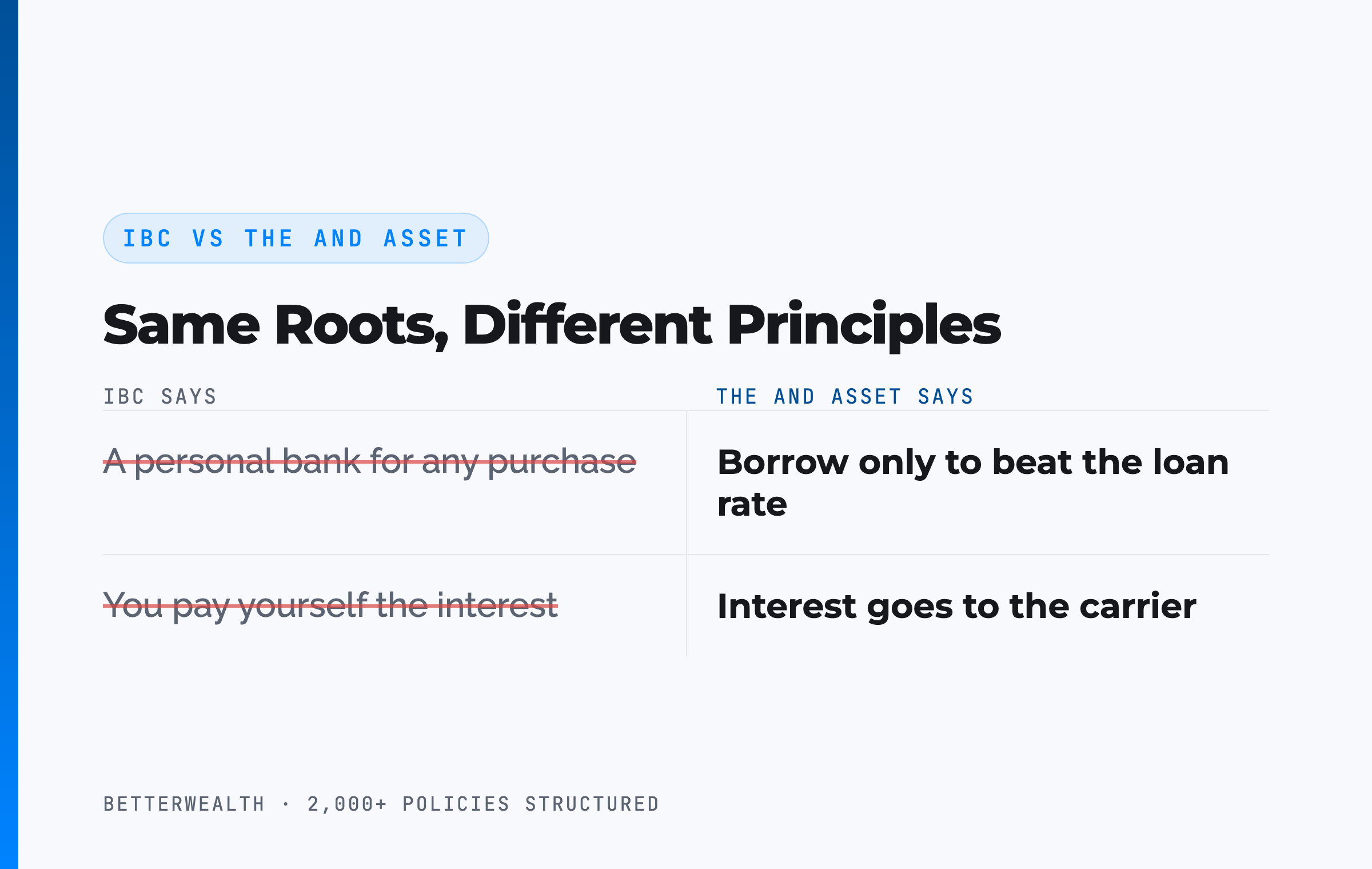
IBC says you can use a whole life policy as a personal bank for any purchase. The And Asset says you deploy capital from the policy only when the borrowed dollars will out-earn the carrier's loan cost, because anything less is an expensive way to spend money. Many IBC marketers also say you are paying yourself interest. You are not. The interest goes to the carrier. Your return is what the deployed capital earns elsewhere while the policy keeps compounding net of charges.
For a W-2 earner this distinction decides everything. A salaried household that borrows from its policy for a vehicle or a vacation has added a loan payment and gained no income. A household that borrows for a rental property that clears the loan rate has put the same dollar to work twice.
The math has to work.
Brian, a W-2 earner and policy owner, put it this way: if all the money is doing is sitting in an account growing some number, that is missing the mark. That is not what the capital is there for.
04 / How It WorksHow a W-2 Earner Builds Cash Flow With a Whole Life Policy, Step by Step
A W-2 earner builds cash flow with a whole life policy in six steps, and the policy does not appear until the third. The first two are about the paycheck. On the whiteboard, the sequence starts with you, moves to cash flow, splits into consumed and saved, and then splits the saved dollars into two buckets: emergency and opportunity.
- Create a savings rate. Decide what share of each paycheck is saved before it is consumed. Audit the consumption side while you are there: spending that does not match what you value, taxes you could plan for, giving with no tracking, debt that has drifted out of line.
- Hold a liquid emergency reserve. Keep several months of expenses in the bank during the early policy years. Cash value trails premiums paid at the start, so the policy cannot be your only reserve on day one.
- Structure the policy for cash value. Use a low base premium and a heavy paid-up additions rider, such as a 30/70 or 40/60 base/PUA split, kept under the Modified Endowment Contract limit. The design matters more than the carrier's headline dividend rate.
- Fund it and let it capitalize. Pay the premium from salary each year. Brian calls this seed time. A healthy insured typically sees cash value reach total premiums paid at year five or later, and not before.
- Borrow only for an asset that beats the loan cost. When an opportunity appears, take a policy loan against the cash value. The cash value stays in the policy as collateral and continues to earn. If the asset will not out-earn the loan rate, do not borrow.
- Send the asset's cash flow back. Route the income from the asset, plus salary if needed, to repay the loan on a written schedule. Repayment restores your collateral for the next opportunity. The discipline of repayment is the whole strategy.
Once the loan is repaid and the asset keeps paying, the household has a second income stream that did not exist before, and the same cash value is available again. Each cycle makes the cash flow line on the diagram a little thicker.
This Fits a Specific Kind of W-2 Earner.
It Fits You If
- You save a consistent surplus after maxing the accounts you value
- You can fund premiums for 10 or more years
- You intend to buy assets that produce income
- You will repay loans on a schedule
It Does Not Fit You If
- You have no surplus cash flow yet
- You carry high-interest debt
- You want a savings account with a better rate
- You cannot name a use for borrowed capital that beats the loan cost
If you are in the first column, a discovery call will show whether a policy adds anything to what you are already doing. If you are in the second, we will tell you that. No pressure, no pitch.
Book a Discovery Call05 / The MathDoes the Asset Beat the Carrier's Loan Rate?
The asset has to earn more than the carrier charges on the loan, or the W-2 earner should not borrow. Policy loan rates vary by carrier and by rate environment. At the time of writing many carriers fall in the 5 to 6 percent range, and the specific figure should be verified with the carrier before any decision.
Three numbers run at once. The policy keeps compounding on its cash value, net of mortality and expense charges and subject to how the carrier treats borrowed funds. The loan accrues interest owed to the carrier. The asset produces its own return. When the third number exceeds the second, the dollars are doing two jobs. That is the AND.
W-2 earners have one advantage here that business owners often lack: a predictable paycheck. If the asset underperforms for a quarter, salary can cover the loan schedule. That is a backstop. It does not excuse a deal that never clears the rate.
A Composite: The Engineering Director Who Bought a Duplex in Year Seven
Consider a 38-year-old engineering director earning $312,000, in good health, already capturing the full employer match in a 401(k). This is a representative composite, not a single named client. The policy is funded at $24,000 a year: $7,200 of base premium and $16,800 of paid-up additions, a 30/70 split.
The early years look the way a real policy looks. After year three, $72,000 has been paid and cash value is $66,900. After year five, $120,000 has been paid and cash value is $118,300. Cash value passes total premiums in year six. By the end of year seven, $168,000 has been paid and cash value stands at $177,400.
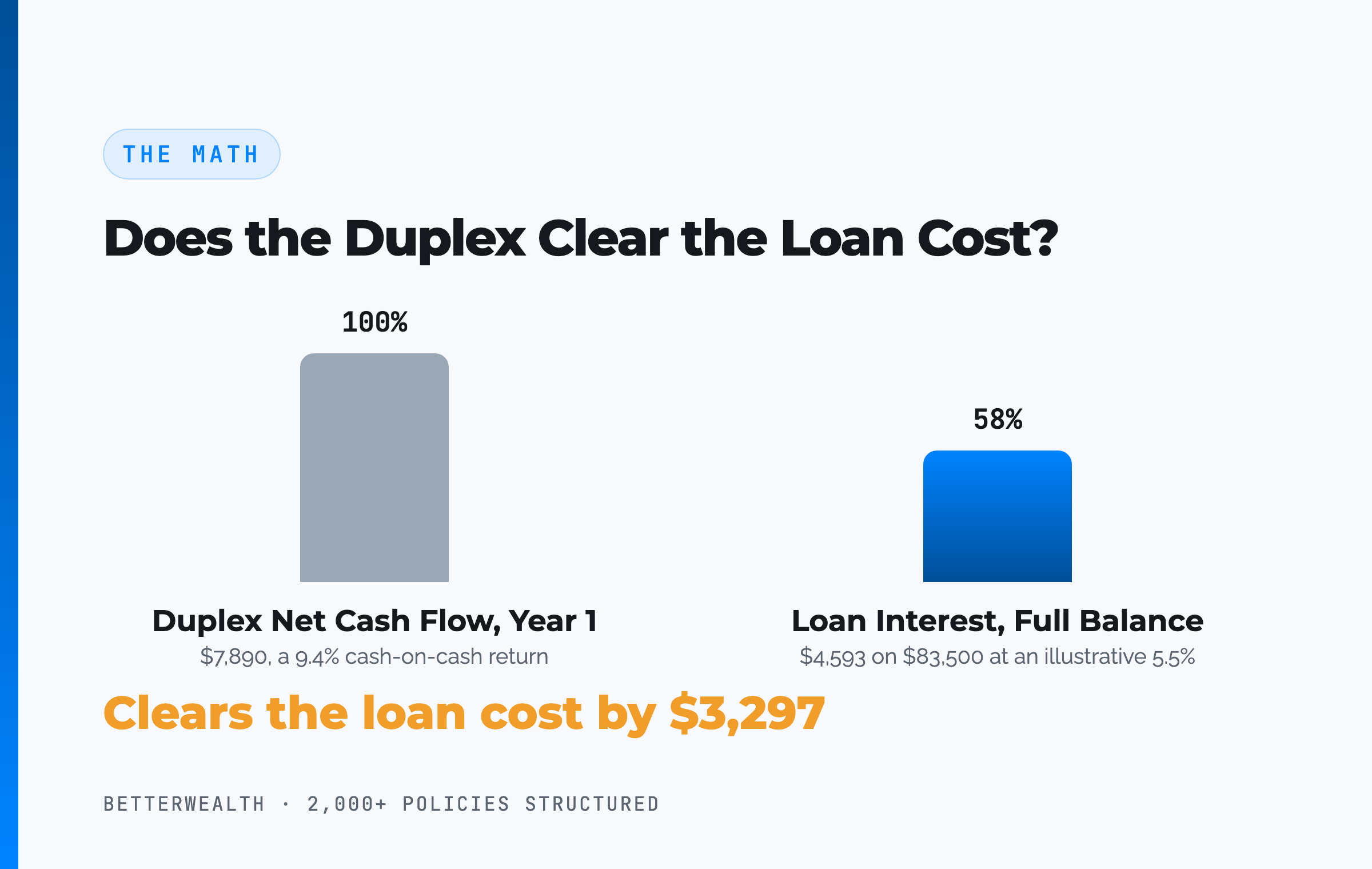
In year seven the director finds a duplex priced at $334,000 and borrows $83,500 against the policy for the down payment and closing costs. That leaves $93,900 of cash value unencumbered. After the mortgage, property taxes, insurance, a vacancy allowance, and maintenance, the duplex nets $7,890 in its first year, a 9.4% cash-on-cash return before any appreciation or principal paydown. One year of interest on the full $83,500 balance, before any repayment, is $4,593 at an illustrative 5.5%. The asset clears that cost by $3,297.
Repayment combines the duplex's $657 a month with $1,150 a month from salary, $1,807 in total, which retires the loan in roughly 52 months. Because repayment starts in the first month, the interest actually paid in year one comes in below $4,593, at roughly $4,100. After that, the rental income continues and the full cash value is available as collateral again.
One dollar. Two jobs. That is the AND.
06 / Where It Goes WrongWhere Do W-2 Earners Get This Wrong?
W-2 earners get this wrong when they treat the policy as the cash flow source instead of the collateral behind it. A whole life policy does not send a monthly check in the accumulation years. Marketers have ruined the way this should be explained, and four errors show up repeatedly.
- Believing loan interest returns to you. It goes to the carrier. Any plan built on the opposite assumption overstates its return from the first loan.
- Borrowing for consumption. A policy loan used for a lifestyle purchase adds a payment and no income.
- Expecting early break-even. Cash value trails premiums until year five or later. A plan that needs the full premium back in year two will fail.
- Starting without surplus. A policy funded by cutting into an emergency reserve or by carrying credit card balances works against the household.
The Same Tool, Two Outcomes
Take the composite director and a colleague with an identical policy. Both borrow $83,500 in year seven. The director buys the duplex and collects $7,890 against $4,593 of interest on the full balance. The colleague remodels a kitchen and owes the same interest with nothing coming back, then repays the principal entirely from salary. The policy was identical. The use of capital decided the result.
If you cannot identify a use for borrowed capital that beats the loan cost, do not borrow. A policy loan for a lifestyle purchase is an expensive way to spend money.
See the Frameworks Before You Talk to Anyone.
The Life Insurance Vault holds the calculators, policy design frameworks, and training we use when we structure policies for high-income earners. It is free, and it is a lower commitment than a call.
Open the Vault07 / The TradeoffsBenefits and the Real Tradeoffs
The benefits of this approach for a W-2 earner are access, collateral, and protection, and each comes with a cost that should be stated first. The costs: cash value sits below premiums paid for roughly five years. Premiums are a long commitment, and stopping early locks in the early-year shortfall. Policy loans accrue interest owed to the carrier, and an unpaid loan reduces the death benefit. Dividends are declared annually and are not guaranteed.
Against those costs, the policy gives a salaried household something its other accounts do not. Capital can be borrowed against without a bank's approval process. A policy that meets the definition of a life insurance contract in IRC Section 7702 and stays under the MEC limit can be borrowed against, and those loans are generally not taxable income while the policy stays in force. The death benefit also protects the one asset every W-2 earner depends on, their own ability to earn, which is difficult to capture on a spreadsheet.
Life insurance is not a make or break. It is an enhancer. The plan starts with you and your cash flow, and the policy makes a working plan work better.
Who This Fits, by Profile
- The high-income professional with surplus. Age 35 to 50, income above $250,000, tax-advantaged accounts already funded, a horizon of ten years or more, and moderate risk tolerance. The use case: accessible collateral for a first or second rental property.
- The employee with a side business. Age 30 to 45, salary plus early business revenue, comfortable with risk. The use case: working capital for inventory or equipment that returns more than the loan rate, without pledging a home.
- The late-career executive. Age 50 to 60, net worth of several million dollars, shorter accumulation window. The use case: a permanent death benefit for estate liquidity and legacy planning, with cash value as a secondary reserve that is borrowed against only for a use that clears the loan rate. Estate questions belong with an attorney.
08 / The Bigger PlanHow the Policy Fits Beside a 401(k) and Everything Else
The policy sits beside a 401(k) as the accessible layer of a W-2 earner's capital, and it replaces nothing. Brian's wealthy profile keeps the qualified accounts in the diagram. I am in favor of people capturing an employer match if they value it. The policy holds the emergency and opportunity dollars that would otherwise sit in a bank.
In the flow of money, the policy belongs in one position: between saving and deploying. Salary funds it. Opportunities draw on it through loans. Asset income repays it and adds to cash flow. As that cycle repeats, the household's spending and giving can grow because the income supporting them has grown, which is the purpose Brian's wife reminds him of when he gets too focused on accumulation.
It is not a product. It is a strategy.
09 / Head to HeadSavings Account vs. 401(k) vs. The And Asset Policy
Compared with the two places W-2 earners usually hold money, a policy built for The And Asset gives up early liquidity in exchange for collateral capacity and a death benefit. The table uses the composite's $24,000 a year for illustration.
| Dimension | The And Asset Policy | Bank Savings Account | 401(k) |
|---|---|---|---|
| Access in Year 1 | About $18,700 of cash value on $24,000 paid | $24,000 on $24,000 deposited | A $24,000 early distribution generally costs $2,400 in additional tax plus ordinary income tax |
| Access in Year 7 | $177,400 of cash value on $168,000 paid; $83,500 borrowed while the rest stays in place | $168,000 plus bank interest, fully liquid | Still restricted before 59½; plan loans exist only if the employer offers them |
| Growth While in Use | Cash value keeps compounding net of charges while borrowed against, subject to how the carrier treats borrowed funds | Withdrawn dollars stop earning | Withdrawn dollars leave the market and the tax shelter |
| Cost of Use | Loan interest to the carrier: $4,593 a year on the full $83,500 balance before any repayment, at an illustrative 5.5% | No interest cost; the lost earnings are the cost | Additional tax and income tax on early distributions |
| Protection | Permanent death benefit included | None | Account balance only |
Access. A bank account wins in the first five years, and that is why the emergency reserve starts there. By year seven the composite policy holds $9,400 more than the premiums paid, and it can be borrowed against without closing a position.
Growth while in use. This is the structural difference. Money withdrawn from a bank or a 401(k) stops working where it was. Cash value pledged as collateral stays in the policy and continues to earn, subject to how the carrier treats borrowed funds. Direct-recognition carriers adjust the dividend on borrowed cash value. That continued growth is why the borrowed dollar can hold two jobs.
Cost of use. The policy loan has an explicit price: $4,593 a year on the composite's full $83,500 balance before any repayment. That price is the threshold. The duplex's $7,890 clears it. A purchase that returns nothing does not.
A Straight Answer on Whether This Fits Your Paycheck.
We have structured 2,000+ policies. We have seen this strategy work as designed, and we have seen it fail. On a discovery call we look at your income, your savings rate, and what you plan to deploy capital into, and we tell you honestly whether The And Asset belongs in your plan. No pressure, no pitch. If you would rather keep learning first, our YouTube channels, The And Asset and BetterWealth, cover the math in depth.
Book a Discovery CallFAQWhole Life Insurance Cash Flow Questions From W-2 Earners
Can a W-2 earner use whole life insurance to create cash flow?
Yes, a W-2 earner can use whole life insurance to create cash flow, but the policy does not produce the cash flow by itself. Salary funds an overfunded policy, the cash value becomes collateral for a policy loan, and the loan buys an asset such as a rental property. The cash flow comes from that asset, and it has to exceed the carrier's loan cost.
What is The And Asset?
The And Asset is BetterWealth's framework for using a properly structured whole life policy as a capital base. You borrow against the policy only for an activity that produces a return greater than the carrier's loan cost, so your dollars do two jobs at once: the policy keeps compounding net of mortality and expense charges while the deployed capital earns its own return.
How is The And Asset different from infinite banking?
The And Asset shares roots with infinite banking but operates on different principles. Infinite banking, as Nelson Nash taught it, frames a whole life policy as a personal banking system for any purchase. The And Asset says you only deploy borrowed capital when it will out-earn the carrier's loan cost, and if you cannot identify that use, you do not borrow.
What is the difference between a savings account and a storage account?
A savings account is money set aside with no plan for its use, while a storage account holds capital that is waiting for a specific deployment. The distinction is intent. Stored capital has a job: it sits where it can grow and stay accessible until an opportunity that beats its cost of access appears.
How long does it take for cash value to equal the premiums paid?
For a healthy insured in a well-designed overfunded policy, cash value typically equals total premiums paid at year five or later. Cash value trails cumulative premiums in the early years because of insurance costs. Any illustration showing break-even in year one or two should be questioned.
Do you pay yourself interest on a policy loan?
No. Policy loan interest goes to the insurance carrier, not back to you. Many infinite banking marketers claim otherwise, and it is wrong. Your return comes from what the borrowed capital earns in the asset you bought, while the policy keeps compounding net of mortality and expense charges.
Should a W-2 earner fund a policy instead of a 401(k)?
No. A whole life policy works beside a 401(k), not in place of it. Many W-2 earners keep contributing to capture the employer match and add a policy as accessible capital, because 401(k) access before age 59½ is restricted and generally carries a 10% additional tax plus ordinary income tax.
What can a W-2 earner buy with a policy loan?
Under The And Asset, a policy loan should only fund an asset expected to earn more than the loan rate. Common examples for W-2 earners are a rental property down payment, a stake in a small business, or a private lending position. Lifestyle purchases are paid from cash flow, not from borrowed policy capital.
What is a typical policy loan rate?
Policy loan rates vary by carrier and by rate environment. At the time of writing many carriers fall in the 5 to 6 percent range. Treat any specific number as a figure to verify with the carrier before borrowing, because that rate is the threshold your deployed capital has to clear.
Is whole life insurance a bad investment for a W-2 earner?
Not necessarily. It suits some W-2 earners and not others. A high earner with surplus cash flow, a ten-year horizon, and a plan to buy cash-flowing assets can use the policy as collateral. An earner with no surplus, high-interest debt, or no plan to deploy capital is better served elsewhere.
Is a policy loan taxable income?
A loan from a policy that is not a Modified Endowment Contract is generally not taxable income while the policy stays in force. If the policy lapses or is surrendered with a loan outstanding, tax can be due on the gain. Confirm your situation with a tax advisor.
- Nelson Nash, Becoming Your Own Banker. The origin of the infinite banking concept.
- IRC Section 7702 (Cornell Law). The tax code definition of a life insurance contract, cited in the tradeoffs section on policy loan tax treatment.
- IRS Topic No. 558. The additional tax on early distributions from retirement plans.
- Robert Kiyosaki, Rich Dad Poor Dad. The asset-versus-liability distinction behind Brian's four profiles.
- BetterWealth resources: The And Asset book, The And Asset YouTube channel, and the BetterWealth YouTube channel.
I founded BetterWealth to treat life insurance as a capital tool. Our team has structured 2,000+ policies, and I wrote The And Asset. If you earn a salary and want to know whether whole life insurance cash flow planning fits your situation, book a discovery call. We will tell you if it does not.