
A super Roth is CPA Paul Sundin's name for private placement life insurance (PPLI), the step above the Roth IRA, backdoor Roth, and mega backdoor Roth, where investments grow inside a life insurance policy without annual income tax and can stay untaxed if accessed through policy loans or paid out as a death benefit.
The tax code rewards saving, but it rations the reward. A Roth IRA takes $7,500 a year. A 401(k) deferral takes $24,500. A business owner netting $600,000 in California, facing a combined marginal rate near 50%, can fill a backdoor Roth and a 401(k) deferral and still have put away barely 5% of income. The rest gets taxed at the top bracket and then sits in accounts that keep taxing the growth every year.
For a high earner, the binding constraint is rarely which investment to buy. It is how many dollars each tax wrapper will hold, what it costs to get them back out, and the order in which the wrappers are filled. Get the order wrong and a plan funded in March can disqualify a far larger deduction in December.
On a recent episode of the BetterWealth YouTube channel, CPA Paul Sundin walked through every rung: the Roth IRA, the backdoor Roth, SEP and SIMPLE plans, the solo 401(k), the mega backdoor Roth, defined benefit and cash balance plans, life insurance inside qualified plans, and the rung he calls the super Roth, PPLI. Sundin's firm designs pension plans for high earners and does not sell insurance, which makes his read on where insurance belongs a useful one.
At BetterWealth we have structured more than 2,000 whole life policies, and our framework, The And Asset, sits in a specific place relative to this ladder. It is not a substitute for any rung. The most expensive mistake on the ladder is a sequencing error: funding a plan you already have before checking whether it blocks a larger one.
- The ladder runs Roth IRA, backdoor Roth, mega backdoor Roth, then defined benefit plans, with PPLI above for a narrow group.
- Defined benefit and cash balance plans can take $100,000 to $300,000 or more a year, driven mostly by age and pay.
- Design the whole plan stack before funding anything for the year, because combining plans after the fact can cap contributions.
- Life insurance can sit inside profit-sharing and defined benefit plans, generally limited to roughly half of contributions under incidental benefit rules.
- PPLI removes the contribution cap but usually requires qualified purchaser status, commonly $5 million in investments, plus strict investor-control rules.
- The And Asset says borrow against a policy only when the deployed dollars out-earn the carrier's loan rate.
The full conversation includes Sundin's live back-and-forth with me on control group rules, the defined benefit funding range, and the Nvidia employee who funded life insurance from an IRA rollover, detail that does not fit on the page.
01 / The ProblemWhy Do High Earners Run Out of Tax-Advantaged Room?
High earners run out of room because every tax-advantaged account has a ceiling, and most ceilings were set with a far smaller income in mind. Sundin's intake starts with two questions besides age: what does the business net after expenses, and how much of that do you want to set aside? A business grossing $500,000 with $200,000 of expenses has $300,000 to work with. The plan design follows from those two numbers.
At $50,000 of income, an IRA is a complete answer. At $300,000, it covers a rounding error. Sundin's average client earns $500,000 to $700,000, and for that client, putting even $70,000 into a 401(k) "doesn't really move the needle." The higher you climb, the more complex and expensive each plan becomes. Simple plans cost almost nothing to run and hold very little.
Qualified plans are not the enemy. They are incentives with rules, and the rules decide who they fit. The mistake is not using them. The mistake is using them in the wrong order.
02 / The LadderWhat Is the Retirement Plan Ladder for Business Owners?
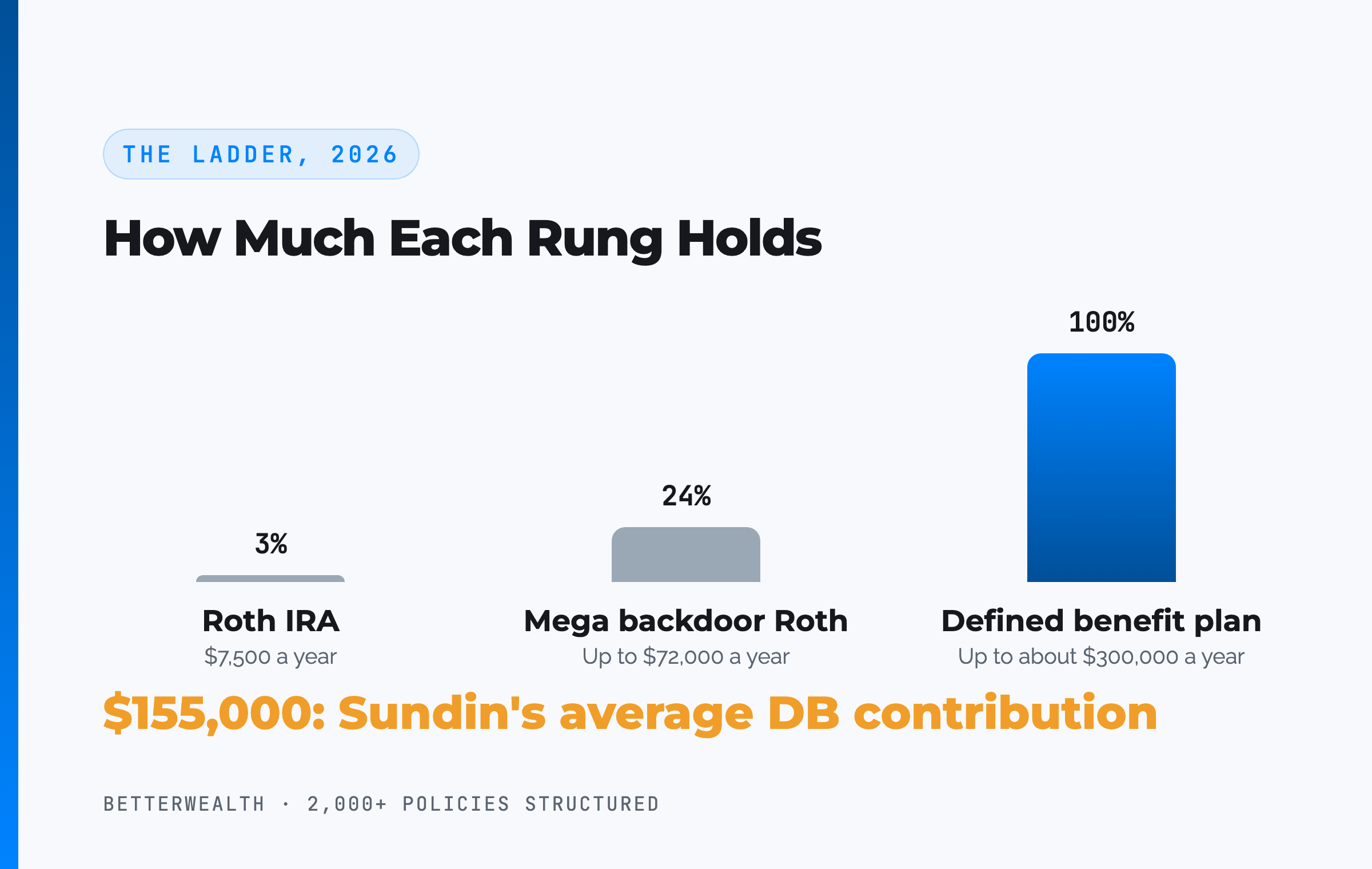
The retirement plan ladder is the order in which a business owner fills tax-advantaged accounts, from the cheapest and smallest to the most complex and largest. Each rung holds more dollars and demands more administration. Here is each one as Sundin lays it out, with 2026 figures.
Rung One: The Roth IRA and the Backdoor Roth
Start with the Roth. Sundin ranks the Roth IRA among the top financial moves for anyone: no deduction going in, tax-free growth, tax-free qualified withdrawals. The limit is $7,500 for 2026, or $8,600 at 50 and older. A traditional IRA has the same limit but gives a deduction now and taxes every withdrawal as ordinary income.
Direct Roth contributions phase out above roughly $153,000 of income for single filers and $242,000 for married couples. Above that, the backdoor Roth applies: a nondeductible contribution to a traditional IRA, then a conversion to Roth. Sundin notes the IRS has acknowledged the workaround and left it open, so the backdoor Roth remains available under current rules. Sundin tells his own kids to fund it on the first business day of January. Not starting at 19 is one of my biggest financial regrets.
Small dollars. Decades of tax-free compounding.
One step precedes even the Roth: an employer match. A 4% contribution matched at 4% is a 100% return on day one.
Rung Two: SEP and SIMPLE Plans
A SEP IRA fits a business owner with no employees who wants to put away $20,000 to $40,000 a year. It can be set up and funded as late as the extended tax filing deadline, has no Form 5500 filing and no restatements, and allows contributions up to the annual additions limit. The catch is employees. A SEP requires the same percentage contribution for every eligible employee, so putting 20% away for yourself means 20% for your staff.
A SIMPLE IRA fits the small business with staff and modest goals. Sundin's example: an auto body shop owner earning about $200,000 with five to 10 mechanics who each want to save a couple thousand dollars a year. The 2026 deferral limit is $17,000, plus a required employer contribution of a few percent. It is cheap and easy to run. It does nothing for someone who wants $60,000 in.
Rung Three: The Solo 401(k)
Sundin calls the solo 401(k) the bread and butter retirement plan. It gets the most money in on the least income because it adds an employee deferral, $24,500 for 2026, on top of employer profit sharing, and it combines with other plans far better than a SEP. It can include a Roth deferral if the plan document allows it, which many free brokerage plans do not.
The costs are administrative. Once plan assets pass $250,000, you file Form 5500 each year. The plan document must be restated on the IRS's six-year cycle, which means paying a plan administrator a few hundred dollars a year. For an owner earning $150,000 to $200,000 who expects the business to grow, Sundin sees this as the best starter plan.
Rung Four: The Mega Backdoor Roth
The mega backdoor Roth is a solo 401(k) with two extra provisions: after-tax employee contributions and in-service conversion of those dollars to Roth. Deferrals, profit sharing, and after-tax contributions together can reach the annual additions limit of $72,000 for 2026, $80,000 at 50 and older, and about $83,000 at ages 60 to 63. Most of that can end up as Roth money.
It works cleanly for solo business owners. With employees, nondiscrimination testing will usually fail when the owner contributes heavily and staff do not. Sundin's clients often pair a mega backdoor Roth with a defined benefit plan: $200,000 pre-tax into the pension and $70,000 after-tax into Roth, in the same year.
Rung Five: Defined Benefit and Cash Balance Plans
Defined benefit plans are where the deductions get large: typically over $100,000 a year and as high as $300,000 to $500,000, all pre-tax. There is no Roth version. They fit income of $300,000 or more and work best for owners in their 50s and 60s. The lifetime benefit they fund toward is capped at roughly $3.7 million at age 62.
Rung Six: PPLI, the Super Roth
Above every qualified plan sits private placement life insurance. Sundin frames it as the natural next step after the mega backdoor Roth for someone who wants to put a lot of money in and not pay tax on the growth. He has seen it funded at $100,000 a year over 10 years, well below the $5 million figure often quoted.
03 / Defined BenefitHow Does a Cash Balance Plan Let You Contribute $100,000 to $300,000 a Year?
A defined benefit plan allows large contributions because the IRS caps the benefit at retirement, not the annual contribution. A defined contribution plan sets a yearly limit and does not care whether the account later grows to $10 million or falls to zero. A defined benefit plan targets a future benefit, and an actuary calculates what you must contribute each year to be on pace for it.
Sundin puts the maximum at roughly $3.7 million in lump-sum value at age 62, indexed upward most years. Sundin calls Social Security the largest defined benefit plan in the world, with one difference: at 67 you cannot ask Social Security for a lump sum and walk away. With a private defined benefit plan, you can roll out the value instead of taking an annuity.
Age and pay drive the contribution. Sundin, at 58, can contribute about $300,000 a year. At 30, I would be closer to $100,000 toward the same target, because I have three decades to get there. Pay matters too. An S corporation owner who takes a $30,000 salary cannot fund an executive-sized pension. Sundin's typical client is about 50, and his firm's average contribution is about $155,000.
The Funding Range and the 50% Cushion
Each year the actuary sets a range, not a single number. Sundin's example: a first-year contribution of $100,000, then a second-year range of roughly $80,000 at the minimum to $150,000 at the top, because the rules let you contribute an extra cushion of up to 50% of the accrued benefit. Funded at target over several years, that cushion grows. Sundin has seen long-running plans with a top of the range near $600,000.
The range gives you room to respond to the year. Income down? Fund the minimum and put the difference into the mega backdoor Roth. Bigger tax bill than expected? Fund the top and skip the after-tax contribution. The constraint is that the target is fixed.
"With a DB plan, every dollar you put in today is one less dollar that you can put in the future."
The Overfunding Trap
I asked what happens if the plan's investments take off. The answer is that a plan holding more than the maximum benefit is overfunded. Terminating an overfunded plan triggers an excise tax of up to 50% on the reverted surplus plus ordinary income tax on it. Sundin's rule of thumb is that you lose about 90% of the excess. There are workarounds, including insurance in some cases, but avoiding the problem is cheaper.
His guidance is to keep defined benefit assets in the conservative part of your portfolio, targeting returns somewhere between 0% and 10% with low volatility. Home-run bets belong in the Roth, where an outsized gain stays tax-free instead of creating a penalty. Plans can hold real estate, crypto, equities, and life insurance. They should not hold your most aggressive positions.
Big upside belongs in the Roth.
04 / How It WorksHow to Sequence the Retirement Plan Ladder Before You Fund Anything
The sequence matters more than any single plan, because the IRS either prohibits or restricts many plan combinations. A model SEP bars any other plan. Combining a 401(k) with a defined benefit plan limits profit sharing to 6% of pay. Sundin's most common intake problem is an owner who has already funded a 401(k) to the maximum and is no longer eligible for the larger deduction that year. Here is the order we would follow, built on his framework.
- Start with two numbers. Know your net taxable business profit, not gross revenue, and how much of it you want to set aside each year. Age is the third input.
- Take the Roth layer first. Capture any employer match, then fund a Roth IRA or backdoor Roth: $7,500 for 2026, or $8,600 at 50 and older. If you put a teenager on payroll for real work, the child can fund a Roth too.
- Match the defined contribution plan to your headcount. No employees: SEP or solo 401(k). Small staff and modest goals: SIMPLE. Staff and larger goals: a safe harbor 401(k), which generally requires around a 4% contribution for employees. Control group and affiliated service group rules apply to all of these, so a second entity you control cannot dodge the employee requirements.
- Add the mega backdoor Roth if you work solo. After-tax contributions with in-service Roth conversion, up to the $72,000 annual additions limit.
- Design the defined benefit plan before funding anything else for the year. A defined benefit plan can be established up to the tax filing date, but plans already funded can lock you out. Get the full design first, then fund it.
- Decide whether life insurance belongs inside or outside the plans. Inside a profit-sharing or defined benefit plan, premiums are paid with pre-tax plan dollars, subject to the incidental benefit and seasoned money rules covered below. Outside, premiums come from after-tax dollars and the policy is fully yours from day one.
- Place after-tax capital above the ladder. For dollars beyond every plan limit, evaluate PPLI if you meet its investor thresholds, or a whole life policy structured under The And Asset if you need a capital base you can borrow against for activities that beat the carrier's loan rate.
Fund the plan you have before designing the plan you need, and you can lock yourself out of the larger deduction for the year. Design first. Fund second.
The Upper Rungs Fit a Specific Person Doing Specific Things.
It Fits You If
- You net $300,000 or more from a business or practice
- You have already filled the Roth and defined contribution rungs
- You have after-tax capital beyond every plan limit
- You can name a use for borrowed capital that beats the loan cost
It Does Not Fit You If
- You have not yet funded a Roth or captured a match
- Your income swings too much to commit to annual funding
- You want a savings account, not a capital strategy
- You cannot identify a productive use for borrowed dollars
If you are in the first column, a 30-minute conversation will show you whether a policy built on The And Asset belongs next to your plans. If you are in the second, we will tell you that too.
Book a Discovery Call05 / Insurance Inside PlansCan You Hold Life Insurance Inside a 401(k) or Defined Benefit Plan?
Yes. Life insurance can be held inside profit-sharing plans and defined benefit plans when the plan document permits it, and Sundin says the code is clear on this. The common belief that you cannot put life insurance in a 401(k) misses that most 401(k) plans are 401(k) profit-sharing plans. Cookie-cutter plans from large brokerages typically do not allow insurance, so the plan design has to include it.
The Incidental Benefit and Seasoned Money Rules
The incidental benefit rule keeps insurance a secondary feature of the plan. In practice, Sundin says, roughly half of contributions can go to life insurance. On a $200,000 defined benefit contribution, that is about $100,000 toward a policy from the start.
Inside a 401(k) profit-sharing plan, salary deferrals can never buy insurance. Only the profit-sharing portion can, and the seasoned money rules decide how much. Profit-sharing dollars that have been in the plan at least two years can be used. Once you have participated for five years, all profit-sharing dollars can be used. Sundin's example: a plan open seven years holding $500,000, of which $200,000 is deferrals. The $300,000 of seasoned profit sharing is available for insurance. The $200,000 is not.
The IRA Rollover Route
IRAs cannot hold life insurance. Sundin's workaround is to roll IRA money into a profit-sharing plan, where, in his reading, rolled-over dollars count as immediately seasoned and can buy coverage. His example: a 40-year-old Nvidia employee earning a couple hundred thousand dollars, with two young kids, about $1 million in an IRA, and no spare cash flow for premiums. Rolling part of the IRA into a profit-sharing plan let him fund coverage he otherwise would have gone without.
The caveats are real. The profit-sharing plan needs a business behind it with genuine intent to contribute, so a pure W-2 employee needs a side business. Real estate investors sometimes use a management company, often a C corporation, to anchor the plan.
What the Tradeoffs Look Like
Insurance held inside a plan works differently from a policy you own outright. The value of the pure insurance protection is generally reported as taxable income to the participant each year. The policy usually has to be bought out of the plan at some point, and the buyout is priced under IRS valuation rules (Sundin references the greater of a premiums-plus-earnings test and the interpolated terminal reserve), not simply the cash value. If the participant dies while the policy is inside the plan, the pure death benefit portion is income-tax-free, but the cash value portion is treated as a plan distribution.
It fits best for: a large, older defined benefit contributor who needs coverage, or someone hard or expensive to underwrite, who can pay premiums with pre-tax plan dollars. Option A is paying premiums out of pocket with after-tax income. Option B is a few more steps and a few more professionals to buy the same coverage with dollars that cost less today. Neither choice gives you a capital base you can borrow against freely while it sits inside the plan.
Inside the plan, the policy is the plan's.
06 / The Super RothIs PPLI Really a Super Roth?
PPLI works like a super Roth for a narrow group of high-net-worth investors, and only when it is built correctly. Private placement life insurance is a variable life policy whose cash value is invested in institutionally priced investment accounts. Sundin's framing: "What you're really doing is you're buying insurance for a wrapper." You accept the insurance cost in exchange for investment gains that are not taxed each year at the federal level, at the state level, or by the 3.8% net investment income tax.
Calling the growth tax-free requires the structure behind it. The policy must meet the Section 7702 definition of life insurance. You cannot direct the individual investments; the investor-control and diversification rules require that the insurer's investment accounts be managed independently. Withdrawals up to basis come out untaxed, and gains above basis can be accessed through policy loans while the policy stays in force and is not a MEC, or pass as an income-tax-free death benefit. Let the policy lapse with loans outstanding and the gain becomes taxable.
The access threshold is the other constraint. Many PPLI platforms require qualified purchaser status, commonly $5 million in investments, which Sundin acknowledges is out of reach for most people. He has also seen PPLI funded at $100,000 a year over 10 years, far below the assumed minimum. He notes PPLI often works well for estate planning and that life insurance creditor protection, which varies by state, tends to be clearer than for retirement accounts.
Sundin also sees 1035 exchanges into PPLI. His example: a client bought whole life years ago at a couple hundred thousand dollars of income to protect his kids. Now earning $1 million a year and meeting the platform's investor thresholds, he wanted more from it, and a Section 1035 exchange moved the cash value into PPLI without recognizing the gain. Compare surrender charges, new insurance costs, and underwriting before doing this. An exchange is a new policy, not a free upgrade.
"Nobody should have permanent life insurance" is a blanket statement that falls apart at PPLI. At this rung, the insurance is the price of the tax treatment, and the investors who use it know exactly what they are paying for.
07 / The FrameworkWhere Does The And Asset Fit Above the Ladder?
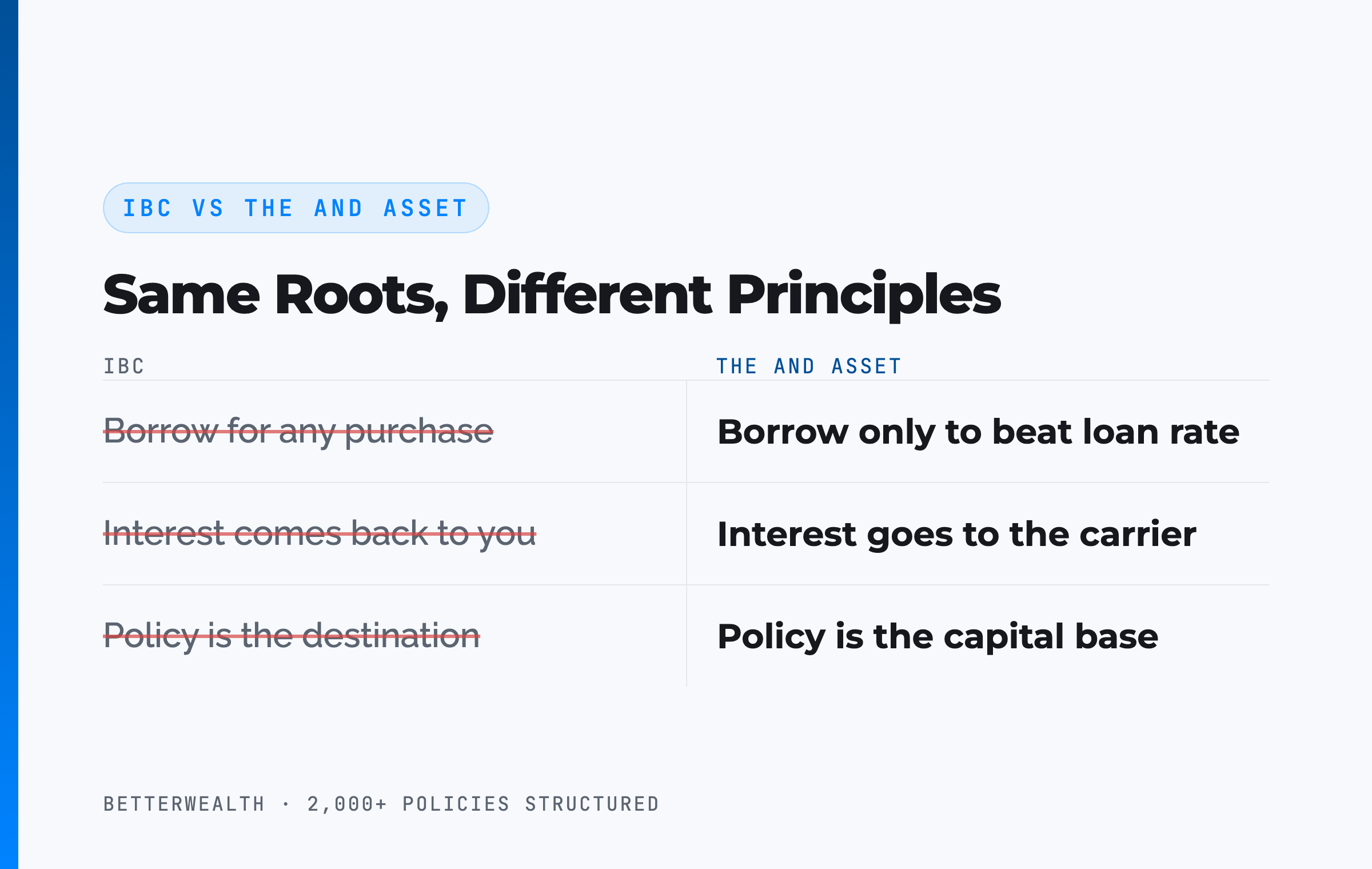
The And Asset fits above the ladder as a capital base you control, funded with after-tax dollars that have no other tax-advantaged home. Every rung below it trades access for tax treatment. Qualified money is restricted before 59½, defined benefit money is committed to a funding schedule, and insurance inside a plan belongs to the plan. A whole life policy built on The And Asset, structured with heavy paid-up additions, gives you cash value you can borrow against at any age, on your own repayment schedule, and under The And Asset only when the deployed dollars beat the loan rate.
Nelson Nash pioneered the idea of using whole life insurance as a personal banking system in Becoming Your Own Banker. His insight holds: you either lose money paying interest to outside lenders, or you lose it to the opportunity cost of capital sitting idle. The And Asset shares those roots but operates on different principles.
Where IBC Ends and The And Asset Begins
IBC says you can use a whole life policy as a personal banking system for any purchase. The And Asset says you only deploy capital from the policy when the borrowed dollars will produce a return greater than the carrier's loan cost, because anything less is an expensive way to spend money. IBC content often frames whole life as the destination. The And Asset frames the policy as the capital base; the value is created in what you deploy that capital into.
Many IBC marketers say you are paying yourself interest. You are not. The interest goes to the carrier. Your return is what the deployed capital earns elsewhere while the policy keeps compounding at its dividend rate net of mortality and expense charges.
This is also why a policy built on The And Asset does not compete with the ladder. A Roth, a cash balance plan, and PPLI are each sold on tax treatment. A policy built on The And Asset is a capital structure tool. Its tax treatment matters (policy loans are not taxable income while a non-MEC policy stays in force), but the reason to own it is control of capital for business owners and investors who have uses for that capital.
08 / The MathDoes the Deployed Capital Clear the Loan Rate?
The return on whatever you deploy must exceed the carrier's loan cost, or you should not borrow. That is the entire test. Policy loan rates vary by carrier and time period. At the time of writing many carriers fall in the 5% to 6% range, but treat the number as a variable to verify, not a constant.
Here is the structure. You borrow at the carrier's loan rate. The policy keeps compounding on its full cash value, net of internal charges, because the loan is collateralized by the cash value rather than withdrawn from it. With a direct recognition carrier, the dividend on the loaned portion can be adjusted. The deployed capital earns its own return. If that return beats the loan cost, the same dollar has done two jobs. If it does not, you have borrowed money to lose money slowly.
Remember the timeline, too. Cash value does not exceed cumulative premiums before year four, and for a healthy insured the break-even typically lands in year five or later. A policy structured under The And Asset is a long-horizon capital base, not a place to park money you need next year.
If the deal does not clear the loan rate, do not borrow.
The Frameworks Behind 2,000+ Policies, in One Place.
The And Asset Vault holds the calculators, design frameworks, and structuring decisions we use when we decide whether a whole life policy belongs next to a client's retirement plans. Free, email-gated, no spam.
Open the Vault09 / The TradeoffsThe Honest Tradeoffs at Every Rung
Every rung on this ladder carries a real cost, and none of them are right for everyone. Sundin pushed back on me directly here, after I once asked on camera why everybody and their grandma would not have a defined benefit plan. First, grandma needs a business. Second, these plans require active management and consistent high income.
Roth accounts hold small dollars. SEP and mega backdoor Roth plans break down with employees. The solo 401(k) adds filings and restatements. Defined benefit plans commit you to minimum contributions, penalize overfunding heavily, and defer tax rather than eliminate it. Insurance inside a plan creates annual taxable income and a future buyout. PPLI often demands $5 million or more in investments, gives up investment control, and carries insurance costs. A policy built on The And Asset has low early cash value, takes about five years to break even, and only creates value when you deploy borrowed capital into something that beats the loan rate.
On the defer-or-pay question, Sundin argues deferral still makes sense for top earners. A physician earning $1 million today will likely earn a few hundred thousand in retirement, so dollars deducted at the top bracket now are likely to be taxed at a lower one later, even if future rate increases land on high incomes. He adds a qualitative point from thousands of client conversations: an extra couple million dollars growing tax-deferred lets people sleep better.
On long-term care, Sundin notes it can be funded through structures like Section 105 medical reimbursement plans, which work for C corporations and for sole proprietors (typically through a spouse employed in the business) but not S corporations, and through 401(h) accounts tied to pension plans. Both are specialized; verify eligibility with a tax advisor before relying on either.
Every wrapper has a price. Know it first.
10 / Head to HeadHow Do the Super Roth, Cash Balance Plans, and The And Asset Compare?
A Roth, a defined benefit plan, PPLI, and a policy built on The And Asset solve different problems, and the table makes the tradeoffs explicit on contribution room, tax treatment, access, and fit.
| Dimension | Roth / Backdoor Roth | Mega Backdoor Roth | Cash Balance / DB Plan | PPLI | The And Asset (Whole Life) |
|---|---|---|---|---|---|
| 2026 Annual Room | $7,500 ($8,600 at 50+) | Up to $72,000 total additions | About $100,000 to $300,000+, set by actuary | No IRS cap; limited by 7702 and MEC rules; seen at $100,000/yr | No IRS cap; limited by 7702 and MEC rules; e.g. $60,000/yr |
| Tax Going In | After-tax | Mostly after-tax | Pre-tax, deductible | After-tax | After-tax |
| Tax on Growth and Access | Tax-free qualified withdrawals | Tax-free once converted and qualified | Ordinary income on withdrawal | Untaxed via loans or death benefit if structured correctly | Loans not taxable income while a non-MEC policy stays in force |
| Access Before 59½ | Contributions yes; earnings restricted | Restricted | Restricted; tied to plan terms | Policy loans | Policy loans at any age, your repayment terms |
| Best Fit | Anyone with earned income (backdoor Roth above the phase-out) | Solo owners earning $200,000 to $300,000+ | Owners 45+ earning $300,000+ | Qualified purchasers, often $5M+ investable | Business owners and investors with uses that beat the loan rate |
Annual room. The Roth holds $7,500 and the mega backdoor Roth $72,000, while a defined benefit plan can absorb $155,000 on average and far more for older owners. PPLI and whole life have no IRS contribution cap, but both are bounded by the Section 7702 and MEC limits relative to the death benefit. Room is where the upper rungs win.
Tax going in and coming out. The defined benefit plan is the only option here that is deductible today, and it pays for that with ordinary income tax later. The Roth and mega backdoor Roth are tax-free on qualified withdrawals. PPLI and a policy built on The And Asset grow without annual tax and can be accessed through loans, which only stays untaxed if the policy is structured correctly and kept in force.
Access and fit. Qualified plans restrict access before 59½ under federal rules, which is the tradeoff for their tax treatment. A policy loan is available at any age with no lender approval, which is why The And Asset sits above the ladder as a capital base rather than in place of any rung. Fit follows income, age, headcount, and whether you have productive uses for capital.
A Composite: The Practice Owner Who Filled the Ladder, Then Built a Capital Base
Consider a 52-year-old orthopedic surgeon who owns a practice with nine employees and nets $647,300. This is a representative composite, not a single named client. The plan design comes first. Both spouses fund backdoor Roths at $8,600 each, $17,200 total. The practice runs a safe harbor 401(k), where the surgeon defers $32,500 ($24,500 plus the $8,000 age-50 catch-up), paired with a cash balance plan the actuary sets at $163,400 for the year. The plan is designed to pass nondiscrimination testing, which costs the practice about $38,650 a year in safe harbor and cash balance contributions for the nine employees, a deductible business expense that belongs in the math before the owner's deduction looks clean. At a combined marginal rate near 41%, the $195,900 of pre-tax contributions defers roughly $80,319 of tax. Deferred, not eliminated.
The household still has after-tax surplus with no qualified home. The surgeon funds a whole life policy structured under The And Asset at $60,000 a year, designed 10/90: $6,000 of base premium and $54,000 of paid-up additions, blended with a term rider so the funding stays under the 7702 MEC limit.
In year three, cash value is $171,940 against $180,000 paid in, still trailing, as a real policy should. Break-even arrives in year five. In year six, with $369,410 of cash value against $360,000 contributed, the surgeon borrows $143,700 against the policy to buy an equity stake in a local ambulatory surgery center where the practice already operates.
The stake distributes $24,860 a year, a 17.3% cash yield. At an illustrative 5.5% loan rate, the first-year interest cost is about $7,904, and that interest goes to the carrier. The first-year spread is roughly $16,956 before any appreciation in the stake. The loan is repaid on a 47-month schedule of $3,405 a month, funded by the $2,072 monthly distribution plus $1,333 a month from practice cash flow. The policy keeps compounding on its full cash value, net of internal charges, the entire time, though with a direct recognition carrier the dividend on the loaned portion can be adjusted.
One dollar. Two jobs. That is the And.
The Honest 30 Minutes About Whether This Fits You.
We have structured more than 2,000 policies, and we have seen this strategy work exactly as designed and fail when there was no productive use for the capital. On a discovery call, we look at your plans, your income, and your after-tax surplus, and tell you whether a policy built on The And Asset belongs next to them. If it does not, we will say so. No pressure, no pitch. If you would rather learn first, the The And Asset and BetterWealth YouTube channels go deep on the math.
Book a Discovery CallFAQSuper Roth and Retirement Plan Questions
What Is a Super Roth?
A super Roth is CPA Paul Sundin's nickname for private placement life insurance (PPLI), the step above the Roth IRA, backdoor Roth, and mega backdoor Roth. Investments grow inside a life insurance policy without annual income tax, and gains can stay untaxed if accessed through policy loans or paid as a death benefit, provided the policy meets Section 7702 and the investor-control rules.
Is PPLI Really a Super Roth?
PPLI works like a super Roth for a narrow group of high-net-worth investors. Unlike a Roth, there is no IRS contribution cap, but the policy must qualify as life insurance, you cannot direct the individual investments, there are insurance costs inside the wrapper, and many PPLI platforms require qualified purchaser status, commonly $5 million in investments.
What Is The And Asset?
The And Asset is BetterWealth's framework for using a properly structured whole life policy as a capital base. You only borrow against it for an activity that produces a return greater than the carrier's loan cost, so your dollars do two jobs at once: the policy keeps compounding net of its internal charges while the deployed capital earns its own return.
How Is The And Asset Different From Infinite Banking?
Infinite banking, as Nelson Nash taught it, frames a whole life policy as a personal banking system for any purchase. The And Asset shares those roots but operates on different principles: you only deploy borrowed capital when the return clears the carrier's loan cost, and the policy is the capital base, not the destination.
What Is the Right Order for Retirement Plans for a Business Owner?
The usual order is employer match first, then a Roth or backdoor Roth, then a defined contribution plan matched to your headcount (SEP, SIMPLE, or 401(k)), then a mega backdoor Roth if you work solo, then a defined benefit or cash balance plan. Design the full stack before funding any of it for the year.
How Much Can You Put Into a Cash Balance Plan?
Contributions to a defined benefit or cash balance plan typically run from about $100,000 to $300,000 or more a year, set by an actuary based on age, compensation, and a lifetime benefit ceiling Paul Sundin puts at roughly $3.7 million at age 62. His firm's average contribution is about $155,000.
Can You Buy Life Insurance Inside a 401(k)?
Yes, through the profit-sharing portion of a 401(k) profit-sharing plan, if the plan document allows insurance. Salary deferrals cannot be used. Seasoned money rules apply: profit-sharing dollars held two years, or all profit-sharing dollars once you have participated five years, can buy coverage within the incidental benefit limits.
Can You Use IRA Money to Buy Life Insurance?
Not directly, because IRAs cannot hold life insurance. According to Paul Sundin, IRA money rolled into a profit-sharing plan is treated as seasoned and can then fund a policy, but the plan needs a real business behind it and must permit insurance, and the policy usually has to be bought out of the plan later.
What Happens If a Defined Benefit Plan Is Overfunded?
Terminating an overfunded defined benefit plan triggers an excise tax of up to 50% on the reverted surplus plus ordinary income tax on it, which Paul Sundin's rule of thumb puts at roughly 90% of the excess lost. Keep the plan's investments conservative and the funding near the actuary's target.
Should You Max Out Your 401(k) Before Setting Up a Defined Benefit Plan?
No. Design the defined benefit plan first. When a 401(k) is combined with a defined benefit plan, employer profit sharing is generally limited to 6% of pay, and funding the 401(k) to its maximum before the design is set can leave you ineligible for the larger deduction that year.
Does Whole Life Insurance Replace a Roth or a 401(k)?
No. Whole life insurance is a different tool. Qualified plans buy tax treatment in exchange for restricted access. A policy built on The And Asset is funded with after-tax dollars and gives you a capital base you can borrow against at any age, which only creates value when the deployed capital beats the carrier's loan rate.
Can You 1035 Exchange a Whole Life Policy Into PPLI?
Generally yes. A Section 1035 exchange moves cash value from one life insurance policy to another without recognizing the gain, so a policy bought earlier for family protection can move into PPLI once income and net worth grow. Compare surrender charges, new insurance costs, and underwriting before exchanging.
- Nelson Nash, Becoming Your Own Banker: the origin of the infinite banking concept.
- IRS: 401(k) and Profit-Sharing Plan Contribution Limits: deferral and annual additions limits.
- IRS: Roth IRAs: contribution limits and income phase-outs.
- IRC Section 7702 (Cornell Law): the definition of life insurance behind the tax treatment of cash value and policy loans.
- IRC Section 1035 (Cornell Law): tax-free exchanges of life insurance policies.
- IRC Section 4980 (Cornell Law): the excise tax on reversions of qualified plan assets.
- IRS: Net Investment Income Tax: the 3.8% tax PPLI growth avoids when structured correctly.
- BetterWealth resources: The And Asset book, the The And Asset YouTube channel, and the BetterWealth YouTube channel.
I founded BetterWealth to treat life insurance as the wealth and capital tool it actually is, not the product most people get sold. Our team has structured more than 2,000 policies across all 50 states. I wrote The And Asset and host the BetterWealth and The And Asset YouTube channels. If you have filled your retirement plans and want an honest read on whether a policy belongs next to them, book a discovery call. We will tell you if it does not.