
PUA flexibility is how freely a whole life policy lets you fund its paid-up additions rider over time, judged on three features: anytime payments, a catch-up provision, and no step-down in future funding limits. Of 10 carriers we ranked, Penn Mutual leads as the only carrier with all three features at full strength, including a full prior-year catch-up. MassMutual ranks last.
Most flexible PUA rider of the 10: Penn Mutual. Least flexible: MassMutual.
Penn Mutual Pros
- PUA payments any time in the policy year
- Full catch-up of the previous year's missed PUA
- No step-down: pay half of one year's max ($50,000 on a $100,000 max) in any rolling 5 years and the full limit stays
Penn Mutual Cons
- Catch-up reaches back one year, not ten
- Early cash value runs 7 to 12% below some competitors in years 1 to 5
- Does not operate in New York (per our 2026 carrier guide)
Who it is for: business owners and investors with uneven income who plan to fund for 10+ years. Who it is not for: New York residents, or anyone who values maximum year-one cash value above long-term funding room.
Whole life carriers get compared almost entirely on the numbers printed on page one of an illustration: the dividend interest rate and year-one cash value. Both numbers assume you pay exactly the illustrated premium, on schedule, for decades. Almost nobody who runs a business does that.
Business owners, real estate investors, and commission earners have lumpy income. One year a sale closes and cash piles up. The next year a project slips and the premium comes from reserves, or does not come at all. A policy built for capital use has to absorb those years. The paid-up additions rider is where a policy's long-term capacity lives, and the rules on that rider decide whether one slow year costs you a year of funding or a decade of it.
At BetterWealth, we have structured more than 2,000 policies across all 50 states, and we work as independent brokers across many carriers. That lets us read the rider contracts side by side. Alden Armstrong, our carrier researcher, ranked 10 whole life companies on PUA flexibility for this review. It extends the PUA rankings in our 2026 IBC carrier comparison guide and adds Foresters Financial to the field. Every ranking here sits inside The And Asset, our framework for using a policy as a capital base.
- A flexible PUA rider has three features: anytime payments, a catch-up provision for missed years, and no step-down.
- No step-down matters most, because a step-down can permanently cut future funding room after a single slow year.
- Penn Mutual ranks first of 10 carriers; Foresters, OneAmerica, Lafayette Life, and Pan-American Life round out the top five.
- MassMutual ranks last, with New York Life ninth, because of rigid payment rules, no catch-up, or punishing step-downs.
- A catch-up payment does not earn back missed dividends; it only restores funding room from the day it is paid.
- PUA flexibility is one factor among several; underwriting, financial strength, and design still decide the right carrier for you.
Alden walks through each carrier's rider contract on screen, including the New York Life step-down schedule and the MassMutual ALIR and PALIR mechanics, and I press him on the edge cases the summaries skip:
01 / The ProblemWhy Does PUA Flexibility Matter More Than the Dividend Rate?
PUA flexibility matters more than the dividend rate for most business owners because it decides whether you get to keep funding the policy at all. The dividend rate describes what the policy credits on money already inside it. The rider rules describe how much money you will be allowed to put inside it in year 8, year 15, and year 25.
Policies designed for capital use are built cash heavy. A minimized base premium carries the death benefit, a term rider buys cheap extra coverage to raise the MEC limit, and the paid-up additions rider receives the majority of each premium. That design is what pushes early cash value toward 80% or more of premium. It also means most of your future funding capacity sits inside one rider with its own contract terms.
When those terms are rigid, a single short year can shrink the rider for good. The policy still works. It just becomes a smaller policy than the one you designed, and the only way to restore that capacity is to buy a second policy, starting the early-year costs over again.
A dividend rate tells you what the policy credits. PUA flexibility tells you whether you will still be allowed to fund it after your first bad year.
02 / The TestWhat Makes a PUA Rider Flexible? The Three-Part Test
A PUA rider is flexible when it has anytime payments, a catch-up provision, and no step-down. Alden calls this the trifecta. Not every carrier has all three, and the ones that claim a feature do not all deliver it at the same strength.
- Anytime payments. You can pay PUA premium whenever you want during the policy year, in any increment up to the maximum. One near-universal exception: a payment made in the last month of the policy year may be applied to the following year.
- Catch-up provision. You can backfill PUA you did not pay in a prior year. Carriers differ on how far back you can reach and how many dollars you can recover.
- No step-down. The maximum PUA you can pay does not shrink because of the policy year you are in or because you underfunded recently.
Asked to rank the three, Alden put no step-down first. A step-down is the only one that can take funding room away permanently. Catch-up came second, because it lets a strong year fill the hole a weak year left. Anytime payments came last, as a convenience. We agree: with the other two in place, timing within the year is a smaller problem.
A Catch-Up Payment Does Not Rewrite History
A backfill restores funding room. It does not restore missed growth. If you skip $30,000 of PUA in year three and catch it up in year four, the carrier does not credit you a year-three dividend on money it never held. The catch-up dollars start compounding the day they arrive, net of the policy's internal costs. That still beats losing the room entirely, but it is not a free do-over.
Room restored. Time not restored.
03 / The FrameworkWhat Does PUA Flexibility Have to Do With The And Asset?
PUA flexibility matters to The And Asset because the framework depends on a capital base that keeps growing while the owner's income moves up and down. The rider is how that base grows. If the rider shrinks after one weak year, the capital base stops at whatever size it reached.
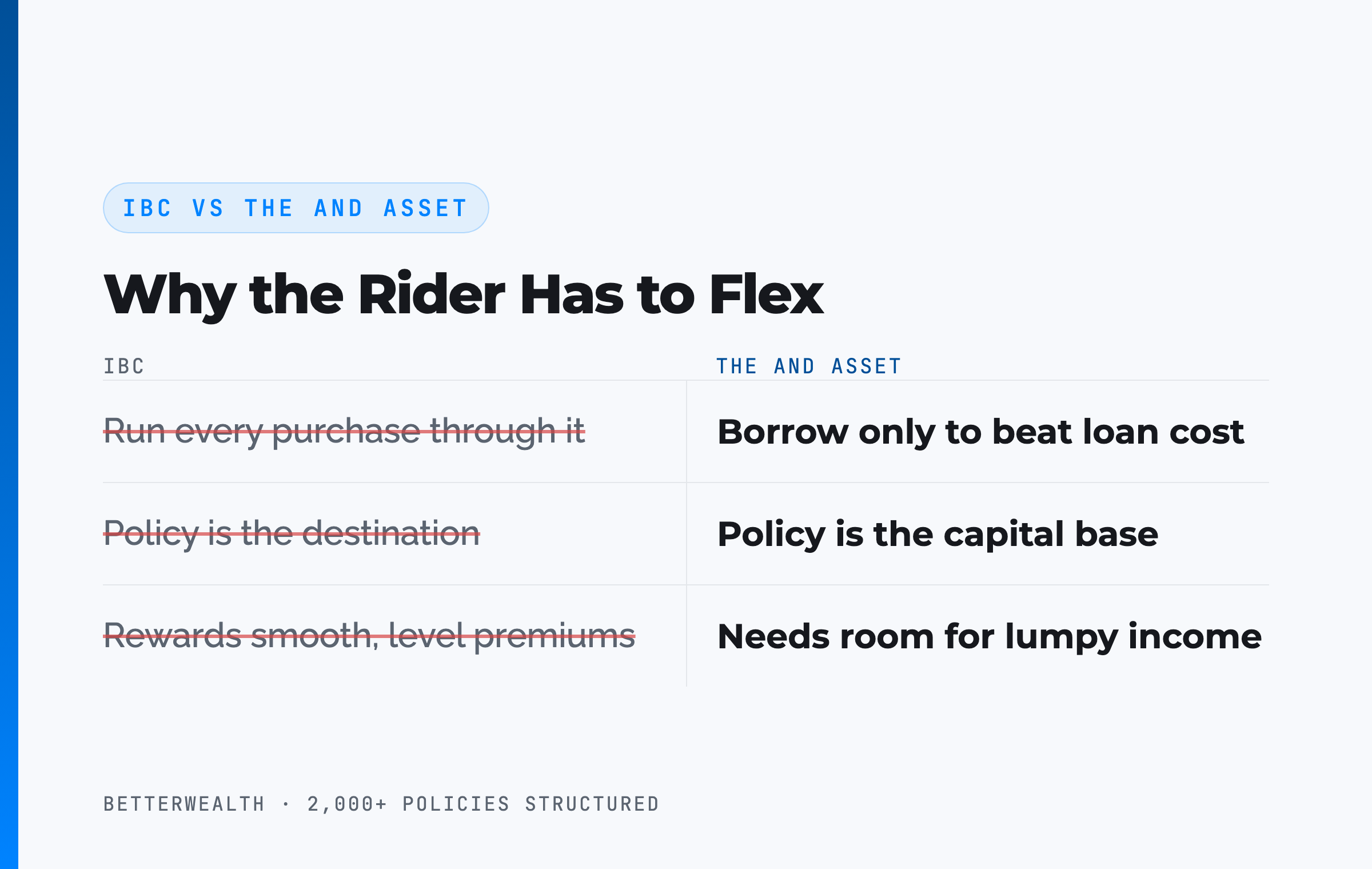
Nelson Nash pioneered the idea of using whole life insurance as a personal banking system in Becoming Your Own Banker. His core insight holds: you either pay interest to outside lenders or you give up the return your idle capital could have earned. The And Asset shares roots with IBC but operates on different principles.
Where IBC Ends and The And Asset Begins
IBC says use the policy as a personal bank for any purchase. The And Asset says the policy is the capital base, and the value is created in what you deploy that capital into, so you only borrow when the borrowed dollars will out-earn the carrier's loan cost. Anything less is an expensive way to spend money. If you cannot name a use that beats the loan rate, do not borrow.
That rule changes what you want from a carrier. Entrepreneurs who follow it do not borrow on a calendar. They borrow when a deal appears, repay as the deal throws off cash, and fund the policy hardest in the years their business has surplus. A rider that rewards smooth, identical premiums fits a saver. A rider that tolerates uneven funding fits a value creator whose capital moves in lumps.
Policy loan rates vary by carrier and rate environment. At the time of writing, many carriers fall in the 5 to 6% range. Treat that as a variable to verify, not a constant. The policy itself compounds at the dividend rate net of mortality and expense charges, not at the gross dividend rate.
The math has to work. Every time.
04 / The RankingThe 2026 PUA Flexibility Ranking: All 10 Carriers
Penn Mutual ranks first and MassMutual ranks tenth, with the other eight separated mostly by how they handle step-downs and how large their catch-up provisions are. As Alden put it, not all checked boxes are created equal. Two carriers can both have a catch-up provision while one lets you recover a decade and the other recovers a fraction of one year.
Rankings also depend on premium size. A $25,000 catch-up cap covers most of a missed year on a $40,000 premium. On a $500,000 premium it barely registers. Read each placement against the size of the policy you plan to fund.
#1Penn Mutual
Penn Mutual is the only carrier on the list with all three features at full strength, including a full prior-year catch-up. It offers two PUA riders (one optimized for long-term funding, one for short pays) and the flexibility rules apply to both. You can pay PUA any time in the policy year. You can backfill the full amount you missed in the previous year. There is no annual minimum; instead, you must pay at least half of one year's maximum PUA within any rolling five-year window to keep the rider alive with its full limit.
Alden holds Penn Mutual policies himself, and his example is a slow sales year followed by a strong one: pay this year's full PUA plus last year's shortfall, and the policy is back on its designed track. Penn Mutual is a direct recognition carrier, and, per our 2026 carrier guide, guarantees the spread between its loan rate and the dividend rate credited on loaned dollars: 0.65% in years 1 through 10 and 0% from year 11. The dividend itself is not guaranteed.
Mini-verdict: On a $100,000 annual PUA maximum, you need only $50,000 across any five years to keep the full rider. The best fit for uneven income. Penn Mutual does not operate in New York.
#2Foresters Financial
Foresters is a fraternal benefit society, so it issues certificates of insurance to its members and attaches member social benefits. We have placed little business there, and we rank it on the rider terms. Its catch-up provision is the most generous Alden has found anywhere: a 10-year look-back that lets you recover up to $25,000 per year of missed PUA across the first 10 years. Payments can be made any time in the policy year.
The weakness is a step-down. If you do not fund the rider at its scheduled amount, the amount you can put in later decreases. That makes it two of three, but the size of the look-back keeps it in the top tier.
Mini-verdict: Up to $25,000 of catch-up per missed year for a decade. Strongest backfill in the field, held back by a step-down.
#3OneAmerica
OneAmerica has all three features, with a catch-up capped by your three-year average, and its rider almost never expires. Pay the roughly $120 annual minimum for fifteen years, then start funding heavily, and the rider accepts it, provided it was built into the policy from day one. PUA can be paid any time, up to three times the base premium, with no step-down.
The catch-up is real but small. OneAmerica averages what you paid in PUA over the previous three years and lets you catch up the prior year by that average. If the policy accepts $10,000 of total premium and you have been paying $2,000 a year in PUA, this year you can pay the full $10,000 total premium plus a $2,000 PUA catch-up. The bigger limit is capacity: the PUA maximum keeps base premium at 25% or more of total premium, so you cannot push as many dollars into PUA as at most other carriers.
Mini-verdict: A $120-a-year minimum keeps the rider open indefinitely. Very forgiving rules, lower funding capacity.
#4Lafayette Life
Lafayette Life lets you pay up to the maximum any time during the first seven policy years and offers a catch-up capped at roughly $25,000. The step-down arrives in year eight. Lafayette averages the PUA you actually paid in years one through seven, and that average becomes your new maximum from year eight onward. Fund below the illustrated ceiling during those seven years and the ceiling comes down to meet you.
Mini-verdict: A $25,000 catch-up and full freedom for seven years, then your seven-year average becomes the permanent cap.
#5Pan-American Life
Pan-American Life keeps the rider open with a minimum of about $100 a year and lets you pay any time between that minimum and your policy's design maximum. The carrier's ceiling is $100,000 a year, and each policy's own maximum sits at or below it. There is no catch-up. If your design maximum is $20,000 of PUA and you pay $100 one year, that year's room is gone, though your full ongoing room remains. Payments in the 12th month of the policy year apply to the following year.
Mini-verdict: Clean forward flexibility, but a skipped year's room is gone for good.
#6Guardian Life
Guardian has no catch-up provision on its PUA rider. Some agents in the IBC community claim otherwise. Alden's standing offer is to retract his position if anyone shows him Guardian documentation saying so, and nobody has.
The Q-Term rider is annual renewable term. While it is on the policy, you can pay up to 10 times the base premium in PUA, which makes Guardian strong for front loads and short pays. The cost of that term rises each year, so it is not something to carry long term. Without Q-Term, PUA is capped at three times base for years 1 through 10, then one times base from year 11. On a $1,000 base, that means $4,000 total premium in the first decade and $2,000 after it.
Mini-verdict: $1,000 of base supports $3,000 of PUA through year 10 and $1,000 after. Built for short pays and heavy front loads.
#7Ameritas
Ameritas has generous features up front. With enough base premium, there is no load on the PUA rider, which nudges designs toward 40/60 base to PUA. It allows up to 100% more PUA than illustrated, under the MEC limit, so a $10,000 premium designed as $4,000 base and $6,000 PUA can accept an extra $6,000. That moves the effective split from 40/60 toward 25/75. Catch-up reaches the current year and the previous two. Per our carrier guide, year one requires the full scheduled PUA premium; payments are flexible after that.
The step-down cannot be avoided. PUA can run at 10 times base in early years but only two times base from year 16. That is why Ameritas illustrations from other practitioners so often show heavy funding for five years and then a reduced premium: the contract enforces it. To pay a level $30,000 a year for 25 years, the minimum base is about $10,000, which lowers early cash value.
Mini-verdict: A level $30,000 premium for 25 years needs roughly a $10,000 base. Strong for front loads and short pays, weak for long level funding.
PUA Flexibility Matters Most to a Specific Kind of Owner
It Fits You If
- Your income varies year to year
- You plan to fund the policy for 10+ years
- You can name uses for capital that beat the loan cost
- You want one policy that grows with you
It Does Not Fit You If
- You want a savings account alternative
- You carry high-interest debt you need to clear first
- You have no plan for borrowed capital
- You are early in building wealth
If you are in the first column, a 30-minute conversation will show which carrier's rider fits how your income actually behaves. If you are in the second, we will tell you that too.
Book a Discovery Call#8Security Mutual
Security Mutual's standard PUA rider requires you to pay between 75% and 125% of the scheduled PUA amount. Fall below 75% for two consecutive years and the rider may be removed, and per the documents Alden has from the carrier, it may not be reinstated. A limited catch-up covers the last two years, and it disappears if you pass on the chance to use it.
The Combo Rider is a blended term rider that converts term coverage into permanent coverage over time, and it can be flexed well above its scheduled premium. A $1,000 scheduled term premium might accept $10,000. That flexibility ends once the term is fully bought out. After that, only the base premium remains, which is a funding cliff rather than a gradual step-down.
Mini-verdict: Stay inside the 75% to 125% corridor or risk losing the rider permanently. The Combo Rider flexes, then stops.
#9New York Life
New York Life scores one of three. There is no catch-up provision, and the rider terminates after three consecutive years with no PUA payment. The step-down is the reason for caution. Miss full funding and your limit falls to a schedule pegged to the policy year: 10 times base in year one, then 8, 6, and 4 times, then two times base from year five onward. A shortfall in year five or later locks you at two times base from the following year. A miss in an earlier year puts you on the rest of the schedule, for example four times base in year four, then two times base from year five.
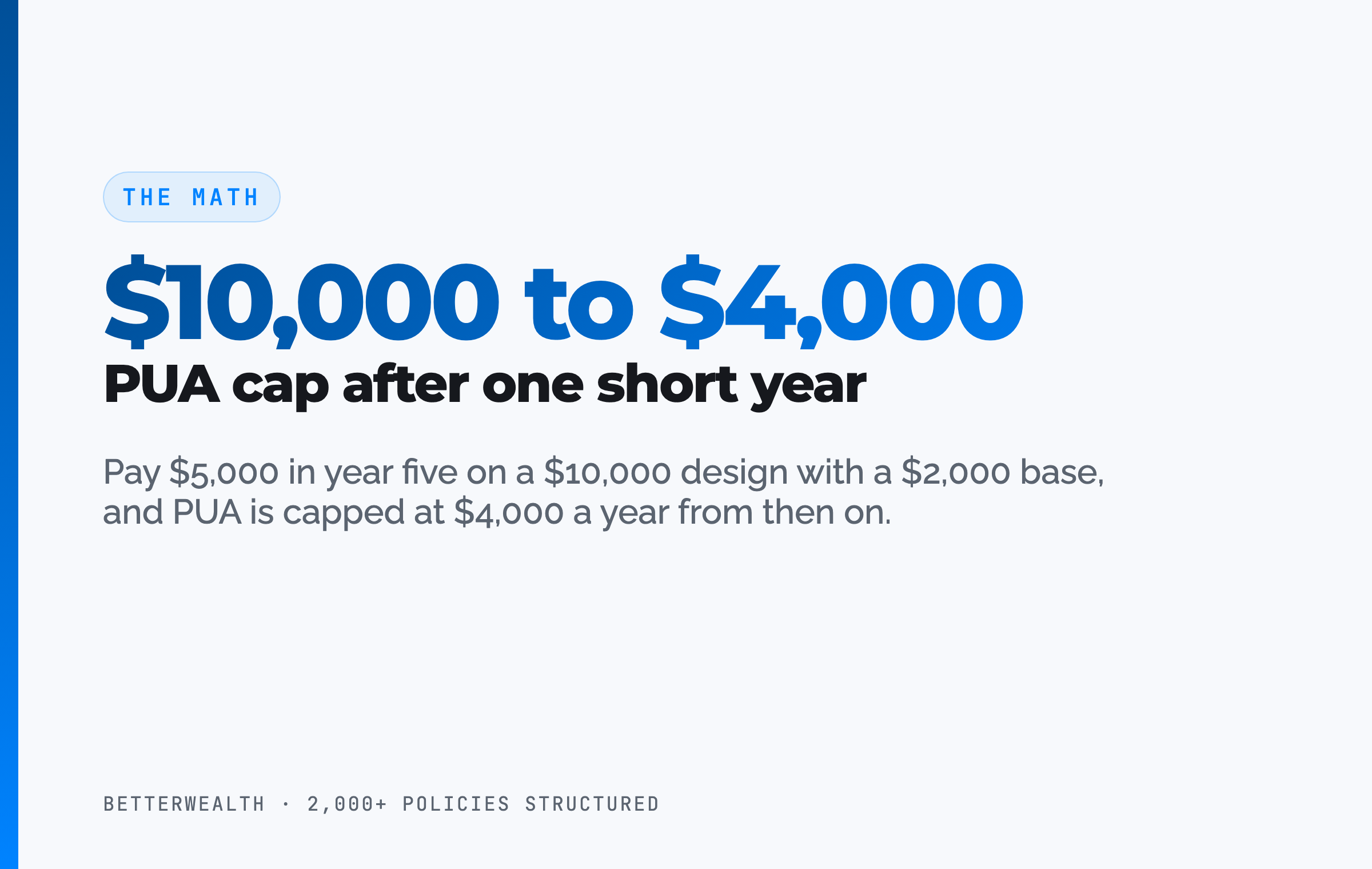
Alden's example: a $10,000 annual premium on a $2,000 base, paid in full for four years. In year five you pay $5,000. Because year five sits in the two-times-base tier of the schedule, from year six you are held to two times base, $4,000 of PUA, and you cannot return to $10,000. People choose New York Life for its balance sheet, not its flexibility. For a buyer who is fully confident in the premium, that trade can still make sense.
Mini-verdict: One $5,000 year on a $10,000 design caps PUA at $4,000 a year from then on. Choose it for strength, not flexibility.
#10MassMutual
MassMutual ranks last on PUA flexibility, with two riders that are each rigid in a different way. ALIR is all or nothing: pay the full illustrated amount on the policy anniversary or pay zero. You can skip two years, and the rider cancels if you skip a third. Its strength is a catch-up that lets you pay both skipped years in one lump sum in that third year.
PALIR flexes from zero to the maximum, but you get three payment opportunities a year, no catch-up, and the maximum adjusts to the highest amount paid in the last two years. Skip one year and you are fine. Skip two in a row and the rider is gone. MassMutual also offers the LISR blended term rider, which can be flexed to accept more premium, though the annual statements encouraging extra term payments confuse many clients.
Mini-verdict: Three PALIR payments a year. ALIR cancels on a third skipped year; PALIR cancels after two consecutive skipped years. The least forgiving structure of the 10.
"It checks the box. Not all check boxes are created equal." Alden Armstrong, on why two carriers with the same features can sit five places apart.
05 / How It WorksHow to Evaluate a Carrier's PUA Flexibility Before You Sign
You evaluate PUA flexibility by reading the rider contract in order of what can hurt you most, then stress-testing the design with a bad year. Here is the sequence we use.
- Find the step-down rule first. Ask whether the maximum PUA ever drops because of policy year or underfunding. A step-down is the hardest limit to undo.
- Size the catch-up against your premium. Confirm how many years back you can reach and the dollar cap. A $25,000 cap matters on a $40,000 premium and barely registers on $500,000.
- Confirm anytime payments and the last-month rule. Check how many payments are allowed a year and whether a final-month payment slides into the next policy year.
- Read the termination terms. Find the annual minimum, any funding corridor, and how many skipped years cancel the rider. Some riders cannot be reinstated.
- Set the base premium for the full horizon. Where PUA is capped as a multiple of base, a very small base limits what you can fund in years 10, 20, and 30.
- Stress-test with a down year. Ask your advisor what happens to your future limits if you pay only the base premium in year three. That answer tells you more than the dividend rate.
Step five deserves more attention than it gets. I learned early from agents who worked mostly with Guardian, where a very small base maximizes year-one cash value. In year 20 or 30, it caps how much the client can still fund. On carriers that tie PUA limits to base premium, a larger base costs some early cash value and buys decades of funding room.
A tiny base looks great in a year-one illustration. On a carrier that caps PUA as a multiple of base, it becomes a ceiling in year 20.
06 / The Full PictureWhy Would BetterWealth Still Place a Policy With a Low-Ranked Carrier?
We still place policies with low-ranked carriers because PUA flexibility is one factor, and for some clients it is not the deciding one. MassMutual sits 10th on this list and remains one of our top five carriers.
Part of that is history. BetterWealth has operated for close to a decade, and early on we placed a good share of business with MassMutual before we knew the other options well. That block of business performs well, and clients like their policies. They can access cash value quickly through MassMutual's phone app. For new cases, the bigger factor is underwriting: MassMutual's is often more reasonable for clients with medical history. Lafayette Life and Guardian underwrite conservatively. For a client with health issues, MassMutual can deliver a better rating class and lower pricing than a more flexible carrier would.
New York Life and Guardian draw clients who prioritize the strength of a large mutual. A buyer who is certain of the premium and wants maximum financial backing gives up little by accepting a rigid rider. The ranking only answers one question: how well does this rider handle uneven funding?
Alden's rule for clients: if he builds the policy right the first time, they should not need a second policy unless their income jumps. Dollars added to an existing, capitalized policy work harder than dollars starting a new one, because the new policy starts its early years over.
"If I build the policy right the first time, you shouldn't have to come back to me for another one unless all of a sudden you're making a lot more money." Alden Armstrong
07 / The WorkaroundCan a Policy Loan Stand In for a Catch-Up Provision?
A policy loan can stand in for a catch-up provision in some cases, as long as the policy is past its capitalization point and you have a clear way to repay. I raised this as the workaround for any carrier with a weak or missing backfill, with a firm disclaimer that it is not a recommendation to borrow.
The mechanics: once a policy passes its capitalization point, usually around year two or three on a cash-heavy, PUA-led design, a new premium dollar adds about a dollar of cash value.
In a tight year, you take a policy loan against existing cash value and use it to pay the full premium, which protects your rider limits. The loan reduces available cash value by the amount borrowed, and the premium it pays adds roughly that much back, so net access stays close to level while the loan accrues interest to the carrier. At a direct recognition carrier such as Penn Mutual, loaned dollars may also be credited differently while the loan is outstanding.
The loan is a defensive cost paid to protect future capacity, justified only if you will fill that room and later deploy the capital above the loan rate. Repaying the loan in a strong year works like a backfill, and a loan repayment restores your available cash value dollar for dollar.
This is the capitalization point, not the break-even point. Total cash value usually does not catch total contributions until year five or later.
Alden has used this with a client who was exiting a business and was at a carrier with no backfill option. The client took a policy loan to pay that year's full PUA, max funded the following year, and paid off the loan. The rider stayed intact.
The And Asset Test Still Applies
Many IBC marketers would describe this as paying yourself interest. You are not. The loan interest goes to the carrier. What you buy with that interest is preserved funding room, and preserved room only has value if you will fill it later and deploy that capital into something that out-earns the loan rate. If you cannot repay, the loan compounds against the policy and can eventually put it at risk of lapse.
Use it as a bridge across a known, short gap with a defined repayment source. Do not use it as a funding plan. On a policy designed with a heavy base, the capitalization point may arrive later, and the workaround may not be available in years two or three at all.
A bridge, not a plan.
08 / The Pitch ProblemsWhere Agents Get PUA Flexibility Wrong
Agents get PUA flexibility wrong in four repeatable ways, and each one costs the client funding room they never knew they had lost.
First, they sell the dividend rate. A carrier with the highest declared dividend rate can carry the most rigid rider, and the illustration will never show the year you miss. Second, they claim features the contract does not have. The Guardian backfill claim is the clearest example: Alden has asked for Guardian documentation of a catch-up provision and has not seen any. Third, they present a carrier's enforced step-down as a client choice. An illustration showing five years of heavy funding and then a lower premium may reflect the contract's limits, not the client's plan. Fourth, they minimize the base to win the year-one cash value comparison, then leave the client with a policy that cannot accept the premium they want to pay in year 20.
Marketers have ruined the way this should be explained. The honest version starts from how your income actually behaves, then picks the rider that survives it.
Run Your Own Numbers Before You Talk to Anyone
The And Asset Vault holds our cash value calculator, The And Asset handbook and audiobook, and a short course on how an overfunded whole life policy is built. It is free. Enter your email to get access.
Open the Vault09 / The TradeoffsBenefits and Real Tradeoffs of Choosing for Flexibility
Choosing a carrier for PUA flexibility buys you funding room that survives uneven years, and it costs you something elsewhere. The tradeoffs are real.
The most flexible carrier, Penn Mutual, runs 7 to 12% lower on early cash value than some competitors in the first five years and does not operate in New York. Foresters has the strongest catch-up but a step-down and a short track record with us. OneAmerica's rules are forgiving but its funding capacity is lower. On the other side, the least flexible carriers bring strengths flexibility does not: MassMutual's underwriting, New York Life's and Guardian's financial strength, and Guardian's and Ameritas's strength in front loads and short pays.
As our carrier guide concludes, the product, its design, and your understanding of it matter more than the carrier logo. Any of these 10 can work for someone. The question is whether its rider fits how you will actually fund it.
Fit the rider to the income, not the other way around.
10 / Head to HeadAll 10 Carriers Side by Side
The table below lines up every carrier on the three-part test, with the dollar or multiple that defines each rider's real limit.
| Rank | Carrier | Anytime Payments | Catch-Up | Step-Down | Defining Limit |
|---|---|---|---|---|---|
| 1 | Penn Mutual | Yes | Full, prior year | None | $50,000 in any 5 years on a $100,000 max |
| 2 | Foresters Financial | Yes | 10-year look-back | Yes, if underfunded | Up to $25,000 per missed year, years 1 to 10 |
| 3 | OneAmerica | Yes | Prior year, by 3-year average | None | $120/yr minimum; PUA up to 3x base |
| 4 | Lafayette Life | Yes | About $25,000 | Year 8+, to 7-year average | $25,000 catch-up cap |
| 5 | Pan-American Life | Yes | None | None | $100/yr minimum; $100,000/yr carrier ceiling |
| 6 | Guardian Life | Yes | None | 3x base to year 10, then 1x | $1,000 base supports $3,000 PUA, then $1,000 |
| 7 | Ameritas | Flexible after year 1 | Current + 2 prior years | 10x base early, 2x from year 16 | $30,000 level premium needs about a $10,000 base |
| 8 | Security Mutual | Within 75% to 125% corridor | 2 prior years, limited | Funding cliff | Must pay 75% to 125% of scheduled PUA |
| 9 | New York Life | Within annual limit | None | Severe: 2x base after a miss in year 5+ | $2,000 base caps PUA at $4,000 after a miss |
| 10 | MassMutual | ALIR: anniversary only; PALIR: 3/yr | ALIR only, 2 years | PALIR max tracks last 2 years | ALIR cancels on a third skipped year; PALIR cancels after two consecutive skipped years |
Top tier (1 to 3). These carriers forgive a bad year. Penn Mutual combines all three features with a full prior-year catch-up, Foresters offers the longest look-back in the field, and OneAmerica keeps the rider open for about $120 a year. Pick among them based on how large your premium is and how far back you may need to reach.
Middle tier (4 to 7). Each has one hard limit. Lafayette Life resets your ceiling in year eight, Pan-American Life has no backfill, and Guardian and Ameritas step down on a schedule regardless of how you fund. They fit front loads, short pays, and buyers confident in their premium.
Lower tier (8 to 10). A missed year can cost you the rider or permanently cap it. Security Mutual's corridor, New York Life's step-down, and MassMutual's skip limits make these carriers a choice for strength or underwriting, not flexibility.
The HVAC Owner Whose Year Three Came in Short
Consider a 46-year-old owner of a commercial HVAC company, preferred non-tobacco, funding a Penn Mutual whole life policy built for early cash value at $60,000 a year: $14,400 base and $45,600 PUA, a 24/76 split. This is a representative composite, not a single named client.
In year three, a large contract slips and she pays only $22,700: the $14,400 base and $8,300 of PUA. In year four, the contract closes. She pays her full $60,000 plus a $37,300 catch-up of the PUA she missed, $97,300 in total. Her rider limit never moves.
| Year | Paid This Year | Total Paid | Cash Value |
|---|---|---|---|
| 1 | $60,000 | $60,000 | $49,380 |
| 2 | $60,000 | $120,000 | $103,940 |
| 3 | $22,700 | $142,700 | $128,610 |
| 4 | $97,300 | $240,000 | $231,720 |
| 5 | $60,000 | $300,000 | $302,150 |
| 7 | $60,000 | $420,000 | $443,870 |
Cash value trails total contributions through year four, as a real policy should. The year-four catch-up dollars did not earn a year-three dividend; they started compounding when they arrived. At year five, cash value crosses total contributions. Under New York Life's schedule, which applies only after a missed year, her year-three shortfall would put her on the step-down: four times base in year four, which still covers her $45,600 of PUA, then two times base from year five. In this like-for-like hypothetical with the same $14,400 base, that cap, $28,800 a year, is $16,800 below her design. Over 15 more years of funding, that is $252,000 of capacity she would never get back.
In year seven, a retiring competitor offers her a book of commercial maintenance contracts for $211,500. She borrows $211,500 against $443,870 of cash value. The contracts produce $41,870 a year in net cash flow, a 19.8% first-year cash yield. At an illustrative 6% loan rate, interest runs about $12,690 in year one; the other roughly $29,180 of the contracts' cash flow pays down principal, and the full $41,870 becomes hers once the loan is retired in month 73. The policy keeps compounding on its full value, net of mortality and expense charges, with loaned dollars credited under Penn Mutual's direct recognition spread. She repays on a 73-month schedule funded entirely by the contracts' cash flow, and the contracts keep paying after the loan is gone.
One dollar. Two jobs. That is The And Asset.
The Honest 30 Minutes About Which Rider Fits Your Income
We have structured more than 2,000 policies across all 50 states. We have seen this strategy work exactly as designed, and we have seen it fail. If you want a real conversation about whether The And Asset fits your situation and which carrier's rider survives your funding pattern, book a call. We will give you the honest answer either way. If you would rather learn first, The And Asset and BetterWealth YouTube channels go deep on the math.
Book a Discovery CallFAQPUA Flexibility Questions
What is PUA flexibility in whole life insurance?
PUA flexibility is how freely a whole life policy lets you vary what you pay into its paid-up additions rider from year to year without losing future funding room. We judge it on three features: anytime payments, a catch-up provision for missed years, and no step-down in future PUA limits.
Which whole life company has the most flexible PUA rider?
Penn Mutual ranks first in our 10-carrier review. It allows PUA payments any time in the policy year, a full catch-up of the previous year's missed PUA, and no step-down, as long as you pay at least half of one year's maximum PUA within any rolling five-year period.
What are the three features of a flexible PUA rider?
The three features are anytime payments, a catch-up provision, and no PUA step-down. Alden Armstrong ranks no step-down as the most valuable, then catch-up, then anytime payments, because a step-down can permanently lower what you are allowed to fund after a single slow year.
What is a PUA step-down?
A PUA step-down is a contract rule that lowers the maximum paid-up additions you can pay, either on a fixed schedule by policy year or after you fund less than illustrated. New York Life, for example, holds the limit to two times the base premium from the following year if you miss full funding in year five or later.
Does a PUA catch-up payment earn back missed dividends?
No. A catch-up or backfill payment does not retroactively earn dividends for the year you missed, because the carrier did not have that money then. It starts working from the day it is paid, which is still better than losing the funding room entirely.
Why is MassMutual ranked last for PUA flexibility?
MassMutual ranks last because both of its PUA riders are rigid. The ALIR rider is all or nothing on the policy anniversary and cancels on a third skipped year, and the PALIR rider allows only three payments a year, has no catch-up, and cancels after two consecutive skipped years.
Does New York Life have a PUA catch-up provision?
No. New York Life has no PUA catch-up provision, the rider terminates after three consecutive years with no payment, and missed funding triggers a step-down schedule that can cap future PUA at two times the base premium.
Does Guardian allow PUA backfill?
No. Guardian's PUA rider has no backfill or catch-up provision. Extra room under the MEC limit can look like a backfill on some Q-Term designs, but it is the product accepting a larger premium, not a contractual catch-up of a missed year.
Can you use a policy loan to keep a PUA rider fully funded?
Yes, in some cases. Once a policy is past its capitalization point, you can take a loan against existing cash value and use it to pay the full premium, then repay the loan in a stronger year, which works like a backfill. The interest goes to the carrier, and unrepaid loans can put the policy at risk, so this is a bridge for a known short gap, not a funding plan.
Does PUA flexibility matter more than the dividend rate?
For most business owners with uneven income, yes. The dividend rate describes what the policy credits, while PUA flexibility decides whether you can keep funding the policy at the level the illustration assumed after a slow year.
What is The And Asset?
The And Asset is BetterWealth's framework for using a properly structured whole life policy as a capital base. You only borrow against it for an activity that produces a return greater than the carrier's loan cost, so your dollars do two jobs at once: the policy keeps compounding while the deployed capital earns its own return.
How is The And Asset different from infinite banking?
Nelson Nash originated infinite banking. IBC marketers today frame a whole life policy as a personal banking system for any purchase. The And Asset shares those roots but operates on different principles: you only deploy borrowed capital when the return clears the carrier's loan cost, and the policy is the capital base, not the destination.
- Nelson Nash, Becoming Your Own Banker: the origin of the infinite banking concept.
- IRC Section 7702 (Cornell Law): the definition of life insurance for federal tax purposes.
- IRC Section 7702A (Cornell Law): the modified endowment contract rules behind the MEC limit that shapes the Guardian Q-Term and Ameritas designs above.
- BetterWealth, The Ultimate 2026 IBC Carrier Comparison Guide, by Alden Armstrong and Caleb Guilliams: carrier PUA flexibility rankings and rider terms.
- BetterWealth resources: The And Asset book, The And Asset YouTube channel, and the BetterWealth YouTube channel.
Leads carrier research for BetterWealth, worked on our 2026 IBC Carrier Comparison Guide, and built the 10-carrier PUA flexibility ranking presented in the source video.
I founded BetterWealth to treat life insurance as the capital tool it is, not the product most people get sold. Our team has structured more than 2,000 policies across all 50 states. I wrote The And Asset and host the BetterWealth and The And Asset YouTube channels. If you want an honest read on which carrier's rider fits how your income actually moves, book a discovery call. We will tell you if a policy does not fit at all.