
Private equity control of a life insurance company changes how policyholder money gets invested, often into affiliated paper the public cannot see. Federal investigators are reportedly examining one group whose disclosed affiliated investments were revised from roughly $1.4 billion to more than $17 billion after a subpoena.
Almost nobody asks who owns the insurance company. Buyers compare illustrations, dividend rates, and premiums, sign the application, and never trace the carrier up to the entity that actually controls its investment decisions. Ownership sits outside the comparison entirely. It should sit at the top of it, because ownership determines what happens to the money after it leaves your account.
The strength of a life insurance policy is a function of who controls the balance sheet behind it, not the illustration in front of it. That distinction has been abstract for most of the last decade. It stopped being abstract this month.
According to reporting, federal investigators are examining whether Delaware Life and Clear Spring Life and Annuity, insurers connected to billionaire Mark Walter, used billions of dollars of policyholder-backed assets to finance other businesses connected to him while failing to properly disclose those transactions as related-party or affiliated investments. Delaware Life had previously reported roughly $1.4 billion in affiliated investments. After a subpoena triggered an internal review, that figure was reportedly revised to more than $17 billion. In percentage terms, that moves the exposure from about 3% of invested assets to closer to 40%.
Tom Gober, a forensic accountant and certified fraud examiner, examined essentially the same structure in 2014. He and a team of attorneys filed a complaint over whether insurance company funds had flowed to affiliates without being disclosed as affiliated. It settled. He has spent the 12 years since warning that the pattern never went away. He joined us on the BetterWealth channel to explain what affiliated paper is, why offshore captive reinsurance makes a balance sheet unreadable, and what a policyholder should actually do with the information.
At BetterWealth, we have structured more than 2,000 policies across all 50 states, and we screen the institution before we screen the illustration. This piece covers what an affiliated investment is, how a reported $1.4 billion became more than $17 billion, the five questions to ask any carrier before you fund a policy, why The And Asset depends on the carrier outliving you, and the honest tradeoffs of the mutual-only stance we take.
- Affiliated investments move policyholder money upstream to entities under the same control, where arm's-length pricing cannot be presumed.
- Reported affiliated investments at one insurer went from roughly $1.4 billion to more than $17 billion after a subpoena.
- Tom Gober's practical ceiling is the lesser of 50% of surplus and 10% of invested assets, and 40% is far past it.
- Offshore captive reinsurance can make liabilities disappear from view, which inflates apparent surplus and enables more affiliated paper.
- Ask any carrier what it cedes offshore and what percentage of surplus is affiliated. A refusal is an answer.
- The And Asset only works if the institution holding your capital base outlives you, so ownership is screened before design.
The full conversation is worth the 25 minutes for one reason the article cannot reproduce: Gober walks through the mechanics of how a reinsurance transaction manufactures the appearance of surplus, in his own words, as someone who has read these statutory filings for a living for decades.
01 / The problemThe one question buyers never ask about their carrier
Buyers evaluate the product and skip the institution, which inverts the actual risk. A life insurance contract is a promise that has to survive decades. The statute behind it is written for that reality: a carrier must have enough money now and enough money 90 years from now, because policies bought for a newborn can run a century. Every illustration you have ever seen assumes the company on the letterhead is still solvent, still paying dividends, and still honoring loan provisions in year 47.
Gober's point is that the assumption stopped being automatic when ownership of the industry changed. When a mutual holding company sits at the top, owned by its policyholders and run by executives who spent their careers running mutuals, affiliated investments worry him less. When private equity or an aggressive alternative asset manager sits at the top, the incentives change, and so does the balance sheet.
The product is the easy part. The institution is the risk.
"There is an absolute lack of transparency in these balance sheets. We are supposed to be able to see this, and we cannot." Tom Gober, forensic accountant and certified fraud examiner.
02 / The mechanismWhat is an affiliated investment, and why does it matter?
An affiliated investment is money the insurance company invests in an entity under the same ownership or control as the insurer itself. It might be labeled a note. It might be labeled a bond. The label is not the issue. The direction is: policyholder premium flows upstream into paper issued by the people who control the insurer.
Statutory accounting treats this differently from an ordinary investment for a reason. Two independent, sophisticated parties negotiating with their own money can be presumed to have struck an arm's-length deal. Two parties under common control cannot. The National Association of Insurance Commissioners' Financial Condition Examiners Handbook says so explicitly, instructing examiners to treat material affiliated transactions as a place to watch for self-dealing.
Gober is direct that affiliated paper is not inherently wrong. Carriers hold some of it routinely. His concern is concentration and concealment. His practical ceiling is the lesser of 50% of surplus and 10% of invested assets, and in most real cases the surplus test is the binding one. Surplus is the excess of assets over everything the company owes, every death claim and every annuity promise. By law it has to stay positive.
Why concentration in affiliated paper behaves differently under stress
Publicly traded bonds have a market. Internal paper does not. If a regulator ever had to place a carrier into receivership to protect policyholder funds, the affiliated entities on the other side of those notes would be the ones most dependent on the insurer, because premium had been flowing to them 365 days a year. Gober's phrase for the insurer in that structure is the cash cow. When the cash cow gets sick, the paper issued by the animals it was feeding does not hold value the way a corporate bond would. It falls faster and further, at exactly the moment liquidity is needed. That is the risk concentration hides.
Internal paper has no buyer when it matters.
03 / The caseHow did $1.4 billion become more than $17 billion?
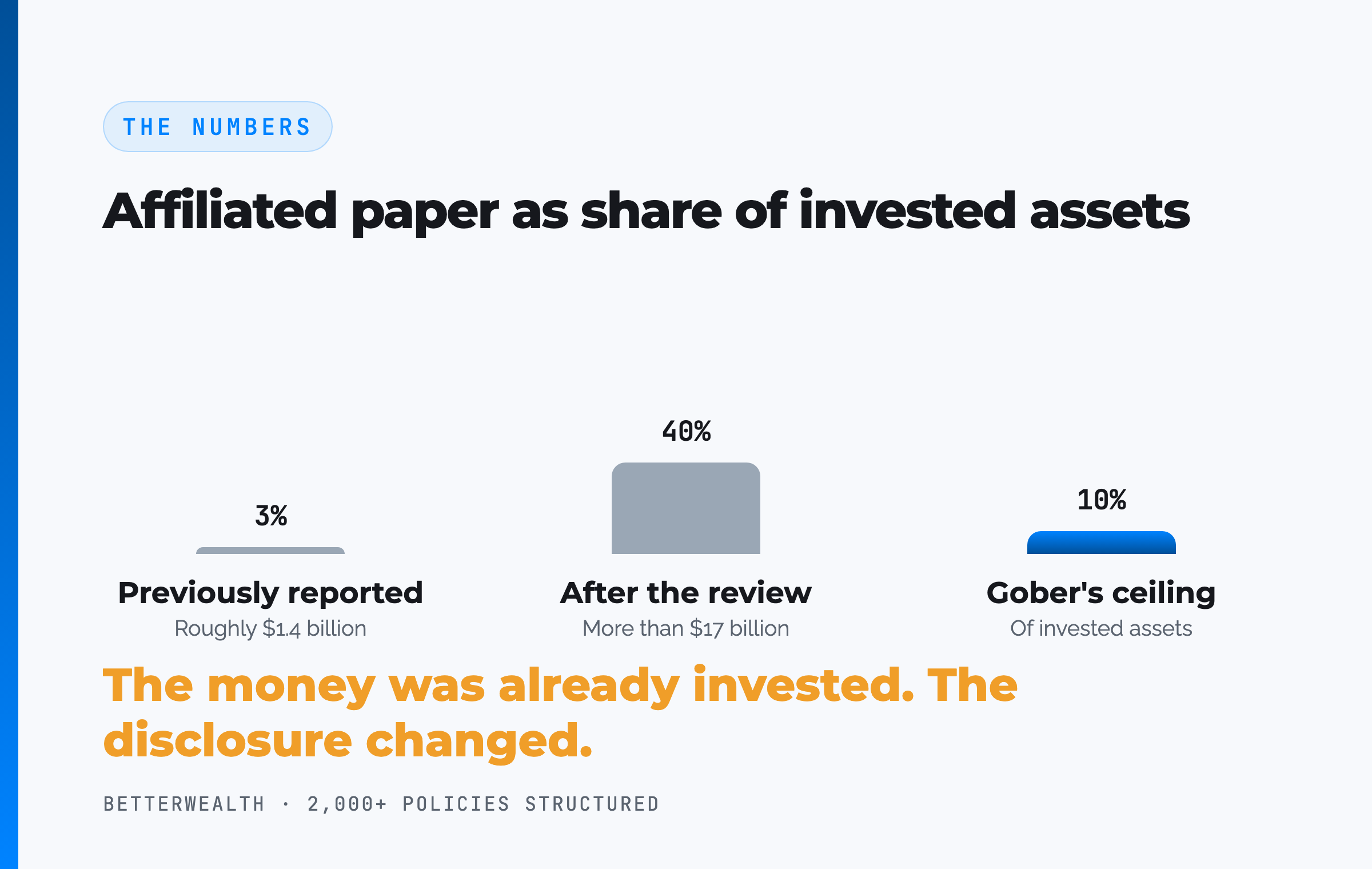
The gap came from disclosure, not from a sudden investment spree. Under the reported timeline, Delaware Life had characterized roughly $1.4 billion of its portfolio as affiliated. A federal subpoena prompted an internal review, and the reported figure was revised to more than $17 billion. The money was already invested. What changed was the acknowledgment of what it was invested in.
That is precisely the issue Gober's 2014 complaint described. In 2013 he read that Mark Walter had acquired the Los Angeles Dodgers and went looking to see whether insurance company assets had helped fund it. What he found looked like affiliated investments that were not disclosed as connected to the purchase. Money moved to an affiliate. From there it moved on. The filings showed the first step and not the destination. The case settled quickly and his clients were satisfied. Twelve years later, the federal examination appears to concern the same category of problem: a material transaction between parties under common control that the public record did not identify as such.
Gober's frustration is not with the feds. It is with the interval.
If the same person sits on both sides of a transaction, in Kansas and in the Cayman Islands, he can negotiate just about any terms he wants. That is what common control means, and it is why disclosure exists.
The conflict that has nothing to do with fraud
Set the disclosure question aside and a structural conflict remains. The capital policyholders made available was extended as debt, a note or a loan. When the underlying asset appreciates, and the Dodgers have appreciated enormously, the holder of a debt instrument receives interest and principal. The equity upside goes to the owners. Policyholder money carried the risk from the beginning and does not share in the result. Gober calls that a conflict of interest. It is a fair description even in a world where every disclosure was perfect.
"The policyholders do not get to share in that benefit, even though their money was at risk from the beginning." You hold the risk. Someone else holds the upside.
04 / The black boxHow does offshore reinsurance make a balance sheet unreadable?
Affiliated reinsurance moves liabilities to an entity the insurer controls, frequently domiciled somewhere the receiving entity does not file a statutory annual statement anyone can read. The Cayman Islands and Bermuda are common. So are United States captive jurisdictions such as Vermont. The transaction is legal. The visibility is the problem.
Gober's illustration of the mechanics is worth understanding, because it explains why the two problems compound. Cede $10 billion of liabilities to an affiliated reinsurer while transferring only $5 billion of assets, and the ceding company's books show the liability gone. The apparent result is $5 billion of additional surplus. Surplus is the denominator in the affiliated investment test. Inflate it and the company can hold more affiliated paper without any ratio looking alarming.
Nobody outside can confirm whether the assets on the other end are, in his words, money good. That is the entire objection. He is not claiming the assets are missing. He is pointing out that the law says we should be able to check, and we cannot.
05 / The playbookHow to vet the company behind your policy in five steps
Vetting a carrier takes five specific questions, and any competent agent can get you the answers. Run these before you fund a policy, and run them again on a policy you already own. None of them require you to read a statutory filing yourself.
- Identify the ultimate owner. Trace the carrier up to the entity that actually controls it. Policyholder-owned mutual, mutual holding company, publicly traded stock insurer, or private-equity-controlled stock insurer are four different animals. When an alternative asset manager takes control, an investment management agreement typically hands investment decisions to the parent from day one. That is the structural fact everything else follows from.
- Ask for affiliated investments two ways. As a percentage of surplus, and as a percentage of invested assets. Gober's ceiling is the lesser of 50% of surplus and 10% of invested assets. A carrier reporting 3% of invested assets in affiliated paper is unremarkable. One reporting 40% is a different conversation.
- Ask what is ceded offshore and to captives. Ask how much of the company's liability sits with reinsurers you cannot see, and whether those entities file a statutory annual statement. Gober's guidance is blunt: if a company is doing a lot of offshore work you cannot verify, stay away. Not because it proves anything is wrong, but because the law contemplates that you can see the other end.
- Compare short-term debt to short-term investments. Funding agreement backed notes, once called guaranteed interest contracts, are short-term debt. Gober has seen carriers carrying $70 billion of it against roughly $8 billion of short-term investments. If a sudden demand for liquidity arrives, or the funding agreements simply stop rolling into the next issue, that mismatch is where the stress lands. This is the one he worries about most.
- Read the persistency record, not just the rating. AM Best ratings and COMDEX scores matter. So does the lapse ratio, which almost nobody asks for. The industry average was 5.1% as of 2023 per AM Best. A carrier meaningfully below that has policyholders keeping policies that perform close to what was illustrated. A carrier well above it does not.
A carrier that answers all five plainly has told you something. A carrier that will not answer the second and third has told you something too.
Ask the question. The refusal is the data.
Carrier due diligence matters for a specific kind of buyer.
This applies to you if
- You hold meaningful cash value inside a policy or annuity
- You are funding a policy as a multi-decade capital base
- You cannot name the entity that controls your carrier
- Your contract sits with a recently acquired insurer
This is not your issue if
- You hold a small term policy with no cash value
- Your carrier is a policyholder-owned mutual you have verified
- You are reacting to a headline rather than your own contract
- You want a savings account, not a capital strategy
If you are in the first column, 30 minutes with a practitioner will tell you what your carrier actually looks like under those five questions. If you are in the second, we will tell you that and give you the time back.
Book a Discovery Call06 / The frameworkWhat does carrier ownership have to do with The And Asset?
Carrier ownership decides whether the capital base is real, which is the precondition for everything The And Asset does. Our framework treats a properly structured whole life policy as a capital base you borrow against while the policy keeps compounding on its full value, net of mortality and expense charges. Every part of that sentence assumes an institution that will still be standing in year 40.
The distinction is load-bearing here. If the policy is just a place to store money, the carrier's balance sheet is a background detail. If the policy is the base you will borrow against for 30 years to fund real activity, the carrier is a counterparty you are betting on. Counterparties get underwritten.
You are underwriting them as hard as they underwrote you.
A composite: the founder who ran the five questions first
Consider a 44-year-old agency owner, preferred non-tobacco, who came to us holding a deferred annuity at a recently acquired carrier and wanting to add a policy. This is a representative composite drawn from patterns across our book, not a single named client.
He asked his existing carrier the affiliated investment question and the offshore cession question. He did not get a straight answer on either. He kept the annuity for the time being and placed the new policy with a policyholder-owned mutual whose affiliated exposure sat in the low single digits of invested assets.
Year one cash value came in at $51,400 against $63,500 contributed. Through the first three years, cash value trailed cumulative contributions, which is what an honest illustration shows. At year five, total cash value of $321,800 crossed total contributions of $317,500. No earlier. Any illustration promising a year-two break-even is marketing fiction.
In year eight, with $547,300 of cash value against $508,000 contributed, he borrowed $214,000 against the policy to acquire a competitor's service book. The acquired contracts produced $91,400 of additional operating profit over the following 44 months. The policy loan, at an illustrative 6% on a declining balance, cost roughly $25,900 in cumulative interest across the same window. He repaid the loan from the acquired book's own cash flow on a 44-month schedule, and the policy compounded on its full value the entire time.
One dollar. Two jobs. That is the And.
07 / The stanceWhy do we structure almost exclusively with mutuals?
We structure with policyholder-owned mutuals because mutual ownership removes one specific conflict: there is no outside shareholder whose return competes with the policyholder's. When the company is owned by its members, the surplus belongs to the people whose premiums built it. Gober named the same category unprompted when we asked which carriers do not worry him.
The carriers we work with are the ones you would expect from that filter. Penn Mutual, founded in 1847, is the only United States carrier with an AM Best rating of A or better for 98 consecutive years, and declared $300 million to policyholders for 2026. Guardian declared $1.7 billion. MassMutual declared $2.9 billion. New York Life declared $2.78 billion. Those are dollars going back to the people who own the company. A non-participating product issued by a stock insurer pays no policyholder dividend at all, because the profit belongs to shareholders.
Gober's closing observation to us was about our advisors, and it is the standard we hold. They place clients only with companies expected to outlive them. If your insurer fails before you do, everything downstream gets ugly.
"If your insurer dies before your client, it is going to be ugly and painful." The company has to outlive the person. That is the first filter, before design, before dividend rate, before anything.
The frameworks behind 2,000+ policies, in one place.
The And Asset Vault holds the calculators, design frameworks, and the carrier screens we run before we place a single policy. Free, email-gated, no spam.
Open the Vault08 / The tradeoffsWhat the mutual-only stance actually costs
Restricting yourself to policyholder-owned mutuals costs you optionality, and pretending otherwise would be the same overselling we criticize. Four honest tradeoffs come with the position.
Mutuals are frequently more conservative underwriters, which means a client with a complicated health history sometimes gets a better offer elsewhere. Product innovation moves slower, and some of the strongest hybrid long-term care solutions live outside the pure mutual set. Geographic gaps are real: Penn Mutual, Lafayette Life, OneAmerica, and Pan-American Life do not operate in New York, which narrows the field for New York residents to Ameritas, Guardian, MassMutual, Security Mutual, or New York Life. Mutual ownership also does not guarantee performance. It removes a conflict. It does not remove investment risk, rate risk, or management risk, and a badly designed policy at a great mutual is still a badly designed policy.
The tradeoff we accept is a shorter list of carriers in exchange for a balance sheet we can read. For a strategy measured in decades, that trade is not close.
09 / Head to headMutual insurer versus private-equity-controlled insurer
The structural differences between the two ownership models show up in five places that matter to a policyholder. The table is about ownership structure generally, not about any specific company's conduct.
| Dimension | Policyholder-owned mutual | Private-equity-controlled stock insurer |
|---|---|---|
| Who owns it | The policyholders. There is no outside shareholder class. | Outside investors. Policyholders are customers, not owners. |
| Dollars returned to policyholders | Declared dividends for 2026: Guardian $1.7B, MassMutual $2.9B, New York Life $2.78B, Penn Mutual $300M. | Non-participating products pay no policyholder dividend. Profit is distributed to shareholders. |
| Investment control | In-house or independent managers accountable to the board and the members. | Typically an investment management agreement giving the parent control from the date of acquisition. |
| Affiliated investments | Generally low single digits of invested assets at the major mutuals. | Varies widely. One reported case revised from roughly $1.4B (about 3%) to more than $17B (closer to 40%). |
| Reinsurance visibility | Predominantly third-party reinsurers that file statutory statements. | Affiliated cessions to offshore or captive entities that may file nothing you can read. |
Ownership and dollars. The dividend figures are the clearest expression of the difference. A mutual sends $1.7 billion or $2.9 billion back to the people who own it. A non-participating contract at a stock insurer returns a contractual rate and nothing more, with the residual going to investors. Neither is wrong. They are different deals, and only one of them puts you on the ownership side.
Investment control. The investment management agreement signed at acquisition is the hinge. It is a normal commercial document. It also means the entity deciding where policyholder money goes is the same entity that benefits from where it lands, which is the conflict statutory disclosure exists to surface.
Visibility. The affiliated investment and reinsurance rows are the same problem viewed from two angles. Concentration you can measure is a risk you can price. Concentration you cannot see is a risk you cannot price at all, which is why Gober's advice is to ask for the offshore cession figure and walk if it does not come.
The honest 30 minutes about the company holding your capital.
We have structured more than 2,000 policies across all 50 states. On a discovery call, a practitioner runs the five questions against your actual carrier and tells you whether your contract, another carrier, or no policy at all belongs in your plan. If you would rather learn first, the The And Asset and BetterWealth YouTube channels go deep on the math.
Book a Discovery CallFAQPrivate equity, affiliated investments, and your policy
What is an affiliated investment in a life insurance company?
An affiliated investment is money a life insurance company invests in an entity under the same ownership or control as the insurer itself. It might be structured as a note, a bond, or a loan. Because both sides of the transaction answer to the same owner, statutory accounting requires it to be disclosed and reviewed for fairness rather than presumed to be arm's length.
Is my life insurance policy at risk if the company is owned by private equity?
Private equity ownership is not automatically a problem, and it is not evidence that any specific policy is impaired. The concern practitioners raise is structural: alternative asset managers typically sign an investment management agreement at takeover that gives the parent control of investment decisions, which creates an incentive to hold higher-risk, less liquid, and affiliated assets. Ask for the affiliated investment and offshore cession numbers rather than guessing.
What are federal investigators examining at Delaware Life and Clear Spring Life and Annuity?
According to reporting, federal investigators are examining whether the two insurers, connected to billionaire Mark Walter, used policyholder-backed assets to finance other businesses connected to him without properly disclosing those transactions as related-party or affiliated investments. Reported affiliated investments were revised from roughly $1.4 billion to more than $17 billion after a subpoena triggered an internal review. No findings of wrongdoing have been established.
How much affiliated paper is too much for a life insurer?
Forensic accountant Tom Gober uses the lesser of 50% of surplus and 10% of invested assets as his practical ceiling. State statutes vary. In the North Carolina matter involving Greg Lindberg, the statutory limit was 10% of invested assets, and the exception that allowed 40% is the gap Gober points to as the source of the damage.
What is offshore captive reinsurance and why does it matter?
Captive reinsurance is when an insurer cedes liabilities to a reinsurer it owns or controls, often domiciled in the Cayman Islands, Bermuda, or a United States captive jurisdiction such as Vermont. It matters because the receiving entity may not file a statutory annual statement you can read, so a policyholder cannot verify that assets backing the ceded liabilities are actually there.
What questions should I ask before buying a life insurance policy?
Ask who ultimately controls the company, what percentage of surplus and of invested assets sits in affiliated investments, how much liability is ceded offshore or to captives you cannot see, how short-term debt compares to short-term investments, and what the company's lapse ratio is against the 5.1% industry average. A carrier that will not answer the second and third questions has answered them.
Are mutual insurance companies safer than stock companies?
A policyholder-owned mutual removes one specific conflict: there is no outside shareholder whose return competes with the policyholder's. It does not remove investment risk, rate risk, or management risk, and mutual ownership alone does not make a policy good. Structure, funding discipline, and the design of the policy still decide the outcome.
Does a state guaranty association protect my policy if a carrier fails?
State guaranty associations provide a backstop when a licensed insurer becomes insolvent, but coverage limits are set state by state and are well below the size of a properly funded capital-strategy policy. Treating the guaranty association as your plan is a mistake. Carrier selection is the plan.
What is The And Asset?
The And Asset is BetterWealth's framework for using a properly structured whole life policy as a capital base. You only borrow against it for an activity that produces a return greater than the carrier's loan cost, so your dollars do two jobs at once: the policy keeps compounding net of mortality and expense charges while the deployed capital earns its own return.
How is The And Asset different from infinite banking?
Infinite banking, as Nelson Nash taught it, frames a whole life policy as a personal banking system for any purchase. The And Asset says the policy is the capital base and the value is created in what you deploy that capital into, so you only borrow when the return clears the carrier's loan cost. It is built on Nash's foundation and operates on different principles.
Does carrier ownership change the And Asset math?
Carrier ownership does not change the rate of return test, and it decides whether the test is worth running. The deployed capital still has to out-earn the loan cost. A capital base only functions if the institution holding it will still be solvent and paying dividends in year 40, which is why we screen ownership before we screen illustrations.
Should I cancel my policy if my carrier is in the news?
Do not surrender a policy on a headline. Surrendering can trigger taxable gain, forfeit cash value, and leave you uninsurable at the same rating later. Get the affiliated investment and offshore cession figures for your specific carrier, then have a practitioner walk through your options with the actual contract in front of you.
Which carriers does BetterWealth use for And Asset policies?
We structure almost exclusively with policyholder-owned mutuals and mutual holding companies, including Penn Mutual, Guardian, MassMutual, New York Life, Lafayette Life, Ameritas, and OneAmerica. The carrier is chosen after the design goal, because policy design and funding discipline matter more than the logo, and a long-dated capital strategy needs a company that will outlive the client.
- National Association of Insurance Commissioners · the Financial Condition Examiners Handbook and statutory accounting guidance on material affiliated transactions and self-dealing.
- AM Best · financial strength ratings and the 5.1% industry lapse benchmark cited above.
- National Organization of Life and Health Insurance Guaranty Associations · how state guaranty association coverage works and where the limits sit.
- Nelson Nash, Becoming Your Own Banker · the origin of the infinite banking concept.
- IRC Section 7702 (Cornell Law) · the tax code provision behind the treatment of life insurance cash value and policy loans.
- LIMRA · life insurance industry data, including persistency benchmarks.
- BetterWealth resources: The And Asset book, the The And Asset YouTube channel, and the BetterWealth YouTube channel.
Has spent decades analyzing statutory filings for life and annuity carriers, and filed a 2014 complaint concerning undisclosed affiliated transactions at insurers in the same corporate family now under federal examination. His analysis in this article is his own, based on publicly reported structures.
I founded BetterWealth to treat life insurance as the wealth and capital tool it actually is, not the product most people get sold. Our team has structured more than 2,000 policies across all 50 states, and we underwrite the carrier before we design the contract. I wrote The And Asset and host the BetterWealth and The And Asset YouTube channels. If you want an honest read on the company standing behind your policy, book a discovery call. We will tell you if there is nothing to fix.