
Private equity in your 401(k) means the plan menu holds illiquid private fund stakes alongside index funds, marketed as access to returns retail investors could not previously reach. The tradeoff is transparency and liquidity, inside an account that already restricts access before age 59½.
The largest pool of long-horizon capital in the United States sits inside retirement accounts, and the people whose names are on those accounts choose from a menu somebody else built. That arrangement has held for four decades and nobody thought hard about it while the menu was boring. What is changing is what goes on the menu.
At the BetterWealth Life Insurance Summit, researcher Barry James Dyke made the case that private equity firms have run out of exits and have identified retirement accounts as the buyer of last resort. Dyke has spent 17 years documenting how the asset management industry earns fee-related income off retail savers, beginning with The Pirates of Manhattan and continuing through his fifth book, Black Eyes for BlackRock, subtitled They Manage Trillions, You Take the Risk.
The issue is not that a 401(k) is a bad account. The issue is that it is somebody else's account structure, and control of the menu has never belonged to you. A plan fiduciary picks the lineup. A recordkeeper picks the share classes. Congress sets the access rules. Every one of those parties is acting inside the law, and none of them is you.
At BetterWealth we have structured more than 2,000 policies across all 50 states, and the entrepreneurs who come to us almost never lead with returns. They lead with access. They passed on a deal because capital was locked somewhere. They watched a credit line get pulled at the exact moment it mattered. The strategy we practice, The And Asset, exists to solve that specific problem.
This article covers what private markets inside a retirement plan actually change, why the asset management industry wants that pool now, what a collective investment trust is and why the acronym matters, and how a properly structured whole life policy functions as a capital base you control. It also covers where the strategy fails.
- Private markets are entering 401(k) menus through vehicles that file no prospectus and price on manager estimates.
- Roughly 30,000 companies sit in private equity portfolios worldwide with no exit, and retirement accounts hold the liquidity.
- A 401(k) carries no guaranteed floor and restricted access before age 59½, on a menu you do not set.
- The And Asset treats a whole life policy as a capital base you borrow against, sitting alongside plan-based accounts.
- IBC says use the policy for any purchase. The And Asset says only when the return beats the carrier loan rate.
- Banks and corporations have held cash value life insurance on their own balance sheets for decades.
Dyke names the vehicles, the fee structures, and the research trail on stage, and the exchange with him runs further into the retirement-income argument than this article does:
01 / The problemWhat a retirement plan actually gives you, and what it does not
A retirement plan gives you tax treatment and, in most cases, an employer match. It does not give you control of the investment menu, control of the timing, or a guaranteed floor. Those three limits are the design, and they were not hidden from anyone. They simply never mattered much while the menu was index funds and bond funds.
Dyke's framing on stage was blunt: the average American's retirement outcome is now a matter of which products get placed in front of them by parties earning fee-related income on the placement. He points to the Mercer CFA Institute Global Pension Index, which ranks national retirement systems annually and consistently puts the Netherlands, Iceland, and Israel at the top, and he places the United States near the bottom of the top 30 economies on that measure. Take that ranking as his read of the index, not as a settled fact. The underlying observation is harder to argue with. Systems built on lifetime income perform better than systems built on account balances.
A defined benefit pension promised a payment. A defined contribution account promises an account. Those are different products sold with the same word.
"A toaster from Walmart has more guarantees than a 401(k). And at least you get toast." Barry James Dyke, BetterWealth Life Insurance Summit
02 / The mechanicsWhat does private equity inside a 401(k) actually mean?
It means a portion of the plan's investment menu holds stakes in companies that do not trade, do not price daily, and are valued by the manager collecting the fee. In a registered mutual fund, the price at 4pm is the price. In a private fund, the reported value is an estimate produced by the party whose compensation depends on it.
The structural argument for including private assets in retirement accounts is real. Public markets have shrunk, more company value is created before an IPO, and a 30-year time horizon is exactly the kind of patient capital private markets need. That argument is not fraudulent. It is also convenient for the seller in a specific way that deserves stating.
Where the convenience shows up
Private equity buys companies with substantial debt, improves or refinances them, and sells. The model depends on the sale. When rates were near zero, the buying was easy and the selling was easy. Both got harder. Dyke cites private equity research counting roughly 30,000 portfolio companies worldwide that funds have not been able to exit, and he is direct about where the buyer is expected to come from: the 12 to 13 trillion dollars sitting in 401(k) and IRA accounts. A fund that cannot sell to another fund can still sell exposure to a retirement plan. Illiquidity moves from the fund to the saver.
The exit problem needs an exit.
None of that makes private assets bad. It makes the placement worth reading carefully, because you will not see a prospectus.
03 / The vehicleWhat is a collective investment trust, and why should you care?
A collective investment trust is a pooled investment vehicle offered inside employer retirement plans that is not registered with the SEC and files no prospectus. It is regulated primarily by banking regulators and by ERISA. Dyke places 52% to 55% of 401(k) investment dollars in these structures, most of it flowing through target date funds, which he says capture roughly 80% of new plan deposits.
The stated case for a CIT is cost. Without registration and prospectus obligations, the vehicle runs cheaper, and cheaper is a legitimate benefit to the participant. The cost of that saving is disclosure. A mutual fund publishes holdings and fees in a document the SEC reviews. A CIT does not.
Put those two facts together and the picture sharpens. More than half of retirement plan dollars sit in vehicles with reduced public disclosure, the default destination for new contributions is a target date fund most participants never actively chose, and the asset managers building those funds are the same firms that need a home for private assets.
The default option in most retirement plans was selected for you, holds assets you cannot inspect line by line, and receives your money every payday whether you looked at it or not.
04 / The patternWhy have banks and corporations quietly held life insurance for decades?
Banks and corporations hold cash value life insurance because it is a stable, tax-advantaged asset on a balance sheet that has to survive cycles. Bank-owned life insurance and corporate-owned life insurance are disclosed in regulatory filings and used to fund employee benefit and pension obligations. Dyke built The Pirates of Manhattan around that research 17 years ago and reports that General Electric has funded obligations this way since 1953.
The banks themselves are structurally different from the asset they hold. A bank lends against deposits. In March 2020 the Federal Reserve reduced reserve requirements on net transaction accounts to zero, down from 10% on balances above the low reserve tranche. Banks operate on capital requirements now rather than reserve ratios. The point stands either way. A bank's liabilities are payable on demand and its assets are not, which is why the institutions most exposed to that mismatch park long-horizon money in contractual assets.
The institutions using the tool are not the ones selling it to you. That gap is the whole observation.
05 / The frameworkWhat The And Asset is, and where it parts ways with infinite banking
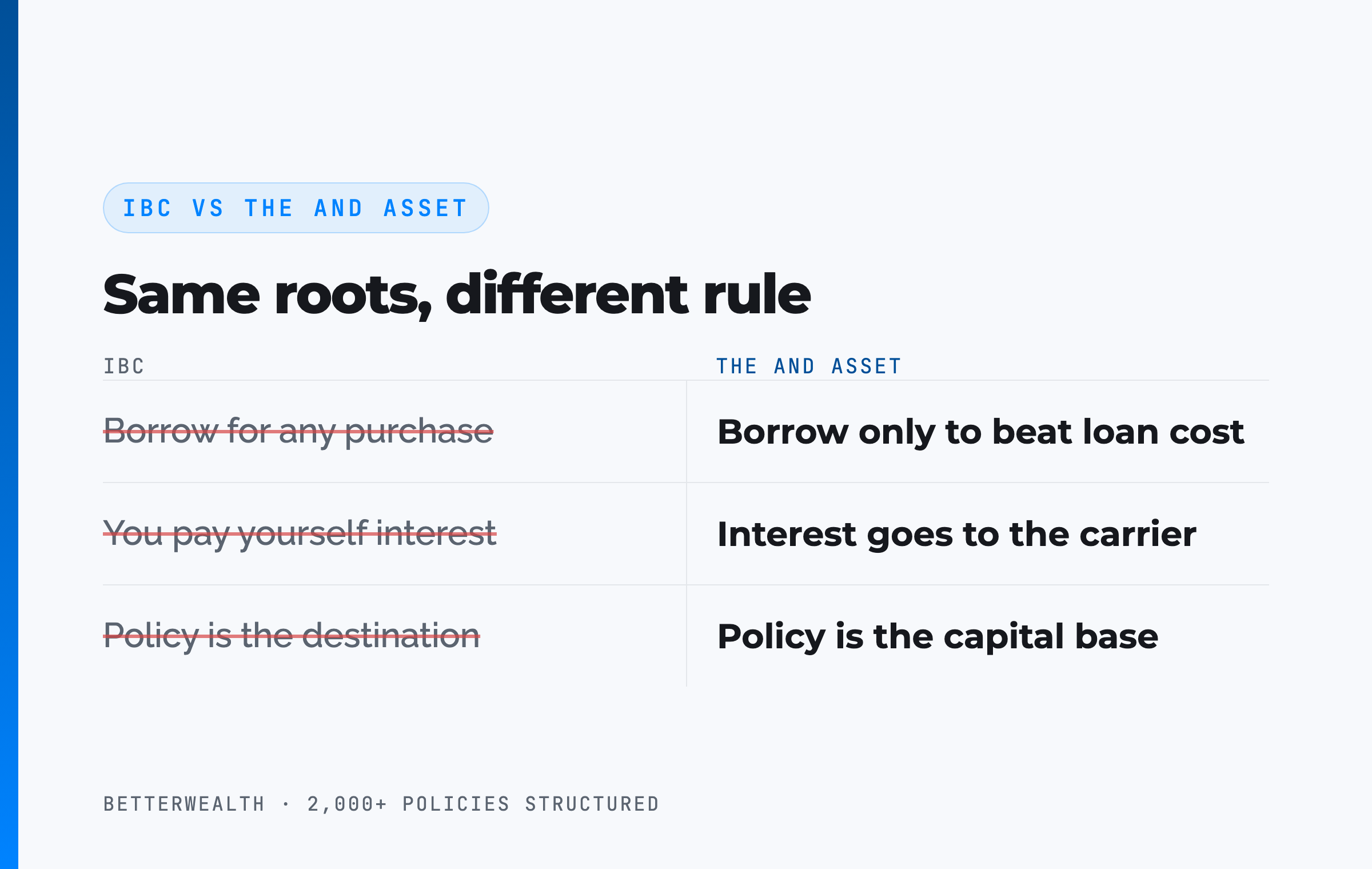
The And Asset is a properly structured whole life policy used as a capital base you borrow against, with one rule attached: you only borrow when the deployed capital produces a return greater than the carrier's loan cost. The policy keeps compounding on its full cash value net of mortality and expense charges while the loan is outstanding. Your dollar does two jobs. That is the AND.
Nelson Nash pioneered the use of whole life insurance as a personal banking system in Becoming Your Own Banker. His insight holds and we credit it in everything we write: you either lose money paying interest to outside lenders or you lose money to the opportunity cost of capital sitting idle. The And Asset builds on that foundation and operates on different principles.
The contrast, stated directly
IBC says you can use a whole life policy as a personal banking system for any purchase, from a car to a vacation. The And Asset says you only deploy capital from the policy when the borrowed dollars will produce a return greater than the carrier's loan cost, because anything less is an expensive way to spend money. IBC frames the policy as the destination. The And Asset frames it as the capital base, where the value gets created in what you deploy into.
One correction we make every time. Marketers say you are paying yourself interest. You are not. The interest goes to the insurance company. Your return is what the deployed capital earns while the policy keeps compounding uninterrupted. Anyone who tells you otherwise is selling.
It is not a product. It is a strategy.
If you cannot name an activity that beats the carrier's loan rate, do not borrow. The discipline of repayment is the whole strategy, and without it this is an expensive savings account.
06 / How it worksHow do you build a capital base you actually control?
You build it in five steps, and the order is what most agents skip. This is the sequence we use when we structure a policy for an entrepreneur or a high-income earner who already has plan-based accounts running.
- Keep the plan dollars that earn their place. Capture the employer match first. A dollar-for-dollar match is an immediate return no insurance policy competes with, and the deferral treatment carries real value at a high marginal rate. An And Asset policy sits alongside plan-based accounts. It does not stand in for them.
- Structure the policy for cash value. Minimize the base premium and load the paid-up additions rider as heavily as the IRS allows without creating a Modified Endowment Contract. A cash-value design commonly runs a 25/75 or 20/80 base to PUA split. The PUA rider is the engine. Without it you have bought an expensive death benefit.
- Fund it and let the early years capitalize. Cash value trails cumulative contributions through the first three years. Break-even lands at year 5 or later for a healthy individual. Any illustration showing a year-one or year-two break-even is fiction, and an agent who shows you one has told you what you need to know about them.
- Borrow only when the use clears the loan rate. Take a policy loan collateralized by the cash value when you can name the activity and defend the number. The policy continues compounding on its full cash value net of internal charges while the loan sits outstanding.
- Repay from the cash flow the activity produces. Set the repayment schedule against the deployed activity's own cash flow, not against household income. Capital that has to be repaid from your paycheck was never an investment.
Steps two and three are where policies go wrong. Steps four and five are where people go wrong. The design failures are fixable at issue. The discipline failures are not.
This is for a specific person doing specific things with capital.
It fits you if
- You are an entrepreneur, business owner, or real estate investor already deploying capital
- You can name uses for capital that beat a 5% to 6% loan cost
- You can fund consistently for 10 years or more
- You have already captured the employer match and maxed the obvious accounts
It does not fit you if
- You are early in building wealth and need every dollar working now
- You are carrying high-interest debt and looking for a quick fix
- You want a savings account with a better story
- You cannot identify a productive use for borrowed dollars
If you are in the first column, 30 minutes with a practitioner will tell you whether the math works in your situation. If you are in the second, we will say so and you will keep your money.
Book a Discovery Call07 / The mathDoes the deployed capital clear the loan rate?
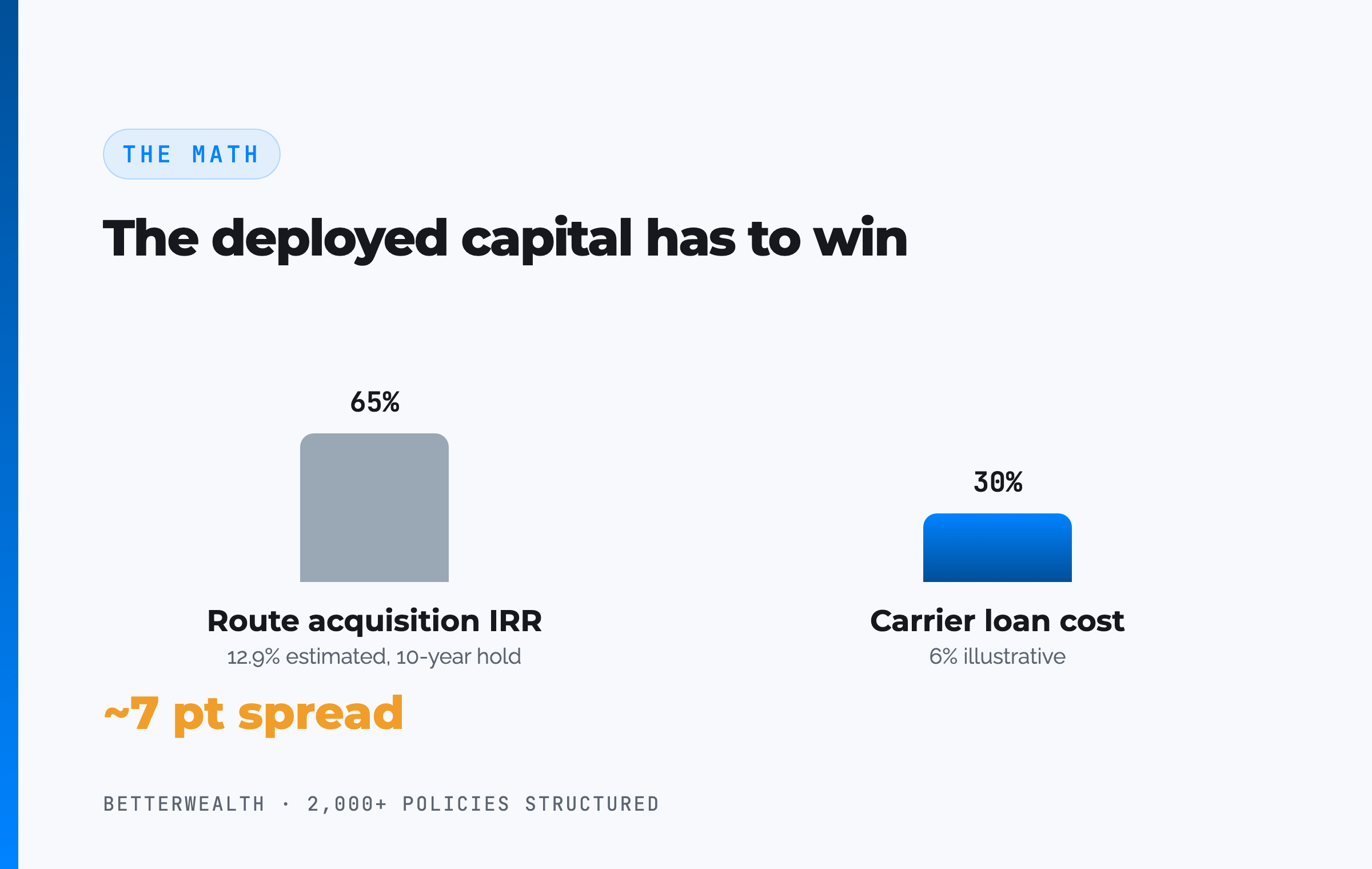
The return on whatever you deploy must exceed the carrier's loan cost, or you should not borrow. That is the entire test and it does not soften for anybody. Policy loan rates vary by carrier and rate environment, and many carriers fall in the 5% to 6% range at the time of writing, so treat any specific figure as a variable to verify rather than a constant.
Here is the structure of the decision. You borrow at the carrier's rate. The policy keeps compounding on its full cash value net of mortality and expense charges, adjusted by the carrier's recognition treatment. The deployed capital earns its own return. If that return clears the loan cost, you are ahead on the spread and one dollar did two jobs. If it does not, you have borrowed money to lose money slowly, and the fact that the lender was an insurance company instead of a bank changes nothing about the arithmetic.
This is also the honest answer to the private markets question. We are not claiming a policy outperforms a good private equity fund. A policy is a capital base with contractual guarantees and a known loan mechanism, and it makes the deployment possible. The returns come from what you do with the capital. Anyone comparing a dividend rate to an equity return is comparing two things that do not do the same job.
If the deal does not clear the loan rate, do not borrow.
A composite: the contractor who bought his competitor's route
Consider a 44-year-old owner of a specialty contracting business, preferred non-tobacco, funding a policy at $63,500 a year. The design splits 25/75 base to paid-up additions: $15,875 of base premium and $47,625 into the PUA rider. This is a representative composite built from patterns we see, not a single named client.
Through the first three years cash value trails cumulative contributions, which is what a real policy does. By year three each premium dollar adds more than a dollar of cash value. At year 5, total cash value of $321,800 crosses total contributions of $317,500. Not before. That timeline is the honest one and it is the reason people who need liquidity next year should not be doing this.
In year eight, with roughly $487,300 of accessible cash value, the owner borrows $214,000 to buy out a retiring competitor's service route and two trucks. The acquired route adds $38,900 of annual operating cash flow against $12,840 of first-year loan interest at an illustrative 6%. Estimated IRR on the deployed capital over a 10-year hold is 12.9%, roughly seven points above the loan cost. Repayment runs on a 47-month schedule funded entirely by the acquired route, never by the owner's household income. The policy compounds on its full cash value net of internal charges the whole time.
Compare that to the alternative he actually had. The same capital sitting in a plan-based account would have been unavailable without a distribution, a plan loan capped well below $214,000, or a taxable event.
One dollar. Two jobs. That is the And.
The frameworks behind 2,000+ policies, in one place.
The And Asset Vault holds the calculators, design frameworks, and structuring decisions we use when we build a capital base for an entrepreneur. Free, email-gated, no spam.
Open the Vault08 / The failure modesWhere people get this wrong
The strategy fails in four predictable places, and three of them are the buyer's fault rather than the product's. We have watched all four across more than 2,000 policies.
The first failure is buying it as a reaction. Someone hears an argument like Dyke's, gets alarmed about their retirement plan, and buys a policy as protest. Alarm is not a capital strategy. The policy has to earn its place on the math, and if the math does not clear, no amount of skepticism about asset managers changes that.
The second failure is design. A policy sold with a heavy base premium and a thin PUA rider pays the agent well and builds cash value slowly. Ask for the base-to-PUA split in writing before you sign anything. If the agent will not put a number on it, that is your answer.
The third failure is funding. A policy structured for $63,500 a year and funded for three years is a bad outcome that no carrier can rescue. Fund what you can sustain through a slow year in your business, not what you can sustain in your best year.
The fourth failure is the borrow. People take a loan because the money is available rather than because a use clears the rate. That is the failure the marketing invites, and it is precisely what The And Asset was defined to prevent.
Marketers have ruined the way this should be explained. If somebody tells you this replaces your retirement account, produces guaranteed wealth, or works for everyone, they are selling a product and calling it a strategy.
09 / The tradeoffsBenefits and the real costs, stated together
The benefits of an And Asset policy are control, contractual guarantees, tax treatment, and a loan that cannot be called. The costs are a long capitalization period, internal charges, an ongoing funding obligation, and a return profile that will never resemble equities. Both lists are true at the same time.
On the benefit side, cash value is not marked to market, policy loans are not taxable income under IRC Section 7702 when the policy is structured and maintained properly, and the carrier cannot revoke access the way a lender can freeze a credit line. Access does not depend on an underwriter's mood in a bad quarter.
On the cost side, you will be underwater against cumulative contributions for the first several years, and that is a feature of how the contract is built rather than a design flaw to shop around. Internal mortality and expense charges are real and they reduce what compounds. The funding commitment is the hardest part for a business owner with variable income, which is why the funding number matters more than the carrier.
Anyone who presents one list without the other has told you which side of the table they are on.
10 / Head to headWhere long-horizon capital can sit
Each of these structures solves a different problem, and the differences that matter are control, pricing, and what happens when you need the money early. The table sets a plan-based account, a private fund sleeve inside that plan, a taxable brokerage account, and an And Asset policy against the dimensions an entrepreneur actually cares about.
| Dimension | 401(k) plan account | Private fund sleeve in-plan | Taxable brokerage | And Asset policy |
|---|---|---|---|---|
| Who sets the menu | Plan fiduciary and recordkeeper | Asset manager and plan fiduciary | You | You and the carrier contract |
| Annual cost, worked | All-in plan fees near 0.55% on a $400,000 balance run about $2,200 a year | A 2% management fee on $100,000 committed is $2,000 a year before carried interest | An index fund at 0.04% on $400,000 is $160 a year, plus tax on distributions | $63,500 annual premium in our composite, with mortality and expense charges inside the policy |
| Access before 59½ | Distribution triggers ordinary income tax plus a 10% penalty in most cases; plan loans are capped at $50,000 or half the vested balance | Same restrictions, plus the underlying assets do not trade | Fully liquid, settles in days | Policy loan against cash value at any age, no plan approval, no credit check |
| Pricing | Daily NAV on registered funds | Manager estimate, reported on a lag | Live market price | Contractual guaranteed value plus declared dividends, not marked to market |
| What happens in a downturn | Balance falls with the market | Value reported late; redemptions can be gated | Balance falls with the market, harvesting losses is possible | Guaranteed cash value does not decline; the loan cannot be called |
Cost. The dollar comparison is not apples to apples and pretending otherwise is how this gets oversold. A $160 index fund bill and a $63,500 premium are different transactions entirely: one is a fee on assets, the other is a contribution that builds a balance you own. What the table shows is that the fee drag inside a plan account and a private sleeve is real money every year, and that nobody quotes it in dollars.
Access. This is where the structures separate. A plan loan is capped at $50,000 or half the vested balance, whichever is less, and it comes due if you leave the employer. A policy loan against $487,300 of cash value has no such cap and no employment condition. For an entrepreneur who needs $214,000 on a two-week timeline, that is the difference between doing the deal and reading about it.
Downturn behavior. Guaranteed cash value does not fall when markets fall, and a policy loan cannot be called. A credit line can be frozen, as many investors learned in 2020. The price of that reliability is a lower long-run growth rate than equities, which is exactly the trade and should be presented as one.
11 / The whole pictureHow this fits with the accounts you already have
An And Asset policy belongs alongside your retirement accounts rather than instead of them, and any advisor arguing otherwise is overreaching. Capture the match. Use the deferral treatment while your marginal rate is high. Keep the brokerage account liquid. Then ask a different question about the capital that sits above all of that.
The question is where the dollars go that you may need to deploy on short notice into a deal, an acquisition, or a piece of equipment that changes your business. Those dollars have historically had two homes: cash earning very little, or an account you cannot touch without a penalty. A properly structured policy gives them a third home where they compound net of internal charges and remain accessible.
Dyke's answer to the same problem is annuities and lifetime income, and he is arguing about the distribution phase for a general population. Our answer is a capital base for entrepreneurs in the accumulation and deployment phase. Both come from the same observation. Contractual products from mutual companies behave differently than products whose value depends on somebody else's estimate.
If you want the full comparison against a retirement plan specifically, we wrote it out in Infinite Banking vs 401(k), including where the 401(k) wins outright.
The honest 30 minutes about whether this fits you.
We have structured more than 2,000 policies across all 50 states. We have seen this strategy work exactly as designed and we have seen it fail. On a discovery call, a practitioner looks at your actual situation and tells you whether a properly designed policy belongs in your capital structure, or whether it does not. If you would rather learn first, the The And Asset and BetterWealth YouTube channels go deep on the math.
Book a Discovery CallFAQPrivate equity, 401(k)s, and The And Asset
Can a 401(k) hold private equity?
Yes. Employer retirement plans can offer investment options that include private market exposure, typically bundled inside a target date fund or a collective investment trust rather than offered as a standalone line item. Plan fiduciaries choose the menu under ERISA, so whether your plan holds private assets is a decision made by your employer and the plan provider, not by you.
What is a collective investment trust?
A collective investment trust is a pooled investment vehicle offered inside employer retirement plans that is not registered with the SEC and files no prospectus. It is regulated primarily by banking regulators and by ERISA. The trade is lower stated cost in exchange for less public disclosure than a registered mutual fund provides.
Why do private equity firms want access to retirement accounts?
Because private equity has an exit problem and retirement accounts hold the liquidity. Barry James Dyke cites private equity research counting roughly 30,000 portfolio companies worldwide that funds have not been able to sell, against a pool he places at 12 to 13 trillion dollars across 401(k) and IRA accounts. Slower deal activity leaves funds holding positions they need a buyer for.
Is a 401(k) guaranteed?
No. A 401(k) is a tax-deferred account and the balance moves with the investments held inside it. There is no guaranteed floor on investment performance. FDIC insurance covers bank deposits and SIPC covers a brokerage failure, and neither one covers investment losses.
What is The And Asset?
The And Asset is BetterWealth's framework for using a properly structured whole life policy as a capital base. You only borrow against it for an activity that produces a return greater than the carrier's loan cost, so your dollars do two jobs at once: the policy keeps compounding net of mortality and expense charges while the deployed capital earns its own return.
How is The And Asset different from infinite banking?
Infinite banking, as Nelson Nash taught it, frames a whole life policy as a personal banking system for any purchase. The And Asset says you only deploy borrowed capital when the return clears the carrier's loan cost, because anything less is an expensive way to spend money. The policy is the capital base, not the destination. It shares roots with IBC and operates on different principles.
Should I stop contributing to my 401(k)?
No, and that is not the argument. An employer match is an immediate return no policy competes with, and the deferral treatment has real value for a high-income earner. The question worth asking is what happens to the dollars above the match and above the deferral limit, and whether all of your long-horizon capital should sit in one account structure whose menu and access rules you do not set.
Do banks and corporations really own cash value life insurance?
Yes. Bank-owned life insurance and corporate-owned life insurance are established balance sheet holdings, disclosed in regulatory filings, and used to fund benefit and pension obligations. Barry James Dyke documented the practice in The Pirates of Manhattan and reports that General Electric has funded obligations this way since 1953.
What does Barry James Dyke argue in Black Eyes for BlackRock?
Dyke argues that the largest asset managers drive the narrative in American retirement savings while earning fee-related income from retail savers, and that pushing private equity and private credit into retirement plans transfers illiquidity risk onto individuals. It is his fifth book, subtitled They Manage Trillions, You Take the Risk, and follows The Pirates of Manhattan, Pirates of Manhattan II: Highway to Serfdom, Guaranteed Income, and The Retirement Ruse.
How much does an And Asset policy cost to fund?
Funding levels vary with income and time horizon, and the designs we structure for entrepreneurs commonly run between 25,000 and 150,000 dollars a year on a 10 to 25 year funding window. The composite in this article funds at 63,500 dollars a year on a 25/75 base to paid-up additions split. The right number is the one you can fund consistently for a decade, because an underfunded policy that lapses is the worst outcome available.
When does borrowing against a policy make sense?
Borrowing makes sense when you can name an activity that produces a return greater than the carrier's loan cost. Loan rates vary by carrier and rate environment, and many carriers fall in the 5 to 6 percent range at the time of writing, so treat any specific number as a variable to verify. If you cannot identify a use that clears that threshold, do not borrow.
Is whole life insurance an alternative to private equity in a retirement plan?
It solves a different problem. A properly structured whole life policy is a capital base with contractual guarantees, a known loan mechanism, and no market pricing on the cash value. It does not target private equity returns and should not be sold as if it does. What it gives an entrepreneur is access to capital on their own terms while the policy keeps compounding net of internal charges.
- Nelson Nash, Becoming Your Own Banker. The origin of the infinite banking concept and the foundation The And Asset builds on.
- IRC Section 7702 (Cornell Law). The tax code provision governing the definition of a life insurance contract and the treatment of cash value.
- Federal Reserve: Reserve Requirements. The March 2020 reduction of reserve requirement ratios to zero.
- U.S. Department of Labor, Employee Benefits Security Administration. ERISA fiduciary duties, plan menu selection, and participant disclosure rules.
- Mercer. Publisher of the Mercer CFA Institute Global Pension Index, the annual ranking of national retirement systems Dyke cites.
- Investment Company Institute. Retirement market data on 401(k) and IRA assets.
- BetterWealth resources: The And Asset book, the The And Asset YouTube channel, and the BetterWealth YouTube channel.
- Source video: Wall Street Is Targeting Your 401(k) Next, with Barry James Dyke, recorded at the BetterWealth Life Insurance Summit.
Author of The Pirates of Manhattan, Pirates of Manhattan II: Highway to Serfdom, Guaranteed Income, The Retirement Ruse, and Black Eyes for BlackRock. He has spent 17 years researching how the asset management industry earns fee income from retail retirement savers, and closed the BetterWealth Life Insurance Summit with the conversation this article draws on. His views are his own and are cited here as his research and analysis.
I founded BetterWealth to treat life insurance as the wealth and capital tool it actually is, not the product most people get sold. Our team has structured more than 2,000 policies across all 50 states. I wrote The And Asset and host the BetterWealth and The And Asset YouTube channels. If you want an honest read on whether a properly structured policy belongs in your capital strategy, book a discovery call. We will tell you if it does not.
This article is educational and does not constitute individualized investment, tax, or legal advice. Policy performance, dividends, and loan rates vary by carrier, product, and time period, and dividends are declared annually and are not guaranteed. Claims attributed to Barry James Dyke reflect his research and opinions. Consult your own tax and legal advisors before making decisions about retirement plan contributions or life insurance.