Life insurance company financial strength depends on more than a rating: who owns the insurer, whether it moves liabilities into captive or offshore reinsurance, how much it invests in affiliates, and whether regulators granted permitted practices. Mutual carriers that report plainly and return profits as dividends carry fewer of these hidden risks than private-equity-controlled insurers.
Most people who buy permanent life insurance spend weeks comparing illustrations and about five minutes on the company that has to honor them. They read a dividend rate, glance at an AM Best grade, and assume the rest is handled. Life insurance company financial strength gets treated as a checkbox, when it is the foundation every other number in the illustration sits on.
A whole life policy is only as strong as the balance sheet of the one company named on the contract, and the warning signs show up years before a failure. Ohio National and PHL Variable are the clearest recent cases. One was a respected mutual that demutualized and sold. The other was a private-equity-controlled insurer that ended up in receivership. Both, according to insurance analyst Tom Gober, showed the same pattern long before the headlines: secret captive reinsurers, offshore reinsurance, and assets on the books that were not really assets.
This matters more for our clients than for the average buyer. Under The And Asset, the policy is a capital base you borrow against for decades. The carrier is your lender, the custodian of your cash value, and the source of the dividend that keeps the policy compounding. At BetterWealth, we have structured more than 2,000 policies, and I learned this lesson the hard way with Ohio National early in my career.
Below: what went wrong at both companies, the accounting tricks that hide a hole, what a state guaranty association actually covers, a six-step process for vetting a carrier, and how carrier risk fits the rate of return math.
- Your only legal claim is against the standalone insurer named on your contract, not its parent or holding company brand.
- Captive reinsurers are affiliates with non-public financial statements, so policyholders cannot see whether the assets behind their promises exist.
- XOL contracts, letters of credit, and parental guarantees are contingent: they only have value if a future event happens.
- State guaranty associations are not pre-funded, commonly cap coverage around $250,000 to $300,000, and can take years to pay.
- High early cash value design kept our Ohio National clients able to exit through Section 1035 exchanges after demutualization.
- The And Asset rule still governs: the carrier's health affects both the policy return and the loan you deploy.
Tom Gober walks through the actual rehabilitator findings and the Society of Actuaries excluded-asset list on screen, which is the clearest look you will get inside a captive that was never meant to be public.
01 / The ProblemWhy Does Carrier Financial Strength Matter for an Infinite Banking Policy?
Carrier financial strength matters because an infinite banking policy is a decades-long relationship with a single counterparty, and every benefit you were shown depends on that counterparty staying healthy. The dividend, the loan provisions, the death benefit, and the cash value are all promises from one balance sheet.
Tom Gober put it plainly in our conversation. The company named at the top of your contract is your only relationship. You do not have a claim against its parent, its private equity owner, or the famous brand it markets under. When a large financial firm talks about its insurance platform as one company, it is often a holding company brand sitting over several separate insurers, each standing on its own.
There is a second, less obvious problem. A policyholder pays premiums to get rid of risk. When an insurer quietly moves liabilities into affiliates no one can examine, the policyholder ends up holding third-party risk they never agreed to and cannot see.
A policyholder pays premiums to shed risk. With secret captives and offshore reinsurance, the policyholder is taking on third-party risk they cannot see.
Tom Gober, Deep Dive Analytics02 / The FrameworkWhat Does The And Asset Say About the Company Behind the Policy?
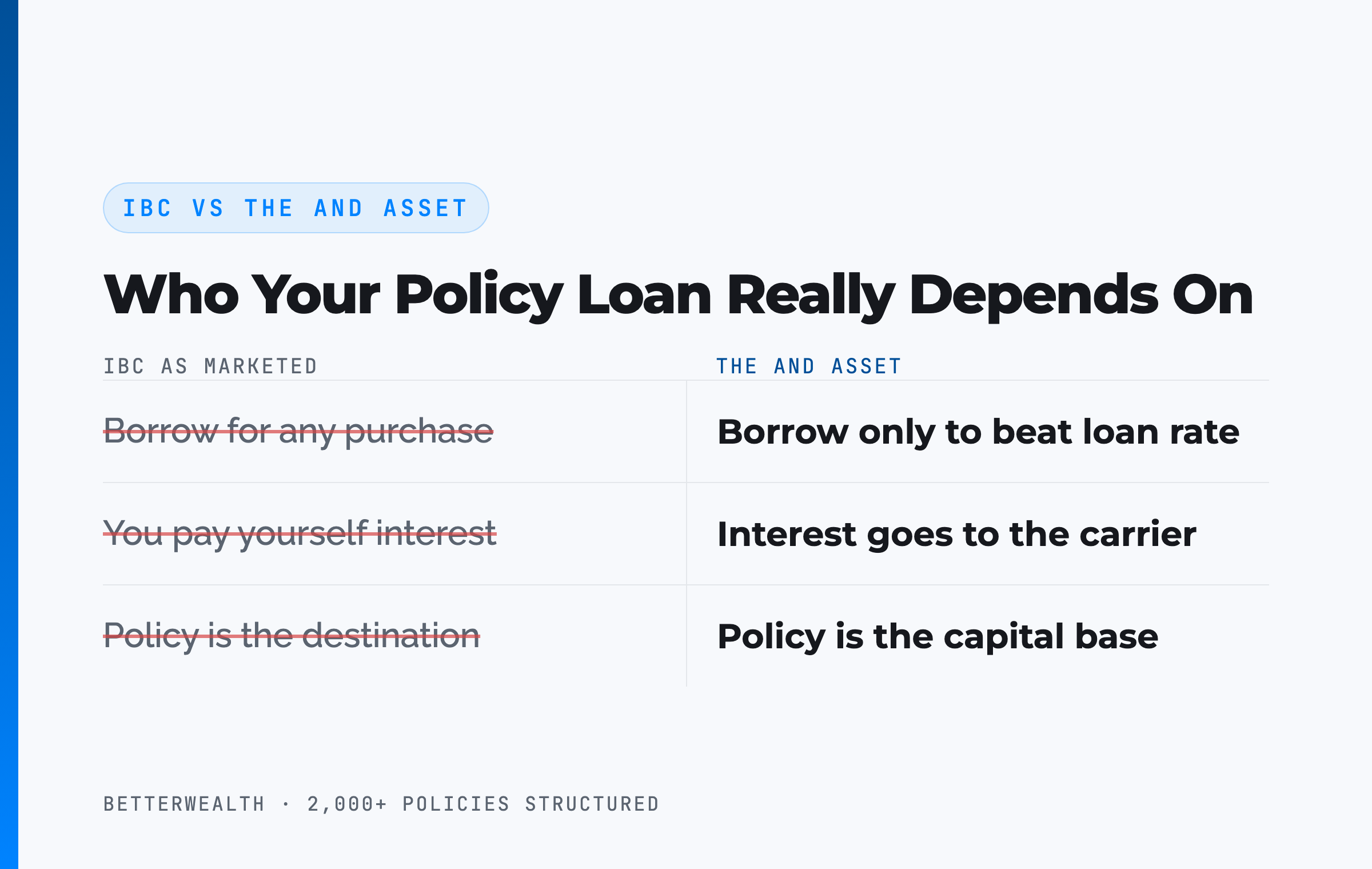
The And Asset says the carrier's balance sheet is part of the math, because the carrier is both the custodian of your capital base and the lender you borrow from. That follows directly from how the framework treats policy loans.
Nelson Nash pioneered the idea of using dividend-paying whole life insurance as a personal banking system in Becoming Your Own Banker. His core insight still holds: you either lose money paying interest to outside lenders, or you lose it to the opportunity cost of idle capital. The And Asset shares roots with IBC but operates on different principles.
Where IBC Ends and The And Asset Begins
IBC says you can use the policy as a personal bank for any purchase. The And Asset says you only deploy capital when the borrowed dollars out-earn the carrier's loan cost, because anything less is an expensive way to spend money. Many IBC marketers also say you are paying yourself interest. You are not. The interest goes to the carrier.
Follow that correction one step further. If the interest goes to the carrier, the carrier is your bank in the literal sense, and you are depending on it twice: once to keep the policy compounding net of mortality and expense charges, and once to honor the loan provisions in your contract. IBC content tends to frame whole life as the destination. The And Asset frames the policy as the capital base, and a capital base held by a company that hides its liabilities is a weaker base than the illustration suggests.
You are choosing a lender. Read its books.
03 / Case OneWhat Happened When Ohio National Started Acting Like a Stock Company?
Ohio National operated as a policyholder-owned mutual holding company that began using captive reinsurers and offshore reinsurance, then demutualized and sold to a Canadian pension-backed group. Agents and advisors had good experiences with the company for many years. It invested traditionally and existed for its policyholders.
Gober noticed the change roughly three years before the sale became public. The company formed several captive reinsurance companies in Ohio, then began moving business offshore. The trigger, in his reading, was a block of annuity products whose liabilities were volatile and could outgrow the assets backing them. Moving those liabilities into captives made reported surplus look better at the moment the company needed it to. It did not make the company stronger.
His question at the time was simple. Why would a mutual that intends to stay a mutual start behaving like a stock company, or worse, like a private-equity-controlled one? His answer: it probably would not stay a mutual. That is what happened. Captives already approved by the home state also made the company more attractive to a buyer who wanted to keep using them.
What I Saw From the Inside
Ohio National was one of the first carriers I wrote business with. The executives told us, up to the day of the sale, that they were not considering demutualization. When the company publicly ended trail commission payments to broker-dealers on certain variable annuities, I stopped selling its permanent products. When the demutualization news broke, I contacted every client we had placed there.
Most of those clients moved their policies to other carriers through Section 1035 exchanges. They could do it because we design for high early cash value, so there was real value to move. Clients elsewhere in the market who held thin early cash value designs, built around long-term dividend projections, had far fewer options. After the sale, the dividends I saw on those policies were, as I put it at the time, practically zero, and I know of nothing about the service that improved. Advisors who would not tell clients to stay were terminated and lost their renewals. I was one of them: the carrier terminated me because I would not tell my clients to stay.
Design is your exit. Cash value is the door.
Going from a mutual to a for-profit is never good for the policyholders.
Tom Gober04 / Case TwoHow Did PHL Variable Hide a Hole Until It Was Too Late?
PHL Variable hid its hole by moving growing liabilities into Connecticut captives and booking contingent contracts as real assets, with the regulator's permission. PHL Variable Insurance Company was a Connecticut insurer whose business came largely from the Phoenix Life lineage. It sat inside a group controlled by the private equity firm Golden Gate Capital, which also owned Nassau Life and Annuity.
PHL had sold a large volume of annuities with riders that let buyers lock in a guaranteed rate. If a contract owner locked in 6% and market rates fell to 3%, the company still owed 6%. Sell billions of dollars of that, and hedging and reserving become a serious problem. As the liabilities grew faster than the assets, the group moved PHL out from under Nassau, still inside the same holding company system, so a failure would not drain the other insurers directly.
Rather than requiring the owner to fill the hole, the Connecticut commissioner allowed PHL to form captives and let those captives count excess of loss contracts as admitted assets. According to Tom Gober, when the regulator later asked Golden Gate to add capital, it declined. PHL was placed in receivership, and the rehabilitator became the first outsider to see inside the captives.
What an XOL Asset Is, and Why It Is Not an Asset
An excess of loss (XOL) contract pays only if losses exceed a set threshold. In property and casualty insurance, it is a legitimate tool. A carrier writing earthquake coverage in Los Angeles might keep the first $7 billion of losses and buy XOL protection above that, paying a small premium because the event may never occur. Because it may never pay, the P&C insurer does not count it as an asset on its balance sheet.
Booking an XOL contract as an admitted asset in a life insurance captive treats a possible future payment as money already in hand. Gober compares it to a lottery ticket. Before the drawing, the ticket is worth what you paid for it. After the drawing, if it wins, it is an asset. Letters of credit, parental guarantees, contingent notes, and credit linked notes share the same flaw. They are worth something only if certain events occur.
The rehabilitator's own finding settled the question. The Connecticut Insurance Department discontinued the permitted practices granted before rehabilitation, and discontinuing the XOL asset treatment increased the companies' surplus deficiency by a material amount. Gober also points to a Conning report describing the XOL issue as widespread, and to a Society of Actuaries list of excluded assets that includes excess of loss reinsurance.
If it only pays later, it is not money now.
What a Permitted Practice Is
A permitted practice is a regulator's approval for one insurer to do something statutory accounting rules otherwise prohibit. Statutory accounting does not allow an XOL contract to be booked as an asset. A permitted practice let PHL's captives do it anyway. Because some states grant these exceptions and others refuse, two insurers with identical economics can report very different surplus. Permitted practices must be disclosed in the notes to the statutory financial statements, which makes them one of the few red flags an outside reader can find.
If a hole forms where no one can see it, it gets bigger, and nobody knows it is getting bigger until a regulator finally opens the box.
Tom Gober, paraphrasedThe And Asset Fits a Specific Person Doing Specific Things.
It Fits You If
- You already deploy capital into business, real estate, or acquisitions
- You can name a use for borrowed dollars that beats the loan cost
- You want a carrier you can verify, not one you have to trust
- You plan to hold and fund the policy for 10+ years
It Does Not Fit You If
- You want the highest illustrated number regardless of who backs it
- You are looking for a savings account alternative
- You are carrying high-interest debt and need a quick fix
- You cannot identify a productive use for borrowed capital
If you are in the first column, a 30-minute conversation will tell you whether a policy belongs in your plan and which carriers we would and would not use. If you are in the second, we will tell you that too.
Book a Discovery Call05 / The BackstopWhat Happens to Your Policy If Your Insurer Fails?
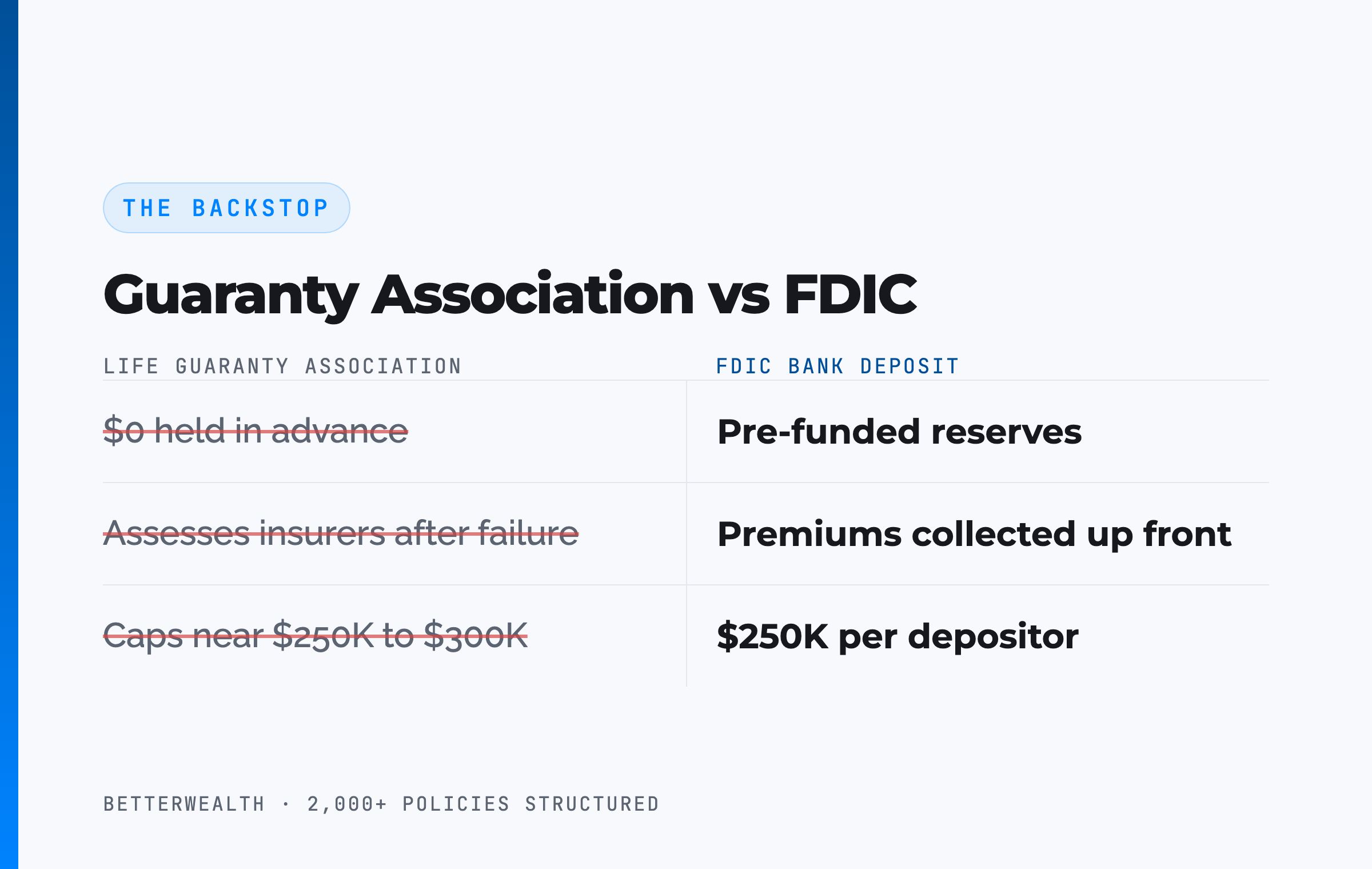
If your insurer fails, your state's life and health guaranty association covers claims up to a statutory cap, and anything above that cap is exposed. Gober notes that caps commonly sit around $300,000 in some states and $250,000 in others, with higher limits on certain products in a few. The limits differ by state and by benefit type, including cash value, so you have to look up your own state's rules.
The structure is the bigger issue. The FDIC and the Pension Benefit Guaranty Corporation collect premiums in advance and hold reserves. Life guaranty associations do not. After a failure, they assess the healthy insurers in the state, including well-run mutuals like New York Life, based on market share. Statutes cap how much they can assess each year, so filling a large hole takes years.
Put those two facts together. Take a policy with $500,000 of value in a state whose cap is $300,000. About $200,000 sits above the cap and is exposed if the insurer fails. The covered $300,000 can take years to arrive, because the association has to assess the healthy insurers first. For a policy you planned to borrow against, a frozen or delayed claim also stops your access to capital.
Gober raises the same concern for pension risk transfer, where a corporation hands its pension obligations to an insurer that issues a group annuity. Many of the carriers taking on those blocks use offshore reinsurance heavily. If you hold a pension that has been transferred, the identity and practices of the insurer now matter to your retirement income.
06 / How ToHow to Vet a Life Insurance Company Before You Fund a Policy
Vetting a life insurance company takes six checks, run in order, before any money moves. This is the process we use when we narrow carriers for a client, built on the patterns Gober has documented.
- Identify the named insurer. Find the company at the top of the contract. That standalone insurer is your only counterparty. A holding company brand or a large parent is not on the hook for your policy.
- Confirm who owns it. Is it a mutual, a mutual holding company, a publicly traded stock company, or controlled by private equity? Has ownership changed in the last few years? Ownership decides who the company serves first.
- Read the ratings as a floor. Check AM Best and the COMDEX composite. A strong rating is a minimum requirement, not a verdict, because ratings rely on the surplus the company reports.
- Read the notes to the statutory statement. Look for captive reinsurance, offshore reinsurance, heavy affiliated investments, intercompany and short-term borrowing, and any permitted practices.
- Flag contingent assets. Letters of credit, parental guarantees, contingent notes, credit linked notes, and XOL contracts counted as assets are warning signs. They only have value if a future event occurs.
- Size against guaranty limits and design an exit. Compare your policy size to your state's guaranty caps, design for high early cash value so a Section 1035 exchange stays possible, and re-check the carrier every year.
Gober's firm, Deep Dive Analytics, now extracts this data from statutory filings digitally, so advisors can see a carrier's offshore reinsurance, captive use, and affiliated investments in one report. He also suggests a test anyone can run: call the regulator in the state where a captive is domiciled, explain that the captive has assumed your business, and ask for its balance sheet. Expect a no. The refusal is the point.
07 / The MathDoes the Deployed Capital Still Clear the Loan Rate If the Carrier Weakens?
The And Asset math only works if both returns hold: the deployed capital has to beat the carrier's loan cost, and the policy has to keep compounding net of mortality and expense charges. A weakening carrier attacks the second half of that equation first.
Policy loan rates vary by carrier and rate environment. At the time of writing, many carriers fall in the 5 to 6% range, but treat any number as a variable to verify, not a constant. If your rental property, business expansion, or acquisition returns more than that loan cost, the spread is yours. If it returns less, do not borrow.
Now add carrier risk. After Ohio National's sale, dividends on the client policies I watched fell sharply, as Section 03 describes. A policy whose dividends fall to a token amount is still collateral for your loan, but the second job your dollar was supposed to do has stopped. The deployment can still clear the loan rate while the overall strategy underperforms what you were shown.
Gober framed the trade in one line: if you are a policyholder who thinks you might earn an extra 1% by taking on risk, that is your call. Most policyholders are not choosing that trade. They do not know they are in it.
Two returns. Both depend on one balance sheet.
The Frameworks Behind 2,000+ Policies, in One Place.
The Life Insurance Vault holds the calculators, design frameworks, and carrier comparison material we use when we narrow carriers for a client. Free, email-gated, no spam.
Open the Vault08 / The MistakesWhere Do Buyers and Agents Get Carrier Selection Wrong?
Buyers and agents get carrier selection wrong by choosing on the illustrated number and treating the rating as proof of safety. Three mistakes show up again and again.
The first is chasing the highest illustration. Products that look too good often are. PHL's rate-lock riders were easy to sell because an agent could describe them in one sentence, and that is exactly why the company sold more than it could stand behind. The second is trusting the brand over the contract. A famous parent company is not your counterparty. The third is ignoring how the company reports. The better mutuals, in Gober's words, know there is no sense in monkeying with the numbers. They just present them.
Marketers have ruined the way this strategy should be explained, and carrier selection is part of that. An agent who leads with a dividend rate and never mentions ownership, reinsurance, or guaranty limits is selling a number. The strategy goes unexplained.
09 / The TradeoffsBenefits and Real Tradeoffs of Staying With Mutual Carriers
Staying with well-run mutual carriers lowers counterparty risk, but it narrows your product menu and does not remove the need to check. A mutual is owned by its policyholders and returns profits as dividends, which is why New York Life, by Gober's account, could find no way demutualization would help its policyholders.
The tradeoffs are real. Mutuals do not always show the highest illustrated numbers in the first years. Some mutual holding companies, such as Lafayette Life, OneAmerica, and Pan-American Life, operate stock insurers owned by policyholders through a holding company, so the structure is worth understanding rather than assuming. Ohio National itself was a mutual until it was not, which is why ownership is a starting point and the filings are the test. Many stock insurers are also well run. The structure tells you who gets served first, not whether a specific company is sound.
Mutuals also differ widely from one another. Early cash value, paid-up additions flexibility, loan recognition, and long-term performance vary by carrier. Our carrier comparison, for example, shows Penn Mutual as a direct recognition carrier whose early cash value runs 7 to 12% lower than some competitors in years one to five, with long-term performance 8 to 21% stronger, while Guardian and Lafayette Life reach 85 to 94% of premium as year-one cash value on front-load designs. The right carrier among sound mutuals is a design question.
10 / Head to HeadMutual vs Stock vs Private Equity Insurers vs a Bank Deposit
A mutual insurer, a stock insurer, a private-equity-controlled insurer, and an FDIC-insured bank deposit differ most in who they serve first, how transparent they are, and what backs you if they fail.
| Dimension | Mutual Insurer | Stock Insurer | Private-Equity-Controlled Insurer | Bank Deposit |
|---|---|---|---|---|
| Serves First | Policyholders, who own the company | Shareholders, then policyholders | Investors, often with a planned exit | Depositors and shareholders |
| Where Profits Go | Dividends to policy owners ($300M to $2.9B distributed for 2026 across the mutuals in our carrier files, per each carrier's declared figure) | Shareholder earnings and buybacks | Owner returns, often moved within the group | Shareholders; depositors earn a set rate |
| Reinsurance Visibility | Generally limited captive and offshore use; check the filings | Varies widely by company | Heavy captive, offshore, and affiliated activity in the cases Gober has studied | Not applicable |
| Backstop If It Fails | State guaranty association, commonly capped around $250,000 to $300,000, assessed after failure | Same guaranty association caps | Same guaranty association caps | FDIC, $250,000 per depositor, per bank, per ownership category, pre-funded |
Serves first. Ownership sets incentives. A mutual has no outside shareholders to satisfy, while a private-equity owner typically plans to sell or restructure, which is the pattern Gober saw in the run-up to both cases above.
Where profits go. A mutual's surplus returns to policy owners as dividends, which is the engine of uninterrupted compounding in a whole life policy. In a stock or private-equity structure, the same dollar competes with shareholder returns, and in the cases Gober examined, captives were used to move money to other entities in the group.
Reinsurance visibility. You cannot evaluate what you cannot see. A carrier with minimal captive and offshore activity lets you read its real condition from public filings. One that relies on them asks you to trust numbers nobody outside can check.
Backstop. Every insurer shares the same guaranty association limits, which is why the backstop is not a reason to accept a weaker carrier. Unlike the FDIC, the associations hold no reserves in advance, so a large failure is paid slowly and only up to the cap.
A Composite: The Real Estate Investor Who Vetted the Carrier First
Consider a 44-year-old real estate investor with six rentals, preferred non-tobacco, funding $60,000 a year into a mutual carrier's whole life policy designed for high early cash value. The base/PUA split is 30/70: $18,000 of base premium and $42,000 into the paid-up additions rider. This is a representative composite, not a single named client.
Before funding, the carrier passed all six checks: policyholder-owned, rated A+ or better, no permitted practices in its statutory notes, limited captive and offshore reinsurance, and no contingent assets above a small fraction of surplus. Two carriers with higher illustrations were removed at step four.
Cash value trails contributions through year four, sitting at $233,900 against $240,000 paid in. At year five, it crosses: $304,300 against $300,000. In year six, with about $373,400 of cash value against $360,000 contributed, the investor borrows $143,500 against the policy for the down payment and rehab on a four-unit property.
At an illustrative 5.75% loan rate, annual loan interest is $8,251. The property produces $14,370 a year in net cash flow after its mortgage, so rent covers the loan interest with $6,119 to spare. That $14,370 is a 10.0% cash flow return on the $143,500 deployed, before any property appreciation and before vacancy or repair risk, so the gap over the loan cost is a projection, not a guaranteed spread. The projected IRR over a seven-year hold is 12.7%. At month 43, a cash-out refinance after the rehab returns $121,574, and 43 months of surplus cash flow ($6,119 a year, or $21,926) covers the remaining $21,926. The policy loan is repaid in full while the policy kept compounding net of mortality and expense charges the entire time.
The carrier work shows up in the downside. If that carrier ever announced a demutualization or began shifting liabilities offshore, the policy holds more cash value than premium paid, and with the loan repaid, a Section 1035 exchange is a decision rather than a loss.
One dollar. Two jobs. One balance sheet you checked.
An Honest 30 Minutes About Your Policy and Your Carrier.
We have structured 2,000+ policies. We have seen this strategy work exactly as designed, and we have seen carriers change underneath clients. On a discovery call, we look at your situation, or the policy you already own, and tell you honestly whether The And Asset fits and which carriers we would trust with it. No pressure, no pitch. If you would rather learn first, the The And Asset and BetterWealth YouTube channels go deep on the math.
Book a Discovery CallFAQLife Insurance Company Financial Strength Questions
How do you know if a life insurance company is financially strong?
Start with ownership and reporting, then ratings. Check whether the insurer is a mutual or controlled by private equity, read its AM Best rating, and look in its statutory filings for captive reinsurance, offshore reinsurance, affiliated investments, and permitted practices. A clean rating sitting on top of a growing web of secret affiliates is a warning sign. Treat it as one.
What is a captive reinsurance company?
A captive reinsurer is an affiliate, often a subsidiary of the insurer itself, that takes on part of the insurer's liabilities. Its financial statements are generally not public, so policyholders cannot see whether the assets backing those liabilities are real. Tom Gober argues this is how hidden holes form inside life insurance groups.
What is an XOL asset in life insurance?
XOL stands for excess of loss reinsurance, a contract that only pays if losses pass a set threshold. It is a legitimate tool in property and casualty insurance, but booking it as an admitted asset inside a life insurance captive counts a contingent payment as money already in hand. In the PHL Variable rehabilitation, discontinuing that treatment increased the companies' surplus deficiency by a material amount.
What is a permitted practice in insurance accounting?
A permitted practice is a regulator's approval for one insurer to depart from standard statutory accounting rules. Because some states grant them and others do not, two insurers with the same economics can report different surplus. Permitted practices are disclosed in the notes to an insurer's statutory financial statements, so they are one of the few red flags a reader can actually find.
What happened to Ohio National Life?
Ohio National operated as a policyholder-owned mutual holding company that formed captive reinsurers and moved business offshore, then demutualized and was acquired by a group backed by Canadian pension money. Policyholders received demutualization compensation, but we saw dividends and service decline afterward. Clients in high early cash value designs were able to move their policies to other carriers through Section 1035 exchanges.
What happened to PHL Variable Insurance Company?
PHL Variable, a Connecticut insurer in a group controlled by the private equity firm Golden Gate Capital, sold annuities with guaranteed rate riders whose liabilities grew faster than its assets. It formed captives that booked XOL contracts as assets, per Tom Gober the owner declined to add capital when the regulator asked, and the company was placed in receivership under a court-appointed rehabilitator. Gober says civil litigation is pending.
Are mutual life insurance companies safer than stock companies?
Not automatically, but a mutual's incentives line up with policyholders because policyholders own it and receive its profits as dividends. A stock or private-equity-controlled insurer answers to investors first. By Tom Gober's account, New York Life spent more than a year and more than $1 million studying demutualization and found no way it would help policyholders.
What does a state guaranty association cover if my insurer fails?
A state guaranty association pays covered claims up to a statutory cap, commonly in the $250,000 to $300,000 range for many benefits, with limits that vary by state and product. Unlike the FDIC, guaranty associations are not pre-funded. They assess healthy insurers after a failure, annual assessment limits apply, and receiving what you are owed can take years.
What is The And Asset?
The And Asset is BetterWealth's framework for using a properly structured whole life policy as a capital base. You only borrow against it for an activity that produces a return greater than the carrier's loan cost, so your dollars do two jobs at once: the policy keeps compounding net of mortality and expense charges while the deployed capital earns its own return.
How is The And Asset different from infinite banking?
Infinite banking, as Nelson Nash taught it in Becoming Your Own Banker, frames a whole life policy as a personal banking system for any purchase. The And Asset shares those roots but operates on different principles: you only deploy borrowed capital when the return clears the carrier's loan cost, and because the loan interest goes to the carrier, the carrier's balance sheet is part of the decision.
Does carrier choice matter for infinite banking?
Among well-run mutual carriers, policy design and your discipline matter more than the logo on the contract. Outside that group, carrier quality decides whether the promise holds. A policy is a long-term promise from one named insurer, so ownership, reinsurance practices, and reporting transparency carry as much weight as the illustrated dividend.
Can I move my whole life policy if my insurer's finances deteriorate?
Yes, a Section 1035 exchange lets you move cash value from one life insurance policy to another without current income tax on the gain, but the exit only works if there is cash value to move. Policies designed for high early cash value keep that option open. A new policy carries new costs, and an outstanding loan complicates the exchange, so confirm the details with a tax advisor first.
- Nelson Nash, Becoming Your Own Banker: the origin of the infinite banking concept.
- Deep Dive Analytics (Tom Gober): research on captive reinsurance, offshore reinsurance, and affiliated investments at life insurers.
- NOLHGA: the national organization of state life and health guaranty associations, with state-by-state coverage information.
- NAIC: statutory accounting principles and insurer financial statement resources.
- Society of Actuaries: actuarial research and guidance on asset adequacy.
- IRC Section 1035 (Cornell Law): the provision governing tax-free exchanges of life insurance policies.
- IRC Section 7702 (Cornell Law): the definition of life insurance for federal tax purposes.
- FDIC Deposit Insurance: how pre-funded bank deposit coverage works, for comparison.
- AM Best: insurer financial strength ratings.
- BetterWealth resources: The And Asset book, the The And Asset YouTube channel, and the BetterWealth YouTube channel.
Studies the statutory filings of life insurers for captive reinsurance, offshore reinsurance, contingent assets, and affiliated investments, and flagged the warning signs at Ohio National and PHL Variable before they became public. deepdiveanalytics.biz →
I founded BetterWealth to treat life insurance as the capital tool it is, not the product most people get sold. Our team has structured more than 2,000 policies across all 50 states. I wrote The And Asset and host the BetterWealth and The And Asset YouTube channels. If you want an honest read on your policy or the carrier behind it, book a discovery call. We will tell you if it does not fit.