
Lafayette Life's long-term growth lags the top-performing carriers, and its variable loan rate can run above the dividend. What it does well is early access: non-direct-recognition whole life with strong first-year cash value, flexible paid-up additions in the first seven years, and IBC-aware underwriting. It fits an early-liquidity and flexibility priority more than a maximum-growth one.
Pros
- Strong early cash value: 82 to 91% in year one on a cashflow design, up to 93% on a front-load
- Strong PUA flexibility for the first 7 years (fund anywhere between the minimum and maximum)
- Non-direct recognition keeps the full dividend paying regardless of any loan
- Western & Southern financial backing, 119 years of dividends, COMDEX 95, AM Best A+
- IBC-aware underwriting that understands overfunded, loan-driven designs
Cons
- Long-term IRR (roughly 3.2 to 4.4%) trails the strongest growth carriers
- Variable loan rate can run above the dividend in a higher-rate environment
- Conservative underwriting with ECG requirements triggered more often than peers
- Customer service and underwriting strained by rapid recent growth; illustration software is dated and clunky
- PUA backfill capped at $25,000; several competitors offer more
- Large policies (over $500,000 per year) hard to approve, with a $5 million contract PUA cap; not available in New York
Choosing an insurance carrier for a multi-decade capital strategy is the wrong place to start, and it is exactly where most people start. They compare dividend rates the way shoppers compare APYs, pick the highest number, and assume they have made the right call. The dividend rate is one input. It says almost nothing about whether a policy will function as a capital base for the next thirty years.
The carrier matters far less than the design of the policy and your discipline in funding it. Lafayette Life is a strong carrier. It is also frequently reduced to a single headline, its early cash value, while the parts that actually shape a thirty-year experience get skipped: how loans behave under non-direct recognition, how the paid-up additions rider tightens after year seven, and how conservative the underwriting runs.
At BetterWealth, we have structured more than 2,000 policies across all 50 states, and Lafayette Life shows up regularly on the short list for the right client. This review covers what the company actually is, how its Patriot Whole Life product behaves under both a cashflow and a front-load design, the math that decides whether borrowing against it makes sense, and the honest tradeoffs nobody puts in a sales deck. We will also tell you who Lafayette Life is not for.
- Lafayette Life is a non-direct recognition carrier with a variable loan rate, so the dividend stays the same whether or not you borrow.
- Its strength is early cash value: 82 to 91% of premium accessible in year one on a cashflow design.
- Its long-term internal rate of return runs roughly 3.2 to 4.4%, behind the strongest growth carriers.
- The And Asset rule still governs: only borrow when the deployed return clears Lafayette Life's loan cost.
- Lafayette Life sells in 49 states and Washington DC, but not in New York.
- Paid-up additions are flexible for seven years, then capped at the average of what you funded in that window.
If you want to see the actual policy illustrations behind these numbers, Alden walks through both the cashflow and front-load designs on screen, including the year-by-year cash value and the PUA flexibility window:
01 / The problemWhat carrier choice actually solves (and what it doesn't)
Carrier choice solves for a handful of structural questions, not for the headline dividend rate. The real questions are whether the company will still be paying dividends in forty years, whether its policy loan mechanics support how you plan to use capital, and whether its product can be designed to push cash value to the limit without tipping into a Modified Endowment Contract.
Lafayette Life answers the first question convincingly. A company founded in 1905, paying dividends for 119 years, now backed by the size of Western & Southern, is not a stability risk. As Alden put it, insurance companies that have been winning for 120 years in a row do not tend to lose. The harder questions are about loan mechanics and design, which is where this review spends most of its time.
"The product and its design and your understanding of that product matter most. The carrier choice, when you are dealing with top-tier carriers, is secondary.", Alden Armstrong
02 / The frameworkWhat does it mean to run infinite banking with Lafayette Life?
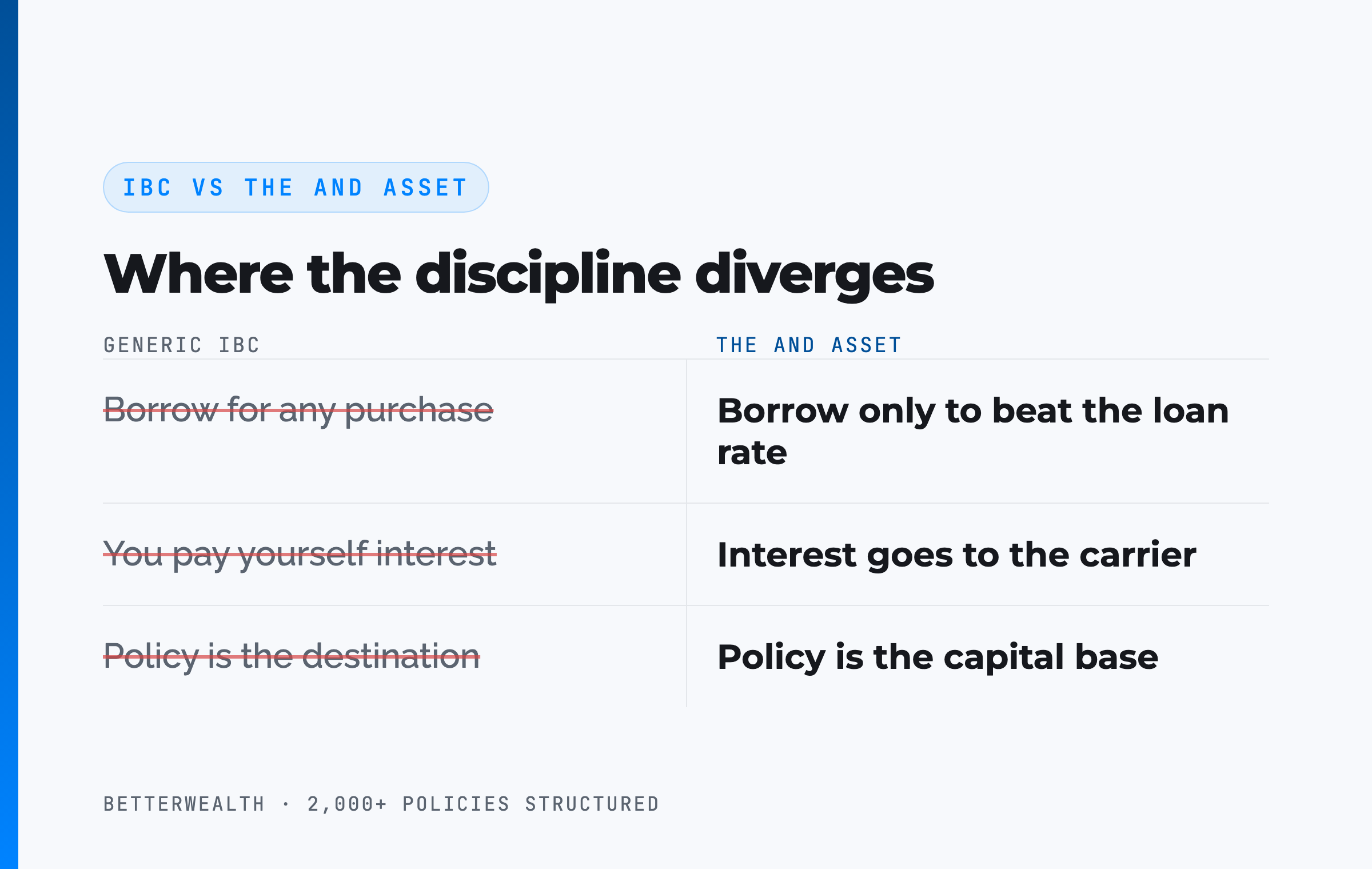
Running infinite banking with Lafayette Life means using a properly structured Patriot Whole Life policy as a capital base you borrow against, while the policy keeps compounding on its full value. That is the mechanical definition. The discipline layered on top of it is what we call The And Asset.
Nelson Nash pioneered the idea of using whole life insurance as a personal banking system in Becoming Your Own Banker. His insight holds: you either lose money paying interest to outside lenders, or you lose money to the opportunity cost of capital sitting idle. We respect that foundation. The And Asset builds on it with one rule Nash's broader teaching does not enforce.
Where IBC ends and The And Asset begins
IBC says you can use a whole life policy as a personal banking system for any purchase. The And Asset says you only deploy capital from the policy when the borrowed dollars will produce a return greater than the carrier's loan cost. Anything less is an expensive way to spend money. Many IBC marketers say you are paying yourself interest. You are not. The interest goes to Lafayette Life. Your return is what the deployed capital earns elsewhere while the policy compounds uninterrupted.
That distinction has real teeth at Lafayette Life, because this is a non-direct recognition carrier with a variable loan rate. In a higher-rate environment that rate can sit above the 5.9% dividend. The full dividend keeps paying on your cash value either way, but if you borrow at a rate above the dividend to chase something earning less, you have lost money slowly. The discipline is the whole point.
If the spread does not work, you do not borrow.
Marketers have ruined how this strategy gets explained. You are not paying yourself interest. You are paying the insurance company, and your return comes from what you deploy into.
03 / Financial strengthWhy does Lafayette Life's stability matter for a 30-year strategy?
Lafayette Life's stability matters because The And Asset only works over a long horizon, and a long horizon exposes you to the carrier's staying power. A company that pays dividends generously this year but cannot fund the next thirty will not perform the same way in year 25.
Two metrics tell the real story. The first is the dividend: roughly $123.3 million declared at a projected 5.9% rate, with a steady climb over time as the company grows its market share. The dividend rate is gross. Your cash value does not grow at 5.9%. It grows at the dividend net of mortality and expense charges, which is the figure that actually compounds inside the policy. Any agent quoting the gross rate as your growth rate is either careless or selling.
The second metric is the lapse ratio, and almost nobody talks about it. Lafayette Life sits at 5.0% from 2020 to 2025, right at the 5.1% industry average. It is average, not a standout, and a book full of IBC practitioners taking loans tends to see more activity than a typical carrier. Read it as middle of the pack.
One quirk worth knowing. Lafayette Life has paid more than one dividend interest rate in the same year, segmented by when the policy was issued. In 2024 those rates ranged from 5.3% to 5.75%. It is unusual, and for some policyholders it is mildly frustrating, but it does not change the long-game case for working with a financially solid carrier.
04 / How it worksHow a Lafayette Life policy actually functions as an And Asset
A Lafayette Life policy functions as an And Asset through five mechanical steps, and the order matters. The product is Patriot Whole Life, designed for maximum cash value rather than maximum death benefit. Here is the sequence we use when we structure one.
- Structure for cash value. Minimize the base premium and load the paid-up additions rider, using a term rider for the early years to create room to overfund up to the IRS limit. The PUA rider is the engine. Without it, this is an expensive death benefit. The base/PUA split is the single design decision that determines early cash value.
- Fund consistently. Choose a cashflow design (the same premium every year) or a front-load design (more in year one, then level). The optimal funding window runs from about seven years to when the term rider falls off, up to roughly 30 years. After the term drops off, overfunding becomes less efficient.
- Let the early years capitalize. First-year cash value on a cashflow design lands in the 82 to 91% range. It climbs from there. Do not expect to break even on day one. You will not, and any illustration that shows it is fiction.
- Borrow against the policy. About 30 days after initial funding, you can take a policy loan collateralized by your cash value. Because Lafayette Life is non-direct recognition, your full dividend keeps paying whether or not the loan is outstanding.
- Deploy and repay. Put the borrowed capital into an activity that beats Lafayette Life's variable loan cost, then repay from the cash flow that activity throws off. The policy compounds on its full value the entire time.
On a well-designed Patriot cashflow policy, the capitalization point, where a dollar of premium adds more than a dollar of cash value, arrives early thanks to Lafayette Life's strong front-end design. Break-even, where total cash value catches total contributions, typically lands around year four to five for a healthy individual, with Lafayette Life's early-cash-value strength pulling it toward the earlier end. No honest illustration shows break-even in year one or two.
Cashflow design versus front-load design
The two designs solve for different funding personalities. A cashflow design keeps the premium level, year after year, and produces a long-term IRR around 3.6 to 4.4% on current dividend projections, with first-year cash value in the 82 to 91% range. A front-load design front-ends a larger premium in year one, then drops to a level amount. It buys more death benefit to stay under the MEC limit, which adds internal cost, so the long-term IRR runs slightly lower at roughly 3.2 to 4.3%, with first-year cash value pushed up toward 85 to 93%.
Front-loading puts more money to work sooner. As Nash framed it, the strategy is not only about rates, it is about volume. More dollars compounding earlier can mean more cash value and a larger death benefit long term, even when the percentage IRR is a touch lower. You trade a little long-term efficiency for more capital working sooner. Neither is "better." They fit different people.
Pick the design that matches how your income actually arrives.
Lafayette Life fits a specific person doing specific things.
It fits you if
- You want strong early cash value and funding flexibility
- Your income fluctuates (commission-heavy or business owner)
- You can name a use for capital that beats the loan cost
- You value a long-standing, financially strong carrier
It does not fit you if
- You need to fund a very large policy each year
- You live in New York
- You want a savings account, not a capital strategy
- You cannot identify a productive use for borrowed dollars
If you are in the first column, a 30-minute conversation will tell you whether Lafayette Life or another carrier fits your design. If you are in the second, we will point you somewhere that fits better.
Book a Discovery Call05 / The mathDoes the return clear Lafayette Life's loan cost?
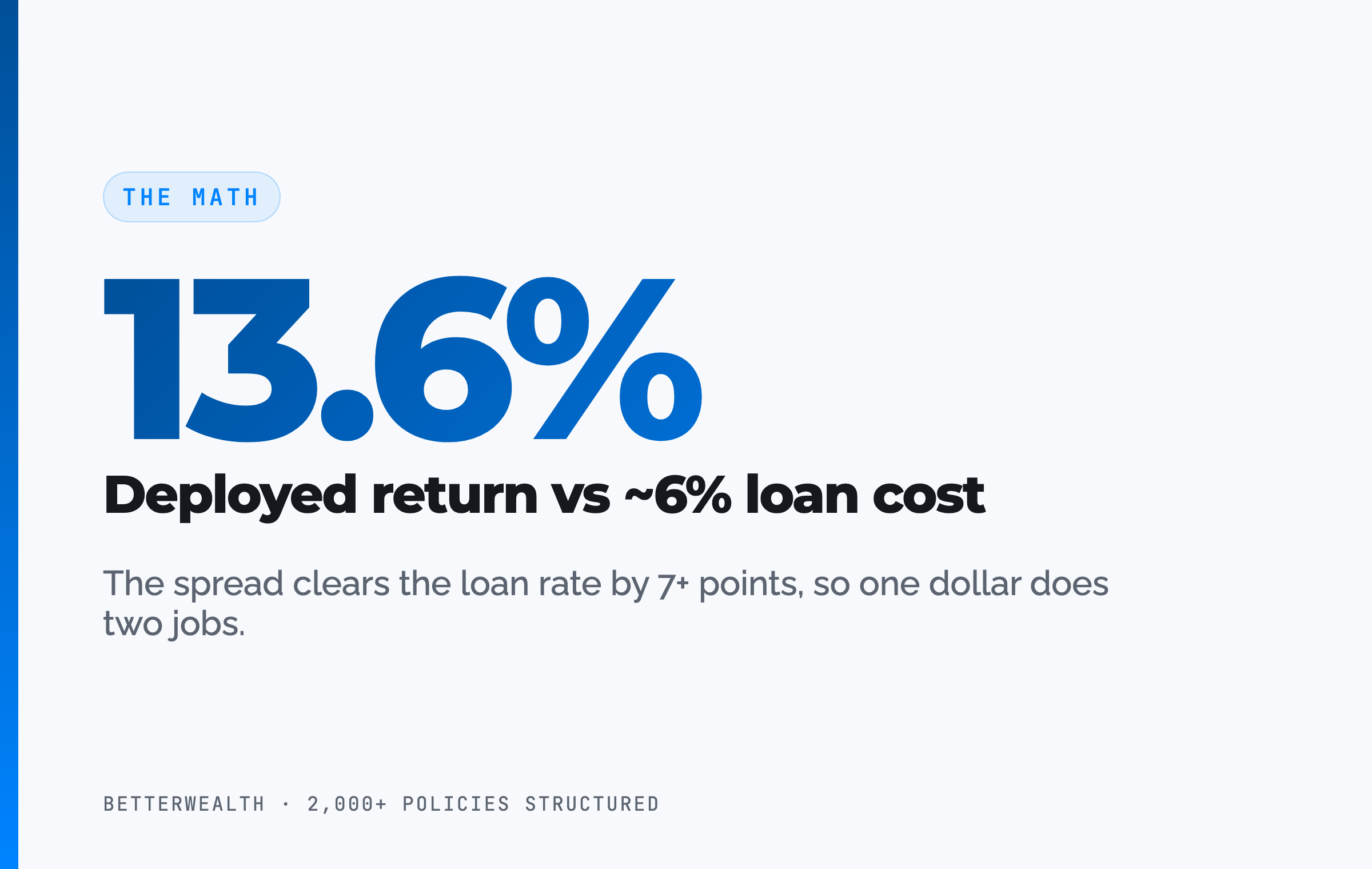
The return on whatever you deploy must exceed Lafayette Life's loan cost, or you should not borrow. This is the entire test. Lafayette Life uses a variable loan rate, so it moves with the rate environment outside the carrier and changes from year to year. Treat the current loan rate as a number to verify with the carrier before you borrow, not a constant.
Here is the structure of the decision. You borrow at the carrier's loan rate. Your policy keeps compounding on its full cash value, and because Lafayette Life is non-direct recognition, your dividend does not change because of the loan. Your deployed capital earns its own return. If that return is higher than the loan cost, you are ahead on the spread, and the policy has done two jobs with one dollar. If it is lower, you have borrowed money to lose money slowly.
If the deal does not clear the loan rate, do not borrow.
06 / RecognitionWhat does non-direct recognition mean here?
Non-direct recognition means your borrowing activity has no effect on the dividend Lafayette Life pays you. You receive the full declared dividend on your full cash value regardless of how much you have borrowed or what interest rate you are paying. That is the defining mechanical feature of how loans work at this carrier.
The benefit is simplicity. With non-direct recognition there is no spread calculation to track between your loan rate and a separately adjusted dividend, so the policy is easier to understand and explain. The catch is that the loan rate and the dividend move independently. When the variable loan rate sits above the dividend, which can happen in a higher-rate environment, the cost of borrowing is real and unrelated to what your cash value is earning.
Non-direct versus direct recognition, without the dogma
Non-direct recognition gets sold as the superior choice for infinite banking. It is not automatically better or worse. It is a different set of tradeoffs. A direct recognition carrier adjusts the dividend on borrowed cash value up or down with the rate environment, which can help or hurt depending on the year. Lafayette Life's non-direct approach removes that variable and keeps the math clean. The honest answer is that recognition type matters less than policy design, funding discipline, and long-term performance. Do not pick a carrier on this feature alone.
Non-direct recognition is not a magic feature. It is cleaner to track, but it does not protect you from a loan rate that runs above your dividend. The deployed return is what has to clear the loan cost.
07 / Where it winsEarly cash value, PUA flexibility, and loan access
Lafayette Life's strongest features are early cash value, first-seven-year paid-up additions flexibility, and a clean loan process. These are the features that shape your experience for thirty years, long after the dividend comparison is forgotten.
Early cash value and the loan process
Lafayette Life produces a lot of early cash value because of how the Patriot product is structured, frequently 82 to 91% of premium accessible in year one on a cashflow design. Loans become available about 30 days after funding. Amounts up to $100,000 can be requested online or through your agent, and larger loans use a signed DocuSign loan form. Interest accrues daily rather than being charged up front, so each time you log into the portal you see exactly what you owe to the day. The transparency is a real convenience.
Paid-up additions flexibility
For the first seven policy years, Lafayette Life lets you fund anywhere between a minimum (about $120 per year to keep the rider active) and the maximum. Think of those as goalposts: you can play anywhere between them and still score. After year seven, the goalposts shrink. Your new maximum is set by the average of what you actually funded in those first seven years. Fund heavily early and you preserve the capacity to keep overfunding. Fund at half your maximum and your future ceiling drops to roughly that level. The rider also offers up to $25,000 of backfill, so a missed year can be partly made up the following year. If you are not funding your PUA over five-plus years, the carrier is not your problem. Your funding is.
The frameworks behind 2,000+ policies, in one place.
The And Asset Vault holds the calculators, design frameworks, and structuring decisions we use when we compare carriers like Lafayette Life, Penn Mutual, and Guardian. Free, email-gated, no spam.
Open the Vault08 / The tradeoffsBenefits and the honest tradeoffs
Lafayette Life's benefits come with tradeoffs that disqualify it for some buyers, and pretending otherwise is how agents lose trust. Here they are, plainly.
First, conservative underwriting. We have seen Lafayette Life issue a standard rating where another carrier offered preferred plus, and that gap is hard to explain to a client. The company also requires ECGs more often, and on smaller policies, than the industry norm. Second, customer service and underwriting speed have taken a hit from rapid growth over the last five years. Lafayette Life is transparent about it and working on it, but slower approvals are a current reality. Third, the agent-facing illustration software is dated and clunky. It can break when an agent runs several versions of the same policy and does not offer multiple plan views, which makes it harder to model a client's design side by side. Fourth, large policies are a challenge: cases over $500,000 of annual premium are difficult to approve, and the contract carries a $5 million PUA cap, so high-volume funders may hit a ceiling. Fifth, the PUA backfill is capped at $25,000, less than several competitors. Sixth, Lafayette Life cannot write business in New York.
One more thing buyers should know, because it cuts against the marketing. Lafayette Life pays its agents well. Between base compensation and production and persistency bonuses, it ranks at or near the top of its peer group on whole life payout. That does not make it a bad choice, but it is a reason you may hear the carrier recommended enthusiastically, so judge the policy design on its own merits.
Against those tradeoffs sits the reason it stays on our short list. Early cash value and first-seven-year flexibility are among the best available, and the underwriting team genuinely understands IBC-style designs.
Strong on early access, weaker on long-term growth. Know which one you are buying for.
Everything looks great on paper, and then underwriting comes back standard instead of preferred. That is the most common frustration with this carrier, and you deserve to know it going in.
09 / The fitWho is Lafayette Life right for, and who isn't it?
Lafayette Life is right for the entrepreneur or value creator who wants strong early cash value and funding flexibility, especially someone with fluctuating income, such as a commission-heavy salesperson or a business owner whose cash flow varies year to year. It fits the person who will fund consistently, who can use the first-seven-year PUA window well, and who can identify productive uses for borrowed capital. It is a frequent carrier of choice for that profile.
It is the wrong carrier for someone who needs to fund a very large policy each year, who lives in New York, or who is looking for a savings vehicle rather than a capital base. If you cannot name an activity that beats the loan cost, no carrier is right for you, and Lafayette Life will not change that.
10 / Head to headLafayette Life against other top IBC carriers
Compared to the other carriers entrepreneurs actually consider for infinite banking, Lafayette Life trades long-term growth for early access and first-seven-year flexibility. The table sets it against Penn Mutual and Guardian on the dimensions that matter for an And Asset policy. For the wider field, see our ranking of the best life insurance companies for infinite banking.
| Dimension | Lafayette Life | Penn Mutual | Guardian |
|---|---|---|---|
| Loan recognition | Non-direct, variable rate | Direct, 0.65% spread yrs 1 to 10, 0% yrs 11+ | Direct, fixed 5% for 10 years, then variable or fixed |
| Year 1 cash value | 82 to 91% cashflow, up to 93% front-load | 77 to 87% | 80 to 87% cashflow, 85 to 94% front-load |
| Long-term IRR | ~3.2 to 4.4% | ~4.2 to 5.3% (industry-leading) | ~3.5 to 4.5% |
| PUA flexibility | Strong for 7 years, then capped at the 7-year average; $25K backfill | Anytime payments, full catch-up, minimal restrictions | No backfill; flexible with Q-Term, limited without |
| New York | Not available | Not available | Available |
Early access. Lafayette Life leads this group on first-year cash value on a cashflow design, which is why it suits someone who wants capital working quickly. Guardian matches or edges it on aggressive front-loads, and Penn Mutual deliberately runs lower early to fund stronger long-term growth.
Long-term growth. Penn Mutual's internal rate of return runs ahead of both, roughly 4.2 to 5.3%, while Lafayette Life lands around 3.2 to 4.4% and Guardian in a similar 3.5 to 4.5% range. If a thirty-year growth rate is your top priority, Lafayette Life is not the leader, and we say so.
Loans and flexibility. Penn Mutual's direct recognition guarantees the spread between loan and dividend, which helps in the distribution years. Lafayette Life's non-direct approach is simpler to track but offers no such guarantee. On paid-up additions, Lafayette Life is strong for seven years and then tightens, while Penn Mutual stays flexible throughout.
A composite: the commission-heavy earner who deployed at year seven
Consider a 43-year-old business owner with variable income, preferred non-tobacco, funding a Lafayette Life Patriot Whole Life policy at $50,000 per year on a cashflow design, structured at roughly a 10/90 base-to-PUA split with a term rider for the early years. This is a representative composite, not a single named client, and the figures below are illustrative. Your own numbers depend on age, health, design, and the dividends actually declared, none of which are guaranteed.
In the early years, cash value trails cumulative contributions, exactly as a real policy should. Lafayette Life's strong front-end design narrows that gap quickly, and total cash value typically catches total contributions somewhere around year four to five on a well-built design. Not in year one or two. Any illustration showing break-even that early is marketing fiction.
Around year seven, with a healthy block of accessible cash value built up, the owner borrows against the policy to fund the down payment on a cash-flowing rental property. In this illustration the deal returns an estimated 13.6% IRR against a loan cost the owner verifies with the carrier first, so the spread works in the owner's favor. Because Lafayette Life is non-direct recognition, the full dividend keeps paying on the entire cash value while the loan is outstanding, and repayment runs on a schedule funded by the property's own cash flow.
One dollar doing two jobs at once. That is the And.
The honest 30 minutes about whether this fits you.
We have structured more than 2,000 policies across all 50 states. On a discovery call, a practitioner looks at your specific situation and tells you whether a Lafayette Life policy, another carrier, or no policy at all belongs in your plan. If you would rather learn first, the The And Asset and BetterWealth YouTube channels go deep on the math.
Book a Discovery CallFAQLafayette Life infinite banking questions
Is Lafayette Life good for infinite banking?
Lafayette Life is one of the stronger carriers for infinite banking in 2026, with strong early cash value, flexible paid-up additions in the first seven years, and IBC-aware underwriting. Its tradeoffs are non-direct recognition (the variable loan rate can run above the dividend), long-term growth that lags the top performers, conservative underwriting, and limits on very large policies.
Is Lafayette Life direct or non-direct recognition?
Lafayette Life is a non-direct recognition carrier with a variable loan rate. Your dividend is unchanged whether or not you have an outstanding policy loan, which is simpler to track but means the loan rate and dividend can move apart in either direction.
What is The And Asset?
The And Asset is BetterWealth's framework for using a properly structured whole life policy as a capital base. You only borrow against it for an activity that produces a return greater than the carrier's loan cost, so your dollars do two jobs at once: the policy keeps compounding while the deployed capital earns its own return.
How is The And Asset different from infinite banking?
Infinite banking, as Nelson Nash taught it, frames a whole life policy as a personal banking system for any purchase. The And Asset adds a discipline: you only deploy borrowed capital when the return clears the carrier's loan cost. The policy is the capital base, not the destination. It is built on Nash's foundation but operates on different principles.
Is Lafayette Life available in New York?
No. Lafayette Life does not write business in New York. It operates in 49 states plus Washington DC. New York residents need a different carrier for an And Asset policy.
What is Lafayette Life's dividend rate for 2026?
Lafayette Life's projected dividend interest rate for 2026 is 5.9%, with roughly $123.3 million declared to policyholders. The dividend rate is gross. Actual cash value growth is the dividend net of mortality and expense charges. Dividends are declared annually and are not guaranteed, and Lafayette Life has at times paid different rates by policy issue year.
What is Lafayette Life's best product for infinite banking?
Lafayette Life's Patriot Whole Life is the product used for And Asset and infinite banking style designs. It is built with a term rider and a heavy paid-up additions rider to accelerate early cash value while staying under the MEC limit.
How flexible are Lafayette Life's paid-up additions?
For the first seven policy years you can fund anywhere between the minimum (about $120 per year to keep the rider active) and the maximum. After year seven, your maximum is capped at the average of what you funded in the first seven years, so funding heavily early preserves your future capacity.
How fast can you access cash from a Lafayette Life policy?
Lafayette Life allows policy loans about 30 days after initial funding. Loans up to $100,000 can be requested online or through your agent. Larger loans use a signed DocuSign loan form, and interest accrues daily with full transparency in the online portal.
What is Lafayette Life's PUA backfill limit?
Lafayette Life allows up to $25,000 of paid-up additions backfill, letting you go back roughly one year to make up a missed contribution. It is a real feature, but several competitors offer a larger backfill range.
Lafayette Life vs Penn Mutual for infinite banking?
Lafayette Life leads on early cash value and first-seven-year PUA flexibility and is non-direct recognition. Penn Mutual is direct recognition with a guaranteed loan-to-dividend spread and stronger long-term internal rate of return. Lafayette fits an early-liquidity and flexibility priority; Penn Mutual fits a long-horizon growth priority. The right carrier depends on policy design and time horizon, not the dividend rate alone.
- Nelson Nash, Becoming Your Own Banker, the origin of the infinite banking concept.
- IRC Section 7702 (Cornell Law), the tax code provision behind the tax treatment of life insurance cash value and loans.
- AM Best, Lafayette Life's A+ (Superior) financial strength rating.
- LIMRA, life insurance industry data, including lapse and persistency benchmarks.
- Lafayette Life, declared dividend and product information.
- BetterWealth resources: The And Asset book, the The And Asset YouTube channel, and the BetterWealth YouTube channel.
Specializes in policy structure and carrier comparisons across the IBC series, and walks through the Lafayette Life illustrations and PUA flexibility in the source video.
I founded BetterWealth to treat life insurance as the wealth and capital tool it actually is, not the product most people get sold. Our team has structured more than 2,000 policies across all 50 states. I wrote The And Asset and host the BetterWealth and The And Asset YouTube channels. If you want an honest read on whether a Lafayette Life policy fits your plan, book a discovery call. Sometimes the right answer is a different carrier, or no policy at all.