The Kyle Busch IUL lawsuit is a civil case in which the NASCAR driver and his wife allege they lost more than $8.5 million on Pacific Life indexed universal life policies they say were sold as guaranteed, tax-free retirement income. The complaint alleges misleading sales language, commission-driven policy design, and neglected servicing.
Life insurance rarely makes national news. When ESPN, Fox News, and CNN all cover the same policy dispute in the same week, the story has moved past one family's finances and into the question of how permanent life insurance gets sold in the United States. The Kyle Busch IUL lawsuit against Pacific Life did exactly that.
The reported figures explain the attention. Kyle and Samantha Busch allege they paid more than $10 million in premiums into indexed universal life policies and lost more than $8.5 million of it. Losses on that scale usually trace back to premium financing, where a bank lends the premium and rising interest rates push the arrangement underwater. This case involves no bank loan. The premiums were paid directly, which makes the alleged outcome far harder to explain as bad luck.
The Busch complaint describes a failure of language, design, and servicing, and none of the three is unique to one agent, one carrier, or one product type. I read the complaint in full. Every claim discussed here is an allegation in a civil lawsuit. Nothing has been proven in court, and the defendants are entitled to contest all of it. This analysis reflects the complaint and public reporting as of November 2025, and the case may have progressed since.
At BetterWealth, we have structured more than 2,000 policies, and most of what we write is max-funded whole life insurance. We review indexed universal life policies constantly. Most are not optimally designed. Almost none approach the ratio of premium to loss alleged here.
- Kyle and Samantha Busch allege more than $8.5 million in losses on Pacific Life indexed universal life policies.
- The complaint describes more than $10 million in premiums paid, and the case did not involve premium financing.
- Life insurance is not an investment, and no illustration of future income is a guarantee of that income.
- Policy design decides the outcome: the same premium can fund the client's cash value or the agent's commission.
- Any 1035 exchange restarts acquisition costs, so an exchange inside the same carrier deserves a hard second look.
- The And Asset rule: borrow against a policy only when the deployed dollars out-earn the carrier's loan rate.
The full video includes the Busches' own statement and my unscripted reaction to each allegation as I worked through the complaint, including the parts that surprised me most.
01 / The ProblemWhat the Busch Lawsuit Exposes About How Life Insurance Is Sold
The lawsuit exposes a gap between what a policy is sold to do and what it is built to do. The Busches say they wanted two things: cash accumulation and retirement income. According to the complaint, they were sold policies whose product selection and structure served a different objective.
That gap exists because a permanent policy is not one fixed product. The same carrier, the same product name, and the same premium can produce very different results depending on how much death benefit is attached, which options are elected, and whether anyone manages the policy after the sale. A buyer sees the illustration. The buyer rarely sees the design decisions underneath it.
Samantha Busch made the wider point herself in the couple's public statement: this does not only happen to athletes and celebrities. If a family paying more than $1.5 million a year allegedly had steps missed on their policy, a teacher or a small business owner paying $500 a month has far less reason to assume anyone is watching theirs.
This is not a story about one product type. Most IULs we review are poorly designed, and almost none of them fail like this. Something beyond the product went wrong.
02 / The AllegationsWhat Does the Kyle Busch Lawsuit Against Pacific Life Allege?
The lawsuit alleges that the Busches were sold indexed universal life policies through misleading language, that the policies were designed to maximize commission, and that servicing steps promised at the sale never happened. It names both the agent and Pacific Life.
The allegations fall into four groups:
- Sales language. The complaint alleges the agent described access to a special proprietary program for athletes and repeatedly promised guaranteed, tax-free income for life. It also points to the policies being described as investments.
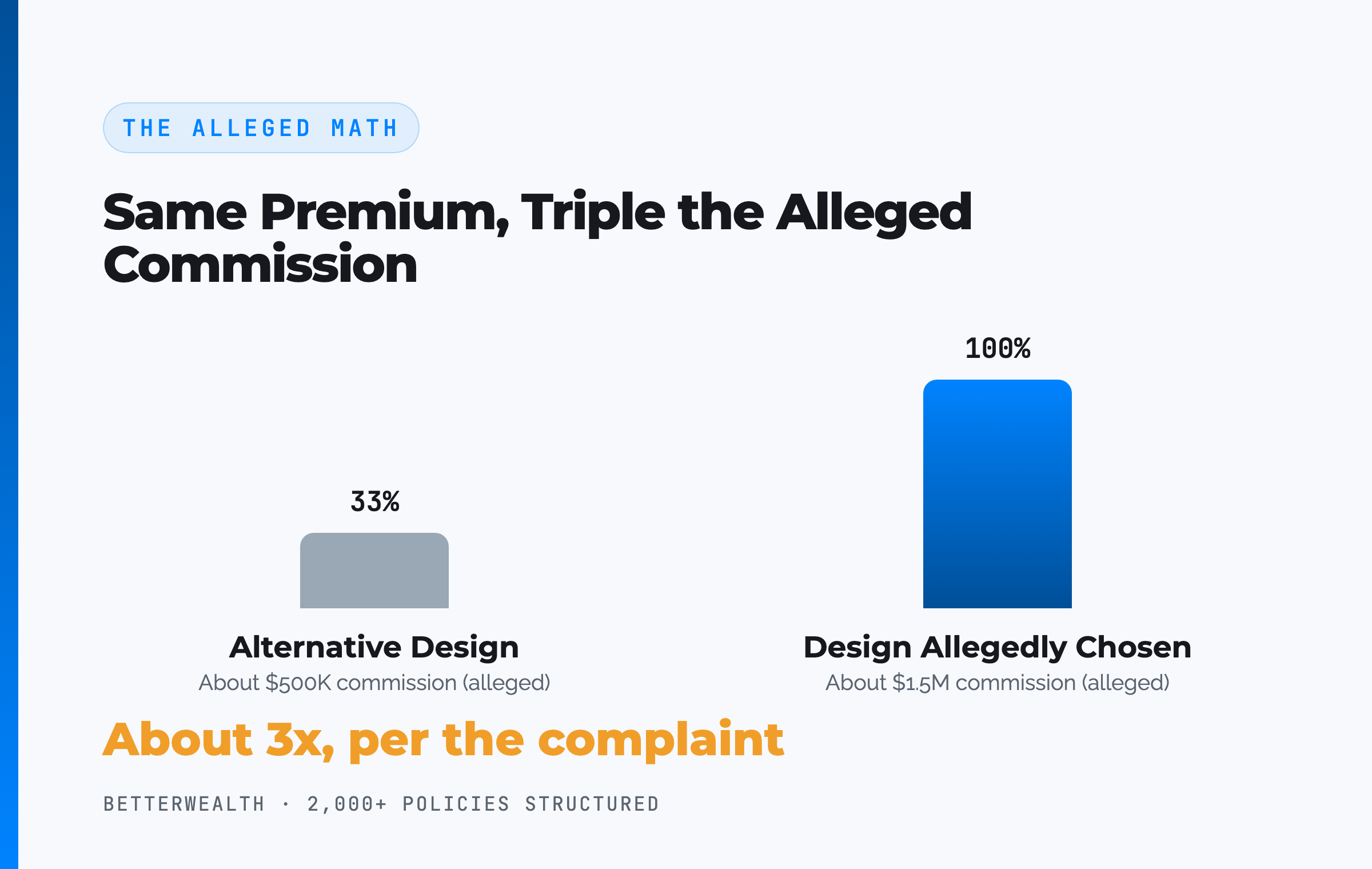
- Design and servicing. The complaint alleges the product was selected to raise the commission from roughly $500,000 to roughly $1.5 million, and that a planned change to the death benefit option was never made.
- The internal exchange. According to the complaint, an underperforming policy was moved through a 1035 exchange into a new policy at the same carrier, which generated a new commission.
- Oversight. The Busches allege Pacific Life reviewed and approved a case of this size and bears responsibility for what it approved. The complaint also alleges the agent did not disclose parts of his record when he obtained his North Carolina insurance license.
Industry analyst Bobby Samuelson, who published a detailed breakdown of the case, reports one more detail: the cash value was allegedly never allocated to the index accounts at all. It sat in the fixed account while insurance charges came out every month.
Again, these are claims. A court has not ruled on them.
03 / The LanguageWhy Was "Guaranteed Tax-Free Income" the First Red Flag?
"Guaranteed tax-free income for life" was the first red flag because no cash value life insurance policy guarantees that. A policy carries certain contractual guarantees. Lifetime income is not among them, and attaching the word "guaranteed" to an income projection changes what the buyer believes they own.
Life Insurance Is Not an Investment
The complaint notes that the policies were referred to as investments multiple times. That single word tells you how the sale was framed. A policy pitched as an investment gets compared to a Roth IRA or a brokerage account on projected return, and the pitch usually ends with the policy winning on paper.
Life insurance is not an investment.
We repeat that sentence constantly because of cases like this one. A well-designed policy is a capital base. It sits beside your investments and makes them work harder. It does not replace them, and an agent who has to disparage your other assets to make the sale is telling you something about the sale.
How an Illustration Gets Made to Look Better Than Reality
An indexed universal life illustration can be made to project large future income because several of its inputs are assumptions the agent chooses. The illustration shows no negative years. It applies an assumed index credit every year for decades. It can also assume loan arbitrage, where borrowed money is credited more than the loan charges, which inflates the projected income further.
Each assumption is permitted. Stacked together, they produce a column of income numbers that outperforms whole life and outperforms a Roth IRA on the page. The projection is not what happens. When reality misses an aggressive IUL projection, the miss is rarely one percentage point. The policy can run short of cash value to cover its own charges and collapse.
Whole life is harder to oversell this way because its premiums, guaranteed values, and death benefit are fixed by contract. Harder, not impossible. Early in my career I was taught to lead with income projections too, and I stopped because I was not comfortable showing a client a number that probably would not happen. Our position now is plain: describe policy income as a possible supplement, and never build the sale on it.
An illustration can look so good that it stops describing anything that will happen in real life. It sounds great in the pitch. It does not show up in the policy.
04 / The DesignHow Did the Policy Design Allegedly Work Against the Busches?
The design allegedly worked against the Busches in four ways: a commission-maximizing structure, a death benefit option that was never changed, cash value that never reached the index, and an internal exchange that restarted costs. Each one compounds the others.
A Structure Built Around Commission
Commission on a permanent policy is driven largely by how much death benefit is attached to the premium. More death benefit means more commission and higher insurance charges. The complaint alleges the product and structure were chosen so the commission rose from about $500,000 to about $1.5 million. That money comes from one place: the policy owner's premium.
For a buyer whose stated goals are cash accumulation and income, the correct design runs the other way. You attach the minimum death benefit the tax rules allow for the premium going in, which pushes the most dollars into cash value. That is max funding. In our experience, the way we structure a max-funded policy pays roughly one tenth of the commission that a commission-maximized design pays on the same premium. The complaint's own alleged range is narrower, about three to one.
Same premium. Opposite beneficiaries.
The Death Benefit Change That Never Happened
The complaint alleges that a change to the death benefit option was planned and discussed, and never made. In many accumulation-focused universal life designs, the option is switched after the funding years specifically to reduce ongoing insurance charges. Skipping that step leaves the policy paying for more insurance than the plan called for, year after year. Kyle Busch's occupation reportedly raised his insurance costs further.
Money That Reportedly Never Reached the Index
Per Samuelson's analysis, the cash value stayed in the fixed account. The entire sales case for indexed universal life rests on index-linked crediting. A policy paying heavy insurance charges and commissions while earning only the fixed account rate has the costs of an IUL without the feature it was bought for.
A 1035 Exchange Inside the Same Carrier
A 1035 exchange lets an owner move cash value from one life policy to another without triggering tax. It is a useful tool. It also resets the clock: the new policy carries new acquisition costs and pays a new commission. Exchanging a mature, well-performing policy is usually a mistake for that reason. The complaint alleges something worse, an underperforming policy exchanged into a new one at the same carrier, with a second commission paid on the way through.
If your client meeting were recorded and broadcast to the world, would you be proud of it? Would you be proud of the plan? Every agent should be able to answer yes.
A Policy Review Fits Some Owners and Not Others.
It Fits You If
- You own an IUL or whole life policy and cannot explain its design
- Your policy was sold mainly on a retirement income projection
- Your policy has been replaced or exchanged at least once
- You deploy capital and want a policy built as a capital base
It Does Not Fit You If
- You want a savings account or a 401(k) replacement
- You are looking for a guaranteed income promise
- You carry high-interest debt and need a quick fix
- You cannot name a use for capital that beats a loan rate
If you are in the first column, book a discovery call. We will look at your policy and tell you honestly whether it is designed for you. No pressure, no pitch. If the policy is fine, we will say so.
Book a Discovery Call05 / The FrameworkWhat Does This Case Have to Do With Infinite Banking and The And Asset?
The Busch case and the worst of infinite banking marketing share a root cause: a policy sold on a promise instead of on its mechanics. In the IUL world the promise is tax-free income. In the infinite banking world the promise is that you become your own bank and pay yourself interest. Both pitches skip the math.
Nelson Nash pioneered the Infinite Banking Concept in Becoming Your Own Banker, and his core insight holds. You either pay interest to outside lenders or you give up what your own capital could have earned. We respect that foundation. The And Asset shares roots with IBC but operates on different principles.
Where IBC Ends and The And Asset Begins
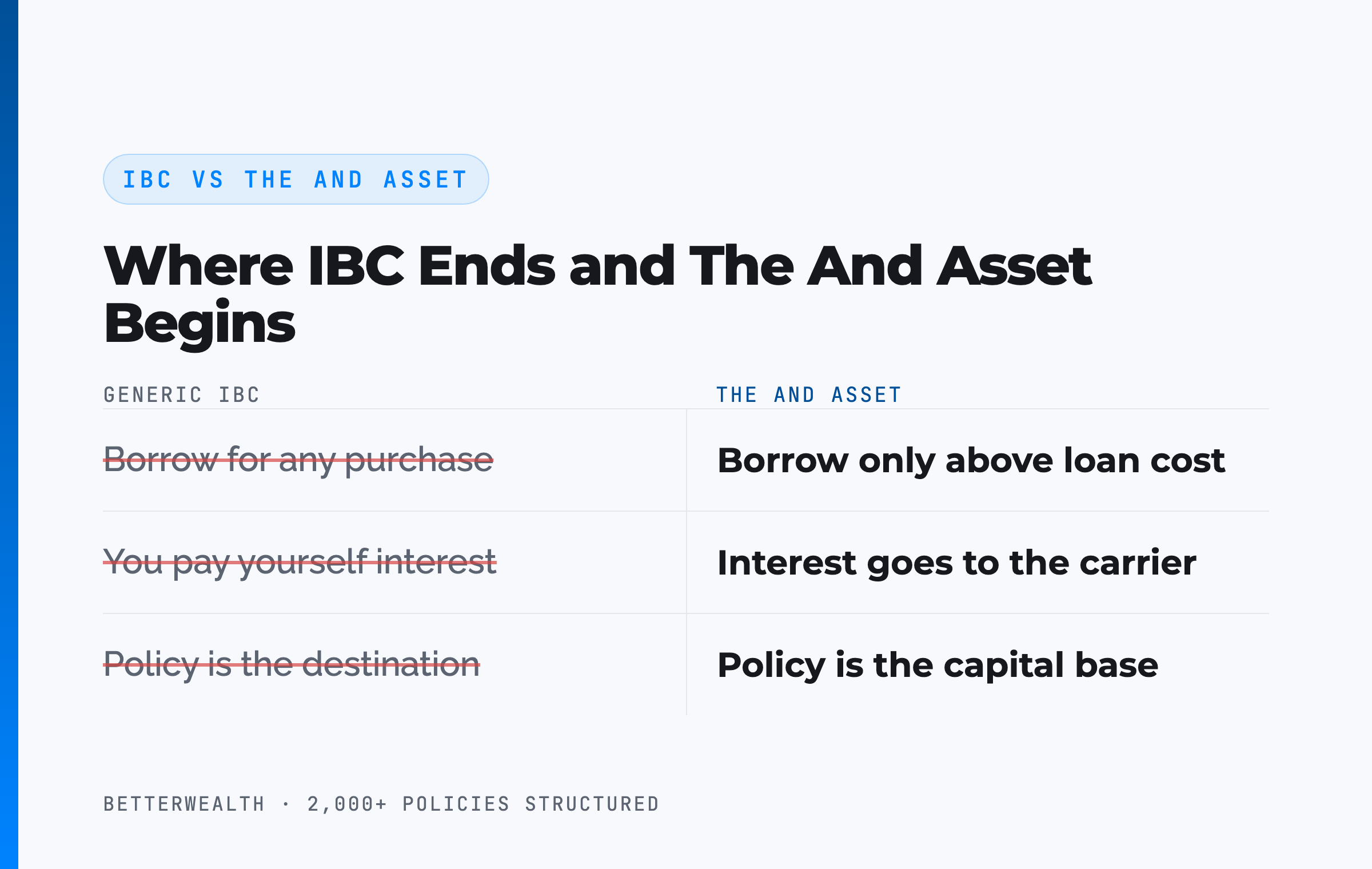
IBC says you can use a whole life policy as a personal banking system for any purchase. The And Asset says you only deploy capital from the policy when the borrowed dollars out-earn the carrier's loan cost, because anything less is an expensive way to spend money.
Many IBC marketers say you are paying yourself interest. You are not. The interest goes to the carrier. Your return is what the deployed capital earns elsewhere while the policy keeps compounding at the dividend rate net of mortality and expense charges.
That is the AND. Life insurance and your other assets, working together. It is the opposite of the pitch alleged in the Busch complaint, where the policy is positioned as the destination and everything else you own is positioned as the inferior alternative. Under The And Asset, the policy is the capital base. The value is created in what you deploy that capital into.
The math has to work.
06 / The ReviewHow to Review a Policy You Already Own
You can review a policy you already own in six steps, and each one maps to a failure alleged in the Busch complaint. None requires taking your agent's word for anything.
- Order an in-force illustration. Request it from the carrier directly. Compare today's actual cash value against total premiums paid and against the original sales illustration for the same policy year.
- Check how the premium was split. Ask how the death benefit compares to the minimum the tax rules require for your premium. On whole life, ask for the base/PUA split in dollars. A cash-focused design keeps the base small and the paid-up additions large without becoming a Modified Endowment Contract.
- Confirm the death benefit option. Ask which option is in force today and whether a change was planned at the sale. If a change was planned, ask for the date it was made.
- Verify where the money sits. On an IUL, the annual statement shows the allocation between index accounts and the fixed account. Read it. Do not assume.
- Question any 1035 exchange. If the policy replaced an earlier one, ask in writing for the new acquisition costs, the new surrender schedule, and the commission paid. An exchange has to leave you measurably better off after those costs.
- Stress-test any income projection. Have the illustration re-run at a lower crediting rate and with no loan arbitrage. If the policy collapses under modest assumptions, the original projection was a sales tool.
A policy that passes all six was probably built for you. A policy that fails two or more needs a second opinion from someone who will show you the design math and the commission in writing.
See How a Max-Funded Policy Is Built Before You Talk to Anyone.
The Life Insurance Vault holds the calculators and design frameworks we use when we structure and review policies. Use it to learn what a cash-focused design looks like, so you can recognize one that is not.
Open the Vault07 / The MathWhat Is the Right Way to Measure a Policy if Not by Projected Income?
The right measure is whether capital borrowed against the policy earns more than the carrier's loan rate. That test uses numbers you can verify today. A 30-year income projection uses numbers nobody can verify.
Policy loan rates vary by carrier and time period. At the time of writing many fall in the 5 to 6% range, and any specific figure should be confirmed with the carrier. The structure of the decision does not change. You borrow at the loan rate. The policy keeps compounding net of mortality and expense charges. The deployed capital earns its own return. If that return is higher than the loan cost, the same dollars have done two jobs.
The honest constraint comes first. If you cannot identify a use for borrowed capital that beats the loan cost, do not borrow. The discipline of repayment is the whole strategy, and a policy bought on an income promise has no such discipline built into it.
A Composite: The HVAC Owner Who Skipped the Income Illustration
Consider a 44-year-old owner of a commercial HVAC company funding a max-funded whole life policy at $62,000 a year. This is a representative composite, not a single named client. The premium is split 30/70: $18,600 of base premium and $43,400 of paid-up additions. Nobody showed him a retirement income column.
The early years cost him liquidity, as they do in any real policy. At the end of year four he had contributed $248,000 and held $241,300 of cash value. Break-even arrived in year five. An illustration showing it sooner would have been fiction.
In year six, with $389,600 of cash value against $372,000 contributed, he borrowed $143,500 against the policy to buy a retiring competitor's book of commercial maintenance contracts. Those contracts produce $21,238 a year in net profit, a 14.8% annual return on the capital deployed. At an illustrative 5.5% loan rate, interest on the full balance is $7,893 a year before any principal is repaid, and it is paid to the carrier. The spread in his favor starts at $13,345 a year and widens as the balance comes down.
The policy keeps compounding net of mortality and expense charges the entire time. He repays the loan on a 43-month schedule from the HVAC company's overall cash flow, because the contracts alone net $21,238 a year and would not retire $143,500 that quickly. If the contracts had not cleared the loan rate, the right decision was to leave the cash value alone.
One dollar. Two jobs. Math you can check.
08 / The TradeoffsDoes the Busch Case Mean IUL Is a Scam and Whole Life Is Safe?
No. The Busch case does not make IUL a scam, and it does not make whole life automatically safe. The Busches used the word "scam" for what they say happened to them. The product category itself includes many max-funded IULs that are serviced carefully by agents who stay in the business, and those do not belong beside the policies described in this complaint.
Our reasons for writing mostly whole life are narrower than "IUL is bad." An IUL has more moving parts: index allocations, changing caps, death benefit options, and insurance charges that rise with age. Every moving part needs someone watching it for decades. Many agents who sell these policies leave the industry within a few years, and the policies they sold go unmanaged. More moving parts raise the cost of neglect.
Whole life carries its own tradeoffs. Cash value trails cumulative premiums until at least year five for a healthy individual. Dividends are declared annually and are not guaranteed. The policy cannot be illustrated to dazzle, which is part of why we prefer it and part of why it is harder to sell. A whole life policy with too much base premium and too little paid-up additions funding fails the owner as surely as a badly built IUL does, only more slowly.
We disagree with max-funded IUL advocates on philosophy. We would never put them in the same category as what this lawsuit describes.
09 / The FalloutWhat the Case Puts Pressure On
As of November 2025, when the video was recorded, the case was in its early stages and put pressure on three things: what carriers allow, how closely owners read their policies, and public trust in life insurance. This section describes that pressure. It is not a status update on the litigation.
Carriers have reason to restrict the design flexibility that lets an agent triple a commission on the same premium, and they should. A product that allows that range puts the burden of restraint on the person with the most to gain from ignoring it.
The harder consequence is reputational. A headline like this one confirms what many people already believe about life insurance, and some will stop listening entirely. We think that reaction is understandable and incomplete. The way permanent insurance is commonly sold and designed does not earn a place in a financial plan. A max-funded policy that is integrated with your other assets, and borrowed against only when the math clears, is a different tool with a different job. This is for entrepreneurs and value creators, not savers, and it is not for everyone in that group either.
10 / Head to HeadThe Alleged Busch Design Against a Max-Funded Policy
Set side by side, the policy described in the complaint and a max-funded policy under The And Asset differ on every dimension that determines the outcome. The whole life figures below come from the composite above. The Busch figures are allegations from the complaint.
| Dimension | Policy Alleged in the Busch Complaint | Max-Funded IUL, Actively Serviced | Max-Funded Whole Life Under The And Asset |
|---|---|---|---|
| The Pitch | Guaranteed, tax-free income for life (alleged) | Index-linked cash value growth with a floor | A capital base to borrow against when the math clears |
| Premium | $1.5M+ per year, $10M+ in total (alleged) | Set to the maximum the tax rules allow for the death benefit | $62,000 per year: $18,600 base, $43,400 paid-up additions |
| Agent Commission | About $1.5M, up from about $500K under another design (alleged) | A fraction of a commission-maximized design | In our experience, roughly one tenth of a commission-maximized design |
| What Has to Go Right | Option changes made, money allocated, charges monitored every year | Index credits, cap rates, and annual servicing for decades | Premiums paid and loans repaid from deployed returns |
| How Success Is Measured | A projected income column decades away | Cash value against premiums paid, reviewed yearly | $21,238 annual return against $7,893 a year of interest on the full loan balance |
The pitch. An income guarantee that the contract does not contain is the start of every problem alleged in this case. A max-funded IUL sold honestly describes a floor and a cap. The And Asset makes no income promise at all. It describes a capital base and a rule for using it.
Premium and commission. The alleged $1 million difference in commission came out of the Busches' premium. Max funding, in either product type, attaches the least death benefit the tax rules allow so that more of each premium dollar reaches cash value. The composite's 30/70 split is one example of that design.
What has to go right. The policy described in the complaint needed several servicing steps to happen on schedule, and the complaint alleges they did not. A whole life policy has fewer steps to miss. It still requires the owner's discipline: fund it, and repay what you borrow.
How success is measured. A projected income column cannot be checked for decades. Interest of $7,893 a year on the full loan balance, before any principal is repaid, against a deployed return of $21,238 can be checked every twelve months.
A Straight Answer About the Policy You Own.
We have structured 2,000+ policies. We have seen this strategy work exactly as designed, and we have seen it fail. If you want a real conversation about whether your current policy is built for you, or whether The And Asset fits your situation at all, book a discovery call. We will give you the honest answer either way. No pressure, no pitch. If you would rather learn first, The And Asset channel and the BetterWealth channel on YouTube cover policy design in depth.
Book a Discovery CallFAQKyle Busch IUL Lawsuit Questions
What Is the Kyle Busch IUL Lawsuit About?
The Kyle Busch IUL lawsuit is a civil case in which Kyle and Samantha Busch allege they lost more than $8.5 million on Pacific Life indexed universal life policies. The complaint alleges misleading sales language, a policy designed around commission, servicing steps that were never taken, and an internal 1035 exchange. These are allegations. They have not been proven in court.
How Much Do Kyle and Samantha Busch Say They Lost?
The Busches allege losses of more than $8.5 million. The complaint describes more than $10 million in total premiums paid into the policies, at a pace of more than $1.5 million a year, after first meeting the agent in 2017.
Was the Kyle Busch Policy a Premium Finance Deal?
No. The case does not involve premium financing, which is when a bank lends the money to pay the premiums. That is what makes the alleged loss unusual: losses of this size are normally tied to a bank loan going wrong, and here the premiums were paid directly.
What Is an Indexed Universal Life (IUL) Policy?
An indexed universal life policy is permanent life insurance whose cash value is credited interest based on the movement of a market index, subject to the limits the carrier sets. Insurance charges and policy expenses are deducted from the cash value every month, so the design and the ongoing servicing decide whether the policy performs.
Is Life Insurance an Investment?
No. Life insurance is not an investment, and the complaint in the Busch case points to the word investments being used repeatedly in the sale. A properly designed policy is a capital base that works alongside your investments. It is not a replacement for them.
Can Life Insurance Provide Guaranteed Tax-Free Income?
No. A policy has some contractual guarantees, but income for life is not one of them. Policy loans are generally not taxable income while the policy stays in force and is not a Modified Endowment Contract, and a policy that lapses with a loan outstanding can create a tax bill. Any income shown on an illustration is a projection, not a promise.
What Is a 1035 Exchange and Why Does It Matter in This Case?
A 1035 exchange moves cash value from one life insurance policy to another without triggering tax. It matters here because the complaint alleges an underperforming policy was exchanged into a new policy at the same carrier. A new policy restarts acquisition costs and pays a new commission, so an internal exchange has to leave the owner measurably better off to be justified.
Does the Kyle Busch Lawsuit Mean IUL Is a Scam?
No. The lawsuit alleges failures in how one set of policies was sold, designed, and serviced. A max-funded IUL that is serviced every year by an agent who stays in the business does not belong in the same category. We write very few IULs ourselves because the number of moving parts raises the cost of neglect.
What Is The And Asset?
The And Asset is BetterWealth's framework for using a max-funded whole life policy as a capital base. You borrow against it only for an activity that returns more than the carrier's loan rate, so your dollars do two jobs at once: the policy keeps compounding net of mortality and expense charges while the deployed capital earns its own return.
How Is The And Asset Different From Infinite Banking?
Infinite banking, pioneered by Nelson Nash, frames a whole life policy as a personal banking system for any purchase. The And Asset says you deploy capital from the policy only when the borrowed dollars out-earn the carrier's loan cost, because anything less is an expensive way to spend money. The And Asset shares roots with IBC but operates on different principles.
Is Whole Life Insurance Safer Than IUL for Infinite Banking?
Whole life has fewer moving parts than IUL, which makes it harder to oversell and harder to neglect. Premiums, guaranteed cash values, and the death benefit are contractual, and dividends are declared annually and are not guaranteed. Whole life can still be designed badly, with too much base premium and too little paid-up additions funding.
How Do I Know if My Policy Was Designed for Cash Value or for Commission?
Compare the death benefit to the premium. A policy designed for cash value carries the smallest death benefit the tax rules allow for the premium you pay, which also produces the smallest commission. A policy carrying far more death benefit than the premium requires was built for a different objective. An in-force illustration and a design review answer the question in one sitting.
- Kyle Busch's $8.5 Million IUL Lawsuit Against Pacific Life: the source video, including the Busches' public statement.
- The Life Product Review: Bobby Samuelson's independent analysis of life insurance products, including his breakdown of this case.
- IRC Section 1035 (Cornell Law): the tax code provision governing exchanges of life insurance policies.
- IRC Section 7702 (Cornell Law): the tax code definition of a life insurance contract.
- IRC Section 7702A (Cornell Law): the Modified Endowment Contract rules that cap how heavily a policy can be funded.
- National Association of Insurance Commissioners: state regulator resources on life insurance sales and illustrations.
- Nelson Nash, Becoming Your Own Banker: the origin of the Infinite Banking Concept.
- BetterWealth resources: The And Asset book, The And Asset channel on YouTube, and the BetterWealth YouTube channel.
I founded BetterWealth nearly a decade ago to treat life insurance as a wealth and capital strategy for entrepreneurs, business owners, and high-income earners. Our team has structured more than 2,000 policies across all 50 states. I wrote The And Asset and host the BetterWealth and The And Asset YouTube channels. If you want an honest read on a policy you already own, book a discovery call. We will tell you if it is fine as it is.