
The IUL challenge offers $25,000 to anyone who produces an indexed universal life policy at least ten years old that has performed at or better than its original current-assumption illustration. In four years and hundreds of submissions, it has never paid out.
A financial product that has to be defended by its projections rather than its history is telling you where the risk sits. Indexed universal life has been sold for more than two decades on a promise that reads well on paper: upside participation in an index, a floor that protects against loss, flexible premiums, and tax-advantaged income later. The projections are compelling. The record of those projections holding up is the part almost nobody publishes.
That gap is what a standing $25,000 challenge from LIFE180 has been probing for four years. Produce an indexed universal life policy at least ten years old, past its surrender period, sold on current assumptions, that has performed at or better than its original illustration. Hundreds of submissions have come in. None has been paid.
The debate is not whether indexed universal life can work. It is whether the thing you were sold and the thing the contract obligates the carrier to deliver are the same thing. One submission finally cleared the year-ten cash value bar, and it was disallowed on the published terms because it was a survivorship policy funded by a lump sum exchange. The agent who built it argues the terms make the challenge unwinnable. The people running it argue the terms exist because a decade of submissions taught them what gets manipulated.
At BetterWealth we have structured more than 2,000 policies across all 50 states, and we do not use indexed universal life as a capital base. This article covers what the challenge actually tests, why the one qualifying policy still carried a $600,000 per year cost of insurance risk in its late years, where indexed universal life genuinely fits, what The And Asset framework requires from a contract, and the honest cost of the certainty whole life provides.
- Four years, hundreds of submissions, and no IUL policy has yet been paid the challenge's $25,000 prize.
- Roughly three quarters of indexed universal life is sold by product category for accumulation and future income.
- Policy performance is driven by caps, participation rates, spreads, and cost of insurance, not by the index alone.
- The one policy that came closest still projected a $600,000 annual cost of insurance at age 89.
- On whole life a design error improves with time. On a universal life chassis it compounds with time.
- The And Asset needs a capital base you can price, which is why we build it on guaranteed whole life contracts.
The illustrations are on screen in the full conversation, including the Monte Carlo run at age 90 and 95 and the whole life comparison built at the same premium. If you want to see the actual columns rather than read about them, start there.
01 / The problemThe gap between what was sold and what is contractually owed
Every permanent life insurance contract splits into two columns, and almost every dispute in this industry lives in the space between them. One column is guaranteed: the carrier is contractually obligated to deliver it. The other column is a current assumption, a projection built on today's crediting rates, today's charges, and today's expectations, and the carrier can adjust most of those inputs within contract limits.
On a whole life contract, the guaranteed column carries the premium, the death benefit, and a cash value floor. The non-guaranteed piece is the dividend, which is declared annually by the board and is not promised. On an indexed universal life contract, the guaranteed column is narrower. Caps, participation rates, spreads, policy charges, and cost of insurance rates all sit on the assumption side, bounded by contract maximums that are typically far worse than what the illustration shows.
The buyer, in most cases, is shown one number: the current assumption projection. That is the number that gets circled on the page.
There is no free lunch in the insurance business. If you believe you are getting upside participation, downside protection, flexible premiums, and a better return, ask who is carrying that risk. It is priced, and it is priced to you.
02 / The challengeWhat is the IUL challenge, and why has nobody won it?
The IUL challenge asks for one specific artifact: an indexed universal life policy, at least ten years old and past its surrender period, whose actual in-force performance matches or beats the original current-assumption illustration it was sold on. The ten-year requirement exists because early-year numbers hide the problem. A policy at year three or year four often looks fine. The strain shows up later, when cost of insurance charges scale against the net amount at risk.
The published terms exclude a handful of categories: policies illustrated below the maximum assumed rate at the time, index swaps after issue, altered premium patterns, survivorship contracts, and lump sum 1035 exchanges. Each exclusion traces back to a real submission pattern. The exclusions are also the heart of the criticism, and it is a fair one to state plainly.
The case against the challenge
The agent who submitted the closest policy argues the terms give the sponsor discretion broad enough to invalidate almost anything: language disallowing overfunded designs "at sole and absolute discretion," a clause allowing terms to change without notice, and an exclusion for guaranteed or principal-protected products that, read literally, could sweep in any policy carrying a no-lapse guarantee. His conclusion is that a four-year record of zero payouts under discretionary terms is not proof about the product.
That argument deserves a real answer rather than a dismissal. Here is ours: the terms are worth tightening, and the underlying observation still stands on its own without the challenge. We just lived through one of the strongest equity runs in market history. A product sold on upside participation should have had its best possible decade. The submissions that did arrive were not close.
The prize is a device. The decade is the evidence.
03 / The frameworkWhat does The And Asset require from a policy?
The And Asset requires a capital base you can price before you deploy it, which is a stricter requirement than most people apply to permanent insurance. Our framework says a properly structured whole life policy functions as a capital base you borrow against while the policy keeps compounding on its full value, net of mortality and expense charges. The discipline attached to it is the whole strategy.
Nelson Nash pioneered the idea of using whole life insurance as a personal banking system, and his insight about lost opportunity cost is foundational. We credit that. The And Asset builds on his foundation and operates on different principles.
Where IBC ends and The And Asset begins
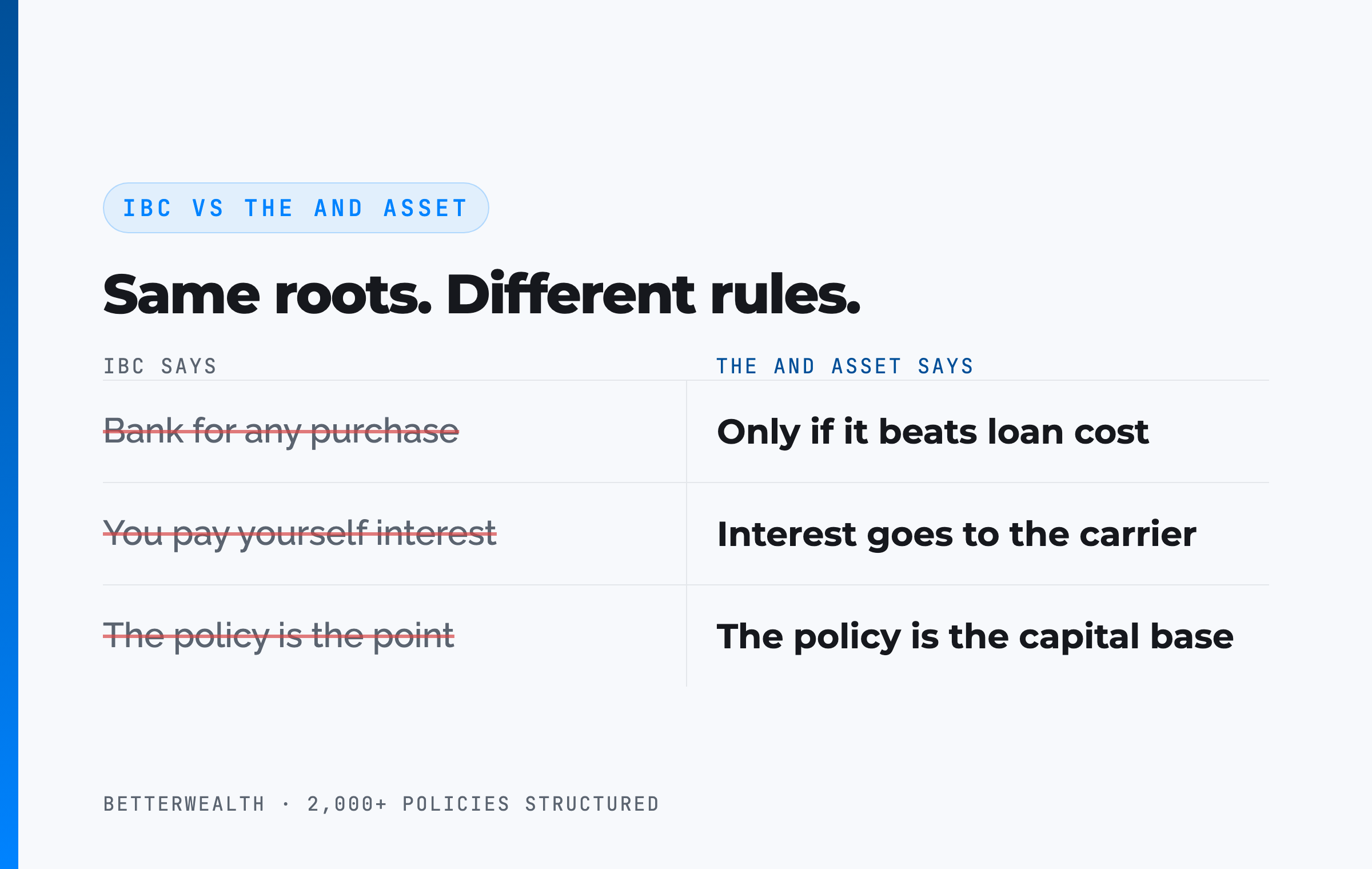
IBC says you can use a whole life policy as a personal banking system for any purchase. The And Asset says you only deploy capital when the borrowed dollars will produce a return greater than the carrier's loan cost, because anything less is an expensive way to spend money. Many IBC marketers say you are paying yourself interest. You are not. The interest goes to the carrier. Your return is what the deployed capital earns elsewhere while the policy compounds uninterrupted.
That rule has a hard technical consequence for product selection. To run the test, you have to know two numbers: what your capital base will be worth when you want to borrow, and what the loan will cost. On a guaranteed whole life contract, both are knowable years in advance. On a chassis where crediting caps, spreads, and cost of insurance charges can move within contract limits, both become estimates. You cannot run a disciplined spread calculation against an estimate.
That is why we do not build The And Asset on an indexed universal life policy. The objection is structural, not moral.
Marketers have ruined the way this should be explained. The question is never whether a product is good. It is whether the contract is aligned or misaligned with the job you hired it to do.
04 / How to evaluateHow do you stress test a policy illustration before you buy?
You stress test an illustration by separating what is guaranteed from what is assumed, then pricing the failure case rather than the projection. Most buyers never see this done, because the sales process is built around the current assumption page. The sequence below is what a diligent review looks like, and it applies to whole life and universal life alike.
- Name the problem before the product. Write down the single job the policy has to do. A capital base you will borrow against, a death benefit that must exist at life expectancy, and a long-term accumulation vehicle are three different assignments with three different right answers.
- Separate guaranteed from assumed. Ask for the guaranteed column and the current assumption column side by side. On indexed universal life, ask specifically which levers the carrier can adjust and what the contractual maximums are on cost of insurance.
- Stress test the crediting rate and the timeline. Re-run the projection at a materially lower crediting rate. Extend it to age 95 and age 100, not to life expectancy. Ask for a range of outcomes rather than a single straight line.
- Price the failure, not the projection. Ask what it costs to keep the policy in force in the first year it strains. If the answer is a six-figure annual premium in your late eighties, that is the number that matters, not the illustrated value at 75.
- Confirm who maintains it for forty years. A universal life chassis needs annual in-force reviews for decades. Ask what happens if your agent retires, leaves the business, or dies, and whether there is a written succession plan behind the policy.
- Compare the cost of certainty. Put the guaranteed structure and the assumption-based structure side by side at identical premium. Guarantees buy less death benefit per dollar. Decide whether that difference buys something you need.
Steps four and five are the ones almost nobody runs, and they are where the real risk lives. A policy that projects beautifully at 78 and requires a $600,000 check at 89 is not a projection problem. It is a plan.
Price the bad year. Not the good one.
A capital base is for a specific person doing specific things.
It fits you if
- You already deploy capital and think in IRR
- You can name a use for borrowed dollars that beats the loan cost
- You have a 10-year-plus funding horizon
- You want contractual certainty more than maximum projected leverage
It does not fit you if
- You are early in building wealth
- You want a savings account alternative
- You are solving a high-interest debt problem right now
- You cannot identify a productive use for the capital
If you are in the first column, thirty minutes will tell you whether a properly structured policy belongs in your capital stack. If you are in the second, we will say that instead.
Book a Discovery Call05 / The mathDoes the deployed return clear the loan cost?
The return on whatever you deploy must exceed the carrier's loan cost, or you should not borrow. That single test governs every And Asset decision, and it is the reason product selection matters more than most agents admit. Policy loan rates vary by carrier and rate environment. At time of writing many carriers fall in the 5 to 6 percent range, and you should treat any specific figure as a variable to verify rather than a constant.
The structure of the decision is simple. You borrow against cash value at the carrier's loan rate. The policy continues compounding on its full value, net of mortality and expense charges and adjusted for the carrier's recognition method. Your deployed capital earns its own return. If that return clears the loan cost, one dollar has done two jobs. If it does not, you have borrowed to lose money slowly.
Run that test against a contract whose internal charges can be repriced and the spread stops being a spread. It becomes a forecast. Uninterrupted compounding is only useful when you can count on the base it compounds against.
If the deal does not clear the loan rate, do not borrow.
06 / The mechanicsWhy do IUL policies underperform their original illustration?
Indexed universal life policies underperform because the index is one input among many, and it is not the input that decides the outcome. Between the index return and your cash value sit the cap, the participation rate, the spread, the premium load, the policy fee, and the cost of insurance charge. The carrier can adjust most of those within contract limits after the policy is issued.
The pattern is visible in the numbers. Products sold roughly a decade ago commonly carried caps in the 10 to 13 percent range. Many of those products were discontinued, and current and in-force caps commonly sit in the 7 to 9 percent range. The illustration was built on the higher number. The performance runs on the lower one.
Actuarial Guideline 49 narrowed the problem without solving it
AG 49, adopted in 2015, capped the maximum rate carriers can use when illustrating indexed crediting and standardized parts of the calculation. Before it, some illustrations showed rates that no realistic cap environment could support. It cleaned up the worst of that. It did not touch what happens after issue, because it governs illustration methodology at the point of sale, not the levers the carrier controls afterward. That is why a decade of post-AG 49 policies is the fair test, and why the challenge uses a ten-year lookback.
Cost of insurance is the part that scales
Cost of insurance is charged against the net amount at risk, which is the gap between the death benefit and the policy value. When crediting underperforms, the policy value falls behind, the net amount at risk widens, and the charge grows. That is a compounding mechanism running in the wrong direction. Late in the contract, at advanced ages, it can turn into six-figure annual charges on a policy that looked healthy at 75. Time makes it worse, not better.
On whole life, time fixes design mistakes. A policy built slightly wrong catches up over twenty and thirty years. On a universal life chassis, time compounds the mistake instead.
07 / Where it fitsWhere does indexed universal life genuinely make sense?
Indexed universal life makes sense in a narrow set of cases, and estate and wealth transfer planning is the clearest one. When the assignment is maximum death benefit per premium dollar rather than accessible capital, a universal life chassis buys materially more coverage than whole life at the same outlay. In the survivorship case reviewed on the video, roughly $50,000 of annual premium supported about $15 million of death benefit on the indexed design against about $10 million on the whole life design.
That extra $5 million is not free and it is not fraudulent. It is actuarially priced. The buyer is retaining performance and longevity risk that the whole life carrier would otherwise absorb, and receiving more face amount in exchange. Where the design is honest, that trade is disclosed and stress tested up front. Where it is not, the buyer learns about it in their late eighties.
The version of that design we can defend is the one carrying an extended no-lapse guarantee well beyond life expectancy, priced accordingly, reviewed annually, and sold to someone for whom the premium is a small share of total capital. The version we cannot defend is an accumulation design with loans illustrated inside the no-lapse window, which is how the guarantee gets quietly voided.
None of that describes a capital base. A death benefit contract and an And Asset are different instruments solving different problems, and conflating them is how people end up with neither.
The frameworks behind 2,000+ policies, in one place.
The And Asset Vault holds the calculators, design frameworks, and structuring decisions we use when we compare product chassis, carriers, and funding strategies. Free, email-gated, no spam.
Open the Vault08 / The tradeoffsWhat whole life gives up, and what it buys
Whole life buys certainty and pays for it in death benefit per premium dollar, and anyone who tells you otherwise is selling. The guaranteed premium, the guaranteed death benefit, and the guaranteed cash value floor are contractual obligations the carrier prices into the product. That pricing shows up as less face amount at the same outlay.
Three things come with that price. The first is the reduced paid-up option, which has no equivalent on a universal life chassis. On whole life you can stop paying and convert to a smaller, fully paid-up death benefit with certainty. On a universal life policy you either satisfy an extended guarantee, add premium, cut the face amount, or carry the risk. The second is that a design error trends toward correction. A whole life policy built with the wrong emphasis still improves for decades. The third is that the agent's ongoing involvement matters less, because the guarantees do the work the annual review would otherwise have to do.
The honest counterargument is worth stating: if you take the premium difference between a guaranteed universal life design and a whole life design and invest it competently over thirty years, you can build a case that the net outcome is better. That case depends entirely on the discipline of the person making it. Most of the time, the premium difference does not get invested.
Whole life gets missold too. Premium finance designs built on aggressive borrowing assumptions have imploded on both chassis. Policies designed for cash value get sold to people who needed death benefit. Dividend projections get presented as if they were promises. The pattern is roughly one bad whole life design for several bad indexed universal life designs, and neither number is zero. Our own honest assessment of the tradeoffs covers where our own strategy fails.
We have seen whole life sold badly. If the majority of whole life sold in this country came across our desk, we would not put our name behind most of it either.
09 / Head to headIUL vs whole life vs guaranteed UL, on the same premium
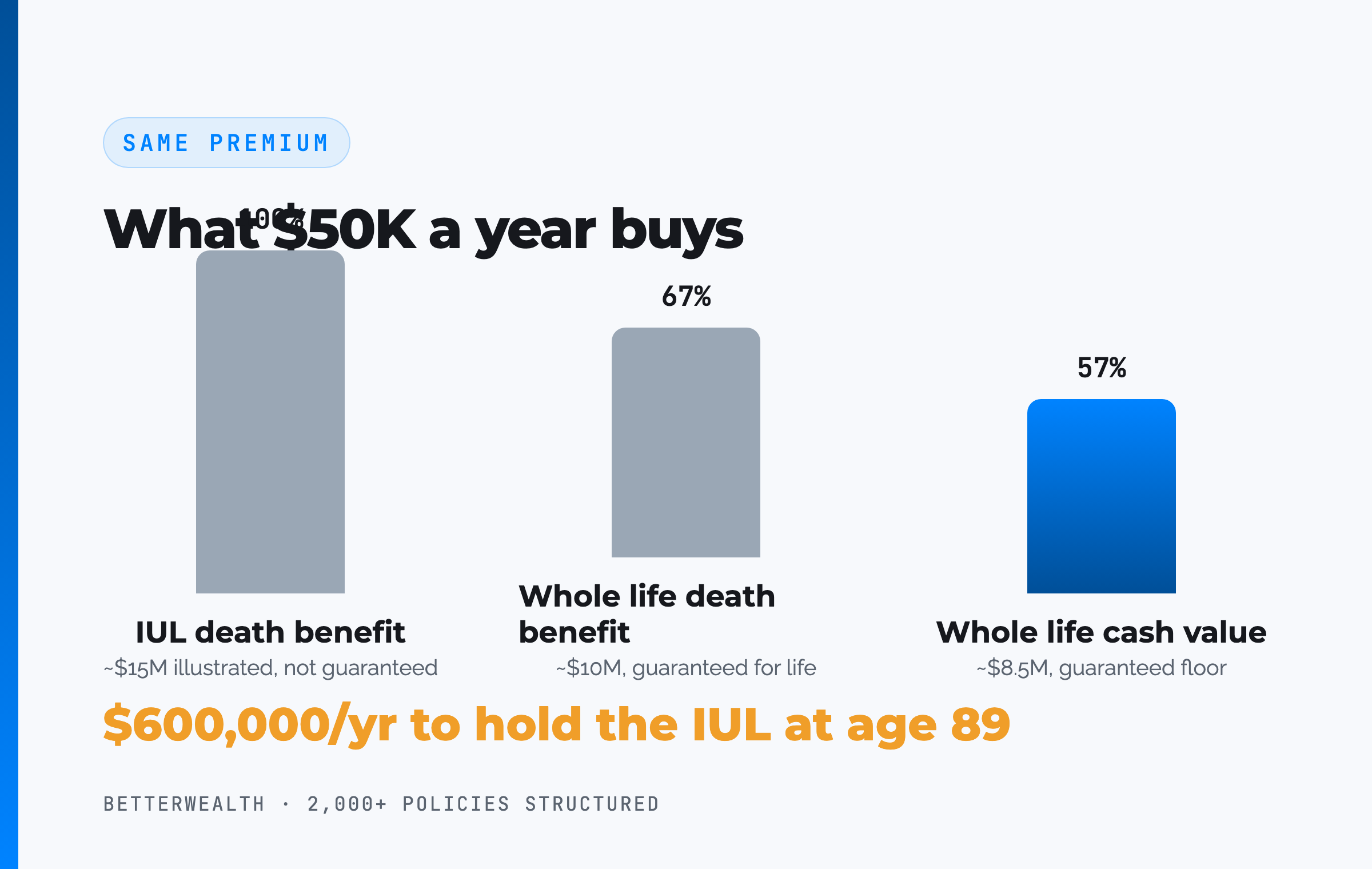
At identical premium, the three permanent chassis trade certainty for face amount in a predictable order. The table uses the survivorship figures reviewed in the conversation, where roughly $50,000 of annual premium was modeled across designs on the same two insureds.
| Dimension | Accumulation IUL | IUL / GUL with extended guarantee | Whole Life (And Asset design) |
|---|---|---|---|
| Death benefit at ~$50K/yr | ~$15,000,000 illustrated, not guaranteed past the no-lapse window | Between the other two; premium rises with the guarantee duration | ~$10,000,000, guaranteed for life |
| Cash value at the same point | ~$6,000,000 illustrated at current assumptions | Minimal; the premium buys the guarantee, not the value | ~$8,500,000, with a guaranteed floor |
| Cost to fix a bad year | ~$600,000/yr of cost of insurance at 89 in the reviewed case; ~$300,000/yr at half the face | $0 extra if the guarantee premium was paid as required | $0. The premium is contractual and level |
| If you stop paying | Policy value absorbs charges until it lapses | Guarantee holds if the required premium was satisfied; no reduced paid-up | Reduced paid-up: a smaller death benefit, fully paid, with certainty |
| Who carries the risk | The policyholder, on crediting and cost of insurance | The carrier, for the guaranteed portion only | The carrier, on premium, death benefit, and cash value floor |
Death benefit. The $5 million spread between the indexed design and the whole life design at the same premium is the single most cited number in this debate, and it is real. It is also the price of the guarantee, quoted in the only currency insurance has.
The bad year. The accumulation column is the one that produces phone calls. A policy projecting cleanly at 78 that needs $600,000 a year at 89 has moved the problem to the point in life when the client has the least ability to solve it.
Stopping. Reduced paid-up is the feature nobody markets and everybody eventually needs. It is the only mechanism among these three that lets a person walk away from the premium with a known, permanent result.
A composite: the operator who redirected an accumulation policy into a capital base
Consider a 44-year-old contractor, preferred non-tobacco, who had been sold an accumulation-oriented policy on a projection of future tax-free income and who moved the same annual dollars into a whole life design built as a capital base. This is a representative composite drawn from patterns across our book, not a single named client.
Through the first four years the policy trails cumulative contributions, exactly as a real contract does. At the end of year one, cash value sits at $51,900 against $63,500 paid in. By the end of year four, $254,000 has gone in and $238,700 is accessible. Year five is where total cash value crosses total contributions at $319,400 against $317,500. Any illustration showing a year-two break-even is marketing fiction.
In year six, with $392,800 of accessible cash value against $381,000 contributed, he borrows $214,000 against the policy to buy two pieces of revenue-producing equipment that let him take on a job class he had been subcontracting out. The equipment throws off $29,140 of additional net margin in the first twelve months against a first-year loan cost of $12,305 at an illustrative 5.75%. Over the 43-month hold, the deployed capital returns an estimated 13.6% IRR against that loan cost. The policy compounds on its full value, net of mortality and expense charges, the entire time. Repayment runs on a 43-month schedule funded by the equipment itself.
The number he could not have run on his prior policy is the one in the middle: what the capital base would be worth in year six. On a guaranteed contract, he knew it in year one.
One dollar. Two jobs. That is the And.
10 / The fitWho should walk away from this entire category?
Anyone who cannot name the problem the policy is solving should walk away from all of it, indexed universal life and whole life alike. That sounds obvious. It is the single most common failure we see, and it produces both the lapsed accumulation policy and the overfunded whole life policy sold to someone who needed term coverage and an emergency fund.
If you are early in building wealth, this is not where to start. If you want a savings account alternative, this is not it. If you are carrying significant high-interest debt, a capital strategy that compounds advantages over decades does not solve a liquidity problem this quarter. If you cannot identify a use for borrowed capital that outperforms the loan cost, do not borrow, and probably do not buy.
For the entrepreneur, business owner, real estate investor, or high-income earner who already deploys capital and thinks in opportunity cost, the question narrows to one thing: do you want a contract whose base you can price, or one whose base you have to forecast? Our answer has been consistent across more than 2,000 policies. Yours might reasonably differ, and we would rather you reach it with the failure case in front of you than with the projection alone.
The honest thirty minutes about which chassis fits your plan.
We have structured 2,000+ policies. We have seen this strategy work exactly as designed, and we have seen it fail. If you own a policy you are unsure about, or you are being shown an illustration you cannot stress test yourself, book a discovery call and we will give you the honest answer either way. If you would rather learn first, the The And Asset and BetterWealth channels go deep on the math.
Book a Discovery CallFAQIUL vs whole life questions
What is the IUL challenge?
The IUL challenge is a standing offer from LIFE180 to pay $25,000 to anyone who produces an indexed universal life policy, at least ten years old and past its surrender period, that has performed at or better than its original current-assumption illustration. It has run for four years, taken hundreds of submissions, and paid out nothing.
Has anyone won the IUL challenge?
No. One submission in four years cleared the year-ten cash value mark against its original illustration, and it was disallowed under the published terms because it was a survivorship policy funded by a lump sum 1035 exchange. Every other submission fell short of the illustration or of the ten-year age requirement.
Is IUL bad?
No product is good or bad. An indexed universal life policy is aligned or misaligned with the job you hired it to do. The critique that holds up is that roughly three quarters of IUL is sold by product category for accumulation and tax-free retirement income, and that is the use where current assumptions have most often failed to hold.
What is the difference between IUL and whole life insurance?
Whole life carries a guaranteed premium, a guaranteed death benefit, and a guaranteed cash value floor, with dividends layered on top that are declared annually and are not guaranteed. Indexed universal life carries a flexible premium and shifts crediting caps, participation rates, spreads, and cost of insurance charges to the policyholder within contract limits, which buys more death benefit per premium dollar and more variability in the outcome.
What is The And Asset?
The And Asset is BetterWealth's framework for using a properly structured whole life policy as a capital base. You only borrow against it for an activity that produces a return greater than the carrier's loan cost, so your dollars do two jobs at once: the policy keeps compounding net of mortality and expense charges while the deployed capital earns its own return.
How is The And Asset different from infinite banking?
Infinite banking, as Nelson Nash taught it, frames a whole life policy as a personal banking system for any purchase. The And Asset adds a rule: you only deploy borrowed capital when the return clears the carrier's loan cost. The policy is the capital base, not the destination. It shares roots with IBC but operates on different principles.
Can you use an IUL for infinite banking or The And Asset?
We do not use indexed universal life as an And Asset capital base. The framework depends on knowing what the capital base will be worth when you want to borrow against it, and on a loan cost you can price against a deal. A chassis where crediting caps, spreads, and cost of insurance charges can move within contract limits makes both of those numbers estimates rather than knowns.
What is a no-lapse guarantee on an IUL?
A no-lapse guarantee keeps the policy in force to a stated age as long as you pay the required premium, regardless of how the crediting performs. Durations vary widely, from five years to age 120 or beyond, and the longer the guarantee, the higher the premium. Taking policy loans can void the guarantee at many carriers, which matters if the policy was sold for retirement income.
What is AG 49 and did it fix IUL illustrations?
Actuarial Guideline 49, adopted in 2015, caps the maximum rate a carrier may use to illustrate indexed universal life crediting and standardizes some of the assumptions behind it. It narrowed the most extreme illustrations. It did not stop underperformance, because the guideline governs how a policy is illustrated at sale, not the caps, participation rates, spreads, or cost of insurance charges the carrier can change afterward.
Why do IUL policies underperform their original illustration?
Policy performance depends on far more than the index. Cost of insurance charges, policy fees, premium loads, caps, participation rates, and spreads all sit between the index return and the cash value, and most of them can be adjusted by the carrier within contract limits. Cap rates that ran in the 10 to 13 percent range on older products commonly sit in the 7 to 9 percent range today.
Can you do a reduced paid-up on an IUL?
No. There is no reduced paid-up equivalent on a universal life chassis. On whole life you can stop paying premiums and convert to a smaller, fully paid-up death benefit with certainty. On an IUL you either satisfy an extended no-lapse guarantee, put in more premium, cut the death benefit, or carry the performance risk yourself.
Is whole life ever missold?
Yes. Whole life gets missold through premium finance designs built on aggressive assumptions, through policies designed for cash value when the client needed death benefit, and through policies sold with dividend projections presented as if they were guaranteed. The structural difference is that a whole life design error tends to improve with time, while a universal life design error tends to compound.
How much death benefit does whole life buy compared to IUL?
Less, at the same premium. In the survivorship case reviewed on the video, roughly $50,000 of annual premium supported about $15 million of indexed universal life death benefit versus about $10 million on a whole life design. The whole life version carried roughly $8.5 million of cash value at the same point and no lapse risk. Certainty is actuarially priced.
- This IUL Policy Started A Huge Debate: We Ran The Numbers, the full conversation this article is built from, with the illustrations on screen.
- National Association of Insurance Commissioners, Actuarial Guideline 49 and the model regulation governing life insurance illustrations.
- IRC Section 7702 (Cornell Law), the tax code provision behind the treatment of life insurance cash value and loans.
- Nelson Nash, Becoming Your Own Banker, the origin of the infinite banking concept.
- LIMRA, life insurance sales and persistency data, including indexed universal life category share.
- LIFE180, the channel behind the IUL challenge and its published terms.
- BetterWealth resources: The And Asset book, the The And Asset YouTube channel, and the BetterWealth YouTube channel.
Publish research and case reviews on indexed universal life performance, and run the $25,000 challenge and the illustration analysis tools discussed here. LIFE180 on YouTube →
Designed and submitted the survivorship policy that came closest to clearing the challenge, and argues the published terms make it unwinnable. His designs and his critique are represented directly in this article.
I founded BetterWealth to treat life insurance as the wealth and capital tool it actually is, not the product most people get sold. Our team has structured more than 2,000 policies across all 50 states. I wrote The And Asset and host the BetterWealth and The And Asset YouTube channels. If you own a policy you cannot stress test, or you are being shown one you do not fully understand, book a discovery call. We will tell you honestly what it is doing.