An infinite banking strategy uses a properly structured whole life policy as a capital base you borrow against, so the cash value keeps compounding net of charges while the borrowed dollars earn a second return elsewhere. It works only when that second return beats the carrier's loan rate and the policy is held long enough to mature.
Most financial plans measure assets one at a time. The brokerage account gets judged on its return, the 401(k) on its balance, the house on its appreciation, and the life insurance policy on whether anyone remembers it exists. Each line looks reasonable. The plan as a whole leaks, because no one is measuring how the pieces affect each other: the tax drag, the cash that sits idle, the forced sale in a down year, the purchase financed at someone else's terms.
The return that decides a family's wealth is rarely the return on any single asset; it is what the assets produce when they are coordinated. A dollar that sits still does one job. A dollar that serves as collateral in a policy while its borrowed twin earns a return in a business or property does two.
That is the argument Nick Palumbo made on The BetterWealth Show. Palumbo has spent 44 years in the life insurance business, starting in Northwestern Mutual's college agent program at 21. His claim: in his models, a coordinated plan built around whole life insurance produces results that a portfolio alone would need a steady 13.5% every year, with no down years, to match. That number deserves scrutiny, and we give it some below.
At BetterWealth, we have structured more than 2,000 policies across all 50 states, and we teach a framework called The And Asset. It agrees with Palumbo on money in motion and disagrees with parts of the standard infinite banking pitch. This piece covers where the 13.5% comes from, how the coordination works step by step, the loan-rate math that governs every decision, the three ways people misuse the strategy, and who should not use it at all.
- Under The And Asset, you borrow against a policy only when the deployed dollars should out-earn the carrier's loan rate.
- Nick Palumbo models a coordinated plan that a portfolio alone would need a steady 13.5% yearly return to match.
- Cash value lets a retiree pause withdrawals from a falling portfolio, which reduces sequence-of-returns risk in a 2008-style year.
- Policy loan interest goes to the carrier, not back to you. Your return comes from what the borrowed money earns.
- Cash value trails total premiums for the first several years; break-even typically lands in year five or later.
- If a car loan costs less than your policy loan, keep the policy capital for a use that can beat the loan rate.
Watch the full conversation to hear Nick Palumbo walk through his 10 financial rules, the retirement spend-down plan behind the 13.5% figure, and Caleb pushing back on whether a car belongs on a policy loan.
01 / The ProblemWhy Does Most Capital Sit Still?
Most capital sits still because conventional planning rewards storing money, not using it. Palumbo frames the economy as four sectors: government, corporations, financial institutions, and the consumer. The first three each set rules that pull dollars away from the fourth. Taxes, product obsolescence, front-end and back-end charges, CD maturity dates, retirement account access restrictions. The consumer, he argues, is the only sector playing without a rulebook of its own.
The result shows up in where people put their money. A 401(k) defers tax rather than eliminating it, and access before 59½ is restricted. A Roth grows tax-free but has contribution limits, income limits for direct contributions, and its own access rules. A 529 plan is tax-advantaged for education, and once the money is spent on tuition, it stops compounding for you.
That last point is where opportunity cost becomes concrete. Palumbo's son's tuition ran $50,000 a year for four years, when Palumbo was 53 to 56. Most people would call that a $200,000 cost. Paid in cash from savings earning 5%, those four payments would have grown to roughly $766,000 by age 82, about $566,000 more than the $200,000 paid, by the life expectancy he used. That gap is why he did not pay from savings: as Section 05 shows, he borrowed against his home and left his investment account in place.
Every dollar you spend stops working for good.
"It's not what it is, it's what it does." Life insurance judged as a standalone asset looks mediocre. Judged by what it lets every other asset do, it looks different. Nick Palumbo
02 / The FrameworkWhat Does Money in Motion Mean Inside The And Asset?
Money in motion means one dollar doing more than one job at the same time. In a whole life policy, the cash value stays in the contract as collateral and keeps compounding, net of mortality and expense charges, while you borrow against it and deploy the loan into something that earns its own return. Palumbo calls this his favorite of his 10 rules. Banks run on the same principle: deposits do not sit in a vault, they get lent out.
Nelson Nash introduced the idea of using whole life insurance as a personal banking system in Becoming Your Own Banker. His core insight holds: you either pay interest to outside lenders or you lose the opportunity cost of paying cash. We credit that foundation. The And Asset shares roots with IBC but operates on different principles.
Where IBC Ends and The And Asset Begins
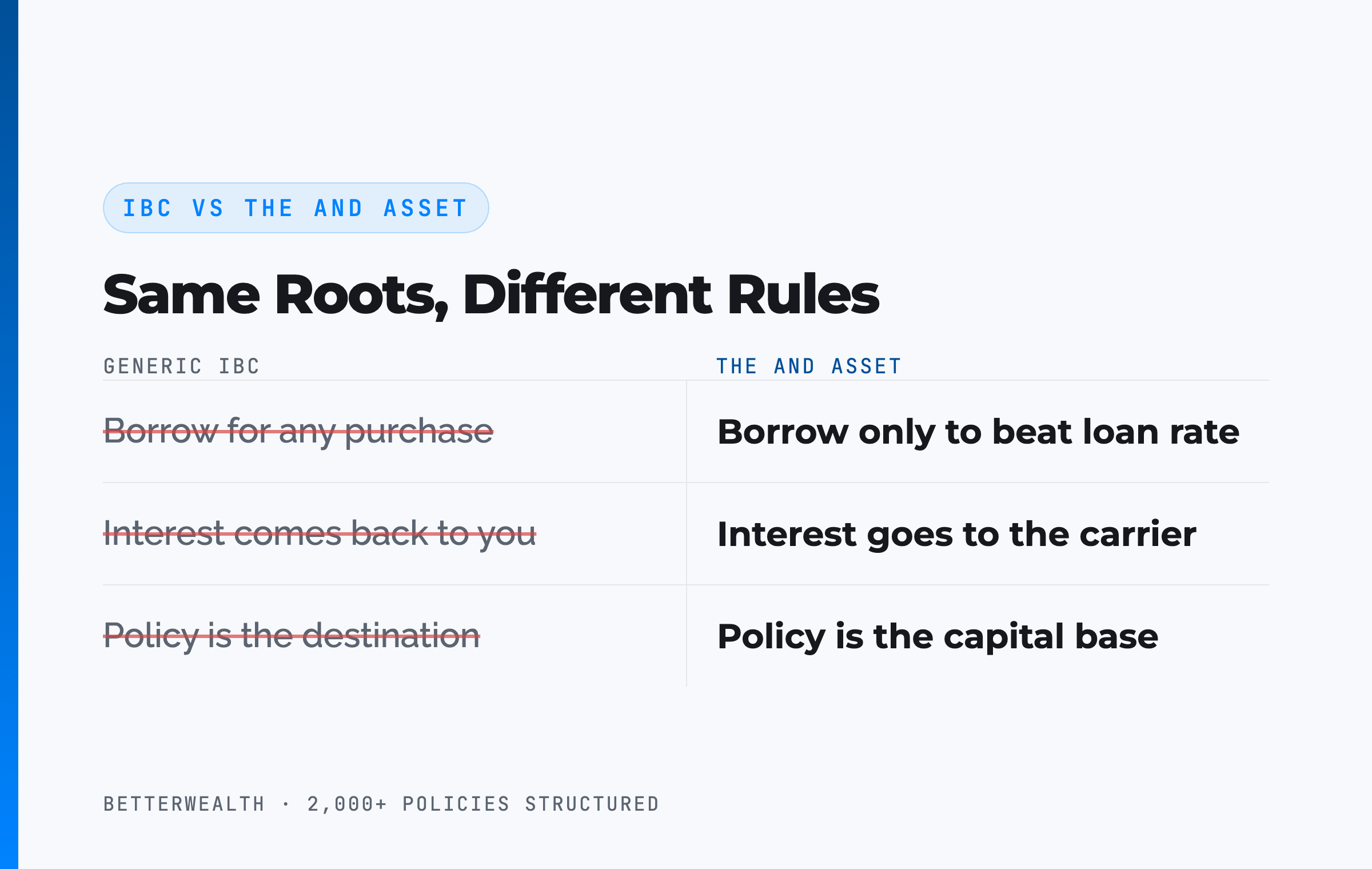
IBC says you can use a whole life policy as a personal bank for any purchase, from cars to vacations, and recapture the payments you would have made to a lender. The And Asset says you only deploy capital from the policy when the borrowed dollars will out-earn the carrier's loan cost, because anything less is an expensive way to spend money. Many IBC marketers also say you are paying yourself interest. You are not. The interest goes to the carrier. Your return is what the deployed capital earns elsewhere while the policy keeps compounding.
IBC content often frames whole life as the destination. The And Asset frames the policy as the capital base. The value is created in what you deploy that capital into: a rental property, a business acquisition, equipment that throws off margin. Palumbo's own best examples fit this test. He borrowed against his policy to buy a restaurant that now pays him an income stream, and he lends policy capital to his real estate LLCs, which repay the policy from rental income.
The math has to work. Every time.
03 / The 13.5% ClaimHow Can a Coordinated Plan Match a 13.5% Return?
A coordinated plan can match a 13.5% return because it changes how retirement assets are spent, not how fast any one of them grows. The policy itself does not earn anything close to 13.5%. A well-designed whole life policy earns a mid-single-digit long-term return that depends on the carrier, the design and a dividend scale that is not guaranteed. The edge comes from what the policy permits the rest of the portfolio to do.
The Spend-Down Plan
Palumbo's example starts at 65 with $2,000,000 in a brokerage account and a whole life policy whose death benefit has grown, through dividends and paid-up additions, from $2,000,000 at purchase to more than $4,000,000. The conventional advice is to withdraw 3 to 4% of the portfolio a year and hope it lasts. Palumbo does the opposite. He spends the brokerage account down, principal and interest, over about 15 years.
Around 80, when the brokerage account is spent, he begins drawing from the policy: withdrawals up to his cost basis first, then policy loans. At death, his family receives the death benefit minus the outstanding loans. He planned to leave $2,000,000 and treated the rest of the death benefit as spendable. The death benefit is what gives him permission to spend the portfolio instead of guarding it.
The Volatility Buffer
The second job is protection against sequence-of-returns risk. A retiree drawing from a portfolio in a year like 2008 has to sell assets at depressed prices to fund living expenses, and those losses never recover because the shares are gone. With accessible cash value, the retiree can stop portfolio withdrawals, draw from the policy for a year or two, and give the portfolio time to rebound. Palumbo calls it turning off one faucet and turning on the other.
This is The And Asset loan-rate test applied to retirement. The use of borrowed capital here is avoiding a forced sale at a loss. If the portfolio is down 25% and recovers, the loss you did not lock in is worth far more than a year of loan interest.
Selling in a crash is the expensive loan.
What the 13.5% Does and Does Not Mean
The 13.5% figure is Palumbo's model output: the steady yearly return, with no down years, a portfolio alone would need to produce the same lifetime spending and the same legacy. It depends on the assumptions in his model, including dividend scales, tax rates, and life expectancy, and dividends are not guaranteed. Treat it as an illustration of coordination, not a return you will earn. The defensible version holds under almost any assumption set: a plan that does not need a perfect sequence of returns is more reliable than one that does.
04 / How It WorksHow to Put a Whole Life Policy at the Center of a Capital Plan
Putting a policy at the center of a plan takes six steps, and the first two have nothing to do with insurance. Palumbo is direct on this: a client who walks in asking for $10 million of coverage does not get it until he knows what role it plays. The sequence below adapts his process to The And Asset discipline.
- Map every asset on one page. Palumbo uses a 27-element model grouped into protection, savings, and growth. The format matters less than the rule: every account, policy, property, and debt sits on one page, so you can see how a decision in one box affects the others.
- Tune the existing engine first. Contribute to a 401(k) up to the employer match, then redirect the rest. Set a liquidity target; Palumbo's rule is liquid assets equal to at least 50% of gross income, so a $250,000 earner holds $125,000. Close disability and liability gaps before adding a new asset.
- Design and fund the policy for cash value. Keep the base premium low and push the paid-up additions rider toward the limit without creating a modified endowment contract. Expect year-one cash value below the first premium and total cash value below total premiums until year five or later.
- Borrow only for a use that beats the loan rate. Before any policy loan, name the use and its expected return. If it does not clear the carrier's loan rate, do not borrow. If a cheaper outside loan exists for a purchase, take it and keep the policy capital available.
- Repay on a schedule. Repay the loan from the cash flow the deployed asset produces, on a written schedule. Palumbo's LLCs sign private mortgages to the policy owner and pay them back monthly. The discipline of repayment is the whole strategy.
- Coordinate retirement income. Spend down other assets on a set horizon, draw from the policy in down-market years or later in life, and monitor the loan balance. A policy that lapses with a loan outstanding can trigger a tax bill on the gain.
A Coordinated Policy Fits a Specific Person Doing Specific Things.
It Fits You If
- You already deploy capital into property, a business, or investments
- You can name a use for borrowed dollars that beats the loan rate
- You have a 10+ year horizon and steady funding capacity
- You want retirement income that does not depend on a perfect market
It Does Not Fit You If
- You need the cash in the next two or three years
- You want a savings account alternative
- You plan to borrow for purchases that cannot out-earn the loan
- You are carrying high-interest debt and need a quick fix
If you are in the first column, a 30-minute conversation will show whether the math works for your situation. If you are in the second, we will tell you that too.
Book a Discovery Call05 / The MathShould You Finance a Car Through Your Policy?
Usually not, if a cheaper loan is available. This was the sharpest exchange in the conversation. Palumbo said he would finance a car through his policy rather than take a cheaper car loan, because paying the policy back lets him recover the principal and use it again. Caleb pushed back: if the policy loan costs 6% and a car loan costs 4%, take the car loan, keep the liquidity in the policy, and stay ready for a better opportunity. Palumbo conceded the point. With a piece of real estate available, he would always choose the real estate.
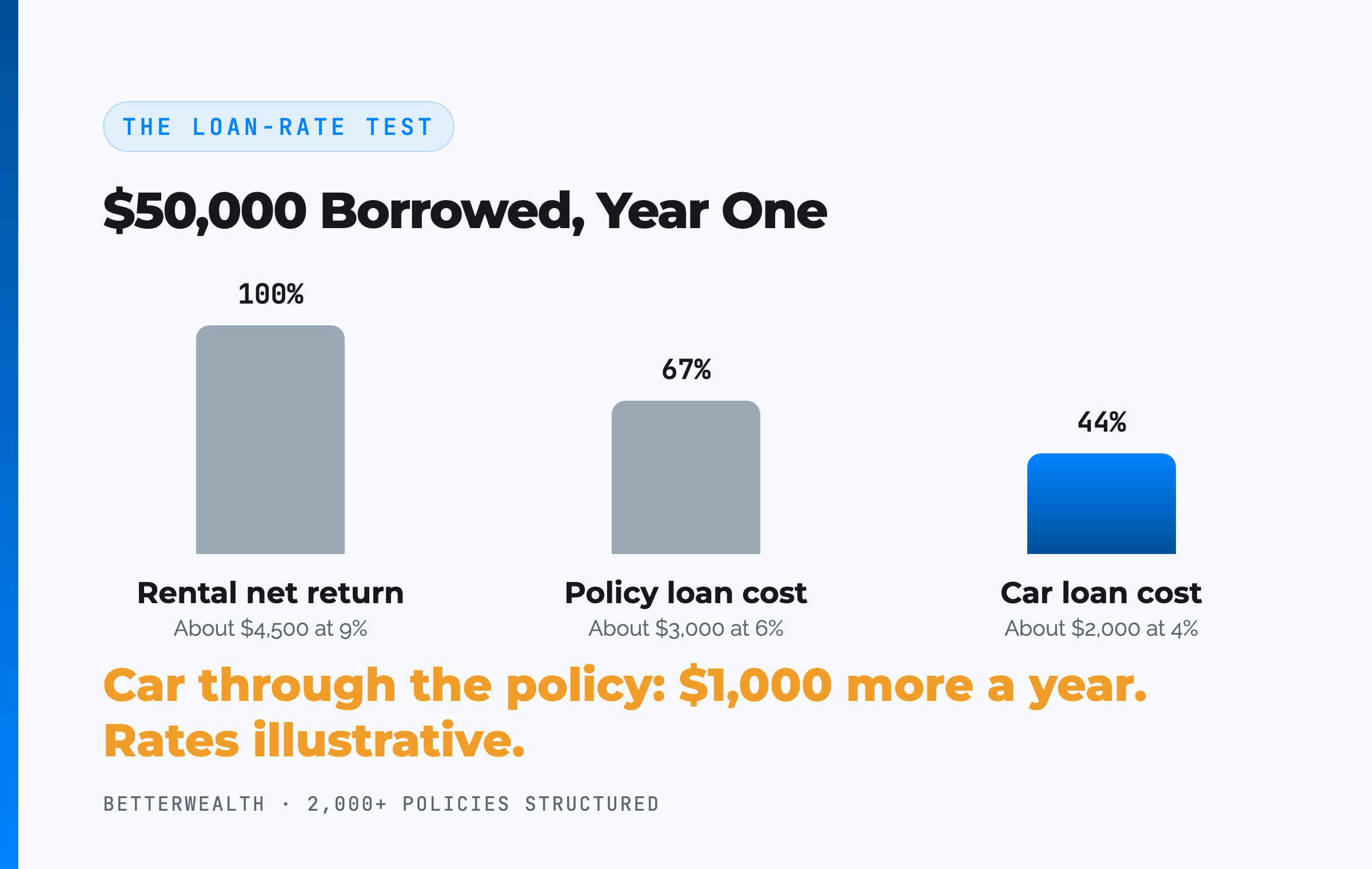
That exchange is the difference between generic IBC and The And Asset in one example. The recapture argument treats every dollar routed through the policy as a win. The And Asset compares rates. Here is the test in numbers, using illustrative rates that vary by carrier and time period:
- Borrow $50,000 from the policy at 6%: about $3,000 of interest in year one, paid to the carrier.
- Borrow $50,000 from a lender at 4%: about $2,000 of interest in year one.
- Keep the $50,000 of policy capacity for a rental that nets 9%: about $4,500 a year against $3,000 of loan cost.
The car is a depreciating purchase. The rental is a productive asset. Routing the car through the policy costs an extra $1,000 a year and ties up capacity the rental could have used. The same tool works for one decision and fails for another. The rate decides which.
Palumbo's own college example makes the same point from the other side. He took $200,000 from a 30-year mortgage at 2.875% to pay tuition by semester and left his investment account untouched through a long bull market. Borrowing at 2.875% while capital compounded at a higher rate is exactly the spread The And Asset looks for.
If a car loan is cheaper than your policy loan, take the car loan. Policy capital is for uses that can beat the loan rate, not for proving a point about recapture.
A Composite: The Real Estate Investor Who Became the Lender
Consider a 44-year-old real estate investor, preferred non-tobacco, funding a whole life policy at $61,300 a year with a 30/70 base/PUA split: $18,390 of base premium and $42,910 to the paid-up additions rider. This is a representative composite, not a single named client.
At year four, cash value sits at $239,880 against $245,200 paid in. Still behind, as a real policy should be. Year five crosses over. By year six, the policy holds $381,563 of cash value against $367,800 of premiums.
In year six, the investor borrows $213,500 against the policy and lends it to an LLC on a private note, the same structure Palumbo uses. The LLC puts $171,750 down on a $687,000 fourplex and spends $41,750 on renovation. After the bank mortgage and expenses, the property nets $26,870 a year. The policy loan, at an illustrative 5.4% that varies by carrier and time period, costs $11,529 in year one. The first-year spread is $15,341, and the projected IRR on the deployed capital, including the refinance and retained equity, is 11.3%.
Repayment runs on a written schedule. The LLC sends all $2,239 of monthly cash flow to the policy. A cash-out refinance after the renovation returns $148,300 in month 19, and the loan is fully repaid in month 38, with about $18,300 of total interest paid to the carrier. Through all 38 months, the cash value stayed in the policy as collateral and kept earning dividends net of charges, adjusted by the carrier's loan recognition method. The investor now owns a fourplex and has the full capacity to lend again.
One dollar. Two jobs. That is the And.
06 / Where It Goes WrongWhat Are the Biggest Mistakes With Infinite Banking?
The biggest mistake is borrowing without a return that clears the loan rate. Palumbo said he likes infinite banking when people understand it and that it is misused often. He named three patterns he has seen, and each one fails the same test.
- Taking a home equity loan to buy stocks. The investor pays a fixed loan cost against an asset that can drop 30% in a year. When the market falls, the loan stays.
- Sending policy loans into speculative private deals. Capital goes into a private equity deal that never closes or never pays. The loan interest compounds while the return is zero.
- Borrowing against real estate to pay life insurance premiums. Palumbo called this ridiculous. It takes a conservative asset and stacks debt under it, and it inverts the strategy: the policy is supposed to fund productive assets, not the other way around.
The Tax Claims That Need a Second Look
Marketers have ruined the way this should be explained, and tax claims are where it shows most. One example from the conversation: the idea that interest on a policy loan used to buy dividend-paying stock is deductible against the dividends. Interest deduction rules are narrow. They depend on how borrowed money is used and traced, whether you itemize, and what kind of income it produces, and personal interest is generally not deductible. Verify any deduction with a tax advisor before you count on it. We do not build plans around one.
The same care applies to "tax-free." Policy loans are generally not taxable income while the policy stays in force and is not a modified endowment contract. Withdrawals are generally not taxed up to your cost basis. A policy that lapses or is surrendered with a loan outstanding can create a taxable gain. Tax treatment is a structural feature with conditions attached, not a blanket promise.
The structure earns the tax treatment.
Borrowing against real estate to pay life insurance premiums is backwards. The policy funds productive assets. It is never the other way around.
07 / The TradeoffsBenefits and the Real Tradeoffs
The benefits of a coordinated whole life plan are real, and so are the tradeoffs. Palumbo opened his list of negatives with the first one: it is not a short-term play. Here is the full picture.
On the benefit side, the death benefit replaces the income a family would lose and gives a retiree permission to spend other assets. Cash value is not correlated with the stock market, which is what makes it useful as a volatility buffer. Creditor protection for cash value exists in many states, though the rules vary by state. A waiver of premium rider can keep premiums paid if the insured becomes disabled, and long-term care riders are available on some products.
On the cost side, early cash value is lower than premiums paid, and break-even takes five years or more. Mortality and expense charges reduce what compounds. Loan interest accrues and has to be managed. And insurability is not guaranteed. Palumbo described a client in his thirties who came in to increase his coverage with a lump on his neck. The application was declined, and he died of cancer before his second child was born. The coverage he already owned was what his widow received. Health you have today is an asset you can lose.
Who Whole Life Fits, and Who It Does Not
Whole life is one tool, not the answer for everyone. Palumbo was explicit that every plan is a fingerprint, and he named the cases where he would use something else. The profiles break down like this:
- The entrepreneur-investor, 35 to 55, with $200,000+ of income and capital already deployed. Long horizon, steady funding, specific uses for borrowed dollars. The strongest fit for The And Asset.
- The medical resident earning $70,000 on the way to $750,000. Convertible term now, sized to protect future income, with the option to convert to permanent coverage once cash flow supports it.
- The 65-year-old who is uninsurable. A annuity with a guaranteed lifetime income rider for guaranteed retirement income may fit better than forcing a policy that cannot be issued at reasonable cost.
- The household carrying high-interest debt. Not a starting point. Clear the debt first; the strategy compounds advantages over time and does not fix a cash crunch.
Palumbo's rule for the order of operations: tune up the existing engine before you turbocharge it.
The Frameworks Behind 2,000+ Policies, in One Place.
The Life Insurance Vault holds the calculators, design frameworks, and structuring decisions we use to decide whether a policy loan clears the bar. Free, email-gated, no spam.
Open the Vault08 / The Bigger PictureHow Does Whole Life Fit Into a Broader Capital Strategy?
Whole life fits as the hub of a capital strategy, with other assets as the spokes. Palumbo describes three layers of return. The internal rate of return is what an asset earns on its own. The external rate of return is what you earn by using that asset: equity pulled from a first condo to buy a second one that produces rent. The third layer, which he calls the eternal rate of return, is how assets perform together, and it is the hardest to calculate.
His claim is that two investors with the same capital can end up far apart if one understands the second and third layers, even when that investor's individual assets earn less. A policy earning a mid-single-digit return that allows a portfolio to avoid forced sales, a business to be financed on the owner's terms, and a retirement to be spent rather than hoarded is doing work that never appears in its own IRR.
The And Asset adds the guardrail. Coordination only creates value when each deployment clears the loan rate. A hub that funds depreciating purchases is a leak, not a hub.
09 / Head to HeadPolicy Loans Against the Alternatives
Compared to the ways entrepreneurs usually borrow, a policy loan trades a fixed repayment schedule for control and keeps the collateral working. The table compares four sources on $50,000 borrowed for one year. Rates are illustrative and vary by lender, carrier, and time period.
| Dimension | Whole Life Policy Loan | Bank Auto Loan | HELOC | 401(k) Loan |
|---|---|---|---|---|
| Interest on $50,000, Year One | About $2,500 to $3,000 at 5 to 6%, paid to the carrier | About $2,000 at 4%, paid to the lender | About $4,000 at 8%, paid to the lender | Interest goes back into your account, but the $50,000 is out of the market |
| What Happens to the Collateral | Cash value stays in the policy and keeps earning dividends net of charges, adjusted by the carrier's recognition method | The car secures the loan and depreciates | Home equity is pledged; the house is at risk on default | Investments are sold to fund the loan |
| Repayment and Control | No fixed schedule; unpaid interest is added to the loan, so a written schedule is your job | Fixed monthly payment set by the lender | Lender can freeze or reduce the line | Typically repaid within five years; leaving your employer can make it due sooner |
| Borrowing Limit | A carrier-set share of cash value, which takes years to build | Tied to the vehicle's price | A share of home equity, subject to underwriting | Lesser of $50,000 or half the vested balance |
Interest cost. A policy loan is not automatically the cheapest money. On $50,000, a 4% auto loan costs about $1,000 less in year one than a 6% policy loan. The policy loan earns its place when the use beats its rate, not because the interest goes somewhere friendlier.
Collateral. This is the policy loan's structural edge. The cash value keeps compounding while the loan is outstanding, while a 401(k) loan pulls money out of the market and a HELOC puts the house on the line.
Control and limits. No lender can freeze or reduce a policy loan the way a bank can freeze or reduce a HELOC line. That flexibility cuts both ways: with no required payment, unpaid interest compounds against you, and the borrowing limit depends on cash value you have to build first.
The Honest 30 Minutes About Whether This Fits You.
We have structured 2,000+ policies. We have seen this strategy work exactly as designed, and we have seen it fail. If you want a real conversation about whether The And Asset fits your situation, book a discovery call. We will give you the honest answer either way. No pressure, no pitch. If you would rather learn first, the The And Asset and BetterWealth YouTube channels go deep on the math.
Book a Discovery CallFAQInfinite Banking Strategy Questions
What is an infinite banking strategy?
An infinite banking strategy uses a properly structured whole life policy as a capital base you borrow against while the cash value keeps compounding net of mortality and expense charges. Nelson Nash introduced the idea in Becoming Your Own Banker.
What is The And Asset?
The And Asset is BetterWealth's framework for using a properly structured whole life policy as a capital base. You only borrow against it for an activity that produces a return greater than the carrier's loan cost, so your dollars do two jobs at once: the policy keeps compounding while the deployed capital earns its own return.
How is The And Asset different from infinite banking?
Infinite banking, built on Nelson Nash's work and as it is commonly marketed, frames a whole life policy as a personal banking system for any purchase. The And Asset shares those roots but operates on different principles: you only deploy borrowed capital when the expected return clears the carrier's loan rate, and the policy is the capital base, not the destination.
Can whole life insurance really beat a 13.5% return?
Not on its own. The 13.5% figure comes from Nick Palumbo's model of a coordinated retirement plan, where a portfolio alone would need a steady 13.5% every year to match the spending and legacy the plan produces. The policy does not earn 13.5%; the coordination of assets produces the result, and the figure depends on the model's assumptions.
What does money in motion mean?
Money in motion means the same dollar does more than one job instead of sitting still. In a whole life plan, the cash value keeps compounding as collateral while borrowed dollars are deployed into an investment, business, or property that earns its own return.
Should I finance a car through my life insurance policy?
Usually not if a cheaper loan is available. If a car loan costs 4% and your policy loan costs more, The And Asset says take the car loan and keep the policy capital available for a use that can out-earn the loan rate, such as a property or a business.
Is a policy loan taxable?
A policy loan is generally not taxable income as long as the policy stays in force and is not a modified endowment contract. If the policy lapses or is surrendered with a loan outstanding, the gain can become taxable, so loan balances need to be monitored.
Is the interest on a policy loan tax deductible?
Do not assume it is. Interest deduction rules are narrow and depend on how the borrowed money is used, how it is traced, and whether you itemize, and personal interest is generally not deductible. Verify any deduction with a tax advisor before counting on it.
Does the interest on a policy loan go back to me?
No. Many IBC marketers say you are paying yourself interest, but the interest on a policy loan goes to the insurance carrier. Your return comes from what the borrowed capital earns elsewhere while the cash value keeps compounding.
How long before a whole life policy has usable cash value?
A well-designed policy has some cash value in year one, typically a large share of the first premium, but total cash value trails total premiums for the first several years. Break-even usually arrives in year five or later for a healthy insured.
When should you not use whole life insurance?
Skip it when you need short-term liquidity, when you cannot name a use for borrowed capital that beats the loan rate, or when another tool fits better. A medical resident may be better served by convertible term, and an uninsurable 65-year-old may need an annuity instead.
What is the biggest mistake people make with infinite banking?
Borrowing without a return that clears the loan rate. Common examples include taking a home equity loan to buy stocks, sending policy loans into speculative private deals, and borrowing against real estate to pay life insurance premiums.
- Nelson Nash, Becoming Your Own Banker: the origin of the infinite banking concept.
- IRC Section 7702 (Cornell Law): the definition of life insurance that governs the tax treatment of cash value.
- IRC Section 7702A (Cornell Law): the modified endowment contract rules that limit how fast a policy can be funded.
- IRS: Retirement Plans FAQs Regarding Loans: the $50,000 and 50% limits on 401(k) loans.
- IRS Topic 505: Interest Expense: which kinds of interest are and are not deductible.
- LIMRA: life insurance industry research and persistency data.
- BetterWealth resources: The And Asset book, the The And Asset YouTube channel, and the BetterWealth YouTube channel.
Entered the life insurance business through Northwestern Mutual's college agent program at 21 and has worked in the field for 44 years. Plans with the LEAP (Lifetime Economic Acceleration Planning) model and is the author of You Have Infinite Power.
I founded BetterWealth to treat life insurance as the wealth and capital tool it actually is, not the product most people get sold. Our team has structured more than 2,000 policies across all 50 states. I wrote The And Asset and host the BetterWealth and The And Asset YouTube channels. If you want an honest read on whether an infinite banking strategy fits your plan, book a discovery call. We will tell you if it does not.