Infinite banking 3.0 is the third level of using a whole life policy: level 1 finances purchases through policy loans, level 2 borrows only to acquire assets that out-earn the carrier's loan rate, and level 3 adds a permanent death benefit and legacy plan on top of that asset-buying discipline.
Most people who practice infinite banking never get past financing cars. A car earns nothing, so every dollar of policy loan interest paid on it is a cost with no return to offset it. On a $58,000 vehicle, a 5.5% policy loan costs roughly $928 more in interest on the full balance for one year than a 3.9% dealer loan (illustrative rates).
The policy was built for a larger problem. Every dollar an entrepreneur commits to a single use carries a cost: interest paid to an outside lender to get capital back, or the lost opportunity cost of the deal that dollar could not fund. Nelson Nash addressed that problem in Becoming Your Own Banker, which argued for taking back control of the banking function. The idea spread. So did a simplified version of it, in which the policy becomes a way to finance cars and vacations.
I interviewed Barry Brooksby, a 25-year insurance practitioner and real estate investor who wrote Live Rich, Die Rich. He describes the progression as infinite banking 1.0, 2.0, and 3.0. His levels map closely onto what we teach at BetterWealth as The And Asset, with one difference that we make explicit below.
We have structured 2,000+ policies, and we have watched people use them at every level. What follows covers what each level is, where the car loan math breaks, how to set up level 2, what level 3 adds, and who should not borrow against a policy at all.
- Level 1 infinite banking finances cars and consumer purchases through policy loans, which rarely beats a competitive bank or dealer rate.
- Level 2 reserves policy loans for assets expected to earn more than the carrier's loan rate, such as cash-flowing real estate.
- Level 3 keeps the asset discipline and layers a permanent death benefit and a legacy plan on top of it.
- Policy loan interest goes to the carrier, never back to you; the return comes from what the deployed capital earns.
- During a loan, cash value keeps compounding net of mortality and expense charges, subject to the carrier's loan and dividend recognition practices.
- If no available use of borrowed capital beats the loan cost, The And Asset answer is simple: do not borrow.
The full interview is worth watching for the back-and-forth on car loans, where Barry and I agree on most of the math and work through the rest in real time:
01 / The ProblemWhy Most Infinite Banking Stops at Level 1
Most infinite banking stops at level 1 because financing a car is the easiest example to sell. Everyone buys cars. Everyone dislikes the dealer's finance office. An agent who says "finance your next car through your own policy" has a pitch that needs no spreadsheet.
The problem is that the pitch skips the comparison. A policy loan carries an interest rate set by the carrier. A car produces no return. If the dealer's rate is lower than the carrier's rate, the policy loan is the more expensive way to buy the same car, and the borrower has also used up capacity that could have funded something productive.
Marketers have ruined the way this should be explained. The car example gets people in the door, and many of them never hear that the policy was built for a different job.
"If your policy loan is 6% and you can go get the car loan at 3%, do not take a policy loan to go buy that car."
Barry Brooksby, on the BetterWealth show02 / The LevelsWhat Are Infinite Banking 1.0, 2.0, and 3.0?
Infinite banking 1.0, 2.0, and 3.0 are three stages of how a policy owner uses policy loans: for consumption, for assets, and for assets plus legacy. The policy can be identical at every level. What changes is the decision the owner makes each time capital leaves it.
Level 1: Financing Purchases
Level 1 uses the policy to buy cars or pay off other debt. The policy still grows, and the owner still has a death benefit. The loan itself earns nothing, so the interest paid to the carrier is a pure cost.
Level 2: Acquiring Assets
Level 2 treats the policy as an opportunity fund. Barry puts it plainly: the number one reason to take a policy loan is to buy assets and create more wealth. A rental property, an equipment purchase for a business, an acquisition. The borrowed dollars go somewhere that is expected to pay more than the loan costs.
Level 3: Assets Plus Legacy
Level 3 keeps everything from level 2 and adds the long view. The permanent death benefit becomes part of the plan, along with the estate design around it and the financial principles the owner wants the next generation to inherit with the money. Barry also uses "3.0" to describe his effort to clarify parts of Nash's original book that readers found confusing, using current illustrations.
Same policy. Three different owners.
03 / The FrameworkWhere IBC Ends and The And Asset Begins
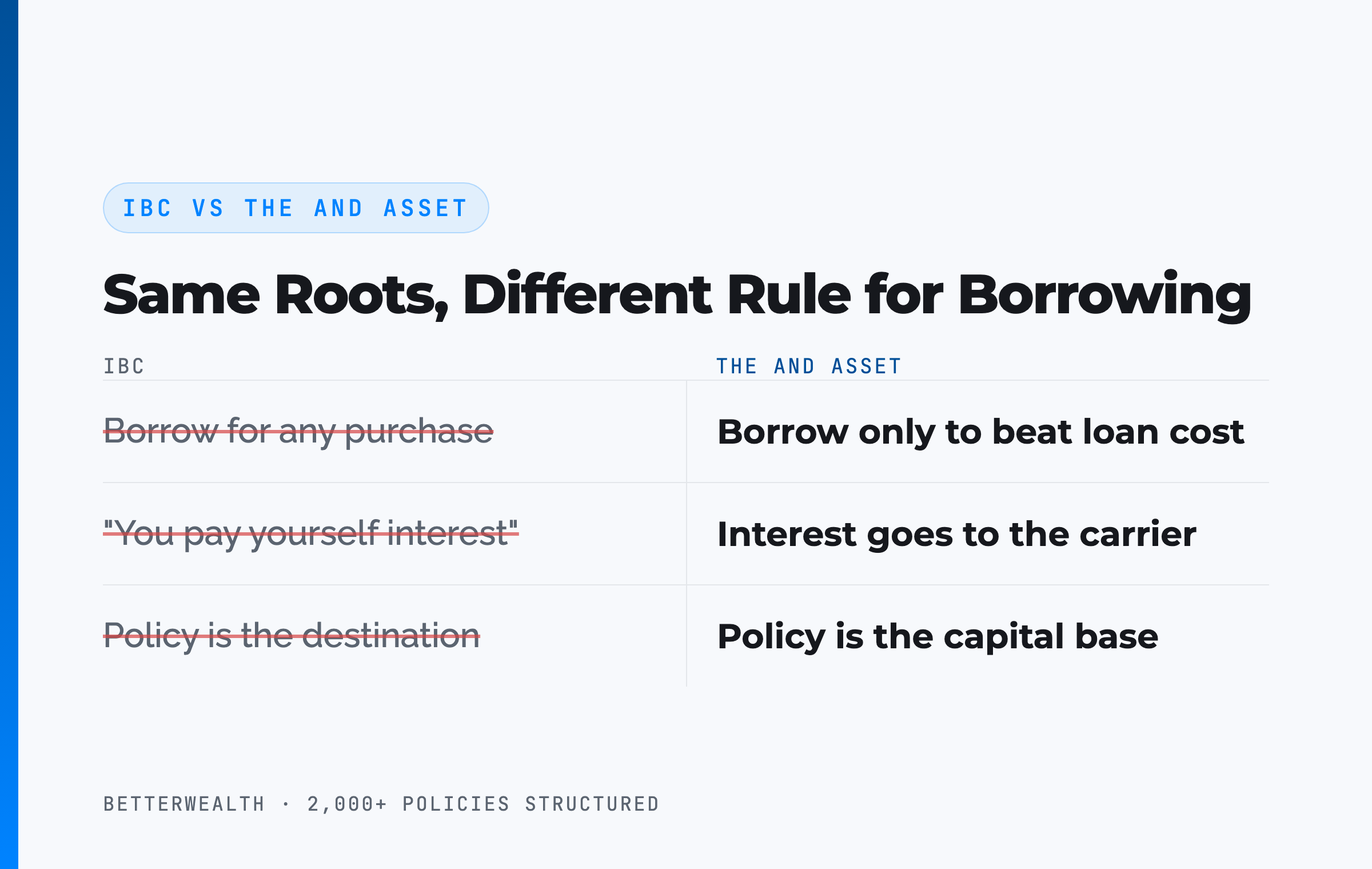
The And Asset begins where the loan decision gets a rule. Nelson Nash pioneered the use of whole life insurance as a personal banking system, and his insight about lost opportunity cost and interest paid to outside lenders is the foundation everything here is built on. The And Asset shares roots with IBC but operates on different principles.
IBC says you can use a whole life policy as a personal banking system for any purchase. The And Asset says you deploy capital from the policy only when the borrowed dollars are expected to return more than the carrier's loan cost, because a loan that earns less than it costs is an expensive way to spend money. Under that rule, level 1 fails the test. A car earns nothing, so the only question left is which loan costs least, and that is a financing decision, not an And Asset deployment.
Many IBC marketers say you are paying yourself interest. You are not. The interest goes to the carrier. Your return is what the deployed capital earns elsewhere while the policy keeps compounding net of mortality and expense charges. Two returns on the same dollar. That is the AND.
IBC content also tends to frame the policy as the destination. The And Asset frames the policy as the capital base, and the value is created in what the capital is deployed into. Levels 2 and 3 are where that framing becomes practical.
You are not borrowing your own money, and you are not paying yourself interest. The carrier lends you its money, holds a lien against your cash value, and collects the interest.
04 / Level 1Is Level 1 Infinite Banking Bad?
Not necessarily. Level 1 suits some people and fails others, and the difference is whether the choice is a principle or a math claim.
Nash held a principle of not doing business with banks. If you hold that principle, the rate comparison is beside the point, and that is a legitimate choice. What we object to is a principle presented as if it were math. Financing a car through a policy is not automatically cheaper, and anyone who says it is should show the two rates side by side.
The Car Loan Comparison
When the outside rate is lower than the policy loan rate, the outside loan wins on cost. Barry's last car purchase came with 0% dealer financing, and he took it.
We go a step further. Even when the car loan costs more than the policy loan (8% against 6%, for illustration), an entrepreneur with deals in view can be better off taking the car loan. Banks lend readily against cars and primary residences. They do not lend readily against a business idea or an unconventional deal. Borrowing capacity inside the policy is the scarce resource, so it belongs to the uses nobody else will finance.
That logic depends on the person. For a W-2 earner with no plans to deploy capital, the lowest rate is the right answer. For a business owner who expects double-digit returns on the next project, liquidity is worth a premium.
Take two business owners with the same policy and the same illustrative 5.5% loan rate. One borrows $58,000 for a personal vehicle the dealer would have financed at 3.9%, and pays roughly $928 more than necessary in interest on the full balance for one year. The other borrows $143,000 for the down payment on a rental that nets $14,157 a year against $7,865 of loan interest. Same policy, opposite results.
05 / How It WorksHow to Move From Level 1 to Level 3
Moving from level 1 to level 3 takes seven steps, and the first two happen before any loan is taken.
- Structure the policy for cash value. Use a low base premium and a large paid-up additions rider, such as a 30/70 base/PUA split, funded up to the limit that keeps the policy from becoming a Modified Endowment Contract. In a properly structured design, most of each premium dollar reaches cash value.
- Fund it and let it capitalize. Cash value trails cumulative premiums in the early years. A healthy individual typically reaches break-even in year 5 or later. Plan deployments around that timeline.
- Set the hurdle rate. Confirm the carrier's current loan rate. That number is the minimum expected return for any use of borrowed capital.
- Send consumer purchases to outside financing. For a car or anything else that produces no return, compare bank and dealer rates first. Keep the policy's capacity for assets.
- Deploy into a vetted asset. Borrow for something you understand. Barry's rule after losing $1.4 million in Las Vegas: start local, or use a turnkey provider you have vetted on occupancy, cash-on-cash return, and track record.
- Match repayment to cash flow. Track every loan in a simple spreadsheet. A rental that pays monthly supports an automatic monthly payment back to the loan. An asset with no cash flow needs a separate repayment source, and at minimum the annual interest gets paid so it is not added to the balance.
- Add the legacy layer. Decide what the permanent death benefit is for: beneficiaries, estate design, and the principles you want passed on with it.
The discipline of repayment is the whole strategy. A loan with no repayment plan compounds against the policy, and flexible repayment terms make that easy to ignore.
Levels 2 and 3 Fit a Specific Person Doing Specific Things.
It Fits You If
- You already deploy capital into a business or real estate
- You can name a use that beats the carrier's loan rate
- You can fund a policy for 10+ years
- You want a permanent death benefit in your estate plan
It Does Not Fit You If
- You mainly want to finance cars or vacations
- You are carrying high-interest debt
- You want a savings account substitute
- You have no plan for borrowed capital
If you are in the first column and want to know whether The And Asset adds anything to what you are already doing, book a discovery call. We will look at your situation and tell you honestly whether this makes sense. No pressure, no pitch.
Book a Discovery Call06 / The MathDoes the Deployed Capital Beat the Loan Rate?
The deployed capital has to earn more than the carrier's loan rate, or the loan should not be taken. That is the entire test at level 2.
The policy alone does not pass it. A policy growing at roughly 4.5% to 5% net against a loan costing 6% (illustrative figures) is not arbitrage. Anyone claiming the policy's growth by itself outruns the loan is selling. The spread comes from the second asset: the rental, the equipment, the acquisition.
The structure works like this. You borrow at the carrier's rate. The carrier lends from its general account and places a lien against your cash value, so the cash value is not withdrawn and the policy continues to earn on its full value, subject to the carrier's loan and dividend recognition practices. The deployed capital earns its own return. When that return exceeds the loan cost, one dollar has done two jobs.
Loan rates vary by carrier and time period. Barry's own outstanding loans sit at 4.85% and about 5.3%. Many carriers fall in the 5% to 6% range at the time of writing. Treat any number here as a variable to verify.
The math has to work. Every time.
A policy growing at 4.5% to 5% against a 6% loan is not arbitrage. The return has to come from what you deploy into, or you do not borrow.
07 / The VehicleWhy Whole Life and Not IUL or VUL?
Whole life is used for this strategy because its guaranteed cash value grows by contract and can be borrowed against from the early years, and most indexed or variable universal life designs do not offer both. Barry started his career in 2001 selling variable universal life with projected returns of 12% to 18%, and he watched clients lose money. His own VUL policy later collapsed. He names three problems, drawn from reviewing hundreds of illustrations.
- Surrender charges. Many IUL and VUL policies carry surrender charges that can last 10 to 15 years. A $10,000 premium may leave only $1,000 to $2,000 accessible early on, which defeats a strategy built on borrowing.
- Rising insurance costs. Universal life is built on annually renewable term pricing, so the internal cost of insurance climbs with age. If premiums do not rise to cover it, the cost is drawn from cash value.
- Illustrations that assume a gain every year. An IUL illustration commonly shows a level positive return, such as 6% or 6.5%, in every year. Markets do not behave that way, and years credited at the floor still carry policy charges.
As I said in the interview, Nash himself told people not to use universal life for this purpose. We take the same position for a narrower reason: a strategy that depends on borrowing against a stable capital base should not sit on a base that can shrink. Universal life can have a place in other planning, particularly when a team monitors it closely. That is a different job.
The Flexibility Objection
The usual case for IUL is premium flexibility, and a properly designed whole life policy has it too. One client Barry had in underwriting could fund up to $150,000 a year with a required minimum of about $8,000, and any amount in between. The base premium is the commitment. The paid-up additions rider is the adjustable part.
The Frameworks Behind 2,000+ Policies, in One Place.
The Life Insurance Vault holds the calculators and design frameworks we use when we structure policies and test whether a deployment clears the loan rate. Free, email-gated, no spam.
Open the Vault08 / Level 3What Does Level 3 Add?
Level 3 adds a permanent death benefit and a legacy plan to the asset discipline of level 2. At level 3 the policy is also part of what the owner leaves behind.
The planning effect shows up while the owner is alive. Conventional retirement advice often says to preserve principal and live on a modest withdrawal rate so that something remains for heirs. A permanent death benefit changes that constraint. An owner who knows a death benefit will replace capital at death has more room to spend down other assets during life.
The death benefit in a paid-up additions design also tends to grow over time. This answers a common objection, that the insurer "keeps your cash value" at death. In a policy that started with a $500,000 death benefit and grew for decades, the benefit paid can be several times the original amount. The cash value is the equity inside that death benefit, not a separate account the carrier retains.
Barry's version of level 3 includes one more piece we agree with: passing on financial principles along with the money. An inheritance without the discipline that built it rarely lasts.
There is an investing parallel. A beginning investor chases the highest return. A seasoned one tries to preserve principal and earn market returns with less risk. Level 3 thinking applies that second posture to the whole balance sheet.
09 / The TradeoffsBenefits and the Real Tradeoffs
The benefits of levels 2 and 3 come with five tradeoffs, and each one has ended the strategy for someone we have seen.
The benefits first. Cash value compounds uninterrupted, net of mortality and expense charges, while capital is deployed elsewhere. Access does not depend on a bank's approval or a lender's willingness to keep a credit line open. Repayment terms are set by the owner. The death benefit is permanent.
The tradeoffs are these:
- Early cash value is below premiums paid. Break-even typically arrives in year 5 or later. Capital needed in year 2 should not go into a policy.
- Loan interest is a real cost paid to the carrier. Unpaid interest is added to the loan and compounds.
- Deployments can lose. Barry lost $1.4 million in 2008 and 2009. The policy loan still has to be repaid when the asset underperforms.
- Flexibility invites poor decisions. No lender forces a repayment schedule, so the owner has to impose one.
- Dividends are not guaranteed. They are declared annually by the carrier, and illustrations are projections.
"You can lose money in real estate, and people do lose money in real estate. It takes work."
Barry Brooksby, on the BetterWealth show10 / The FitWho Should Move Up a Level, and Who Should Not?
Moving up a level makes sense for people who already have productive uses for capital, and each type of buyer has a different reason to do it.
- The business owner with recurring capital needs. Typically 35 to 55, income of $300,000 or more, comfortable with business risk, a horizon of 15+ years. Why it fits: a capital base for equipment, inventory, or acquisitions that return more than the loan rate, without waiting on a bank.
- The active real estate investor. Owns several rentals, net worth of $1 million or more, moderate risk tolerance. Why it fits: down payment capital on demand, paired with conventional bank financing for the rest of each purchase.
- The high-income professional with estate goals. A physician or executive earning $400,000 or more who has filled tax-advantaged accounts, with lower risk tolerance and a 20+ year horizon. Why it fits: a permanent death benefit for estate planning, with capital access as a secondary benefit used rarely. This person belongs at level 3 only if the death benefit is the goal, and they do not borrow unless a use clears the carrier's loan rate.
It does not fit someone early in building wealth, someone in high-interest debt looking for a fix, or someone whose only planned use is consumer purchases. We are not saying this is for everyone. If you cannot identify a use for borrowed capital that beats the loan cost, do not borrow.
11 / The Capital StackHow the Policy Fits a Broader Capital Strategy
The policy fits a broader capital strategy as one source of capital among several, used alongside banks. Barry still uses bank financing. On a typical real estate purchase he takes a policy loan for the down payment and a conventional mortgage for the remainder, which keeps the long amortization and lower payment of the bank loan while the policy supplies the cash a bank will not.
The same reasoning applies to home equity. Equity in a paid-off house is accessible only if a lender agrees to open or keep open a line of credit, and lenders tend to tighten at the moments capital is most useful. Cash value is accessible by contract. That is control of the banking function in practical terms.
None of this is an argument for more debt. Debt that funds consumption beyond your means is a problem at any rate. The claim is narrower: when the decision to buy an asset is already sound, having a ready source of capital adds options.
12 / Head to HeadLevel 1 vs Level 2 vs Level 3
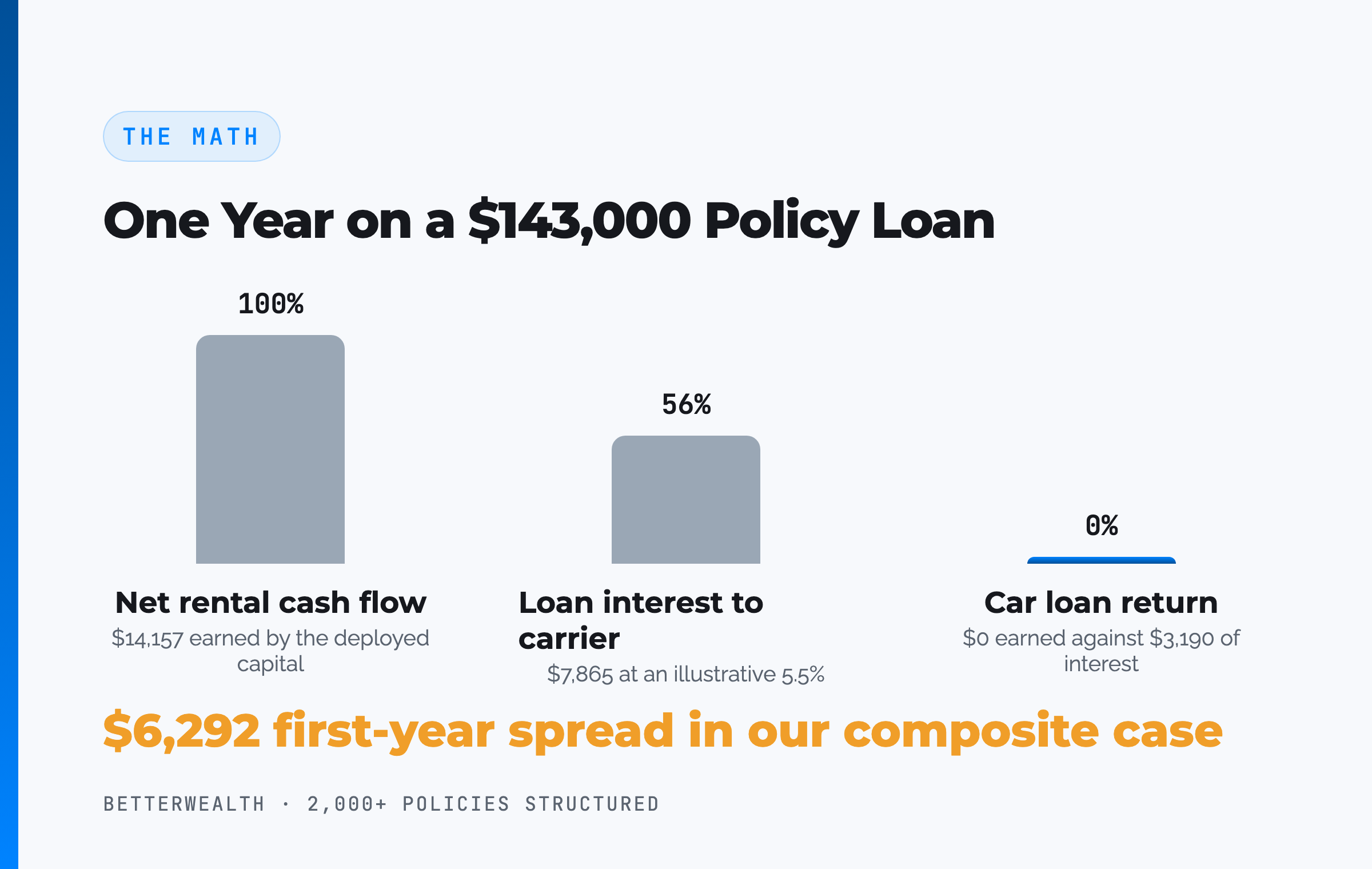
Compared side by side, the three levels differ in where the loan proceeds go and whether anything comes back. The dollar figures use an illustrative 5.5% policy loan rate and the numbers from the composite case below. Each interest figure is one year of interest on the full loan balance, before any paydown.
| Dimension | Level 1 | Level 2 | Level 3 |
|---|---|---|---|
| Use of the Loan | Cars, debt payoff, purchases | Assets expected to beat the loan rate | Same as level 2 |
| Interest on the Full Balance for One Year | $3,190 on a $58,000 vehicle | $7,865 on a $143,000 down payment | $7,865 on a $143,000 down payment |
| First-Year Return on the Loan | $0 | $14,157 net rental cash flow | $14,157 net rental cash flow |
| Net Result | $3,190 cost, or roughly $928 more than a 3.9% dealer loan | $6,292 positive spread | $6,292 spread plus a planned death benefit |
| Repayment Source | Personal income | The asset's cash flow, supplemented by business income | The asset's cash flow, supplemented by business income |
| Role of the Death Benefit | Incidental | Incidental | Central to the estate plan |
Use of the loan. Level 1 spends borrowed capital. Levels 2 and 3 place it. Only placed capital can produce the second return that The And Asset requires.
Cost and return. A $58,000 vehicle loan at 5.5% costs $3,190 in interest on the full balance for one year and earns nothing. A $143,000 loan into the rental costs $7,865 on the same basis and nets $14,157. The larger loan is the cheaper decision.
Repayment. At level 1 the owner repays from income that was already committed elsewhere. At levels 2 and 3 the asset's cash flow carries most of the repayment, and business income can shorten the schedule.
A Composite: The Business Owner Who Skipped Level 1
Consider a 43-year-old owner of a commercial HVAC company, in good health, funding a whole life policy at $60,000 a year on a 30/70 base/PUA split: $18,000 of base premium and $42,000 of paid-up additions. This is a representative composite, not a single named client.
Cash value trails contributions for five years: $222,800 against $240,000 paid by year 4, and $296,400 against $300,000 by year 5. It crosses in year 6. The $47,700 year 1 cash value and the year 6 crossover are illustrative figures for a 30/70 design, and actual values vary by carrier, age, and health. During that stretch the owner needs a vehicle and finances it through the dealer, leaving the policy untouched.
In year 6 a four-unit rental near his shop comes up at $547,000. He borrows $143,000 against the policy: $136,750 for the 25% down payment and $6,250 for closing costs and reserves. A bank finances the rest on a 30-year mortgage. After the mortgage, taxes, insurance, management, and a vacancy allowance, the property nets $14,157 a year, a 9.9% cash-on-cash return before any appreciation or principal paydown.
At an illustrative 5.5% loan rate, one year of interest on the full $143,000 balance is $7,865, paid to the carrier. The spread is $6,292. He sends $1,175 a month of rental cash flow plus $2,000 a month from business distributions back to the loan, which retires it in roughly 51 months. The policy continues to compound on its full cash value, net of mortality and expense charges, subject to the carrier's loan and dividend recognition practices.
One dollar. Two jobs. That is the AND.
A Real Conversation About Whether This Fits You.
We have structured 2,000+ policies. We have seen this strategy work exactly as designed, and we have seen it fail. If you want a real conversation about whether The And Asset fits your situation, book a discovery call. We will give you the honest answer either way. No pressure, no pitch. If you would rather learn first, The And Asset channel and the BetterWealth channel on YouTube go deep on the math.
Book a Discovery CallFAQInfinite Banking 3.0 Questions
What is infinite banking 3.0?
Infinite banking 3.0 is the stage where a whole life policy is used to acquire assets and to fund a legacy plan at the same time. Level 1 finances purchases, level 2 borrows only for assets that out-earn the carrier's loan rate, and level 3 adds a permanent death benefit and estate planning to that discipline.
What are the three levels of infinite banking?
The three levels are consumer financing, asset acquisition, and legacy. Level 1 uses policy loans for cars and debt payoff. Level 2 treats the policy as an opportunity fund for assets expected to beat the loan cost. Level 3 keeps level 2 and plans the death benefit for the next generation.
What is The And Asset?
The And Asset is BetterWealth's framework for using a properly structured whole life policy as a capital base. You borrow against it only for an activity expected to return more than the carrier's loan cost, so your dollars do two jobs at once: the policy keeps compounding net of mortality and expense charges while the deployed capital earns its own return.
How is The And Asset different from infinite banking?
The And Asset shares roots with infinite banking but operates on different principles. Infinite banking, as Nelson Nash taught it, frames a whole life policy as a personal banking system for any purchase. The And Asset says you deploy borrowed capital only when the expected return clears the carrier's loan cost, and if nothing clears it, you do not borrow.
Should you use a policy loan to buy a car?
Not as an And Asset deployment. A car does not produce a return, so it cannot clear the loan rate, whatever that rate is. What remains is a financing decision: compare the policy loan against bank and dealer offers and take the lowest cost. When an outside loan is cheaper or close, use it, and the policy's borrowing capacity stays available for assets a bank will not finance.
Are you borrowing your own money when you take a policy loan?
No. The carrier lends you money from its general account and places a lien against your cash value as collateral. Your cash value is not withdrawn, which is why the policy can keep earning on its full value while the loan is outstanding, subject to the carrier's loan and dividend recognition practices.
Do you pay yourself interest on a policy loan?
No. Policy loan interest is paid to the insurance carrier, not to you. Your return comes from what the borrowed capital earns in the asset you deploy it into, while the policy continues compounding net of mortality and expense charges.
Can you use IUL or VUL for infinite banking?
We do not use indexed or variable universal life for this strategy. Many of those policies carry surrender charges that limit early access to cash, their internal insurance costs rise with age, and their illustrations often assume a positive return every year. Universal life can have a place in other planning when it is actively monitored.
Is whole life insurance flexible enough for this strategy?
Yes, when the policy is designed with a low base premium and a large paid-up additions rider. In one case discussed in the source interview, a policy that accepts up to $150,000 a year carries a required minimum of about $8,000, and the owner can fund any amount between the two. Flexibility terms vary by carrier and design.
How should you repay a policy loan?
Match the repayment schedule to the cash flow of the asset the loan funded. A rental property that pays monthly can support an automatic monthly payment back to the loan. An asset with no cash flow needs a separate repayment source, and at minimum the annual interest should be paid so it is not added to the loan balance.
When does a whole life policy break even?
A well-designed policy for a healthy individual typically breaks even in year 5 or later. Cash value trails cumulative premiums through the early years because of insurance costs, and any illustration that shows break-even in year 1 or 2 should be treated with suspicion.
Who should stay away from policy loans altogether?
Anyone who cannot name a use for borrowed capital that is expected to beat the carrier's loan cost should not borrow. The strategy also does not suit people carrying high-interest debt or people looking for a savings account substitute.
- Nelson Nash, Becoming Your Own Banker: the origin of the infinite banking concept.
- IRC Section 7702A (Cornell Law): the Modified Endowment Contract rules that cap how fast a policy can be funded.
- Barry Brooksby, Live Rich, Die Rich: the guest's book and the source of the 1.0, 2.0, and 3.0 framing.
- Source interview: How To Level Up To Infinite Banking 3.0 on the BetterWealth YouTube channel.
- BetterWealth resources: The And Asset book, The And Asset YouTube channel, and the BetterWealth YouTube channel.
Guest on the BetterWealth show. An insurance practitioner since 2001 and a longtime real estate investor, he supplied the 1.0, 2.0, and 3.0 framing and the loan-tracking practices described here.
I founded BetterWealth to treat life insurance as a wealth and capital strategy for entrepreneurs, business owners, and high-income earners. Our team has structured 2,000+ policies across all 50 states. I wrote The And Asset and host the BetterWealth and The And Asset YouTube channels. If you want an honest read on whether infinite banking at level 2 or 3 fits your plan, book a discovery call. We will tell you if it does not.