
An ICHRA (individual coverage health reimbursement arrangement) lets an employer of any size give each employee a fixed, tax-free monthly allowance to buy their own individual health plan, instead of carrying one group policy. The employer caps its cost, and each employee picks from the 50 to 200 plans available where they live.
Health insurance rarely shows up in a conversation about capital strategy, and that is a mistake. For a business owner it is often among the largest line items, second only to payroll by the estimate of Brad Owens, a health insurance broker who joined us on the BetterWealth Show. For a couple retiring at 60 it can be the single expense that decides whether they retire at all. Owens expects one of every five dollars in the economy to go to health care, and General Motors spends more on health insurance than it does on steel.
The cost is only half of the problem. The other half is volatility. Once a group is rated on its own claims, which applies to groups above 50 employees and to level-funded or self-funded plans of almost any size, a renewal can come in 5% higher one year and 80% higher the next because one employee was diagnosed with something expensive. Owens saw 80% renewals this year. Million-dollar claims, which used to be a once-in-a-career event, are up 46% in four years by his count. Every dollar a business owner loses to an unpredictable health plan is a dollar that cannot be deployed into the business, a property, or a policy that compounds.
At BetterWealth, we do not sell health insurance. We have structured more than 2,000 whole life policies for entrepreneurs, business owners, and high-income earners, and we care about this topic for one reason: health costs leak capital, and a leak that size changes every other number in a financial plan. That includes how The And Asset gets used in the years before Medicare.
This article covers how to compare health plans on worst-case cost, why bronze plus an HSA often beats gold, what ICHRA is and how employers use it, why it stabilizes costs over time, and how the ACA subsidy cliff creates a case where a policy loan can clear the loan rate by a wide margin.
- An ICHRA gives each employee a fixed monthly allowance to buy individual coverage, replacing one group plan with 50 to 200 choices.
- Group plans rated on their own claims can renew anywhere from 5% to 80% higher, while the individual market pools about 25 million people.
- Employers can set different allowances by class, such as hourly versus salaried or by state, but cannot favor owners.
- Bronze plus an HSA usually beats gold once premiums are counted, even for people with a known surgery coming.
- Near the ACA subsidy cliff, one extra dollar of income cost a retired couple about $30,000 a year in premiums.
- Policy loans are generally not taxable income, so The And Asset can fund bridge years without pushing MAGI over the cliff.
Brad walks through his ICHRA slides on screen, including the plan-tier mix employees actually chose and the renewal cycle that traps small groups. The full conversation also covers health shares and Medicare timing in more depth than this article does.
01 / The ProblemWhy Is Health Insurance a Capital Problem for Business Owners?
Health insurance is a capital problem because it is a large cost that you cannot forecast, and unforecastable costs force you to hold idle cash. A business owner who cannot predict next year's renewal keeps a reserve against it. A retiree who cannot predict premiums from 60 to 65 delays the retirement. Both are paying an opportunity cost on top of the premium.
One episode frames the scale. Warren Buffett, Jeff Bezos, and Jamie Dimon combined the buying power of Berkshire Hathaway, Amazon, and JPMorgan to fix employer health care for their own workforces. They gave up. The long-term fix is probably legislative. Between now and then, the people who do well are the ones who manage the cost structure they control.
The first principle is asset protection. Going uninsured works only for someone with nothing to lose, because hospitals forgive bills they cannot collect. The threshold is low: if you earn more than about $50,000 a year or hold assets beyond your home and retirement account, one $50,000 knee surgery or one helicopter transport can undo years of work. Surgeons and specialists are not bound by a hospital's charity program.
Insurance is there to cap the worst case.
Picking the highest deductible is no longer the safe default. With million-dollar claims now routine, run the worst-case math on every plan before you assume the cheapest premium wins.
02 / The MathHow Do You Compare Two Health Plans in Five Minutes?
You compare two health plans by adding the annual premium you pay to the plan's maximum out-of-pocket, which gives you your worst-case cost for the year. Deductibles, copays, and coinsurance matter, but every one of them sits under that ceiling. Once you know each plan's worst case, you weigh it against your own health and the size of your emergency fund.
The mechanics are simple. You pay a premium whether you use the plan or not. You pay the deductible before coverage starts, anywhere from $0 to the highest Brad has seen, $10,600. After the deductible you share costs through coinsurance until you hit the maximum out-of-pocket, and from there the carrier pays 100%.
Why "Always Pick the Highest Deductible" No Longer Holds
Ten years ago the rule was to close your eyes and pick the highest deductible. That rule assumed carriers priced mostly on routine, first-dollar claims. They now price heavily on tail risk: the rising share of claims above $1 million. A higher deductible shifts routine costs to you, but it does little to reduce the carrier's exposure to the catastrophic tail, so the premium discount is smaller than it used to be. Run the worst-case math every year.
If the worst case on a cheaper plan would wipe out your reserve, there is a third option between paying more premium and taking the risk. Supplemental GAP plans cover the gap between your deductible and real protection. A GAP plan can turn a bronze plan into near-gold coverage for about $35 a month, where the same upgrade through a major carrier costs around $200 a month for an individual, by Owens's figures.
Every plan forces a trade.
Everyone wants a plan that is good, simple, and affordable, and today you get two. Most people who want good and affordable give up simplicity: a high deductible plan plus a supplement, or a health share plus a reserve. The question is whether the added complexity pays enough to be worth managing.
03 / The HSA CaseIs a Bronze Plan With an HSA Better Than a Gold Plan?
A bronze plan paired with an HSA often beats a gold plan once you count premiums, even for people who know they have medical costs coming. Brad Owens says he cannot recall recommending a gold plan in 2026. Several clients came to him with a scheduled surgery, and after running the numbers the bronze plan plus HSA still won.
Plan tiers measure actuarial value, the share of total medical costs the carrier is expected to pay across everyone on that tier. Under the ACA, bronze plans target about 60%, silver about 70%, gold about 80%, and platinum about 90%, each within a narrow allowed range. A gold plan is better coverage by definition. It also costs far more in premium, and actuarial value ignores premium entirely.
The HSA is what flips the math. Contributions are deductible, growth inside the account is not taxed, and withdrawals for qualified medical expenses are not taxed. Starting in 2026, bronze and catastrophic marketplace plans are HSA-eligible. The premium you save by not buying gold can go into the HSA, and those dollars stay yours if you stay healthy.
The policy logic behind high deductible plans is the third-party payer problem. When the person choosing care is not the person paying for it, nobody shops on price. An HSA puts the first few thousand dollars back in your hands, which is why HSA eligibility has historically been limited to high deductible plans, now expanded to bronze and catastrophic marketplace plans.
04 / Your OptionsWhat Options Do Self-Employed People and Small Teams Have?
Self-employed people and small teams without a group plan choose between two markets: guaranteed issue and underwritten. Guaranteed issue plans must accept everyone at the same price regardless of health, so they carry the highest rates, because roughly 5% of people drive about half of all claims. Underwritten plans price your health, so a healthy applicant usually does better there.
The intake questions are health history, pre-existing conditions, and income. Income matters because ACA subsidies are based on MAGI, modified adjusted gross income, and many business owners show a lower MAGI than they expect once retirement and HSA contributions come off. Well-paid families with three or four children sometimes still qualify. If a subsidy is available, take it.
If no subsidy is available and you are healthy, the field opens up: health shares, association plans, short-term medical (some states have allowed terms up to three years, but federal and state limits on short-term plans have changed recently, so check current rules), multiple-employer plans, and PEOs that accept single-owner companies. Each has a catch worth knowing before you sign.
The Two Risks Most People Miss
The first is renewability. Many short-term and underwritten plans review you every year and can decline to renew you. Get cancer on one of those plans and you are pushed back to the guaranteed issue market at the worst possible time. Some health shares offer perpetual insurability, meaning you stay on the plan after you get sick.
The second is the guarantee itself. A health share is not an insurance contract. It has a social obligation to pay, not a legal one. If you go that route, pick one with a large membership. A guarantee is only as strong as whoever stands behind it.
Read the contract, not the brochure.
05 / The FrameworkWhat Is an ICHRA and How Does It Work?
An ICHRA is an arrangement in which the employer sets a monthly allowance and reimburses employees, pre-tax, for individual health insurance they choose themselves. The rule was finalized in 2019, and employers have been able to use it since 2020. Brad Owens describes CHOICE (Custom Health Option and Individual Care Expense arrangement) as a proposed new name for ICHRA; confirm its status before relying on it.
The shift mirrors the move from pensions to 401(k) plans. The employer stops owning an open-ended benefit and starts funding a defined contribution. In practice, the employer says: here is $500 a month, and here are 200 plans in your county. Pick one. If the plan costs more, the employee covers the balance (see step 5 below for how that balance is paid).
How an Employer Moves to an ICHRA
- Pull the census. Every payroll system has a canned census report: names, ages, home ZIP codes, and what each employee pays today.
- Gather the current plan documents. Benefit summaries or last year's benefits booklet let a broker model the current plan against the individual market. A broker with modeling software can usually return a proposal within a week.
- Define classes and allowances. Set allowances by legitimate class: full-time versus part-time, hourly versus salaried, seasonal, union, or state of residence. Age-band within IRS rules so older employees, whose plans cost more, receive more.
- Enroll employees in individual plans. Each employee picks an ACA-compliant plan from the 50 to 200 options in their county. Employees 65 and older may choose Medicare instead (see section 06 for the limits).
- Reimburse and verify. Reimburse up to each allowance tax-free to the employee and verify that each employee has qualifying coverage. For off-exchange plans, employees can usually pay any balance pre-tax through payroll. Marketplace plans cannot be paid that way.
The Rules That Trip People Up
You cannot be inherently discriminatory. Pre-tax benefits come with rules that bar pushing the benefit toward owners or the highest earners, so every class has to make sense on its own terms. You can keep a group plan for one class and run an ICHRA for another, and a common first step is keeping salaried staff on the group plan while hourly staff move to the ICHRA. You cannot offer both to the same person.
Most health shares do not qualify for reimbursement, because ICHRA requires ACA-compliant coverage, including preventive care. And you do not have to replace your broker. Platforms built for ICHRA let an existing broker keep the relationship and the compensation.
Size is not the barrier people assume. An ICHRA works for a team of two. By Owens's figures, the fastest growing segment is companies with more than 1,000 employees, up 170% last year, the largest covers about 20,000, and only about a third of group health brokers have ever written one.
Most business owners have never heard of an ICHRA because two of every three group brokers have never written one, and a group renewal is less work.
06 / The SavingsWhy Does an ICHRA Cost Employers Less Over Time?
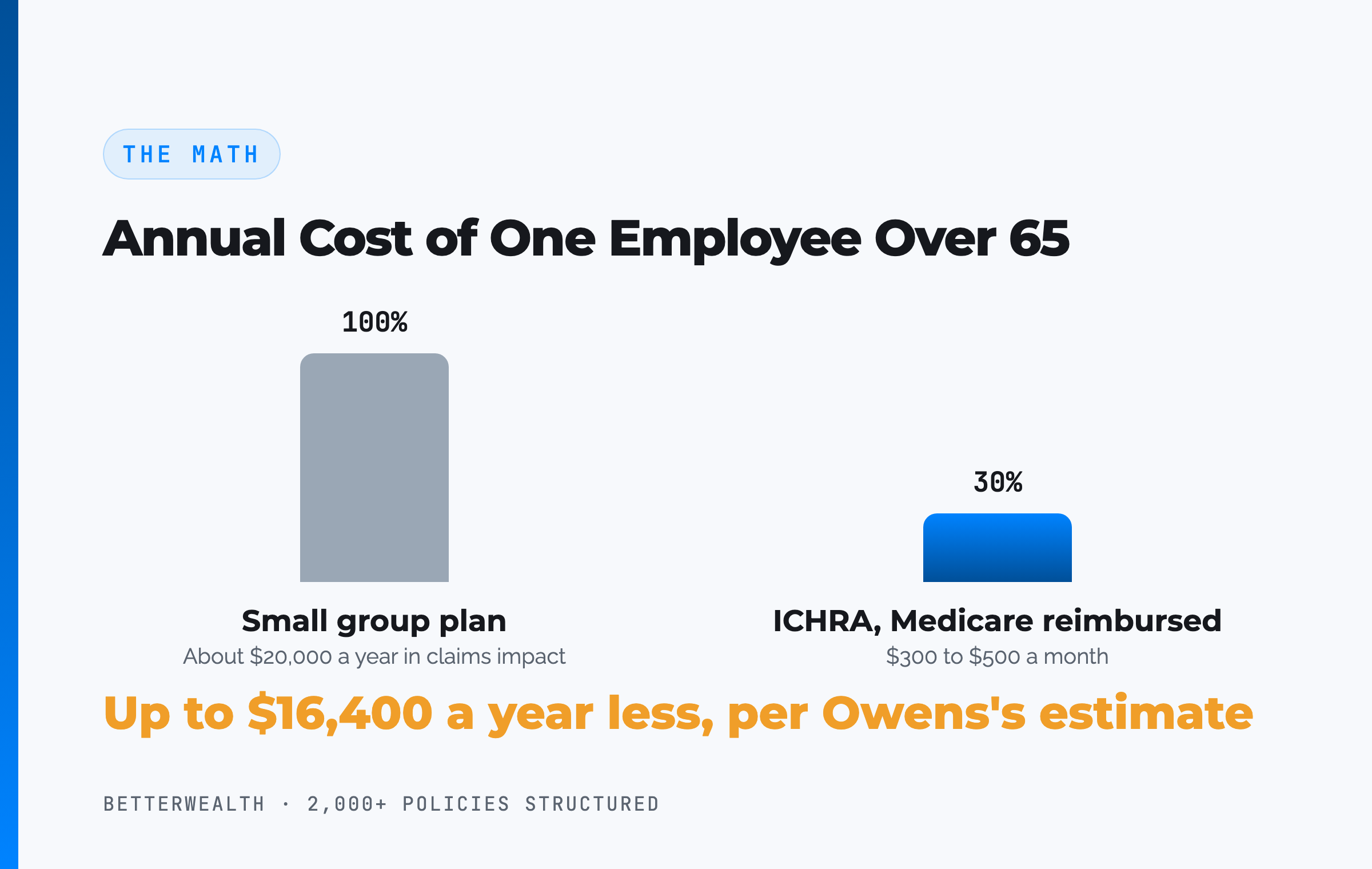
An ICHRA costs employers less over time because it moves employees out of a small risk pool, where one sick person sets the price, into an individual market of roughly 25 million people, where no single claim moves the rate. There are five sources of savings, and claims come first.
Groups above 50 employees, and level-funded or self-funded plans below that size, are rated on their own claims. Fully insured ACA small groups are community-rated instead, which is why claims-driven renewal shocks hit the first category. One child on a cystic fibrosis drug costs about $500,000 a year by Owens's estimate, and spread across 50 employees that one claim can consume the entire budget. Employers in that position have saved over $1 million by leaving a group plan after a 50% renewal. The second source is geography: one group plan rarely fits employees in Maine, Florida, Washington, and California, while an ICHRA lets each employee buy where they live. The third is age: the 25-year-old and the 64-year-old in accounting get plans that fit them. The fourth is conceptual alignment, meaning the employer stops underwriting an open-ended cost. The fifth is the cap: the allowance is a fixed number the employer sets.
The Renewal Treadmill
Claims-rated group plans renew every year, and the renewal arrives 60 to 90 days before the plan date. It is always an increase. A 5% increase is a good year. Owens saw 80% increases this year. A group with a known high claimant that tries to shop its plan gets declined by every other carrier, and the remaining options are cutting the plan, cutting the employer's contribution, or asking the incumbent for a favor. Level-funded, captive, and self-funded plans all try to give the employer more control, and all of them still put the employer on the hook for the next large claim.
An ICHRA gets you off that cycle.
Employees Over 65 and the Valuation Question
Employees who keep working past 65 are not required to move to Medicare, and an employer cannot pressure them to. Owens estimates each one who stays on a small group plan costs about $20,000 a year in claims impact. Under an ICHRA, employees 65 and older may choose Medicare and have the employer reimburse it, typically $300 to $500 a month for a strong Medicare plan. Employers with 20 or more employees face Medicare Secondary Payer limits on how that can be offered, so confirm the design with benefits counsel before you build a plan around it.
Health plans also show up in an exit. When a buyer runs diligence on your company, they look at the health plan and its claims, and a group plan with heavy claimants can lower the price or break the deal. An ICHRA is simple to review, so it holds up well in diligence.
The employees appear to agree. On Owens's platform, gold-tier selections rose 30% after employers moved to an ICHRA. Most did not default to the cheapest plan they could find.
Health Costs Are One Leak. The And Asset Addresses Another.
A Conversation Fits If
- You own a business and deploy capital into it or into real estate
- You can name a use for borrowed capital that beats the loan cost
- You are planning a retirement before Medicare age
- You want a capital base you control, not a savings account
It Does Not Fit If
- You are looking for health insurance (we do not sell it)
- You are carrying high-interest debt and need a quick fix
- You want a replacement for your 401(k)
- You have no clear use for borrowed dollars
If you are in the first column, a 30-minute discovery call will tell you whether a policy belongs in your capital structure. If you are in the second, we will tell you that too.
Book a Discovery Call07 / The CliffHow Does the ACA Subsidy Cliff Connect to The And Asset?
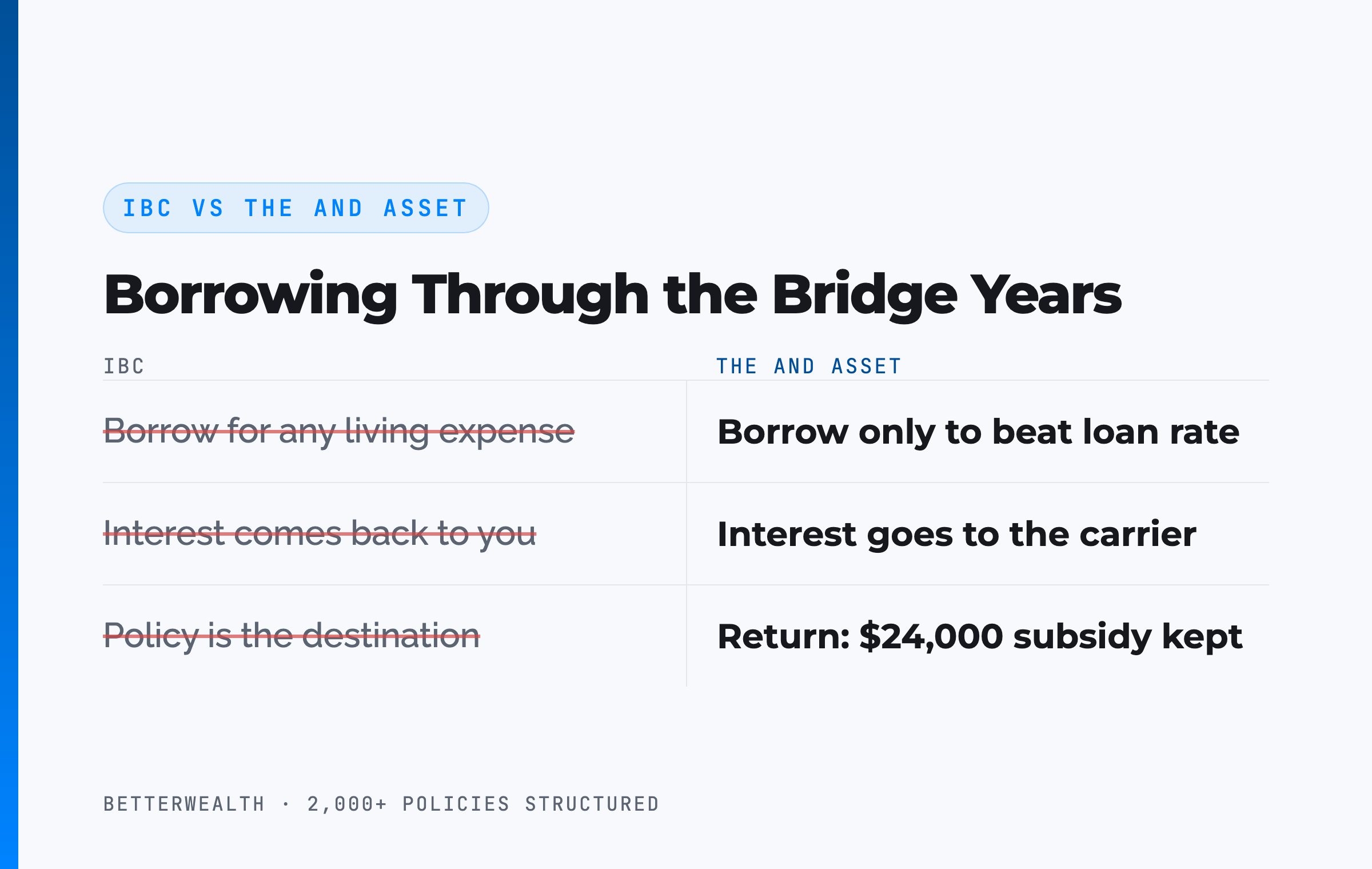
The ACA subsidy cliff connects to The And Asset because policy loans are generally not taxable income, so they let a pre-Medicare retiree fund spending without raising the MAGI that decides their premium. For a household sitting just over the cliff, that difference can be worth tens of thousands of dollars a year.
Brad's example is two 60-year-olds planning to live on about $100,000 a year from pensions and savings. For a household of two in 2026, the subsidy cutoff sat around $85,000 of MAGI. The subsidy does not phase out gradually. One dollar under, they had an affordable plan. One dollar over, they faced about $30,000 a year in premiums for five years until Medicare. Working with their financial advisor, Owens got them under the line with HSA contributions and IRA timing, and they landed at about $500 a month.
There is a limit. The approach only works within roughly $15,000 to $20,000 of the cutoff, and a projection that lands right at the edge can fail. A $10,000 scratch-off win in the wrong year could cost that couple $30,000.
Where IBC Ends and The And Asset Begins
Nelson Nash pioneered the idea of using whole life insurance as a personal banking system in Becoming Your Own Banker. We respect that foundation. The And Asset shares roots with IBC but operates on different principles.
IBC says you can use the policy as a personal bank for any purchase, including living expenses in retirement. The And Asset says you only borrow when the borrowed dollars out-earn the carrier's loan cost, because anything less is an expensive way to spend money. A loan that keeps MAGI under the cliff clears that bar on paper: at an illustrative 6% loan rate, $21,300 of borrowing costs about $1,278 in first-year interest and protects roughly $24,000 a year in subsidies. The real comparison is narrower than that: the loan is replacing a larger IRA withdrawal, which would count toward MAGI. Roth withdrawals, cash, and the cost basis in a brokerage account also stay out of MAGI, so a household with enough of those may find them cheaper than borrowing. The loan earns its place only when those sources are thin or are doing a better job elsewhere.
Many IBC marketers will tell you that you are paying yourself interest on that loan. You are not. The interest goes to the carrier. Your return is the subsidy you keep. Meanwhile the policy keeps compounding net of mortality and expense charges, and how the borrowed portion is credited depends on whether the carrier uses direct or non-direct recognition.
The math has to work, or you do not borrow.
Precision matters here. Loans from a policy that is not a modified endowment contract and stays in force are generally not taxable income under the rules in IRC Section 7702 and related sections. If the policy lapses with a loan outstanding, the gain can become taxable. Confirm how the loan interacts with your MAGI with a tax advisor before you rely on it.
A Composite: The Business Owner Who Bridged to Medicare Under the Cliff
Consider a business owner who started a whole life policy at 46, built for cash value, and sold the business at 61. This is a representative composite built on Brad's subsidy-cliff example, not a single named client.
The premium was $24,000 a year, split $7,200 base and $16,800 paid-up additions, a 30/70 design. Year one cash value was $15,900, well under the $24,000 contributed. The policy reached break-even in year six, at $146,700 of cash value against $144,000 paid in. By the sale at 61, after 15 years of premiums totaling $360,000, cash value stood at $441,300.
The couple planned to spend $100,700 a year. Pensions, a part-time consulting fee, and IRA withdrawals produced $79,400 of MAGI after HSA contributions, $5,600 under the roughly $85,000 cliff. They kept that $5,600 as a buffer instead of borrowing $5,600 less, because a projection that lands at the edge can fail: one unexpected distribution or a larger consulting fee would cost about $24,000 in lost subsidy, against roughly $336 a year of interest on $5,600 at 6%. They covered the remaining $21,300 each year with a policy loan instead of a larger IRA withdrawal. That kept them on a subsidized plan at about $500 a month, or $6,000 a year, rather than about $30,000 unsubsidized. The avoided premium came to about $24,000 a year and $96,000 over four years. Their Roth balance was small and their cash reserve was earmarked for the business sale's tax bill, so the honest comparison was the loan against a larger IRA withdrawal. A couple with ample Roth money or cash would likely bridge more cheaply with those before borrowing.
At an illustrative 6% loan rate, the four loans accrued roughly $13,100 in interest by 65, for a balance near $98,300. Once Medicare began, MAGI no longer set a marketplace subsidy, so they took larger IRA distributions and repaid the loan on a 47-month schedule. Medicare Part B and D premiums carry IRMAA surcharges based on MAGI from two years earlier, so the repayment distributions were sized to stay under the IRMAA thresholds. The policy kept compounding net of mortality and expense charges, and how the borrowed portion was credited depended on whether the carrier uses direct or non-direct recognition.
One dollar. Two jobs. That is the And.
The Frameworks Behind 2,000+ Policies, in One Place.
The And Asset Vault holds the calculators, design frameworks, and structuring decisions we use when we model a policy against a client's real cash flow, including the years before Medicare. Free, email-gated, no spam.
Open the Vault08 / The MistakesWhere Do People Get Health Insurance Wrong?
People get health insurance wrong by optimizing for the monthly premium instead of the worst case, and by taking advice from someone with one product to sell. Work with someone who has multiple options and no reason to push one.
The advice to skip insurance entirely works only when you have nothing to protect. Hospitals forgive. Surgeons, specialists, and anyone scheduling elective care often will not see you. For anyone with assets, going uninsured trades a known premium for an unlimited liability.
Financial advisors make a different error: they ignore health insurance in retirement projections. Owens works with clients who did everything right for decades and still cannot retire at 60 because nobody planned for the five years before Medicare. COBRA runs 18 months and costs up to 102% of the full plan cost, so it rarely solves the problem. The sequence of withdrawals (Roth first, IRA timing, HSA contributions, policy loans) decides whether a household lands under the cliff or over it.
You control two numbers. Premium plus maximum out-of-pocket is your worst case, and MAGI decides your subsidy. Near the cliff, one dollar of MAGI was worth about $30,000 a year.
09 / The TradeoffsBenefits and the Real Tradeoffs of an ICHRA
An ICHRA's benefits are a capped, predictable cost for the employer and real choice for the employee. Its tradeoffs are complexity, dependence on the individual market, and the change-management work of moving people off a familiar plan.
On the benefit side: the employer sets the number, large claims stop driving renewals, employees in different states get plans that fit where they live, and employees over 65 may choose Medicare and have it reimbursed. On the cost side: there are more decisions to make, from class design to age bands; individual market networks vary by county and some are narrow; carriers enter and leave that market (Owens noted Cigna recently pulled out of guaranteed issue individual coverage); and most health shares will not qualify.
The Medicare savings only appear if employees 65 and older choose to leave the group plan, and an employer cannot push them; the Medicare Secondary Payer limits in section 06 also apply. Enrollment software can model classes and handle enrollment, but someone still has to explain the change to the team. Some owners start with one class, often hourly employees, and expand once it works.
Simplicity has a cost. So does a 50% renewal.
10 / Head to HeadICHRA Versus the Alternatives
Compared with the other ways small employers fund health coverage, an ICHRA trades the simplicity of one group plan for a fixed cost and protection from any single large claim. The table compares the four common funding models on the four dimensions an owner actually feels.
| Dimension | ICHRA | Fully Insured Group | Level-Funded | Self-Funded or Captive |
|---|---|---|---|---|
| Annual cost control | Employer sets a fixed allowance, e.g. $500/mo per employee | Community-rated under 50; renewals of 5% to 80% possible above 50 | Refund if claims run low, next year's price rises if they run high | Employer pays claims directly, capped by stop-loss coverage |
| Exposure to one large claim | Spread across about 25 million individual market members | Pooled, but drives renewals for groups over 50 | One bad claim raises next year's cost | A $1M claim hits the employer up to the stop-loss limit |
| Employees 65 and older | May choose Medicare, $300 to $500/mo reimbursed (MSP limits apply) | About $20,000/yr cost impact per person | About $20,000/yr cost impact per person | Claims paid by the employer |
| Employee choice | 50 to 200 plans per county | One or a few plans for everyone | One or a few plans for everyone | Plan design set by the employer |
Cost control. With an ICHRA the employer's cost is the allowance it sets. Every group model, including level-funded and self-funded plans, ties next year's cost to this year's claims, which is the source of the 50% and 80% renewals.
Large claims. The individual market spreads a $500,000-a-year drug across tens of millions of people. A 40-person group plan cannot absorb that claim without raising every other employee's cost.
Employees over 65 and choice. When a 65-plus employee chooses Medicare, about $20,000 a year of claims impact becomes a $300 to $500 monthly reimbursement, within the limits covered in section 06. The 30% rise in gold-tier picks shows employees use the added choice to buy more coverage, not less.
An Honest 30 Minutes on Your Capital Structure.
We have structured more than 2,000 policies across all 50 states. We have seen this strategy work as designed, and we have seen it fail. If you want a real conversation about whether The And Asset fits your situation, including how it interacts with your retirement income and the years before Medicare, book a discovery call. We will give you the honest answer either way. If you would rather learn first, the The And Asset and BetterWealth YouTube channels go deep on the math.
Book a Discovery CallFAQICHRA and Health Insurance Questions
What is an ICHRA?
An ICHRA, or individual coverage health reimbursement arrangement, is an employer-funded allowance that reimburses employees for individual health insurance they choose themselves. Brad Owens dates it to 2019, when it was announced, with employers able to use it from 2020. Reimbursements up to the allowance are tax-free to the employee when the employee has qualifying coverage; paying any balance above the allowance pre-tax works only for off-exchange plans, not marketplace plans.
What does CHOICE stand for?
CHOICE stands for Custom Health Option and Individual Care Expense arrangement. Brad Owens describes CHOICE in the source video as a proposed new name for ICHRA, with the same mechanics; confirm its status before relying on it in plan documents.
How many employees do you need for an ICHRA?
There is no upper limit, and Brad Owens has set ICHRAs up for teams as small as two employees. The fastest growing segment is companies with more than 1,000 employees, and the largest he has seen covers about 20,000.
Can an employer offer both a group plan and an ICHRA?
Yes, but not to the same class of employees. A common setup keeps salaried staff on the group plan and moves hourly staff to an ICHRA. No single employee can be offered both.
Do health share plans qualify for ICHRA reimbursement?
Generally no. ICHRA reimbursement requires coverage that satisfies ACA requirements, and most health shares fail that test, partly because they do not cover preventive care the way ACA plans must. A health share is also not an insurance contract, so it has no legal obligation to pay.
What is the ACA subsidy cliff?
The ACA subsidy cliff is the income point where premium subsidies stop entirely instead of phasing out. In Brad Owens's 2026 example, a household of two lost its subsidy above roughly 85,000 dollars of MAGI, which raised the couple's premium to about 30,000 dollars a year.
Do life insurance policy loans count toward MAGI?
Policy loans from a properly structured whole life policy that is not a modified endowment contract and stays in force are generally not taxable income, so they generally do not add to MAGI. Confirm your own situation with a tax advisor before relying on it.
Is a bronze plan with an HSA better than a gold plan?
Often, yes, once you count premiums. Brad Owens says he cannot recall recommending a gold plan in 2026, even for clients with a known surgery coming, because the premium savings from bronze placed in an HSA usually came out ahead.
How do you compare two health plans quickly?
Add the annual premium you pay to the plan's maximum out-of-pocket. That sum is your worst case for the year. Compare worst cases across plans, then weigh them against your own health and the size of your emergency fund.
What happens to employees over 65 under an ICHRA?
Under an ICHRA, employees 65 and older may choose Medicare and have the employer reimburse it. Employers with 20 or more employees face Medicare Secondary Payer limits, so confirm the design with benefits counsel. Brad Owens estimates each 65-plus employee on a small group plan costs about 20,000 dollars a year, versus roughly 300 to 500 dollars a month in reimbursement under an ICHRA.
What is The And Asset?
The And Asset is BetterWealth's framework for using a properly structured whole life policy as a capital base. You only borrow against it for an activity that produces a return greater than the carrier's loan cost, so your dollars do two jobs at once: the policy keeps compounding while the deployed capital earns its own return.
How is The And Asset different from infinite banking?
Infinite banking, as Nelson Nash taught it, frames a whole life policy as a personal banking system for any purchase. The And Asset shares those roots but operates on different principles: you only deploy borrowed capital when the result clears the carrier's loan cost, and the interest goes to the carrier, not back to you.
- 26 CFR 54.9802-4 (Cornell Law): the federal rule governing individual coverage HRAs, including employee classes.
- IRS Publication 969: health savings accounts and high deductible health plan rules.
- U.S. Department of Labor, COBRA: continuation coverage duration and cost rules.
- HealthCare.gov: the federal marketplace for individual plans and premium subsidies.
- IRC Section 7702 (Cornell Law): the definition of life insurance behind the tax treatment of cash value.
- Nelson Nash, Becoming Your Own Banker: the origin of the infinite banking concept.
- BetterWealth resources: The And Asset book, the The And Asset YouTube channel, and the BetterWealth YouTube channel.
Brad has worked across employer groups from national accounts to small businesses, and for the last five years has focused on where individual and group coverage meet. He works with clients in all 50 states and runs an ICHRA enrollment platform that partners with existing brokers.
I founded BetterWealth to treat life insurance as the capital tool it is, not the product most people get sold. Our team has structured more than 2,000 policies across all 50 states. I wrote The And Asset and host the BetterWealth and The And Asset YouTube channels. If you want an honest read on whether a policy fits your plan, book a discovery call. We will tell you if it does not.