
Dave Ramsey's claim that whole life agents are crooks overstates a real problem. Bad designs and fear-based selling exist. A well-built policy from a mutual carrier gives tax-advantaged access through loans, a reserve that does not fall with the market, and, on cash-value-heavy designs, total commissions near 10 to 15% of premiums over the funding period.
A caller to The Ramsey Show described a retirement plan his advisors had built. It matched his own budgeting app to within about $100. Then he said the words "whole life," and the segment turned. Within a few minutes, Dave Ramsey and George Kamel had called the advisors liars and crooks, told the caller to get out of the building, and said his sister should cancel her policy. Nobody on air asked about the policy design, the carrier, the caller's income, or what job the money was meant to do.
A product category cannot be judged without the design, the carrier, and the job it is meant to do, and Ramsey's verdict skips all three. Some whole life policies are bad. Some agents sell them with fear. Neither fact makes the label "crook" accurate for everyone who recommends the tool, and neither answers the question the caller actually asked: how do you protect retirement income from a down market?
At BetterWealth, we have structured more than 2,000 policies across all 50 states. We have seen whole life work exactly as designed and we have seen it sold to people who should never own it. What we practice is The And Asset, a framework that shares roots with infinite banking but operates on different principles. Below, we take Ramsey's four claims in order (carrier safety, taxes, market risk, and commissions), show where each one holds and where it breaks, and lay out how to judge any policy, and any agent, on the evidence.
- Every state has a life and health insurance guaranty association that backstops covered policies if a carrier fails, up to limits that vary by state.
- Withdrawals up to basis and policy loans are generally not taxable while a non-MEC policy stays in force.
- Term policies pay as much as 90 to 100% of first-year premium as commission, depending on carrier and agent contract.
- In year one, a 30/70 whole life design pays commission mostly on its base premium, a small share of the year's total.
- A volatility buffer of one to four years of spending lets a portfolio recover instead of being sold low.
- The And Asset rule: only borrow against a policy when the deployed capital out-earns the carrier's loan cost.
Watch the full reaction to see the original Ramsey Show clip next to each response, including the exact moment the caller's question about a market downturn gets reframed as a bet on economic collapse.
01 / The ProblemWhy Does a Call-In Show Get Whole Life So Wrong?
A call-in show gets whole life wrong because it judges a product with almost no data. The hosts did not know the caller's income, assets, goals, carrier, premium, or how the policy was built. They knew one word, and the word was enough to trigger a verdict.
The caller's real question was reasonable. He asked whether he should hold money he could draw on during a downturn in retirement, instead of selling his retirement investments while they were down. Ramsey restated that as a belief that "the life insurance company will be open and prospering, but the stock market will have disappeared." That is a different claim, and he was right to call it absurd. If the advisors pitched whole life as protection from a collapse of the American economy, they deserve the criticism. We were not in the room, and neither was Ramsey.
Fear-based selling is a red flag in any product. So is name-calling as a substitute for analysis. A retirement distribution plan is a math problem with real inputs, and it deserves an answer built from those inputs.
If anyone sells you anything by predicting the collapse of the economy, walk away. If anyone tells you to cancel a policy they have never seen, walk away from that too.
02 / The FrameworkWhat Is Whole Life Insurance Actually For?
A properly structured whole life policy is a capital base: a pool of cash value that compounds net of mortality and expense charges and can be borrowed against without selling anything. That makes it useful for two specific jobs, neither of which is "replace your investments."
The first job is a volatility buffer, a reserve outside the market for down years. The second is deployment, where you borrow against the cash value to fund a business or real estate opportunity. The second job is where our framework departs from how most people teach this strategy.
Where IBC Ends and The And Asset Begins
Nelson Nash pioneered the idea of using whole life as a personal banking system in Becoming Your Own Banker. His insight holds: you either lose money paying interest to outside lenders, or you lose it to the opportunity cost of idle capital. We credit that foundation. The And Asset builds on it with its own operating rules.
IBC says you can use the policy as a personal bank for any purchase. The And Asset says you only deploy capital when the borrowed dollars will out-earn the carrier's loan cost, because anything less is an expensive way to spend money. Many IBC marketers also say you are paying yourself interest. You are not. The interest goes to the carrier. Your return is what the deployed capital earns elsewhere while the policy keeps compounding.
The math has to work, or you do not borrow.
This discipline is also our answer to Ramsey's best point. Whole life sold as a universal product, to everyone, for everything, deserves skepticism. The And Asset is for a specific person doing specific things with capital.
03 / Carrier SafetyWhat Happens If a Life Insurance Company Goes Under?
If a life insurance company fails, policyholders are not simply left with "zippy," as Ramsey put it. Every state has a life and health insurance guaranty association that continues coverage or pays covered claims up to state limits, in a role similar to what the FDIC does for bank deposits. The difference: guaranty associations are run by each state and funded by assessments on member insurers, not by a federal fund. Coverage limits vary by state, so the backstop has a ceiling.
A guaranty association is a fallback, not a plan. Carrier failures are rare. They have happened, and they can happen again. The defense is choosing the carrier well before you ever need the backstop.
Not All Insurers Are Built the Same
Ramsey's argument treats every life insurer as interchangeable. They are not. A mutual company is owned by its policyholders, so profits return to them as dividends. A stock company answers to shareholders. A growing group of insurers is owned or heavily backed by private equity, and guests on our channel, including Tom Gober and Barry James Dyke, have raised concerns about reserve requirements, offshore activity, and investing at some of these insurers.
Those are real concerns, and they argue for selectivity, not avoidance. If you value safety and stability, choose a heavily regulated mutual carrier with long dividend history and strong financial strength ratings. If you hold a large amount of cash value, spreading it across more than one carrier is ordinary prudence.
Safety is also the strangest attack to make on whole life. The usual criticism runs the other way: the returns are modest precisely because insurers are heavily regulated, hold more assets than liabilities, and invest mostly in long-term, investment-grade bonds.
The critique that returns are low because mutual carriers are conservative cannot also call those same carriers reckless.
04 / TaxesIs Whole Life Insurance Tax Exempt?
Whole life insurance is tax-advantaged when it is accessed correctly, which is the part Ramsey's argument leaves out. He said a policy is "only tax exempt if you lose money," and his example shows why: put in $100,000, end up with $90,000 of cash value, and you owe no tax because there is no gain. He is right about that example. He is also right that if you surrender a policy worth $150,000 after paying in $100,000, the $50,000 above your basis is taxable.
Almost nobody who uses whole life well plans to surrender it. Here is how access actually works in a policy that is not a Modified Endowment Contract:
- Withdrawals up to basis. You can generally withdraw up to the total premiums you paid without tax, because you are taking back your own after-tax dollars first. Basis is premiums paid minus any earlier tax-free distributions, and withdrawing paid-up additions lowers the death benefit.
- Policy loans beyond that. A loan collateralized by cash value is not a distribution, so it is not taxable income while the policy stays in force.
- The death benefit settles the balance. Any outstanding loan is repaid from the death benefit, which is generally income-tax-free to beneficiaries.
This is the same logic as "buy, borrow, die," a strategy long associated with wealthy families who borrow against appreciated assets instead of selling them. Life insurance fits that pattern because the death benefit settles any loan balance at death.
The Real Risk Is Lapse, Not Loans
Loans have to be monitored. If a policy lapses or is surrendered with a large loan outstanding, the gain above basis can become taxable in that year, with no cash to pay the bill. Cash value and death benefit typically grow each year in a well-funded policy, which gives room, but someone has to watch the ratio. A good advisor discloses this in the written plan.
Call it tax-free access while the policy stays in force, not income.
Language matters here. Policy loans are not income, so they do not show up as income on your return. Advisors who call loan proceeds "tax-free income" create exactly the confusion Ramsey exploits. The tax rules are narrow, and anyone building a distribution plan around them should confirm the details with a tax advisor.
05 / Market RiskWhy Hold One to Four Years of Money Outside the Market?
A volatility buffer exists so you never have to sell investments while they are down. It is a distribution tool, not an accumulation tool, and that distinction is where the Ramsey segment talked past the caller.
George Kamel pointed to 2008, when the market fell about 38%, and noted it rose about 23% the next year. Ramsey concluded the risk to a young investor was "zero." For a 35-year-old still buying, he is close to right. For a 64-year-old withdrawing $80,000 a year, a 38% drop followed by forced selling is how a portfolio permanently shrinks. Shares sold at the bottom do not participate in the recovery.
Ask the question back: in a year your retirement account fell 30%, would you keep withdrawing the same amount? Most people would say no. That answer concedes the whole point. Spending from a depressed portfolio damages future compounding, and having money somewhere else lets the portfolio recover.
We are not betting against the American economy. We are planning for the years the market is down, because down years happen, and historically the market has recovered from them.
Where Whole Life Fits Among the Options
Cash, bonds, a reverse mortgage line, and whole life cash value can all serve as a buffer. Bonds can fall at the same time as stocks. Cash is simple but taxed every year. Retirement researcher Dr. Wade Pfau has said on our channel that whole life cash value works well as a volatility buffer. Reasonable people can still prefer term insurance and a high-yield savings account. That is a legitimate disagreement about inputs. It is not a reason to call anyone a crook.
06 / How It WorksHow to Evaluate a Whole Life Policy and the Agent Selling It
You evaluate a whole life policy, and the person selling it, with six questions asked in order. Each one has an answer you can check on paper.
- Check who owns the carrier. Mutual, stock, or private-equity-backed. Then check financial strength ratings and dividend history.
- Ask for the base/PUA split and year-one cash value. A design weighted toward paid-up additions, such as 30/70 or 10/90, builds cash value far faster than a base-heavy policy. Find the year cash value crosses total premiums. For a healthy person on a strong design, that is year five or later, never before year four.
- Ask how the agent is paid. Ask for total commission as a share of premiums over the funding period. A good advisor answers without hesitation.
- Map the access plan. Confirm the policy stays under the MEC limit, how withdrawals to basis and loans will work, and what happens if the policy lapses with a loan outstanding.
- Name the job for the capital. A buffer for down-market years, or deployment into an activity that returns more than the loan cost. If you cannot name the job, stop here.
- Run scenarios both ways. Model a market that rises every year and one that falls 20 to 30%. If the policy only looks good in one scenario, you know what you are buying.
Any advisor who resists these questions has answered the "crook" question for you. Any advisor who answers them in writing deserves a hearing.
Whole Life Fits a Specific Person Doing Specific Things
It Fits You If
- You can fund a policy consistently for 10+ years
- You want a buffer for down-market years in retirement
- You can name a use for capital that beats the loan cost
- You already max your tax-advantaged accounts
It Does Not Fit You If
- You carry high-interest consumer debt
- You might need to surrender in the first five years
- You want a place to park cash you may need in the next five years
- You cannot identify a productive use for borrowed dollars
If you are in the first column, a 30-minute conversation will show you what a properly designed policy looks like for your numbers. If you are in the second, we will tell you that plainly.
Book a Discovery Call07 / The MathWhen Does Borrowing Against the Policy Make Sense?
Borrowing against a policy makes sense only when the deployed capital returns more than the carrier's loan cost. Loan rates vary by carrier and rate environment. At the time of writing many carriers fall in the 5 to 6% range, but treat any specific number as a variable to verify with your carrier.
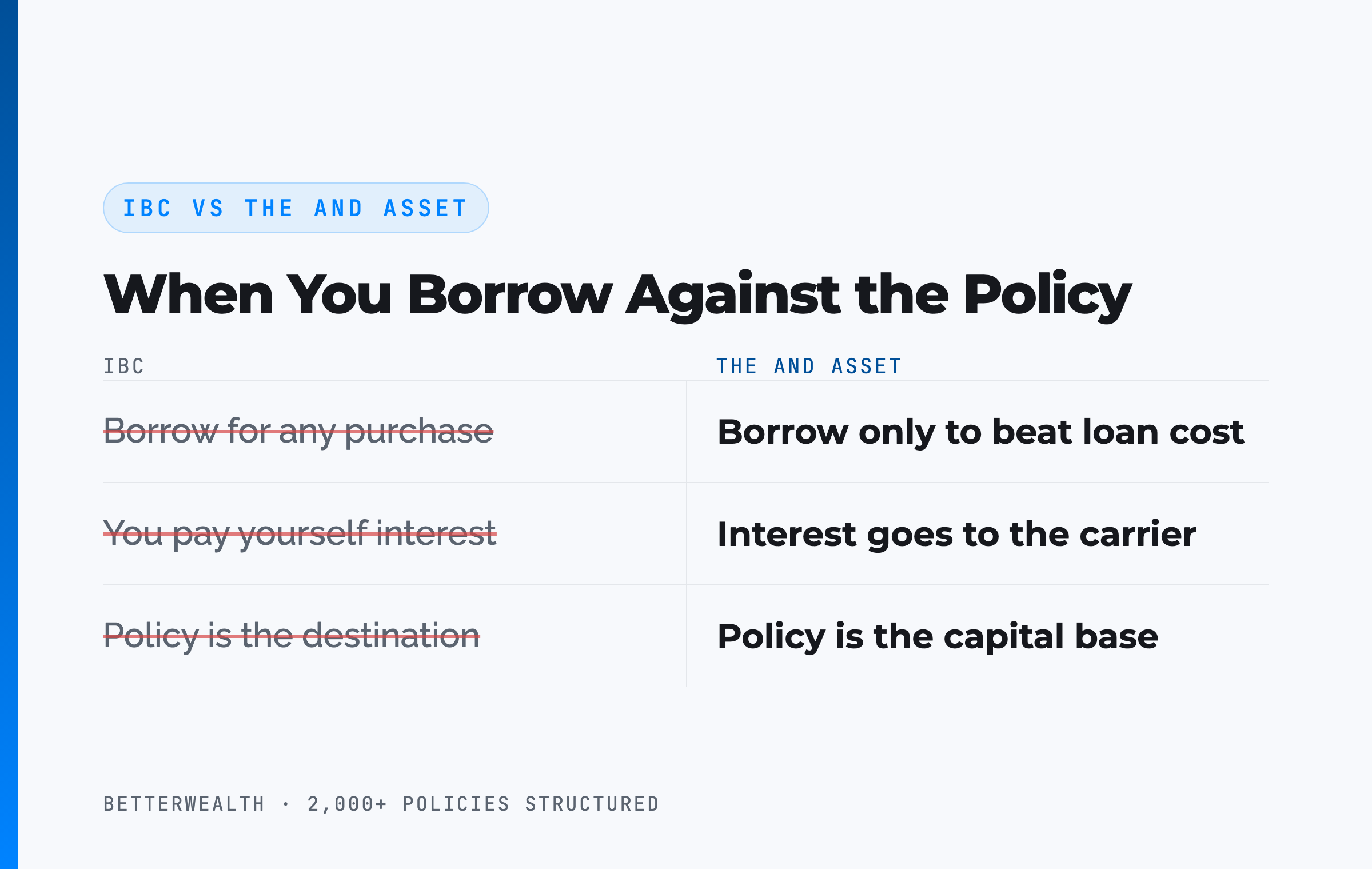
The structure is simple. You borrow at the loan rate and pay that interest to the carrier. The policy keeps compounding on its cash value, net of mortality and expense charges and subject to how your carrier treats borrowed funds. The deployed capital earns its own return. When that return exceeds the loan cost, one dollar has done two jobs. When it does not, you have borrowed money to lose it slowly.
The volatility buffer follows the same test with a different return. The "return" on a buffer loan is the loss you avoid by not selling depressed assets. The comparison is the interest cost against what the unsold shares recover, and the loan has to be repaid from earnings, not from selling those shares. If the recovery takes longer than the loan term, the math can fail. The case study below runs this test on both jobs a loan can do at once. That is a case to model, not a promise.
If the deal does not clear the loan rate, do not borrow.
08 / CommissionsDo Whole Life Agents Get Paid More Than Term Agents?
Per dollar of death benefit, whole life agents are paid more. Per dollar of first-year premium, they are often paid less. The Ramsey Show's comparison, a $1 million term policy against a $400,000 whole life policy, measures the first and ignores the second.
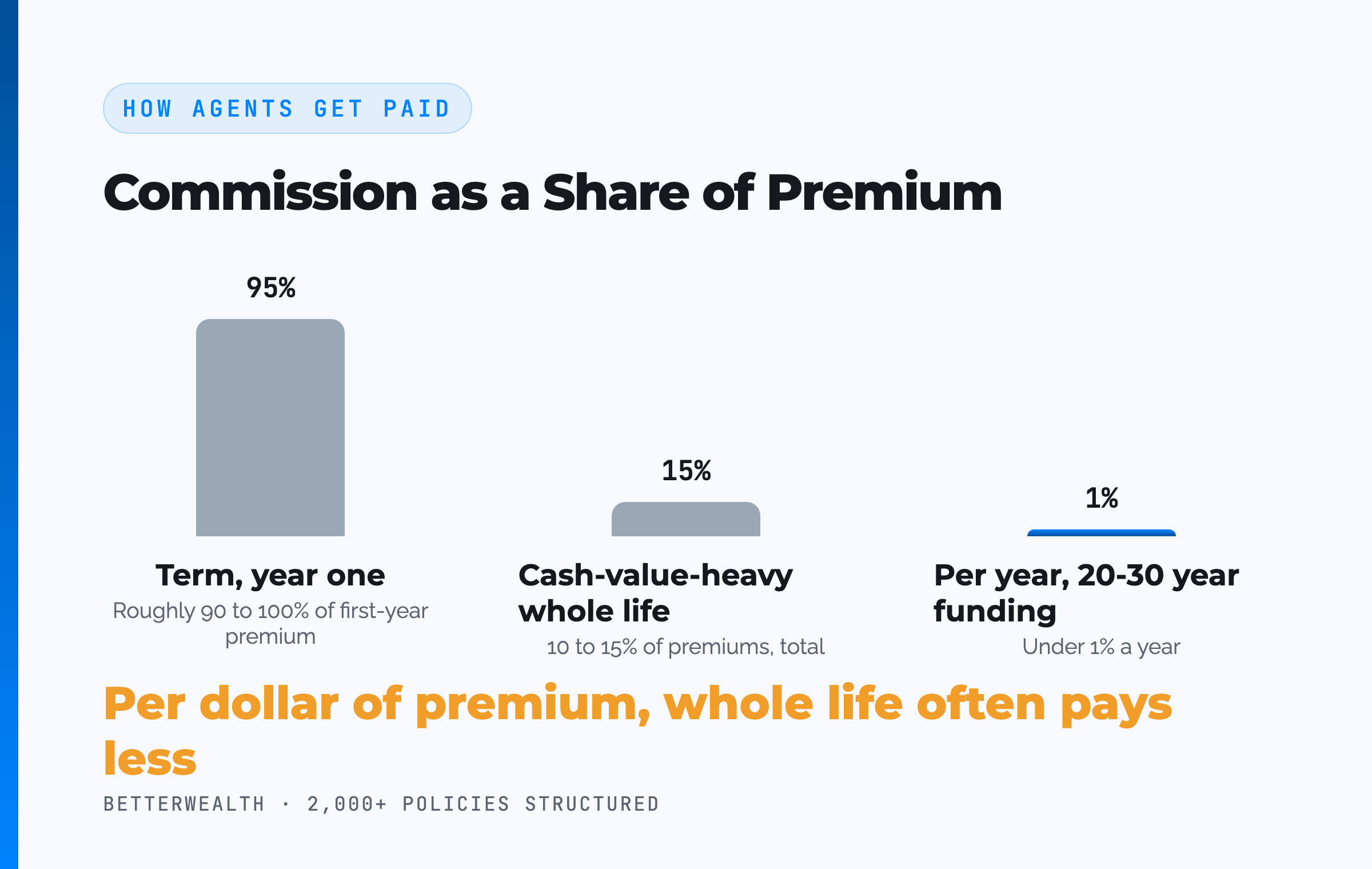
Term insurance can pay as much as 90 to 100% of the first year's premium as commission, depending on carrier and agent contract. On a $500 annual term policy, nearly all $500 goes to the agent in year one. Nobody calls term agents crooks for that.
Whole life commission depends heavily on design. Base premium pays a high first-year commission rate, much like term. Paid-up additions pay far less, so on the 30/70 case design below, year-one commission is paid mostly on the $11,400 base, a small share of the $38,000 premium. A cash-value-heavy design that pushes most premium into PUAs can put roughly 70 to 90% of year-one premium into cash value, depending on the base/PUA split and the carrier. In designs like the ones we build, total commission often lands around 10 to 15% of what the client pays in. Most of it is paid in the early years.
Compare that with the advisory model Ramsey does not attack: a fee of often around 1% charged every year on the full balance under management, which compounds as the balance grows, for as long as the account exists. That is a yearly share of the whole account, not a share of contributions. Either model can be fair or abusive. It depends on the person and the design, not the label.
An advisory fee of about 1% on a $500,000 balance is $5,000 a year, every year, and it grows with the balance. Over decades it can collect more dollars than a commission paid mostly up front.
Run Your Own Numbers Before You Talk to Anyone
The And Asset Vault holds our cash value calculator, The And Asset handbook and audiobook, and a short course on how an overfunded whole life policy is built. It is free. Enter your email to get access.
Open the Vault09 / The VerdictIs Whole Life Insurance a Bad Product?
Not necessarily. Whole life is a good fit for some people and a poor one for others, and the outcome depends on who owns it, how it is designed, and what job it does. Three buyers tend to get real value from it:
- The business owner or investor who deploys capital. Age 35 to 55, income of $250,000 or more, comfortable with business or real estate risk, with a 10+ year horizon. The reason to buy: a capital base to borrow against for deals that out-earn the loan rate, without selling other assets.
- The pre-retiree building a volatility buffer. Age 45 to 60, $1 million or more in market-based retirement accounts, low tolerance for selling during a drawdown, planning withdrawals within 10 to 15 years. The reason to buy: one to four years of spending held outside the market.
- The high-net-worth family planning an estate. Net worth well into eight figures, a long time horizon, and concern about estate taxes or illiquid assets such as a business or farmland. The reason to buy: a death benefit that delivers cash to heirs when it is needed, rather than cash value growth alone.
The same tool fails for the wrong owner. Take two people with identical $24,000-a-year policies on identical designs. One is a 52-year-old practice owner who funds it for 15 years and draws on it during two down markets in retirement. The other is a 31-year-old who loses a job in year three, surrenders, and walks away with less than the $72,000 paid in. Same policy, opposite outcomes.
The product did not change. The owner did.
10 / TradeoffsWhere Do Both Sides Get This Wrong?
Both sides of this debate get something wrong, and the honest version sits between them. Insurance marketers oversell whole life as a solution for everyone, quote gross dividend rates as if they were growth rates, and tell clients they are paying themselves interest. It goes to the carrier. Critics dismiss every policy because the worst ones exist.
The real tradeoffs are these. Early cash value trails premiums paid, so you need to commit to years of funding. Growth is steady but modest, so it will not beat stocks in a long bull market. Loans cost interest, paid to the carrier. Dividends are declared annually and are not guaranteed. Against that, you get access that does not depend on a bank's approval, growth that does not fall with the market, and a death benefit that settles any loan balance.
Fiduciaries carry a responsibility here too. An advisor who calls themselves a fiduciary should understand how life insurance, annuities, and reverse mortgages can fit into a plan, even if they rarely recommend them. Dismissing a tool you have not studied is not prudence.
11 / Head to HeadWhole Life vs Other Volatility Buffers
As a volatility buffer, whole life cash value trades slower setup for tax treatment and independence from the market. The table compares four ways to hold roughly $150,000 of down-year spending. Figures are illustrative.
| Dimension | Whole Life Cash Value | High-Yield Savings | Bond Portfolio | Reverse Mortgage Line |
|---|---|---|---|---|
| Cost to Build $150,000 | About $38,000 a year; cash value reaches about $150,000 near year 4 and crosses premiums paid at year 5 | $150,000 deposited at once | $150,000 invested at once | No deposit; requires age 62+ and home equity, plus upfront costs |
| Tax on Growth | Not taxed while inside the policy; loans not taxable income | At 4%, $6,000 a year taxed as ordinary income (about $1,920 at a 32% bracket) | Interest taxed each year | Draws are loan proceeds, not income |
| Tie to Stocks | None; cash value does not fall with the market | None | Partial; bonds can fall with stocks | Tied to home value, not stocks |
| Main Drawback | Early surrender loses money; requires years of funding; loan interest if accessed by loan | Yield floats with rates and trails inflation in some years | Price drops when rates rise | Balance grows over time and reduces home equity |
Cost to build. Savings and bonds are faster: you deposit and the buffer exists. Whole life takes years to build, which is why it fits someone planning a decade ahead, not someone retiring next year.
Tax on growth. A $150,000 savings buffer earning 4% produces $6,000 of taxable interest every year. Inside a policy, growth is not taxed annually, and access through loans is not taxable income while the policy stays in force.
Tie to stocks and the drawback. A buffer only works if it holds its value when stocks fall. Cash and whole life cash value both do. Bonds sometimes do not. The cost of whole life is time and commitment; the cost of the others is ongoing tax and rate exposure.
The Practice Owner Who Did Not Sell in a Down Year
Consider a 47-year-old dentist who owns her practice, preferred non-tobacco, funding a whole life policy at $38,000 a year. The design puts $11,400 into base premium and $26,600 into paid-up additions, a 30/70 split. This is a representative composite, not a single named client.
Through year four, cash value trails cumulative premiums, as a real policy should. At year three she has $104,860 of cash value against $114,000 paid in. At year five the lines cross. By year eight, she has $334,615 of cash value against $304,000 paid in.
In year eight, two things happen at once. Her brokerage account is down 24%, and a second treatment room she has wanted for two years becomes available for $143,500. Without the policy, she would have sold $143,500 of index funds to fund the room, locking in the loss. She borrows $143,500 against the policy instead.
At an illustrative 5.75% loan rate, interest starts at about $8,251 a year on the full balance, paid to the carrier, and falls as she repays. The new treatment room adds an estimated $31,900 a year in margin, an estimated 17.9% IRR on the capital over a 10-year useful life, well above the loan cost. She repays at $2,719 a month over 61 months, funded almost entirely by the treatment room's $2,658 monthly margin. Total loan interest comes to $22,359. Her index funds stay invested. If they return to their pre-drawdown value within the repayment window, that recovery is worth about $45,300, roughly twice the $22,359 of interest. So the loan does two jobs: the room's margin clears the loan cost, and avoiding the sale preserves the recovery. The policy keeps compounding, net of charges and subject to the carrier's treatment of borrowed funds.
One dollar. Two jobs. That is The And Asset.
The Honest 30 Minutes About Whether This Fits You
We have structured 2,000+ policies. We have seen this strategy work exactly as designed, and we have seen it fail. If you want a real conversation about whether The And Asset fits your situation, book a discovery call. We will give you the honest answer either way. If you would rather learn first, The And Asset and BetterWealth YouTube channels go deep on the math.
Book a Discovery CallFAQDave Ramsey and Whole Life Insurance: Common Questions
Are whole life insurance agents crooks?
No, not as a group. Some agents sell poorly designed policies or use fear about a market collapse to close a sale, and those are red flags. Many others design low-commission, cash-value-heavy policies and disclose the costs, the timeline, and the tax rules in writing.
Is whole life insurance tax exempt?
Partly, and it depends on how you access the money. In a policy that is not a Modified Endowment Contract, withdrawals up to your basis are generally not taxed, and policy loans are not taxable income while the policy stays in force. Surrendering the policy or letting it lapse with a loan outstanding can make the gain above basis taxable.
What happens if a life insurance company goes bankrupt?
Covered policies are protected up to state limits. Every state has a life and health insurance guaranty association that provides a backstop for covered policies, with coverage limits that vary by state. Amounts above those limits depend on what the failed carrier's estate can pay. It is a fallback, not a plan, which is why carrier selection comes first.
Do whole life agents earn more commission than term agents?
Per dollar of death benefit, yes. In year one, often no: term can pay as much as 90 to 100% of first-year premium as commission, while a 30/70 whole life design pays mostly on its base premium, a small share of the year's total. Over the funding period, on cash-value-heavy designs like the ones we build, total whole life commission runs 10 to 15% of premiums.
What is a volatility buffer?
A volatility buffer is one to four years of spending money held outside the stock market. In a down year, a retiree draws from the buffer instead of selling depressed investments, which gives the portfolio time to recover. Whole life cash value, cash, bonds, and reverse mortgage lines are all used for this job.
Should I cancel my whole life policy because Dave Ramsey said to?
Not without reviewing the policy first. Canceling in the early years usually locks in a loss because cash value has not yet caught up to premiums paid. Get the in-force illustration, check the base/PUA split and the break-even year, and decide based on your goals rather than a radio segment.
Is a policy loan taxable income?
In a policy that is not a Modified Endowment Contract, no. A policy loan is a loan collateralized by your cash value, not a distribution, so it is not reported as taxable income while the policy remains in force. The interest is paid to the carrier, and any unpaid loan balance plus accrued interest is deducted from the death benefit.
What is The And Asset?
The And Asset is BetterWealth's framework for using a properly structured whole life policy as a capital base. You only borrow against it for an activity that produces a return greater than the carrier's loan cost, so your dollars do two jobs at once: the policy keeps compounding while the deployed capital earns its own return.
How is The And Asset different from infinite banking?
Nelson Nash originated infinite banking. IBC marketers today frame a whole life policy as a personal banking system for any purchase. The And Asset shares those roots but operates on different principles: you only deploy borrowed capital when the return clears the carrier's loan cost, and the policy is the capital base, not the destination.
Why does it matter whether a life insurance company is mutual?
A mutual company is owned by its policyholders, so profits flow back to them as dividends rather than to outside shareholders. Stock companies and insurers backed by private equity answer to owners whose incentives can conflict with policyholders, which matters most for a policy you plan to hold for decades.
When does whole life cash value exceed the premiums paid?
In a well-designed, cash-value-heavy policy for a healthy person, cash value typically crosses total premiums paid at year five or later, and never before year four. Base-heavy designs can take a decade or more.
This debate does not need a winner. It needs better questions: what carrier, what design, what job, and what happens in a down year. Ask those, and the label "crook" either sticks to the person in front of you or it does not.
- Nelson Nash, Becoming Your Own Banker: the origin of the infinite banking concept.
- National Organization of Life and Health Insurance Guaranty Associations (NOLHGA): how state guaranty associations protect policyholders and how coverage limits vary by state.
- FDIC Deposit Insurance: coverage of $250,000 per depositor, per insured bank, per ownership category.
- IRC Section 7702 (Cornell Law): the definition of life insurance for federal tax purposes.
- IRC Section 7702A (Cornell Law): the Modified Endowment Contract rules that govern how much a policy can be funded.
- IRC Section 72 (Cornell Law): the tax treatment of amounts received under life insurance contracts, including basis recovery.
- BetterWealth resources: The And Asset book, The And Asset YouTube channel, and the BetterWealth YouTube channel.
I founded BetterWealth to treat life insurance as the wealth and capital tool it can be, and to say plainly when it is the wrong tool. Our team has structured more than 2,000 policies across all 50 states. I wrote The And Asset and host the BetterWealth and The And Asset YouTube channels. If you want an honest read on a policy you own or are considering, book a discovery call. We will tell you if it does not fit.