
Convertible term life insurance is level term coverage you can later exchange for a permanent policy at the same carrier with no new medical exam. Among Penn Mutual, Lafayette Life, MassMutual, and Guardian, the right choice depends on conversion window, conversion credits, waiver of premium definitions, and the whole life policy you plan to own later.
Works with clients daily on coverage sizing and policy design, and ran the four-carrier term research behind this comparison.
A whole life policy designed for cash value makes a deliberate trade. Every dollar steered into the paid-up additions rider instead of the base premium buys faster early cash value and a smaller initial death benefit. That trade is correct for a capital base. It often leaves families underinsured for years, precisely when the income a household depends on is most exposed.
The efficient answer is two tools doing two jobs: a whole life policy structured for capital, and convertible term life insurance covering the protection gap at a carrier you would want to convert with later. The term is cheap now. The conversion right is the part people underprice. It lets you move coverage into permanent insurance later without a new medical exam, whatever happens to your health in the meantime.
At BetterWealth, we have structured more than 2,000 policies across all 50 states, and many of our clients carry both. I carry both, and so does my wife. The research behind this comparison is by BetterWealth coach Demetrius Walker.
- Term generally converts only into the same carrier's permanent products, so buy term where you would want your future whole life policy.
- On $1,000,000 of 20-year term, Penn Mutual priced lowest at younger ages and Guardian lowest at older ages.
- Guardian's standard conversion window is five years. Penn Mutual allows conversion anytime on terms of 20 years or less and within the first 20 years of a 30-year term. Lafayette Life allows it up to age 65.
- Penn Mutual and Lafayette Life credit the prior policy year's term premium toward the new whole life policy at conversion.
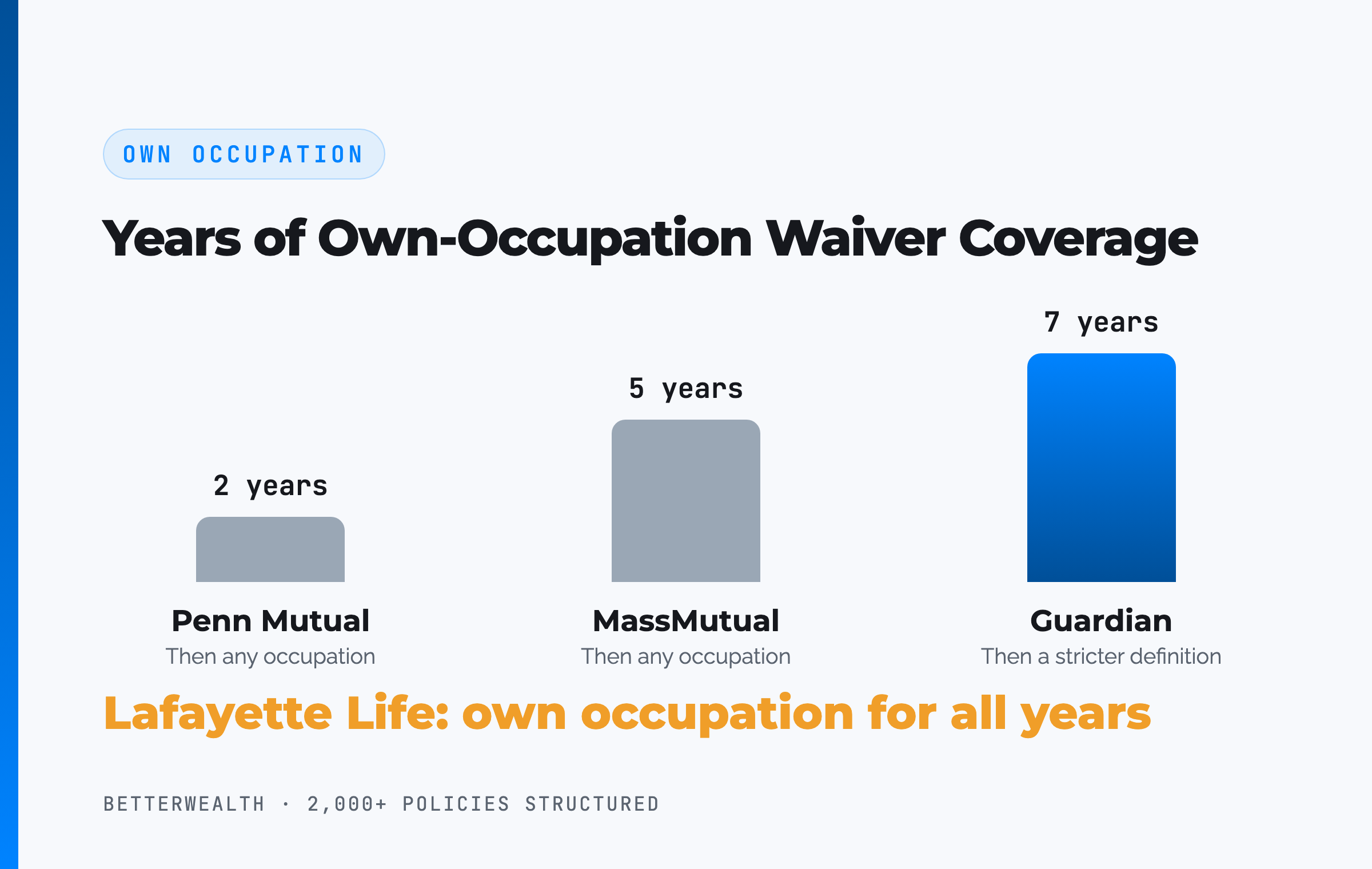
- Waiver of premium own-occupation coverage runs two years at Penn Mutual, five at MassMutual, seven at Guardian, and all years at Lafayette Life.
- Because The And Asset treats the policy as the capital base, we design it for cash value and buy protection separately with convertible term.
The video shows the side-by-side premium quotes for ages 35, 45, and 55 that this article summarizes, plus Demetrius and me debating which conversion rules matter most for a future policy owner:
01 / The ProblemWhy Doesn't a Max-Funded Whole Life Policy Cover Your Family on Its Own?
A max-funded whole life policy does not cover most families on its own because it keeps base premium low, so the initial death benefit is small next to what the family needs. The design pushes premium into paid-up additions to accelerate cash value, using a term blend rider so the policy stays under the Modified Endowment Contract limit. Less base premium means a smaller initial death benefit.
The death benefit grows over time as paid-up additions and dividends compound. Early on, though, the gap between what the policy pays and what your family would need can run into the millions. Demetrius has a policy built for cash accumulation and borrowing, and he is the only income earner in a family of five. The whole life death benefit alone would not carry that household.
Some advisors respond by blending everything into one large whole life policy with a bigger base. That raises internal cost, slows early cash value, and locks you into funding the whole structure every year.
Blending all your coverage into one big base-heavy whole life policy makes the family pay whole life costs for coverage it only needs for 20 years.
02 / SizingHow Much Life Insurance Should You Carry?
Size coverage with one of three methods Demetrius uses, from covering your debts up to insuring your full human life value, which carriers cap at roughly 25 to 35 times income.
- Cover your debts. Enough to pay off the mortgage and other obligations so no one inherits a burden. This is the floor.
- Replace a multiple of income. The common industry rule is 10 to 20 times income. The better question: how many years of your income would your family want replaced? Ask your spouse. The answers often differ.
- Insure your human life value. Get as much coverage as the carrier will issue. Carriers typically cap total coverage at roughly 25 to 35 times income, depending on age, income, and net worth.
Carriers insure the present value of your future earnings and cap it so no one is worth more dead than alive.
Size the coverage first. Then pick the tools.
03 / The FrameworkWhy Would an Infinite Banking Client Buy Term Insurance?
An infinite banking client buys term insurance so the whole life policy can stay designed for cash value while the family is fully protected. The two policies solve different problems, and forcing one to do both makes it worse at each.
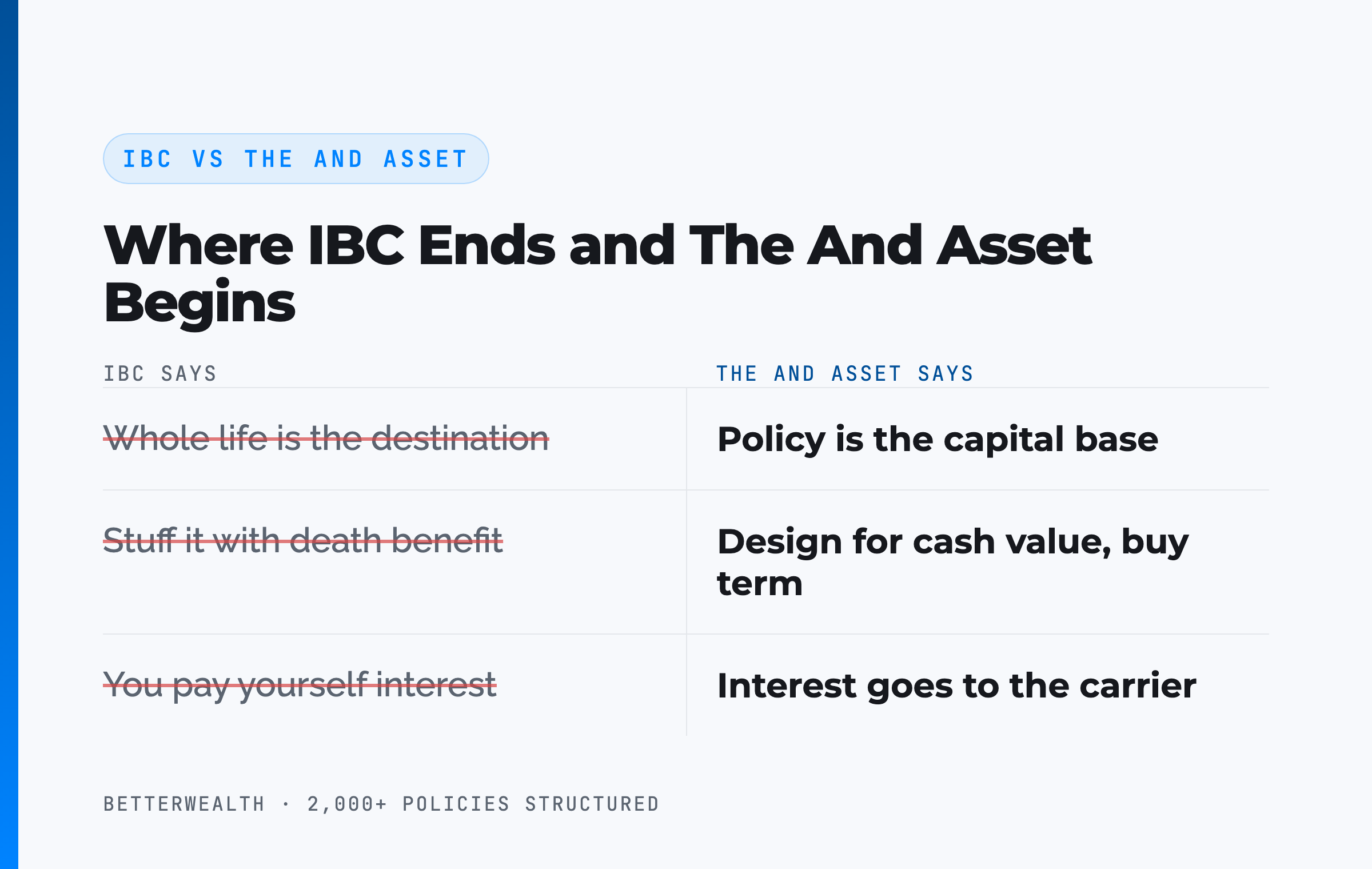
Nelson Nash pioneered the idea of using whole life insurance as a personal banking system in Becoming Your Own Banker. His core insight holds: you either lose money paying interest to outside lenders, or you lose it to the opportunity cost of capital sitting idle. We respect that foundation. The And Asset shares roots with IBC but operates on different principles.
Where IBC Ends and The And Asset Begins
IBC frames whole life as the destination. The And Asset frames the policy as the capital base and says you only borrow against it when the deployed dollars will return more than the carrier's loan cost. That rule shapes how you buy coverage. A policy stuffed with death benefit it does not need carries higher internal cost and slower early cash value, which delays the point where you can deploy capital at all. So we design the whole life policy for cash value and buy the protection separately, with convertible term, at a fraction of the cost.
Many IBC marketers also say that when you borrow against the policy you are paying yourself interest. You are not. The interest goes to the carrier. Your return is what the deployed capital earns elsewhere while the policy keeps compounding, net of mortality and expense charges. At a direct recognition carrier such as Penn Mutual or Guardian, the true cost of borrowing depends partly on how the carrier credits loaned dollars, so ask the carrier what dividend rate it credits on loaned dollars versus unloaned dollars before you borrow.
The math has to work. The protection has to be there too.
A whole life policy designed for cash value will not carry the full death benefit your family needs. Design it for capital and buy the rest of the protection cheaply.
04 / The Carrier RuleWhy Does the Term Carrier Decide Your Future Whole Life Policy?
The term carrier decides your future whole life policy because term generally converts only into a permanent product at the same company. Convert a Penn Mutual term policy and you get a Penn Mutual permanent policy. There is no conversion path into another carrier's whole life without new underwriting.
Early in my career I worked at a bank and sold $100,000, $200,000, and $300,000 term policies through carriers like Banner Life. Banner's term rates are competitive. Converting a Banner term policy into a whole life policy you would want to own is a different story, and there is no way to move that coverage into Penn Mutual, Lafayette Life, MassMutual, or Guardian without extra underwriting.
That is why this comparison covers only the four carriers we work with most often for properly structured whole life. The right term policy is the one that leads to a permanent policy you would be happy to own.
Carrier fit also depends on how you plan to fund the future policy. Penn Mutual is strong on long-term performance, but for large frontloads followed by lower ongoing premiums it is usually not the best fit. Guardian and Lafayette Life tend to suit heavy frontloads, with year-one cash value in the 85 to 93% range on illustrated frontload designs, varying by age and structure. One geographic filter: Penn Mutual operates in 49 states and Washington, DC, but not New York, and Lafayette Life does not operate in New York either (availability can vary by product, so confirm for your state), so New York residents are limited to MassMutual and Guardian among these four.
Cheap term with no conversion path you would ever use is a bet that your health never changes.
05 / How It WorksHow Do You Layer Convertible Term With a Whole Life Policy?
Layering convertible term with whole life works in six steps, and the order matters because the coverage target drives everything after it.
- Set the coverage target. Size coverage by your debts, a multiple of income, or your full human life value, and pick the method you and your spouse agree on.
- Design the whole life policy for cash value. Minimize the base premium and load the paid-up additions rider. A 30/70 or 10/90 base/PUA split produces a much smaller initial death benefit than a base-heavy design, and that is the point. PUA-heavy designs such as 30/70 and 10/90 typically use an internal term blend rider for MEC room; that rider is sized for the policy, not your family.
- Measure the protection gap. Subtract the whole life policy's initial death benefit from your target. A $10,000,000 target with a $2,000,000 initial death benefit leaves an $8,000,000 gap.
- Buy convertible term at the carrier you would convert with. Compare conversion window, conversion credit, waiver of premium definition, and price.
- Convert in chunks as cash flow allows. Conversions can be partial. You can move $2,000,000 of term into a second permanent policy today and leave the rest as term, with no new medical exam, as long as you stay inside the conversion window.
- Borrow only when the math works. Once cash value has built (break-even typically lands in year 5 or later for a healthy insured), borrow against the whole life policy only for activities that return more than the carrier's loan cost.
The permanent coverage grows over time. The term fills the gap until it does, and the conversion right keeps the door open if your health changes.
Term Plus Whole Life Fits a Specific Person.
It Fits You If
- Your family depends on your income
- You own or plan to own a whole life policy designed for cash value
- You want the option to add permanent coverage later without a new exam
- You can name uses for capital that beat the loan cost
It Does Not Fit You If
- You only want the cheapest possible term, forever
- You want whole life as a savings account
- You have no plan to deploy borrowed capital productively
- You are carrying high-interest debt looking for a fix
If you are in the first column, a 30-minute conversation will tell you how much coverage to carry, how to split it between term and whole life, and which carrier fits. If you are in the second, we will tell you that too.
Book a Discovery Call06 / Cost and TermsWhich Carrier Has the Cheapest Term Insurance?
Penn Mutual priced lowest for younger insureds and Guardian priced lowest for older insureds in our quotes. Demetrius ran $1,000,000 of 20-year level term for males aged 35, 45, and 55 at the second-best health class, paying annually.
The gap between the cheapest and most expensive carrier ran from about 9% to 23% depending on age. The spread narrowed as age went up. On price alone, the four carriers sit close enough that conversion terms usually matter more than the premium.
Term Length Options
Most carriers offer 10, 15, 20, and 30-year level terms. Lafayette Life does not offer a 15-year term. MassMutual adds two options the others do not: a 25-year term and annual renewable term (ART). Level term holds the same premium for the full period. ART starts cheaper than level term for the same coverage and then rises every year. It is a short-horizon tool.
ART is cheap because it is temporary.
Our read: if you know you will convert within a year or two, ART at MassMutual can be the right move. Outside that, MassMutual's level term is rarely the most competitive of the four.
07 / ConversionHow Long Do You Have to Convert a Term Policy?
The conversion window depends on the carrier, and the differences are large enough to decide the choice.
- Guardian: the standard conversion window is five years. The Extended Conversion Rider lengthens it. Decide on the rider at application rather than counting on adding it later.
- Penn Mutual: on terms of 20 years or less, you can convert anytime during the level term. On a 30-year term, conversion must happen within the first 20 years.
- Lafayette Life: conversion is allowed at any time up to age 65.
- MassMutual: the level term window varies by product, so confirm it on the current contract; its ART is built for people who expect to convert within a year or two.
Among the stated windows, Guardian's standard terms are the most restrictive unless you add the Extended Conversion Rider. Rerun Guardian's quote with the rider included before you decide.
Why the Conversion Right Is Worth Paying For
The conversion right lets you get permanent coverage without qualifying medically again. In his first year in the industry, Demetrius worked with a client diagnosed with cancer who held convertible term. A new application from scratch would likely have been declined. Because the conversion right was built into his term, he converted a portion into a new permanent policy without a medical exam when his finances made it sensible.
Non-convertible term exists, even at some of these carriers. It is cheaper for a reason. If the conversion right is irrelevant to you, buy on price and carrier strength alone. For anyone planning to own whole life, the conversion right is the reason to buy it.
The conversion right is insurance on your insurability.
08 / Conversion CreditsIs Term Insurance Premium Wasted Money?
Term premium is not wasted money, and at some carriers part of it carries forward into the permanent policy as a conversion credit. The common objection that term is "renting" insurance ignores two things: the protection your family had for the years you paid, and the credit some carriers apply at conversion.
- Penn Mutual and Lafayette Life: the prior policy year's term premium (the previous 12 months) is credited toward the new whole life policy.
- MassMutual: premium you prepaid for the rest of the current policy year is credited. Pay annually at the start of the policy year, convert six months later, and the six months you prepaid count toward the new policy.
- Guardian: depends on how long you have held the term. In year one it works like MassMutual. In years two through ten it works like Penn Mutual, but because Guardian's standard conversion window closes at year five, a conversion after year five requires the Extended Conversion Rider. After year ten there is no conversion credit.
You can still convert without a credit. The credit simply lowers the cost of the first year of permanent coverage.
09 / Waiver of PremiumHow Does Waiver of Premium Differ by Carrier?
Lafayette Life's waiver is the most protective because it uses an own-occupation definition for all years; the other three switch to a stricter definition after two to seven years. All four offer the rider; the difference is how each defines disability. The rider keeps coverage in force if an injury or illness leaves you unable to pay premiums.
Own occupation means premiums are waived if you cannot perform the duties of your own job. Any occupation means premiums are waived only if you cannot work any job at all. A surgeon who loses fine motor control would generally meet an own-occupation definition, subject to the contract's terms, and may not meet an any-occupation definition.
- Penn Mutual: own occupation for two years, then any occupation.
- MassMutual: own occupation for five years, then any occupation.
- Guardian: own occupation for seven years, then a stricter disability definition.
- Lafayette Life: own occupation for all years.
Two waiver riders with the same name can behave very differently. Compare the definition, not the label.
10 / ExtrasWhat Extra Riders and Features Separate the Four Carriers?
The extras rarely decide the carrier, but a few are worth knowing because they can tip a close call.
Children's Term Rider: Penn Mutual and Lafayette Life
Both attach up to $25,000 of coverage on each child aged 17 or younger. Demetrius called the carriers to confirm the detail that stands out: one premium covers every eligible child, whether you have two children or eight.
Annual Renewable Term: MassMutual
A medical resident two years from finishing training can buy cheap ART now and convert into a whole life policy designed for high cash value once income arrives. ART's rising cost matters little over a two-year horizon.
Long-Term Care Conversion and Charitable Benefit Rider: Guardian
Guardian lets you convert term into a policy designed to provide long-term care benefits without additional approval. Its charitable benefit rider adds a death benefit payable to a charity of your choice without reducing what goes to your family.
ACE Accelerated Underwriting: Penn Mutual
Penn Mutual says its ACE system can approve up to $10,000,000 of coverage with no medical exam for applicants with a simple or well-documented health history, and that over 40% of applications are approved without a medical exam. Demetrius has seen approvals land in about two days.
Run Your Own Numbers Before You Talk to Anyone.
The And Asset Vault holds our cash value calculator, The And Asset handbook and audiobook, and a short course on how an overfunded whole life policy is built. It is free. Enter your email to get access.
Open the Vault11 / Head to HeadConvertible Term at Penn Mutual, Lafayette Life, MassMutual, and Guardian
Side by side, the four carriers separate more on conversion rules than on price. The table summarizes the research on a $1,000,000, 20-year term for a male at the second-best health class.
| Feature | Penn Mutual | Lafayette Life | MassMutual | Guardian |
|---|---|---|---|---|
| Term lengths | 10, 15, 20, 30 | 10, 20, 30 (no 15) | 10, 15, 20, 25, 30, plus ART | 10, 15, 20, 30 |
| Conversion window | Anytime on 20-year or shorter; first 20 years of a 30-year | Anytime up to age 65 | Varies by product; confirm with MassMutual | 5 years standard; longer only with Extended Conversion Rider |
| Conversion credit | Prior policy year's premium | Prior policy year's premium | Current-year premium already paid | Year 1 like MassMutual; years 2 to 10 like Penn Mutual (after year 5 only with Extended Conversion Rider); none after year 10 |
| Waiver of premium (own occupation) | 2 years, then any occupation | All years | 5 years, then any occupation | 7 years, then stricter |
| Notable extras | $25,000 children's term rider; ACE underwriting up to $10,000,000 | $25,000 children's term rider | Annual renewable term; 25-year term | Long-term care conversion; charitable benefit rider |
| New York | Not available (confirm by product) | Not available (confirm by product) | Available | Available |
Price. On the same $1,000,000 quote the four carriers sat within a 9% to 23% band, and the band narrowed with age. That is close enough that a better conversion window or credit usually outweighs a small premium difference.
Conversion window and credit. Penn Mutual and Lafayette Life offer the longest windows and credit the prior year's premium. Guardian's five-year standard window is the tightest of the stated windows, so its older-age price edge should be rerun with the Extended Conversion Rider included before you decide.
Waiver and extras. Lafayette Life's own-occupation definition for all years is the most protective of the four. MassMutual's ART is the only short-horizon option, and Guardian's charitable and long-term care features serve specific planning goals.
The Dentist Who Covered $10,000,000 and Kept Cash Value First
Consider a 39-year-old dentist with a practice, preferred non-tobacco, earning $411,000 a year with a spouse and three children. This is a representative composite, not a single named client. The coverage target is $10,000,000, about 24 times income and inside the typical carrier ceiling.
The whole life policy is a Penn Mutual design built for cash accumulation, funded at $50,000 a year on a cashflow design, split 30/70: $15,000 of base premium and $35,000 into the paid-up additions rider. A 30/70 split fits a dentist who will fund the same amount every year and wants room to keep doing so. The design includes a term blend rider inside the policy to widen MEC room for the paid-up additions, which brings the initial death benefit to $1,937,000. The gap to $10,000,000 is covered with $8,063,000 of separate 20-year convertible term at Penn Mutual, at an illustrative $5,915 a year (preferred, non-tobacco; actual pricing varies by health class and carrier).
Through year four, cash value trails cumulative contributions, as a real policy should. At year five it crosses: $253,940 of cash value against $250,000 paid in. No earlier.
In year six, with the practice's cash flow up, the dentist converts $2,000,000 of the term into a second Penn Mutual whole life policy. No medical exam. The new policy is priced at the dentist's year-six age, and its premium comes from practice cash flow, not the equipment margin. Penn Mutual's conversion credit applies to the converted amount under the contract's terms. The remaining $6,063,000 of term stays in force to cover the gap.
In year seven, the first policy holds $372,610 of cash value against $350,000 contributed. The dentist borrows $143,500 against it to add a second hygiene chair and imaging equipment. The added capacity produces roughly $41,770 a year of margin, a 14.0% IRR over the equipment's five-year life. At an illustrative 6% loan rate (loan rates vary by carrier and time period), interest starts at about $8,610 a year on the full balance, falls as the loan is repaid, and totals about $17,900 over the 47 months, paid to the carrier. Repayment of the $143,500 plus interest runs about $3,430 a month over 47 months, covered by the new $41,770 of annual margin. The deployment clears the test because 14.0% beats the ~6% loan cost. It also cash-flows, but only just: repayment takes about 99% of the new margin, so a smaller margin would call for a smaller loan. After month 47 the full margin goes to the owner, and the policy keeps compounding, net of mortality and expense charges. Because Penn Mutual uses direct recognition, the $143,500 loaned portion is credited at a dividend rate that can be lower or higher than the unloaned rate.
The cash value kept compounding while the borrowed $143,500 earned 14.0% in the practice.
12 / The TradeoffsBenefits and Real Tradeoffs of the Term-Plus-Whole-Life Approach
Separating protection from capital gives you cheaper coverage now, a leaner whole life design, and the option to convert later. It also has real costs.
Term expires. If you never convert and outlive the term, the premiums bought protection and nothing more. Conversion windows close, sometimes after only five years. Converting later means paying permanent-insurance premiums based on your age at conversion, even though your health class carries over. Two or three policies also mean more statements, more premium dates, and more decisions than one blended policy.
The payoff for that complexity is control. Each policy is optimized for its job, and you choose when and how much to convert rather than committing to fund one large structure from day one.
13 / The FitHow Should You Choose Among the Four Carriers?
Choose the carrier by starting from the whole life policy you expect to own, then weigh conversion terms and price. We weigh three factors: price, conversion options, and whether you would be proud to convert into that carrier's permanent products. In my view, only a short list of carriers is worth converting into at all.
Demetrius adds one more: the design of the eventual whole life policy. Are you going to frontload? Fund level cash flow for decades? Short-pay? That answer can move the choice between Penn Mutual, Guardian, and Lafayette Life.
If low premiums matter most, start with Penn Mutual or Guardian. If you will convert within a year or two, look at MassMutual's ART. If conversion might be 20 years away, Penn Mutual (anytime on a 20-year term), Lafayette Life (if you will convert before 65), or Guardian with the Extended Conversion Rider deserve a look. The children's rider and fast underwriting are perks, not deciding factors.
We Will Tell You Honestly Whether This Fits.
We have structured 2,000+ policies. We have seen this strategy work exactly as designed, and we have seen it fail. On a discovery call we will look at how much coverage you carry, how your whole life policy is designed, and whether convertible term belongs in the plan. We will give you the honest answer either way. If you would rather learn first, The And Asset and BetterWealth YouTube channels go deep on the math.
Book a Discovery CallFAQConvertible Term Life Insurance Questions
What is convertible term life insurance?
Convertible term life insurance is level term coverage that includes the right to exchange some or all of it for a permanent policy at the same carrier without new medical underwriting. The conversion right is what separates it from the cheapest term on the market.
Can you convert term insurance from one company into whole life at another company?
Generally, no. A term policy converts into a permanent product at the same carrier, so the carrier you buy term from decides which whole life policy you can own later without a new medical exam.
Which of the four carriers has the cheapest term insurance?
In our $1,000,000, 20-year quotes for a male at the second-best health class, Penn Mutual priced lowest at younger ages and Guardian priced lowest at older ages. The spread between carriers ran from about 9% to 23%, and it narrowed as age increased.
How long do you have to convert a term policy?
It depends on the carrier. Guardian's standard window is five years unless you add its Extended Conversion Rider. Penn Mutual allows conversion anytime on terms of 20 years or less and within the first 20 years of a 30-year term. Lafayette Life allows conversion up to age 65.
What is a conversion credit?
A conversion credit is term premium the carrier applies toward the first-year premium of the permanent policy you convert into. Penn Mutual and Lafayette Life credit the prior policy year's premium, MassMutual credits premium already paid for the current year, and Guardian's credit depends on how long you have held the term.
What does own occupation mean on a waiver of premium rider?
Own occupation means the carrier waives your premiums if you cannot perform the duties of your own job. Any occupation means premiums are waived only if you cannot work in any job, which is a much harder standard to meet.
How much life insurance can I get?
Carriers typically cap total coverage at roughly 25 to 35 times your income, depending on age, income, and net worth. Carriers set that cap near your human life value, the economic value of your future earnings.
Should I combine term and whole life into one policy?
For most clients we keep them separate. A whole life policy designed for cash value stays efficient, and a separate convertible term policy covers the protection gap cheaply, which keeps more options open than one blended policy.
Can you convert only part of a term policy?
Yes. Carriers generally allow partial conversions, so you can move term into permanent coverage in chunks as your cash flow grows while the remaining term keeps protecting your family.
Is term life insurance a waste of money?
No. Term buys protection your family needs now at a low cost, and at carriers with conversion credits part of that premium can count toward a future permanent policy. The coverage has value whether or not you ever convert.
What is The And Asset?
The And Asset is BetterWealth's framework for using a properly structured whole life policy as a capital base. You only borrow against it for an activity that produces a return greater than the carrier's loan cost, so your dollars do two jobs at once: the policy keeps compounding while the deployed capital earns its own return.
How is The And Asset different from infinite banking?
Nelson Nash originated infinite banking. IBC marketers today frame a whole life policy as a personal banking system for any purchase. The And Asset shares those roots but operates on different principles: you only deploy borrowed capital when the return clears the carrier's loan cost, and the policy is the capital base, not the destination.
- Nelson Nash, Becoming Your Own Banker: the origin of the infinite banking concept.
- IRC Section 7702 (Cornell Law): the federal tax definition of life insurance. Section 7702A sets the modified endowment contract limit.
- Carrier product information: Penn Mutual, Lafayette Life, MassMutual, and Guardian. Rider availability and conversion terms vary by state and product; confirm against the current contract.
- Source video: We Compared Term Life Insurance From 4 Major Companies, The And Asset YouTube channel.
- BetterWealth resources: The And Asset book, The And Asset YouTube channel, and the BetterWealth YouTube channel.
I founded BetterWealth to treat life insurance as the wealth and capital tool it actually is, not the product most people get sold. Our team has structured more than 2,000 policies across all 50 states. I wrote The And Asset and host the BetterWealth and The And Asset YouTube channels. If you want an honest read on how much coverage you carry and how to split it between term and whole life, book a discovery call. We will tell you if it does not fit.