An income annuity turns savings into guaranteed lifetime income, about $2,000 a month per $300,000 for a 65-year-old woman at recent quotes. Structured whole life provides tax-advantaged liquidity and a death benefit that protects heirs. Retirees with large taxable bond holdings, a legacy goal, and five or more years before they need the cash value can use both.
At recent quotes, $300,000 buys a 65-year-old woman about $2,000 a month for life, roughly double the $12,000 first-year draw the 4% rule allows on the same money. Generation X is among the first generations to reach retirement without a pension. For most households, the only guaranteed income left is Social Security. Everything else sits in a pile of savings that has to be turned into a paycheck, and the conventional method for doing that asks retirees to guess two numbers nobody knows: how markets will perform and how long they will live.
The efficient retirement income plan does not try to beat those two unknowns. It transfers them. Longevity risk goes to an insurer that can pool it. Market risk stays with the portion of capital that can afford to absorb it. And tax drag gets removed from the money that would otherwise lose a slice of its return every April.
Michael Finke has spent more than 15 years researching this problem, at Texas Tech University, and in research with Wade Pfau and David Blanchett, now at The American College of Financial Services. In a recent conversation on the BetterWealth channel, he laid out why, in his words, economists have treated income annuities as the most efficient retirement income tool since it was "proven mathematically back in the 1960s," why the 4% rule works poorly for real people, and where permanent life insurance fits.
At BetterWealth, we have structured more than 2,000 whole life policies. We are not annuity salespeople, and whole life is not a retirement income product in the way an annuity is. This piece covers the retirement income math, the step-by-step income floor, how The And Asset framework applies in the distribution years, and the honest limits of each tool.
- At recent quotes, $300,000 buys roughly $2,000 a month for life for a 65-year-old woman through an income annuity.
- Annuities win on efficiency because insurers pool longevity risk, letting everyone spend to average life expectancy instead of age 100.
- Finke's framework: cover fixed expenses with Social Security plus annuities, then invest the rest with flexible spending.
- Permanent life insurance works as a tax wrapper for bond-like money held outside retirement accounts, plus an income-tax-free death benefit.
- A cash reserve buffer helps behaviorally, but by itself it does not raise how much a portfolio can sustainably spend.
- The And Asset rule holds in retirement: borrow against the policy only when deployed dollars out-earn the carrier's loan cost.
Finke walks through the 2000 to 2002 sequence of returns example in real time and answers Caleb's question about pairing life insurance with a higher-paying annuity, a nuance the written version can only summarize.
01 / The ProblemWhy Does a Pile of Savings Make a Poor Paycheck?
A pile of savings makes a poor paycheck because you do not know how long it has to last or what the market will do while you draw on it. Finke frames the longevity problem plainly. A 65-year-old could live 5 more years, 15, or 40. If you spend as though you will reach average life expectancy, you carry roughly a 50/50 chance of running out. If you stretch the money to age 100, you still might run out, and you spend very little every year you are alive.
The 4% rule was built to manage the market half of this problem. As Finke notes, Bill Bengen published the research in 1994: even if a balanced portfolio averages 7 or 8% a year, you cannot withdraw 7 or 8%, because returns arrive unevenly. Bengen looked at historical US stock and bond returns and found the withdrawal rate that survived the worst stretches. Finke's critique is that the US got lucky in the 20th century relative to the rest of the world, and that today's lower expected returns push a rigid safe rate closer to 3%.
Sequence of Returns Risk, in Dollars
Finke illustrates the danger with the popular claim that retirees can withdraw 8% a year from an all-stock portfolio. Retire on January 1, 2000, with $1,000,000. The market drops about 10% and you take $80,000, leaving roughly $820,000. The market drops again in 2001 and you take another $80,000, leaving about $650,000. In 2002 the market falls 20%. You now hold less than $500,000 and are still scheduled to withdraw $80,000 a year.
That plan does not recover.
A 30% rebound on $500,000 adds $150,000. The same rebound on $1,000,000 would have added $300,000. Losses taken early, while withdrawals continue, shrink the base that any recovery has to work with. This is why the order of returns matters more than the average, and why Finke's practical advice is spending flexibility: start around 5% if you like, but if the first year is bad, take $45,000 instead of $50,000.
Finke's view: most advisors try to pull a stable income out of a risky portfolio, then manage the risk by spending as little as possible. To an economist, none of that makes sense.
02 / The EconomicsWhy Are Annuities the Most Efficient Way to Generate Retirement Income?
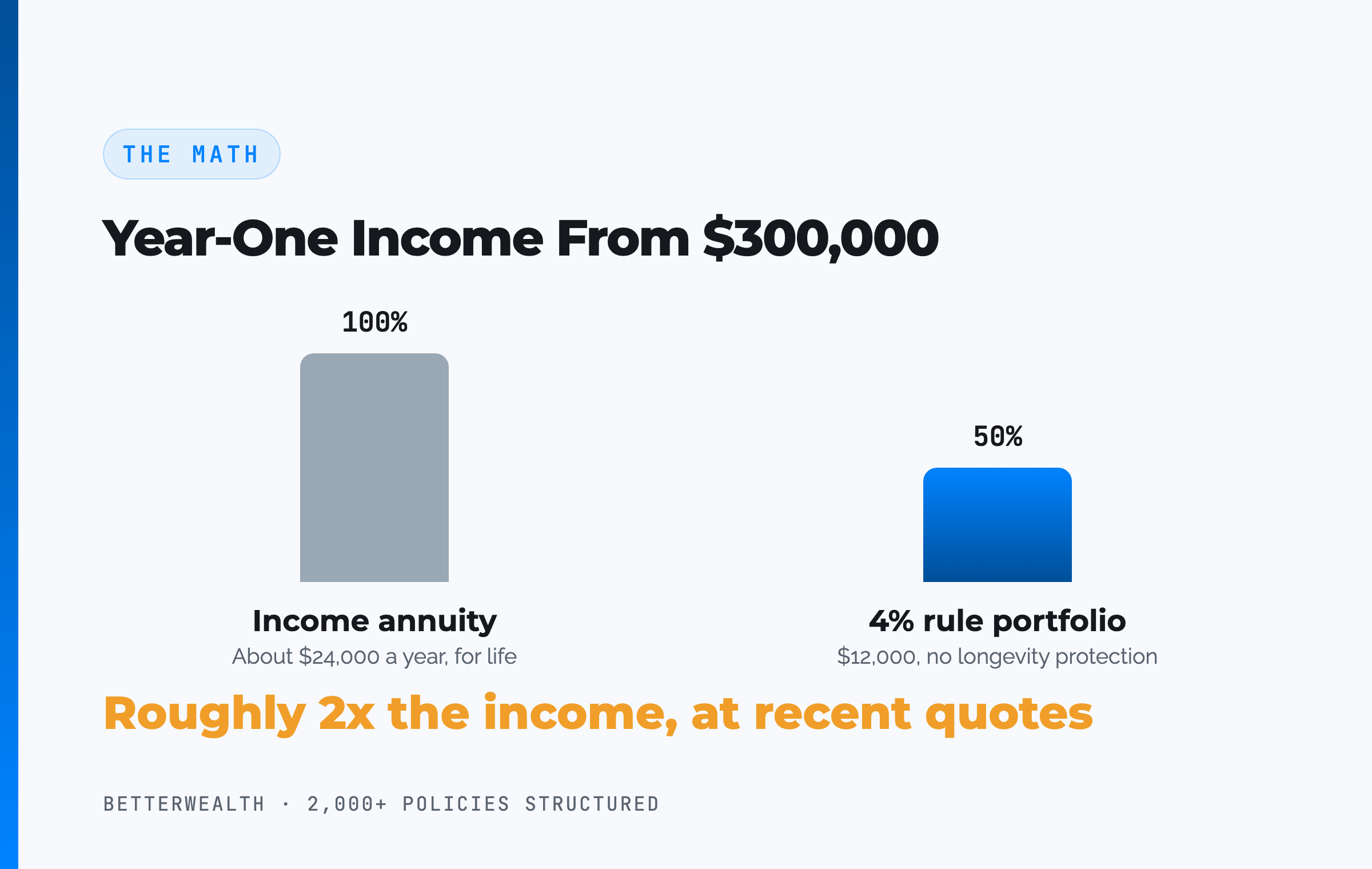
Annuities are the most efficient way to generate retirement income because they pool longevity risk across thousands of lives. Finke describes the trade directly: a group of retirees pools its money with an insurer, some live a long time, some do not, and the insurer pays everyone roughly what they could have spent if they knew they would live to average life expectancy. Actuaries price the distribution. You get paid for life regardless of where you land in it.
At the quotes Finke cited, a 65-year-old woman receives about $2,000 a month per $300,000 of premium. He compares that to buying a ladder of bonds that matures and pays out between ages 65 and 87 or 88, roughly average longevity for a healthy American. The difference is that the annuity keeps paying at 95.
Why Advisors Rarely Recommend Them
The resistance to annuities is partly earned. Finke acknowledges a long history of abusive sales practices, and annuities, variable annuities in particular, remain the top source of consumer complaints at FINRA. Part of it is structural. An advisor billing a percentage of assets on a $1,000,000 portfolio who recommends moving $300,000 to $400,000 into an annuity loses up to a third of that client's fee. Finke credits Fidelity's platform, where five carriers compete on quotes and the planning software treats annuities as a legitimate income source, with helping make income annuity pricing more competitive. He says he has never seen so many generous income products on the market.
You simply cannot match the income from an annuity with a traditional investment carrying similar risk. Economists have agreed on that for decades. Most people still do not do it.
03 / The FrameworkWhere Does Permanent Life Insurance Fit in a Retirement Income Plan?
Permanent life insurance fits as a tax wrapper for bond-like money and as a legacy asset, not as the primary engine of lifetime income. Finke's research on insurance focuses on tax rules. Wrap an investment in an insurance structure and a different set of rules applies. Under IRC Section 7702, cash value in a qualifying policy grows without annual tax on gains. On a policy that is not a modified endowment contract, you can generally withdraw up to your basis without tax and borrow against the cash value without the loan counting as income. The death benefit passes to heirs income-tax-free.
Compare that to a retiree holding CDs, money market funds, or bonds in a taxable account. Every year of interest is taxed as it is earned, and the heirs inherit an account that paid tax on 40 years of gains. Finke's view is that people with large assets outside retirement accounts underuse permanent life insurance, and that it is poorly understood by many financial professionals.
Where IBC Ends and The And Asset Begins
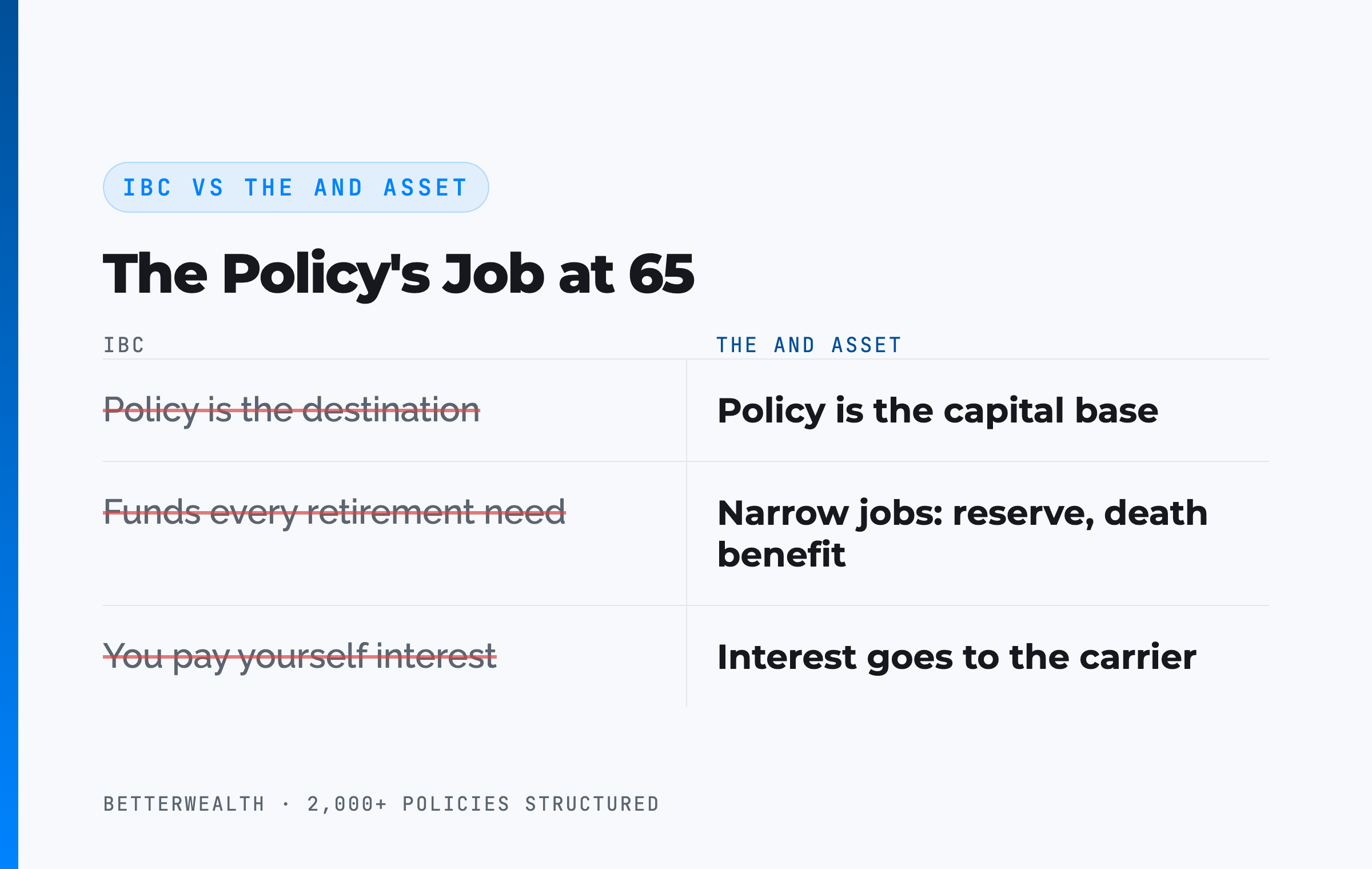
Nelson Nash pioneered the idea of using whole life insurance as a personal banking system in Becoming Your Own Banker, and his insight about lost opportunity cost still holds. The And Asset shares roots with IBC but operates on different principles. IBC content often frames whole life as the destination, a vehicle that can fund every phase of life including retirement income. The And Asset frames the policy as the capital base, because the value is created in what the capital is deployed into, and in retirement that means the policy has narrow, specific jobs: a tax-advantaged reserve, a death benefit, and a source of capital you borrow against only when the deployed dollars out-earn the carrier's loan cost.
That last rule does not relax at 65. Many IBC marketers tell retirees they will pay themselves interest on policy loans. They will not. The interest goes to the carrier. The return is what the deployed capital earns elsewhere while the policy keeps compounding, net of mortality and expense charges.
The math has to work at 65, too.
A cash buffer helps retirees sit through volatility. It is not fairy dust. On its own, it does not let a portfolio support more spending, and anyone selling it that way is overselling.
04 / How It WorksHow to Build a Retirement Income Floor, Step by Step
You build a retirement income floor by covering fixed expenses with guaranteed income first, then investing everything else for growth. This is the sequence Finke describes for his own plan, as someone in his mid-50s who is pulling annuity quotes for himself, with the insurance wrapper step added where it applies.
- Price your fixed expenses. Add up the monthly spending you cannot flex: housing, insurance, food, utilities, healthcare premiums. Finke uses $10,000 a month as an illustration of the paycheck he wants regardless of what markets do.
- Maximize Social Security. Where health and cash flow allow, delay claiming toward 70. Finke calls it the way to maximize inflation-protected lifetime income, and the monthly benefit grows for each year you delay past full retirement age up to 70. Finke plans to delay.
- Annuitize the gap. Cover the difference between fixed expenses and Social Security with an income annuity. At the quotes Finke cited, each $300,000 buys about $2,000 a month for a 65-year-old woman. Treat the annuity as the bond portion of your portfolio.
- Invest the rest with flexible spending. Invest the remaining portfolio for the highest after-tax return, using Roth conversion windows and asset location. Spend more in good years and cut back in bad ones. The floor is already covered.
- Wrap tax-inefficient money. Bond-like money that is taxed every year belongs in an insurance wrapper. A multi-year guaranteed annuity defers tax on a fixed rate. A properly structured whole life policy adds tax-advantaged access during life and a death benefit at the end.
- Layer a later-life annuity. Add a second annuity that begins later in retirement. It offsets inflation's erosion of the first one and protects against outliving the invested portfolio.
Finke's reason for this structure is behavioral as much as mathematical. His research with David Blanchett finds retirees spend readily from income and resist spending from savings. Converting part of the savings into income lets people actually spend in their 60s, when they are most able to travel and stay active, instead of waiting for RMDs at age 73, or 75 if you were born in 1960 or later, to give them permission.
Whole Life Fits a Specific Person in a Retirement Plan
It Fits You If
- You hold $250,000+ in bond-like assets outside retirement accounts
- You have 5+ years before you need the cash value
- Leaving a defined legacy matters to you
- You can name uses for capital that beat the loan cost
It Does Not Fit You If
- You need lifetime income from every dollar (that is an annuity's job)
- You need the money liquid in the next 2 to 3 years
- All your savings sit in a 401(k) or IRA
- You want a savings account, not a capital strategy
If you are in the first column, a 30-minute call will tell you whether a policy belongs next to your annuities and portfolio. If you are in the second, we will tell you that too.
Book a Discovery Call05 / The MathDoes the Math Work? The Loan Rate Test in Retirement
The math works only when every borrowed dollar out-earns the carrier's loan cost, and in retirement that test gets stricter, not looser. Policy loan rates vary by carrier and rate environment. At the time of writing many carriers fall in the 5 to 6% range, but treat that as a variable to verify, not a constant. If you borrow at that rate to fund ordinary living expenses, nothing out-earns the loan. You are spending, and the loan balance grows against your cash value. The one exception is a down-market reserve, and it has its own test: the loan wins only when the portfolio loss you avoid by not selling at the bottom is larger than the interest paid to the carrier before you repay. A short drawdown repaid within a year or two can pass. A long one funded by years of loan interest usually does not.
That leaves two loan uses where the math can work in the distribution years, plus one job the policy does without a loan. First, deploying capital into a business, practice buyout, or property whose return clears the loan cost by a clear margin. Second, using the cash value as a reserve in a down market so the invested portfolio is not sold at the bottom, but only when the avoided loss beats the interest, and with repayment when the portfolio recovers. The non-loan job: letting the death benefit carry the legacy so the rest of the plan can spend more freely.
The Life-Only Annuity and the Death Benefit
Caleb raised that non-loan idea with Finke. A life-only annuity pays more than one with a refund or period-certain guarantee, because nothing remains if you die early. That loss of legacy is what stops many retirees from buying one. A death benefit can replace it. Finke's answer was to start from goals: decide how much income you want and how much you want to pass on, then pick the tools. He added a related example. Home equity carries what economists call idiosyncratic risk, meaning the value of one house in one neighborhood can swing as much as a stock. Moving some of that equity into a life insurance death benefit turns an uncertain inheritance into a known number.
Start with the goal, not the product.
06 / The AudienceWhy Do Business Owners Need a Different Retirement Income Plan?
Business owners need a different plan because their wealth usually sits outside retirement accounts, arrives unevenly, and often converts to cash all at once. A dentist who sells a practice, a founder who exits, or a real estate investor who sells a portfolio ends up with a large taxable balance and no pension. The 401(k) playbook covers only part of their net worth.
That taxable balance is exactly where Finke sees insurance wrappers doing the most work. Money parked in CDs or bonds in a taxable account loses part of its return to tax every year. Some of it belongs in an income annuity to build the floor. Some of it may belong in a whole life policy designed for cash value, where growth is not taxed annually and the death benefit carries the legacy. The remainder stays invested.
Business owners also carry the spending psychology Finke describes in his research. He sorts retirees into grasshoppers, who spent most of their paycheck while working, and ants, who always saved. In his spending data, grasshoppers who inherit money spend it down in under four years, while ants spend an inheritance so slowly that, at their pace, it would take the equivalent of 500 years to use it up. Most people reading a piece like this are ants.
07 / The MistakesWhere Do Annuity and Life Insurance Pitches Go Wrong?
Annuity and life insurance pitches go wrong when they sell the product before the plan. The annuity industry's complaint record came from high-cost products placed for the commission, not from the math of pooling longevity risk. The life insurance industry has its own version: policies sold as complete retirement solutions, illustrations that imply cash value outpaces contributions in year two, and the claim that you pay yourself interest.
Finke's warning on life insurance is direct: you can make many mistakes, and there are public examples of people who worked with advisors who did not understand the product and ended up with the wrong outcome. Design is everything. A policy built for maximum death benefit behaves nothing like one built for cash value, and a realistic cash value timeline does not reach break-even before year 5 for a healthy insured.
Carrier Risk Is Real
Finke also addressed private equity ownership of insurers. There is evidence that some private-equity-linked insurers have taken extra risk in their general account portfolios, and he notes that some bad actors may have engaged in fraud. He does not see it as systematic across private equity, but the guarantee on an annuity or a policy is only as strong as the company behind it. Check ratings, ownership, and the investment portfolio before you buy.
As Finke puts it, if you do not have a strong desire to pass money on, you win the game by bouncing the check to the undertaker. Our read: frugality without a goal is just an accidental inheritance.
The Frameworks Behind 2,000+ Policies, in One Place
The Life Insurance Vault holds the calculators, design frameworks, and structuring decisions we use when we decide whether a whole life policy belongs in a plan, and how it should be built if it does. Free, email-gated, no spam.
Open the Vault08 / The TradeoffsBenefits and the Real Tradeoffs of Each Tool
Each tool solves one problem and creates a cost somewhere else. An income annuity delivers the most guaranteed income per dollar, but a life-only contract gives up liquidity and leaves nothing at death. A refund or period-certain option restores some legacy at the cost of a lower payment. Payout quotes also move with interest rates, so the $2,000 per $300,000 figure is a snapshot.
A whole life policy offers tax-advantaged growth, access through loans and withdrawals, and an income-tax-free death benefit. Its costs are time and discipline. Cash value trails contributions for the first several years, outstanding loans accrue interest owed to the carrier, and a policy that lapses with a large loan can create a tax bill. Growth compounds at the dividend rate net of mortality and expense charges, not at the headline dividend rate, and dividends are not guaranteed.
The flexible-spending portfolio keeps the most upside and the most control. It also asks you to cut spending in bad years, and Finke's research suggests most retirees spend too little from it in the good ones.
No single tool covers every risk.
09 / The PointWhat Separates a Good Retirement From a Funded One?
A good retirement spends money while the retiree can still enjoy it, and holds a positive outlook while doing it. Finke shows audiences a grid of 90 dots, one per year of life. A healthy 65-year-old woman has about 25 left. The question is how to spread the money across them, and the honest answer is that the early dots, when health is strongest, deserve more.
He quotes his grandmother, who paid for family dinners at a Columbus, Ohio cafeteria: it is better to give with a warm hand than a cold one. Help with a down payment in your child's 30s means more than an inheritance in their 60s. Finke also cites recent economic research suggesting more guaranteed income is associated with longer life, plausibly because people with income spend more on what brings them joy and stay more active.
His final finding surprised him. In a survey with David Stewart, a question about how people feel about the future turned out to be one of the strongest predictors of good retirement outcomes. Mindset, in his words, may be the most underestimated part of retirement planning.
10 / Head to HeadIncome Annuity vs Whole Life vs the 4% Rule
Compared per $300,000 at age 65, each tool does a different job. The table puts an income annuity, a 4% rule portfolio, a multi-year guaranteed annuity, and a whole life policy side by side on the dimensions that decide a retirement income plan.
| Per $300,000 | Income Annuity | 4% Rule Portfolio | MYGA (Fixed Deferred) | Whole Life (The And Asset) |
|---|---|---|---|---|
| Year-One Income | About $24,000/yr for life at recent quotes | $12,000, then inflation-adjusted | None until withdrawn or annuitized; grows at a fixed rate (Finke cited about 6% at recording) | None required; loans and withdrawals available against cash value |
| Longevity Protection | Full: pays as long as you live | None: depends on markets and spending | None until annuitized | None for income; death benefit protects heirs |
| Liquidity | None after purchase on a life-only contract | Full | Limited by surrender charges during the term | Policy loans; cash value builds slowly, break-even year 5+ |
| Tax on Growth | Depends on account type; confirm with a tax advisor | Taxed by account type; taxable accounts pay yearly | Deferred until withdrawn | No annual tax on cash value growth; loans generally untaxed while in force (non-MEC) |
| Legacy | $0 at death on life-only | Whatever remains | Account value passes to heirs | Income-tax-free death benefit |
Income. The annuity pays roughly twice the 4% rule's first-year withdrawal on the same $300,000 because it spends principal and pools longevity risk. The portfolio keeps the principal and the upside. Whole life is not built to compete on this row.
Longevity and liquidity. The annuity is the only tool here that removes the risk of outliving your money, and it buys that by giving up access. Whole life keeps access through loans but needs years of funding before the cash value exceeds what you put in.
Tax and legacy. For bond-like money sitting in a taxable account, both the MYGA and whole life remove annual tax drag. Whole life adds the death benefit, which is why it pairs well with a life-only annuity when legacy matters.
A Composite: The Dentist Who Built Both Sides of the Plan
Consider a 52-year-old dentist, preferred non-tobacco, who owns her practice and holds most of her savings outside retirement accounts. She funds a whole life policy at $40,000 a year on a 30/70 design: $12,000 of base premium and $28,000 of paid-up additions. This is a representative composite, not a single named client.
At the end of year 4, cash value sits at $157,300 against $160,000 contributed, still behind, as a real policy should be. Year 5 is the first year cash value passes total premium. By year 7, at age 59, she has $301,300 of cash value against $280,000 contributed.
That year she borrows $143,000 against the policy to add a second treatment room and imaging equipment. The added production produces an estimated first-year return of about $16,159 (11.3%), against roughly $8,580 of loan interest at an illustrative 6% rate. The first-year dollar spread is about $7,579 in her favor. Her carrier is non-direct recognition, so dividends keep crediting on her full cash value, net of charges, while the loan is out. The added production covers the interest; she repays the principal over the next few years from the practice's overall cash flow, not from the new room alone.
She keeps funding through age 64, for $520,000 of total premium. At 65 she places $300,000 of her taxable bond allocation into a life-only income annuity, about $2,000 a month at the quotes Finke cited, and plans to delay Social Security to 70. The annuity covers her fixed expenses. The death benefit replaces the $300,000 legacy the annuity removed. The invested portfolio funds travel, and she spends from it without worrying that a bad market year will touch her floor.
One dollar. Two jobs. That is the And.
The Honest 30 Minutes About Whether This Fits You
We have structured more than 2,000 policies across all 50 states. We have seen policies work exactly as designed, and we have seen them fail when they were sold as something they are not. On a discovery call, we look at your income floor, your taxable assets, and your legacy goals, and tell you whether a whole life policy belongs in your retirement plan. No pressure, no pitch. If you would rather learn first, the The And Asset and BetterWealth YouTube channels go deep on the math.
Book a Discovery CallFAQAnnuities and Life Insurance for Retirement Income: Common Questions
How Much Monthly Income Does a $300,000 Annuity Pay?
At the quotes Michael Finke cited, a 65-year-old woman can buy about $2,000 a month for life with $300,000 placed in a single premium income annuity. Quotes move with interest rates, age, sex, payout option, and carrier, so get current quotes before you decide.
Why Are Annuities the Most Efficient Way to Generate Retirement Income?
Annuities are efficient because they pool longevity risk. You do not know whether you will live 5 years or 40, so on your own you must spend as if you will live to 100. An insurer pricing thousands of lives can pay everyone income closer to average life expectancy, for life.
What Is the 4% Rule?
The 4% rule says you can withdraw 4% of a balanced portfolio in year one and adjust that dollar amount for inflation each year with a high chance of the money lasting 30 years. Bill Bengen derived it in 1994 from historical US stock and bond returns, and Finke argues lower expected returns make a rigid version less reliable today.
What Is Sequence of Returns Risk?
Sequence of returns risk is the damage done when bad market years arrive early in retirement while you are still withdrawing. Finke's example: a $1,000,000 all-stock portfolio withdrawing $80,000 a year from January 2000 falls below $500,000 within three years, leaving too little capital to recover.
Should I Annuitize All of My Retirement Savings?
No. Finke's approach is to annuitize only enough to cover fixed expenses after Social Security, then invest the rest for growth with flexible spending. The annuity acts as the bond-like portion of the portfolio, not the whole plan.
How Does Permanent Life Insurance Fit Into a Retirement Income Plan?
Permanent life insurance fits as a tax wrapper for bond-like money and as a legacy asset. Cash value grows without annual tax on gains, withdrawals up to basis and policy loans are generally not taxed while a non-MEC policy stays in force, and the death benefit passes to heirs income-tax-free.
Are Policy Loans Taxable in Retirement?
Policy loans are generally not taxable income while the policy stays in force and is not a modified endowment contract. If the policy lapses or is surrendered with a loan outstanding, the gain can become taxable, so loans must be managed against cash value. Confirm your situation with a tax advisor.
Can Life Insurance Let Me Take a Higher Annuity Payout?
It can. A life-only annuity pays more than one with a refund or period-certain guarantee because nothing is left at death. A death benefit can replace the legacy that a life-only annuity gives up, so the decision should start from your income and legacy goals, not from the product.
Are Annuities Safe Given Private Equity Ownership of Insurers?
Annuities are only as safe as the insurer behind them. Finke points to evidence that some private-equity-linked insurers have taken extra risk in their general account portfolios. He does not see it as systematic across private equity, but you should check the carrier's ratings, ownership, and investment portfolio before you buy.
What Is The And Asset?
The And Asset is BetterWealth's framework for using a properly structured whole life policy as a capital base. You only borrow against it for an activity that produces a return greater than the carrier's loan cost, so your dollars do two jobs at once: the policy keeps compounding while the deployed capital earns its own return.
How Is The And Asset Different From Infinite Banking?
Infinite banking, as Nelson Nash taught it, frames a whole life policy as a personal banking system for any purchase. The And Asset shares those roots but operates on different principles: you only deploy borrowed capital when the return clears the carrier's loan cost, and the policy is the capital base, not the destination.
Is Whole Life Insurance Better Than an Annuity for Retirement Income?
No, not for lifetime income. An income annuity produces more guaranteed income per dollar than whole life because it spends down principal and pools longevity risk. Whole life does a different job: tax-advantaged liquidity during life and a death benefit at the end. Retirees with bond-like taxable money, a legacy goal, and five or more years before they need the cash value can use both.
- Source interview: How To Turn $300,000 Into $2,000 A Month FOR LIFE | Michael Finke, BetterWealth YouTube.
- The American College of Financial Services: Michael Finke's institution, home of the RICP and WMCP designations.
- IRC Section 7702 (Cornell Law): the definition of life insurance behind the tax treatment of cash value.
- IRS: Required Minimum Distributions: current RMD rules and starting ages.
- Social Security Administration: Delayed Retirement Credits: how benefits grow when you claim after full retirement age.
- FINRA: investor guidance on annuities and broker conduct.
- Nelson Nash, Becoming Your Own Banker: the origin of the infinite banking concept.
- BetterWealth resources: The And Asset book, the The And Asset YouTube channel, and the BetterWealth YouTube channel.
I founded BetterWealth to treat life insurance as the wealth and capital tool it is, not the product most people get sold. Our team has structured more than 2,000 policies across all 50 states. I wrote The And Asset and host the BetterWealth and The And Asset YouTube channels. If you want an honest read on whether a whole life policy belongs beside your annuities and portfolio, book a discovery call. We will tell you if it does not.