
Whole life insurance policy loans let you borrow against your cash value at a rate the carrier sets, while the policy keeps compounding net of internal costs. Rates, direct or non-direct recognition, and whether interest is charged up front or accrues daily all vary by carrier.
Every dollar borrowed from a life insurance policy carries a price, and the carrier sets that price. Most of what gets published about policy loans skips past this. The pitch stops at "you can borrow against it," as though access were the whole story. Access is the easy part.
A policy loan is a financing decision, and it has to clear the same bar as any other financing decision you make. The cost is real, the interest compounds if you ignore it, and an outstanding balance sits against your death benefit until it is repaid. None of that makes policy loans bad. It makes them a tool with a price tag, which is exactly how an entrepreneur should evaluate any source of capital.
At BetterWealth we have structured more than 2,000 policies across all 50 states, and the loan question comes up in nearly every conversation. It usually arrives wrapped in something a marketer said: that you become your own bank, that you pay yourself the interest, that the loan is free money because the cash value keeps growing. Two of those three are wrong.
This article covers how a policy loan actually functions, what direct and non-direct recognition change (and what they do not), how Penn Mutual, Lafayette Life, Guardian, and Mass Mutual each handle loan rates and interest timing, how carriers set those rates in the first place, and the math that decides whether borrowing makes sense at all. Two borrowing outcomes close it out: one that cost a policyholder the policy, one that worked exactly as designed.
- A policy loan is collateralized by your cash value, so the cash value stays invested and keeps compounding.
- Direct versus non-direct recognition matters far less than policy design, funding discipline, and what you do with the money.
- Penn Mutual guarantees a 0.65% loan-to-dividend spread in policy years 1 to 10 and a 0% spread from year 11.
- Guardian offers a fixed 5% loan rate for ten years, while Lafayette Life and Mass Mutual run variable rates with non-direct recognition.
- There is no free money: $100,000 borrowed at 5% costs $5,000 a year, paid in cash or compounding against you.
- The And Asset rule: borrow only when the deployed capital out-earns the carrier's loan rate.
The full conversation walks through each carrier's loan terms on screen and tells both client stories in the practitioners' own words, including the detail on why your cash value can drop by more than the loan you just took.
01 / The problemWhy do policy loans get sold as something magical?
Policy loans get oversold because "borrow against yourself" is easier to market than "here is a collateralized loan with an interest rate." The magic framing sells policies. It also sets up the two failures we see most often: people who borrow with no plan for the capital, and people who never pay the interest because someone told them they never have to.
Both failures trace back to the same missing sentence. There is a cost to borrow, every time, from every carrier. A $100,000 loan at 5% costs $5,000 in the first year. Pay it and the balance stays flat. Skip it and the $5,000 joins the balance, and next year interest is charged on $105,000. Run that for twenty years while you are still paying premiums and the policy ends up dramatically smaller than the illustration you signed.
There is no free money. A $100,000 loan at 5% costs $5,000 a year whether you write the check or let it compound against your own death benefit.
02 / The frameworkWhat is a whole life policy loan, actually?
A policy loan is money the insurance company lends you, collateralized by the cash value inside your policy. The distinction that matters: your cash value does not leave. It stays in the policy, credited at the dividend rate net of mortality and expense charges, while the carrier hands you cash from its general account and puts a lien on your contract.
Compare that to a withdrawal. A withdrawal pulls money out permanently, lowers the death benefit, cannot be replaced, and above your cost basis it is generally taxable. A loan keeps the asset intact and reverses cleanly. As you repay principal, available cash value frees back up and the net death benefit is restored. If you die with a balance outstanding, that balance is subtracted from what your beneficiaries receive. A $1,000,000 death benefit with a $10,000 loan outstanding pays $990,000.
That mechanism is what makes an overfunded whole life policy usable as a capital base rather than a savings account. It is also where the framework comes in.
Where IBC ends and The And Asset begins
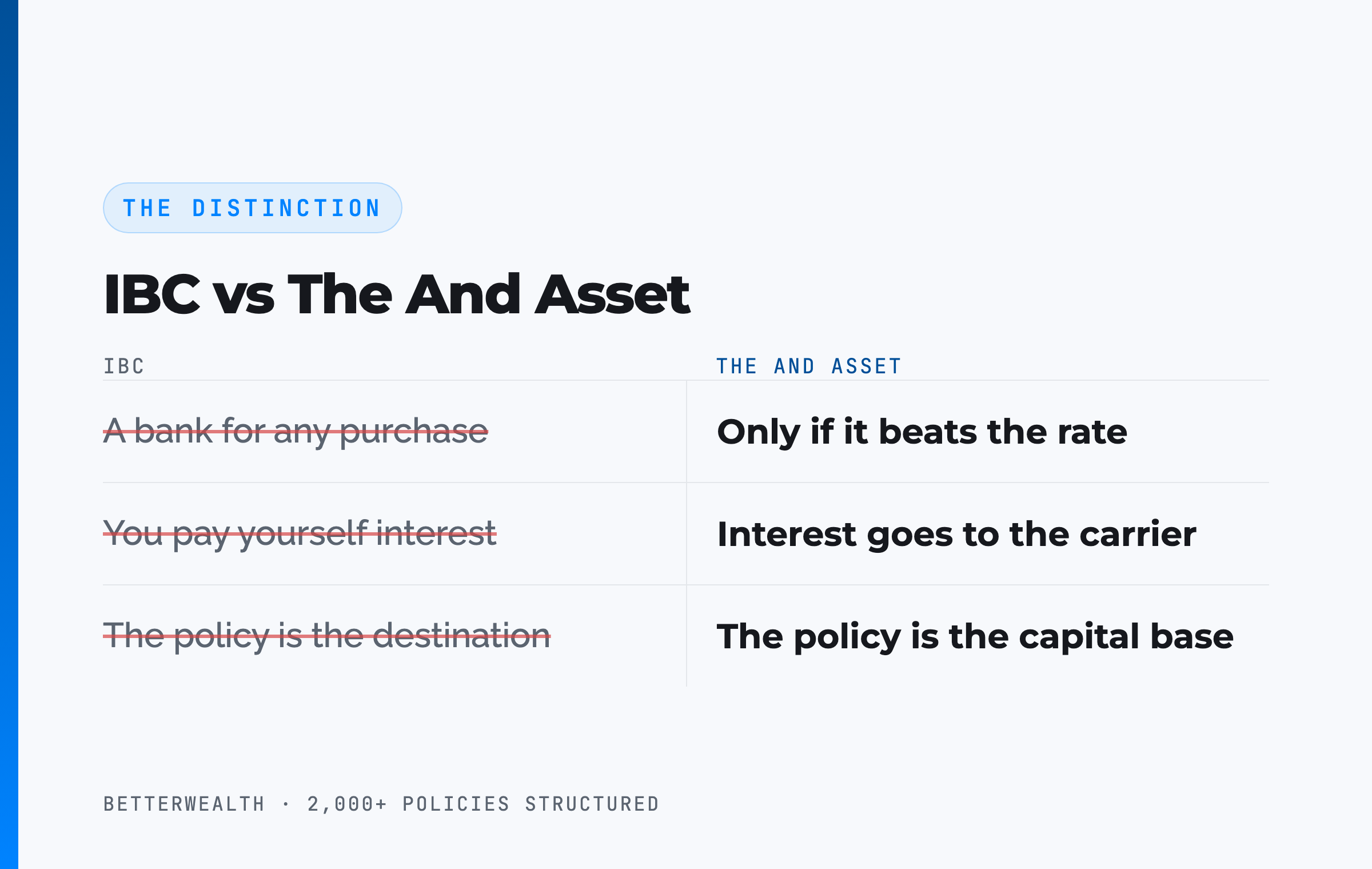
Nelson Nash pioneered the idea of using whole life insurance as a personal banking system in Becoming Your Own Banker. His core insight holds: you either lose money paying interest to outside lenders, or you lose it to the opportunity cost of capital sitting idle. We credit that foundation. The And Asset builds on it and adds a rule the broader teaching does not enforce.
IBC says a whole life policy can serve as a personal bank for any purchase. The And Asset says you deploy capital from the policy only when the borrowed dollars will produce a return greater than the carrier's loan cost, because anything less is an expensive way to spend money. Many IBC marketers say you are paying yourself the interest. You are not. The interest goes to the insurance company. Your return is what the deployed capital earns somewhere else while the policy keeps compounding.
The math has to work. Every time.
03 / How it worksHow to take a policy loan, step by step
Taking a policy loan correctly is a seven-step sequence, and the first two happen before you ever contact the carrier. Skipping them is what turns a useful tool into a problem.
- Build accessible cash value first. Fund the policy and let the early years capitalize. Cash value does not exceed cumulative contributions before year 4, and break-even typically lands at year 5 or later for a healthy individual. Any illustration showing you ahead in year one is fiction.
- Run the return test before you request the loan. Name the specific activity the capital is going into and confirm its expected return clears the carrier's loan rate. If you cannot name it, you are not ready to borrow.
- Size the loan and keep a reserve. Leave one to two years of base premium sitting in accessible cash value. That reserve is what carries the policy if the deployment stalls.
- Request the loan. Most carriers handle smaller loans through the online portal or by phone and larger loans through a signed form. Funding usually takes days once the policy is past its initial funding window, which runs from roughly 10 to 30 days after the first premium depending on the carrier.
- Know how your carrier charges the interest. Some charge it in advance and credit it back if you repay early in the same policy year. Others accrue it daily in arrears. The total cost lands in roughly the same place, but your portal balance will look different.
- Pay at least the annual interest. This is the step people skip. Interest you do not pay is added to the loan balance and compounds against the policy.
- Repay from the cash flow the deployment produces. The activity funds the repayment, not your household budget. Repaid principal restores both available cash value and net death benefit.
Name the deal before you take the loan.
04 / RecognitionDoes direct or non-direct recognition actually matter?
Direct versus non-direct recognition matters far less than the internet says it does, and it is the single most oversold decision in this business. Both structures work. We hold personal policies of both types, and across 2,000+ policies the recognition method has never been the variable that decided whether a strategy succeeded.
Here is the actual difference. Under non-direct recognition, the carrier credits the same dividend across your entire cash value whether or not a loan is outstanding. Nothing about your growth changes when you borrow. Under direct recognition, the carrier credits the borrowed portion at a different rate than the unborrowed portion.
The direct recognition misconception
Most people arrive believing direct recognition means borrowed dollars stop growing. That is wrong. Every dollar of cash value continues to be credited. If you hold $100,000 of cash value and borrow $50,000, the unborrowed $50,000 receives the normal dividend and the borrowed $50,000 is credited at an adjusted rate. In most environments that adjusted rate is modestly lower. In a sharply rising rate environment it can run higher.
Which structure wins depends on conditions nobody can forecast. Non-direct tends to look better when rates are low and falling, and during long unrepaid loans early in a policy. Direct tends to look better as rates rise, and during the distribution years when carriers narrow the spread. Direct recognition also gives the carrier a lever to stay balanced, which is part of why a carrier like Penn Mutual can guarantee its spread contractually.
Pick the policy. Then live with the recognition method.
Direct versus non-direct recognition is a selling technique dressed up as a strategy. If two strong carriers sit in front of you and the only difference is recognition type, pick either one and move on.
05 / The carriersHow four carriers handle policy loans
The four carriers below differ on three things: recognition type, whether the loan rate is fixed or variable, and when interest is charged. Rates listed are at the time of writing and reset on the carrier's schedule, so verify current terms before making a decision on them.
Penn Mutual: direct recognition with a guaranteed spread
Penn Mutual is a direct recognition carrier with a variable loan rate, 5.30% at the time of writing, held for the full policy year and adjusted each January. Its structure is unusual: the spread between the loan rate and the credited rate on borrowed dollars is guaranteed at 0.65% in policy years 1 through 10, and 0% from year 11 onward. On a 5.30% loan in year six, the borrowed portion of cash value is credited at 4.65%, and the unborrowed portion is credited normally.
Interest accrues daily in arrears, so the loan balance builds through the year rather than appearing all at once. The 0% spread after year ten is the piece that matters for anyone planning to take policy income later, because the loan rate and the credited rate move together instead of working against each other during distribution.
Lafayette Life: non-direct with the highest current rate
Lafayette Life is non-direct recognition with a variable loan rate, 6.75% at the time of writing, the highest of the four. No dividend adjustment applies to borrowed dollars, and interest accrues daily. That combination is the simplest to explain and currently the most expensive to use.
The rate spread across carriers is not permanent. Lafayette Life has been the cheaper option in past rate environments, and a carrier with a large share of its portfolio out on loans has different pricing pressure than one with a small share. Comparing carriers on today's loan rate snapshot is how people talk themselves into the wrong policy.
Guardian: a fixed rate, then a choice at year 10
Guardian is the most structurally interesting of the four. It is direct recognition, and it is the only carrier here with a fixed loan rate: 5.00% at the time of writing, locked for the first ten policy years. On eligible policies, at year 10 you can switch to a variable rate, and that switch also moves the policy to non-direct treatment. You choose predictability now or flexibility later.
Guardian's direct recognition spread runs about 1% through the first twenty policy years and narrows with age, dropping to roughly 0.5% and to about 0.1% for insureds past age 59. On the Whole Life 95 and 10-pay designs we most often use, the fixed loan rate also steps down around age 65, landing near 3.5%. The design intent is clear: cheapest borrowing in the years when policyholders are most likely to be pulling income.
Guardian charges loan interest in advance. Take a $10,000 loan at 5% and your available cash value drops by roughly $10,500, because the year's interest is charged up front. Repay early in the same policy year and the unused portion is credited back. This is the most common cause of the "my cash value dropped more than the loan I took" question.
Mass Mutual: non-direct, variable, interest in advance
Mass Mutual is non-direct recognition with a variable loan rate at 5.53% at the time of writing. Borrowed and unborrowed cash value are credited identically. Like Guardian, Mass Mutual charges interest in advance and credits back the unused portion on early repayment inside the policy year.
Penn Mutual recognizes the loan and charges 5.30%. Lafayette Life ignores the loan and charges 6.75%. Whichever one you thought was the obvious winner, look at the whole picture again.
Borrowing against a policy fits a specific person doing specific things.
It fits you if
- You can name the activity the capital is going into
- Its expected return clears the carrier's loan rate
- You can carry the premium without the deal's cash flow
- You keep a reserve of accessible cash value
It does not fit you if
- Your premium depends on the deal going well
- You plan to never pay the interest
- You are borrowing to cover high-interest consumer debt
- You want the loan because it sounds clever
If you are in the first column, 30 minutes with a practitioner will tell you whether the loan makes sense and which carrier structure fits your timeline. If you are in the second, we will tell you that instead.
Book a Discovery Call06 / PricingHow do insurance companies set policy loan rates?
Carriers set loan rates using an external benchmark plus their own internal requirements. Several contracts tie the variable loan rate to a published corporate bond index, commonly a Moody's series, which is why the four rates above cluster within about 175 basis points of each other. Pull up the index and you will see the shape of the loan rates.
The internal piece explains the gaps. A carrier has to charge enough to stay solvent and fund the dividend it pays everyone else. A company with a large percentage of its portfolio out on policy loans carries different liquidity math than a company with a small percentage, and that shows up in the rate. This is also why a rate that is highest today was not highest a decade ago and may not be in five years.
07 / The mathDoes the deployed capital clear the loan rate?
The return on whatever you deploy has to exceed the carrier's loan rate, or you should not borrow. That is the whole test, and it does not care which carrier you chose.
Structure the decision this way. You borrow at the carrier's rate. Your cash value stays in the policy and keeps compounding at the dividend rate net of mortality and expense charges, adjusted by the recognition spread if the carrier uses one. The deployed capital earns its own return somewhere else. When that return is higher than the loan cost, one dollar has done two jobs and you keep the spread. When it is lower, you have borrowed money to lose money slowly, and the policy loan is not the reason. The deal is.
Run the numbers at the carrier's rate, not at a rate you hope for. At 5.30%, a $148,000 loan costs $7,844 in the first year. The deployment has to beat that before it produces anything. If your honest expectation is 6%, the spread is too thin to justify the risk you are taking. If it is 18%, you have a decision worth making.
If you cannot identify an activity that outperforms the loan rate, do not borrow. The discipline of that sentence is the entire strategy.
A composite: the franchise buyer who borrowed in year six
Consider a 43-year-old business owner, preferred non-tobacco, funding an overfunded whole life policy at $41,000 per year on a cashflow design, split 25/75 between base premium and the paid-up additions rider. That is $10,250 of base premium and $30,750 into the PUA rider annually. This is a representative composite, not a single named client.
Year one cash value comes in at $33,600 against $41,000 contributed. It stays behind cumulative contributions through year four, at $158,200 against $164,000. At year five the two cross: $206,300 of cash value against $205,000 of premium paid. By the end of year six, cash value sits at $256,700 against $246,000 contributed.
In year six he buys into a franchise location and needs $148,000 for the down payment. He borrows it against the policy at an illustrative 5.30%, which costs $7,844 in first-year interest. He leaves $108,700 of cash value untouched, well above the $20,500 reserve rule of two years of base premium. The policy keeps compounding on its full $256,700 of cash value, with the borrowed portion credited 0.65% below the unborrowed portion under the carrier's direct recognition spread.
The location distributes $34,600 to him in its first full year after debt service, a 19.2% IRR on the deployed capital over the hold period. Against $7,844 of loan interest, the first-year margin is $26,756. He repays the loan on a 44-month schedule at $3,708 per month, funded entirely by the business distribution, and keeps paying the $41,000 premium out of operating income the whole time. Loan retired, policy intact, capital base larger than when he started.
One dollar. Two jobs. That is the And.
08 / Where it goes wrongTwo borrowers, two outcomes
The difference between a policy loan that builds something and one that costs you the policy is almost never the loan itself. It is how much room the borrower left themselves. Both situations below came out of the source conversation.
The one that ended in a surrender
A policyholder in their fifties inherited a lump sum and was told to move it into a policy immediately and borrow it back out so the money could go to work. They funded just over $100,000, borrowed most of it back, and placed it in a private lending deal. The borrower disappeared. The capital was gone.
The loss on the deal was survivable. The structure was not. Their policy carried a minimum premium near $10,000 a year against roughly $12,000 a year of total savings capacity, so there was no slack anywhere. Add roughly $5,000 of annual loan interest and the yearly obligation exceeded what they could produce. With the policy only a couple of years old, cash value was still below cumulative contributions, and they surrendered. The death benefit went with it. The investment loss would have happened in a savings account too. Losing the policy on top of it is what made it a structural failure rather than a bad deal.
A smaller policy with a lower minimum, the same investment, and a reserve intact produces a completely different ending. The deal still fails. The policy survives it.
The one that worked
The second policyholder wanted a similar structure and funded a similar amount, with one difference: their premium was a fraction of what they were saving each year. They funded for two full years before touching anything, which built a buffer, then borrowed for a partial payment on the purchase of a small franchise business. The business performed. They repaid the loan from its cash flow, kept paying premiums, and are now sitting on a larger capital base waiting for the next opportunity.
The investment outcome was different, but that is not the lesson. The second borrower structured the policy so that a failed deal would not have taken the policy with it. That is the variable you actually control.
The policy did not fail that client. The plan did. Never build a structure where the premium depends on the deal going well.
Two rules that come out of this
First, keep one to two years of base premium sitting in accessible cash value at all times. Most carriers include an automatic premium loan provision that borrows the minimum premium to keep a policy in force if you go quiet, which means a funded reserve can carry the contract through a rough stretch without you doing anything. Second, pay the loan interest annually at minimum. The "never pay it back" idea is technically true and practically expensive, because unpaid interest compounds against the same asset you built.
Leave yourself room. Always.
The frameworks behind 2,000+ policies, in one place.
The And Asset Vault holds the calculators, design frameworks, and structuring decisions we use when we compare carriers and run the borrow-or-do-not-borrow math. Free, email-gated, no spam.
Open the Vault09 / The alternativeWhere third-party lending fits
A third-party line of credit lets you borrow against your policy from a bank or specialty lender instead of from the carrier, which makes the direct versus non-direct debate irrelevant. The carrier never sees a policy loan, so your full cash value is credited normally. The lender holds the collateral assignment.
Rates move independently of the carrier. At the time of writing, third-party lines in our own use run around 5.95% and 6.50%, which sits above Penn Mutual's current 5.30% and below Lafayette Life's 6.75%. Chasing the cheapest of those numbers on any given day is a waste of attention, because every one of them will change.
What makes third-party lending worth considering is the operating experience: checkbook and wire access, multiple policies consolidated into one line, and capital that moves at the speed a deal requires. For someone deploying capital regularly, that convenience is worth more than 40 basis points. For someone who borrows once a decade, it is not.
10 / Head to headThe four carriers, side by side
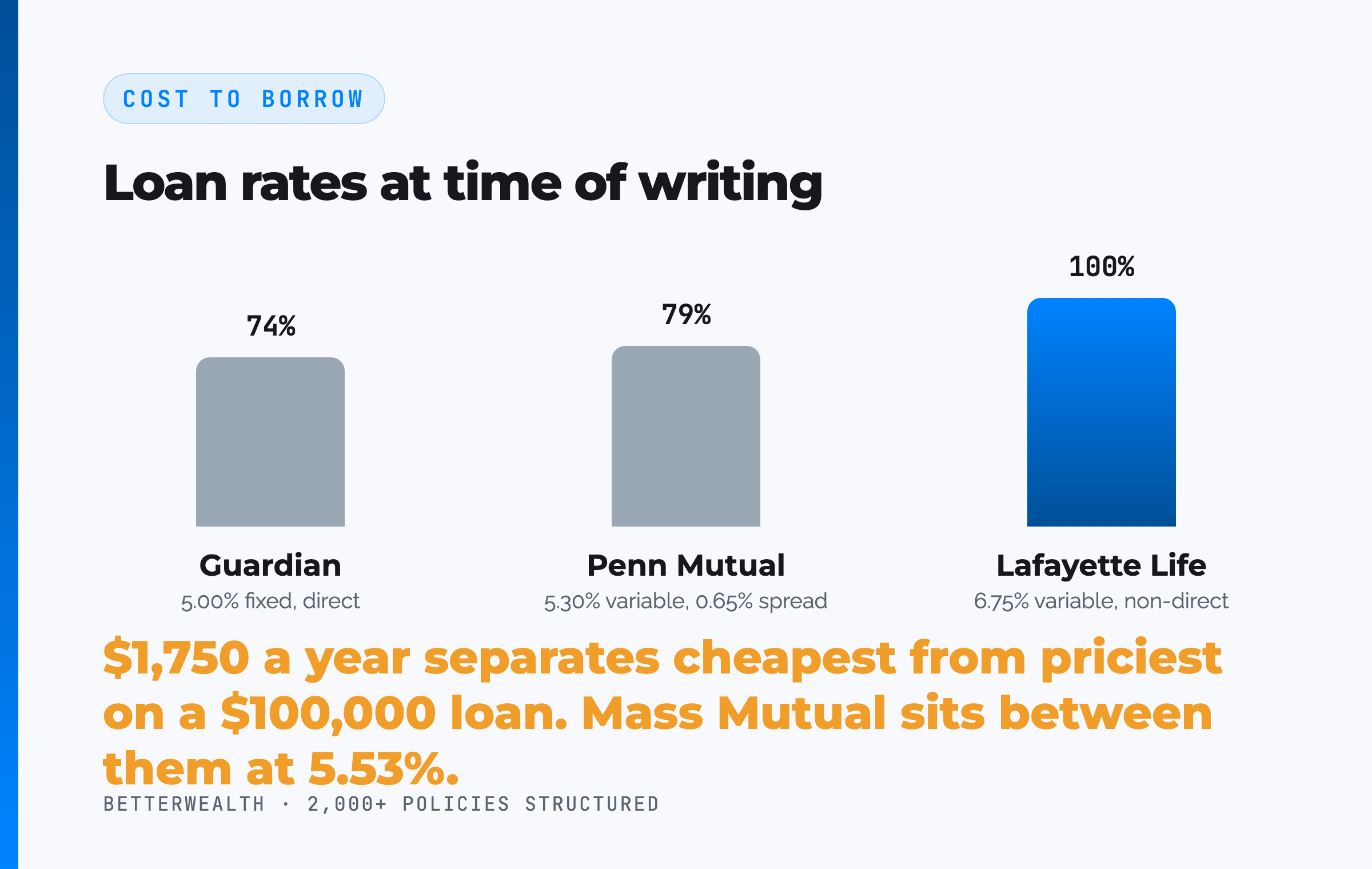
Compared on the terms that govern borrowing, the four carriers split evenly between direct and non-direct recognition and span 175 basis points of loan cost. All figures are at the time of writing and reset on each carrier's own schedule.
| Dimension | Penn Mutual | Lafayette Life | Guardian | Mass Mutual |
|---|---|---|---|---|
| Recognition | Direct | Non-direct | Direct (non-direct option at year 10 on eligible policies) | Non-direct |
| Rate structure | Variable, reset each January | Variable | Fixed for 10 years, then fixed or variable by choice | Variable |
| Loan rate (at time of writing) | 5.30% | 6.75% | 5.00% | 5.53% |
| Annual interest on a $100,000 loan | $5,300 | $6,750 | $5,000 | $5,530 |
| How interest is charged | Accrues daily, in arrears | Accrues daily, in arrears | In advance, credited back on early repayment | In advance, credited back on early repayment |
| Dividend adjustment on borrowed dollars | 0.65% spread years 1 to 10, 0% from year 11 | None | About 1% through year 20, narrowing with age to roughly 0.1% past 59 | None |
Recognition. Two of the four adjust the dividend on borrowed dollars and two do not. Penn Mutual is the only one of the four that puts a number on the adjustment and guarantees it, which removes a variable from long-range planning. Guardian's adjustment shrinks as the insured ages, by design.
Cost. On a $100,000 loan, the spread between the cheapest and most expensive of the four is $1,750 a year, Guardian at $5,000 against Lafayette Life at $6,750. That gap is real, and it is also smaller than the difference between a deal that returns 12% and one that returns 8%.
Timing. Interest charged in advance makes your available cash value drop by more than the loan amount, which alarms people who were not warned. Daily accrual builds the balance through the year instead. Over a full year of borrowing the two approaches land within a rounding error of each other.
11 / The bigger pictureDo you have to borrow for the policy to be worth it?
No. A properly designed whole life policy earns its place as a stable, contractually guaranteed portion of a balance sheet whether or not you ever take a loan. Most people who describe themselves as fully invested in equities already hold bonds through their funds and ETFs without realizing it, and this asset occupies similar territory with different tax treatment and a death benefit attached.
The borrowing feature is what makes the policy an And Asset for an entrepreneur or real estate investor with a steady flow of opportunities. If you are a high-income earner without a pipeline of deals, a smaller and more flexible policy funded alongside your other investing still does its job. Sizing the policy to the life you actually run, rather than to the strategy you read about, is the decision that matters most.
The honest 30 minutes about your policy, or the one you are considering.
We have structured more than 2,000 policies across all 50 states. On a discovery call, a practitioner looks at your actual situation and tells you whether borrowing makes sense, whether a third-party line beats your carrier's rate, and whether a policy belongs in your plan at all. If you would rather learn first, the The And Asset and BetterWealth YouTube channels go deep on the math.
Book a Discovery CallFAQWhole life policy loan questions
How does a whole life insurance policy loan work?
A policy loan is money the carrier lends you, collateralized by your cash value. Your cash value stays in the policy and keeps compounding net of mortality and expense charges. The carrier charges interest on the loan balance, and any amount still outstanding at death is subtracted from the death benefit paid to your beneficiaries.
What is the interest rate on a whole life policy loan?
Policy loan rates are set by the carrier and vary by company and rate environment. At the time of writing, the four carriers in this review sit between 5.00% and 6.75%: Guardian at a fixed 5.00% for the first 10 years, Penn Mutual at 5.30% variable, Mass Mutual at 5.53% variable, and Lafayette Life at 6.75% variable. Treat any specific number as a rate to verify with the carrier, not a constant.
Do you have to pay back a policy loan?
You are not contractually required to repay a policy loan on a set schedule, but the interest does not disappear. Unpaid interest is added to the loan balance and compounds against your cash value and death benefit for as long as the loan is outstanding. At minimum, pay the annual interest so the balance stays flat.
What is direct recognition vs non-direct recognition?
Under non-direct recognition, the carrier credits the same dividend on your entire cash value whether or not you have a loan outstanding. Under direct recognition, the carrier credits a different rate on the borrowed portion, usually slightly lower, while the unborrowed portion is credited normally. Direct recognition does not mean you stop earning on borrowed dollars.
Is direct or non-direct recognition better?
Neither is better in the abstract, and the difference is the most oversold decision in this business. Non-direct recognition tends to look better in falling or low rate environments and during long unrepaid loans early in a policy. Direct recognition tends to look better in rising rate environments and during the distribution years. Policy design and funding discipline move your outcome far more than recognition type.
Does a policy loan reduce the death benefit?
An outstanding loan reduces the death benefit paid to your beneficiaries by the loan balance. On a $1,000,000 death benefit with a $10,000 loan outstanding, beneficiaries receive $990,000. As you repay principal, the net death benefit is restored.
What is the difference between a policy loan and a withdrawal?
A withdrawal permanently removes money from the policy, reduces the death benefit, and cannot be put back. A loan leaves your cash value in the policy as collateral, so it keeps compounding, and repayment restores both available cash value and net death benefit. Withdrawals above your cost basis are also generally taxable, while loans from a policy that is not a Modified Endowment Contract are generally not treated as income while the policy stays in force.
How do insurance companies set policy loan rates?
Carriers set loan rates using a benchmark plus their own internal requirements. Several contracts tie the variable loan rate to a published corporate bond index such as Moody's, then adjust for what the carrier needs to charge to stay solvent and fund its dividend. A carrier with a large share of its portfolio out on policy loans may need a higher loan rate than a peer.
What happens if you cannot repay a policy loan?
If the loan balance plus accrued interest grows toward the policy's cash value, the policy can lapse, which ends the death benefit and can create a taxable event on any gain above your cost basis. Most carriers include an automatic premium loan provision that borrows the minimum premium to keep the policy in force, which is why leaving a reserve of accessible cash value matters.
Are whole life policy loans taxable?
Loans from a whole life policy that is not a Modified Endowment Contract are generally not treated as taxable income while the policy remains in force. If the policy lapses or is surrendered with a loan outstanding, gain above your cost basis can become taxable in that year. Tax treatment depends on your specific policy and situation, so confirm with your tax advisor.
What is a third-party line of credit against a life insurance policy?
A third-party line of credit is a loan from a bank or specialty lender that uses your policy's cash value as collateral instead of borrowing from the carrier. Because the carrier never sees a policy loan, the dividend is credited on the full cash value, which makes direct recognition irrelevant. Rates float with the lender's index and can run above or below the carrier's rate depending on the environment.
What is The And Asset?
The And Asset is BetterWealth's framework for using a properly structured whole life policy as a capital base. You only borrow against it for an activity that produces a return greater than the carrier's loan cost, so your dollars do two jobs at once: the policy keeps compounding net of internal costs while the deployed capital earns its own return.
How is The And Asset different from infinite banking?
Infinite banking, as Nelson Nash taught it, frames a whole life policy as a personal banking system you can use for any purchase. The And Asset says the borrowed dollars must out-earn the carrier's loan rate before you borrow at all. The policy is the capital base, not the destination. It is built on Nash's foundation and operates on different principles.
- Nelson Nash, Becoming Your Own Banker. The origin of the infinite banking concept and the lost opportunity cost argument.
- IRC Section 7702 (Cornell Law). The tax code provision behind the treatment of life insurance cash value and policy loans.
- IRC Section 7702A (Cornell Law). The Modified Endowment Contract rules that govern how policy loans are taxed.
- Moody's Seasoned Aaa Corporate Bond Yield (FRED). The type of published index several carriers reference for variable loan rates.
- AM Best. Financial strength ratings for each of the carriers referenced here.
- BetterWealth resources: The And Asset book, the The And Asset YouTube channel, and the BetterWealth YouTube channel.
Walks through each carrier's loan terms in the source video and brings the two borrowing situations from his own client conversations.
I founded BetterWealth to treat life insurance as the wealth and capital tool it actually is, not the product most people get sold. Our team has structured more than 2,000 policies across all 50 states. I wrote The And Asset and host the BetterWealth and The And Asset YouTube channels. If you want an honest read on whether borrowing against a policy makes sense in your situation, book a discovery call. We will tell you if it does not.