
Record life insurance dividends in 2026 reflect the total dollars mutual insurers return to policyholders, not a record rate of return. Northwestern Mutual and MassMutual pay more because their balance sheets have compounded for 150 years and cover more people, not because any single policy earns a higher rate.
Every year the largest mutual insurers announce their dividends, and every year the number is bigger than the last. The trade press calls it a record. Agents screenshot it. Somewhere in the reaction, a reader concludes that a $9.2 billion dividend means a $9.2 billion kind of return, and that conclusion is wrong.
A record dividend is a volume story, not a rate story: the total dollars grow because the company grows, which tells you nothing on its own about how your individual policy performs. That distinction is the whole game, and almost no one draws it.
At BetterWealth, we have structured more than 2,000 policies across all 50 states, and we spend a lot of time correcting the reads people take from headlines like these. The 2026 numbers are genuinely large. Northwestern Mutual reported $9.2 billion, up roughly $1 billion from 2025. MassMutual declared $2.9 billion. New York Life, in its 172nd year of paying, declared $2.78 billion. Guardian declared $1.7 billion. Underneath the record dividends, a separate LIMRA report showed permanent life insurance is not dying at all: it is growing across almost every product line.
This piece explains what a record dividend actually measures, why the dividend rate is not the same as your cash value growth, what the LIMRA sales data says about the "life insurance is a scam" crowd, and where dividends fit inside The And Asset framework. We will also name the two opposite ways people oversell all of this.
- Record dividends measure total dollars paid, not rate of return. A bigger payout can sit on top of a flat or lower rate.
- Mutuals pay record dividends because 150-plus years of compounding and more policyholders, a volume story, not a performance spike.
- The dividend interest rate is gross. Your cash value grows at that rate net of mortality and expense charges.
- Permanent life insurance is not dying: whole life new premium rose 9% and policy count 13% in the first quarter of 2026.
- The And Asset rule holds regardless of the dividend: only borrow when the deployed return beats the carrier's loan cost.
- Dividends are declared annually by the board and are not guaranteed, no matter how long the streak has run.
Caleb and Dom walk through the full LIMRA report and each carrier's dividend figure on screen, including the rate-versus-volume breakdown and the viewer Q&A on retirement, inflation, and trusts:
01 / The problemWhat a record dividend headline actually tells you
A record dividend tells you that a mutual insurer paid out more total dollars this year than last year. That is all it tells you. It does not tell you that your policy grew faster, that the dividend rate went up, or that this is a good moment to buy. Those are separate questions, and the headline answers none of them.
The confusion is understandable. Most financial headlines are about returns, so a nine-figure or ten-figure number reads like a performance number. With a dividend, it is closer to a scale number. A company that has been collecting premiums for 155 years, covering trillions of dollars of coverage, will pay a large aggregate dividend almost by definition, in good years and mediocre ones alike.
We are not going to sugarcoat this and pretend a record dividend is the best thing to happen to your money. It is a big number. Big is not the same as good for you.
02 / The distinctionWhat does a "record dividend" actually mean?
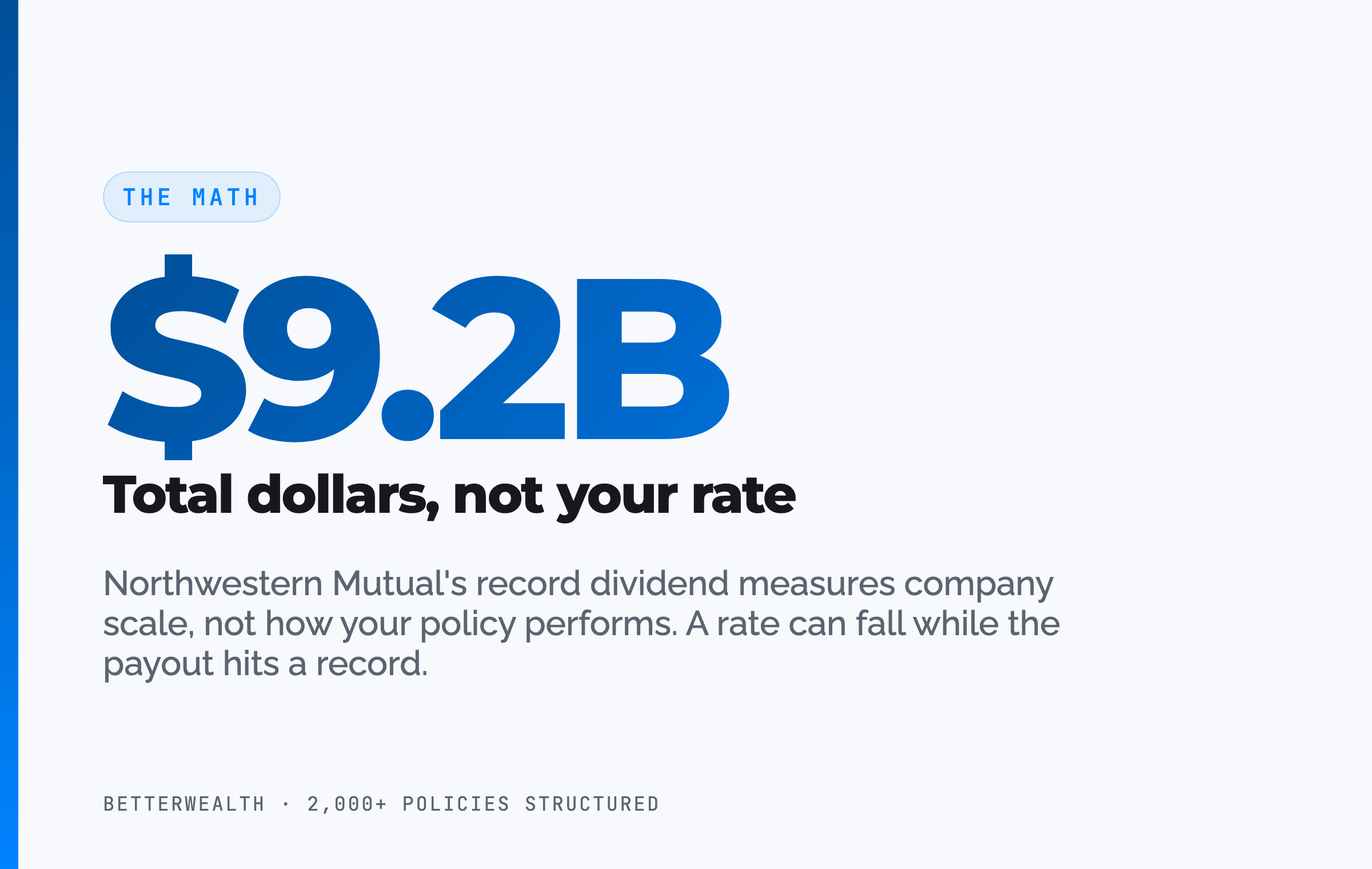
A record dividend means the total surplus a mutual insurer returned to policyholders reached a new high, driven mostly by the company's growing size rather than a jump in its dividend rate. Rate and volume are two different things, and the headlines only ever report volume.
Think about it the way you would think about any long-lived business. These carriers have been around for 170-plus years in some cases. Their balance sheets compound. Their policyholder count climbs every year. When you have more policies in force paying premiums, you generate more divisible surplus, so you distribute more total dollars. That is natural attrition of being in business for a very long time, working in your favor.
Here is the trap. Suppose a carrier paid a dividend rate of 12% decades ago and pays 6% today. The rate is cut in half, yet the total dollars paid can still hit a record, because the book of business is many times larger. A shrinking rate and a record payout can be true in the same year. Anyone waving the record number as proof of strong current performance is skipping that math.
Rate versus volume. Never confuse the two.
Dividend rates as a whole are low by historical standards. A record dollar figure does not mean rates are climbing. It usually means the company got bigger.
03 / The frameworkWhere the dividend fits inside The And Asset
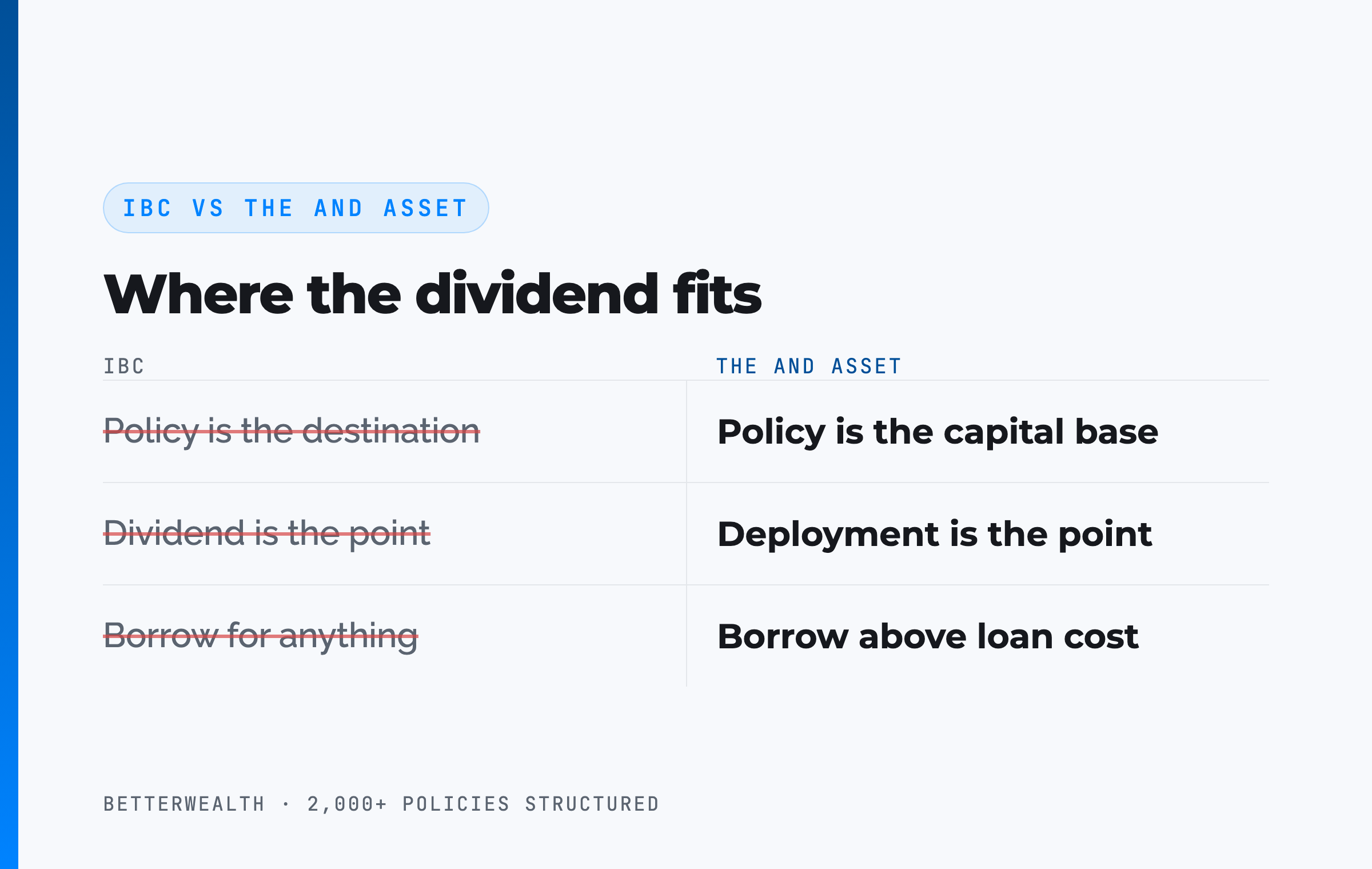
The dividend is fuel for the capital base, not the point of the strategy. That is the core of how The And Asset treats it, and it is where our approach diverges from how most people talk about dividend-paying whole life.
Nelson Nash pioneered the idea of using whole life insurance as a personal banking system in Becoming Your Own Banker. His insight holds: you either lose money paying interest to outside lenders, or you lose money to the opportunity cost of capital sitting idle. We respect that foundation. The And Asset builds on it with a rule Nash's broader teaching does not enforce.
Where IBC ends and The And Asset begins
IBC frames whole life as the destination, and dividend growth as the reason to be there. The And Asset frames the policy as the capital base and says the value is created in what you deploy that capital into. You only borrow against the policy when the borrowed dollars will produce a return greater than the carrier's loan cost. Anything less is an expensive way to spend money. A record dividend does not change that test. It slightly increases the fuel in the tank. The return still has to come from what you do with the capital.
This is also why chasing the carrier with the flashiest dividend number is the wrong move. The dividend feeds the cash value that becomes your capital base. It is one input among several, and it is not the input that decides whether the strategy works for you.
You are not paying yourself interest. The interest on a policy loan goes to the insurance company. Your return is what the deployed capital earns while the policy keeps compounding.
04 / How it worksHow a mutual dividend becomes capital you can deploy
A dividend becomes usable capital through a five-step path from the insurer's surplus to your policy loan, and the order matters. Understanding the path is what lets you read a dividend announcement correctly instead of reacting to the headline.
- The insurer prices conservatively. A mutual carrier builds premiums on cautious assumptions about mortality, expenses, and investment returns, so it collects more than it expects to spend.
- Actual experience beats the assumptions. When claims come in lower, expenses run leaner, or investments perform better than assumed, the gap becomes divisible surplus.
- The board declares a dividend. The board of directors decides each year how much surplus to return to participating policyholders. This is the number the headlines report, and it is not guaranteed.
- You direct the dividend to paid-up additions. Elect to use the dividend to buy paid-up additions, which increase both cash value and death benefit. Your cash value grows at the dividend rate net of mortality and expense charges, not the gross rate you saw announced.
- You borrow against the larger cash value. Take a policy loan against the accumulated value and deploy it into an activity that clears the carrier's loan cost. The policy keeps compounding on its full value the entire time the loan is outstanding.
Step four is where most of the misunderstanding lives. The dividend interest rate is a gross number. The 6.1% or 6.4% you see quoted is before the internal cost of insurance comes out. Your cash value does not grow at the headline rate. It grows at that rate net of mortality and expense charges. Any agent quoting the gross dividend rate as your growth rate is either careless or selling.
Gross rate is the headline. Net is what compounds.
A record dividend does not make this a fit. Your situation does.
It fits you if
- You are an entrepreneur or investor already deploying capital
- You have a long capital horizon (10+ years)
- You can name a use for borrowed capital that beats the loan cost
- You want control and access, not the highest headline rate
It does not fit you if
- You are early in building wealth and need liquidity now
- You want a savings account, not a capital strategy
- You are chasing the biggest dividend number you saw
- You cannot identify a productive use for borrowed dollars
If you are in the first column, a 30-minute conversation will tell you whether an integrated policy adds anything to what you are already doing. If you are in the second, we will tell you that too.
Book a Discovery Call05 / The mathDoes the dividend even matter to your return?
The dividend matters far less to your return than what you do with the capital the policy holds. This is the single hardest thing to accept for someone comparing carriers by dividend rate, and it is the truest thing in this entire piece.
Run the actual decision. You borrow against your policy at the carrier's loan rate. Policy loan rates vary by carrier and rate environment. At the time of writing many carriers fall in the 5 to 6% range, but treat the specific number as a variable to verify with the carrier, not a constant. Your policy keeps compounding on its full cash value while the loan is out. Your deployed capital earns its own return. If that return exceeds the loan cost, you are ahead on the spread, and the same dollar has done two jobs. If it is lower, you have borrowed money to lose it slowly, and no dividend rate rescues that.
Notice what did the work in that math. The spread between your deployed return and the loan cost, not the dividend. The dividend keeps the base compounding in the background, which is valuable and real. It is not the lever that decides the outcome.
If the deal does not clear the loan rate, do not borrow.
06 / The marketWhy is permanent life insurance growing if it's "dying"?
Permanent life insurance is growing because more people are buying it across nearly every product line, which is the opposite of what the "buy term and invest the difference" crowd has predicted for decades. The LIMRA first-quarter 2026 report makes that plain.
Whole life new annualized premium plus excess hit $1.6 billion, up 9% from the prior year, with policy count up 13%. Life insurance remained the dominant product at 36% of new premium. Indexed universal life reached $1.1 billion, up 14%, with six of the top ten IUL carriers reporting double-digit growth. Variable universal life rose 12% to $729 million. Even term insurance climbed 9% to $788 million. The one product line that fell was fixed universal life, down 6% to $221 million, the awkward middle child that costs more than term without building meaningful cash value.
Part of the whole life growth traces to final expense policies, which are small whole life contracts often sold through high-volume distribution. That is why premium and policy-count percentages can move differently: a burial policy carries a much smaller premium than a business owner's overfunded design, so counting policies and counting dollars tell different stories. Both are up. The point stands.
After years of "permanent life insurance is a scam, buy term," term is still only 18% of the US market and its policy count grew just 5%. The scam narrative has not moved the market it claims to speak for.
07 / Where people get this wrongThe two opposite oversell traps
People oversell this topic in two opposite directions, and both cost readers money. The first trap comes from the anti-permanent crowd, the second from the pro-permanent crowd, and honesty means calling out both.
The first oversell says permanent life insurance is a scam and everyone should buy term and invest the difference. For a lot of families with young children and no permanent need, term is genuinely the right call, and we wish more people carried it. But "term is right for many" is not "permanent is a scam," and the market data does not support the scam framing.
The second oversell is the mirror image, and it is closer to home for our industry. Marketers point at a record dividend, quote the gross rate as if it were your return, promise you can "pay yourself interest," and imply everyone should own one of these. That is how the strategy gets ruined. The interest goes to the carrier. The gross rate is not your growth. And this is not for everyone. It is for a specific person doing specific things with capital.
Two opposite pitches. Same problem: neither respects the math.
We do not recommend putting all your money into insurance. Whether taxes rise or fall, insurance is not the one asset that saves everyone. It is a capital tool for the right situation.
08 / The tradeoffsWhat record dividends do and do not buy you
Record dividends carry real benefits and real limits, and pretending the number is all upside is how trust gets lost. Here is the honest split.
On the benefit side, a large and rising dividend from a 150-year-old mutual is a signal of scale and staying power, which matters when your strategy depends on the carrier being there in year 30. A low lapse ratio at these carriers, often well below the roughly 5% industry average, tells you policyholders are keeping their policies, which usually means the policies are performing close to what was illustrated. Directed into paid-up additions, the dividend accelerates the cash value that becomes your capital base.
On the limit side, the dividend is not guaranteed, and a long streak does not change that: each year's dividend is still a board decision. The headline dollar figure says nothing about your rate. The gross rate says nothing about your net growth. And the highest-dividend carrier is frequently not the strongest performer. MassMutual often posts one of the largest dividend rates yet does not always deliver the most competitive product growth. The number that sells the headline is rarely the number that decides your outcome.
The frameworks behind 2,000+ policies, in one place.
The And Asset Vault holds the calculators, design frameworks, and structuring decisions we use to separate what actually drives a policy's performance from the headline numbers. Free, email-gated, no spam.
Open the Vault09 / The fitWho should actually care about a record dividend?
The reader who should care is the entrepreneur or high-income earner already using, or seriously considering, a whole life policy as a capital base, because for them the dividend feeds a system they are actively running. For everyone else, the record dividend is trivia.
If you own a properly structured policy and direct dividends to paid-up additions, a rising dividend quietly compounds your capital base, and that is worth understanding. If you are shopping carriers, the dividend is one input to weigh against policy design, funding flexibility, loan mechanics, and long-term performance. If you have no plan to deploy capital above a loan cost, the dividend number changes nothing for you, and no headline should push you into a policy you have no use for.
A composite: the dividend was the quiet part, the deployment was the point
Consider a 44-year-old business owner, preferred non-tobacco, funding an overfunded whole life policy at $48,000 per year on a cashflow design with a 30/70 base-to-PUA split. This is a representative composite, not a single named client.
Through the first three years, cash value trails cumulative contributions, exactly as a real policy should. By year three, each premium dollar starts adding more than a dollar of cash value. At year five, total cash value crosses total contributions. No earlier. Any illustration showing a year-two break-even is marketing fiction.
In year seven, with roughly $353,000 of accessible cash value, the owner borrows $164,000 against the policy to buy into a revenue-producing asset for the business. The deployed capital returns an estimated 13.8% IRR against an illustrative loan cost near 6%, a spread of almost eight points working in the owner's favor. Repayment runs on a 44-month schedule funded by the asset's own cash flow.
Here is the part the headline would have missed. That year's dividend, directed to paid-up additions and net of mortality and expense charges, added a few thousand dollars to the cash value while the loan was outstanding. Helpful. Real. Nowhere near the eight-point spread the deployment produced. The dividend was the quiet part. The deployment was the point.
One dollar. Two jobs. That is the And.
The honest 30 minutes about whether this fits you.
We have structured more than 2,000 policies across all 50 states. We have seen this strategy work exactly as designed, and we have seen it fail. On a discovery call, a practitioner looks at your specific situation and tells you honestly whether an integrated policy belongs in your plan, and whether it does not. If you would rather learn first, the The And Asset and BetterWealth YouTube channels go deep on the math.
Book a Discovery Call10 / The landscapeWhole life, term, IUL, VUL, and fixed UL in Q1 2026
Across the five main product lines, the first quarter of 2026 showed growth almost everywhere, with only fixed universal life falling. The table sets the LIMRA first-quarter figures against what each product is actually built to do, so you can see why the money is moving the way it is.
| Product | Q1 2026 new premium | Growth | Market share | What it is built for |
|---|---|---|---|---|
| Whole life | $1.6 billion | +9% premium, +13% policies | 36% | Guaranteed cash value and dividends; the chassis for a capital base you borrow against |
| Term | $788 million | +9% premium, +5% policies | 18% | Cheap, temporary death benefit; strong fit for young families with no permanent need |
| Indexed UL (IUL) | $1.1 billion | +14% premium, +8% policies | 25% | Market-linked growth with caps and floors; more upside and more variability than whole life |
| Variable UL (VUL) | $729 million | +12% premium, +4% policies | 16% | Market-driven cash value in a tax wrapper; tends to track investor confidence |
| Fixed UL | $221 million | -6% premium, +5% policies | 5% | Low-cost permanent death benefit with little usable cash value; the shrinking middle child |
Whole life leads on policies. At $1.6 billion in new premium and 13% policy-count growth, whole life still writes the most new business, which is why it remains 36% of the market. Its guarantees are also why we design a capital base around it rather than a market-linked product.
IUL leads on premium growth. Indexed UL grew premium faster at 14%, and the gap between whole life and IUL has been tightening for years. IUL offers real flexibility and upside, with more variability in what it delivers 30 years out. Neither is universally "better." They solve different problems.
Term is not disappearing, and neither is permanent. Term grew 9%, driven by digital platforms and easier underwriting, while every permanent line except fixed UL grew too. For a fuller side-by-side, see our whole life versus term breakdown.
FAQRecord life insurance dividend questions
Do record life insurance dividends mean higher returns?
No. A record dividend measures the total dollars a mutual insurer pays out, not the rate of return on your policy. A company can pay a record total dollar amount while its dividend rate stays flat or declines, because a 150-year-old balance sheet covering millions of policyholders pays more in aggregate as it grows.
Why are mutual life insurance companies paying record dividends in 2026?
Mutual insurers are paying record dividends in 2026 mostly because of compounding scale. Carriers like Northwestern Mutual, MassMutual, New York Life, and Guardian have been in business for 150 years or more, so their balance sheets and policyholder counts keep growing. More policies in force means more total surplus to distribute, which produces record aggregate dollars year after year.
Is the dividend interest rate the same as my cash value growth?
No. The dividend interest rate is a gross figure. Your cash value grows at that rate net of mortality and expense charges, which is lower than the headline rate. Any agent who quotes the gross dividend rate as your growth rate is being careless or selling.
What is The And Asset?
The And Asset is BetterWealth's framework for using a properly structured whole life policy as a capital base. You only borrow against it for an activity that produces a return greater than the carrier's loan cost, so your dollars do two jobs at once: the policy keeps compounding while the deployed capital earns its own return.
How is The And Asset different from infinite banking?
Infinite banking, as Nelson Nash taught it, frames a whole life policy as a personal banking system for any purchase. The And Asset adds a discipline: you only deploy borrowed capital when the return clears the carrier's loan cost. The policy is the capital base, not the destination. It is built on Nash's foundation but operates on different principles.
Is permanent life insurance dying?
No. According to LIMRA first-quarter 2026 data, whole life new annualized premium rose 9% to $1.6 billion and whole life policy count grew 13% year over year. Life insurance remained the dominant product at 36% of new premium. Permanent life insurance is growing, not disappearing.
Are life insurance dividends guaranteed?
No. Dividends are declared annually by the insurer's board of directors and are not guaranteed, no matter how long the payment streak has run. Northwestern Mutual has paid dividends for more than 150 years, but each year's dividend is still a board decision based on that year's surplus.
Should I pick the carrier with the highest dividend rate?
No. The dividend rate is one input and it tells you almost nothing about how a policy performs. MassMutual often posts one of the highest dividend rates but does not always deliver the most competitive cash value growth. Policy design, funding strategy, and how you use the policy matter far more than the headline rate.
Does inflation erode a life insurance policy's purchasing power?
Every place you store capital competes with inflation, so the real question is not whether a policy beats inflation but where the same dollar is best stored. A well-designed policy can grow near 4.5% over a long horizon, ahead of a low-yielding bank account, while giving you access to that capital through policy loans. The value is the utility of the capital, not an inflation-beating claim.
Should whole life insurance be owned by a trust?
For most people, no. Having a trust own the policy can cost you control and flexibility, especially with an irrevocable trust. It is more common to name a revocable trust as beneficiary so the death benefit pays cleanly. Irrevocable trust ownership is usually reserved for the small share of families managing estate-tax exposure. This is general information, not tax or estate-planning advice.
What is the difference between whole life and IUL for cash value?
Whole life is a fixed-guarantee, dividend-paying contract with contractual cash value, while indexed universal life ties growth to a market index with caps and floors and carries insurance costs that can rise over time. Whole life offers stronger long-term guarantees; IUL offers more upside potential and more variability. For a capital base you plan to borrow against for decades, the predictability of whole life is why we design around it.
- LIMRA, US individual life insurance sales data, including the first-quarter 2026 product-line figures cited here.
- Nelson Nash, Becoming Your Own Banker, the origin of the infinite banking concept.
- IRC Section 7702 (Cornell Law), the tax code provision behind the tax treatment of life insurance cash value and loans.
- AM Best, financial strength ratings and industry lapse-ratio benchmarks for the mutual carriers referenced.
- BetterWealth resources: The And Asset book, the The And Asset YouTube channel, and the BetterWealth YouTube channel.
Co-hosts The And Asset show alongside Caleb and drives the rate-versus-volume breakdown in the source video, pressing for the context behind the record dividend numbers rather than the headline.
I founded BetterWealth to treat life insurance as the wealth and capital tool it actually is, not the product most people get sold. Our team has structured more than 2,000 policies across all 50 states. I wrote The And Asset and host the BetterWealth and The And Asset YouTube channels. If you want an honest read on whether an integrated policy fits your plan, book a discovery call. We will tell you if it does not.