
Infinite banking car financing means borrowing against a whole life policy's cash value to buy the car, then repaying on your own schedule. At equal rates the policy loan finished about $917 ahead over five years; when the bank rate dropped more than roughly 0.3% below the policy rate, the bank loan won.
Every dollar of car payment in America is doing exactly one job: retiring a lender's loan. The borrower gets no access to what they have repaid, no growth on it, and no say over the terms once the paperwork is signed. That structural cost, capital flowing out with nothing compounding behind it, is the problem the infinite banking crowd has been arguing about for years, usually with strong opinions and no repayment schedules on the table.
Four months ago that argument played out on this channel. Chris Naugle, who finances every vehicle he owns through his life insurance policies, and I disagreed about whether the math supports it. The conversation went viral, spawned two response videos from other channels, and produced at least one widely shared calculation that turns out to be wrong. This time we ran the numbers together, on screen, using the same policy for both sides of the comparison.
The debate was never really about interest rates. It was about what control costs, and whether you know the number before you agree to pay it. The results cut both ways. At matching 6% rates, the policy loan finished $917 ahead over five years. At a 4% bank rate against a 6% policy loan, the bank borrower finished $2,359 ahead. Both sides of the old argument were right, in different rate environments.
At BetterWealth we have structured more than 2,000 policies, and the framework we practice, The And Asset, has a strict rule about moments like this. This article walks through the full comparison: how a policy loan actually credits payments, the exact crossover rate where each path wins, what Chris's famous $33,000 G Wagon story really consists of, and where the discipline has to override the enthusiasm.
- At identical 6% rates, financing a $54,300 SUV through a policy loan ended $917 ahead of bank financing after five years.
- At a 4% bank rate against a 6% policy loan, the bank borrower finished $2,359 ahead over the same five years.
- The crossover sat near a 5.7% bank rate: below it the bank wins, above it the policy loan wins.
- Policy loan payments reduce principal immediately; interest is tallied separately and added at the policy anniversary.
- You do not pay yourself interest on a policy loan. The interest goes to the insurance carrier.
- A general AI calculator got this exact scenario wrong, overstating interest by $579 and the payoff by a month.
The article gives you the outcomes. The video shows the actual Vault repayment schedules and the policy illustration behind them, month by month, which is where the mechanics click for most people:
01 / The debateWhat is the infinite banking car argument actually about?
The argument is about whether control over your capital is worth paying a measurably higher interest cost. Chris's position is unambiguous. He finances every vehicle through his policy system, and he told us he would do it even at a 6% policy rate against a 4% bank rate, because when he repays his own system, every dollar of that payment is usable cash value again the next day. When he repays a bank, every dollar is gone.
He is equally unambiguous that this is a personal preference, not client advice. His stated rule for everyone else contradicts his own car habit, and he says so on camera.
"Never take a loan from your policy unless that loan money can be used at a higher rate than what your cost of capital is." Chris Naugle then finances his cars anyway. The gap between the rule and the habit is the whole debate.
My pushback was on the control claim itself. A policyholder who finances the car at the bank keeps $54,300 of untouched borrowing capacity inside the policy. They can retire the bank loan whenever they choose, or deploy that capacity into an opportunity the moment one appears. The policy borrower has already spent that capacity on the car. Control is real on both sides. It just lives in different places, and only one side of the trade shows up on a spreadsheet.
02 / The frameworkWhere does The And Asset stand on financing cars?
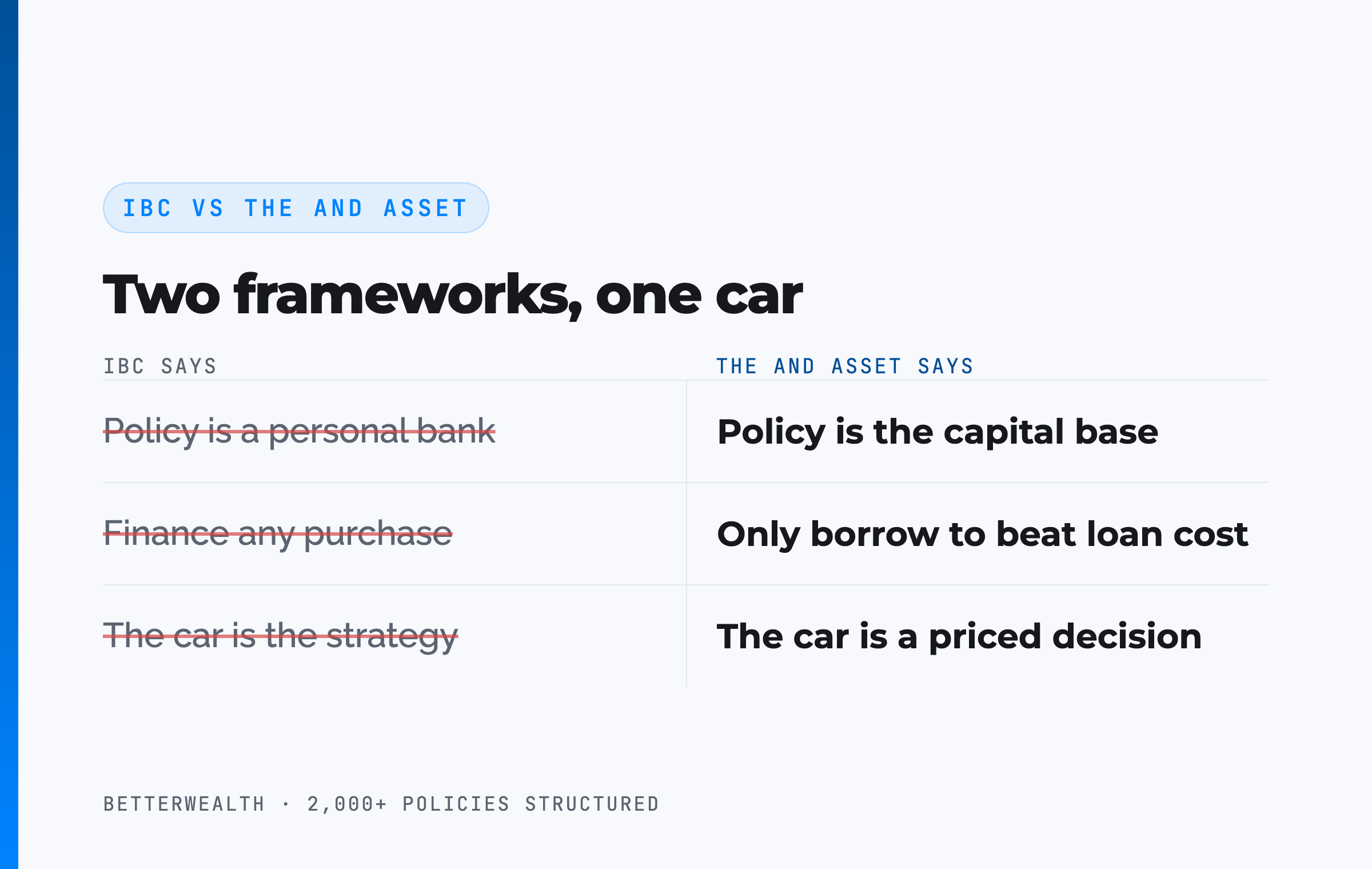
The And Asset treats a car purchase as a financing decision to be priced honestly, not as a wealth strategy. The And Asset is our framework for using a properly structured whole life policy as a capital base, and it is built on the foundation Nelson Nash laid in Becoming Your Own Banker. Nash's insight holds up: you either pay interest to outside lenders or you absorb the opportunity cost of idle capital. We credit that foundation fully. The And Asset shares those roots but operates on different principles, and the car question is exactly where the difference shows.
IBC, as it is popularly taught, says the policy is a personal banking system for any purchase, cars included. The And Asset says you only deploy borrowed capital when the dollars will out-earn the carrier's loan cost. A depreciating vehicle almost never clears that bar on its own. So under our framework the honest description of policy-financed cars is this: at equal rates the mechanics hand you a small structural edge, worth $917 over five years in this comparison, and at a rate disadvantage you are paying a known, quantifiable price for flexibility. Neither of those is a wealth engine. The wealth is built by what you deploy capital into, and the policy is the capital base underneath it.
The math has to work. When it doesn't, know the price.
If the framework is new to you, start with the pillar explainer, What Is Infinite Banking? The And Asset Guide, and come back for the schedules.
03 / The mechanicsWhy does a policy loan repay differently than a bank loan?
A policy loan credits every payment straight to principal, while the interest is calculated separately and added to the balance once a year at the policy anniversary. A bank loan amortizes: each payment is split between interest and principal every single month. That crediting difference, small as it sounds, is why a 6% policy loan with a $1,200 monthly payment retired a $54,300 balance in month 51, slightly ahead of a conventionally amortized 6% loan at the same payment.
Here is the sequence, step by step, as Craig Yenni modeled it.
- Confirm the capital base. The policy in the comparison held roughly $211,000 of cash value by year five, more than enough to collateralize the purchase without stripping liquidity.
- Take the policy loan. The carrier lends against the cash value. The cash value itself stays in the policy and keeps compounding net of mortality and expense charges. You are borrowing against it, not withdrawing it.
- Shop the market rate. Chris checks bankrate.com for the lowest auto rate his credit qualifies for. That market payment becomes the floor for what he sends back to his own system, so his capital is never repaid on softer terms than a bank would demand.
- Set the payment and automate it. In the model, $1,200 per month against the $54,300 loan. Every payment reduces the principal by the full $1,200, and every repaid dollar is available to borrow again the next day.
- Let the interest roll. The first policy year accrued $2,790 of interest. Rather than writing a check for it, the model added it to the balance at the anniversary and kept attacking principal. Total interest over the life of the loan: $6,827, paid to the carrier.
- Redeploy the freed payment. The loan cleared in month 51. From that point the $1,200 flowed into paid-up additions instead. How the PUA rider turns those dollars into cash value is covered in Paid-Up Additions Explained.
The counterintuitive move: do not save up for the interest bill
Craig has run this more times than anyone should admit, and his conclusion surprises people. Policyholders who set cash aside all year to pay the loan interest at the anniversary end up less efficient than policyholders who let the interest roll onto the balance and throw every available dollar at principal instead. Principal payments shrink the base the interest accrues on, and they stay accessible if life demands them back. The set-aside cash does neither job.
Pay principal. Let the interest roll.
You are not paying yourself interest. The interest goes to the carrier. Repaying your loan at a bank-equivalent rate is disciplined saving flowing back into your own system, and it deserves to be called that.
04 / Head to headDoes a policy loan beat a bank loan on a car?
It depends entirely on the spread between the two rates, and the video pinned down exactly where the line sits. Every scenario used the same $54,300 vehicle, the same 60-month horizon, the same policy, and the same total monthly outlay of $1,200 per person. Person A financed at the bank and put the leftover into paid-up additions each month. Person B took the policy loan, paid $1,200 until it cleared, then shoved the freed payment into PUAs.
Scenario one: 4% bank against 6% policy loan
The bank borrower paid roughly $1,000 per month and about $5,700 of total interest, and invested the spare $200 monthly into PUAs for the full five years. Ending cash value: $224,569. The policy borrower ended at $222,210. The bank borrower finished $2,359 ahead. Chris conceded the math without blinking; his counterargument is that a 4% car loan did not exist at the time of recording, and on that point he is right.
Scenario two: 5% bank against 6% policy loan
A realistic new-car rate with strong credit. The bank payment rose to $1,025, the PUA leftover shrank to $175, and the bank advantage narrowed to $721.
Scenario three: the crossover
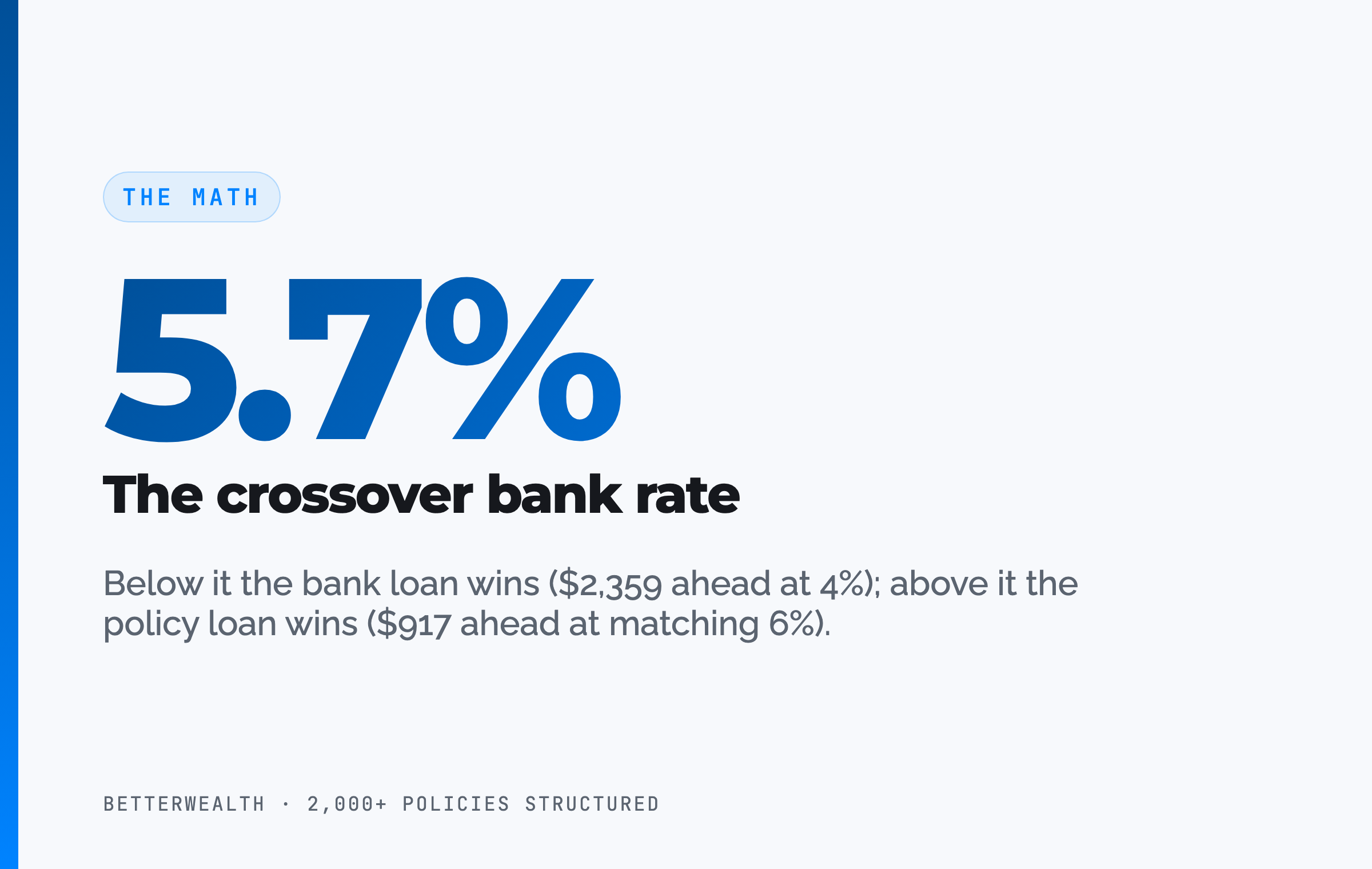
Craig kept nudging the bank rate up until the two paths matched. The break-even landed near 5.7%. A bank rate below that beats the 6% policy loan; a rate above it loses.
Scenario four: 6% against 6%
The most realistic comparison for used-car buyers, where rates run six to seven percent or higher depending on credit. At matching rates the bank payment is $1,050 with roughly $8,700 of interest over 60 months, and the policy borrower finishes $917 ahead after five years. The crediting mechanics, principal-first payments with interest tallied annually, generate the entire edge.
Below a 5.7% bank rate, the bank wins. Above it, the policy loan wins. Anyone who tells you one side always wins has not run the schedules.
The AI calculator got it wrong
One of the response videos that circulated after the original debate leaned on a general AI tool to model the 6% policy loan. It reported $7,406 of interest and a 52-month payoff. The correct figures, from a model built on how carriers actually credit payments, are $6,827 and 51 months. The AI applied standard monthly amortization to a loan that does not amortize monthly. On a car loan the error is $579. On a strategy people run for decades, the same class of error compounds. Verify any AI-generated policy math against the carrier's actual method before you act on it.
Policy-financed purchases fit a specific person with a specific system.
It fits you if
- Your policy is mature, past the early capitalization years
- Your cash flow comfortably covers the repayment schedule
- You have compared the policy rate to real market rates
- You value repayment terms you control and will actually repay
It does not fit you if
- You want the policy to make a depreciating car profitable
- A bank rate meaningfully below your policy rate is available and cost matters most
- You have no reserves behind the repayment plan
- You are buying the policy just to buy cars
If you are in the first column, a 30-minute conversation will tell you whether the structure supports it. If you are in the second, we will tell you that too.
Book a Discovery Call05 / The G WagonWhat did the $33,000 G Wagon "profit" actually consist of?
The car lost money and the system around it grew; the $33,000 is the system's growth, not the car's. Chris bought the G Wagon for $170,000, drove it little, and sold it about two and a half years later for roughly $130,000. A $40,000 loss on the asset. He still describes the episode as making $33,000, and unpacking that claim was the most useful ten minutes of the conversation.
Two things were happening while he owned the car. First, his policies kept compounding, net of mortality and expense charges, because the cash value collateralizing the loan never left the policy. Second, he repaid his loan at the bank-equivalent rate of the day, around 7.7%, while his policy loan charged about 5%. He calls that a 2% spread. Named precisely, it is extra money he injected into his own system on top of the required payments. Forced saving with a market-rate benchmark. Add the compounding to the injections and the system grew by enough to absorb the $40,000 vehicle loss and show $33,000 besides.
So I asked the only question that settles it: would he have been better off never buying the G Wagon? His answer, on the record, deserves its own box.
"I would have been better off for sure, and I shouldn't have bought the G Wagon." Chris Naugle, on camera. The system performed. The car did not.
The right way to hold both truths: the policy is a foundation that compounds regardless of what you bolt onto it. A bad purchase financed through it is still a bad purchase, softened by the foundation underneath. That is a real benefit. It is not a profit.
06 / Where people get this wrongThe marketing claims that don't survive a repayment schedule
Marketers have ruined the way this strategy should be explained, and the car pitch is where the damage concentrates. Three claims come up constantly, and the schedules in this comparison retire all three.
"You get all the money back on every car you buy." What actually happens: you repay your own loan, the repaid dollars become available capital again, and the policy compounds throughout. That is genuinely better than a bank loan's one-way outflow. It does not repeal depreciation, and it does not make the car free. The G Wagon lost $40,000 no matter how it was financed.
"You pay yourself interest." You pay the carrier. Every time. The correction matters because the false version makes a higher policy rate sound like a feature in all circumstances, which is exactly how people end up paying a $2,359 penalty without knowing it existed.
"The policy makes you rich." Chris himself put this one down: the policies will never make you rich; they are slightly better than the banks and savings accounts we are taught to use. The wealth comes from what the capital base lets you do. For the broader honest ledger, benefits and real tradeoffs together, see Infinite Banking Pros and Cons.
"The policies will never make you rich. They're just slightly better than what we're normally taught to use, which is banks and savings accounts." Chris Naugle
The six-and-six purchase, dollar by dollar
The policy behind every scenario: a 40-year-old male, standard rating, non-direct recognition carrier, funded with a $90,000 initial paid-up additions deposit plus $25,000 of annual premium split 40/60 base to PUA. The early years behave the way real policies behave. By the end of year one the owner had contributed $117,400 and held about $105,600 of cash value, with the gap going to mortality charges, expenses, and commissions. Cumulative cash value crossed cumulative premium around year six. No fictional year-one break-even.
In year five, with $211,795 of cash value available, the owner borrows $54,300 against the policy at 6% and buys the vehicle. The alternative on the table is 6% bank financing at $1,050 per month, which costs roughly $8,700 in interest over 60 months and frees $150 monthly for paid-up additions. The policy borrower instead pays $1,200 per month against the loan, watches every payment drop principal by the full $1,200, lets each year's accrued interest roll onto the balance, and clears the loan in month 51 having paid $6,827 of interest to the carrier. The freed $1,200 then flows into PUAs for the remaining months.
After five years the policy borrower's cash value stands $917 above the bank borrower's, both starting from the same policy and the same monthly budget. Flip the bank rate to 4% and the result flips with it: the bank borrower ends $2,359 ahead, $224,569 against $222,210. The mechanics are constant. The spread decides the winner.
One budget. Two schedules. The spread picks the winner.
The frameworks behind 2,000+ policies, in one place.
The And Asset Vault holds the calculators, design frameworks, and structuring decisions we use when we run comparisons exactly like this one. Free, email-gated, no spam.
Open the Vault07 / The comparisonPolicy loan against the other ways to buy the same car
Set the policy loan beside the tools people actually use for a $54,300 vehicle and the trade becomes concrete: you are exchanging the lowest possible sticker rate for repayment control and a capital base that never stops compounding. The dollar rows below use the 6% scenarios from the video; the HELOC comparison is expanded in Infinite Banking vs HELOC.
| Dimension | Policy Loan (And Asset) | Bank Auto Loan | HELOC | Cash Purchase |
|---|---|---|---|---|
| Cost on $54,300 at 6% | $1,200/mo by choice; $6,827 interest, done month 51 | $1,050/mo fixed; roughly $8,700 interest over 60 months | Variable rate; interest recalculated onto principal monthly | $0 interest; $54,300 leaves your accounts on day one |
| What compounds while you repay | Full cash value keeps compounding net of internal costs | Nothing; payments retire the lender's asset | Nothing; a credit line is not an asset | Nothing; the capital is spent |
| Access to repaid dollars | Every repaid dollar is borrowable again the next day | None until the loan is closed and the title clears | Available, but the lender can freeze or reduce the line | Gone until you rebuild savings |
| Who sets the terms | You: pause, change, or accelerate payments at will | The lender; miss payments and repossession follows | The lender; terms and access can change | Nobody; there are no terms |
Cost. The bank's amortized 6% loan costs about $8,700 in interest against the policy loan's $6,827 at the same rate and a higher voluntary payment. Drop the bank rate below roughly 5.7% and the bank becomes the cheaper path, full stop.
Compounding and access. The policy loan is the only column where an asset keeps growing behind the purchase and where repaid dollars return to service immediately. A HELOC looks similar on paper, but its interest is folded into principal monthly and the lender can freeze the line exactly when you need it, which is the structural weakness the policy loan does not share.
Terms. Control is the honest reason Chris pays a premium for this. The policy loan has no repossession trigger and no required schedule. That flexibility has real value in a bad year. The point of this article is that it also has a real price in a good one, and now you know the number.
08 / The bigger pictureHow does this fit a broader capital strategy?
The car is the smallest use case for the capital base, and treating it as the headline undersells the structure. Chris works with family offices, including one attached to a name you would recognize, and none of them are financing SUVs. They hold whole life for two jobs. The guaranteed cash value growth acts as a stability layer under the speculative slice of the portfolio, the venture bets that can go to zero. The death benefit acts as the ultimate backstop: whatever the risk capital does, a known amount regenerates for the next generation. Multi-generational families have run that playbook for the better part of a century.
For the entrepreneur or high-income earner, the same logic scales down. The policy is the capital base. Its highest use is funding the deployments that out-earn the loan rate: the equipment purchase, the acquisition, the property. A car financed through it at equal rates is a mechanically sound convenience. A car financed through it at a two-point disadvantage is a $2,359 flexibility fee. Design decides how well the base performs either way, and design is a bigger lever than any single purchase; the base and PUA split that drives it is covered in How to Structure an And Asset Policy.
Craig said the quiet part well: there are math reasons to make a decision and non-math reasons, and a practitioner's job is to make sure you know which one you are using. Behavior beats spreadsheets in most financial lives. The discipline is refusing to let a behavior story wear a math costume.
Control is worth paying for. Just read the price tag first.
The honest 30 minutes about whether this fits you.
We have structured 2,000+ policies. We have seen this strategy work exactly as designed, and we have seen it fail. If you want a real conversation about whether The And Asset fits your situation, book a discovery call. We will give you the honest answer either way. No pressure, no pitch. If you would rather learn first, the The And Asset and BetterWealth YouTube channels go deep on the math.
Book a Discovery CallFAQInfinite banking and car financing questions
Should you use infinite banking to buy a car?
Only when the rate math supports it. At equal interest rates, a policy loan finished about $917 ahead of bank financing over five years on a $54,300 vehicle. When the bank rate was two points lower than the policy loan rate, the bank borrower finished $2,359 ahead. Run both schedules before deciding; the crossover in this comparison sat near a 5.7% bank rate against a 6% policy loan.
Is a policy loan cheaper than a bank car loan?
At the same stated rate, yes, by a small margin. Policy loan payments reduce principal immediately while interest is calculated separately and added at the policy anniversary, so a 6% policy loan paid off slightly faster than a 6% amortized bank loan at the same payment. Against a meaningfully lower bank rate, the bank loan wins. In this comparison a bank rate below roughly 5.7% beat the 6% policy loan.
How does a whole life policy loan actually work?
The carrier lends you money collateralized by your cash value. The cash value stays in the policy and keeps compounding net of mortality and expense charges. Your payments reduce the loan principal immediately, interest accrues on the outstanding balance, and any unpaid interest is added to the balance at the policy anniversary. Every dollar you repay becomes available to borrow again.
Do you pay yourself interest when you repay a policy loan?
No. The loan interest goes to the insurance carrier, not to you. When someone repays a policy loan at a rate above the carrier's charge, the excess is simply additional money flowing into their own system, which is disciplined saving, not an investment return. Marketers who describe policy repayment as paying yourself interest are describing the mechanics incorrectly.
What happens if you do not pay the interest on a policy loan?
The accrued interest is added to your loan balance at the policy anniversary. Counterintuitively, letting the interest roll and putting every available dollar toward principal is more efficient than saving up cash to pay the interest bill, because principal payments immediately reduce the balance that interest accrues on and remain accessible if you need them.
What is The And Asset?
The And Asset is BetterWealth's framework for using a properly structured whole life policy as a capital base. You only borrow against it for an activity that produces a return greater than the carrier's loan cost, so your dollars do two jobs at once: the policy keeps compounding while the deployed capital earns its own return.
How is The And Asset different from infinite banking?
Infinite banking, as Nelson Nash taught it, frames a whole life policy as a personal banking system for any purchase, including cars. The And Asset adds a discipline: you only deploy borrowed capital when the return clears the carrier's loan cost. A depreciating vehicle rarely clears that bar on its own, so under The And Asset a car purchase is a financing decision to be priced honestly, not a wealth strategy.
Did Chris Naugle really make $33,000 on a car he sold at a loss?
The vehicle itself lost roughly $40,000; he bought at $170,000 and sold near $130,000. The $33,000 figure came from the policy's compounding over the holding period plus the extra dollars he injected by repaying his loan at a bank-equivalent rate about two points above his policy loan rate. On the show he acknowledged he would have been better off financially not buying the car at all. The system performed; the car did not.
What policy design was used in this comparison?
A whole life policy on a 40-year-old male at a standard rating with a non-direct recognition carrier, funded with a $90,000 initial paid-up additions deposit plus $25,000 of annual premium split 40/60 base to PUA. Year-one cash value trailed contributions, cumulative cash value crossed cumulative premium around year six, and year-five cash value reached roughly $211,795 before any loan.
What are policy loan rates right now?
Rates vary by carrier and rate environment. At the time of the recording the carriers surveyed ranged from about 4.97% to 6.25%, with the better rates near 5.4% to 5.5%. Treat any specific number as illustrative and verify with your carrier before running the comparison for your own situation.
Can a general AI calculator run policy loan math?
Not reliably. A widely shared AI-generated comparison of this exact scenario showed $7,406 of interest and a 52-month payoff. The purpose-built model with identical inputs showed $6,827 and 51 months, because the AI tool applied standard monthly amortization instead of the way carriers actually credit policy loan payments. Verify any AI-generated policy math against a real amortization of the carrier's method.
- Nelson Nash, Becoming Your Own Banker, the origin of the infinite banking concept and the foundation The And Asset builds on.
- IRC Section 7702 (Cornell Law), the tax code provision behind the tax treatment of life insurance cash value and policy loans.
- Bankrate, current auto loan rates by credit tier, the market benchmark used for repayment schedules in this comparison.
- Federal Reserve G.19 Consumer Credit release, official data on auto loan rates and consumer credit terms.
- Source video: This Math Settles The Infinite Banking Car Debate? | With Chris Naugle, the full Vault walkthrough behind every figure here.
- BetterWealth resources: The And Asset book, the The And Asset YouTube channel, and the BetterWealth YouTube channel.
Has financed 15 to 20 personal vehicles through his policy system and co-created the Vault policy-tracking software used for every schedule in this comparison.
Built the repayment models behind the Vault and ran every scenario in the source video, including the correction of the AI-generated comparison.
I founded BetterWealth to treat life insurance as the wealth and capital tool it actually is, not the product most people get sold. Our team has structured more than 2,000 policies across all 50 states. I wrote The And Asset and host the BetterWealth and The And Asset YouTube channels. If you want an honest read on whether this strategy fits your plan, book a discovery call. We will tell you if it does not.