
I founded BetterWealth to treat life insurance as a wealth and capital strategy for entrepreneurs, business owners, and high-income earners. Our team has structured more than 2,000 policies across all 50 states. I wrote The And Asset and host the BetterWealth and The And Asset YouTube channels.
Financial professional since the early 2000s and author of What We're Worth, a business fable built on the loss described below.
Human life value is your knowledge, experience, and relationships, which in Michael Isom's framework are the source of your earning power. Applied to infinite banking, it means capital goes first into areas you control and understand. Money you cannot deploy there sits in a guaranteed, protected, liquid whole life policy until a use earns more than the loan cost.
$4.8 million of family savings, more than $10 million of client capital, and a promise of 5% a month. Michael Isom did not lose that money inside his business. He lost it after it left, sent in search of a higher yield somewhere he did not control and did not understand. The cost of that kind of loss lands twice: once in dollars, and again in the attention the owner stops giving to the one area that produced the capital to begin with.
Isom, founder of Vault AIS, opened a recent BetterWealth event with that story, then sat down with me for the full interview to walk through the framework he built from it.
Your ability to produce in your own area of expertise is the highest-returning asset you own, and every dollar you move outside your control should be measured against it. A policy holds capital safely and accessibly until you have a use for it that clears the math. The wealth gets created in that use.
The failures we see rarely come from the policy. They come from what the owner borrowed against it to chase. Isom's AIS framework draws a hard line between investing and gambling, and The And Asset adds the rate-of-return test most infinite banking content skips.
- Michael Isom lost $4.8 million of family savings and over $10 million of client capital to a promised 5% monthly return.
- His AIS framework: you are the number one asset, your business is the number one investment, and idle capital needs a safe home.
- Investing requires control and expertise in the area. Capital placed without both is gambling, however attractive the promised return.
- Whole life cash value does not exceed cumulative premiums in years one through four; break-even typically lands at year five or later.
- A policy loan at 5% instead of a 7.2% bank loan keeps $2,200 a year per $100,000 borrowed. That is a cheaper way to finance a purchase, not a return.
- The And Asset rule: borrow against the policy only when the deployed capital earns more than the carrier's loan cost.
The full conversation covers the parts of Isom's story that do not translate to a page: the phone calls he had to make and the daily practice he uses now to stay present with his family.
01 / The ProblemWhy Do Successful Business Owners Lose Money Outside Their Businesses?
They lose it because boredom pushes capital out of the area they control and into areas they do not understand. Isom says it in one line: "I got bored in my business. So I started looking for the solution outside of my control and outside of my expertise. That's called gambling."
His path there looked reasonable at every step. By his mid-twenties he was earning over $250,000 a year and owned rental properties. He moved into financial services around 2001 and built a practice. Then a business partner he trusted introduced him to an investment promoter who promised 5% a month. Isom did his own due diligence, put in $50,000, and received $2,500 checks. He added $250,000, then $500,000. With $800,000 in the deal and the checks arriving on time, he began sharing it with clients.
The checks stopped in August 2007. For four months he paid clients' interest out of his own accounts while the promoter offered one explanation after another. Then the FBI called. Isom cooperated with federal investigators, but the money was already gone: $4.8 million of his family's savings and more than $10 million of his clients' capital. Because he had credit lines against the losses, his net worth landed at negative $800,000.
One asset survived: his whole life cash value.
A few hundred thousand dollars of cash value fed his family through the three years he describes as unable to work. He is candid that 2007 through 2010 were the darkest years of his life. The policy did not make him whole. It kept his family eating while he rebuilt the one asset that could.
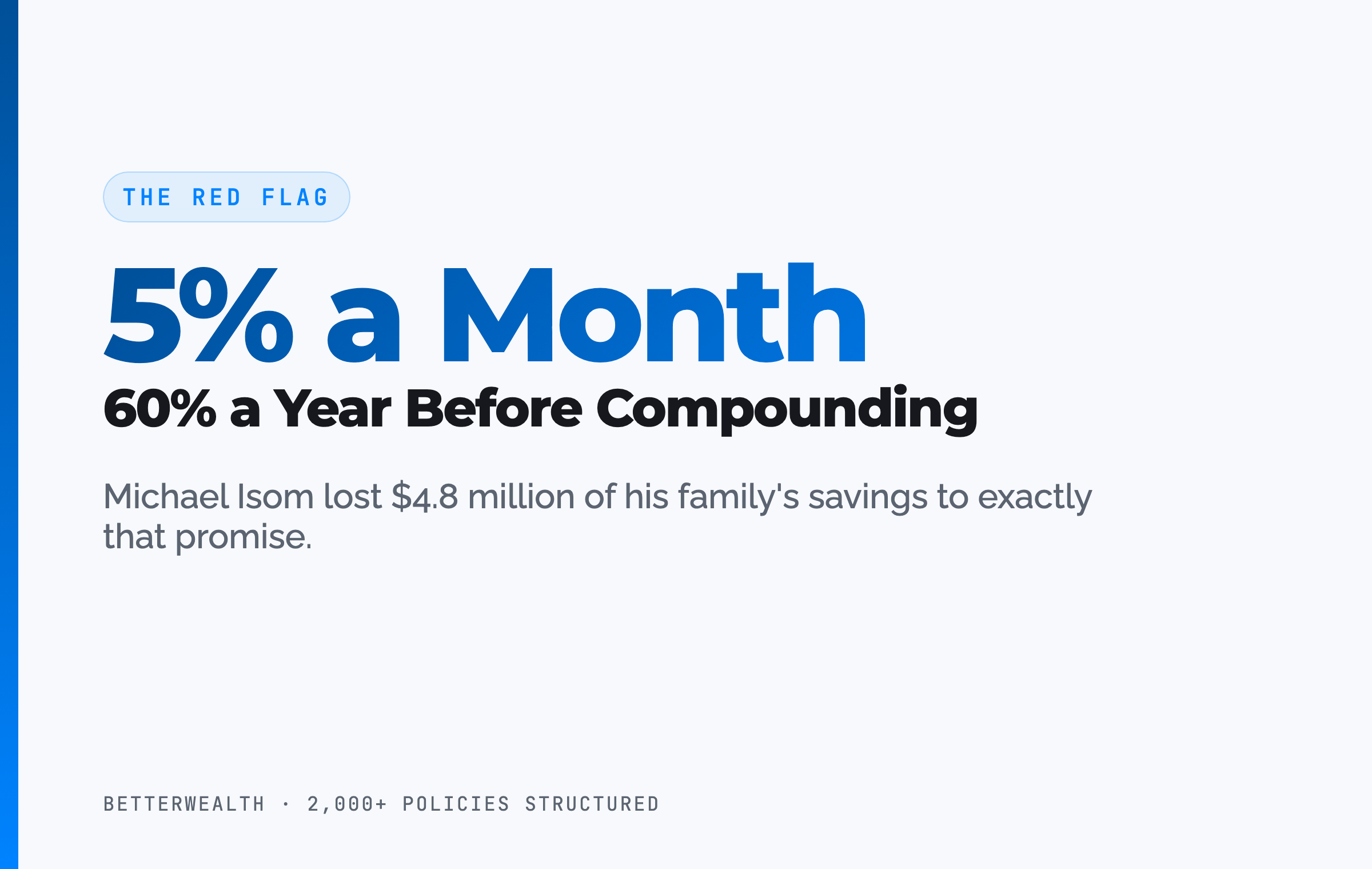
A promised 5% a month is 60% a year before compounding. Consistently high returns regardless of market conditions is the textbook warning sign.
02 / The FrameworkWhat Is Human Life Value, and Why Does It Come Before Property Value?
Human life value is the second balance sheet every person carries, and it produces the first one. Everyone understands a property value balance sheet: assets minus liabilities equals equity. Isom had put his entire sense of worth on that sheet. When it went negative, he felt worthless, because nothing else was being counted.
The human life value balance sheet lists different line items. Its assets are your knowledge, experience, education, relationships, values, and faith. Its liabilities are limiting beliefs, fear, scarcity thinking, and worry, the things that pull you out of the present and reduce your ability to produce. Isom's formula: if you want to increase your property value assets, you must first increase your human life value assets.
"Human life value is the source and creator of all property value."
Michael Isom, Founder, Vault AISHow He Rebuilt From the Second Balance Sheet
Isom did not rebuild by finding a better investment. He started by writing down, on paper, what he was grateful for and what he still had: skills, relationships, and experience the loss had not touched. He used $3,000 of his remaining cash value to hire a coach. Then he began exchanging those assets in the marketplace again. In his words, dollars follow value.
He still reviews both balance sheets daily, human life value first. His practice for the liability side is to write down a limiting belief, ask whether it is true, and judge it by results: if a belief is producing poor outcomes personally or professionally, it gets replaced.
The earning power came back before the money did.
The math supports the order of operations. Isom's example: someone earning $100,000 who invests less than 5% of it. That is under $5,000 a year going to work. A $5,000 to $10,000 raise earned by getting better at the job adds more to that person's yearly income than everything they invest in a year. For most people, Isom argues, the asset that creates long-term cash flow is not even close. It is them.
03 / The TestWhat Separates Investing From Gambling?
Investing means placing capital where you have both control and human life value; missing either one makes it gambling. Isom calls this the number one investment, and for most business owners it is their own business or career.
Control means you run it. You are not handing money to someone else and relinquishing any say over it. Human life value means you have knowledge, experience, or expertise in the area, enough to evaluate what is happening and act on it. When Isom asked me what has put the most money in my pocket, the answer was obvious: my business. For almost every entrepreneur we work with, the answer is the same.
The Real Estate Test
Is real estate a good investment? Is crypto? Isom's answer is always the same: it depends on the person's human life value. He speaks from experience. Years ago he co-owned hundreds of rental properties with a partner, and by his own account neither of them had a real grasp of what was happening. Some properties ended up boarded up. They got out, and he calls that a relief.
Today his entire financial life is his business, his whole life policies, his home, and a mountain cabin. When a client tells him they want to get into real estate, his answer is a question: which courses will you take, and which mentors will you learn from first? Build the expertise, then deploy the capital.
In his words: "I'm not against any investment. I'm against gambling."
Boredom Is the Red Flag
The failure pattern starts with success. A business throws off strong cash flow, the owner gets restless, and capital starts leaking into ventures that drain time and attention. The owner then worries about money at risk, and the worry erodes production in the business that funded everything. Isom's verdict on that trade: too big of a cost.
I get bored too, and I treat it as a sign I am close to a bad decision. Isom's answer is to surround yourself with people who remind you of the distinction, and to reinvest in your own skills when the restlessness shows up.
"If you don't have expertise in real estate, don't gamble in real estate. I'm not saying don't invest in real estate. Invest. Don't gamble."
Michael Isom04 / The StrategyWhere Should Capital Go When You Cannot Deploy It Productively?
It should go somewhere guaranteed, protected, and liquid, and for Isom and many of the business owners we work with that means properly structured, optimally funded whole life insurance. He calls this GPL, and it completes his framework: number one asset, number one investment, number one strategy.
GPL exists so capital sitting outside your control does not become a source of worry that pulls you away from producing. Each of the three words has a precise meaning inside a whole life contract, and marketers routinely stretch all three.
Guaranteed refers to the contractual schedule: guaranteed cash value and a guaranteed death benefit, provided premiums are paid. Dividends are not guaranteed. They are declared annually by the carrier, and the policy compounds at the dividend rate net of mortality and expense charges, not at the headline rate.
Protected means the cash value is not exposed to market losses. Creditor protection is a separate question, and it varies by state.
Liquid means you can borrow against your cash value without a bank's approval process, on a repayment schedule you set, at the carrier's loan rate. The loan stays outstanding at your discretion as long as the loan balance and accrued interest stay below the cash value.
Where IBC Ends and The And Asset Begins
Nelson Nash pioneered the idea of using whole life insurance as a personal banking system. His core insight holds: you either pay interest to outside lenders, or you give up what your capital could have earned while it sat idle. We credit that foundation every time. The And Asset shares roots with IBC but operates on different principles.
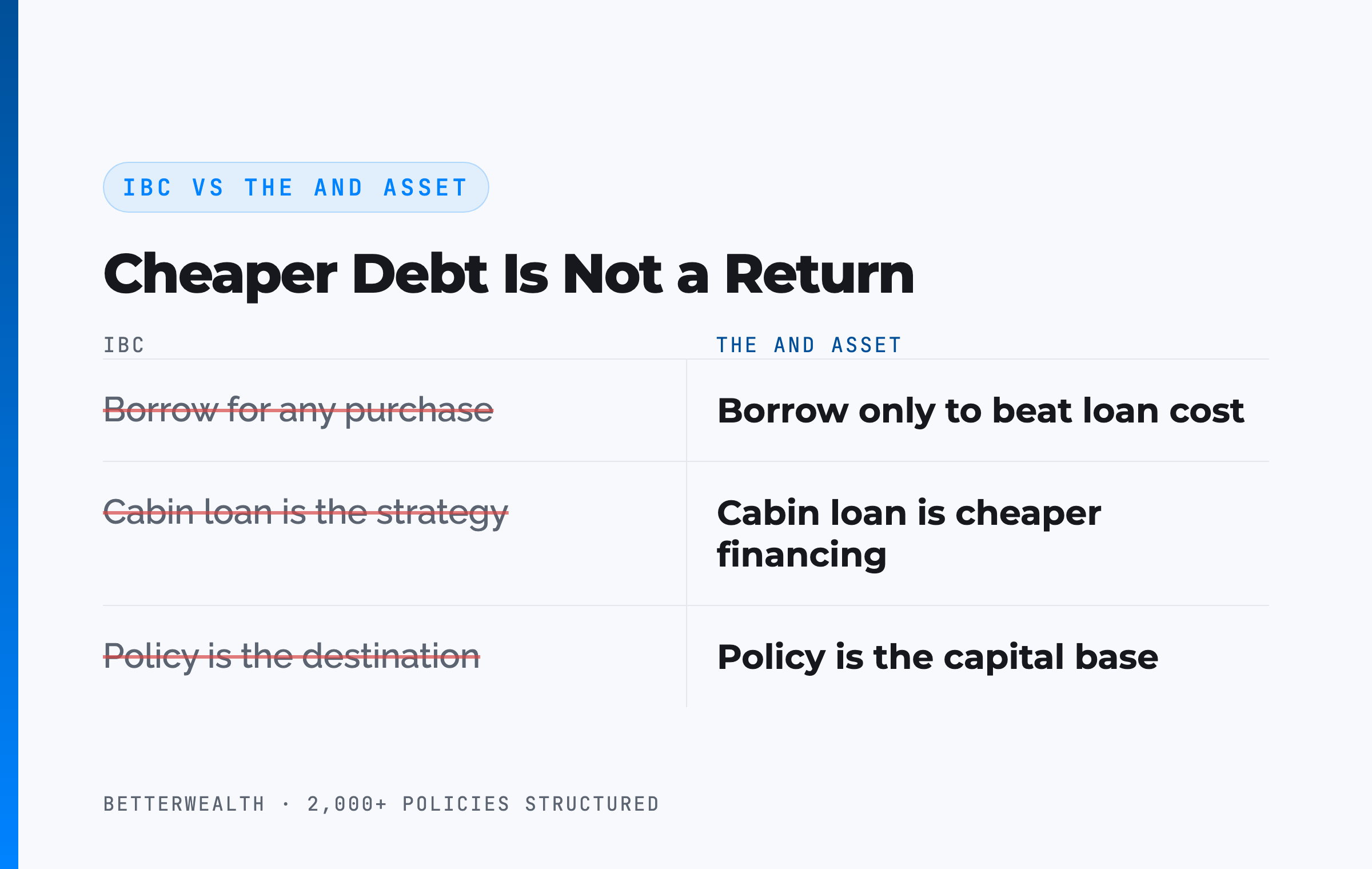
IBC says you can use a whole life policy as a personal bank for any purchase. The And Asset says you only deploy capital from the policy when the borrowed dollars will produce a return greater than the carrier's loan cost, because anything less is an expensive way to spend money. IBC often frames whole life as the destination. The And Asset frames the policy as the capital base; the value is created in what you deploy that capital into.
Isom's framework and ours meet at the same place. His investing-versus-gambling test tells you where borrowed capital is allowed to go. The And Asset's rate-of-return test tells you whether it should go there at all.
05 / How It WorksHow to Apply the Human Life Value Test With a Whole Life Policy
Applying the test takes six steps, and the order matters because the policy comes after the thinking, not before it.
- List your human life value balance sheet. Write down the assets (knowledge, experience, expertise, relationships, values) and the liabilities (limiting beliefs, fear, scarcity) that drive your earning power. This is the balance sheet that produces the other one.
- Run the control and expertise test. Before any dollar leaves your business or career, ask two questions: do I control this, and do I have knowledge, experience, or expertise in it? Two yes answers make it an investment. Missing either one makes it gambling.
- Park undeployable capital somewhere guaranteed, protected, and liquid. Capital you cannot put back into your business or career can go into a properly structured, optimally funded whole life policy, if you have a 10-year-plus horizon, with a heavy paid-up additions rider, designed to stay under the MEC limit. One illustrative cash value design is a 30/70 base/PUA split; the right split depends on your age, health, and funding horizon.
- Let the policy capitalize. Fund consistently and let the early years build. Cash value does not exceed cumulative premiums in years one through four; for a healthy individual, break-even typically lands at year five or later.
- Borrow only when the math clears. Take a policy loan only when the deployed capital will earn more than the carrier's loan cost, and only into an activity that passes the control and expertise test.
- Repay from the activity's cash flow. Set a repayment schedule funded by the deployed activity itself. The policy has no mandatory schedule, so the discipline has to come from you.
Steps one and two are Isom's contribution. Steps five and six are where The And Asset adds its discipline. Skip either half and the policy becomes a well-funded account attached to the same bad decisions.
This Fits a Specific Person Doing Specific Things With Capital.
It Fits You If
- Your business or career produces more cash than it can absorb
- You want idle capital protected from market loss
- You can name a use for borrowed capital that beats the loan cost
- You have a horizon of 10 years or more
It Does Not Fit You If
- You need a short-term savings account
- You carry high-interest debt and want a quick fix
- You plan to borrow for deals you cannot evaluate
- You cannot fund consistently for at least five years
If you are in the first column, a 30-minute conversation will tell you whether a policy belongs in your capital structure. If you are in the second, we will tell you that too.
Book a Discovery Call06 / The MathIs a Policy Loan Cheaper Than a Bank Loan?
Sometimes it is, and a cheaper rate alone does not tell you whether the loan creates value. Isom's own example shows both halves of that answer.
About two and a half years ago, he and his wife found the mountain cabin they had been looking for over five or six years. With an 840 credit score and a low debt-to-income ratio, the bank quoted him 7.2% on a second-home loan. He took a policy loan instead, at 5%. On every $100,000 borrowed, that is $5,000 a year in interest instead of $7,200, so he keeps $2,200. Isom describes the result as a 44% savings, measuring the 2.2-point gap against his 5% rate. Measured against the bank's quote, his interest cost is about 31% lower. Either way, he keeps $2,200 a year on every $100,000.
Cheaper debt is a saving. It is not a return.
This is where The And Asset parts ways with how infinite banking usually gets taught. A traditional IBC presentation counts the cabin loan as the strategy working: you financed through your own policy instead of the bank. The And Asset treats it as a lower-cost way to finance a purchase Isom was making anyway. That did not make the policy loan productive. Only an activity that earns more than the loan cost does that, and it is the only case where the same dollar does two jobs.
What the Spread Leaves Out
Isom himself notes there are other factors, and they matter. Policy loan rates vary by carrier and time period. At the time of writing many carriers fall in the 5 to 6% range, but treat any number as a variable to verify, not a constant. Under direct recognition, the carrier may credit a different dividend on the borrowed portion of cash value, which changes the real cost of the loan. And because a policy loan has no mandatory repayment schedule, unpaid interest accrues against your cash value. If the loan balance plus accrued interest reaches the cash value, the policy can lapse, and any gain over basis may become taxable. A bank enforces a payment plan. With a policy, you have to enforce your own.
The test we apply is the same every time: does the deployed capital outperform the loan rate? If you cannot identify an activity that clears it, do not borrow. The discipline of repayment is the whole strategy.
The HVAC Owner Who Stopped Gambling
Consider a 46-year-old owner of a regional HVAC company, preferred non-tobacco, clearing about $610,000 a year in owner earnings. This is a representative composite, not a single named client. Two years earlier, a friend had talked him into wiring $187,000 into a private lending fund promising 2% a month. He could not read its books. After 19 months he recovered $61,000.
He funded a whole life policy at $60,000 a year, split 30/70: $18,000 to base premium and $42,000 to the paid-up additions rider.
Through year four, cash value trails cumulative premiums, exactly as a real policy should. At year five, $306,900 of cash value passes $300,000 of contributions. By year seven, cash value sits near $461,300 against $420,000 paid in.
In year seven, he ran Isom's test on a decision inside his own business: a second service truck, tools, and a technician to cover a backlog of maintenance contracts. He controlled it, and he had spent 22 years in the trade. He borrowed $143,700 against the policy. At an illustrative 5.5% loan rate, interest starts at about $7,900 a year on the full balance and falls as he repays it. The new crew added roughly $41,900 a year in net margin after wages, fuel, and truck costs, an estimated 21.8% IRR over a seven-year service life.
Repayment runs $3,470 a month over 46 months, covered fully by the crew's $3,490 in monthly margin, with about $20 a month to spare. A slow quarter would be covered from the company's operating reserve, which is why the repayment schedule is set before the money moves. The composite is built with a deliberately tight margin to show why that reserve matters. The cash value stays in the policy and keeps compounding net of internal charges, subject to the direct recognition note above.
Same owner. Same capital. Different test.
07 / Where People Get This WrongWhere Do Infinite Banking Pitches Go Wrong?
They go wrong by selling the policy as the source of the return. Marketers have ruined the way this should be explained, and three claims do most of the damage.
The first is that you pay yourself interest. Many IBC marketers say you are paying yourself interest. You are not. The interest goes to the carrier. Your return is what the deployed capital earns elsewhere while the policy keeps compounding net of its charges.
The second is that you become the bank. Isom uses the phrase ("now we become the bank"), and it describes a real feeling of control. A bank, though, lends to borrowers it has underwritten. Borrowing against your own policy with no underwriting of the deal is how a policy loan ends up funding the next promoter's pitch. The And Asset puts that job on you: underwrite your own deal against the loan rate before you borrow.
The third is that the strategy fits everyone. It does not. It fits people who produce more capital than their business can absorb and who have the discipline to leave that capital alone until the math works.
A whole life policy will not protect you from a bad deal. It will fund one, at the carrier's loan rate, if you let it.
Run Your Own Numbers Before You Talk to Anyone.
The And Asset Vault holds our cash value calculator, The And Asset handbook and audiobook, and a short course on how an overfunded whole life policy is built. It is free. Enter your email to get access.
Open the Vault08 / The TradeoffsWhat Do You Give Up for Guaranteed, Protected, Liquid Capital?
The benefit of GPL capital is that it survives the worst case, and the tradeoff is that it grows more slowly than capital you deploy well. Isom's story shows both. Cash value was the only asset left standing in 2007, and it fed his family. It did not replace the $4.8 million.
The early years are expensive. Cash value trails premiums until around year five for a healthy individual, so money you might need in the next three years does not belong in a new policy. Dividends are not guaranteed, and growth is net of mortality and expense charges. Policy loans carry real interest, and under direct recognition the dividend credited on borrowed cash value can change. Creditor protection depends on your state.
Against that: the cash value does not fall when markets do, you can access it without asking a lender, and a loan outstanding against it cannot be called while the policy remains in force with enough cash value to support it (the lapse risk above is the limit). For an entrepreneur whose real engine is the business, those features buy the one thing Isom lost for three years, which is the ability to stop worrying about money and go back to work.
09 / The Bigger PictureHow Does This Fit Into a Broader Capital Strategy?
It fits as the reserve layer, sitting behind your business rather than competing with it. Isom's own balance sheet makes the point by being short: his business, his whole life policies, his home, and his cabin. The business builds the wealth. The policies hold the cash. When he dies, the death benefit flows to a family trust, and his children decide what to keep.
Clients with hundreds of thousands, or millions, in cash value often ask him whether they should diversify. His answer is to diversify within your area of expertise, and to build expertise before you diversify outside it. That is a stricter standard than most financial advice, and it is the right one for a business owner whose best return is almost always the one they control.
The And Asset sits on top of that structure as the decision rule for borrowing. Human life value tells you where capital can go. The loan rate tells you whether it should. Our resources on The And Asset YouTube channel and the BetterWealth YouTube channel go deeper on the design and the math.
10 / Head to HeadWhere Idle Capital Sits: Whole Life vs the Alternatives
A properly structured whole life policy trades some growth for guarantees, protection from market loss, and access you control. The table compares it with where business owners usually park excess cash, using $100,000 as the reference amount and illustrative rates.
| Dimension | Structured Whole Life | High-Yield Savings | Outside Deal You Don't Control | Brokerage Account |
|---|---|---|---|---|
| Principal Risk | No market loss; early surrender returns less than premiums paid until about year five | FDIC-insured up to $250,000 per depositor, per insured bank, per ownership category | Total loss possible; Isom's family lost $4.8 million | Market loss possible; a 25% drawdown costs $25,000 |
| Cost to Access $100,000 | Policy loan at an illustrative 5%: about $5,000 a year; cash value keeps compounding net of charges (see the direct recognition note above) | $0 interest, but at an illustrative 4% yield the $100,000 stops earning about $4,000 a year | Often locked up; exit may be impossible | Sell positions and possibly owe capital gains tax, or borrow on margin at the broker's rate |
| Versus a Bank Loan | $2,200 a year less interest per $100,000 than a 7.2% second-home loan | Not a borrowing tool | Not a borrowing tool | Margin loans can be called in a downturn |
| Control | You set loan timing and repayment | Full control, low growth | None; the promoter controls the money | Full control, full market exposure |
Principal risk. The outside deal is the column that ruined Isom, and it is the one most often pitched to successful business owners. Whole life cash value is not exposed to market loss, though surrendering early returns less than you paid in until about year five. Whole life is the only column that also carries a death benefit and a loan feature that does not depend on a lender.
Cost to access. Withdrawing from savings costs nothing in interest, but the money stops earning. A policy loan costs interest, yet the full cash value stays in the policy and keeps compounding net of charges. Which one wins depends on what the $100,000 is deployed into.
Versus a bank loan and control. The 2.2-point gap in Isom's example saves $2,200 a year on every $100,000. The control matters as much as the rate: no lender approval and no payment schedule imposed on you.
An Honest 30 Minutes About Whether This Fits You.
We have seen this strategy work exactly as designed, and we have seen it fail. On a discovery call, we look at your situation and tell you whether a policy belongs in your capital structure. We will tell you if it does not. If you would rather learn first, The And Asset and BetterWealth YouTube channels go deep on the math.
Book a Discovery CallFAQHuman Life Value and Infinite Banking Questions
What is The And Asset?
The And Asset is BetterWealth's framework for using a properly structured whole life policy as a capital base. You only borrow against it for an activity that produces a return greater than the carrier's loan cost, so your dollars do two jobs at once: the policy keeps compounding while the deployed capital earns its own return.
How is The And Asset different from infinite banking?
Nelson Nash originated infinite banking. IBC marketers today frame a whole life policy as a personal banking system you can use for any purchase. The And Asset shares roots with IBC but operates on different principles: you only deploy borrowed capital when the return clears the carrier's loan cost, because anything less is an expensive way to spend money, and the policy is the capital base, not the destination.
What is human life value?
Human life value is the economic value of the person behind the balance sheet: knowledge, experience, expertise, relationships, and values. Michael Isom's framework treats it as a second balance sheet with its own assets and liabilities, and holds that it is the source of all property value.
What is the difference between investing and gambling?
In Michael Isom's framework, investing means putting capital where you have control and human life value, meaning knowledge, experience, or expertise in that area. Gambling means handing capital to something you do not control or do not understand, however good the promised return looks.
What does guaranteed, protected, and liquid mean for whole life insurance?
Guaranteed refers to the contractual cash value and death benefit schedule, while dividends are not guaranteed. Protected means the cash value is not exposed to market losses, and creditor protection varies by state. Liquid means you can borrow against the cash value without a bank approval process.
Is a policy loan cheaper than a bank loan?
Sometimes. In Michael Isom's example, a bank quoted 7.2% on a second-home loan and his policy loan cost 5%, which saves $2,200 a year per $100,000 borrowed. Loan rates vary by carrier and time period, so compare the actual quotes every time. Cheaper debt is a saving, not a return. The And Asset test is whether the deployed capital earns more than the loan cost.
Do you pay yourself interest on a policy loan?
No. Many IBC marketers say you are paying yourself interest, but the interest on a policy loan goes to the insurance carrier. Your return comes from what the borrowed capital earns elsewhere while the policy keeps compounding net of its internal charges.
How long does it take for cash value to exceed the premiums paid?
For a healthy individual with a well-designed policy, cash value typically catches cumulative premiums around year five or later. Cash value does not exceed contributions in years one through four, so a whole life policy is a long-horizon tool, not a short-term account.
Should I use my cash value to diversify into investments I do not understand?
No. Michael Isom's answer to clients with large cash values is to diversify within their area of expertise, or to build expertise first through courses and mentors. Borrowing against a policy to fund an investment you cannot evaluate is gambling with borrowed money.
What is the AIS framework?
AIS is Michael Isom's framework: number one asset, number one investment, number one strategy. You are the number one asset, your own business or career is the number one investment, and capital you cannot deploy there belongs somewhere guaranteed, protected, and liquid.
Is a promised return of 5% a month a red flag?
Yes. Five percent a month is 60% a year before compounding, and the SEC's investor site lists consistently high returns regardless of market conditions as a classic Ponzi warning sign. Michael Isom lost $4.8 million of his family's savings to exactly that promise.
Who is this strategy not for?
It is not for someone who needs a short-term savings account, who carries high-interest debt looking for a quick fix, or who cannot name a use for borrowed capital that beats the loan cost. The And Asset is for entrepreneurs and value creators with a long horizon.
- Nelson Nash, Becoming Your Own Banker: the origin of the infinite banking concept.
- IRC Section 7702 (Cornell Law): the tax code definition of life insurance.
- IRC Section 7702A (Cornell Law): the modified endowment contract (MEC) test.
- SEC Investor.gov: Ponzi Schemes: warning signs, including consistently high returns regardless of market conditions.
- FDIC Deposit Insurance: coverage limits for bank deposits referenced in the comparison table.
- Source interview: It Cost Him $4.8 Million To Learn This About Wealth | Michael Isom, BetterWealth YouTube channel.
- BetterWealth resources: The And Asset book, The And Asset YouTube channel, and the BetterWealth YouTube channel.
I founded BetterWealth to treat life insurance as a capital strategy for entrepreneurs. Our team has structured more than 2,000 policies across all 50 states, and I wrote The And Asset. If you want an honest read on whether a policy fits your plan, book a discovery call. We will tell you if it does not.