
A family banking system lets a family pool capital inside properly designed whole life policies and lend against it under written rules, instead of routing that banking function to outside lenders. The policies keep compounding while the borrowed capital is deployed, and the family sets its own governance and repayment terms.
Most families that build wealth lose it inside three generations. The money accumulates. The structure to govern it never gets built. An estimated $84 trillion is set to change hands in the United States over the next two decades, and the studies on what happens to it are unforgiving: the majority of that wealth erodes by the second generation and almost all of it by the third. The failure is rarely investment performance. The failure is governance.
A family banking system is not a life insurance policy. It is a governing structure that happens to run on one. The policy is the capital base. The structure around it, who can borrow, on what terms, toward what end, is what determines whether the system survives the person who started it. Skip the structure and you have an expensive savings account with a nice story attached.
At BetterWealth, we have structured more than 2,000 policies across all 50 states, and the families who build something durable treat the paperwork of governance as seriously as the funding. In a recent live session, Caleb sat down with authorized Infinite Banking practitioner Jayson Lowe and about twenty other people, and Jayson walked through the 110-page family constitution he built for his own family. This guide takes that conversation apart and rebuilds it into a practitioner's roadmap.
We will cover what a family banking system is, why the constitution comes before the capital, how the whole life base is designed and funded, the math that decides when the family should actually lend, and how The And Asset framework separates a disciplined family bank from the version marketers oversell.
- A family banking system is a governance structure first and a life insurance policy second. The rules carry the system, not the product.
- The family constitution documents what a family already believes, then makes it the one governing document above every trust and account.
- Family banking is one function of a family office, alongside an investment function and a giving function. It is not a synonym for the whole office.
- The capital base is dividend-paying whole life built for cash value, with break-even at year 5 or later for a healthy individual.
- The And Asset rule governs the lending: only deploy borrowed capital when the return clears the carrier's loan cost.
- The goal is transferring the wealth mentality, not only the wealth. One requires a document read across generations, the other only a wire transfer.
Jayson opens his actual 110-page family constitution on screen and walks through the patriarch's letter, the identity statement, and the governance sections. If you want to see what the document itself looks like before you build your own, watch the full Q&A:
01 / The problemWhy does generational wealth usually disappear?
Generational wealth usually disappears because families transfer money without transferring the mindset that created it. The heirs inherit the balance sheet and none of the discipline. Every financial professional has heard the phrase "generational wealth" so many times it has lost meaning, and almost no one is talking about the thing underneath it: generational values, generational governance, and a documented way of making decisions about capital.
Transferring wealth is a wire and a signature. Transferring the wealth mentality is a different exercise entirely. It requires the founder to write down who the family is, what it believes, and how it will make decisions long after the founder is gone. Without that, the third generation gets the assets and none of the operating manual, and the studies show exactly where that ends.
It is one thing to transfer wealth. It is a whole different ballgame to transfer the wealth mentality. Most families do the first and skip the second, then wonder why the money is gone by the grandkids.
02 / The frameworkWhat is a family banking system, and where does The And Asset come in?
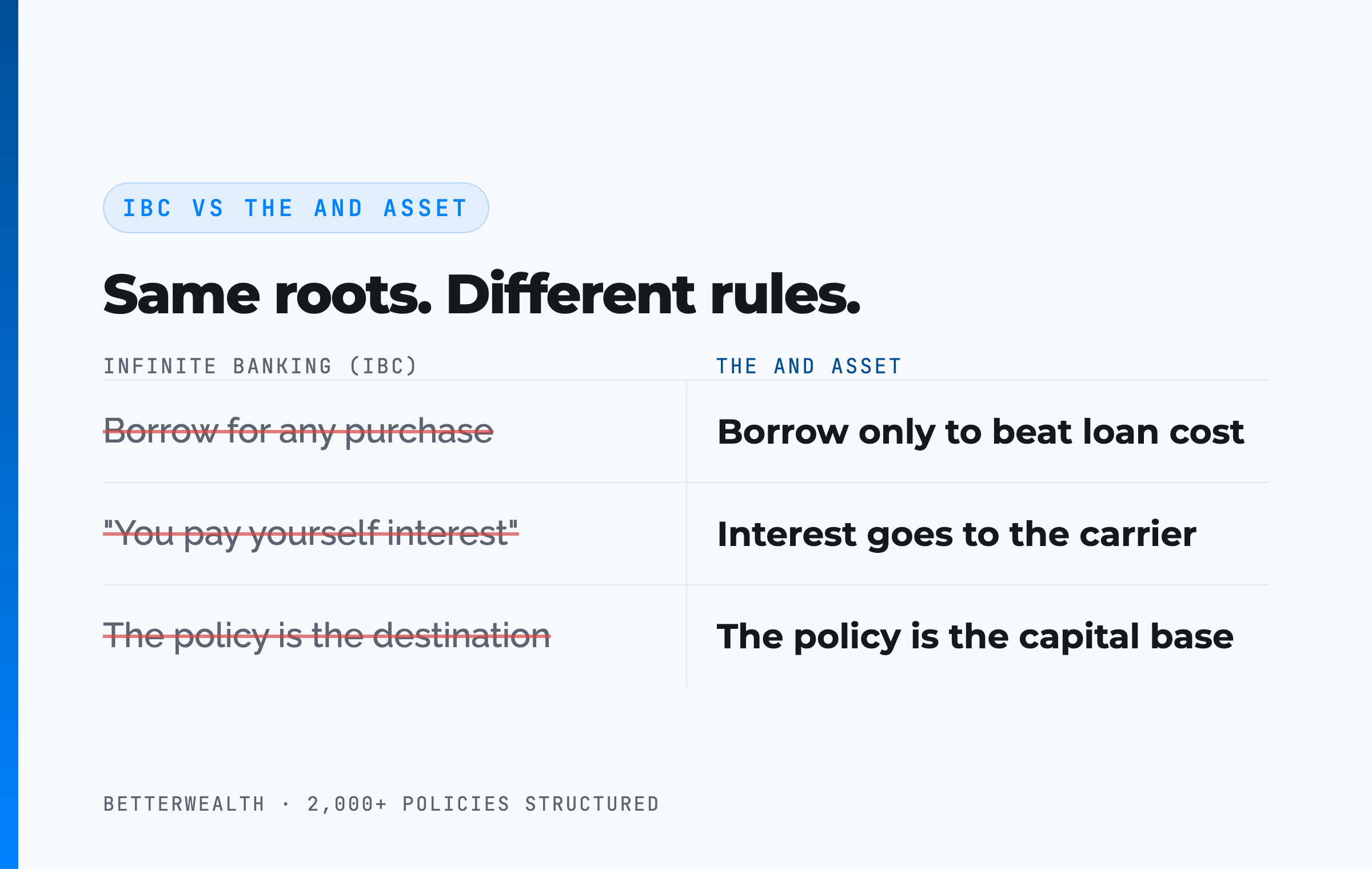
A family banking system is a structure that lets a family act as its own source of financing, borrowing against a pool of whole life cash value under rules the family writes, rather than sending that banking function to outside lenders. Nelson Nash pioneered the underlying idea in Becoming Your Own Banker. His insight holds: you either lose money paying interest to outside lenders, or you lose money to the opportunity cost of capital sitting idle. Control the banking function and you stop leaking on both.
We respect that foundation. The And Asset builds on it with one rule that most family-bank teaching leaves out.
Where IBC ends and The And Asset begins
IBC says the family can use the policy as a personal banking system for any purchase: a car, a wedding, a kitchen renovation. The And Asset says the family only deploys capital when the borrowed dollars will produce a return greater than the carrier's loan cost. Anything less is an expensive way to spend money the family already had. Many marketers say the family is paying itself interest. It is not. The interest on a policy loan goes to the insurance company. The family's return is what the deployed capital earns while the policy keeps compounding net of mortality and expense charges.
That distinction is the difference between a family bank that compounds advantages and a family bank that just reshuffles spending. The discipline of when to lend is the strategy. The policy is only the tool that makes the strategy possible.
The math has to work. Every loan.
Marketers have ruined how this gets explained. A family bank is not free money and it is not "paying yourself interest." It is a capital base with rules, and the rules are the whole point.
03 / The constitutionWhy write a family constitution before funding anything?
You write the family constitution first because the governance is what makes the capital durable, and governance costs nothing to start. Jayson's core belief is worth sitting with: your family already has a constitution. You already have beliefs, ambitions, objectives, and values. They just are not documented, and in many families they have never even been discussed out loud. The work is not inventing a philosophy. The work is assembling the one you already live by and writing it down.
His document runs 110 pages and opens with a letter from the patriarch, meant to be read aloud at every family office meeting in perpetuity. At the last session, one of his twin daughters read it. That is not ceremony for its own sake. Reading the founding intent aloud, generation after generation, is the mechanism that keeps the mentality alive when the founder is not in the room.
What actually goes in the document
The constitution moves from identity to governance. It states who the family is, why it exists, and what it believes, the identity statement that anchors every later decision. It sets the long-range frame: think and communicate three generations past your own. Then it lays out governance, including how the family's trusts in every jurisdiction are directed. In Jayson's case, one constitution governs trusts across both Canada and the United States, so there is a single governing document rather than a stack of disconnected legal instruments pulling in different directions.
Write it as a family. The values, the ambitions, the lending rules: all of it comes out of a real conversation, not a template handed down by an advisor. Advisors and attorneys refine and formalize. The family authors.
You already have a constitution. It just is not written down.
04 / The structureHow is a family banking system different from a family office?
A family banking system is one function inside a family office, not the office itself. The family office is the broader structure that governs how the family's capital operates across several distinct roles. In Jayson's structure, those roles are an investment function, a lending function, and a giving function that runs through a family foundation. The family bank is the lending function. It is one component, and treating it as the whole office is a common mistake.
Separating the functions matters because each one answers a different question. The investment function asks where capital grows. The giving function asks how the family expresses its values in the world. The lending function, the family bank, asks how the family finances its own needs and opportunities without surrendering control to a lender who can change the terms or freeze the line. Keep them distinct and each can be governed on its own terms inside the same constitution.
Family banking is not the family office. It is the lending function inside it, sitting next to how the family invests and how the family gives.
05 / How it worksHow to build the whole life capital base, step by step
The capital base is built through a sequence of design and funding decisions, and the order matters more than the carrier's name on the policy. The product is dividend-paying whole life from a mutual company, designed for maximum cash value rather than maximum death benefit. Here is the sequence we use.
- Write the governance first. Draft the constitution and the family's lending rules before a dollar of premium is paid. The rules define who can borrow, on what terms, and what a use of capital must clear before the family deploys. Governance leads. Funding follows.
- Design for cash value. Minimize the base premium and load the paid-up additions rider as heavily as the IRS allows without creating a Modified Endowment Contract. The base-to-PUA split, often something like 30/70 or 40/60, is the single design decision that drives early cash value. The PUA rider is the engine.
- Fund consistently. Pay premiums on a schedule the family can sustain for a decade or more. Consistency is what compounds. A family bank funded in fits and starts never reaches the scale where it can do real work.
- Let the early years capitalize. Cash value is available in year one but stays below cumulative premiums at first. Around year three, each premium dollar begins adding more than a dollar of cash value. Break-even, where total cash value catches total contributions, lands at year five or later for a healthy individual. Any illustration showing day-one break-even is fiction.
- Borrow, deploy, repay, govern. Take a policy loan against the cash value for a use that beats the carrier's loan cost. Repay on the schedule the constitution sets. Review the system at recurring family office meetings so the discipline transfers to the next generation.
Notice that four of the five steps are about design, discipline, and governance. Only one is about the policy itself. That ratio is the whole lesson.
For a deeper walkthrough of how the base premium and PUA split actually drives early cash value, we broke policy structure down here:
A family banking system fits a specific kind of family.
It fits your family if
- You think in generations, not just the next inheritance
- You are willing to write and follow governance
- You have consistent cash flow to fund the base
- You can name uses of capital that beat the loan cost
It does not fit if
- You want a savings account, not a capital strategy
- You are looking for a quick fix for high-interest debt
- You need maximum liquidity in year one
- The family will not commit to the rules
If your family is in the first column, a 30-minute conversation will show you how the constitution and the capital base fit together. If it is in the second, we will tell you that too.
Book a Discovery Call06 / The mathWhen should the family actually lend from its own bank?
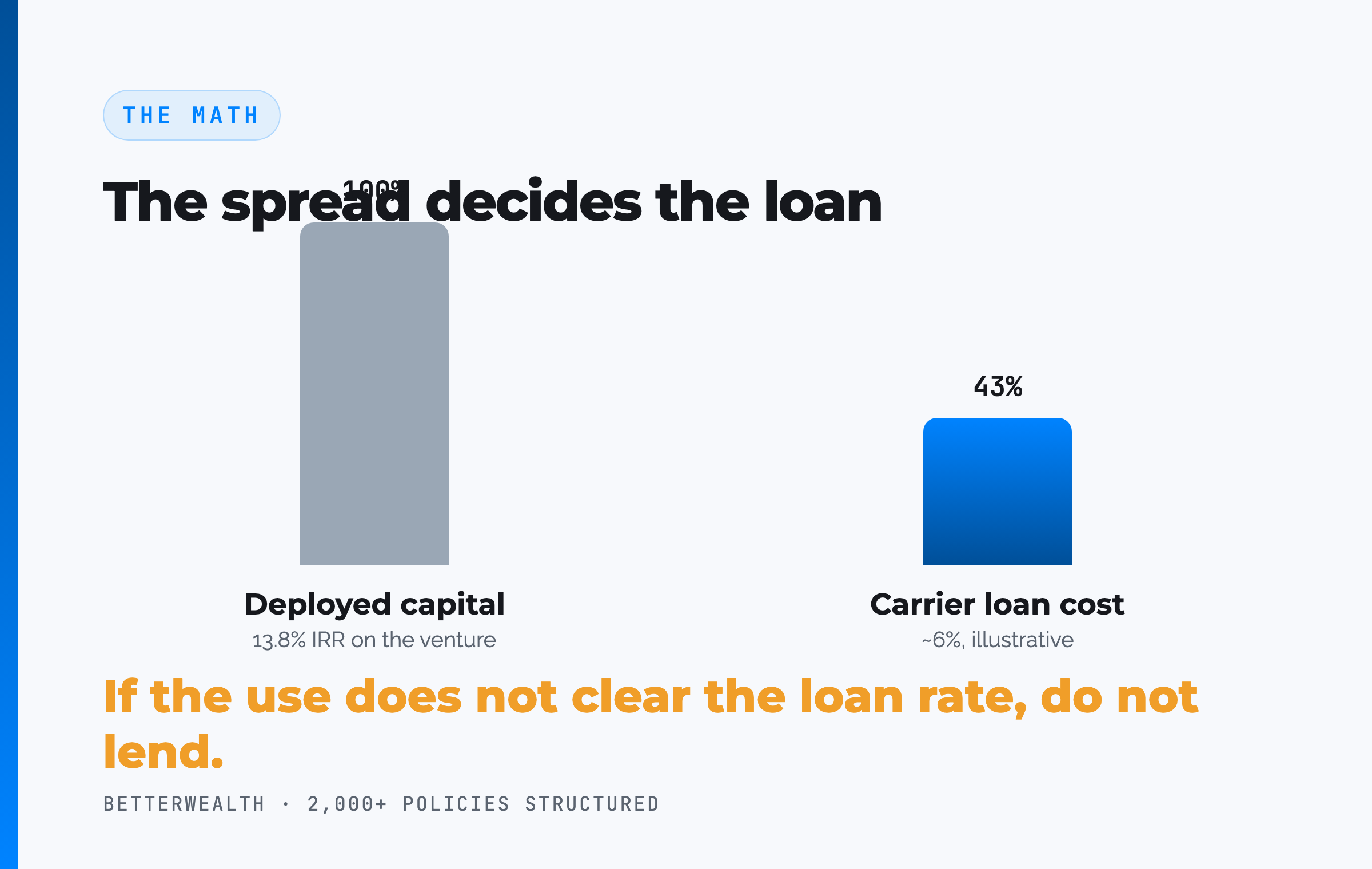
The family should lend only when the return on the deployed capital exceeds the carrier's loan cost. That single test governs every decision the family bank makes. Policy loan rates vary by carrier and rate environment. At the time of writing, many carriers fall in the 5 to 6% range, but treat the specific number as a variable to verify with the carrier, not a constant to bake into your planning.
Here is the structure of the decision. The family borrows against the policy at the carrier's loan rate. The policy keeps compounding on its full cash value, net of mortality and expense charges, while the loan is outstanding. The borrowed capital goes to work in a business, a piece of equipment, a real estate opportunity, an intra-family loan to a member starting a venture. If that use returns more than the loan cost, the family is ahead on the spread and the same dollar has done two jobs. If it returns less, the family has borrowed money to lose money slowly, and no amount of "keeping it in the family" changes that arithmetic.
If the use does not clear the loan rate, do not lend.
A family bank does not make a bad use of capital good. It makes a good use of capital better, because the policy keeps compounding while the money works. The discipline is knowing the difference.
A composite: the family that financed the next generation's venture
Consider a business-owning couple, both healthy non-tobacco, funding a whole life policy designed for cash value at $48,000 per year, split roughly 30/70 base to paid-up additions ($14,400 base premium, $33,600 into the PUA rider). This is a representative composite, not a single named family.
Through the first three years, cash value trails cumulative premiums, exactly as a real policy should. Around year three, each premium dollar starts adding more than a dollar of cash value. At year five, total cash value crosses total contributions at roughly $251,900 against $240,000 paid in. No earlier. Any illustration showing year-two break-even is marketing fiction.
In year eight, with about $418,000 of accessible cash value, the family lends $92,500 to their daughter to buy into a franchise location, structured as a policy loan against the base and repaid to the family bank under the constitution's lending policy. The franchise throws off enough margin to return an estimated 13.8% IRR against an illustrative loan cost near 6%, a spread of nearly eight points in the family's favor. The policy keeps compounding on its full value the entire time. Repayment runs on a 44-month schedule funded by the franchise's own cash flow, and the repaid dollars refill the capital base for the next family member who has a use that clears the test.
One dollar. Two jobs. Governed by the rules. That is the And.
The frameworks behind 2,000+ policies, in one place.
The And Asset Vault holds the calculators, design frameworks, and structuring decisions we use when we build a capital base for a family. Free, email-gated, no spam.
Open the Vault07 / Where people get this wrongThe three mistakes that sink a family bank
Most family banking systems fail on execution, not concept, and the failures cluster into three patterns we see across the book. Knowing them upfront is how you avoid them.
The first is funding without governance. A family buys the policies, calls it a bank, and never writes the rules. The first informal loan with no repayment schedule turns the "bank" into a gift, and the discipline that makes the strategy work is gone. The second is treating the policy as the strategy. The policy is a tool. The strategy is the constitution, the lending rules, and the discipline of only deploying capital that beats the loan cost. The third is buying the wrong policy design, a whole life policy loaded for death benefit instead of cash value, which starves the bank of the early liquidity that makes it usable. The base-to-PUA split is where that gets decided.
There is a fourth, quieter mistake: believing the marketing that a family bank is free money or that you are paying yourself interest. You are not. Correct that framing early, inside the family, or the next generation inherits a misunderstanding along with the money.
This is not for every family, and no policy fixes a family that will not follow its own rules. The governance is the hard part. It is also the part that lasts.
08 / Head to headThe family bank against the alternatives
Compared to the ways families usually finance themselves, a family banking system trades a little day-one liquidity for control, tax treatment, and uninterrupted compounding. The table sets a family bank against a bank line of credit, a 401(k) loan, and simply gifting or lending from a taxable account, on the dimensions that decide whether a financing structure survives generations.
| Dimension | Family Banking (And Asset) | Bank line / HELOC | 401(k) loan | Gift from taxable account |
|---|---|---|---|---|
| Cost of capital | Carrier loan rate, often ~5-6% and verifiable, while the policy keeps compounding | Variable rate, often 8%+ and rising with prime | Prime + 1-2%, but repaid with after-tax dollars | No interest, but the capital stops compounding entirely |
| Growth while borrowed | Policy compounds on full cash value, net of internal costs, even while borrowed against | None (a credit line is not an asset) | Borrowed balance is out of the market until repaid | Gifted dollars leave the family's balance sheet |
| Control | Loan cannot be called; family sets repayment terms in the constitution | Lender controls terms and can freeze or revoke access | Plan and IRS rules govern; job change can trigger repayment | Full control, but the money is simply gone |
| Tax treatment | Policy loans are not taxable income under IRC 7702 | Interest deductible only in limited cases | Double taxation risk on repaid interest | Gift limits and potential gift-tax reporting apply |
Cost and growth. A $92,500 family loan at an illustrative 6% carrier rate costs the family about $5,550 a year in loan interest, while the underlying cash value keeps compounding on its full amount. A HELOC at 8%+ costs more and builds nothing, because a credit line is not an asset. Gifting the same $92,500 costs no interest but ends the compounding entirely and removes the dollars from the family's balance sheet for good.
Control and tax. A family bank loan cannot be called, and the family writes the repayment terms into its own constitution. A bank line can be frozen exactly when the family needs it, as many learned in 2020. Policy loans are not taxable income under Section 7702, while a 401(k) loan carries repayment rules set by the plan and Congress and a double-taxation risk on the interest. The family bank trades the highest possible early liquidity for control and tax treatment the family keeps.
09 / The fitWho is a family banking system right for, and who isn't it?
A family banking system is right for the family that thinks in generations, has consistent cash flow to fund a capital base, and is willing to write and follow governance. It fits entrepreneurs, business owners, real estate investors, and high-income earners who already deploy capital and want to keep the banking function inside the family rather than renting it from a lender. It fits the family ready to have the conversation about values and rules before the conversation about products.
It is the wrong move for a family looking for a savings vehicle, a quick fix for high-interest debt, or maximum day-one liquidity. It is also wrong for a family unwilling to govern itself, because the discipline of the rules and the repayment is the strategy. Without the governance, you have policies, not a system, and policies alone do not survive the person who bought them.
The honest 30 minutes about whether this fits your family.
We have structured more than 2,000 policies across all 50 states. On a discovery call, a practitioner looks at your family's situation and tells you whether a family banking system, a single policy, or neither belongs in your plan. If you would rather learn first, the The And Asset and BetterWealth YouTube channels go deep on the math and the design.
Book a Discovery CallFAQFamily banking system questions
What is a family banking system?
A family banking system is a structure that lets a family pool capital inside properly designed whole life insurance policies and lend against it to family members under written rules, instead of sending that banking function to outside lenders. The policies keep compounding while the borrowed capital is deployed, and the family sets its own repayment terms in a governing document.
How do you start a family banking system?
You start by writing a family constitution that documents the family's values, purpose, and lending rules, then define the family office functions (investment, lending, giving), fund a whole life capital base built for cash value, and set the discipline that borrowed capital must beat the carrier's loan cost before it is deployed. Governance comes before funding.
What is a family constitution?
A family constitution is the one governing document that captures who the family is, what it values, what it aspires to across generations, and how its capital is governed. It sits above the family's trusts and accounts and is meant to be read aloud and revisited at recurring family meetings so the wealth mentality transfers, not just the wealth.
What is The And Asset?
The And Asset is BetterWealth's framework for using a properly structured whole life policy as a capital base. You only borrow against it for a use that produces a return greater than the carrier's loan cost, so your dollars do two jobs at once: the policy keeps compounding while the deployed capital earns its own return.
How is The And Asset different from infinite banking?
Infinite banking, as Nelson Nash taught it, frames a whole life policy as a personal or family banking system for any purchase. The And Asset adds a discipline: you only deploy borrowed capital when the return clears the carrier's loan cost. The policy is the capital base, not the destination. It is built on Nash's foundation but operates on different principles.
Do you have to be wealthy to start a family bank?
No. A family banking system scales to the family's cash flow, not a minimum net worth. The governance comes first and costs nothing to write. The capital base grows from consistent premiums over years, so a family that funds steadily builds the system over time rather than needing a large lump sum up front.
What life insurance do you use for a family banking system?
You use dividend-paying whole life insurance from a mutual carrier, structured for maximum cash value with a heavy paid-up additions rider rather than maximum death benefit. The design, specifically the base-to-PUA split, matters more than which carrier you choose.
How is a family banking system different from a family office?
A family office is the broader structure that governs all of a family's capital functions, including an investment function, a giving or foundation function, and a lending function. The family banking system is the lending function, the capital base the family borrows against. Family banking is one component of the family office, not a synonym for it.
Can a family banking system replace a trust or estate plan?
No. A family banking system works alongside trusts and estate documents, not instead of them. In a well-built structure, the family constitution is the governing document that sits above the trusts, aligning them to a single set of values and rules. Keep your attorney and tax advisor involved; this is educational, not legal or tax advice.
How long does it take a family banking policy to build usable cash value?
A well-designed policy makes cash available within the first year, though early cash value stays below cumulative premiums. Each premium dollar starts adding more than a dollar of cash value around year three, and total cash value catches total contributions at break-even around year five for a healthy individual.
Who is a family banking system not right for?
It is not right for someone looking for a savings account, a quick fix for high-interest debt, or day-one liquidity above all else. It is also the wrong move for a family unwilling to write and follow governance, because the discipline of the rules and repayment is the strategy, not the policy alone.
- Nelson Nash, Becoming Your Own Banker, the origin of the infinite banking concept and controlling the banking function.
- IRC Section 7702 (Cornell Law), the tax code provision behind the tax treatment of life insurance cash value and loans.
- Cerulli Associates, projections on the multi-decade US wealth transfer through 2045.
- The Williams Group, the widely cited study of 3,200+ families on generational wealth attrition (the 70% / 90% figures).
- LIMRA, life insurance industry data, including persistency and product benchmarks.
- BetterWealth resources: The And Asset book, the The And Asset YouTube channel, and the BetterWealth YouTube channel.
Guest in the live Q&A. Built a documented 110-page family constitution and a multi-generational family banking system for his own family, and walks through the governance and lending structure on screen.
I founded BetterWealth to treat life insurance as the wealth and capital tool it actually is, not the product most people get sold. Our team has structured more than 2,000 policies across all 50 states. I wrote The And Asset and host the BetterWealth and The And Asset YouTube channels. If you want an honest read on whether a family banking system fits your family, book a discovery call. We will tell you if it does not.