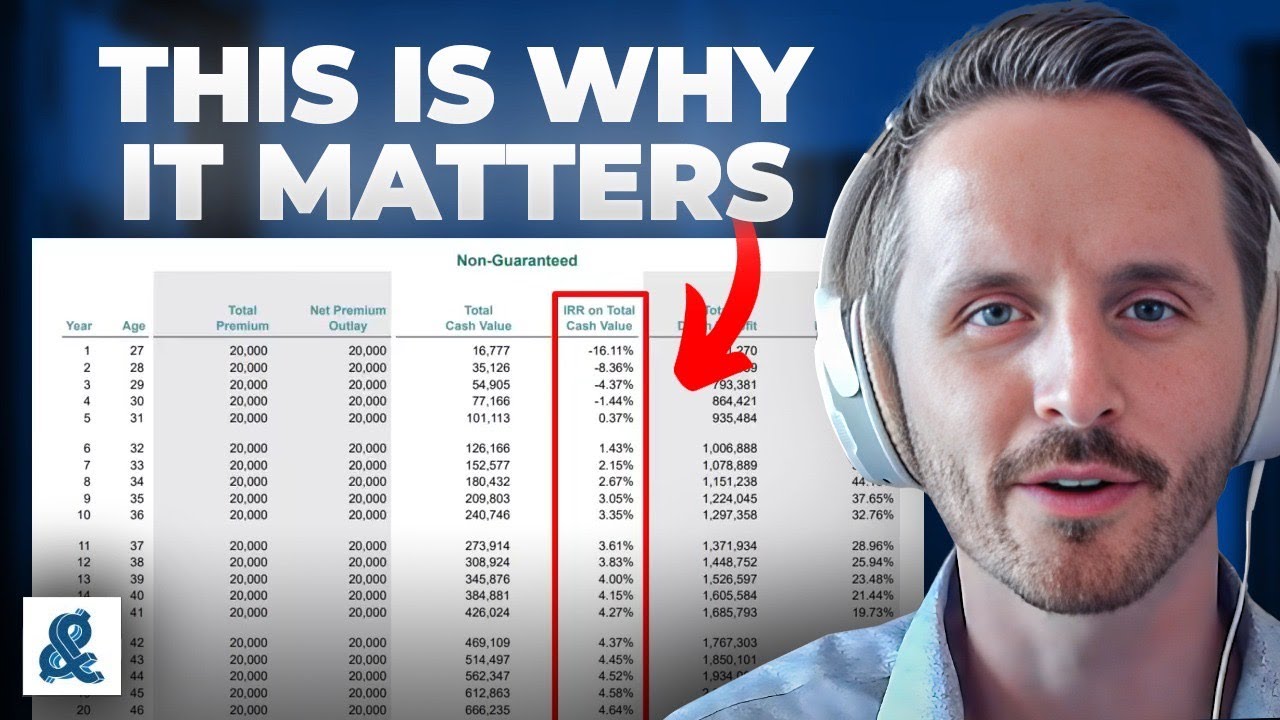
The Real Return of Whole Life Insurance | IRR vs ROR Explained Simply · The And Asset
Understanding the difference between Internal Rate of Return (IRR) and Average Rate of Return (AROR) is crucial when evaluating your financial options, especially if you're considering life insurance as part of your wealth strategy. Austin Williams, a wealth coach at BetterWealth, breaks down why these two metrics are fundamentally different and why it’s inaccurate to directly compare life insurance returns with stock market investments using these metrics. If you want to avoid common misconceptions and get clear on how life insurance fits into your financial plan, this article will clarify the distinctions.
Austin emphasizes upfront that life insurance is not an investment. Unlike volatile investments such as stocks, life insurance acts as a hedge against risk and serves as a liquid savings tool with no down years in the policy’s cash value. This unique role means comparing life insurance using average returns from volatile assets is like comparing apples to oranges. Instead, understanding how IRR applies to life insurance and how it differs from AROR used in investments is a game changer for making intentional financial decisions.
At BetterWealth, we focus on helping clients use max-funded whole life insurance policies within a larger financial strategy built around tax efficiency and legacy planning. If you want to dive deeper into how whole life insurance builds cash value and offers unique benefits, visit our comprehensive resource here: Cash Value Life Insurance Benefits.
What You'll Learn in This Episode
In this episode, you'll discover the clear difference between average rate of return (AROR) and internal rate of return (IRR), why life insurance does not behave like typical investments, and how these calculations impact your perceived growth. Austin walks through real-world examples, including data from the S&P 500 over the last 30 years, revealing why the widely quoted average returns often mislead when compared to actual investment growth.
You’ll see how losses affect returns more dramatically than gains, why advisor fees and taxes further reduce your effective returns, and how the steady internal rate of return of life insurance policies can actually come close to the after-fee, after-tax returns of stock market investments. To expand your financial knowledge on related strategies, check out this detailed explanation: Why Average Rate Of Returns Are So Misleading.
How Is Average Rate of Return Different from Internal Rate of Return (IRR)?
The average rate of return (AROR) calculates the simple mean of gains and losses over a period by summing all percentage returns and dividing by the number of periods. It is commonly used to measure the performance of volatile assets like stocks. For example, the S&P 500’s average rate of return over 30 years from 1994 to 2024 was about 10.31% annually.
Internal rate of return (IRR), on the other hand, is the discount rate that makes the net present value (NPV) of all cash inflows and outflows equal to zero. In simpler terms, it determines the steady annual growth rate needed for an initial investment to reach its final value over time, accounting for the time value of money. Austin describes IRR as the consistent yearly rate of appreciation required for an outflow (investment) to zero out at the end of the period.
This difference is vital. For volatile investments, AROR can exaggerate expected growth because it doesn’t reflect how losses impact the compounding value, while IRR gives a more realistic steady growth rate. Using 30 years of S&P 500 data, Austin shows how the actual compounded growth from a $1,000 investment was roughly 8.8% IRR, not the 10.31% average rate.
Examples illustrate this well: a 50% loss followed by a 50% gain results in a net loss, but the average return is zero; a 100% gain followed by a 50% loss yields a zero net change but averages a misleading 25% return. These results demonstrate how losses hurt your capital more than equivalent gains help, which AROR fails to account for.
Mentioned in This Episode
This discussion references several significant entities and concepts central to understanding life insurance and investment returns.
“Life insurance is not an investment. It is a hedge against risk and a liquid savings tool. Comparing life insurance's IRR to volatile assets' AROR is like comparing apples to oranges.” — Austin Williams
Key Takeaways with Austin Williams
- Life insurance is not an investment but a risk hedge and liquid savings tool without down years.
- The average rate of return (AROR) for volatile assets often exaggerates real growth because it ignores compounding losses.
- Internal rate of return (IRR) provides a more accurate steady annual growth rate by considering the time value of money and cash flow timing.
- Advisor fees (usually 1-2%) and taxes (e.g., 22% tax bracket) significantly reduce actual investment returns over time.
- Over 30 years, the compounded S&P 500 IRR (after fees and taxes) can fall to about 6.8–8.8%, less than the average quoted 10.31% AROR.
- Whole life insurance policies designed in an overfunded way can have a reliable IRR in the low to mid-5% range.
- Northwestern Mutual’s dividend interest rate history (dating back to 1872) shows consistent positive returns around 5.68% annually, contributing to steady policy growth.
- Life insurance and volatile investments serve different purposes and should not be devalued based on inappropriate comparisons.
Resources
FAQ: Frequently Asked Questions
What is the difference between internal rate of return (IRR) and average rate of return?
IRR accounts for the timing and scale of cash flows and gives the steady annual return rate needed for an initial investment to grow to a future value, factoring in time value of money. Average rate of return simply averages yearly percentage changes and does not consider compounding or cash flow timing.
Why is life insurance not considered an investment?
Life insurance functions as a hedge against risk and a liquid savings tool rather than a volatile investment. It offers stable growth in cash value without down years, unlike stocks or mutual funds, which fluctuate and carry market risk.
How do losses affect average returns compared to IRR?
Losses impact investments more severely than equivalent gains with regard to overall growth. For example, a 50% loss followed by a 50% gain results in a net loss, which average rate of return calculations can fail to reveal.
What is the impact of advisor fees and taxes on investment returns?
Advisor fees typically between 1-2% annually and taxes reduce net gains, lowering actual return rates. Over 30 years, fees and taxes can push an expected return from around 8.8% IRR down to roughly 6.8% effective return.
How has Northwestern Mutual's dividend interest rate performed historically?
Northwestern Mutual has maintained consistently positive dividend interest rates since 1872, averaging about 5.68% annually. This steady performance contributes to reliable cash value growth in whole life insurance policies.
Can life insurance returns compete with stock market returns?
While life insurance returns (measured by IRR) are generally lower, they are roughly comparable to after-tax, after-fee returns of stock investments. Their stability and liquidity make them valuable in a balanced wealth strategy.
What's the main takeaway for evaluating life insurance versus investments?
Do not compare life insurance IRR to average returns from volatile assets directly. They serve different purposes—insurance hedges risk, investments assume it. Evaluate each on appropriate metrics and roles in your portfolio.
Why do some people misunderstand average rate of return?
People often mistakenly believe average returns represent steady yearly growth, but volatility and losses distort actual outcomes. Understanding IRR clarifies the realistic compound growth rate of investments and insurance policies.
Want My Team's Help?
If you’re frustrated by confusing financial metrics or unsure how life insurance fits into your retirement or tax strategy, you’re not alone. Many people get overwhelmed comparing apples and oranges when trying to grow or preserve wealth. Our team at BetterWealth specializes in simplifying these complexities with clear, actionable plans tailored to your goals. Whether it’s structuring overfunded whole life insurance or optimizing your retirement investments, we can help you build a balanced portfolio that fits your life.
Click the Big Yellow Button to Book a Call and let's explore what it would look like to keep, protect, grow, and transfer your wealth the BETTER way.
Connect with Caleb Guilliams
Follow Caleb on Instagram, connect on LinkedIn, and follow BetterWealth on Instagram.
Below is the full transcript.
Full Transcript3,151 words
Hey, I'm Austin Williams. I'm a wealth coach here at Better Wealth. And today's video topic is going to be why IRR or internal rate of return is not equivalent to what I'll call AROR or average rate of return. If you have not heard of those metrics before, let me just kind of break it down for you. And that's what I'm going to do over the course of this video. But a big, big thing to note right away is that before we even get started talking about this, I want you to know, hear me out loud and clear. that life insurance is not an investment. A lot of times people make a comparison from life insurance to investment as a way to show why, for instance, life insurance is a really bad asset class. That was part of the reason why I wanted to make this video today to kind of dispel some of these misconceptions. And just like apples to oranges comparisons, life insurance is not an investment because investments are volatile and they connotate risk. Life insurance is actually a hedge against risk. It is a liquid savings tool. You're never going to have a down year inside your life insurance policy. Unlike with stocks, it's not to say that stocks are bad. Hear me out with what I'm saying. It's not to say that just because it's not risky, it means life insurance is good and everything else is bad. It's just different. And to compare life insurance to volatile assets and use the average rate of return of volatile assets to the internal rate of return of life insurance is just... like wrong thinking and i'm going to kind of break down mathematically kind of why that is the case so let's look at aroar versus irr right now so aroar average rate of return what is it it's a very commonly used financial metric to measure the success of an investment a volatile asset over time it basically is the average return equals the sum of returns divided by the number of those returns makes very very simple mathematical sense now there's irr or the internal rate of return Now, the internal rate of return, this is the exact appropriate definition. So I'm going to quote this, and then I'm going to tell you kind of my slightly different Austin definition for this. It's the discount rate at which the net present value of all cash flows, and this is inflows and outflows, from a project equals zero. And then here is a sort of convoluted mathematical equation to represent it. Now, it takes into account that a dollar earned today is worth more than a dollar in the future. because of its earning ability over time. Now, the way I would define IRR is that it is the amount that an outflow today, or you think of an outflow as like a negative, like you're spending money, would have to appreciate into the future to some point in the future, which has a certain set amount, how much would it have to earn every single year, in this case, between this point right now and this point in the future to make this net. initial outflow equal zero or the net present value. So that's how I define it. But that's the technical definition of AROR versus IRR. Now, this is a graph of the S&P 500. And I'm going to put a link in the description of this video to this exact website. So you can see that I'm not pulling anything over your eyes. I just pulled this directly off the internet. It was like the second result. And it's great because it let me like kind of pick an exact data range I wanted the seas. So this is 1994 to 2024. I picked the last 30 years. of the S&P. I didn't pick 2025 because we haven't been through the whole year yet. Who knows what can happen? So this is the last 34 years of it. All right. So mostly, as you see, it is years that are positive with approximately eight years out of that 30 year period that are negative, right? That's a very common because usually we only have a down year about once every four years in S&P. So this is a very statistically average set of years. Okay. So average rate of return. So the average rate of return for the S&P 500. over the last 30 years, 94 to now was 10.31%. So let's imagine that you started investing $1,000 in a no load fund that mirrors the S&P 500 with no advisor fees. So this is like the best case scenario, right? So let's say you take 1,000, you're putting it in a no load fund, and you have no advisors, right? So this is like the best possible case scenario. So in 2024, if you actually had 10.31% a year, you should have... about $19,000. That's, I mean, 10.31% a year is fantastic. But in reality, if you multiply that $1,000 initial outflow by the year over year gain and loss of the S&P 500, you'd actually have $12,608. And I know that some of you who are thinking here, like that's hogwash, there's no way, it's that much less. It is. You probably will feel the need to do the math by yourself, and that's fine. Go do it. Because when I read Caleb's book initially, When he went over this, I did not think that this was true. So I literally had to do the math myself until I realized that it was true. But in reality, you'd have $12,608. So that's an actual rate of return of 8.8%, which still isn't bad. You know, 8.8% is still pretty good, but it's not 10.31%. So let's take an example of just kind of like, and you might be asking yourself, like, why does this happen? Like, why is there so much such a delta between the average and the actual? Well, let's say you start out with $1,000. And then say, let's say this year, you have a 50% loss. And the next year, you have a 50% gain. If you're kind of maybe like the simpleton way of thinking of that would just be like, oh, you just be back at $1,000. Because 50% down 50% up, you're back at even. No, that's actually not the case. So if you took 50% off 1000, that's 500. So let's say you lost 50%. And then next year you gained 50%. So you gained 50% on 500, which is only 250. And that means you're only actually at 750 at the end of those two years. So your average rate of return is 0% because once again, you take the sum of all returns, which is the 50% negative plus the 50% positive, and you divide it by the number of returns. So 0 divided by 2 equals 0. So you think, oh, average rate of return is just 0. No. But your ax rate of return is actually negative 25%. $750 is 25% lower than 1,000. So another example here. So let's say you start out the same $1,000. But this year, you have 100% gain. You're like, oh, it's fantastic. And the next year, you only have a 50% loss. And you're like, oh, I'm going to be ahead because plus 100 minus 50, that's still like 50% is still somewhere in the works there, right? No, actually. So if you make 1,000% on your investment this year, so. Right now, you have $2,000 in the end of year one. And then you have 50% loss, 50% in 2000, 1,000. So subtract that from 2,000 and you're back to 1,000. So your average rate of return is actually 25% because it's plus 100 minus 50 divided by two, and that's 25. But your actual rate of return is 0%. And this is why it's just kind of a misleading statistic. So note that losses actually affect you more than an equivalent gain here. So now let's actually factor in a different thing, which is. The AROR, average rate of return, and let's say you have an advisor fee. So across the industry, advisor fees average between basis points 2%. Robo advisors can be a little bit less. Human advisors usually 1% to 2%. So let's say you added a 1% modest advisor fee to that original initial investment. And so every year, whether or not it does well or does poorly, the advisor gets 1% of the funds that you have invested, 1% of them. That is the dirty truth of advisors. So your return after 30 years, would now only be $9,232. And that's an actual growth rate of only 7.7%. So now let's actually also tax on taxes. Let's say you don't have this in like Roth. Let's say that you have a qualified account and you're going to take it out. Taxes have to be deducted. Let's just say, just picking a random one here, you're in the 22% tax bracket. I know that obviously your income is taxed differently in lower brackets, but just for sake of illustration. So after the ARO or the advisor fees have slowed your growth for 30 years, then the government swoops in at the very end, takes out 22%. So your return after 30 years would actually only be $7,200. And that's an actual annual growth rate of only 6.8%. So that's to say is that to start with 1,000 and get to 7,200 is only a 6.8% gain every single year. Because we're actually trying to make this apples to apples to internal rate of return. Now, the internal rate of return, once again, is this number. that means what does this value in this beginning value have to appreciate every single year unceasingly to get to this point in the future, right? And so the internal rate of return of life insurance, as you can see here, this is an extra report that I printed on one of the policies that we made. It starts out low and it quickly by year five, it actually gets, it goes from negatives to positive, which means there's more dollars in the cash value than there has been contributed to the policy. And within not too long, it hits the 4% range, which means that by year 13, this policy, the internal rate of return over all those 13 years means that to go from where it started to where it ended in year 13, whenever we're looking at that, means that it would have had to earn 4% a year, every single year for those numbers to be where they are. By the year 25, this is in the upper fours, right? And it gets better and better. Now this policy, this person is younger. They are putting $20,000 a year in every single year. This is not an exceptionally, like, the best case scenario policy. This is standard health rating. It is designed in an overfunded way. But ultimately, you know, there's nothing that is like, I haven't like really stacked the deck in the favor here. This is just a very steady, consistent, and dependable internal rate of return on that initial outflow. Most people have no idea where to start or how to really evaluate whole life insurance. That's why we've built the vault. It's all of our best life insurance resources and educational tools all in one place. all for free. We have calculators, handbooks, crash course, deep dive videos on numbers. If you want to learn more, click the link in the description or tag comment below to unlock the vault. All right, back to the video. Now, the great part is that like, I know that we looked at the last 30 years of the S&P, but when it comes to the different carriers that we work with, and we work with mutual life insurance carriers, most of them, we don't actually know beyond maybe the last 30 to 50 years, kind of what their dividend interest rate is. And the dividend interest rate... is what drives a lot of that internal rate of return growth that we see. We don't know, but there is one, one carrier that has actually published their dividend interest rates going back to 1872. And so I actually made this graph because the paper in which all the data exists, the official public-facing copy of their dividend interest rates, Northwestern, it's just very horribly formatted. So I formatted it correctly. And I also added in some of the more recent years that was left off. of that sheet. And that sheet is also going to be linked in the description of this video below. But as you see over time, ever since 1872, this has been the dividend interest rates of Northwestern Mutual. So it goes from like a high of over 10% there in the 1980s. And there was like a low of, you know, you know, in the 3% range in the 1950s. But it has always been positive. There is never a this is why there's never a down year inside your life insurance policy is that the dividend interest rate is only ever going to appreciate your policy. Now, disclaimer, dividends are not guaranteed, but considering the performance of these carriers, we do certainly assume them. And as you see, there's a very consistent performance over the last 153 years at Northwestern to award dividends. So as you see, 153-year average is 5.68%. So that means on average, the money is growing at 5.68% a year. And there's never a point in which it loses because it's the losses that... actually affect your money more so than an equivalent gain does. So really, really cool just to see kind of why if you do choose to use life insurance as a liquid savings tool, that there's just a really strong history of growing your money inside your policy with the profits of the carrier, because that's what dividends are. And then here is that same policy inside life insurance. And this is the same one. Once again, he is in his mid-20s and standard health rating. And what I did is I did an RPU, and that's where I reduced paid up the policy at age 26. So he doesn't put in anything else after age 26. And the policy is just growing, growing, growing. And as you see, by the time in 30 years, which once again is the same time period that we looked at the S&P, his intro rate of return at the end of that 30 years is in the low fives. And I could even, I even just was like playing around with this. I kind of tried to stack the deck in his favor after this. And I was like, okay, what if he was only 20 years old and he has the highest health rating. I designed the policy the exact same way, overfunded it. And I was able to get the internal rate of return a little bit higher than 5% was. And by the time this guy was in his 70s, so about 50 years or so after the policy had been, and once again, in the case where I kind of stacked the deck, it was in like the 5.3 range. So it was about a 5.3% internal rate of return. So when you look at it this way, though, like... all of a sudden, boring old life insurance isn't so far away from the actual rate of return that you're going to get inside a volatile asset like the S&P 500. So hear me out. Like I said in the beginning, life insurance is not an investment. Please do not hear what I am not saying. I'm just saying that it's not fair to compare life insurance to investments using the metrics that we use to describe investments because IRR is different than AROR. So while ARR gets quoted often, it's a misleading statistic. And nobody actually makes the ARR every year. And years with losses are way more powerful than years with equivalent gains. Now, IRR rarely gets used. But how it functions, which is how the amount of initial outflow and how much that would have to appreciate every year into the future to make the net present value equal zero, that's actually how most people conceive of. a ROAR or average rate of return is that people think that, oh, 10.31% for the S&P, that that's what you get every year. But that's actually not the case, is that's just the average. And so people think the average functions like the internal rate of return, because the internal rate of return is a true, like when you say the internal rate of return is 5%, is that if that initial outflow made effectively would have had to make 5% every year at this point in the present to the point in the future for those numbers to work out. And people think that that's happening behind the scenes with average rate of return, but it's not because you don't actually get 10.31% a year. We went over that and we showed you with the math, like why that's not actually happening. So even if it's in the single digits, the IRR of a liquid cash value in a tax sheltered environment of a dividend paying mutual life insurance carrier is going to be roughly in the ballpark. And once again, as long as it's structured in an overfunded way, is going to be roughly in the ballpark of the error of an illiquid qualified retirement account where the money is invested in the S&P 500 like index. managed by an advisor charging a 1% fee whose owner is in the 22% tax bracket. So that's like a very long winded way of saying like they're, they're roughly equivalent, but do not hear me like it is not apples to apples. So that's why I want to say it's very roughly equivalent. They do two different things. They can have two very different purposes inside a very balanced portfolio. So please don't use one statistic to demean the other. All right. So big moment, life insurance is not investment. Do not hear what I am not saying. But know that it's not fair to compare life insurance, which uses IRR, to a volatile investment, which might use average rate of return because it's just not apples to apples. So thank you so much. If you have any comments, I'd love to hear them. Please let me know what you think of this. Thanks so much. Bye-bye.