
I founded BetterWealth to treat life insurance as a wealth and capital strategy for entrepreneurs, business owners, and high-income earners. Our team has structured more than 2,000 policies. I wrote The And Asset and host the BetterWealth and The And Asset YouTube channels.
A former construction company owner with about 170 employees and 47 rental properties, John has helped clients integrate whole life insurance with real estate and business capital since 2010.
Infinite banking for real estate investors means holding lender-required reserves, rental cash flow, and opportunity capital inside a properly structured whole life policy instead of a bank account. The capital stays accessible through policy loans while compounding net of mortality and expense charges, which, once the policy matures, raises the return on dollars that would otherwise sit idle.
Every buy-and-hold real estate investor carries capital that does not work. Lenders require months of reserves on each property. Rental cash flow arrives in increments too small to deploy, $250 or $500 a month per door, and accumulates for a year or more before it becomes a down payment. Opportunity funds wait for the deal. For most investors, all of it sits in a bank account earning less than inflation, taxed as ordinary income on the little it does earn.
The usual response is to minimize that idle balance and push every spare dollar into the next property. It works in a rising market. It fails in a falling one, because equity on paper cannot cover a mortgage payment, and lenders stop lending against it at exactly the moment you need them to. The question for a real estate investor is never whether to hold reserves. It is where those reserves sit, what they earn while they wait, and who controls access to them when the market turns.
I put that question to John Stewart, a practitioner at Paradigm Life who learned the answer the hard way in 2010. Below: how John holds reserves inside whole life insurance, the honest math behind the claim that a policy can "double your returns," the hurdle every deal must clear before you borrow, and where The And Asset parts ways with generic infinite banking.
- Real estate investors must hold reserves somewhere; the decision is whether that capital earns a taxable 0.45% to 4% or compounds tax-deferred inside a policy once it matures.
- A policy does not double the return on your properties. It raises the return on the reserve capital beside them.
- The And Asset rule governs every loan: borrow only when the deal's return beats the carrier's loan rate with margin.
- Cash value does not exceed cumulative premiums before year 4; healthy investors typically break even in year 5 or later.
- Growth inside the policy is tax-deferred, and loans are generally not taxable income while the policy stays in force and is not a Modified Endowment Contract.
- Policy design decides the outcome: John's first policy shifted return risk to him, and he spent four years unwinding it.
The full interview includes John's story of the 2010 collapse in his own words, and his account of the first policy that was built wrong, the warning anyone shopping for a policy now should hear first.
01 / The ProblemWhy Do Real Estate Investors Run Out of Capital at the Worst Time?
Real estate investors run out of capital at the worst time because they optimize for the rising market and hold almost nothing for the falling one. In good years, a dollar in a bank account at 1% looks like waste next to a property returning 10 to 20%. So the dollar goes into the property. Then the cycle turns, and the investor holds a portfolio of equity no lender will advance against.
John lived the full version. In November 2010 his construction company was doing about $1 million a month in revenue. By December, banks that had financed construction loans were failing, five-year contracts were cancelled, and revenue fell to roughly $200,000 a month. He laid off 100 employees. Over the next three months, 30 of his 47 rental tenants stopped paying.
"Prior to that, every month I was going, where do we stack our cash?" John says. "After that, it's like, where are we going to get the cash?"
Through that period, by his account, his whole life policies were the one asset that did not lose value and the one asset a bank could not freeze or call. That experience is why he holds reserves the way he does today, and why he left the construction business to help other people do the same.
Investors who think they are maximizing every dollar are often just removing their margin for error. The deals at pennies on the dollar go to whoever is still liquid.
02 / The FrameworkWhat Does Infinite Banking Mean for a Real Estate Investor?
For a real estate investor, infinite banking means using a whole life policy as the place your reserves, rental cash flow, and opportunity funds accumulate, then borrowing against that cash value to fund the next acquisition. The cash value stays in the policy as collateral while the loan is outstanding, and it keeps compounding. That is the mechanical definition.
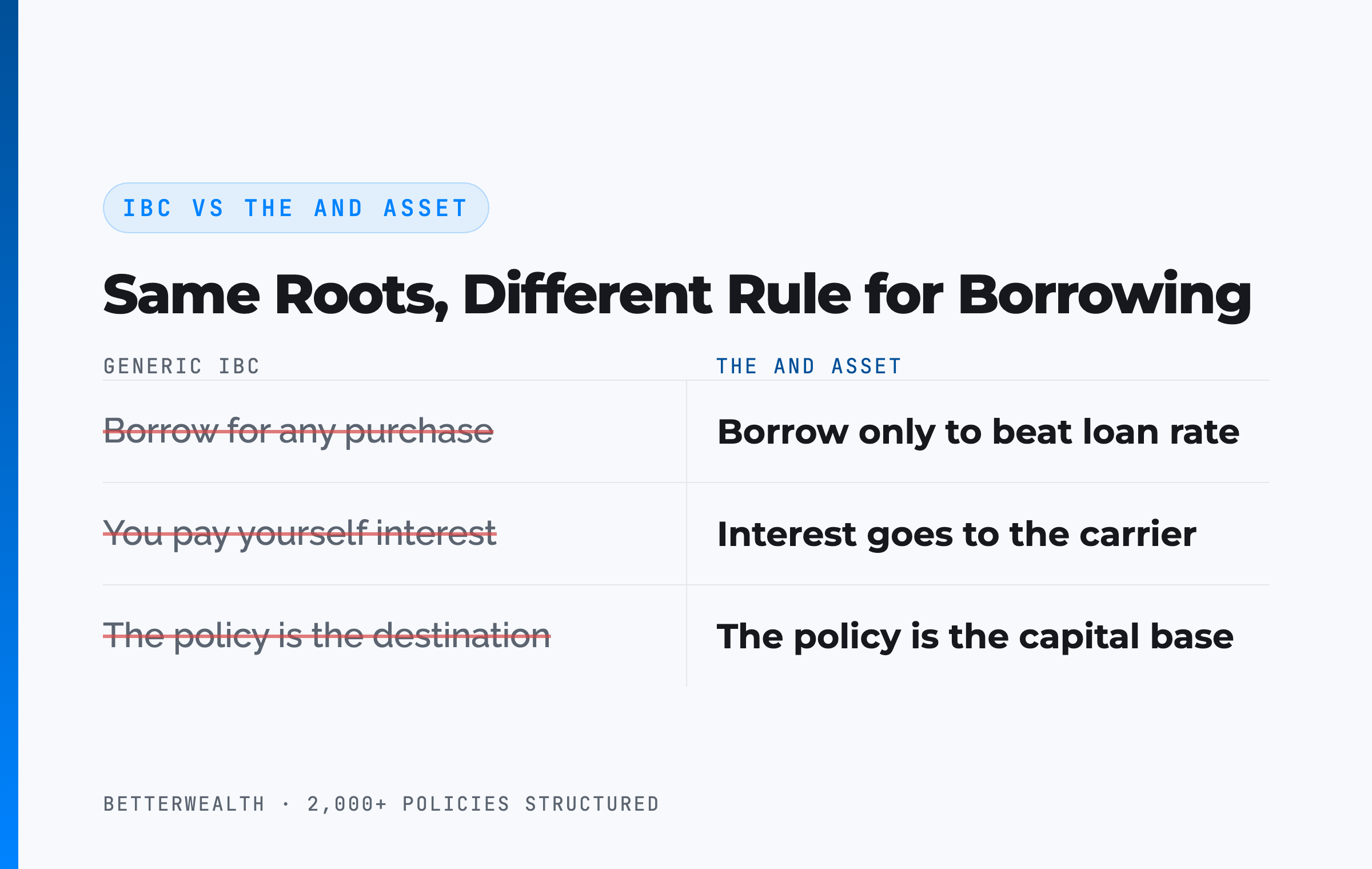
John came to the idea through Nelson Nash's Becoming Your Own Banker. Nash pioneered the use of whole life insurance as a personal banking system. His core insight holds: you either lose money paying interest to outside lenders, or you lose it to the opportunity cost of capital sitting idle. We credit that foundation in everything we teach. The And Asset shares roots with IBC but operates on different principles.
Where IBC Ends and The And Asset Begins
IBC says you can use the policy as a personal bank for any purchase. The And Asset says you only deploy capital from the policy when the borrowed dollars will out-earn the carrier's loan cost, because anything less is an expensive way to spend money. John, for example, uses some of his policies for personal events such as family weddings and home projects, and frames it as saving toward a known expense. That is a legitimate choice. It is not The And Asset. Under our framework, a policy loan for a wedding is spending, and spending is not strategy.
The second divergence matters just as much. Many IBC marketers say you are paying yourself interest when you repay a policy loan. You are not. The interest goes to the carrier. Your return is what the deployed capital earns elsewhere while the policy keeps compounding net of its internal charges.
The policy is the capital base. The return is in the deal.
Some people teach that whatever you do with your policy will make you rich. It will not. You cannot borrow against a policy to buy a liability and come out ahead.
03 / The ClaimCan Life Insurance Really Double Your Real Estate Returns?
A whole life policy does not double the return on your properties; it raises the return on the capital that sits beside them. John's phrasing on camera is that for a long-term buy-and-hold investor, the strategy "can almost always double your returns." The defensible version is narrower, and more useful.
Take John's own example. An investor puts $200,000 into down payments: 20% down, $40,000 each, on five properties. The lenders want six months of reserves on all five. That reserve balance has to exist somewhere. In a bank account at under 1%, it earns almost nothing and is taxed on what it does earn. Inside a mature, well-designed policy, John's point is that the same dollars can earn several times that, still accessible within days.
Add the rental cash flow. A property producing $250 to $500 a month cannot be redeployed immediately. "Where's it going to build?" John asks. If the answer is the policy, the accumulating cash flow compounds instead of idling.
What the Claim Leaves Out
The long-term return on a well-designed policy is often projected in the high 4s to low 5s on current dividend scales, a range I raised with John in the interview. That figure is a long-horizon number. It is not guaranteed, and it is not what the policy earns in year one or two, when cash value still trails what you have paid in. A policy funded this year cannot hold next year's reserves at full value. The investor who benefits is the one who builds the policy years before the reserves are needed, then lets the reserve dollars do two jobs for decades.
Higher return on idle dollars. Not on the properties.
A policy that holds next year's reserves has to be funded this year. Build it before the deal, not during it.
04 / How It WorksHow to Integrate a Whole Life Policy With a Real Estate Portfolio
Integrating a policy with a real estate portfolio starts with your reserve floors, not with the policy. John's method separates what he will never touch from what he will deploy. Here is the sequence, expanded with the design steps we use when we structure one.
- Set your reserve floors. John keeps a personal reserve and a business reserve and never borrows below either. He holds 3 to 6 months of expenses in cash and 6 to 12 months in precious metals, and treats everything above those floors as opportunity capital. Your lenders' reserve requirements belong in this floor.
- Structure the policy for cash value. Minimize the base premium and load the paid-up additions rider as heavily as the IRS limits allow, stopping short of a Modified Endowment Contract. A 30/70 or 10/90 base/PUA split pushes far more of each dollar into early cash value than a death-benefit-first design. Very low base designs such as 10/90 usually need a term blend rider to stay under the MEC limit.
- Route idle capital into the policy. Fund it with what would otherwise sit in a bank: reserves, accumulating rental cash flow, and opportunity funds. John now holds seven policies on himself and five on his wife, separated by purpose: some for personal reserves, some for investment capital.
- Let the policy capitalize. Cash value trails cumulative premiums for the first several years. It does not catch them before year 4, and for a healthy investor break-even typically lands in year 5 or later.
- Borrow only when the deal clears the hurdle. When a deal appears, borrow against the policy only if its return beats the carrier's loan rate with margin for risk. John says he can usually have policy loan proceeds in 3 to 5 days.
- Repay from the property. Set a fixed repayment schedule funded by the property's cash flow, so the capital returns to the policy for the next opportunity. The discipline of repayment is the whole strategy.
The Contract Underneath Matters
John's first policy, bought in 2003, was set up wrong. He brought Nash's book to the agent who handled his company's insurance and asked for exactly that. The agent said he could do it "only better" and sold him a policy that was not whole life and carried return risk John did not understand. Two years later the agent left the business. John's annual statements stopped matching the illustration, and the home office could only read him a script.
John frames the product types by who carries the risk. Whole life puts the guarantees on the carrier. Variable universal life passes market risk to the policyholder. Indexed universal life adds a cap and a floor, but the policyholder still carries more of the return risk than with whole life. All three are tools. John's mistake was holding a contract that put the risk on him during a period when it did not work, without knowing it. He spent four years in that policy before moving out of it through a Section 1035 exchange, which lets one life insurance policy be exchanged for another without triggering tax on the gains.
Know which contract you are building on.
This Fits a Specific Investor Doing Specific Things.
It Fits You If
- You hold rentals long term and carry lender reserves
- You have a 10+ year horizon for the policy
- You can name deals that beat the loan rate
- You will repay loans on a schedule
It Does Not Fit You If
- You need the money within a few years
- You carry high-interest debt
- You want a savings account alternative
- You have no clear use for borrowed capital
If you are in the first column, a 30-minute conversation will tell you whether a policy belongs in your capital structure. If you are in the second, the same call will show you why.
Book a Discovery Call05 / The MathWhat Return Does a Deal Need Before You Borrow Against Your Policy?
A deal needs to beat the carrier's loan rate by enough to cover its risk, its taxes, and the chance you lose the capital. Policy loan rates vary by carrier and rate environment. At the time of writing, many carriers fall in the 5 to 6% range, but treat any specific number as a variable to verify with your carrier.
John's hurdle is higher than the loan rate alone. When I asked whether an 8% investment would move him, John said it would have to be something he was very interested in and extremely secure. A deal returning 8% against a loan near 5.5% leaves about 2.5 points of spread, before taxes and before any risk of loss. For a speculative deal, that margin is not enough.
The cash value stays in the policy and keeps compounding while the loan is out, so The And Asset hurdle is the loan rate plus a margin for risk. At a non-direct recognition carrier the dividend is generally not adjusted for the loan. At a direct recognition carrier the dividend on the loaned portion is adjusted up or down depending on the carrier, so check the actual net cost of the loan before you set your hurdle. The policy also raises the bar for risk: because a mature policy's projected long-term return (high 4s to low 5s, not guaranteed) is comparable to many conservative investments, a risky deal has to pay for that risk, not only for the loan. As John puts it, the policy "is pretty comparable to a lot of investments out there," which is why he says he grows more liquid as he gets older.
If the deal does not clear the loan rate, do not borrow.
An 8% deal should not get you out of bed if your loan costs 5.5%. The spread has to pay you for the risk of being wrong.
A Composite: The Five-Door Investor Who Built the Policy First
Consider a 44-year-old investor, preferred non-tobacco, who owns five financed rentals with monthly payments (principal, interest, taxes, and insurance) of $1,913 each. This is a representative composite built on John's five-property example, not a single named client.
The premium. The investor funds a whole life policy at $36,000 a year: $10,800 of base premium and $25,200 of paid-up additions, a 30/70 base/PUA split. The money comes from rental cash flow and a reserve balance that previously sat in a savings account at 0.45%.
The early years. Cash value trails contributions exactly as a real policy should: $61,730 against $72,000 paid in at year two, $135,180 against $144,000 at year four, $176,610 against $180,000 at year five. At year six it crosses: $221,410 against $216,000. No earlier.
The reserves. Six months of payments on five properties is $57,390. In the savings account, that balance earned $258 a year, taxed as ordinary income. By year seven, with $268,970 of cash value, the investor's reserve floor sits inside the policy and keeps compounding.
The deal. In year seven, a sixth property comes available. The investor borrows $61,500 against the policy for the down payment and closing costs. The loan costs about $3,383 in its first year at an illustrative 5.5%. The property's projected return, rent plus principal paydown plus modest appreciation, works out to a projected 11.3% IRR on the $61,500 borrowed and invested. That is total return, not yearly cash, and it sits about 5.8 points above the 5.5% loan cost while the policy keeps compounding. With a non-direct recognition carrier, the full cash value keeps earning dividends; with direct recognition, the dividend on the $61,500 loaned portion is adjusted.
The repayment. The investor repays $1,600 a month from the combined net cash flow of all six properties, clearing the loan on a 43-month schedule. The capital returns to the policy, ready for the next deal that clears the hurdle.
One dollar. Two jobs. That is the And.
06 / Who Uses ItWhy Do Experienced Real Estate Investors Hold Capital This Way?
Experienced investors hold capital this way because they have lived through a downturn and younger investors usually have not. John says young real estate investors resist the idea more than anyone, precisely because they understand leverage. What they have not experienced is a market where the account that made 20% last year just lost 30%, and the deal of the decade appears in the same month.
John estimates that almost all of his clients own real estate, and roughly 30% are investors at some scale. The reasons that drew him in 2003 were liquidity that a lender cannot revoke, a measure of asset protection (which varies by state), separation from business risk, tax-deferred growth, and permanent coverage in place of the term insurance he was already paying for. Doing several jobs with one dollar was the attraction.
John's firm frames it as a pyramid: guaranteed, liquid capital you control at the base, then businesses and real estate, then riskier assets someone else manages. Many investors who come to us have a thin base under everything else.
A bigger pyramid needs a wider base.
Run Your Own Numbers Before You Talk to Anyone.
The And Asset Vault holds our cash value calculator, The And Asset handbook and audiobook, and a short course on how an overfunded whole life policy is built. It is free. Enter your email to get access.
Open the Vault07 / Where It Goes WrongWhere Investors and Agents Get This Wrong
Most failures come from the sale, not the strategy. John's own story is the clearest example: a trusted agent, a borrowed concept, a product that did not match it, and an agent who left the business two years later. The policy was not whole life, the design shifted return risk to John, and nobody told him.
The second failure is the pitch. Agents who present a policy as a replacement for real estate, or real estate as a replacement for a policy, are selling a false choice. "It's not either or," John says. "You have to have both." A policy is where capital waits and compounds. Real estate is where it goes to work.
The third is the promise of a single answer. When I pressed John for a rule on how much to fund, he declined to give one without knowing the person's goals, age, and risk. "Anybody that just tells you go do X without really seeing what your goals are," John says, is "either oversimplifying it to take work off of them or to just sell you something."
The wrong contract costs more than the wrong deal. John spent four years in one before a 1035 exchange got him out.
08 / TradeoffsBenefits and Real Tradeoffs
The policy buys a real estate investor compounding, uncallable access, and a death benefit, and it costs years of early underperformance and a loan rate paid to the carrier. In detail, it gives capital that compounds tax-deferred, a loan that cannot be called or frozen (the one limit: if the loan plus accrued interest grows past the cash value, the policy can lapse and the gain becomes taxable), access in days without credit approval, and a death benefit underneath all of it. Those features matter most in exactly the market where everything else stops working.
The tradeoffs come first in time. Cash value trails premiums for the first several years, so the policy is a poor place for money you need soon. It requires consistent funding over a decade or more to reach the long-term returns people quote. The loan carries an interest cost, 5.5% in the composite, paid to the carrier. Surrendering a policy with gains creates taxable income. And a policy designed by an agent who does not understand it can lock you into years of underperformance, as John learned.
Some lenders accept policy cash value as a reserve asset, but rules vary by lender and loan program. Confirm with yours before you count on it.
09 / Head to HeadWhere Should a Real Estate Investor Hold Reserves?
A whole life policy trades early liquidity for long-term growth, control, and tax treatment. The table compares it with the places investors usually hold reserves, using the $57,390 reserve balance from the composite case study.
| Dimension | Whole Life (The And Asset) | Bank Savings | HELOC as Backup | High-Yield Account |
|---|---|---|---|---|
| Earnings on $57,390 | About $2,750/yr, illustrative, at a 4.8% projected long-term rate net of charges, only once the policy is mature (not guaranteed); negative return in early years | $258/yr at 0.45% | $0 (a credit line, not an asset) | About $2,296/yr at an illustrative 4.0%; rate floats |
| Tax treatment | Tax-deferred growth; loans generally not taxable income | Interest taxed as ordinary income | Draws not income; interest costs you | Interest taxed as ordinary income |
| Access in a downturn | Policy loan in days; cannot be called or frozen, but the policy can lapse (and the gain become taxable) if the loan plus interest exceeds cash value | Immediate | Can be frozen or reduced by the lender | Immediate |
| Cost to set up | The early gap between cash value and premiums paid ($9,800 in year 1 in the composite above), plus years of funding before it can hold reserves | None | Closing costs; interest only on draws | None |
Earnings. On the same $57,390, a savings account produces $258 a year and a high-yield account a floating rate that tracks short-term interest rates. A mature policy's long-term return is projected, not guaranteed, and the early years run below what you paid in.
Tax treatment. Bank interest is taxed every year as ordinary income. Policy growth is tax-deferred, and loans are generally not taxable income while the policy stays in force and is not a Modified Endowment Contract.
Access. Cash in a bank is the most liquid option on day one. A HELOC looks like free reserve capacity until a lender reduces or freezes it in a downturn. A policy loan does not depend on a lender's appetite, which is why John calls his policy, from 2008 to 2010, "the only asset the bank couldn't touch."
Setup cost. The policy costs time. It takes years of funding before the cash value can carry a lender's reserves, so it must be built ahead of the need.
10 / The FitHow a Policy Fits a Real Estate Investor's Broader Capital Strategy
A policy fits as the foundation under a real estate portfolio, not as a substitute for it. John's own setup shows the shape: reserve floors he never touches, policies separated by purpose, and every deployed dollar held to a hurdle that rises as his risk tolerance falls.
The right amount to fund depends on where you are going and where you are starting, which is why no honest practitioner will give you a percentage without seeing your situation. A young investor with no family and a long runway will build differently from a couple heavy in the market and close to retirement with little liquidity. The question is the same for both: is each tool getting you to the result you want?
IBC frames whole life as the destination. The And Asset frames the policy as the capital base; the value is created in what you deploy that capital into. Build the policy before you need it, hold your reserves inside it, and borrow only for deals that beat the loan rate, and the policy keeps compounding while the properties do their own work.
The Honest 30 Minutes About Whether This Fits Your Portfolio.
We have structured 2,000+ policies. We have seen this strategy work exactly as designed, and we have seen it fail. If you want a conversation about whether The And Asset fits your real estate portfolio, book a discovery call. We will give you the honest answer either way. If you would rather learn first, The And Asset and BetterWealth YouTube channels go deep on the math.
Book a Discovery CallFAQInfinite Banking for Real Estate Investors: Questions
Is infinite banking good for real estate investors?
Infinite banking fits buy-and-hold real estate investors because they must hold reserves and opportunity capital somewhere, and a properly structured whole life policy lets that capital compound while staying accessible through policy loans. It only adds value if the investor has a long horizon and holds every loan to The And Asset rule: the deal must beat the loan rate before you borrow.
Can a whole life policy hold my lender-required reserves?
Some lenders accept the cash value of a life insurance policy as a reserve asset, but the rules vary by lender and loan program, so confirm with your lender before you count on it. The policy also needs several years of funding before its cash value is large enough to cover reserves on multiple properties.
What is The And Asset?
The And Asset is BetterWealth's framework for using a properly structured whole life policy as a capital base. You only borrow against it for an activity that produces a return greater than the carrier's loan cost, so your dollars do two jobs at once: the policy keeps compounding while the deployed capital earns its own return.
How is The And Asset different from infinite banking?
Infinite banking, as Nelson Nash taught it, frames a whole life policy as a personal banking system for any purchase. The And Asset shares those roots but operates on a different principle: you only deploy borrowed capital when the return clears the carrier's loan cost. The policy is the capital base, not the destination.
Does life insurance really double real estate returns?
No, a policy does not double the return on your properties; it raises the return on the reserve and opportunity capital that sits beside them. Against a standard savings account paying under 1%, a mature policy's projected return is several times higher. Against a high-yield account the edge is smaller and comes mostly from tax deferral and loan access.
How fast can I get cash out of a policy for a deal?
Policy loans typically fund in a few business days; John Stewart reports receiving his within 3 to 5 days. There is no credit approval, because the loan is collateralized by your cash value, though exact processing times vary by carrier.
Is the growth inside a whole life policy tax-free?
The growth is tax-deferred, not tax-free. Policy loans are generally not taxable income while the policy stays in force and is not a Modified Endowment Contract, but surrendering a policy with gains creates taxable income, and that gain is taxed as ordinary income.
What return should a deal clear before I borrow against my policy?
A deal must clear the carrier's loan rate with enough margin to cover its risk, taxes, and the chance of loss. Loan rates vary by carrier and time period, often 5 to 6% at the time of writing, so an 8% deal leaves little margin unless it is very secure.
When does cash value exceed what I have paid in?
For a healthy individual, cash value typically catches cumulative premiums in year 5 or later, and never before year 4. Any illustration showing break-even in year one or two is not realistic.
What is a 1035 exchange?
A 1035 exchange, named for Section 1035 of the Internal Revenue Code, lets you exchange one life insurance policy for another without triggering tax on the gains. John Stewart used one to move out of a poorly designed policy and into a whole life policy built for cash value.
Should a real estate investor use whole life or indexed universal life?
The core question is who carries the risk. With whole life, the carrier guarantees the base cash value and death benefit, though dividends are not guaranteed; with variable and indexed universal life, more of the return risk shifts to you, which is the risk John Stewart unknowingly took in his first policy.
Who is infinite banking not right for?
It is not right for someone who needs the money within a few years, who is carrying high-interest debt, or who cannot name a use for borrowed capital that beats the loan rate. It is also not a replacement for a 401(k) or a savings account.
- Nelson Nash, Becoming Your Own Banker: the origin of the infinite banking concept.
- IRC Section 7702 (Cornell Law): the definition of life insurance that qualifies cash value for tax-deferred growth.
- IRC Section 1035 (Cornell Law): the provision that allows tax-free exchanges of one life insurance policy for another.
- IRC Section 7702A (Cornell Law): the Modified Endowment Contract rules that change how loans and withdrawals are taxed if a policy is funded too quickly.
- Source interview: How I Doubled My Real Estate Returns Using Life Insurance | John Stewart, BetterWealth YouTube.
- BetterWealth resources: The And Asset book, The And Asset YouTube channel, and the BetterWealth YouTube channel.
I founded BetterWealth to treat life insurance as the wealth and capital tool it actually is. Our team has structured more than 2,000 policies across all 50 states, many for real estate investors. I wrote The And Asset and host the BetterWealth and The And Asset YouTube channels. If you want an honest read on whether a policy belongs under your portfolio, book a discovery call. We will tell you if it does not.