

Paid-up additions are small blocks of fully paid-up whole life insurance bought with extra premium through a PUA rider. Each one is permanently paid for, adds immediate cash value, and compounds at the dividend rate net of mortality and expense charges. They are the design feature that makes a policy function as a capital base.
Most people shopping for whole life insurance compare carriers and dividend rates, then never ask the question that actually decides how the policy performs. They assume two policies from the same A-rated mutual carrier, funded with the same premium, will behave roughly the same way. They will not. One can sit nearly dead for a decade. The other can be usable as a capital base inside five years. The variable is the paid-up additions rider, and how much of every premium dollar is routed through it.
The paid-up additions rider is the single design decision that determines how fast a whole life policy becomes useful, and it has nothing to do with which carrier you pick. A policy with a thin or absent PUA rider is an expensive death benefit. A policy designed around the rider is a different instrument entirely, even when the carrier, the dividend rate, and the premium are identical.
At BetterWealth, we have structured more than 2,000 policies across all 50 states, and the base/PUA split is the first number we look at on any illustration, before the carrier name and long before the dividend rate. This piece covers what paid-up additions actually are, how the base/PUA ratio drives early cash value, why design beats carrier choice, the Modified Endowment Contract limit that caps how aggressively you can fund, and where PUAs fit inside The And Asset framework. We will also be clear about who the PUA-heavy design is wrong for.
- Paid-up additions are blocks of fully paid-up insurance you buy with extra premium; each one adds cash value immediately and compounds.
- The base/PUA ratio, often 40/60 to 10/90 for cash-value designs, drives early cash value more than the carrier or dividend rate does.
- Cash value compounds at the dividend rate net of mortality and expense charges, never at the gross dividend rate.
- The MEC limit caps how much PUA funding you can add; cross it and the policy loses its tax treatment as a Modified Endowment Contract.
- Even a heavy PUA design does not break even before year four; break-even lands at year five or later for a healthy individual.
- PUAs only matter if you deploy the resulting capital into activity that beats the carrier's loan cost. That is The And Asset rule.
01 / The problemWhy two identical-looking policies behave nothing alike
The problem most buyers never see is that a whole life policy's performance is set at the design stage, not at the carrier-selection stage. You can take the same person, the same carrier, the same $30,000 of annual premium, and produce two policies whose cash value differs by tens of thousands of dollars in the first five years. The difference is entirely in how the premium is split between base coverage and paid-up additions.
A traditional whole life policy, the kind an agent sells when the goal is maximum commission and maximum death benefit, puts almost all of the premium into base coverage. Cash value crawls. The same premium aimed at a PUA-heavy structure routes most of every dollar into paid-up additions, and cash value accelerates from year one. This is the gap between a policy that sits idle and a policy that becomes a capital base. Understanding the underlying mechanics is worth the detour through how whole life insurance cash value works before you ever look at a single carrier.
The carrier debate that dominates most sales conversations is the wrong debate. Design decides whether the policy works. The carrier decides the rounding error.
02 / DefinitionWhat are paid-up additions, exactly?
Paid-up additions are small, fully paid-up blocks of whole life insurance you purchase with extra premium beyond the base, through a rider on the policy. The word "paid-up" is doing the work: once you buy a PUA, it is permanently paid for. You never owe another premium on that specific slice of coverage, and it stays in force for life.
Each paid-up addition does two things at once. It adds a little death benefit, and it adds cash value, most of it in the same policy year you fund it. From that point on, the addition earns dividends and compounds, just like the base policy, at the dividend rate net of mortality and expense charges. That compounding, accumulating on a growing base of paid-up insurance, is why PUAs are the engine rather than a side feature.
The PUA rider versus the base policy
The base policy is the mandatory chassis. It carries a fixed premium, builds cash value slowly in the early years because of front-loaded internal costs, and provides the core death benefit. The PUA rider is the optional accelerant bolted onto that chassis. A base premium dollar in year one might add a fraction of itself to cash value. A PUA dollar in the same year adds far more, because it is buying paid-up insurance with very little new acquisition cost attached.
The base keeps it alive. The PUA makes it work.
03 / The ratioWhat is a good base to PUA ratio?
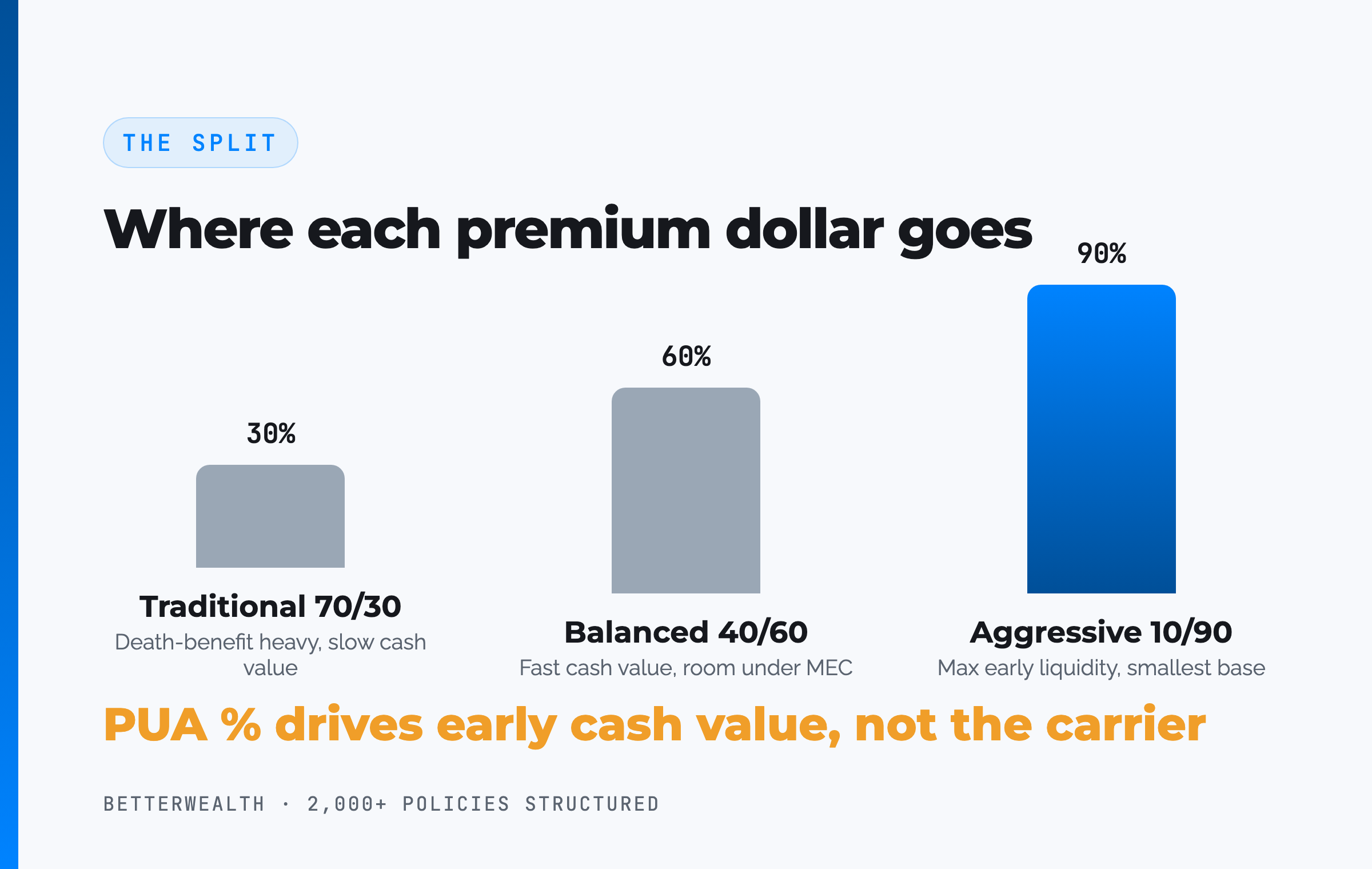
A cash-value-focused policy usually lands somewhere between a 40/60 and a 10/90 base/PUA ratio, meaning 10 to 40 percent of premium funds the base policy and the remaining 60 to 90 percent funds paid-up additions. The more weight you put on the PUA side, the faster early cash value builds, up to the ceiling the IRS allows. There is no single correct ratio. The right split is a function of the death benefit you need and how close you want to run to the MEC limit.
Run the base too high, say 70/30, and you have bought a death-benefit-heavy policy with sluggish cash value. Run the PUA as high as the carrier and the tax code permit, like 10/90, and you maximize early liquidity but you are funding the smallest death benefit that will legally hold all that premium. Most of our designs for entrepreneurs sit in the 20/80 to 40/60 range, balancing fast cash value against a death benefit large enough to keep the policy comfortably under the MEC threshold.
If an agent shows you a whole life illustration and cannot tell you the base/PUA ratio off the top of their head, they did not design the policy. They sold you a product.
04 / How it worksHow to design a policy around paid-up additions
Designing a policy around paid-up additions is a five-step sequence, and the order is deliberate. The goal is to push as much premium as possible through the PUA rider while keeping the contract under the MEC limit and leaving the base death benefit only as large as it needs to be. Here is the sequence we use.
- Minimize the base premium. Set the base whole life premium as low as the carrier allows for the death benefit you actually need. Every dollar you keep off the base is a dollar that can route into PUAs, where it works harder.
- Maximize the PUA rider. Load the rider as heavily as the IRS limit permits. This is where the 40/60 to 10/90 ratios come from. The rider is the engine, so you feed it.
- Stay under the MEC limit. Keep total funding below the seven-pay threshold. Cross it and the policy converts to a Modified Endowment Contract, which changes the tax treatment of every future loan and withdrawal. This constraint is what caps how aggressive the PUA load can be.
- Fund the PUA every year. Pay the rider consistently within each policy year. Each PUA payment immediately buys paid-up insurance that adds cash value and begins compounding. Most carriers require a minimum level of PUA funding over a rolling period to keep the rider active.
- Let it capitalize, then deploy. Allow the early years to capitalize. Break-even, where cash value catches cumulative contributions, lands at year five or later for a healthy individual. After that, you borrow against the policy for an activity that beats the carrier's loan cost.
On a well-designed, PUA-heavy policy, each premium dollar starts adding more than a dollar of cash value around year three. Break-even on total contributions typically arrives at year five. Any illustration showing cash value above contributions in year one or year two is not a real whole life policy. It is a sales prop.
Why PUA-heavy design serves the life insurance strategy
The reason we push the PUA rider so hard is that the entire strategy depends on having accessible capital sooner rather than later. A policy that takes fifteen years to become usable cannot serve an entrepreneur who wants to deploy capital across the next business cycle. The PUA rider compresses that timeline. It is the mechanical reason the policy can function as the capital base described in What Is Infinite Banking? The And Asset Guide, where the value is created in what you deploy the capital into, not in the policy sitting still.
Design for access. Then deploy with discipline.
A PUA-heavy design fits a specific person doing specific things.
It fits you if
- You will fund the PUA rider consistently for 10+ years
- You want early cash value to deploy as capital
- You can name a use that beats the loan cost
- You understand the death benefit stays modest by design
It does not fit you if
- You primarily want the largest death benefit per dollar
- You expect to break even in year one or two
- You want a savings account, not a capital base
- You cannot identify a productive use for borrowed dollars
If you are in the first column, a 30-minute conversation will show you what the right base/PUA split looks like for your situation. If you are in the second, we will tell you that too.
Book a Discovery Call05 / The limitWhat is the MEC limit, and why does it cap your PUAs?
The MEC limit is the maximum amount of premium you can put into a policy before the IRS reclassifies it as a Modified Endowment Contract. It is set by the seven-pay test under IRC Section 7702A: roughly, the policy cannot be funded faster than it would take to pay it up in seven level annual payments. Paid-up additions are powerful precisely because they let you fund right up toward that line. The MEC limit is the wall that stops you from going further.
Why does crossing it matter? A normal whole life policy gives you favorable tax treatment on loans and withdrawals. Once a policy becomes a MEC, that treatment changes. Distributions and loans are taxed on a gains-first basis as ordinary income, and there can be an additional 10 percent penalty on amounts taken before age 59 and a half. For a strategy built on borrowing against the policy, becoming a MEC defeats the purpose. So the design lives in the space just under the limit: maximum PUA funding, MEC avoided.
The death benefit lever
Here is the part that surprises people. If you want to pour more premium into PUAs without triggering a MEC, you raise the base death benefit. A larger death benefit raises the seven-pay limit, which creates more room for premium. The tradeoff is that a larger base means more internal cost, which slightly slows cash value growth. This is the central tension of policy design: enough death benefit to hold the premium you want to contribute, but no more than that, because every extra dollar of death benefit is a small drag on cash value.
A MEC is not a disaster for everyone. For our strategy it is, because the whole point is tax-advantaged access to capital. Cross the line and you have built the wrong tool.
06 / CompoundingHow do paid-up additions actually grow?
Paid-up additions grow through dividends, and the growth compounds because each year's dividend can buy still more paid-up additions. This is the snowball that makes the design work over a long horizon. A PUA you buy this year earns a dividend next year. That dividend buys a tiny additional PUA, which itself earns dividends the year after. The base of paid-up insurance keeps expanding.
One precision point that marketers routinely get wrong: the policy does not compound at the dividend rate. A carrier may declare a 6 percent dividend rate, but your cash value does not grow at 6 percent. It grows at the dividend net of the mortality and expense charges inside the policy, which is the figure that actually accumulates. Anyone quoting the gross dividend rate as your growth rate is either careless or selling. Dividends themselves are declared annually by the carrier's board and are not guaranteed, so the compounding engine runs on a variable, not a fixed rate.
Net of costs. Always net.
07 / The frameworkWhere IBC ends and The And Asset begins
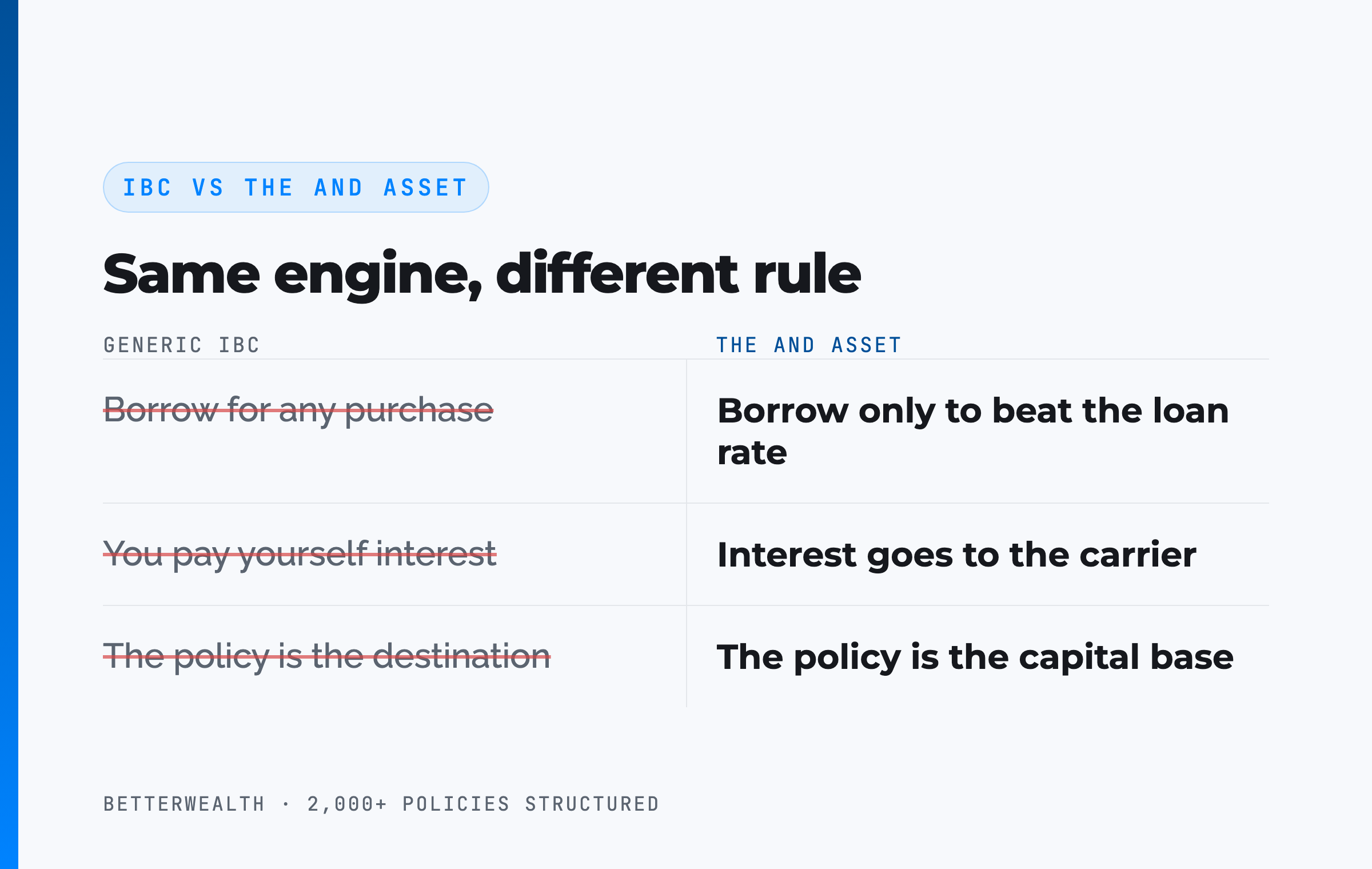
Paid-up additions are mechanics. The framework that decides what to do with the resulting cash value is what we call The And Asset. Nelson Nash pioneered the idea of using whole life insurance as a personal banking system in Becoming Your Own Banker. His insight holds: you either lose money paying interest to outside lenders, or you lose money to the opportunity cost of capital sitting idle. We respect that foundation. The And Asset builds on it with one rule Nash's broader teaching does not enforce.
IBC says you can use a whole life policy as a personal banking system for any purchase, and a fat PUA rider gives you the liquidity to do exactly that. The And Asset says no. You only deploy capital from the policy when the borrowed dollars will produce a return greater than the carrier's loan cost. Anything less is an expensive way to spend money. Many IBC marketers say you are paying yourself interest when you repay a policy loan. You are not. The interest goes to the carrier. Your return is what your deployed capital earns elsewhere while the policy compounds uninterrupted.
This is why we obsess over the PUA design. A heavy PUA rider builds the capital base faster, but the base is only worth building if you have the discipline to deploy it well. The rider is the engine. The deployment is the destination.
Marketers have ruined how this strategy gets explained. The PUA rider is not a money-printing trick. It is a tool that builds a capital base. What you do with that base is the whole ballgame.
The frameworks behind 2,000+ policies, in one place.
The And Asset Vault holds the design frameworks and calculators we use to set base/PUA ratios, model the MEC limit, and decide when borrowing against a policy actually makes sense. Free, email-gated, no spam.
Open the Vault08 / The tradeoffsBenefits and the real tradeoffs of a PUA-heavy design
A PUA-heavy design accelerates cash value, but it comes with tradeoffs that disqualify it for some buyers, and pretending otherwise is how agents lose trust. Here they are, plainly.
First, a smaller death benefit per premium dollar. By minimizing the base to maximize PUAs, you are deliberately buying the least death benefit the strategy allows. If your primary goal is the largest possible payout to heirs, this is the wrong design. Second, the MEC ceiling caps how aggressive you can be, so there is a hard limit on how fast the rider can fill, no matter how much you want to contribute. Third, the early years still lag. Even the best PUA design does not break even before year four, and year five or later is normal. If you need liquidity inside three years, this is not your tool. Fourth, it demands funding discipline. The PUA rider needs consistent contributions, and most carriers require a minimum over a rolling period, so a policy you cannot reliably fund will underperform its illustration.
Against those tradeoffs sits the reason to do it at all. A properly designed policy gives you a growing pool of capital you can borrow against on your own terms, with the policy compounding the entire time. That is the structural feature nothing else on this list offers.
Less death benefit now. More usable capital sooner. That is the trade.
09 / The fitWho should run a PUA-heavy policy, and who shouldn't?
A PUA-heavy policy is right for the entrepreneur, business owner, or high-income earner who will fund the rider consistently for a decade or more and who wants accessible capital to deploy. It fits the value creator who understands the death benefit is intentionally modest, who plans to borrow against the policy for activity that beats the loan cost, and who treats the policy as a capital base rather than a finish line.
It is the wrong design for someone whose main goal is the largest death benefit per dollar, for someone who expects to break even immediately, or for someone looking for a savings vehicle. If you cannot name an activity that beats the carrier's loan cost, the most aggressive PUA design in the world will not help you. It will just be an efficient way to store money you are not using.
10 / Head to headPUA-heavy design versus the alternatives
Compared to the other ways people fund whole life or store capital, a PUA-heavy And Asset design trades maximum death benefit and day-one liquidity for fast-building, accessible cash value. The table sets it against a traditional whole life policy, a paid-up additions design with no deployment discipline, and a high-yield savings account on the four dimensions that matter for life insurance strategy.
| Dimension | PUA-heavy And Asset design | Traditional whole life | PUA design, no discipline | High-yield savings |
|---|---|---|---|---|
| Early cash value | Builds fast; break-even at year 5+, then accelerates | Crawls for a decade or more | Builds fast (same mechanics) | Immediate, dollar for dollar |
| Death benefit | Modest by design, kept low to maximize PUAs | Largest per premium dollar | Modest by design | None |
| Growth while borrowed | Compounds on full value, net of internal costs | Compounds, but base grows slowly | Compounds, but capital may sit idle | Stops the moment you withdraw |
| Capital outcome | Deployed only when return beats the loan cost | Capital rarely accessed efficiently | Borrowed for purchases that lose to the loan cost | Erodes to inflation over time |
PUA-heavy And Asset design. The mechanics build accessible cash value fast, and the discipline ensures the capital is only deployed when the return clears the loan cost. That combination is the entire point: the policy compounds on its full value while the borrowed dollars work elsewhere.
Traditional whole life and the undisciplined PUA design. Traditional whole life builds cash value too slowly to serve as a capital base. The undisciplined PUA design has the right mechanics but the wrong behavior, borrowing for purchases that lose to the loan cost. Same engine, opposite result.
High-yield savings. Savings is fully liquid and grows from day one, but it stops earning the instant you spend it, and it has no leverage feature. The And Asset design trades a few years of patience for capital that keeps compounding even while it is deployed.
A composite: the 20/80 design that funded a renovation
Consider a 43-year-old real estate investor, preferred non-tobacco, funding a whole life policy at $36,000 per year on a 20/80 base/PUA design. This is a representative composite, not a single named client.
Through the first three years, cash value trails cumulative contributions, exactly as a real policy should. By year three, each premium dollar adds more than a dollar of cash value because the PUA rider is doing its work. At year five, total cash value crosses total contributions. No earlier. Any illustration showing a year-two break-even is marketing fiction.
In year six, with roughly $223,000 of accessible cash value, the investor borrows $94,500 against the policy to fund a value-add renovation on a held property. The renovation lifts net operating income enough to return an estimated 13.8% IRR. The loan cost is illustrative at around 6%, so the spread works in the investor's favor by nearly eight points. The policy keeps compounding on its full value the entire time. Repayment runs on a 29-month schedule funded by the property's improved cash flow.
One dollar. Two jobs. That is the And.
The honest 30 minutes about how your policy should be designed.
We have structured more than 2,000 policies across all 50 states. On a discovery call, a practitioner looks at your situation and shows you what the right base/PUA split, MEC headroom, and funding plan look like for you. If a whole life policy is the wrong tool, we will tell you that too. If you would rather learn first, the The And Asset and BetterWealth YouTube channels go deep on the math.
Book a Discovery CallFAQPaid-up additions questions
What are paid-up additions in whole life insurance?
Paid-up additions are small blocks of fully paid-up whole life insurance you buy with extra premium through a PUA rider. Each one is permanently paid for, adds immediate cash value, and compounds at the dividend rate net of mortality and expense charges. They are the engine that drives early cash value.
What is a good base to PUA ratio?
For a cash-value-focused policy, a base/PUA ratio in the range of 40/60 to 10/90 is common, meaning 10 to 40 percent of premium funds the base policy and 60 to 90 percent funds paid-up additions. The right split depends on the death benefit you need and the MEC limit, not a single formula.
Do paid-up additions increase cash value immediately?
Yes. A large share of each PUA dollar becomes cash value in the same policy year, far more than a base premium dollar does early on. Total cash value still does not exceed total contributions before year four, and break-even typically lands at year five or later for a healthy individual.
What is the MEC limit and why does it matter for PUAs?
The MEC limit is the seven-pay funding threshold set by IRC Section 7702A. Fund a policy with more premium than that limit allows and it becomes a Modified Endowment Contract, which taxes loans and withdrawals as income with a possible penalty before age 59 and a half. PUAs are powerful precisely because they push funding toward that limit without crossing it.
Why does policy design matter more than the carrier?
Two policies from the same carrier can behave completely differently based on the base/PUA split alone. A poorly designed policy with little or no PUA rider produces slow cash value regardless of the dividend rate. Design determines how fast the policy becomes usable as a capital base, which is why we treat it as the first decision, not the last.
What is The And Asset?
The And Asset is BetterWealth's framework for using a properly structured whole life policy as a capital base. You only borrow against it for an activity that produces a return greater than the carrier's loan cost, so your dollars do two jobs at once: the policy keeps compounding while the deployed capital earns its own return.
How is The And Asset different from infinite banking?
Infinite banking, as Nelson Nash taught it, frames a whole life policy as a personal banking system for any purchase. The And Asset adds a discipline: you only deploy borrowed capital when the return clears the carrier's loan cost. The policy is the capital base, not the destination. It is built on Nash's foundation but operates on different principles.
Are paid-up additions guaranteed?
The paid-up insurance you buy with a PUA dollar is permanent and cannot be taken away. The ongoing growth on it comes from dividends, which are declared annually by the carrier's board and are not guaranteed. The guaranteed floor and the non-guaranteed dividend are two separate parts of the same policy.
Can you stop paying paid-up additions?
Yes. The PUA rider is flexible. You can reduce or pause PUA payments within carrier rules, though most carriers require a minimum level of PUA funding over a rolling period to keep the rider active. The base premium is the only mandatory payment to keep the policy in force.
Do paid-up additions reduce the death benefit?
No. Paid-up additions increase the death benefit. Each PUA is a small slice of additional paid-up insurance, so funding the rider raises both cash value and total death benefit. The design tension is the reverse: you keep the base death benefit low so more premium can route into PUAs without triggering a MEC.
- Nelson Nash, Becoming Your Own Banker, the origin of the infinite banking concept.
- IRC Section 7702 (Cornell Law), the definition of a life insurance contract for tax purposes.
- IRC Section 7702A (Cornell Law), the seven-pay test that defines a Modified Endowment Contract.
- LIMRA, life insurance industry data on policy design and persistency.
- BetterWealth resources: The And Asset book, the The And Asset YouTube channel, and the BetterWealth YouTube channel.
I founded BetterWealth to treat life insurance as the wealth and capital tool it actually is, not the product most people get sold. Our team has structured more than 2,000 policies across all 50 states, and the base/PUA design is the first thing we look at on every one of them. I wrote The And Asset and host the BetterWealth and The And Asset YouTube channels. If you want an honest read on how your policy should be designed, book a discovery call. We will tell you if it does not fit.