
Using life insurance while you are still alive means borrowing against the policy's cash value, which stays accessible without lender approval while the death benefit remains intact. A properly structured whole life policy lets the same dollars fund an opportunity today and replenish the family's legacy later.
Most people who own life insurance own a contract they expect to never touch. They pay the premium, they file the policy, and they assume the only event that unlocks any value is their own death. That assumption is where the majority of the asset's usefulness gets thrown away, because the feature set inside a permanent policy operates during your lifetime, not after it.
A properly structured cash value policy is a pool of capital you can access without asking a lender for permission, and the death benefit is what remains after you have used it. That is a structural claim, not a marketing one. The mechanics are ordinary: the cash value serves as collateral, the carrier lends against it, and the policy keeps compounding on its full value while the loan is outstanding.
At BetterWealth we have structured more than 2,000 policies across all 50 states, and the single most common misunderstanding we correct on a first call has nothing to do with dividend rates or carriers. It is the belief that the money is locked until death. Van Mueller, who has spent 54 years running 30 to 50 client appointments a week, puts the correction in one line: no insurance company that has ever existed has paid a single dollar to a dead person.
This piece covers what living access actually means, how a policy loan works step by step, the tax treatment that makes repositioning taxable retirement money worth considering, the long-term care and legacy math that most comparisons miss, and the test The And Asset applies before any of it is worth doing. It also covers who should skip this entirely.
- Cash value in a permanent policy is accessible through a policy loan, with no credit check and no lender approval.
- A policy loan is collateralized by cash value, so the policy keeps compounding on its full value while the loan is outstanding.
- The interest on a policy loan goes to the carrier, not to you. Marketers who say otherwise are selling, not explaining.
- Cash value does not exceed cumulative contributions before year four. Break-even lands at year five or later for healthy individuals.
- The And Asset test: borrow only when the deployed capital produces a return greater than the carrier's loan cost.
- Life insurance is not an investment. It is a capital structure with defined tax and access features.
Van Mueller spends most of the conversation on something this article cannot reproduce: the exact questions he asks to get a client thinking about living access in the first place, delivered the way he actually says them.
01 / The problemWhat most people actually own when they own life insurance
Most people own a contract whose entire value they have mentally deferred to a date they cannot control. That deferral is the problem, because a permanent policy is not a one-event instrument. It holds a growing pool of capital that the owner can collateralize at any point, and treating it as untouchable is functionally the same as keeping money in an account you have decided never to open.
The cost of that decision shows up in two places. The first is liquidity. When an opportunity or a shock arrives, the owner goes to a bank, a HELOC, or a brokerage margin desk, and pays interest to an outside lender while their own capital sits idle inside the policy. The second is the care years. A retiree who spends down an IRA to cover chronic care in their final years reduces the inheritance dollar for dollar, and pays ordinary income tax on the way out.
Nelson Nash named the first problem decades ago. You either lose money paying interest to outside lenders, or you lose it to the opportunity cost of capital that is not working. Living access is the structural answer to both.
"There is not an insurance company that has ever existed that has ever paid any money to a dead person.", Van Mueller
02 / The answerCan you use life insurance while you are still alive?
Yes, if the policy is a permanent policy with cash value. Term insurance has no cash value and offers no living access unless a rider allows acceleration of the death benefit for terminal or chronic illness. A whole life policy designed for cash value gives you three distinct forms of lifetime access, and they behave differently.
The first is the policy loan, which is the mechanism this article spends most of its time on. You borrow from the carrier using your cash value as collateral. The money is not withdrawn, so the policy continues to compound on its full value, net of mortality and expense charges. There is no credit check, no underwriting, and no committee, because the collateral already sits on the carrier's balance sheet.
The second is acceleration. Under IRC Section 101(g) and carrier-specific riders, a portion of the death benefit can be paid out during life for terminal, chronic, or in some contracts critical illness. Availability and definitions vary by carrier and by state, so this is a contract-level question, not a general one.
The third is conversion of the asset into an income stream in retirement, which is a distribution strategy rather than an access mechanism. It is the reason a carrier's loan structure in the later policy years matters more than most buyers realize.
The money is not locked. It is collateral.
03 / The frameworkWhat does it mean to use the policy while you are alive?
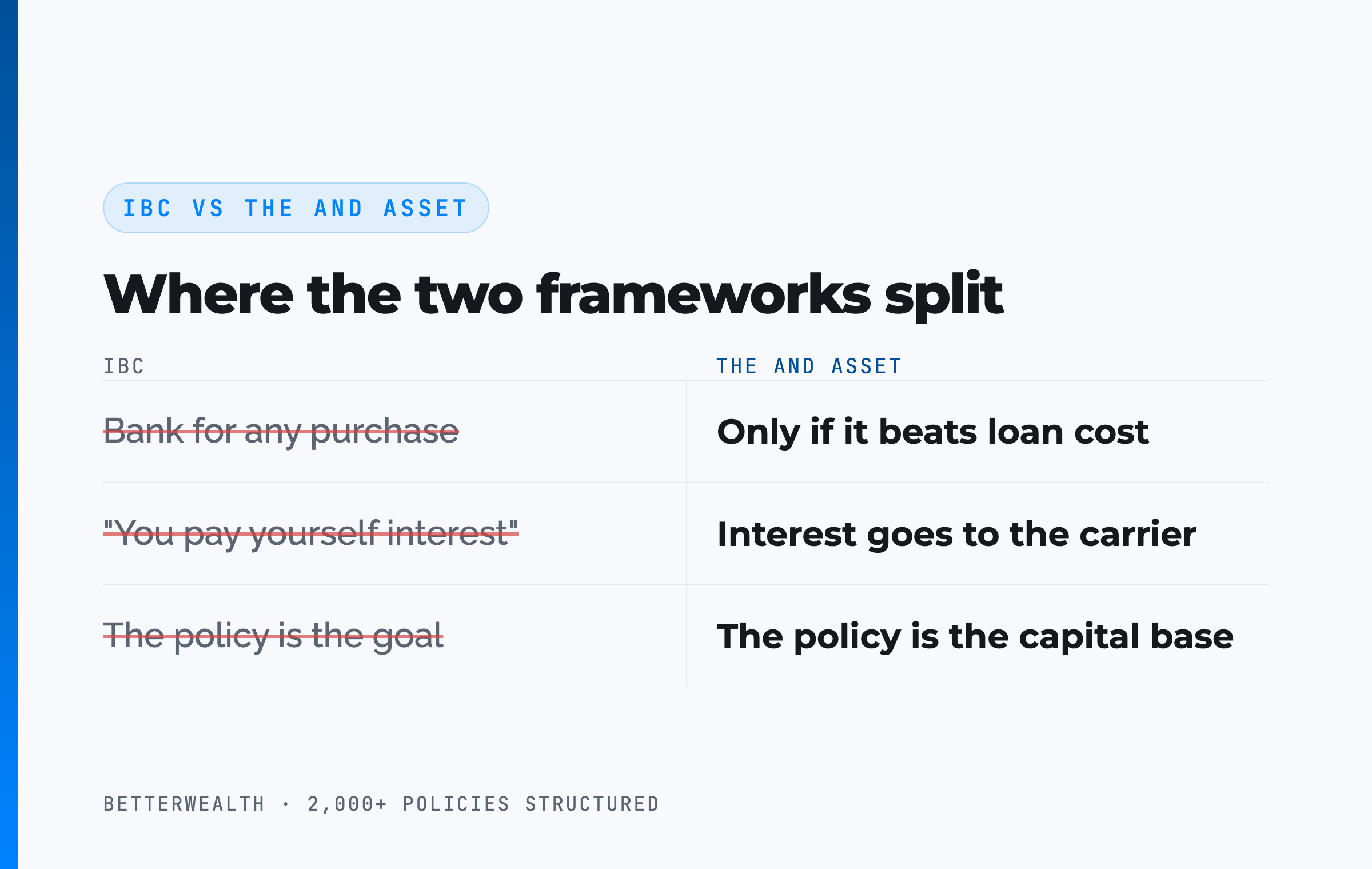
It means treating the policy as a capital base rather than a death benefit you happen to be funding. That framing is where The And Asset starts, and it is where our approach separates from how infinite banking is usually taught.
Credit belongs where it is due. Nelson Nash pioneered the idea of using whole life insurance as a personal banking system, and his insight about lost opportunity cost is the foundation everything else is built on. The And Asset shares those roots and operates on different principles.
Where IBC ends and The And Asset begins
IBC says you can use a whole life policy as a personal banking system for any purchase, including consumption. The And Asset says you only deploy capital from the policy when the borrowed dollars will produce a return greater than the carrier's loan cost, because the interest is a real cost paid to a real counterparty. Borrowing at roughly 6% to buy a depreciating asset is an expensive way to spend money, and the policy does not change that arithmetic.
Many IBC marketers say you are paying yourself interest. You are not. The interest goes to the insurance company. Your return is what the deployed capital earns elsewhere while the policy continues compounding on its full value. That correction is the whole difference between a strategy and a pitch.
Living access does not suspend the rule. It is the reason the rule exists.
Marketers have ruined the way this should be explained. The dollars have to beat the loan rate, or you do not borrow. The discipline is the strategy.
04 / How it worksHow do you actually get money out of a life insurance policy?
You take a policy loan, and the sequence has six steps that determine whether it works. The order matters, because most of the failures we see happen at step one or step three, long before anyone touches a loan form.
- Structure the policy for cash value. Minimize base premium and load the paid-up additions rider as heavily as the IRS limit allows without creating a Modified Endowment Contract. The base-to-PUA split, written as 25/75 or 10/90 depending on design, is the single decision that determines how much capital is accessible in the early years.
- Fund it and let the early years capitalize. First-year cash value typically lands between 75 and 92% of premium depending on carrier and design. Cash value trails cumulative contributions for the first several years, and that is correct behavior for a real policy.
- Confirm the use before you borrow. Name the specific activity and estimate its return. If you cannot identify something that clears the carrier's loan cost, stop here. This is the step that separates The And Asset from a personal credit line.
- Request the loan. Most carriers allow a first loan 10 to 30 days after initial funding. Smaller loans are usually handled by phone or online portal, larger loans by a signed loan form. Interest typically accrues daily and shows in the portal.
- Deploy the capital and track both returns. The policy compounds on its full cash value, net of mortality and expense charges, while the deployed capital earns its own return. Two returns, one dollar. That is the AND.
- Repay from the cash flow the activity produces. Repayment restores borrowing capacity and clears the loan balance against the death benefit. An outstanding loan reduces the death benefit paid to beneficiaries until it is repaid.
Step six is the one people skip in the marketing and the one that decides outcomes in practice. The discipline of repayment is the whole strategy.
What break-even really looks like
Van Mueller has been running this for five decades and he sets the expectation harder than most agents will. He does not show a client any gain in a cash value policy for the first ten years. His words: you are lucky if you get back to even. That is a conservative framing, and it is far closer to reality than the illustrations that show a first-year break-even.
Our own numbers: cash value does not exceed cumulative contributions before year four, and break-even typically lands at year five or later for a healthy individual. The capitalization point, where each premium dollar adds more than a dollar of cash value, generally arrives around year three on a well-designed policy. Anything faster is a marketing document, not an illustration.
Early years are the price. Later years are the product.
"I don't show anybody that they make any money in a cash value life insurance policy for 10 years. You're lucky if you get back to even.", Van Mueller
Living access is worth something only if you have somewhere to put the capital.
It fits you if
- You already deploy capital into deals, equipment, or acquisitions
- You have named a use that clears the carrier's loan cost
- You have a 10-year-plus funding horizon
- You want capital that a lender cannot freeze or call
It does not fit you if
- You are early in building wealth and need every dollar liquid now
- You are carrying high-interest debt and need a fast fix
- You want a savings account with better yield
- You cannot name a productive use for borrowed dollars
If you are in the first column, 30 minutes will tell you whether the design works for your situation. If you are in the second, we will say so on the call and save you the premium.
Book a Discovery Call05 / The mathDoes the return clear the carrier's loan cost?
The return on whatever you deploy must exceed the carrier's loan cost, or you should not borrow. That is the entire test, and it does not soften because the money came from your own policy. Policy loan rates vary by carrier and by rate environment. At the time of writing many carriers fall in the 5 to 6% range, but treat the specific number as a variable to verify with your carrier rather than a constant.
Here is the structure of the decision. You borrow at the carrier's loan rate. The policy keeps compounding on its full cash value, net of mortality and expense charges, adjusted by the carrier's recognition method. The deployed capital earns its own return. If that return is higher than the loan cost, the spread is yours and one dollar has done two jobs. If it is lower, you have borrowed money to lose money on a slower schedule.
Notice what this test does to the marketing version of the strategy. Financing a vacation through the policy fails it. Financing a car fails it unless the alternative financing was more expensive and you actually run the comparison. Financing a piece of revenue-producing equipment, an acquisition, or a real estate deal with a modeled return above the loan rate passes it. The mechanism is neutral. The use is what determines the result.
If the deal does not clear the loan rate, do not borrow.
06 / The tax angleWhy do high earners move taxable retirement money into a policy?
They do it to convert money that will be taxed as ordinary income later into money that can be accessed without triggering income tax, and the decision turns entirely on the marginal rate they pay to move it. This is the plumbing behind the strategy Van Mueller walks through on the podcast, and it is worth stating precisely because the sloppy version of it is everywhere.
The mechanics: a retiree past age 59 and a half takes measured distributions from a pre-tax IRA or 401(k) over a period of years, pays the tax at a rate they control by sizing the distribution, and funds a cash value policy with the net. The federal brackets are progressive, so a household can realize a meaningful amount of income at an effective rate well below its marginal rate. Using illustrative figures from the source conversation, a household realizing roughly $146,500 in a year could remain in the 12% marginal bracket at an effective federal rate near 8%. Brackets and the standard deduction are indexed annually, so those exact figures move every year and should be run against current tables.
Applied to $400,000 moved across 10 years, an 8% effective federal rate is roughly $32,000 in tax. What the household gets for that $32,000 is a pool of capital they can borrow against without creating taxable income under the treatment described in IRC Section 7702, plus a leveraged death benefit that replenishes the estate. We cover the tax structure in more depth in our Section 7702 breakdown.
Two constraints belong in the same paragraph as the benefit. State income tax stacks on top of the federal number and can change the answer entirely. And the tax treatment of policy loans depends on the contract staying in force and staying inside the Section 7702 definition of life insurance. A policy that lapses with a large loan outstanding can produce a taxable gain at the worst possible moment. This is a strategy that requires management, not a set-and-forget structure.
You did not create a return. You converted money that will be taxed on the way out into money that will not be, and you bought access to it in the meantime. Those are different things and they should be priced differently.
07 / The care yearsWhat happens to the money if you need long-term care?
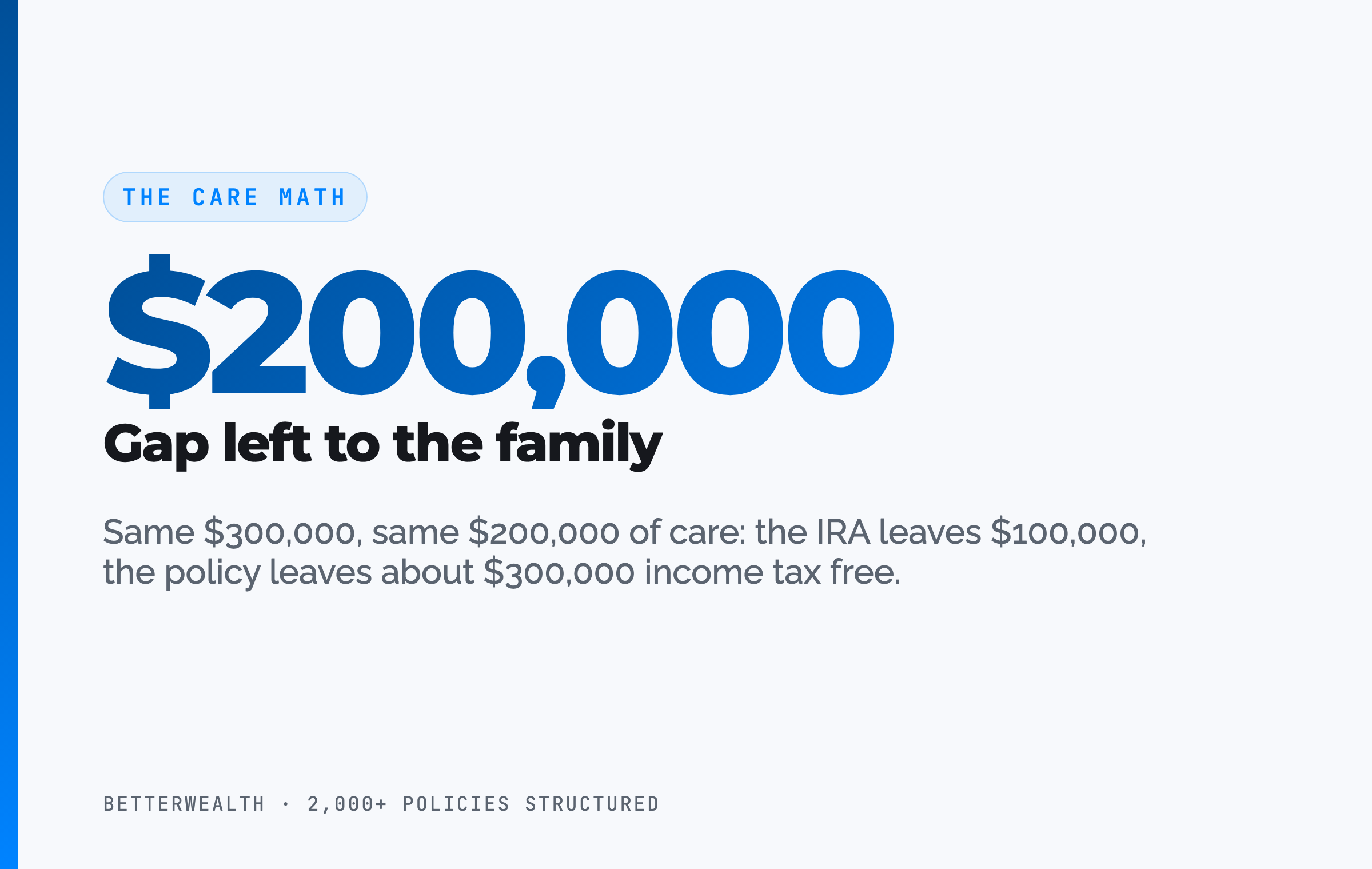
This is where the structure of the asset separates from every account that holds the same dollar amount. Spending in the final years of life reduces a retirement account balance dollar for dollar. It does not reduce a life insurance death benefit dollar for dollar, because the benefit is leveraged above the cash value.
Run the comparison Van Mueller uses with clients. Two retirees each hold $300,000 earmarked for the last stage of life. One holds it in an IRA. The other holds it as cash value in a policy with a $500,000 death benefit. Both spend $200,000 on care in their final two years.
The IRA holder leaves $100,000 to the family, taxed as ordinary income to the beneficiary on distribution. The policy holder spends from a $300,000 cash value against a $500,000 death benefit, and the family still receives roughly $300,000 income tax free. Same starting balance. Same spending. A $200,000 difference in what reaches the next generation, driven entirely by the leverage sitting above the cash value.
Standalone long-term care insurance solves the care problem and creates a different one. The most common objection we hear is the accurate one: if you never need care, the premium is gone. A permanent policy with an acceleration rider does not have that failure mode, because unused benefit is not forfeited. It becomes the death benefit. That structural difference is why hybrid designs have taken so much share from standalone products.
Self-funding care from a portfolio is the third option, and it deserves the same scrutiny. Setting aside $300,000 to self-insure means that capital sits reserved against a contingency instead of deployed. You would not self-insure your house for the same reason.
The frameworks behind 2,000+ policies, in one place.
The And Asset Vault holds the calculators, design frameworks, and structuring decisions we use when we model living access, loan capacity, and the break-even timeline on a real policy. Free, email-gated, no spam.
Open the Vault08 / Where people get it wrongThe four claims that discredit this strategy
Four specific claims do more damage to this strategy than every critic combined, and they all come from inside the profession. Each one has a precise correction.
"You pay yourself interest"
You pay the insurance company. The interest leaves your control and lands on the carrier's books. The return you get is what the deployed capital earns while the policy compounds on its full value. Every practitioner who says otherwise is either careless or selling, and the moment a sophisticated buyer catches it, everything else you said becomes suspect.
"Life insurance is a great investment"
It is not an investment, and framing it as one loses the argument on the buyer's terms. Van Mueller calls that framing demeaning to the asset, and he is right. Compared to equities on rate of return alone, a whole life policy loses. What it offers is a different set of properties: liquidity without lender approval, tax treatment under Section 7702, creditor protection that varies by state, and a leveraged benefit that self-completes if you die early. Judge it on those and it holds up. Judge it on IRR against the S&P and you should not buy it.
"This replaces your 401(k)"
It does not. A 401(k) is a regulated, tax-deferred account with an employer match and distribution rules set by statute. Those are different features solving a different problem. Van Mueller, who has sold life insurance for 54 years, tells young clients to fund a Roth first. The policy sits alongside retirement accounts. We break down the comparison in infinite banking versus a 401(k).
"Everyone should have one"
The strategy has a specific buyer. Someone early in building wealth, someone carrying high-interest debt, and someone with no identified use for borrowed capital are all better served elsewhere. Saying so is the fastest way to establish that you are not running a pitch.
A composite: the operator who deployed at year eight
Consider a 44-year-old business owner, preferred non-tobacco, funding an overfunded whole life policy at $62,400 per year on a cashflow design. The premium splits $14,300 base and $48,100 paid-up additions, a 23/77 ratio. This is a representative composite, not a single named client.
Through years one to four, cash value trails cumulative contributions, exactly as a real policy behaves. By year three each premium dollar adds more than a dollar of cash value. At year five total cash value crosses total contributions at $316,800 against $312,000 paid in. No earlier.
In year eight, with $499,200 contributed and roughly $541,000 of cash value on the contract, the owner borrows $214,000 to buy revenue-producing equipment for a second facility. At an illustrative 6% loan rate, the annual interest cost runs about $12,840. The equipment produces roughly $29,100 per year in additional operating margin, a 13.6% IRR on the deployed capital, so the spread runs about $16,260 a year in the owner's favor before the policy's own growth is counted.
The policy keeps compounding on its full $541,000, net of mortality and expense charges, the entire time the loan is outstanding. Repayment runs on a 43-month schedule funded by the equipment's own cash flow. When the loan clears, the death benefit is whole again and the borrowing capacity is restored for the next use.
Change one variable and the case collapses. Replace the equipment with a purchase returning 3% and the owner has paid $12,840 a year to earn less than that. Same policy. Same loan. Different answer.
One dollar. Two jobs. That is the And.
09 / Head to headLiving access compared to the alternatives
Against the accounts most people already hold, a cash value policy trades early growth for access, tax treatment, and a leveraged benefit that pays whether or not the care years arrive. The table sets a $300,000 position in a policy against the same amount held in a pre-tax retirement account, a taxable brokerage, and a standalone long-term care policy, using the care scenario from Section 07.
| Dimension | And Asset policy | Pre-tax IRA / 401(k) | Taxable brokerage | Standalone LTC policy |
|---|---|---|---|---|
| Starting position | $300,000 cash value supporting a $500,000 death benefit | $300,000 pre-tax balance | $300,000 after-tax balance | Roughly $4,800/yr premium, no cash balance |
| After $200,000 of care spending | Family receives about $300,000 income tax free | $100,000 remains, taxed as ordinary income to the beneficiary | $100,000 remains, with a step-up in basis at death | Care is covered; nothing passes to the family |
| If care is never needed | Full $500,000 death benefit passes to the family | $300,000 plus growth, taxed on distribution | $300,000 plus growth, taxed annually on gains | Premiums paid are gone |
| Access before the care years | Policy loan in 10 to 30 days, no credit check, cost 5 to 6% illustrative | Restricted before 59½ (10% penalty plus tax) | Fully liquid, settles in days | None. It is pure protection. |
| Growth profile | Dividend net of mortality and expense charges; no break-even before year 4 | Market growth, tax-deferred | Market growth, taxed yearly on gains and dividends | No growth |
The care row is the whole argument. Every column starts at the same place and ends somewhere different, and the gap is created by the leverage sitting above the cash value rather than by any growth assumption. A $200,000 draw against a $500,000 benefit is not the same event as a $200,000 draw against a $300,000 balance.
Access is where the brokerage wins and the retirement account loses. A taxable brokerage is more liquid than a policy on any given Tuesday. A pre-tax retirement account is the least accessible of the four before 59½, with a 10% penalty plus ordinary income tax on early distributions under rules set by Congress.
Growth is where the policy loses, and it should. Nobody should buy this expecting to beat a market portfolio on rate of return. The reason to hold it is the combination in the other four rows, which no single alternative reproduces. We walk through how the growth actually accrues in how whole life cash value works.
10 / The fitHow does this fit into a broader capital strategy?
It fits as one component in a structure, never as the structure itself. The failure mode we see most often is not skepticism about life insurance. It is an agent who positions a policy as the answer to every question, which devalues the client's other assets and, in the end, devalues the policy too.
The right sequence for most high-income households looks ordinary. Fund the employer match. Fund a Roth or backdoor Roth while current rates are historically low relative to where the country's fiscal position points. Hold a working cash reserve. Then, if there is surplus capital and an identified use for borrowed dollars that clears the carrier's loan cost, structure a policy as the capital base. Van Mueller, five decades into selling life insurance, gives the same order and tells clients in their twenties to start with the Roth.
What the policy adds to that stack is a place where capital compounds without market drawdown risk while remaining accessible on your timetable rather than a lender's. For an entrepreneur or real estate investor who has passed on deals because liquidity was tied up, that combination is the point. For someone with no deal flow, it is an expensive way to hold money.
The integration question is the one worth asking: does this make what you are already doing better? If the answer is no, the answer is no. We cover the honest ledger in infinite banking pros and cons.
The honest 30 minutes about whether this fits you.
We have structured more than 2,000 policies across all 50 states. We have seen this strategy work exactly as designed, and we have seen it fail when the owner could not name a use for borrowed capital. On a discovery call a practitioner looks at your situation and gives you the honest answer either way. If you would rather learn first, the The And Asset and BetterWealth YouTube channels go deep on the math.
Book a Discovery CallFAQUsing life insurance while you're alive
Can you use life insurance while you are still alive?
Yes. A permanent policy with cash value can be borrowed against during your lifetime, and many policies also allow the death benefit to be accelerated for chronic or terminal illness. Term insurance has no cash value, so it offers no living access unless a rider provides acceleration.
How do you take money out of a life insurance policy?
Most people use a policy loan, which is collateralized by the cash value rather than withdrawn from it. Carriers typically allow loans 10 to 30 days after initial funding, with small loans handled by phone or online portal and larger loans by signed form. There is no credit check, because your own cash value secures the loan.
Are policy loans taxable?
A loan against a policy that is not a Modified Endowment Contract is generally not treated as taxable income, because it is a loan rather than a distribution. This treatment depends on the policy staying in force and staying inside the Section 7702 definition of life insurance. If the policy lapses with a loan outstanding, the gain can become taxable, which is why loan management matters.
What is The And Asset?
The And Asset is BetterWealth's framework for using a properly structured whole life policy as a capital base. You only borrow against it for an activity that produces a return greater than the carrier's loan cost, so your dollars do two jobs at once: the policy keeps compounding while the deployed capital earns its own return.
How is The And Asset different from infinite banking?
Infinite banking, as Nelson Nash taught it, frames a whole life policy as a personal banking system for any purchase. The And Asset adds a discipline: you only deploy borrowed capital when the return clears the carrier's loan cost. The policy is the capital base, not the destination. It is built on Nash's foundation but operates on different principles.
How long before you can borrow against a life insurance policy?
Most carriers allow a first loan 10 to 30 days after initial funding, depending on the company. What limits you in year one is not the waiting period but the amount of cash value available, which typically runs 75 to 92% of first-year premium depending on carrier and design.
Do you pay yourself interest on a policy loan?
No. The interest on a policy loan goes to the insurance carrier, not to you. This is the most repeated error in infinite banking marketing. Your return comes from what the borrowed capital earns elsewhere while the policy continues to compound on its full value, net of mortality and expense charges.
Can life insurance pay for long-term care?
Many permanent policies allow the death benefit to be accelerated for chronic or terminal illness, and some carriers offer hybrid designs built specifically for long-term care. The structural advantage is that unused benefits are not forfeited, because whatever is not spent on care passes to the family as a death benefit. Availability, definitions, and state approval vary by contract.
When does cash value exceed what you have paid in?
For a healthy individual in a well-designed policy, cash value typically catches cumulative contributions around year five, sometimes later. It does not exceed cumulative contributions before year four. Any illustration showing break-even in year one or two is not a real policy.
Is life insurance a good investment?
No, and framing it that way is how the strategy gets oversold. A properly structured whole life policy is a capital base with a defined set of features: liquidity without lender approval, tax treatment under Section 7702, creditor protection that varies by state, and a leveraged death benefit. Judged purely on rate of return against equities, it loses. Judged on what it does structurally, it does things equities cannot.
Does borrowing against your policy reduce the death benefit?
An outstanding loan reduces the death benefit paid to beneficiaries by the loan balance plus accrued interest until it is repaid. Repay the loan and the full death benefit is restored. This is the mechanical reason the discipline of repayment matters.
Should you replace your 401(k) with life insurance?
No. A properly structured policy sits alongside retirement accounts rather than replacing them. Employer match, Roth contributions, and the policy each solve a different problem. The policy solves for capital that stays accessible without lender approval and for tax treatment on the way out. It does not solve for market growth.
- Nelson Nash, Becoming Your Own Banker, the origin of the infinite banking concept.
- IRC Section 7702 (Cornell Law), the definition of life insurance for federal tax purposes, and the basis for the tax treatment of cash value and policy loans.
- IRC Section 101 (Cornell Law), the exclusion of death benefits from gross income, including the 101(g) accelerated death benefit provisions.
- IRS: Tax on Early Distributions, the 10% additional tax on retirement account distributions before 59½.
- Administration for Community Living: Long-Term Care, federal data on the likelihood, duration, and cost of long-term care.
- LIMRA, life insurance industry data, including ownership, persistency, and product trends.
- BetterWealth resources: The And Asset book, the The And Asset YouTube channel, and the BetterWealth YouTube channel.
Fifty-four years in the life insurance profession, 36 consecutive years at Top of the Table, and 30 to 50 client appointments a week. He appears on the source podcast to walk through how he opens the living-benefits conversation with clients, and he is a keynote speaker at the BetterWealth summit.
I founded BetterWealth to treat life insurance as the wealth and capital tool it actually is, not the product most people get sold. Our team has structured more than 2,000 policies across all 50 states. I wrote The And Asset and host the BetterWealth and The And Asset YouTube channels. If you want an honest read on whether living access to a policy adds anything to what you are already doing, book a discovery call. We will tell you if it does not.