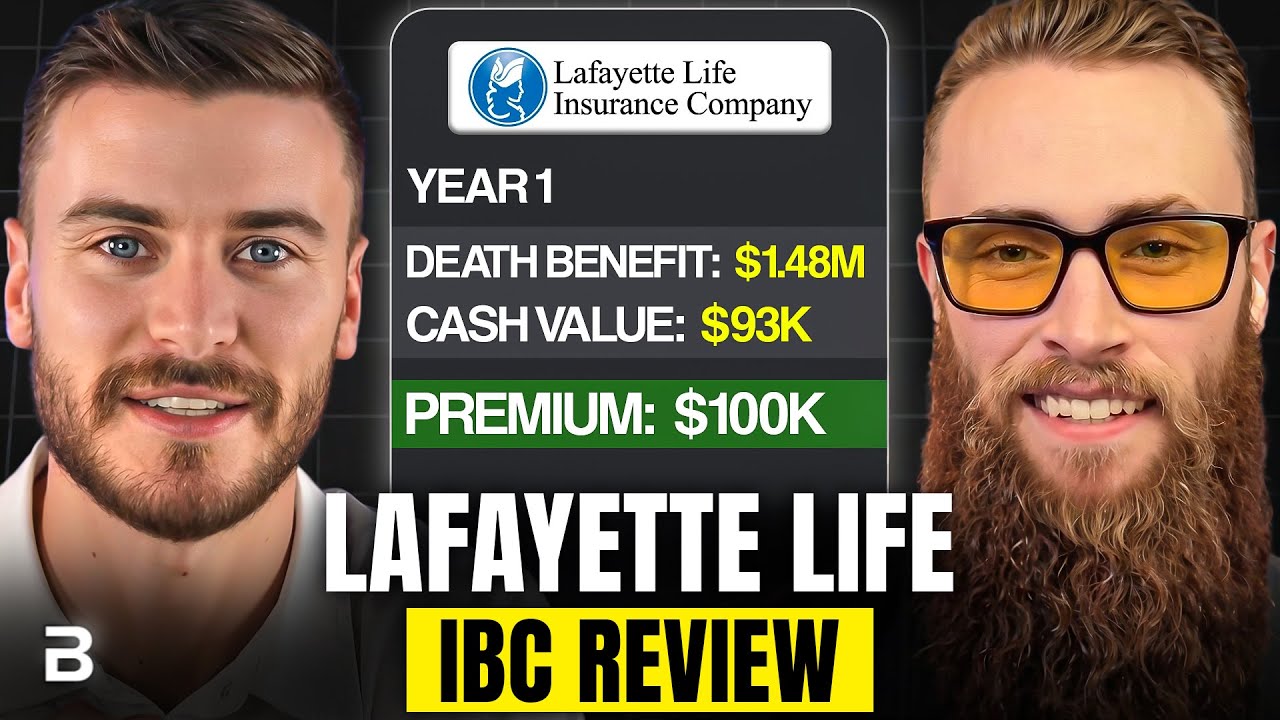
Choosing the right insurance company is crucial for successful infinite banking strategies. Lafayette Life stands out as a strong choice for whole life insurance, offering reliable financial strength, dividend history, and policy flexibility. If you're exploring how to build wealth with life insurance, understanding Lafayette Life’s unique offerings will clarify why it's favored among infinite banking practitioners. In this comprehensive review, BetterWealth co-founder Caleb Williams and Head of Product Alden Armstrong dive deep into Lafayette Life’s history, ratings, product structures, and infinite banking applications. Their expertise provides you with a clear lens on the best tax strategy and retirement planning options with whole life insurance and cash value growth.
In this episode, you'll discover how Lafayette Life operates as a carrier dedicated to whole life insurance, with a strong 119-year dividend history and a solid financial rating—95 out of 100 on the Comdex scale. We analyze key metrics such as their average lapse ratio, payout dividends, and the impact of their non-direct recognition loan structure on infinite banking loans.
You'll explore practical illustrations demonstrating cash flow and front load policy designs with premium payments of $50,000, highlighting how Lafayette Life creates early cash value access, viable break-even periods, and long-term growth ranging between 3.6% to 4.4%. We'll also unpack their flexible paid-up additions (PUA) funding options, loan access and interest accrual terms, and key underwriting considerations that affect your policy performance.
This episode is designed to give you not just data but real actionable perspectives, with links below to BetterWealth’s policy review services, supporting you in optimizing your life insurance as a powerful financial tool.
The carrier's non-direct recognition approach means that borrowing against your policy does not affect your dividends. While this simplicity is appealing, it can create discrepancies when external interest rates go above or below their dividend rates, which investors should understand when planning.
The PUA rider offers remarkable flexibility. Policyholders can adjust contributions within a minimum and maximum range annually, making it ideal for those with fluctuating income or commission-heavy businesses. Plus, the option to backfill missed premiums within a limited scope adds a safety net for real-life interruptions.
With underwriting focused on conservative risk management, Lafayette Life offers consistent policy performance but may require more stringent health evaluations compared to other carriers.
This review references key entities and strategies central to understanding Lafayette Life’s role in infinite banking.
Non-direct recognition means your borrowing activity does not reduce the dividends your policy earns. Lafayette Life uses this structure, so you receive full dividends regardless of your loan balance, simplifying growth and loan calculations.
Lafayette Life allows access to loans in approximately 30 days. Small loans up to $50,000 can be requested easily online or via phone, while larger loans require additional verification with a signature loan form.
A cash flow design spreads premium payments evenly each year, while a front-load design involves higher payments up front and lower premiums later. Front-loads build more immediate cash value but may show a lower internal rate of return over time.
PUA flexibility allows you to adjust your policy contributions annually within a minimum and maximum range, accommodating income changes and optimizing cash value growth. Lafayette Life offers a very low minimum PUA premium and limited backfill opportunities.
Lafayette Life does not officially endorse infinite banking but maintains a friendly stance and employs many producers who practice and support the strategy, offering tailored underwriting and product designs.
No, Lafayette Life is not licensed to write new policies in New York due to state regulatory requirements, so residents should explore other carriers compatible with their goals.
Focus on your policy contract, dividend history, cash value growth, rider agreements, and payment records. A comprehensive review helps ensure your policy is optimized for your infinite banking or retirement strategy.
If you're overwhelmed by choices or uncertain about your whole life insurance policy design, we can help. Our team specializes in reviewing existing policies to maximize cash value and optimize your infinite banking strategy. Don’t let inefficiencies cost you money or delay your financial independence. Click the Big Yellow Button to Book a Call and let's explore what it would look like to keep, protect, grow, and transfer your wealth the BETTER way.
Below is the full transcript.
Full Transcript6,661 words
Welcome back to Infinite Banking with a series dedicated to answering the question, what is the best insurance companies to work with Infinite Banking? My name is Caleb Williams. We got Alden Armstrong. And Alden, this has been probably one of the biggest requested series for us to do because the biggest question we get on people that want Infinite Banking is, what's the right insurance company? And so we have put together the most thorough walkthrough analyzing different insurance companies. Today's video, we're going to be looking at Lafayette life and we're going to be looking at their company. the track record, their ratings, their lapse ratio. We're also going to be looking at their view publicly when it comes to infinite banking. We're going to be looking at an illustration, looking at cash flow design. We're going to be looking at an illustration, looking at front load design. We're going to look at how loans work at that insurance company. We're going to also look at how PUA funding and their flexibility. And then we're going to wrap it all up with our summary and our takes. And Alden, this series is only made possible because you are an insurance nerd and you went down the deep dive to make this possible. And so without further ado, I'm excited, I'm fired up, and I'm gonna hand it over to you. Amazing. Well, Caleb, thanks for the intro. And I'm excited, guys. This is gonna be a really good video. Lafayette Life, we've been working with them for a while, and we have a lot of really good things to say about the company. But this is gonna be as unbiased as I can make it, but this is the honest truth coming from yours truly. Diving in, IBC with Lafayette Life. So let's set the stage. Okay, so we're founded back in 1905. So they've been around for a while. They've been paying dividends about 119 years. Now, the unique aspect of Lafayette Life is that they themselves are not a technical mutual insurance company. They are part of a mutual holding company. So for the policyholder, it really doesn't make much of a difference at all. There are some out there that say like, oh, well, mutual holding companies are worse because it's a sign that they may demutualize. I don't buy into that. There's some other history involved here, but we don't have to go deep. The moral of the story is to understand that Lafayette Life has been dedicated to mutuality. since 1905. Now, in 2005, they switched from a mutual company to a mutual holding company. Policy owners still receive full dividends, and Western Southern makes this particular company, Lockheed Life, very financially stable because Western Southern is massive. All right, so as we compare carriers, we want to dive into some specific metrics that you can compare across the board. Now, they are paying out, as of 2025, they've announced $123 million dividend spread across their policyholders. So if we look back at history with Lafayette Life, we can see a steady increase of their dividend because they're continuing to increase their market share, which is a really, really good sign of a healthy company. Right now, they have a 5.75 projected dividend rate, and they have an average lapse rate ratio of 5%. So we've defined this before. We'll just do it again very briefly. Insurance companies, on average, in the United States, lose about 5.1% of their policies per year. So over time, that lapse ratio can tell you the satisfaction on average across insurance industry. Lafayette Life, I almost said the wrong carrier, Lafayette Life is sitting right there with the average at 5%. So it's a good indication that policyholders are generally satisfied with the policies that they purchase and maintain premium payments over time. Three other quick metrics we'll touch on. One, and this is a big one for embedded banking, is that they are a non-direct recognition carrier. So in layman's terms, your borrowing activity against the insurance policy has no sway to the dividend that's being paid. They're going to get the full dividend, whatever it is, regardless of the interest rate that you're paying or how much borrowing that you're doing. Something that we're going to do in these video series is just indicate what's the pro, what's the con, right? The pro, you get the full dividend no matter what. The con, we have certain circumstances actually like today where the interest rate is far higher than what the dividend is. So until recently... interest rates with Lafayette Life are about 7%, dividends are about 5.5%. It's a pretty big difference. We can also have the reverse of that and have a much higher dividend and a much lower interest rate in certain circumstances. So the moral of the story, direct recognition, non-direct recognition, it depends. And we'll let you make the decision on that, but we'd be glad to talk to you about it as well. We've said on the channel many times that we want to work with solid, financially stable insurance companies with a lot of experience. Lafayette Life definitely is that. We've got a Comdex rating. This is a conglomeration score out of 100. So 95 out of 100, this puts them in the top 5% of insurance carriers for financial strength and stability. So very strong carrier rated at AM Best Superior right there. This is an interesting note, Caleb, and I'd love to hear your take on this as well. Lafayette Life chose to pay three different dividends interest rates in 2024 to three different policy groups, depending upon when the policy was issued. This is not a pattern we see very often with insurance companies. Usually it's one dividend hits the entire book of business. Lafayette life ranged from 5.3 to about 5.75 in 2024. Yeah, I think this is very similar to even how they do loans because something similar happens depending on when your policy. you know, date was issued, your loan rate might be different. And I and I bet you that it's it's the classic example when you do a non direct recognition. A lot of times that's sold as it being the best thing for infinite banking. But there's there's always tradeoffs. And these insurance companies are going to make sure that they cover their basis and that that could be a way for them to do that. And so just like direct recognition is not a big, big deal for me personally, seeing something like this is not as big of a deal either, because I'm I'm playing the long game when it comes to working with a solid company. But the things that I would just mention is companies been around for a long time, has good ratings. And that's when it comes to the financial strength of a company. Those are all things that are thumbs up. Yep, absolutely. One thing my mentor told me, Caleb, is that insurance companies don't lose, especially if they've been winning for 120 years in a row. So that's just a good thing to keep in mind. All right. IBC positioning. So. how does IBC actually interact with Lafayette Life as a carrier, but then also their products? I'll say very briefly here, but they are very well known for infinite banking. Most of their top producers are infinite banking practitioners. So their book of business is filled with people wanting to do what you may be wanting to do, which is leveraging against the policy to self-finance or buy assets. They are friendly because of that. A lot of their business is something they want to be friendly to. They want to make sure that people have a space within Lafayette Life to build these policies for their clients. Now, I'm going to say it here. They do not officially endorse this strategy. There are some insurance companies that we have access to and work with that do openly endorse it and support the IBC symposium and all these different things. Lafayette Life is, I think, a little bit more cars to the chest in that regard. Yeah, and I will say they they're more friendly than even other insurance companies that we work with that are totally fine structuring high cash value life insurance. They may not officially. endorse in writing, but I know that their people are going to the Infinite Banking Institute's annual event. And they're, like you said, some of their top agents out there are very into Infinite Banking and they're proudly supporting them. Yeah, absolutely. Official stance? No. General feel? Yes. Let's say it that way. All right. So this next section, we're going to look at the product. And so Lafayette Life has about five or six different whole life insurance products. They are a whole life heavy carrier. The one that we use most often and the best product, in my opinion, for these type of high cash value policies is their Patriot whole life product. So what I've done for us here today is I'm going to be showing you cash flow and front load. So, Caleb, can you remind everyone what what those two mean for us? Yeah, when we say cash flow, we are essentially looking at each year you're paying the same out of pocket each each year. Obviously, there's flexibility with both of these designs. But in this series, we're taking a look at $50,000. And as you're watching the series, you'll be able to compare different companies and what they look like because we're trying to overfund optimally in this series. And then the front load is for the type of person that is putting more money in year one and then lowering their contribution in year two and beyond. Still has flexibility in that, but you'll see that you have earlier cash value. And in most cases, the internal rate of return is lower. on the front loads. But in a lot, in most cases, you have more cash value build up because you're putting more money up front. So that's the difference between cash flow and front load. And thanks to you, Alden, like you've done the work and are able to actually show real illustrations in this series. Yeah. Well, thank you, Caleb, for the definition and also the compliment. I love that. So first of all, cash flow designs. We're going to take a look at one here in a moment from Lafayette Life. But as a whole, Lafayette Life. produces a lot of early cash value because how their product is structured. I won't geek out on you fully, but I'll give you some highlights here. One thing that is really cool about Lafayette Life's structure, they have a paid up additions writer that we'll dive into a little bit more detail later, but they have a lot of flexibility between their minimum premium and the maximum premium within a certain timeframe. So that can be very, very helpful for people with fluctuating cashflow, commission heavy sales individuals, for example, and more business owners. The other aspect is that their long-term growth and projections. are pretty solid, right? So this is close to industry average around 3.6% up to about 4.4% given current dividend assumptions. Now, IRR will change year to year depending upon that dividend rate, as we all know. All right. So on our screen right now, we have a typical cash flow design. This is on a 40-year-old male whose health rating is one level above standard, so preferred non-tobacco rating. And we have it funded for 20 years. So from age 40 to age 60. In this time frame, we're putting in $50,000 per year. Then after that, we're doing what's called an offset. Offset being the policies paying for itself. You don't have to worry about. So when we look at this design, there's a couple of things I want to draw attention to. First off is cash value access. So in the very first year, we're pushing 90% cash value access on a cash flow design. Now, this number can fluctuate, health ratings, age, everything else. But this is just an example of how strong this carrier can be from a cash flow perspective. When we start walking this out, the other metric that I like to look at is the capitalization point. What do I mean by that? Well, at what point are we earning more money in the policy in that year than what we paid in premium? So the cap point on this is in year three. We've put in $50,000. in that year. And now we have almost $52,000 of cash value growth in that year. So we've overcome the cost of insurance. And now we're going to have icing on the cake every time we pay that premium. Last metric that a lot of people care about, I don't put as much weight into it personally, but we have a break-even point of four years in this design. So 50 for over four years times four is $200,000. And we have $201,000 in this policy design. So break-even of year four, highly efficient cash value vehicle early on. Yeah. And when we're looking at these illustrations, you're already highlighting it. I'm looking at early cash value. I'm looking at the initial death benefit, which is somewhat low. I mean, that's a 777,000, but you can see that it's rapidly increasing. And then, yeah, I'm looking at the breakeven. Personally, I like that, not because the breakeven matters that much unless you're going to cancel, which you do not want to do that. It just shows you from a, if you had a break even at year 12 versus year four, it just. Shows you like how much more potentially efficient this policy could be from a cash growth rate. But then I'm also looking out if we look look out over 20 years, you're able to see that the cash value of one one point five million dollars with a death benefit of three million. And then like in this series, not to say that we do this with all of our clients, but to stay as accurate as possible where we're not paying any premiums after year 20 just to keep it consistent. but I We'll also say that, do I see this right, that the minimum premium in this case is only five grand? Almost. So what you're seeing is the base cost of insurance. We have a term insurance writer that's built into the policy for the first 20 years to allow you to overfund. I see. After 20 years, we see that drop. And so the actual cost of insurance on this is a little bit higher than that. Okay. But still very, very flexible. And that's another reason why lots of people use this company for these type of... of policies is you get really early cash value, lots of flexibility, a healthy death benefit increase, and again, solid growth, but not knocking it out of the park as it relates to growth rates compared to some other carriers. And that's probably where people will decide when at the end of the day, when they look at illustrations, do they value earlier cash and flexibility, or do they value more long-term growth rate? So Caleb, you're exactly right. Breakevens, they do mean a lot. It shows that quick efficiency of the policy. What it doesn't show us is long-term efficiency. That's where we look at the IRR, as you know. So this is pushing about 3.6 to about 4.4 with current dividend assumptions. Now, something you mentioned earlier is when we do front-loaded insurance policies, that IRR is going to drop, sometimes significantly, sometimes just mildly. Why is that? The reason is because we have to buy more insurance to justify the amount of premium you want to pay in the first year. And so when we're doing a front-loaded strategy with the whole life here at Lafayette, we're getting slightly higher cash value. We can get this 85 to 93% cash value in year one, depending upon ratings and age, everything else. And then with this type of strategy, this is my opinion, but we typically recommend a seven year timeframe at minimum, and then out to basically where the term insurance rider drops off. And that point, because the term's on there, you can fund it at a high level. Once the term drops off, you kind of lose some of that ability and it becomes less efficient overall to keep funding it. Yeah. When it comes to front load, These are something that, you know, I won't give us too much credit, but I think us making content around this has made this strategy a lot more popular. I know firsthand some big time producers that we showed this and taught them. It's great for people that are sitting on capital that see the benefit of insurance, but don't necessarily want to outlay that much capital each year. And so they can kind of get the best of both worlds. You can see that internal return is lower, but the argument against that is. you're getting more money compounding faster. And so you actually will have more cash value and a greater death benefit long-term. And so it goes back to even what Nelson says, it's not all about rates, it's about volume. And this is a way to just get more volume of money growing for you. That's an excellent point, Caleb. And what we're gonna see as we start looking at this illustration is exactly that, much more cash in the first year. Well, why is that? Well, he's putting in an extra 50 grand, right? So you're increasing the volume and therefore increasing the compounding. But the internal rate of return is averaging the entire contract. And because the costs are higher, the average of growth based on your inputs is decreasing. So some metrics that we'll look at here, same as the last illustration I pulled up, is higher cash value, about almost 94%. Almost 94%, which is kind of dumb to think about. Just like policies could be efficient, that efficient. Yep. Yep. And the death benefit, if you were paying attention last time, was just above $700,000. Now we've effectively doubled that. Why? Well, we doubled the first year premium. We had to give ourselves some more room. Breakeven point on this policy is pushed out a little bit more. So now we're looking at... it here at year four. And then the cap point, which we looked at the other policy as well, when does it start becoming more profitable than what you're putting into it is happening in year two. So we brought that closer to the first year because we put so much extra capital, so much extra value in able to become efficient in that regard quite quickly. You nailed it. And then obviously you look at in year 20 and you see the cash value numbers and death benefit numbers and you just have more money, but shocker because you funded with more money as well. It's a very good point. And I will also just say, if you have a policy that you want us to review, there will be links down below. And if you're someone that is watching this series and saying, I would love to work with Better Wealth when it comes to my own life insurance strategy and all, we'd be honored to work with you. You'll be able to see how you can get in touch with our team. Just wanna make that plug as we're looking at illustrations as we want to lead the industry with education, but also know that we do this and work with people all over the country. All right, so since we are talking about the infinite banking concept, this whole concept behind leverage, right? How quickly can we actually access our capital? Lafayette Life, as well as a lot of the other carriers we work with, allow us to get to it within about 30 days. It's a fairly quick funding process. They are non-direct recognition, as we touched on before, and they do have a variable loan rate. So one year, maybe 5% the next year, maybe 6.5% and vice versa. It just depends on where interest rate environment is outside of the carrier. Now, a cool feature with this particular carrier is that they do have easy access to loans. So over the phone, through your agent, or through their portal system for small loans up to about $50,000. Larger loans require an additional clarification or verification, I should say, of your identity with a signature. So you do need to use a signature loan form. And then this type of interest accrual is a daily interest. Daily interest accrual just means that you're going to earn the interest. I'm sorry, you're going to be charged the interest over time. That's going to be affecting your policy. However, it's not charged up front. So every time you log into the portal, you can see a snapshot of what you owe today. And so it's always a clear metric of what you're being charged and what you're owed. And while all insurance companies are fair when it comes to interest, Lafayette Life, the way that they track it just makes it a lot cleaner from a standpoint of, you know, what's actually going on. And yeah, I think they make the loan process quite easy and hence. Infinite banking is one of the things that they do a lots of and so that's kind of a big deal for people To know this and then obviously the non direct recognition There's lots of different debates around is that is that superior versus direct recognition? One of the things that is for sure is it's just a lot easier to understand because you're getting the same dividend Regardless and so it takes takes away more more unnecessary Calculations that you may want to do if you want to be exactly exact accurate. So And that's that's one of the benefits of non-direct is it just is a lot cleaner to understand. Absolutely, Caleb. So this is one of my favorite slides. Every career that we work with, what I'm focused on is flexibility. We don't do vacuum planning. What I mean by that is that today's assumptions do not guarantee tomorrow's reality. And because of that, wow, that was really good. I'll put that in a T-shirt. When we're looking at this, paid up addition flexibility to me is very important and important to my clients because year to year, your situation may change. What you're planning to do may change. You might want to do more. and they want to less. And so with Lafayette Life, we have a very, very low minimum of what you have to pay each year to keep that rider active, which is 120 bucks. So it's not going to break the bank. It gives you a lot of peace of mind to know it's going to be there. Now, a little bit of complexity comes in. The first seven years of the policy, you have a minimum and you have a maximum. Between these two, think of them as goalposts. You play anywhere in between, you score. After seven years, they shrink the goalposts, depending upon the average of what you have paid in the first seven. So this could be a little confusing, but Caleb, did that resonate with you or should I restate? Yeah, no, what I see this is first seven years, as long as you're paying the 120, you can put as much or as little in. And then after year seven, they're taking the average number of that, of what you paid in PUA and then adjusting it ongoing. And so if you max funded each year for seven years, it's my understanding that you'll be able to keep max funding to that level. but let's say your average was 50%. Well, then it sounds like after year seven, your ability to overfund is limited to 50% of the initial PUA. Yeah, you got it. You got it exactly. So the final part of a PUA rider, and this is different with every carrier, is a backfillability, let's say. And so if you miss a premium one year, the next year you're able to put in your full PUA premium. Lafayette Life gives you the ability to go back one year, theoretically, and put in up to $25,000 of backfill. And so you may have the ability to put in $100,000 a year. If you didn't do that, you can make up at least $25,000 the following year. So that's a pretty flexible opportunity for policy owners to, let's say, exploit. that opportunity. However, there are some in the industry that have a greater range for the backfill. So it's limited in scope, but it is helpful if you need it. I want to give you your flowers, Alden. This type of research is something that's really rare for you to do. And you have this during the entire series, how companies do PUAs. This is actually not something that a lot of people talk about, and they should talk about it more because life's not perfect. And this gives gives you flexibility and freedom on the back end. And so I really am grateful for you putting in this work because it's one thing to look at an illustration in a perfect scenario. It's another thing to say what happens when perfect doesn't actually work. Yep, absolutely. And that goes right into, there's another PUA writer at this carrier actually that we choose not to use because it's inflexible. And so we see that sometimes with carriers because they're not baking products for our benefit, right? They make it for the clients and there's a huge client base. So we need to pay attention to these as agents for sure. So a couple of things that are just helpful to know about Lafayette Life is that they are really specialized in whole life insurance. They do term, they do whole life, they do annuities, that's it. And so for them, whole life is their bread and butter, which for a lot of people gives them some degree of confidence. Another thing to know, as I mentioned earlier, they do at times segment their dividends. And so depending upon when your policy is issued, you may receive a different dividend other than the one that was declared by the insurance carrier. So for some, That can be a little frustrating. Now, we haven't done a deep dive on this as to why or ask the insurance carrier themselves, but it's something we don't currently see with other insurance carriers. And then last thing, I'm sorry, if you live in the state of New York, you can't work with Lafayette Life. So this is just something that is an unfortunate reality. The state of New York is difficult to do insurance in, and some companies just choose not to deal with the paperwork. These last two slides, we're going to look at the advantages and the disadvantages or the considerations, let's say. So the advantages of Lafayette Life are... they have very strong financial backing. So the concept of them going bankrupt, for example, is like not even possible. Technically, it might be, but you get my point. Western and Southern, massive, massive, massive carrier, right? It's an insurance company. They do a lot of other things. They do financial planning. They do assets under management. They have a lot of different companies that they own. It's a very, very strong carrier. Now, dividend history for almost 120 years, not quite. They've been paying dividends. Some before they were, when they were a mutual insurance company. Now, even so, in the last 20 years since they're a mutual holding company. So I think we have a lot of confidence there. A big one for this carrier is the strong early cash value, as we just saw in those illustrations. Strong early cash value is where Lafayette Life excels. They are also IBC aware, meaning their underwriting at Lafayette Life is very familiar with IBC style policies and the idea of putting perhaps large sums of capital into an insurance policy to then use for. other expenses such as vehicles for self-financing or buying piece of real estate on the asset side. Last thing I'll mention as an advantage is very flexible early paid up additions. There is that seven year horizon we talked about that can be a limitation. But between that minimum and max, you got a lot of flexibility year to year to take advantage of that, which is great. So Caleb knows I try to be nice at all times, but I need to tell the truth as well. So some things with Lafayette Life I have some concerns about and we need to just let our customers know about. And so... Because of the growth, the drastic growth of Lafayette Life within the last five years, customer service and underwriting has taken a little bit of a hit. And now we know Lafayette Life, we know the administration, they're actively trying to solve this problem. And I love that they're transparent with us about that. Another consideration would be they have highly conservative underwriting. We've been in experiences before where we get a standard rating at Lafayette Life and a preferred plus or ultra rating at another carrier. It's kind of hard to explain to a client as to why. So in general, we see. conservative underwriting as a consideration for this carrier. Backfillability. Considerations with this carrier, it's there, it's limited. Some carriers do it better. So that's something to keep in mind. Another thing is if you're a producer or a client, right, who has the ability to fund a lot of premium, you're looking at very large policies, they might not be the best option because they have some limitations on the amount of capital you can put into a policy per year for paid petitions. Two other things to note. On average, they... require ECGs, so stickers on your chest, your arms and your legs, more often than other carriers. Their underwriting requirements for that kicks in much sooner. And then finally, they are still unable to write in the state of New York. Yeah, I would just say that. a lot of it comes down to, you could see this as a positive because as a mutual carrier, you want to make sure that they're really, really solid. So the other argument, if I'm playing devil's advocate is, hey, some companies are a lot easier in underwriting. That might be good for you, but it might be bad for the whole policy holders that are all grouping together. But it has in times been frustrating. And I will say that while they're very aware of the customer service because they have lots of people that are doing IBC style policies, that's a blessing and a curse. Also playing devil's advocate. If you're endorses and have a lot of people that are teaching their clients on how to take loans, what you'll find is higher lapse ratios, which Lafayette is average, but it's not like they're excelling or it's not like they have any major problems, but they're on average. But you also see that there's a lot of demand when it comes to their customer service teams and they're continuing to work on that. And so those would be the two two things that I would just... mentioned, plain devil's advocate, depending on who you are, how you're talking about it, you can spin this as a positive thing. But overall, from a consumer standpoint, or from an agent standpoint, these are things that, you know, everything looks great on paper, and then underwriting gets back and you're like, Oh, man, like, that's, that's frustrating. Yep, yep, absolutely. So overall, really good carrier. And because I know a lot of agents are watching our channel as well, I wanted to throw in an agent perspective. It's a little fun fact about Lafayette Life. If you work for him, you have to wear a suit and tie. Some things to understand about Lafayette Life is that the compensation from this carrier can be substantial. It can be high depending upon your contract. They also offer persistency bonus. So the longer that policy stays in force across your entire book of business, they may pay you additional bonuses for the good business that you're selling and doing, which is pretty cool. Access to resources and support, I would say, is average. They're a small mutual company by comparison. They do have a dedicated team, but they've got a lot of people trying to use that team, similar to what Caleb said about the customer service side as well. A nice thing for your clients is that the insurance contract itself, the things that you can adjust on there are fairly limited. It's a fairly simple product. So I've given it about a 4 out of a 10 from a complexity rating perspective. This is a rating we'll see at each carrier we review. The last thing, and this is something I've been speaking with Lafayette Life Team about for some time, the illustration software is just outdated and clunky. Now, they did just update the client portal as of this year, as well as the agent advisor portal as of last year. So that's phenomenal. The illustration software, it breaks, it's clunky, and sometimes just decides to shut down for looking at it wrong, which is kind of frustrating. But the contract and the policy are still very, very sound. So when you're looking at this, should I write with Lafayette Life? Should I not? I think it's a positive yes, in my opinion. Just understand that there are some things that they're still working on. And I just want to clarify something you mentioned about suit and tie. You have to wear a suit and tie if you work for actual Western Southern Lafayette Life as an agent. or as an advisor that's contracted with them, they don't require us to wear a suit. And people might be thinking, half of the videos Caleb shoots is in a t-shirt. How does that work? That's how that works. But yes, thank you for that. So guys, in conclusion, Lafayette Life. So they do remain a carrier of choice for us when it comes to the infinite banking concept, building these types of policies. They are very strong early cash value as compared to some of the competition. And they are friendly from an underwriting perspective to these style of policies. That does come with trade-offs. Right. Agent support, underwriting in general from a conservative standpoint, and then customer service can be a concern. And so one thing I'll say until I'm blue in the face is that the product and its design and your understanding of that product are more important. They matter most than what carrier you choose when it comes to top mutuals. And so Lafayette Life, this gives a stamp of approval from us. We do really appreciate working with this company and we look forward to doing a lot more business with them. Yeah. And my one of the things that was not a part of this presentation that I'll just. also add is there's pros and cons of working with big companies versus small companies. And in our series, we're going to be covering both. One of the things that is beneficial about Lafayette Life is them being more on the smaller side makes them more accessible. So while someone might be able to say, well, they're smaller than these big companies, and it's almost like a contest on who's paying greater dividends, on the flip side, we can pick up the phone and get... executives, the president and all on the phone. Why is that important? Well, it's important because we're not just a number. Now, that kind of is flexing us as a as a as a company because we have great relationships with a lot of different insurance companies. And that does make a difference sometimes when we need to put in a cover letter or explain a situation. We're not just filling out something that some random person is going to see. A lot of times we have the relationships of the people that we're working with. And again, that's a that's just important. for whoever you work with we hope that you work with us but whoever you work with it's important that You're not just feel good about your situation, your contract, the company. You want your advisor, your agent to have a good relationship with that company because that could be the difference of some really valuable, valuable things that you get, not just currently, but in the future. I'll just say this. If you need a policy review or if you're interested in getting an infinite banking style policy, we have links down below. And a lot of people that watch this want us to review their policy. We've done videos in the past, Alden, where we've seen that there can be some... big, big differences based on if your policy is optimally designed versus versus not. And then then obviously liking, subscribing and commenting are all free ways for you to help out our channel. Like it tells YouTube this is valuable by you watching the content tells you to this is valuable and it just tells other people that they they should consider watching this. And so from the bottom of our heart, we just want to say thank you. And and we are continuing to grow. We're getting some really exciting guests on the channel. That's only possible because we have you, the subscribers and the people that like and share our content. You make us reaching out to people that normally would say no, say yes, because of our following. Caleb, this has been a really fun episode. The thing I'll leave you with, guys, is at the end of the day, your understanding of what you're doing is more important than anything that you're presented. And so our job is to present the right things based on what you tell us. So going through our process, going through any process with an agent, be very upfront and transparent about what you're looking for, what you want, what you. would like to have happen and allow that agent to serve you. So we have the luxury, let's say, of working with a lot of carriers. That's why we're doing a review on a lot of them. But at the end of the day, we want you to have value in this video. So like, subscribe, and we'll see you in the next one. If you're serious about using whole life insurance for infinite banking, we have a free gift for you. It's called the IBC Company Guidebook, and it gives you inside access to the data behind these videos. Things like life insurance company conduct scores, their dividend performance how they approach infinite banking style policy designs. It's all the information we cover in these videos organized in one place for easy reference. To access the guidebook, click the link in the description or pin comment.