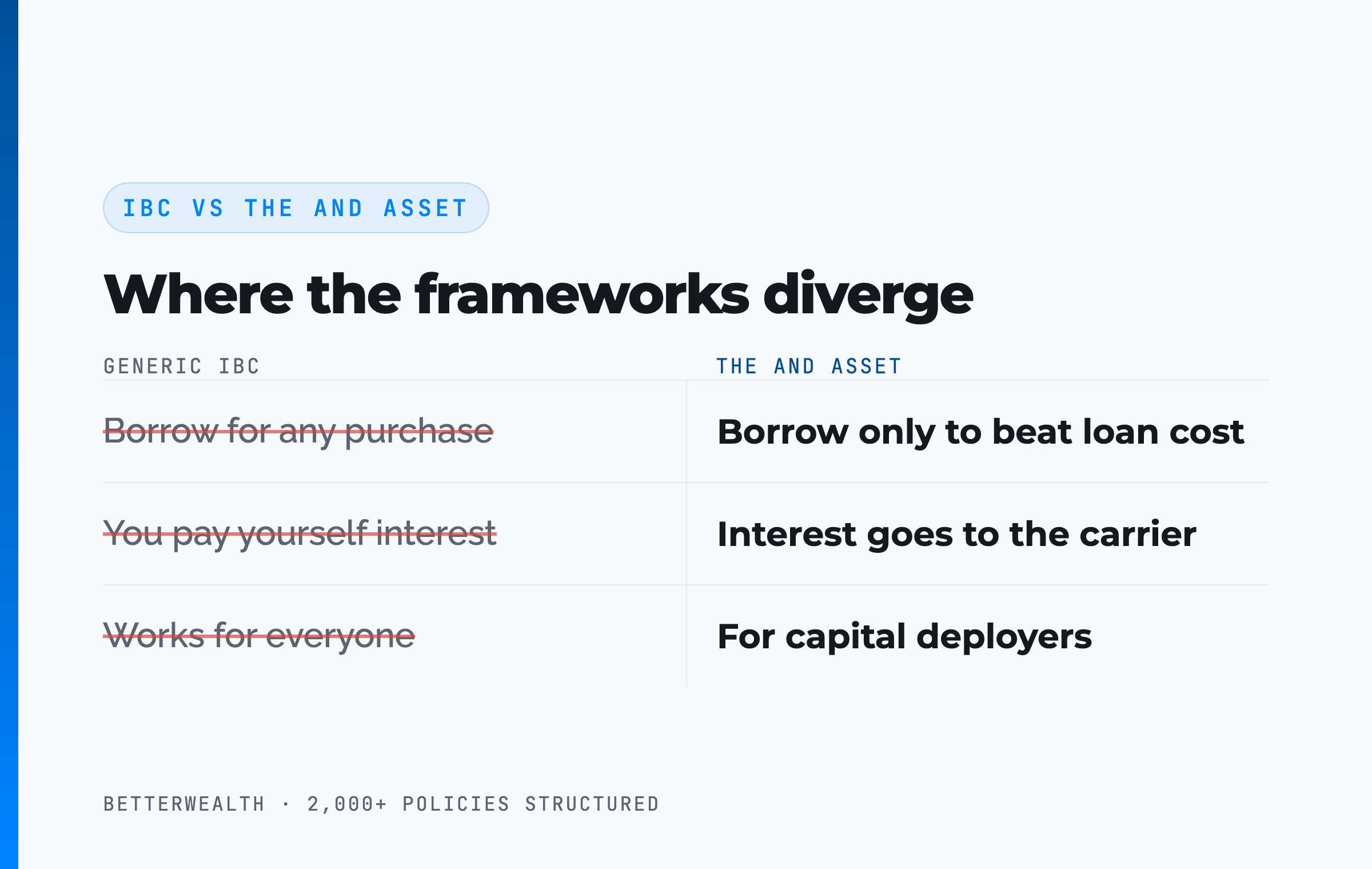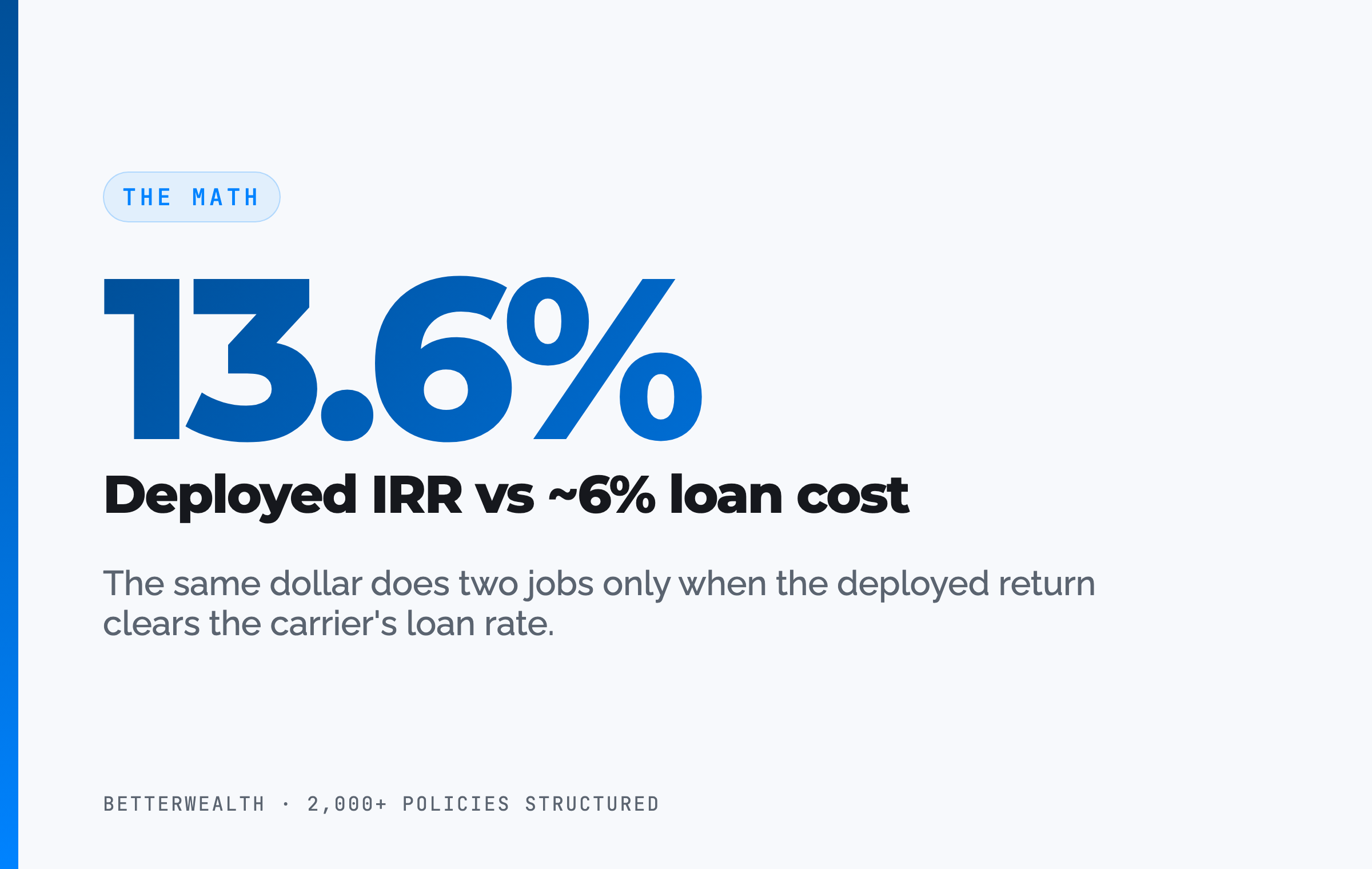

Using infinite banking while buying investments, I want to understand your process. I'll tell you from my perspective as an investor, the number one thing that a lot of people that look at infinite banking will say, yeah, but look at these first few years in whole life insurance. It's a net cost. Why wouldn't I just invest my money? Okay, well, that's cool. I'm glad you got the offense figured out. But what about the defense? And more importantly, it's like, how do we design this in a way that even as an investor would say, that makes sense? Let's dive into the nuts and bolts on how this thing works. Here's how I use it with real estate investing, for example. Well, let's just say that I have $50,000 for a down payment. Let's just assume that maybe my cash in cash is only 4%. So that means I'm only earning $200 a month. As we mentioned before, if this was at 6% that we're borrowing, we've got $3,000. Well, guess what? I'm only earning. So I show people, of course, if I borrow that 50,000 from the policy right here, I have not cashed out. So let's just assume that my policy have 100,000. Well, if I borrow from it and 100,000 is still... earning tax-free dividends. It's compounding interest. But here, this loan that I got that I was able to invest here is at simple interest. As long as I, a lot of times people are worried, they're like, yeah, but I'm paying principal and interest. Well, some companies will say, when you pay back the loan, you pay only to principal. So in some ways you can actually pay it down faster than a traditional loan. You write off the interest off your taxes. Not with all my investments. It has to be something that I don't. get excited about something like this. I made that mistake in 2006, 2007, and that didn't go so great. A question that you could ask yourself is if there was a once in a lifetime opportunity, would you be able to say yes to that? Chris Miles, welcome to Tennessee. Hey, thank you. You were on my show, was it almost two years ago? And we were in Hawaii, and we're just chopping it up. And you're talking about infinite banking, alternative investments. It did quite well. We got a lot of great feedback from it. What I would love to do in this, you could say part two, is really dive into how you use infinite banking or life insurance. I know we both have our opinions about how infinite bank has been used, but like how you use life insurance to invest in other alternative assets, how the process works from funding your life insurance to taking loans, to finding other deals, vetting those deals, investing in those deals, and then how the actual cash flow works when you start getting those deals, how you pay off insurance loans. And again, like for those of you that it's your first time watching this, this might not be the very first episode that you should watch. We have a ton of content that's big picture, including our first episode that we'll link down below. But one of the things that we've gotten a ton of feedback on, we're trying to honor is people want to go like the 2.0. They want to go deeper and they want they want popular guests to come back on and say show exactly how they do things. And so earlier, I don't know when this will come out, but I had Mr. Burr here and we were walking through the math. of buying cars and kind of going back and forth. It was really helpful drawing because I got to share kind of my thesis and, you know, things that I disagreed with what he said, but we both got to kind of like map what, what it looked like. And so, you know, if anyone knows me, they know I love whiteboards. And so this is like the best version of being able to do that. But before we jump in, how are you, how are you doing? What's been new since we've, since we've chopped it up? Well, let's see. We just released our book, The Work Optional Blueprint. I love it. Just came out on Amazon and everything. And we'll have the link down below if you definitely want to help support that out. Absolutely. So, yeah, I have a launch party and everything going on, too. So that's been fun that I never actually ever thought I would write a book. I mean, maybe I knew that at some point I would have to and people would ask me to. But I absolutely hate writing. I absolutely hate it. I mean, even my my college thesis that I had written, you know, I did one on college student stress, you know, for my. for my major. And I like went to all these different universities and, you know, sampled all the, all the different populations and stuff and put it all in. And I wrote out this huge thesis that ended up being a whopping 38 pages. Like that was it. And so trying to write a book that at least has some meat to it, that was hard. And fortunately with the, the, I don't know if you call it the invention of it, but with the progress of AI and everything else, I was able to take some of my content, get it there to start. Right. And then I can try to build off of that and build in the stories and everything else and the examples. And next thing I know, I have this like 200 plus page book, you know, although my wife read it in like a couple hours. That's a compliment, by the way. It is. The best compliment that I was given is someone read my book and they're like, yeah, I feel like a fourth grader could read this. And I'm like, that's exactly why people are enjoying it, because we're trying to take complicated things and making them simple. Right. That tells me if someone can read it fast, it's a good read, but it's an easy to understand, which is. A form of intelligence, by the way, is making complicated things simple. Exactly. Well, it's kind of interesting, though, with my wife. I can't remember if I shared on the last interview we did, but my wife actually was the first approved Dave Ramsey instructor in the state of Utah. And for her infinite banking, she's like, I don't get it. It doesn't make sense. Why would you buy that? That's just ridiculous. Why not just buy term and invest the rest? Right. That was her thing. Well, she went through the book and she went through it. Of course, she's she was a journalism major and things like that. And even in the military, she's a little bit journalism stuff. And she said, you know, like I did have to slow down on the infinite banking section. She's like, but I've got a whole bunch of a whole bunch of questions here. She had this whole post in that full of questions. And then one of our first questions was, why didn't you tell me about this sooner? Wow. Like, why didn't you tell like have my girls set this up when they were younger even? So we could actually have more money because I was looking for a place to put it beside the bank. This looks way better. I said, well, it's because you poo-pooed all over it. You pretty much said it was a stupid thing or you just didn't get it. She's like, yeah, but now I get it. And that was like, okay, that's a good testament to the book that at least that small section, even though it's not all about infinite banking, still that small section got her intrigued enough to say, oh, now I kind of see how this plays out. Now I've been hearing you from the office, you know, talking about this all the time. Now it makes more sense how this all works together. You're talking about how people can store money into life insurance and then how they can use it to buy other investments. Correct. What's the thesis of the book? So the thesis is how do you become work optional, right? Work optional means I hate the word retirement because so many people don't want to retire. I've tried it twice and it was the most depressing time of my life. You know, so every time it's more of having enough passive income coming in that you work because you want to, not because you have to. Like your bills are paid, but you know that now you work. you show up, it's all by choice, not because out of survival or necessity. And obviously everyone should go buy the book. If you buy the book, read it. And if you read it, review it, because that really helps authors out. If someone wasn't going to do that and they just wanted like the chat GPT cliff notes, what is the framework on 200 pages? You had to summarize it in a few sentences. Yeah. If I make it really simple, the three main categories we talk about is how to get lean, get liquid and get out. Get lean, get liquid. get out. Yeah. So get lean means be a wise steward of your money, right? It doesn't mean live on rice and beans, cut out that latte, like David Bach would say. You know, it's more about how do we be a wise steward of our money? You know, prioritize the things we're going to spend money on, but things that aren't important to us, cut that, right? And how do we free up cash flow? How do we save money on taxes? How do we pay off debt more creatively using our cash flow index method and things like that? And then, of course, we talk about get liquid. Get liquid means have cash available, have it in your possession versus. locking it away in prison, like your 401ks and IRAs where you can't touch them anyways, especially if you work for a job or a company with a 401k, you have to quit or get fired just to access that money. That's not right. Or lock your money into equity in a house that you can't pull out because the only time you can get your money is when you don't need the money. Right. But banks love lending money to people that don't need it. They hate lending money to people that actually need it. Exactly. So that's what I mean by get liquid is get that money in your possession. Don't lock it away in your possession. and then get that money out into investments that do pay you passive income, that allow you to become work-optional faster than saving for decades, hoping and praying that the market just smiles on you the right way, that you can actually have some sort of retirement down the road. I get hit up all the time with investments. I'm sure you do as well. How do you go about vetting investments? Because that is like, it sounds so great. You know, your framework's amazing until an underlying investment goes south. That's right. How do you go about vetting deals? Yeah. Best way is sadly to lose a lot of money investing. That will sell zero copies. How to lose a ton of money. That might be my next book. It's like two pages. Like don't do this. Right. No, I mean, definitely from that experience I've gained over the last, you know, 20 plus years doing real estate investing, for example. And even like I was a stock trader. I mean, don't think I was only real estate. I started out as a traditional financial advisor. I was also a stock trader, taught people how to trade stocks and options. I was all in on the stock market and Wall Street. and then went away from that to now anti-Wall Street. And the reason is because when you're looking at a deal, say like it's something that is alternative space, right? Like something in real estate. The first thing I look at is not necessarily just what the investment is, but who is doing the investment, who's in charge of it. Because I'm more, it's kind of like they talk about the horse and the jockey, right? If the investment were the horse, you're also betting on the jockey who's obviously riding that horse, the operator. And so I look at the operator first. For example, somebody had. show me today and said, hey, here's a group that does the kind of stuff. And it almost sounded like another company like TARDIS. In fact, they were some of their own clients that went and created their own company. They're like, yeah, we do lending. We do this and this, and we invest your money and all this stuff. Right. And I was like, well, that's great. But they've been around since 2020. There's no track record there. They don't even know what they're doing. It's a blindly in the blind. So when I look for operators, I look for the ones that aren't the best marketers necessarily. In fact, in many cases, the best marketers are the biggest charlatans. That's really interesting. Actually, I tend to agree with you is someone's really really good at marketing a lot of times they can they can make up for their bad behaviors in other areas because they're a good marketer. And usually that's a red flag when it comes to investing. Absolutely. Like I look for the most boring investors, like the ones that just do it day in, day out, have done probably for at least 15 years. I like to see full market cycle so that if even if they experience stress, they found a way through it. Even if they lost money in some of their deals, they learn from it so that they could be better prepared the next time. And so I look for that. I look for really experience. I look for what have they done. Are they still in the same place? I've seen people pivot from real estate to oil, for example. Well, that's great. And then one of them we reached out and says, hey, maybe you should do something with us. I said, reach back out to me in 2035 and we'll talk again. You know, like just, you know, I need you to bang your knees and be let other people be your guinea pig or you your own money be your guinea pig than my own money. And that goes even for my clients, too. You know, when they when they always say, hey, who do you use? Who do you invest with? Right. They want to know. It's like, well, I'm not going to send you to some person that's. hasn't done this before hasn't done it for very long so that's the biggest thing i do and then yes i do look at the investment is this something that's actually sustainable yeah um i i don't know if you've seen some of these lately i've seen several where people are like yeah i'm making five percent a month yeah any time someone says that i i i mean i wouldn't i wouldn't even have them on the show i feel so uncomfortable and by the way this is not investment advice not not insurance advice, not tax advice. We can say whatever we want. Right. And I want to do my best to make sure that I'm not including something that's like totally like, you know, like I will say, even if I disagree with someone, I'll be like, I want to be able to like call them out or challenge them. Yeah. Because it's so easy to like want to throw our money and things that are like 5%. You look at a compound interest calculator and that's. Yeah. That's incredible. The problem is it's just not going to work long term. Right. I mean, I don't want to be that guy because maybe there's some people that can make it work in a short period of time. But if it was that good, there'd be unlimited money going to it. And then you as your little investor would get squeezed out, I would imagine. But what is the 5%, the whole deal? Yeah, like, you know, sometimes it's like sometimes they're stock traders, right? They'll say, oh, with options trading, I can make you 5% a month, 10% a month. And they'll say it's not guaranteed. But they still say, yeah, but my track record has been great for the last couple of years. And it's almost always been like three, four years. There's usually not something really before it that's verified. And that bothers me because, like you said, you do the math. I mean, just run the math on, say, somebody start with 100 grand. Let's just say these people are so good because obviously they're paying you 5% a month. Let's just say that's 60% a year. Well, 60% a year means that assumes they make more than 60% a year. Do the math. Take 100 grand and say. 65%. Let's just say they only take a small cut. So like you run those numbers and you realize after just 20 years, these people should be on the richest billionaires list, right? I mean, there was even, I ran one was a hundred thousand and somebody had claimed they were making, you know, a hundred percent a year, like on their match to the 401k. I said, well, you're not making a true a hundred percent on your 401k match. Even when you get the a hundred percent, it's not a compounded a hundred percent. If it were, you would be a quadrillionaire in 20 years. And there's no way you're richer than Bezos because. They interview you like, what'd you do? Like the school of hard knocks guy. How'd you become a multi-quadrillionaire? I saved my 401k, right? It's like the same thing. Like, yeah, I invest in the stock market. You don't see those people because it just doesn't happen. I know because I met those guys that were the good stock traders. Long-term, maybe 20, 25% a year was what you could hope for. But they always shine on the month when they made like 30%, 50% that one month, right? And you think, oh, that's going to be every month. They extrapolate it and that doesn't work. I wrote this as just like a free thought. I was on the airplane and I just, I try to keep good notes of some ideas for future posts. And I put this, a new investor looks at potential growth rate, really understands the concept of compounding, smiley face. Intermediate investor, trying to maximize growth while reducing risk in the process. Experienced investor, primary focus on reducing risk over getting high returns. getting market returns with taking less risk is their goal they understand the power of long-term compounding as well smiley face and then and then warren buffett's two rules so investing don't lose don't lose money rule number one rule number one and then rule number two is never forget rule number one exactly so it's just a good reminder of like yeah are there better rates of return out there yes but experienced people that have been around the block is is really factoring in risk not just as a checkmark, but they're like, looking at the deal first and foremost through risk and Their goal is not necessarily to get a higher return They can get the same return or a little bit higher with also factoring in that risk adjusted like they're they're in a good they're in a good place I try to remind myself that because Even myself, I like, I'm always looking for like that. I find myself default wanting to be that intermediate investor that's like saying what I need to say, but I'm really trying to like go for the moon. And I just need to remind myself like the power of compounding over time without losing your money is a really powerful thing. Absolutely. It's so much harder. I mean, it's always that I run into people all the time where they get their first 10,000, 20,000, and then they want to go invest. And I share this with one of our 15 year olds, right? We got like eight kids. You know, almost all of them are teenagers right now, which is awesome and not awesome, depending on the time of the month, especially with all these girls. Right. But but with one of them, like she's definitely more investment, you know, more minded. And I played this this Charlie Munger clip like or really is like a 20 minute long like audio interview that they did. And in a lot of it was about don't even invest until you have at least $100,000, which is the same thing I mean, teach my clients is like so you have at least 100, $150,000, don't even worry about investing because... If you have 10,000, you say, what do I do with it? It's like, well, let's just say that you can make a good 10% off that money. You make a whopping thousand bucks a year. That's not going to move the needle, go from 10,000 to 11,000 bucks. The whole miracle of compounding interest is a joke. But if you can show up better as a value creator in your job, in your business, and you focus on that and try to drive up income while not trying to drive up your expenses, that's just so you get an extra. 5,000, 10,000, you're going to move the needle way faster, get to 100,000 faster. And then you can start to get to a point of critical mass. We start to build that up better and better. But again, so many people are like, I got money. And that's congratulations. You have money now. That's good. Keep going. You know, it's interesting. You're going back to your three rules. Yeah. What a lot of people do when they first make money is they get not liquid. Yes. I'm starting to make money. Let me lock up my money and get to where I like. where I am from the very beginning. And it's, I love talking to you because we have very similar philosophies and it's because we've learned from a lot of the same people. We've rubbed shoulders with a lot of the same people. Anything else you want to say before we start getting into the fun stuff, the case studies on how you flow money? You know, I would just say this is, you know, it is tough because there's so much out there. And the truth is that most of the stuff I see that come across my table are not really investments, they're gambles. And I think that's a big thing you have to understand is, are you an investor or are you a gambler? And investors, like you said, which is really great, the experienced investors say, how can I lessen my risk and still get great returns? But I want a return of my money first and foremost, as well as get a return on my money. Gamblers say high risk creates high returns. They believe that somehow a higher chance of losing equals a higher chance of winning. And that doesn't equate. Those two do not equal each other, right? Higher chance of losing is a higher chance of losing. If you have a higher chance of loss or risk, That means you will have a much higher chance of losing and you will lose. And that's what happens. People just think, oh, I'm just going to swing for the fences and they strike out every time. Rather than focus on how do I get base hits? How do I make sure I keep making money off my money? And you'll make way more than these people that are just out there gambling. They think they're investors. They'll claim they're investors. They'll buy their Bitcoin. They have a good month. They have their good months, right? They think they're great investors because they have money in a stock market that goes up whether they blink or not. You know, like it just keeps going without them. Like that didn't make them brilliant. They just wrote a wave. If you can't control the return, you're not a good investor. You don't know what you're doing. You're literally just writing waves. And the problem is the last 16 years, really people that are under the age of 40 have no clue what it's like to lose money because it's been an everything bubble, especially the last five years. And so people have just been lulled away into this security, like all is well in Camelot. Why I'm here to tell you it's not all as well in Camelot. Like there's a big, big correction coming. And the people that are now gambling the most, they have no cash on hand, right? They're not liquid. They have all their money. They have it out, but they have them out in things that are high, high risk. They're going to find that there's a correction and they're going to lose a lot of money and they're going to find themselves set back years, even decades worse than what they thought they were going to be. On that note, let's dive into infinite banking, using infinite banking while buying investments. I want to understand your process. So you don't have to share your numbers, but I would love to, like, if we were. sitting on a whiteboard and being like, okay, Caleb, I want to walk you through exactly what I do or how I teach clients, how they fund life insurance policies, how they look for investments, the philosophy, the frameworks. I'll interrupt you plenty of times, but I really would love to take time to actually sketch this out. Yeah. So let me talk about conceptually, then we'll sketch it out a little bit too. First and foremost, my philosophy has changed over the years a little bit, or maybe more with the market conditions. I'm all about being liquid. Right. As I've been saying, right, having cash in your control. And so I've been having people more move their money away from the banks, you know, unbanking themselves, getting away from what could be high risk. Because every time there's a recession, it's usually the bank's fault. You know, it's always some financial institution that's collapsing or something's going wrong that creates some sort of recession. And I feel like that's the same way. We keep hearing like little things like, you know, remember a couple of years ago we had Signature Bank and some of those banks start to fail. And then it's like it stopped. Nothing happened. And then just recently we had regional banks and all of a sudden talking about these. Really, they were lending out money to people that were defrauding them. You know, even like Zion's Bank, which is a huge bank, you know, regional bank and some others, too. They were like losing. They're having to write it off on their books. Do we really think that's over? Or are we just seeing just the evidence of something beginning? And so I'm not that I'm not that I'm opposed to using banks. I'll still use banks, especially for money I can get to quickly. But this is where I'm using my life insurance even more because I can store my money. It's safe. It's guaranteed. It's going to make more than I'm going to make in the bank. It's tax free. And in most states, protected from lawsuits and creditors, 100%. So why wouldn't I have more of my money there? So I'm starting to change my view of, hey, let's get at least a good baseline inside of there that I'm not always using to flush money in and out. Whether you're trying to use it for, you know, use it for debt purposes or use it for investing. I actually want to build that up more. I'll even use the first few years where I'm just using my emergency fund to fund it those first few years rather than just trying to dump cash in or something like that. Like some people will teach like, yeah, throw all your money in. No, let's do it in a wise way that minimize the costs and everything in the drag on policy and let it. grow faster. But then by the time I am getting to the point where I can invest, now it's already paying for itself. Now it's scoring by more than what I put in. Because I'll tell you from my perspective as an investor, the number one thing that I know that it's not just me, but a lot of people that look at infinite banking will say, yeah, but look at these first few years in whole life insurance. It's a net cost. Why would I just invest my money? You know, besides I've got term insurance. I don't really need it. You know, I don't even care about the death benefit. You know, even if they don't even have a family, like, I don't care, right? I'll just get rich. Okay, well, that's cool. Great. I'm glad you got the offense figured out. But what about the defense? And more importantly, is like, how do we design this in a way that even as an investor would say, that makes sense. And that's what I realized, like those two years of net cost or three years, whatever it might be for you, well, it wouldn't be great if you used your emergency fund to go in there and use that. So let's just say that your emergency fund, you know, which you have for at least six months of your expenses. If you're an entrepreneur, I would say at least 12 months. especially lately actually not even if you're an entrepreneur if you're somebody has a high salary like middle level you know management type position we've had a lot of people in the tech space of our clients laid off get laid off and they've been laid off for 6-12 months at least and no opportunities in sight and and the difference between 12-month emergency versus like a six months could be massive when it comes to the job opportunity you get because if someone has no money, they're going to be forced to take the next newest gig. They need to say yes to that. If you're able to if you're able to be a little bit more selective that that zero percent that you're making on your emergency fund could get you a way larger greater rate of return because it just allows you to be a little bit more patient. It's a volatility buffer in life. But yeah, I so you're saying six months to a year. And personally, do you even have more than a year? Oh, yeah, personally, I do. OK, sure. Yeah, it's. What do you what do you think if you had to like just if you had to be like, guys, just trust me, according to Chris Miles, like as an entrepreneur, how much how much volatility or emergency fund would you recommend someone if they wanted to like just create an optimal for their wealth? Because obviously there's an opportunity cost of 20 years of emergency fund. Like there's an opportunity cost of that not earning. Yeah. What do you think is like the ideal scenario if you had to like if you could snap your fingers as a business owner? Yeah, as a business owner. I would say a minimum at least two months of operating expenses in your business. Okay. And then 12 months at home of personal expenses. So if your expenses are, say, $10,000 a month, you want to have at least $120,000 a month at home. And if you say that maybe your expenses in the business are $40,000 a month, you want at least $80,000 to $100,000 in the business. Don't let it drop below that. Okay. And then do you recommend anything more if someone's got more? Oh, for sure. What do you think is an ideal? Like, what would... What would you say you are shooting for? For me personally? Like personally at home, we actually aim for 400,000 that we have as like the baseline. Okay. And it's really based on more comfort than just a calculation. In that case, there's emotional reason too. More for my wife than it is for me. But that's kind of like the number we agreed upon. Yeah. And so for me, I mean, that would cover well more than a year of expenses and everything else. However, I'm even building more beyond that because. I'm also doing like what Warren Buffett's been doing. Which Warren Buffett now has 30% of all of his Berkshire Hathaway money sitting in cash. Interesting. Wow. You know, which we'll have to talk about another point of how he's using life insurance companies for that, too. But, yeah, he's got he's got really 344, 347 billion sitting in cash right now. Never in history of Berkshire Hathaway have they had that much cash. But again, he's looking at saying, no, we've got to have the cash available. He was cashing out his Apple stocks in the last two years. Bank of America, all the stuff that people are saying. go buy more of this. He's been selling, right? And that's the thing, because people will look at Warren Buffett and say, oh, you're an idiot. Like you're just old. You're antiquated with today's world, especially with the digital assets and AI. You just don't get it, right? But understand he's an investor. I guarantee he studied that probably more than most people would say you don't get it. And he's even saying, hey, with all the valuation in the stock market right now, it's ridiculous. It's about an all-time high based on the PE values that. price to earnings, right? If it takes you over 25 years to make back your money inside of a company, that's not a good thing, you know, to say, oh, I'm going to make my investment back in 25 years. That's horrible. But that's exactly what Wall Street's doing right now. And so he's pulling, he's been cashing his chips for the last few years, building that cash more and more. Then he's been leveraging life insurance companies that's, you know, doing float to use that money to then go and invest to buy new companies. So he's not even touching his cash. He's been using insurance companies that he has ownership in. using the money they have sitting on the sidelines because insurance companies will keep money. They call it float, which is the money they have for insurance claims. They're just sitting there. Well, he has access because he has ownership in those companies to literally borrow at 0%. He's essentially doing infinite banking using life insurance companies, the money is sitting there and using that money he bought into an energy company here recently, just back in October. So when you think about that, you're like, dude, the guy is even doing his own version of infinite banking. Next level. Yeah. Instead of his own policies, he's using the insurance company's balance sheet. Yeah. He just has actually the entire insurance company. We're like, we've got our little cash, but he's got his little store in the billions, right? Yeah. And that's the cool thing is that, you know, he is storing up cash. He's getting ready. And I'm kind of doing the same thing. I've still been investing into things like in the real estate category. I just did an investment a few weeks ago. However. I'm also building up cash on the side to get it bigger because I do see opportunity coming. I think if you're a question that you could ask yourself is if there was a once in a lifetime opportunity. Yeah. Because there will be a few in our lifetime that are just like this is a life like once in an opportunity to take advantage. Would you be able to say yes to that? Right. Unfortunately, so many people wouldn't be able to say absolutely. And if you're wondering, is this a once in a lifetime? It's probably not. But it's like if there is that. Heck yes, whether it's in your business or just outside of your business, would you be able to say yes to that? And what I hear you saying is whether it's Warren Buffett that has billions of dollars that he's getting ready or whether you're someone who's just stacking chips off to the side. That's a good frame of reference. It's like long term, 30, 40 years, you don't want your money earning nothing. But over a period of time, even 10 years, creating that one decision could be a game changer. but a lot of times you won't be able to say yes because your money's tied up with everybody else because a lot of times if it's a amazing opportunity that means a lot of people are unable to say yes meaning there's there's bad things happening in the market another way to say this is when the market is down and everyone's panicking and and freaking out usually that's the best time to buy opportunity you know that's right that's what that's what buffett did you know with bank of america ironically enough he literally was the one that bailed them out rather than the government bailing them out and so he bought it for dirt cheap was able of course it was it was able to come back and he made lots of money off of it, but now he's cashing his chips, waiting for the next opportunity. It's interesting. And I just saw this stat recently at a conference I was at, where right now the average portfolio manager only has about 1% sitting in cash in their portfolio. And a lot of actual, really the beginning investors, same thing. I mean, how many times have we heard over the years, hey, we can't just have it sitting in cash because we're going to lose to inflation or we can make money or I should go buy Bitcoin. I got to do something with my money. That's the problems that when you're not experienced, you just feel like you have to do something. You have the scarcity of time, scarcity of opportunity. The truth is, is that there's going to be an abundance of opportunity when nobody thinks there's opportunity because they're going to be losing money. Yep. New entrepreneurs, I see that all the time. They start making money for the first time, good money, and they feel like it's burning a hole in their pocket. And they, you know, they read Rich Dad, Poor Dad, and they're like, I get it. I need to go buy assets. And then they just deploy all their money into it. assets and five years later they're broke and they're doing they're trying to do all the right things but they're they're not doing their due diligence putting their money in a bunch of things some things work out some things don't but they end up sometimes their businesses end up suffering because their businesses don't They're not on this like exponential curve and then their business needs help. But then they have no liquidity. So they can't even bail out the thing, the engine that got the money in the first place. It's crazy to me. I see it all the time. And yeah. Yeah. You can't act like everything's going to be fine and that everything's always going to be this way. Right. If you have this great, you know, great months or years in your company, you got to pretend like, hey, this might come to an end at some point or this might change in some sort of way. I need to take some chips off the table. And this is where I view infinite, you know, the infinite banking using really life insurance for that way. It's like a great war chest to build it up. Right. You know, it's great for my emergency fund because at least now I'm not earning point nothing percent at the bank and getting taxed on point nothing percent. I'm earning much, much higher interest. Right. I'm right around six percent tax free. Talk to me about the six percent tax free. Yeah. The dividends. But OK, so walk through that because I I want to better understand how you teach that. because I also believe that life insurance, when you factor in all the other benefits, can get you those type of rates of return. But the actual rate of return, I see more like four or four and a half percent. Exactly. Yeah, you gotta be careful. I mean, because there's really the upfront costs. Once you get past the upfront costs, usually you see at least a five to 6%, even when the gross dividend is 6%, because there's insurance costs coming out. But it's usually not a whole lot different is what I've noticed. But it's those first few years that throws the numbers off. the rest of your life you know that initial investment and so i always tell people like listen like if i have to invest a little bit up front to get a much better return down the road and i know i'm going to get this tax haven that is protected that's going to allow me to make sure i always have that money you know and i would say even safer than the bank especially safer than fdic which hardly has any reserves anyways right i mean that's that's worth the price you know But if once it's in there, the cash is in there and you got past those initial costs, yeah, it's going to earn nearly what the dividend rate is even after those insurance costs come out. And that's that's one thing that I explain to people all the time is like, you know, even if it were, say, 5 percent, you factor in your tax rate. That's still like earning at least 7 or 8 percent, which, by the way, is pretty close to what the market usually averages as a real rate of return to S&P. You know, and but you get tax on that because there are no tax advantages in the stock market. Not naturally. You have to use. Roth IRAs to finally get a tax benefit. You know, IRAs and 401ks, I don't count them because you just get taxed down the road anyways. Yeah, they're postponing. I'm sure our YouTube producer, Joel, is not going to like that I'm going to say this, but we are working on a one sheet right now that actually can factor in internal rate of return. And then we factor in all kinds of things like taxes, fees, creditor protection, chronic illness rider, the death benefit and all, and factor an equivalent rate of return. And if you want to see your own numbers, we'll have some type of link down below where you can get a time with our team to actually see what that looks like. Because I'm telling you, if you're an entrepreneurial investor, really, really powerful to at least understand how this works. And very excited to, like, we've been working on this because I do believe it's really, really valuable to help people understand life insurance. Because if they understand the value of it, I find that more people want to put money into it. But if they just look at one or two values. It's like, oh, I don't know. But the more you understand about the asset, I just find the more you want to put money towards it. So with that, Chris, this has been a ton of fun. Let's dive into the nuts and bolts on how this thing works. Most people have no idea where to start or how to really evaluate whole life insurance. That's why we've built The Vault. It's all of our best life insurance resources and educational tools all in one place, all for free. We have calculators, handbooks, crash course, deep dive videos on numbers. If you want to learn more, click the link in the description or tag comment below to unlock the vault. All right, back to the video. Yeah, let's get away from just the savings part, right? And let's actually see how we use it. Yeah, let's look at how you use infinite banking to invest in assets and then how the money flows. That's a big, big question we get, and there's a lot of different ways to explain it. I'm just curious how you go about that. Yeah, so there's a We've talked about this in the last episode, so I'm not going to go into it much, but there are a lot of half-truths or even lies talked about with infinite banking. And no wonder, of course, people don't trust it as much. But when I look at it, again, it's like the offense-defense. You can have a one-two punch, you know. I do look at it as a defense that has a potential for an offense, too. And you're right, because a lot of people say, well, why don't I just invest my money? Because the return, they only look at the one return, the life insurance. And you're right. And I love that's where you talk about the and concept. because it's not just. whole life insurance by itself is if you just look at it by itself you're like okay it's cool and yeah there's a great benefit of the cash flow side that could rival almost any plan you do even in the stock market with but you can do it with less risk right It's not just about how much you accumulate in there. It's how much you're able to access as income without the worry of not having that income, you know. But here's how I use it with real estate investing, for example, or whatnot. And when I talk about real estate investing, I'm not just talking about buying that rental in your backyard. You know, that there's something in your town that's a piece of junk, you know, where it's way overpriced. I'm talking about like in real estate investing could be a number of things beyond just doing rentals, which, by the way, when I buy a rental, I get a property manager because I don't want to deal with it. I've got one here in Memphis I've never seen before, but I've had it for eight years. One of these days I might see it. You know, maybe I won't. Yeah. Right. You got to swing by at some point. But, you know, but I also do lending, you know, whether I lend on a specific property or I lend into a lending fund that will pay me as a contractual type of return, whether it be 10, 11, 12 percent or more. And that's per year. I'll do things with raw land. I've had a business partnership with that still going. I have things with oil and gas. You know, you get paid for mineral rights. I've got I know I'm missing a whole bunch, you know, yeah, apartment buildings, you know, things like that. Although the last three years have sucked with apartments, you know, but, you know, they are making a comeback right now because now they've already had their dip where a lot of things haven't had their dip in the last while. So anyways, that's what I'm talking about here. So let's just take an example of, you know, I just put my money to a lending fund recently. It contractually pays me 1% a month or 12% a year. Now, if I have, and actually this is exactly what it is. I just put in. 50,000 with them. Now that 50,000 will kick off $500 a month. Now, most time, of course, people talk about using life insurance. It's like, cool, I use that money. And they talk about paying yourself back, which we know is not exactly true, right? We are literally being charged interest. The nice thing is when I borrow from it, it's not like I have to pay the interest payment, right? Unlike a home equity line of credit, I do. I talked to somebody today about Velocity Banking? You know, and they've been using that strategy. I said, wow, the last few years must have kind of been horrible for you. Yeah, hasn't been great. They haven't made the spread. And lots of people I hear when you talk about infinite banking think, oh, it's the same thing, right? Because if they charge you, say, 5% for the loan, but I make 10%, then I make a 5% spread. Like, you might make more. And here's why, right? So I show people, of course, if I borrow that $50,000 from the policy right here, right? That's the funds I get. I have not cashed out. So let's just assume that in my other. my policy have a hundred thousand. Well, if I borrow from it and everybody who's been on this channel, I know you already know this, listen to Caleb, the a hundred thousand still earning tax-free dividends, right? It's compounding interest. But here, this loan that I got, that I was able to invest here is at simple interest. As long as I pay towards it. If I don't, then it compounds against me. And what interest rate is that at? For the loan on the, yeah. Let's just say that here it's, I'll even put it high. I'll put it at 6%. Okay. Right. I know some are higher, some are lower. So let's just say it's at 6%. Now, of course, I'm taking that $500 a month. I'm going to apply it back to that $50,000 line of credit. Now, we did that, and I'm sure you already calculated the numbers as we speak. $50,000 is the interest for the year. Exactly. So, yes, let's look at year one, right? So we had $3,000, but we had... 6,000 in payments, bringing that down to 47,000, that loan balance. Now that means that 47,000 is at 6%, right? Whoa, hello. There we go. 6%. There, I squeezed it in. So it's at 6%. So that means obviously we're paying less because now that 6% on that 4,700 is going to be somewhere in the ballpark of around, I don't know. know, $2,800. Now you're contributing the full $6,000 back to your policy. Correct. $3,000 is going to the interest and $3,000 is going to pay back. Exactly. And depending on the insurance company, the cool thing is, is that a lot of times people are worried. They're like, yeah, but I'm paying principal and interest. Well, some companies will say when you pay back the loan, you pay only to principal. I mean, they'll calculate the interest throughout the year, but you're paying to principal first. So in some ways you can actually pay it down faster than a traditional loan. Do you do you take a do you write off? the interest off your taxes? Not with all my investments. It has to be something that legitimately is a write-off. So if you did it for business purposes, yes, then you could. I actually had somebody who was trying to tell me like, no, you can't. I talked to the CPA. He quoted this tax code and said, you can't do that. I said, well, and I asked my CPA, I said, is this true? Because if so, I'm really mad because we've been telling everybody we could write off interest. I've been writing off interest on things that were used for business purposes. He said, of course it's allowed. Here's the code for it. You know, he's like the code they were quoting was one. If you only use it, not just a personal insurance policy, but you're using it for personal purposes. Right. Yes. You can't write it off because you're already getting the tax benefits. Right. So. So, yeah. So in this case here, it's just a simple fund. There are no tax benefits to it in that sense. So in that case, no, I don't write it off at all. But in this case, I really don't need to. Right. And so just just to write this out on forty seven thousand forty seven thousand, if we take six percent, that's two thousand eight hundred and twenty dollars of interest for that next year. And so you're you're able to see that over time. you're able to free this up. And the other thing that I just want to mention is the at this time, you're seeing that you're like, quote unquote, you're just putting all that money back into your policy. But as you're paying that, that it's re revolving, meaning now you have access in this example of over $6,000 of capital that you can now redeploy if you wanted to. That's right. And in this example, and that's again, your due diligence, but this money that's in this fund. you could take that money out, I would imagine, almost at any time. Right. So, or it has some type of like 90-day liquidity. And so you still have $50,000 asset somewhere. And now you're, and so the goal is you're just whittling this thing down. But it's not like it's a traditional loan where it's like you don't really get any benefit of putting more money towards it. Exactly. Well, and another way to look at it is like this, you know, like. Let's just say that this one on the left is your cash and life insurance. This is your loan balance, right? Obviously, this is not going to be equal to equal here. But, you know, because some people say like, okay, you just pay $12,000 and look, you only have $6,000 and you're freed up. But most people, again, forget that the other side here, let's just say that I brought $50,000. Like I said, there's $100,000 in here. You're getting all the benefits of life insurance over there. Yeah, I'm getting the benefits of life insurance and… And let's just say, like to your point, let's just say we net 5%. Well, that next year, I now have 105. Yeah. The next year after that, because it compounds, now I'm 110 and change like 200 or something like that. Right. So, yeah, maybe my balance is 44,180. You said, oh, it's only 6,000. But yes, my total cash gained another 10,000. So as I pay 12,000 back in, I've actually got 16,000. not even adding my own premiums, right? Because people argue, well, it's just because you're paying more money in. Yeah, you're right. That's a good point. But even if you don't factor that in at all, let's just say you stop paying premiums, just let it grow. It's still, I got now, you know, $16,000 that I can invest, you know, and then use again to do the same thing like I was doing over here or whatever it might be. And so I think this is the key point. When I've run the numbers in as much as the investment does earn. I'd say better than the interest rate that you're paying on the loan. I think it makes sense. And I would even say significantly more. So if I'm paying at 6%, I would want at least 7% or 8% return to create that spread to keep the money from compounding against me. Right. Where I see it being a problem, you know, erase all this. Or you could just scroll down if you wanted. Oh, there we go. Look at that. Work smart, not hard, you know. I know. I'm used to the old school, like you just got to erase everything on a whiteboard, right? But so like I do know some people out there that talk about using this for rental properties. Now, if you would have said this five years ago, yeah, I mean, that property in Memphis, I put $32,000 down, but my profit on that was about over $300 a month, right? So it was almost like a 1% return per month or a 12% per year cash on cash. Now it's like $800 a month net profit, which is awesome, right? But the problem I see is a lot of people say, Oh, yeah, you should do on properties. Well, let's just say that I had the same $50,000, right, for a down payment. So I'm buying like a $250,000 property. But let's just assume that maybe my cash on cash is only 4%. So that means I'm only earning $200 a month on this or $2,400 a year. Oops, that's supposed to be per month. Well, as we mentioned before, if this was at 6% that we're borrowing. you know, we've got $3,000. Well, guess what? I'm only earning 2,400. And, and, and I, and I even know a guy that he's not even an insurance guy. Like he's literally like he does loans. He's like, this is the best thing ever because there's appreciation. Right. And, and I've been saying for a few years now, I was like, I would not bank on appreciation with properties right now at all. I mean, you might get a little. But short term, it's not a great strategy. It's like, hey, I'm losing money every single month for the hope to to exit. It's like, if you're going to do that, why not just invest in private equity? And right. The ones that, you know, because it's not like you're going to make. million times x your money it's just like that's just so it's just like yeah i would not i i don't get excited about something like this but oh no but yeah this you could even make this work make sense on paper if the if the house in itself appreciated right i mean if it appreciates great but i made that mistake in 2006 2007 and 8 and that didn't go so great you mean houses don't go up every single year. It's weird. Yeah. I mean, they usually do. Yeah. But especially right now with the affordability crisis that's going on, I really, there's always pockets in the country that could be the exception. But I think the vast majority of places you look, you won't see the prices going up. And so that, I believe that always thinking you're always going to have appreciation is a big, big gamble, a big risk take. Not to mention, like, say you're getting $2,400. You're like, oh, that's great. I'm making that per year. Yeah, but what if you have maintenance issues? Exactly. Well, and then on the other side. Your loan is actually compounding. It is. That's right. And so when people say like, well, where does it not make sense? Or it sounds too good to be true. Well, there are situations where it would not be too good to be true. It is if you use it the right way. It seems too good to be true, but it's actually just, it makes sense. But here it doesn't. This is why also I don't go and borrow from my policy to go buy a car because I literally just got a car loan at 3.7%. If I can get the money from the bank, their money, not mine. Why not use that? Because That's the thing that drives me nuts about a lot of the traditional infinite bankers. They try to say, oh, no, it's better. Like you buy all your cars, buy all your houses using this policy. And I know you've had people on the show say the same thing. But you're like, yeah, but I got to call bull on that. I'm always paying interest to these guys, an insurance company or a bank otherwise. Why would I just go with the insurance company other than maybe a peace of mind knowing I don't have to make a payment? That makes sense. But when I know that I can get a better interest rate or even a similar interest rate using the bank's money versus my own money. I'm going to do that all day long. And then the cash I have in my policy, I can then use for things like this that actually do make sense. So let me ask this. So let's say you're borrowing at 6% and you can get an 8% loan. Yeah. It's like solid. The devil's advocate in me would say, well, I still would. If I am going to deploy capital into the 8% investment, yes, on paper, it makes sense. But I value liquidity. and control more than that delta. And so for someone like me, I'm still going to say no, not because the math doesn't work, but because I would rather go for something higher. Yeah. And I'm okay for going that money that I could be earning. Yeah. It goes back to what we said earlier about the power of being liquid. That's right. But everyone's got a different value of what that is. How do you help people measure that? For me, let's say it's 15%, meaning like I really don't have any interest deploying capital if I can't make 15%. I was given a deal that was pretty much bulletproof, someone I knew, but it was a 12% rate of return. And I know some people watching this would be like, man, 12%, I'm not going to say it's risk-free, but it was pretty much risk-free. The reason I wasn't interested in it, I just explained to them like I don't really personally, personally, I'm talking about myself, don't want to deploy capital, tie up money. at 12% when I could be earning a lot more in other areas. And they understood that. They thought I was like, oh man, that's tough. But I was just like, you know, this is going to be a year lockup, which is not that long, but I always assume the worst. I'm like, you're saying a year, I'm assuming three. And it's like, you know, would I be frustrated if I locked up $100,000 at 12%? Many people would take that in a heartbeat. For me, I would actually rather keep my money in a life insurance policy. earning a lot less, but it's there, but I have liquidity. And like that power of liquidity is allowing me to potentially make moves. Yeah, exactly. I mean, how do you determine what people, how would people determine what they say yes to and what they say no to? It always comes back to this every time. And this is why it's an individual thing is yours might be 15%, but it's always about stewardship. Like what could you be doing with that money? Right. Or what other opportunities do you have? Yeah. like you said some people say i wish i could get 12 a year right and that's totally true for some people for a lot of people really i would say most americans would say i'll take eight yeah you know i'll take eight percent and and they're totally valid and right because what they would do with that money if they were trying to do higher returns they might probably find the gambles not the real returning ones and lose money right it's kind of like like whether somebody should pay off their house like for the most part i think you get lower straight on a house why pay it off early Yeah. But. If someone's an unwise steward of their money. Yeah. Locking up your money in your home could be one of the best things. Yeah. Get it out of your hands because you're a horrible steward, right? Yeah. You know, it might hurt, but you know that's the case. And some people will even justify the 401k because they're like, no, I know I can't get to it. Now, does that do them any good in the financial crisis? No, not really. I mean, sometimes you're your greatest liability, though. And so many people, if you're going to gamble or if you're going to spend that money, lock it up. Yeah. I mean, Ted, Ted Benna, I've had him on my show a couple of times. He said his favorite feature of the 401k is it makes it hard to access your money. Right. And I laughed inside because I was like, I see that as a negative. Yeah. And yet that's such a positive for so many people. And they're not watching this because if you're like watching this lame conversation with us. You're you're you're not like everybody else that you're just like, yeah, like most of America would find this very boring. People that are watching this really want to go deep. And they're there. We don't have to necessarily worry about them, you know, blowing money on, you know, something shiny or like going on a trip or something. Most of our followers are people that like we're like Dave Ramsey poster children that say, I want more than that. And I actually admire Dave Ramsey a ton because he's building people that. are thinking long term. And it's like the idea of paying cash for things like you have to create discipline. Yeah. Oh, absolutely. I mean, that's if there's anything good about what he teaches, it's usually the first few baby steps, you know, ignore the later ones. And they talk about how to create wealth. But those first ones. Yeah. He's incredible about that. And I think that's why. Yeah, you're right. If you're watching this episode right now, you're not doing this because you're saying, man, I'm the worst spender in the world. I'm going to blow it. You're probably saying, I want to learn how to become a better steward of my money. I want to learn how to maximize. So let me draw some things out and ask you some questions. You bet. So if you have, all right, here we go. So if you're making money, okay, you can save it or you can consume it. So obviously, if we're working with people, obviously, you want to be clear. what you're doing obviously making money is really important but once you have money it's only able to do two things and obviously we're talking about you know saving money and what I kind of do is I build like you have like an emergency an opportunity an emergency we were talking it could be six months it could be two years yeah personally call me crazy I feel really good with two years yeah just like if I have this two years of emergency And everything up above this, I can very much think of like, okay, where am I going to deploy this capital? Yeah. As an entrepreneur, I have the opportunity cost to deploy in my businesses, alternative investments, which I get pitched all the time, which I love. That's why I'm actually having more people that are talking about other investments on this channel, not to give investment advice, but just to show people that there's opportunities out there. Yeah. Just to open their eyes. And then, you know, those are the main two. Dollar cost average into Bitcoin and crypto, but we won't even include that so and so for me I have you talked about stewardship the things that I'm looking at when I'm looking to deploy money is I'm looking at the value the value of Being liquid so I have that and I don't this is where it's like. I don't know what that number is I just it's more of an in intuition of like 15% but I don't I would love to hear your thoughts and like how I actually can get to this number Because I'm sure there's a framework. Yeah, and then and then for me, I'm also I'm over here I'm thinking risk and risk of getting my money back. I liked what you said about it's it's the return of Money not just on your money Yeah, I like like I want to make sure I get my money and then obviously I want to make something in addition But like the the rule of thumb is if I'm going to deploy capital, I'm looking at two things. I'm looking at control cost, which my control cost is the cost of controlling money. So in your example, it's 6%. So this is like the actual cost. And so I need to make sure if I'm going to pay 6% to control capital, I need to make sure that the opportunity over here is much greater than 6%. Absolutely. And so for me, maybe at a minimum, it's 8%. And this makes sense on paper. But for me, my buy box is going to be I don't want to go through the work vetting and all if I don't think there can be an opportunity for me to make 15. Sure. 15 percent. Yeah. Which might mean I just stack cash and invest in businesses that I really understand. Right. And maybe the market's not going to perform super well. And so I need to lower my expectations. But that's that works for me. Talk to me about like how what am I. Yeah. Talk to me about this and your thoughts around like. Is there questions that you would ask me, things that you would challenge me on? How can we go about helping people build their own framework on figuring out how much they should save up for an emergency? What should be their stewardship opportunity cost number? I would love in real time to actually figure out how we come up with this opportunity cost number, if you think we could come up with that. And then how you factor in risk, because you have to always factor in risk. Anything that's not guaranteed, like insurance, you're going to factor in risk. And so you have to factor that in. Yeah, for sure. If you're a high income earner or own a successful business, you're already creating real value in the world. The real question is, are you keeping that money, protecting it, and growing it the way that actually supports your long term goals? At Better Wealth, we help people like you better keep, protect, and grow their wealth through various tax strategies, estate planning, specially designed life insurance, retirement planning, and even a fractional family office service. If you're interested in one or more of the areas we can serve and want to learn more, the next step is to book a free clarity call with us. Click the link in the description or tag comment below to get started. Back to the video. Yeah, so framework-wise, I mean, even when you said like when it comes to like your intuition. Yeah. That's one thing I actually do take very seriously because I believe there is a spiritual component there that sometimes we feel or sense things that maybe our logical minds or even just the logical world. Well, sometimes the world's logical, but in that world that you can see doesn't make sense. You know, I used to teach that to people and I used to teach people how to trade stocks and options. Right. I would say I was like. investing 101 is, you look at the charts, you make sure the fundamentals are good and they're in your watch list of the stocks that you're going to watch. And then based on the technicals, based on what the little ups and downs are doing, you're going to know when to buy. But I said, here's the 202 part is, if all of a sudden you feel like something doesn't feel right, even though it says buy, something feels off, don't do it. I would say like when in doubt, stay out. Also on the flip side, maybe you're thinking there's nothing wrong with this. but I feel like I should sell. That also should be taken seriously. You know, I did that with some rental properties where, you know, even though, you know, it was doing great, it was making lots of money, it was just got that feeling. It's like, you know what, let's just get out of them. You know, and that was right around the time that things were selling pretty well. It wasn't just maybe several months later, the market got harder. You know, it's more of a buyer's market than a seller's market at that point. You know, so, you know, I've noticed that intuition is important. So if you say two years, there might be a reason. It might very well be that you need two years and there might be an instance where you'll realize you need those two years. Yeah. Or maybe that two years ends up being because you can take care of your family, but then maybe some opportunity does come up. You said, man, my opportunity fund's already gone. It's already invested in business investments, wherever it might be, but I need more. Yeah. You know, or I need more cash because the bank's going to come in with money, but I'm going to need to show more assets or more liquidity. So then they'll give me that loan. And that's the thing is it's hard because that's. It's a it's not like a hard, firm, logical framework. But from my experience, it's taught me that that's the thing that's difference between successful and unsuccessful people. Right. And it's the same reason why Warren Buffett, you know, he says no to almost everything because he has it has to feel right. You know, you know, if you kind of mentioned this earlier, right, if it's not a heck, yeah, don't do it. You know, in business, in life with a lot of things and so many of us, because we think there's a scarcity of opportunity, scarcity of time, scarcity of money. We say yes to things that we know we shouldn't. Yeah, that's why I'm trying to bring on more people is I want people to know that there's abundance of options out there. That's right. The downfall of that is, you know, people will watch one episode and be like, oh, this is it. You're like, no, please don't. But I, you know, I can't again, I've I've done the whole cycle of like, I can't control what people do and I need to do my very best to share, share the good, the bad, the ugly, try to be as honest as possible. and People will do what they want to do. So, yeah. What is. OK, so another thing that I mentioned that I saw in what you are drawing up here is the money that you're putting back. All of it's going towards the policy. Yeah. Until the policy is paid off. I like that because it's again, you're ensuring that your return of money is first and foremost. Yes. After you get that, let's say you pay off the loan and now you're cash flowing in this example, five hundred dollars a month. Yeah. What does Chris do with that money? Do you increase your lifestyle? Do you start a new life insurance policy? Do you divvy it up to say, hey, we're going to increase. Like, how do you, your policy's already, your policy loan's already paid off. Yeah. And now it's kicking off cash flow. Yeah. And you also have that underlying still 50 grand in the deal. So now you have your 50 grand in the deal. It's kicking off cash flow. Yeah. How do you go about the first world problem of where you put their money? Yeah, I see it the same as if somebody was just taking that money and putting it into savings, right? The reason why we do that strategy is because we know we can build a little bit more interest. By doing that, right, by paying simple interest while we're compounding interest, we can pick up some extra interest dollars along the way to then help us speed up the process. Because what most people, the people that would be critics of using this method would say, well, why go through all that problem? I just use a savings account, take that 500 a month, put in my savings and build it back up. But if you do the math, you look at the interest on it, even if it's a money market account making 1%, you know, yay. Even if you do that math, you say, well, yeah, but over. several years, it really doesn't add that much interest. And that's what people don't realize. They think, oh, it's growing a lot. No, it's really not. It's really not doing much, at least with those kind of small numbers. It looks better with bigger ones, right? And so when I use that policy, yeah, I might get to the point where it's paid off. Well, it's no different because then the question is, is am I going to use the loan again? Am I going to, you know, am I going to get another policy? I may or may not. I might just cycle the money through and just keep doing it again and again. I might get another policy. I mean, I will buy convertible terms sometimes just to get a bigger death benefit for my family's protection and then also have the option to convert later on without having to requalify my health. But again, money's always moving, right? It's always in motion that way. However, it's circumstantial too. It depends on where you are and what's going on in the marketplace, right? Because just like I said, like before it made sense even a few years ago, I just keep cycling that money through my policy. But now lately I'm thinking. now I'm going to start storing more and that like pay those loans off, you know, have less of a balance of any at all, store a lot more cash and not use it for investments. And just, you know, whatever cash I have in my bank account, get it out, you know, get that money out, get that invested and then build up all this liquid net worth inside my policy where I know I'm going to get paid better than the bank anyway, especially as the rates have come back down again. So that's, that's based on market. But if things switch again, maybe. Bank savings start paying more. Maybe I do something different. Maybe high yield savings count more. Maybe I use my life insurance. It's always dependent upon the market. So I wish there was like an easy answer, but the easy answer just comes back to what's the best use of my money right now? And for some people, I get clients that they are building up their cashflow. They're going to get to a point and they're saying, well, now I'm going to switch from really the hustle mode and accumulation of assets and trying to build up that cashflow to the point they say, now I have enough IM work optional. Do I keep working or do I not? Because if they keep working, they probably want to get more policies to be able to do more, especially have all this passive income coming in, too. Now they got their money they're already saving plus passive income. Now they're going to need more policies and that's inevitably going to happen. Right. But on the flip side, if they all of a sudden say, all right, I'm going to stop my job now. Now I don't have that income coming in. Now I'm going to live off that income. Well, now we're not going to get more policies because now we're live off the income. So it's it's always situational, but it always comes back to. All right, where are you right now? And do you need that money? Do you not? Do you grow in a story? Are you in the accumulation phase? Are you in the phase of distribution, right? Where you're starting to live off that money? Yeah, I love it, man. What other questions should I ask you? I feel like this is a good, this is a lot fun to draw out kind of how you view your life insurance and how you invest. Yeah, well, let's talk about my framework of how I get people work optional. Let's do it. Let's do it. Yeah. So yeah, there's five phases we take people through. And of course, I'm going to butcher like what the names of these phases, because I always forget, right? For me, it's just like in my head, but people are like, you should name it something. Like, okay, cool. So the first phase right here is really we're capturing money. We're finding the low hanging fruit, right? So like even when we take people through our coaching process outside of life insurance, right? Outside that when we're getting bigger now, like this is like the overall financial freedom plan. You know, we try to figure out like, where do we capture it? You know, this is where we start addressing cashflow. You know, do you have cashflow leaks? Do we have assets sitting there that aren't doing anything? I'll give you an example. We were looking at one client. They hired us because they said, we got $5 million, mostly in meta and Google. So in some of the big tech companies, $5 million in those stocks. They said, we should probably be more diversified. So we want to diversify some into real estate. And so you think that would be easy. It's like, great, let's look at your $5 million. Where can we put that money? But instead we said, well, let's look at your cash flow first. And so we analyzed everything from their income and expenses, their balance sheet to see where everything is. And we started to look at it. We realized, hey, do you know, without spending any of your money yet, we could actually refinance your mortgage, consolidate some of these loans, even though they were making hundreds, like four or five hundred thousand a year. You saw different loans are like, oh, who cares? We got to make thirty thousand plus a month. Right. So we're good. Well, I said, well, what if we refinance your home, pay off some of these loans? We'll actually free up thirty eight hundred dollars a month. And it wasn't just they had a high interest rate, nothing like that. It was just because the loan was so old, we could just refinance, get a very low rate at that time. It was a few years ago before the rates went back up again. And so I was like, let's just do that. So we freed up $3,800 a month. That's $45,000 a year without a dime out of their pocket. And then we looked at taxes. We said, you know, we should probably have you talk to our CPA because it looks like you might be paying a little bit too much on your taxes compared to your income. That was confirmed. The CPA said we can save you over $30,000 a year. So even before you even started doing anything with the investing, which is what they wanted, I said, let's address what you need, right? Which is let's free up the cash flow. And it's also reducing their expenses, right? It's really when it comes down to it, like you have income, right, that you want, and then you have expenses. The ideal is you get that passive income up over that number, right? But if you're lowering expenses- But if you lower expenses down here, well, that makes it easier and easier, right? It's like a double whammy. Yeah. So that's where he said, let's just do that. And then I saw that they had a rental property. I said, well, that's how much you making cashflow? Zero per month net. I said, oh, but you got 200,000 equity. That's a horrible return on your equity. Let's sell that property, 1031 tax-free exchange into another property. Or that one will pay you about $2,000 a month. And so already before we even got to it, it was like, oh, that's about $100,000 a year of cash flow we can improve upon, right? Then we said, great, now you can invest with the stocks or figure out what to do with that. And they decided to do some different stuff with it where really, I mean, they just took $2 million, right? $2 million earning 10% is $200,000 a year, plus the $100,000 we already freed up. That's $300,000 difference. They still have $3 million they can leave in their Google and... meta stocks that they want to leave them or not, you know? So that's like, that's kind of what we look at right from the get-go. It's like, let's analyze that. Let's see if there's something missing. Then we move into the, you know, the kind of the explore, like really like start to look, my goodness, that's the worst X in the world. There we go. Start to explore opportunities. So, because again, we're not financial, you know, investment advisors in that sense. We're not like saying, hey, you should put your money here, put it there. But I do have a lot of people to say, where do you have money with, or who would you trust? And so we always tell them like, listen, disclaimer, we're not investment advisors. We're not telling you to do any of these investments. Do your own due diligence as well. But here's some people that I've done some due diligence on that you can continue that due diligence to see if it's a good fit for you. Right. And so I have connections that way. And I don't take anything on the back end. You know, like people will say like, oh, I guess you're getting paid. No, I don't take anything on the back end because that's the easy way to lose your licenses and get sued. That's right. So we start exploring opportunities. And a lot of times what we'll do is we'll try to narrow it down because Say, for example, their goal is like I've had a couple that were younger and they said, you know, honestly, we love cash flow, but we really don't need the income because we're going to plan to keep working for a while. If this money grows and then becomes cash flow later, we're OK with that. OK, well, that's a whole nother set of investments that do that. Like oil and gas could be one of those. Or there's some things with like land and things like that working cash flow later, but might take a good four or five years to really build it up. Cool. Maybe look at those options versus cash flowing now. Where I get other people to say, I don't want cash flow from day one. Great. Well, that's some of these options over here. Let's do that. So we start exploring those options. And so we take it, you know, we kind of, you know, take it from here, like where there might be like 20 different options to like maybe three to five. Yeah, fine. Three to five. That they have there. And then they got to commit, right? This is where they take action. So once they start to explore the option, they start talking, having a conversation with people. They even ask us like, hey, you know, come on, you're not paid by them. You're paid by us. what do you think is bad? We can kind of tell them, Hey, you know, here's the honest truth in your situation. Maybe this makes sense. Maybe not, you know, don't put all your eggs here, you know, make sure you spread it out. Right. So they start to commit this. This is where like the real, you know, the passive income really begins right here. This is where we make sure we protect because as you're growing your assets, we also want to make sure we protect it. You got to have the defense going with the offense. Yeah. Life insurance is part of that too, but Do you have, you know, what about health insurance? Because one of the number one fears you have of people is saying, well, if I quit my job, how am I going to have health insurance? Not realizing that they've been brainwashed so much that they have to have a job to get health insurance. Like, no, there's plenty of options, whether it's the marketplace, there's even other like, you know, health share options, things like that. Like, you know, my family pays just over 400 bucks a month for ours because if I went on the Obamacare plan, I'm paying close to 2,000 bucks a month, you know. So, you know, I do different stuff that way. But, you know, how do we protect, you know, legally? How about have the right? corporations or entities in place, especially if you get sued or even for tax purposes when you're trying to do some of these investments and things like that. So really building that wall of protection and upgrading as you go along, right, whether you're dealing with CPAs or attorneys or whatever. And then this last one is kind of fun, which is at this point now we're kind of creating what I refer to as like an income avalanche, right? Where in this point, this is where you start to really like, you know, double down on some of the investments you really start to like and start to do more in those areas, maybe start doing others. So really, we're just reinvesting the cash flow. So your compound, instead of trying to compound interest, you try to compound income. And this is one that's the hardest for people because a lot of people are thinking like, oh, like this is like watching grass grow. It is. It really is. But this is the fun part because, you know, we're not just trying to compound your interest like some people do. They'll put away for decades and hope that it works. No, we're literally taking your income, reinvesting that, keep saving it, saving it with the money you're already saving. This is where a lot of people stop funding their 401ks, add that money with the money they're earning on their investments. And that just gets them to do it faster and faster and faster. And how fast? On average, can you get someone to replace their expenses? Depends on where they're starting from. I mean, we get a lot of people that sometimes they could take over 10 years. Like they're starting with just a few hundred thousand, but they want to have like, you know, 10, 15, 20,000 a month. And they're not saving a whole lot. It can take a lot longer. We get other people where, I mean, I talked to this one couple recently. They had, you know, about $2 million in their retirement accounts. And their whole goal was to have about, you know, 15 to 20,000 a month. So roughly 200,000 a year. They kept asking their Vanguard advisor. They're saying, okay, when can I stop? Because the oldest, I was going to say the oldest dad, the oldest husband was 59. He just turned 59 and a half. His wife's 55. He's saying, okay, when can I stop? And the Vanguard advisor's like not giving him a specific answer. There's no answer. And I had to tell both him and his wife. I said, well, the reason is, is because it's kind of depressing. Because if he were to give you the answer, because most advisors realize it's not a 4% rule anymore. It's a 3%, especially in your 60s. If you're 70, it is a 4% rule, but you have to wait until you're about 70. before that because people are living longer for that number to still work out with market ups and downs and so it's three percent well if you want to have let's say 200 000 a year pull out three percent well that means you got to have roughly about seven million dollars and you can see both him and his wife's face fall because it's depressing because he's like hey we have 1.9 million she had 600 000 her her retirement plan they're like well there's no way we're gonna It's $7 million. I said, well, that's why. The advisor probably doesn't want to tell you, keep saving, keep working. And even the guy says, you know, I don't mind working until 70. I just don't want to feel like I have to. And I told him, I said, well, here's the good news. You have $2 million in retirement accounts. If you earn 10% a year, how much is that? $200,000 a year. I'm like, you could in the next year or two, if we're trying to give you a little buffer and even go higher, next year, two or three, get you there. Now, in this example. Are they paying significant taxes and fees getting that money out of their retirement account? They could be, unless we self-direct it. And then even then, if you pull off income, of course, you're going to get taxed. But yeah, you can roll over to a self-directed IRA and then just invest in these same kind of opportunities and deals. The only ones we'd say not to, and that's why there's always a strategy and a plan involved. Because say, for example, there are some tax benefits to some of these investments, like buying a rental property has a lot of tax benefits where you don't really pay any taxes on that, at least not usually. Oil and gas can have some tax benefits too, right? So depending on where they invest, we might say, well, let's not do that from the IRA. Maybe we do cash them out. Maybe we do pay some taxes and then use that there. And if we do pull money out, are there things that we can do to offset it? Like could we do a certain investment where you can write off a good chunk of it? You know, there are some investments that you might get an upfront tax benefit in the beginning or something like that. So there's a lot of ways to look at it. So the framework is capture the cash flow, explore opportunities. Commit. Commit, allocate your money and protect. Yep. Is there a reason why protect isn't, is number four or not sooner? Is it just the idea is like once you get moving, you want to make sure you're protecting yourself along the way? Well, it's kind of, I've realized like over time with doing the process, I mean, we've done this with hundreds and hundreds of clients. It's almost like natural when people get to the point to commit money, that's kind of that grass growing phase and they get a little bit bored. So it kind of creates a mental space for them to say. all right what's next yeah like i'm waiting i'm watching great while you're doing that protect yourself let's protect yourself and it's always the least sexy part for people because a lot of them are like i just want to make money it's like i get it but what's the point of making all this money if you'd be taken away with one life event right and so then you're saying like let's say early on i'm able to create five thousand dollars a month but my goal is twenty thousand dollars a month you would say instead of spending that five grand you're gonna now reinvest into other assets second get myself to that $20,000. So when you say the avalanche, explain why you say avalanche, because a lot of times people say that way of paying off debt is the avalanche, avalanche strategy. So explain that for our viewers. Yeah. Well, it's probably because I watched a lot of cartoons as a kid, you know, and you always think about like, you know, that, that cartoon character that like falls down the mountain and becomes a big snowball, just keeps it bigger and bigger, creates like an avalanche with them. So yeah, let's talk about that. Like, so I'm going to use, you know, eeny, meeny, miny, moe. I'll take this client, for example, right? So this client, she had. $600,000 to invest. Now, in the first year, we were able to get her going pretty well. She got to about like $5,500 a month, right? Oh my goodness. Oh, the best drawing yet? I know. You can't tell my mom was a professional artist, right? So yeah, that's like $5,500 per month. Now, for her, her goal was about $6,500 a month. Now, this is a pretty short example. It doesn't take long. But she was also saving roughly about $30,000 a year. So you think of that $5,500 a month, that's about $66,000 plus the $30,000. It gives her now $96,000 more to invest, right? Well, if that $96,000 makes 10%, that means she makes an extra $9,600 a year. So, I mean, obviously, like the $5,500, she's trying to get to, you know, roughly. A year, essentially. Yeah, exactly. Because now, like, it's added on. That's, what is that, roughly $800 a month, right? Now she's at $6,300 per month, year two. Yeah, I just have to remind, like, this is all good until, like, the underlying investments are the real value here. And you're saying you have access to a bunch that you've vetted that you can help give people to look at. Right. It's not guaranteed for sure. But it's kind of funny because even, let's just say that 25% of our money loses, right? Usually it's not that much. I'd say less than 10% of our deals, even the last three years, which have been the worst real estate market we've seen. You know, still, even then, that 400,000, still that 400,000 making 10% is still 40,000 a year. Remember that 600,000, if you're looking at traditional financial advisors, right? Pulling out. 3% a year only equals 18,000 a year. So even when we've had some clients say, ooh, that apartment building did not go well, I end up losing my money in that deal. Well, because we're not trying to have them put all their money in one place, put all their eggs in one basket. That's why we usually require a minimum of like 150 to 200 grand even to work with us, because we want them to make sure they're diversified, not just saying, I'm all in, I hope this works, right? That's the worst place to be. But even then, like they said, wow, I like. lost about 20% of my money, but it's still working. You know, like I had a client that way recently, she was so bummed she lost 300,000 in a deal. And I said, oh, and I was wondering like, maybe she doesn't have anything left. No, she still had like 1.2 million working for her, you know, kicking off like $8,000 a month. Yeah, and you just, you remind, you went back. And I think that's also key is if you reverse engineer from the cash flow that's being created and you look at what their phantom net worth could be. Yeah. In a traditional way, I find that that could be a really interesting mental model. Oh, yeah. To think through. Absolutely. So that's really what we do is we just keep helping people do that and stay disciplined. That's why you said, like, it really does require discipline. You know, especially as a great way of a saver can go from a saver to what I refer as a steward. Okay. Because, you know, most people think it's just spenders and savers, right? Spenders just blow their money and they hyper focus on the income, but they ignore the expenses. Savers ignore the income, but. hyper-focused on the expenses, right? They're always looking at the expenses. Well, a steward says, let's look at both. Let's look at my income and expenses, the full financial picture here. How am I doing as a steward? Am I keeping my expenses in a reasonable control? Am I finding ways to produce more income and create more value so that that can continue to grow and build my stewardship? That's what a steward does. It's a very abundant way of looking at money where spenders and savers both have a very scarcity point of view because savers can never save enough. They never feel like it's enough. That's why they just keep supporting and saving. Just like that couple that had 1.9 million, you know, in his retirement account. He said, I'm worth $3 million and my cash flow is 300 bucks a month from a couple of rentals that I have, which by the way, had 800,000. So I said, man, when we go back and we go to phase one, let me look at that saying, okay, that 800,000 of equity producing 300 a month. That's like a, that's not even a half percent return on your equity. You can put that in a CD and do a better job. Right. Let's find better ways to use that money so that we can actually improve your situation without even having to invest all of it. Yeah, that's good. That's good. I love it. And your book, they can learn all about it. They get your book. Yep. The Work Optional Blueprint talks about that. We'll have the link down below. Chris, thank you. This was fun. Really appreciate you and look forward to seeing what the future holds. Same. Thank you. I only went for a day and that was my biggest regret because people start to see something in themselves they haven't seen before. I'm just so grateful.