
Whole life insurance is a type of permanent life insurance that offers lifelong coverage and a savings component known as cash value. Unlike term life insurance—which provides coverage for a limited time and offers no investment component—whole life insurance is designed to protect you for your entire life, as long as you pay the premiums. In this guide, we’ll break down what whole life insurance is, how it works, its benefits and drawbacks, and why many people choose it as a cornerstone of their long-term financial planning.
Understanding the Basics
When you purchase whole life insurance, you enter into a contract with an insurance company. Here’s what that entails:
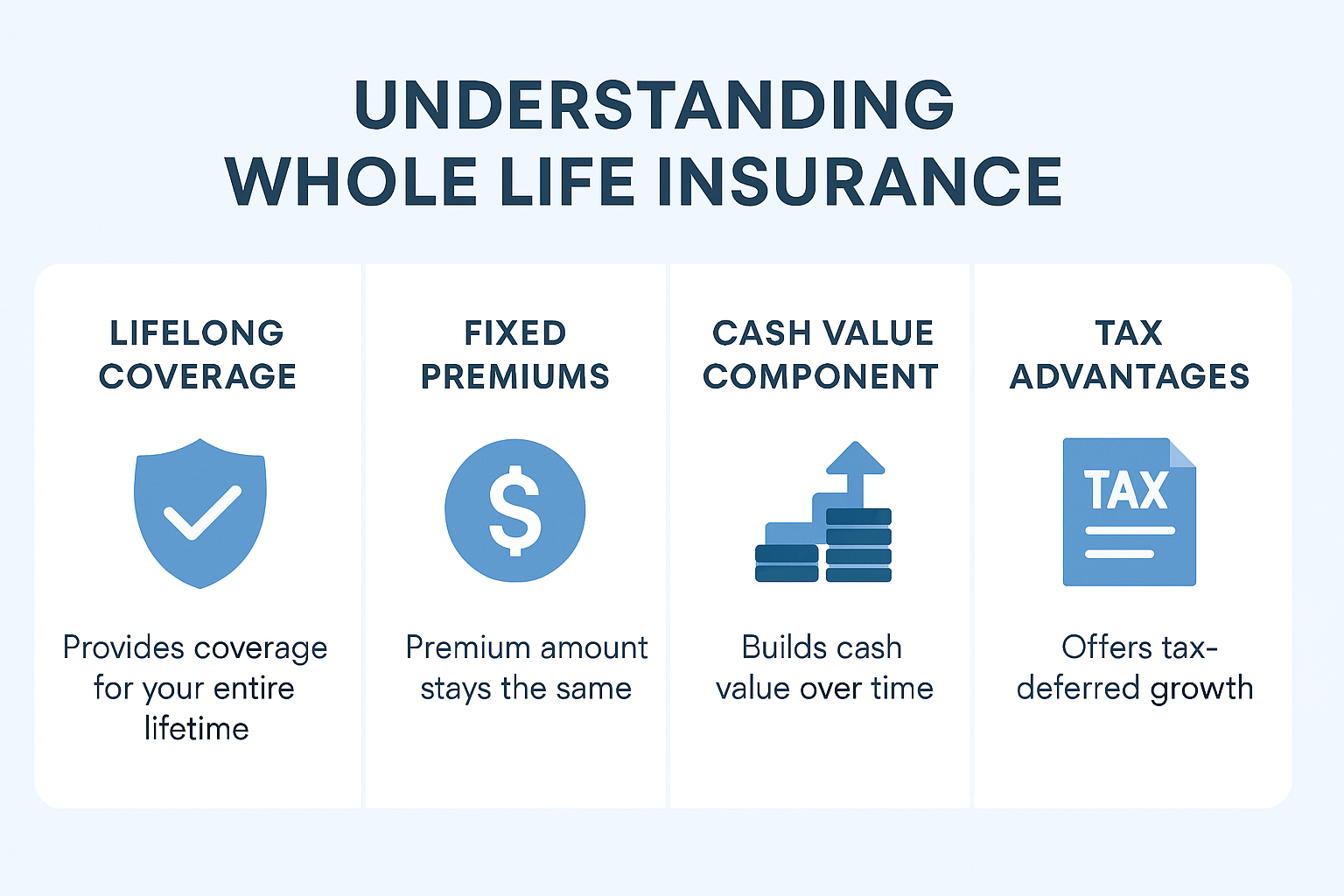
- Lifelong Coverage:
Whole life insurance provides coverage for your entire lifetime. Whether you pass away at 40 or 90, your beneficiaries will receive the death benefit, provided the policy remains in force. - Fixed Premiums:
One of the hallmarks of whole life insurance is its fixed premium structure. This means you pay the same premium amount throughout the life of the policy, regardless of changes in your age or health. This predictability can be reassuring for budgeting and long-term financial planning. - Cash Value Component:
In addition to the death benefit, whole life policies build a cash value over time. A portion of each premium payment is allocated to this cash value, which grows at a guaranteed rate, often enhanced by dividends. The cash value is tax-deferred and compounds over time, meaning you earn interest on both your initial investment and the accumulated interest. This feature transforms your policy into a long-term financial asset.
For a clear overview of the fundamentals of life insurance, the Insurance Information Institute provides accessible explanations that can help you understand how these products function.
How Whole Life Insurance Works
Premium Allocation
When you pay your premium, it’s divided into two parts:
- Cost of Insurance: This portion covers the insurer’s risk, administrative costs, and the death benefit.
- Cash Value Contribution: The remaining amount is added to your cash value account, where it grows over time at a guaranteed interest rate.
The guaranteed growth rate is usually modest (often between 2% and 3.25% per year), but because of the power of compound interest, even a small rate can lead to significant growth over decades. For more on how compound interest works in savings vehicles, you can refer to the IRS guidelines on tax-deferred growth.
Cash Value Growth and Dividends
One of the unique features of whole life insurance is its cash value accumulation:
- Guaranteed Growth: The cash value grows at a rate that is guaranteed by the insurer. This means that even if market conditions are poor, your cash value will continue to grow at the minimum guaranteed rate.
- Dividends: Many whole life policies from mutual insurance companies pay dividends if the company performs well financially. These dividends can be used to purchase additional paid-up insurance, reduce premiums, or accumulate in your policy’s cash value. Although dividends are not guaranteed, they can significantly enhance the growth of your cash value over time.
The American Council of Life Insurers explains that the combination of guaranteed growth and potential dividends makes whole life insurance a stable and predictable asset for long-term financial planning.
Tax Advantages
Whole life insurance offers several tax benefits:
- Tax-Deferred Growth: The cash value grows tax-deferred, meaning you don’t pay taxes on the interest and dividends as long as they remain within the policy.
- Tax-Free Death Benefit: Generally, the death benefit is paid out tax-free to your beneficiaries. This means that the full amount of the death benefit goes to your loved ones without being diminished by taxes.
- Tax-Free Policy Loans: When structured correctly, you can borrow against your policy’s cash value without triggering an immediate tax event. However, if the policy lapses with an outstanding loan, there could be tax implications.
For more detailed information on the tax treatment of life insurance, the IRS provides resources such as IRS Topic 404.
The Advantages of Whole Life Insurance
Lifelong Protection
Whole life insurance guarantees that no matter when you pass away, your beneficiaries will receive a death benefit. This lifelong protection is invaluable for estate planning and ensuring that your loved ones have a financial safety net for the future.
Cash Value as a Savings Component
The cash value in a whole life policy is one of its most powerful features. It acts as a savings vehicle that accumulates over time through compound interest. This cash value can be:
- Used as collateral for policy loans.
- Withdrawn (subject to tax implications if not structured correctly) for emergencies or opportunities.
- Leveraged in financial strategies like Infinite Banking, where you use your policy’s cash value as your personal bank.
This steady, predictable growth can serve as a low-risk way to build wealth over the long term—something that many volatile investment options can’t promise.
Fixed Premiums for Predictable Planning
The fixed premium structure of whole life insurance ensures that your cost remains stable over the life of the policy. This predictability helps you plan your finances more effectively, knowing that your premiums won’t unexpectedly rise as you get older.
Tax Benefits
The tax-deferred nature of the cash value growth and the tax-free death benefit make whole life insurance a powerful tool for long-term financial planning. These tax advantages are particularly useful when considering the long-term impact of compound interest and the importance of leaving a tax-efficient legacy.
Considerations and Drawbacks
While whole life insurance offers a wealth of benefits, it’s important to weigh these against some potential drawbacks.
Higher Premiums
Whole life insurance premiums are higher than those for term life insurance because they include both the death benefit and the cash value component. For someone on a tight budget or someone who only needs temporary coverage, this higher cost can be a significant drawback.
Complexity of the Product
The structure of whole life insurance can be complex. It involves understanding how premiums are allocated, how the cash value grows, and how dividends are applied. For many, this complexity requires guidance from a financial advisor who specializes in life insurance to ensure that you fully understand your policy’s details.
Limited Flexibility in Returns
While the cash value in whole life insurance grows at a guaranteed rate, the returns are typically modest compared to more aggressive investment vehicles. However, this modest, predictable growth is exactly what makes whole life insurance a low-risk, stable asset—particularly appealing in times of market volatility.
Comparing Whole Life Insurance to Other Financial Tools
When evaluating whole life insurance, it’s helpful to compare it to other savings or investment vehicles:
Versus Term Life Insurance
- Term Life Insurance: Offers pure protection for a limited time with lower premiums, but no cash value. It’s ideal for covering temporary financial obligations.
- Whole Life Insurance: Provides lifelong coverage, builds cash value, and offers tax advantages. While more expensive, it also functions as a low-risk, compound interest-driven asset.
Versus Roth IRAs and Other Investments
Many young people consider vehicles like Roth IRAs for long-term growth. However, whole life insurance offers certain advantages:
- Guaranteed Growth: The cash value accumulates at a guaranteed rate, which is not subject to market fluctuations.
- Tax-Deferred Compound Interest: Unlike many taxable investments, the growth in whole life insurance is tax-deferred, allowing your money to compound more efficiently.
- Additional Financial Flexibility: Whole life insurance provides the ability to borrow against the cash value, giving you a source of funds when you need them.
For a deeper look at these comparisons, resources like the BetterWealth And Asset Vault offer calculators, courses, and audiobooks to help you analyze how whole life insurance fits into your overall financial strategy.
Who Can Benefit Most from Whole Life Insurance?
Whole life insurance is not for everyone. Its benefits are best suited to individuals who:
- Want Long-Term Financial Security: If you value lifelong coverage and the certainty of a fixed premium, whole life insurance is a strong choice.
- Are Looking for a Low-Risk, Stable Growth Vehicle: The guaranteed growth and tax-deferred accumulation make it an excellent option for conservative savers who want to build wealth over time.
- Plan for Estate and Legacy Purposes: The tax-free death benefit ensures that your heirs receive a significant, reliable inheritance, making whole life insurance an effective tool for estate planning.
- Seek Financial Flexibility: With the ability to borrow against the cash value, whole life insurance can serve as a financial safety net and provide funds for various opportunities throughout your life.
Conclusion
Whole life insurance is much more than a policy that provides a death benefit—it’s a comprehensive financial tool that offers lifelong protection, predictable cash value growth through compound interest, and significant tax advantages. With fixed premiums and guaranteed returns, whole life insurance creates a stable, low-risk vehicle to park your wealth, ensuring that your money grows steadily over time.
While it comes with higher premiums and a more complex structure compared to term life insurance, its dual benefits of protection and investment make it a valuable component of a long-term financial strategy. Whether you’re focused on building a legacy, planning for retirement, or simply seeking peace of mind, whole life insurance can be a cornerstone of your financial plan.
To make an informed decision, consider your personal financial goals, assess your current situation, and explore the many tools available at BetterWealth’s And Asset Vault. There, you can access policy calculators, courses, and audiobooks that provide additional insights into how whole life insurance works as a long-term, compound interest-driven asset.
For more detailed information, trusted sources such as the Insurance Information Institute, the American Council of Life Insurers, and IRS documents like IRS Publication 525 offer further guidance on the mechanics and benefits of whole life insurance.
In the end, whole life insurance is a robust financial tool that not only protects your loved ones but also allows you to build and preserve wealth in a predictable, tax-efficient manner. By understanding its features and how it operates, you can decide if it’s the right fit for your long-term financial strategy—and set the stage for a secure, prosperous future.
Whole life insurance offers lifelong protection, predictable growth, and valuable tax advantages, making it an important component of any comprehensive financial plan. With the right approach and expert guidance, it can become a cornerstone of your wealth-building strategy.
We help people use overfunded whole life insurance as a capital tool: honest design, real numbers, and a straight answer when it does not fit. Our team has structured more than 2,000 policies across all 50 states. If you want an honest read on your situation, book a discovery call.