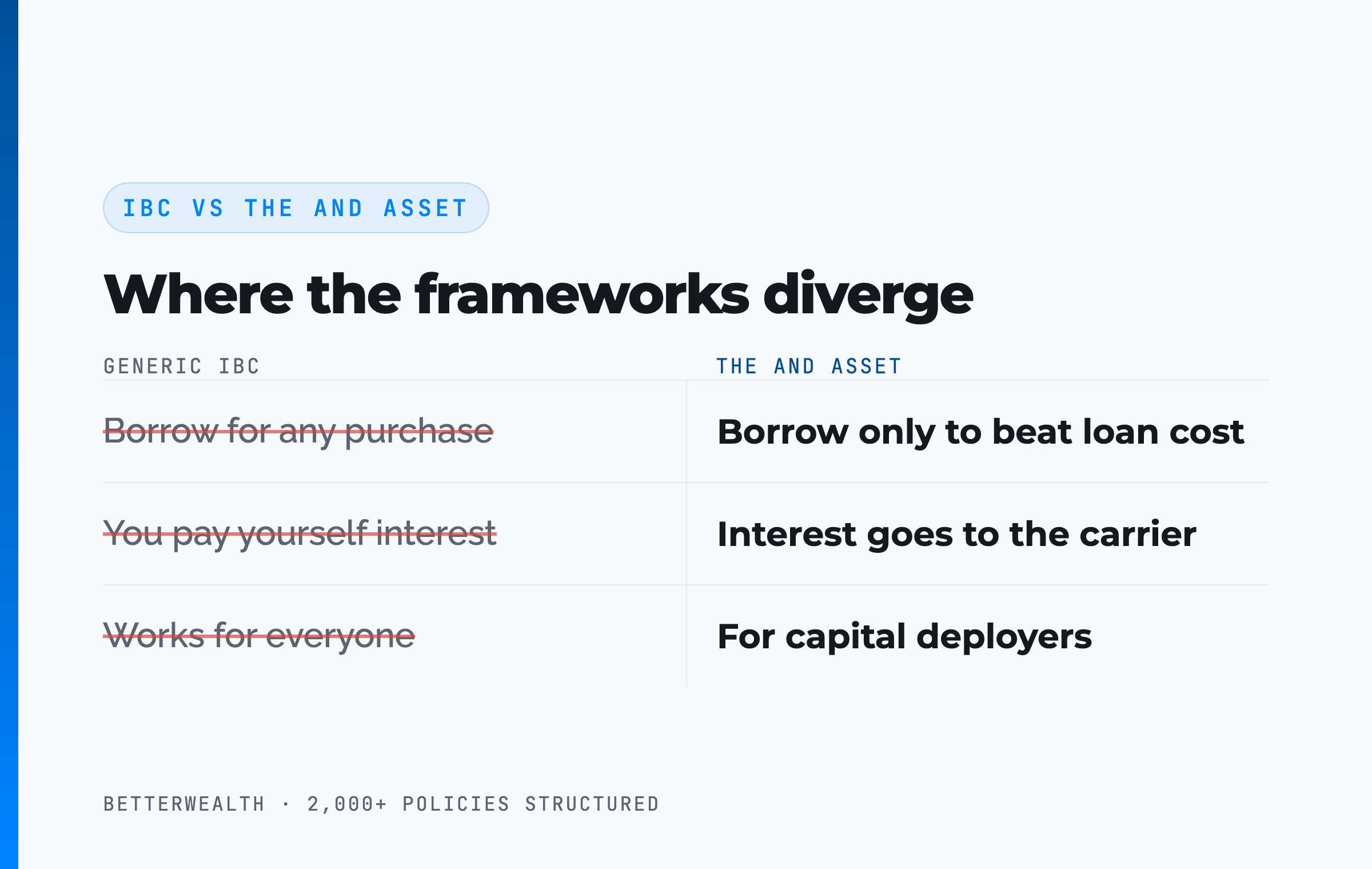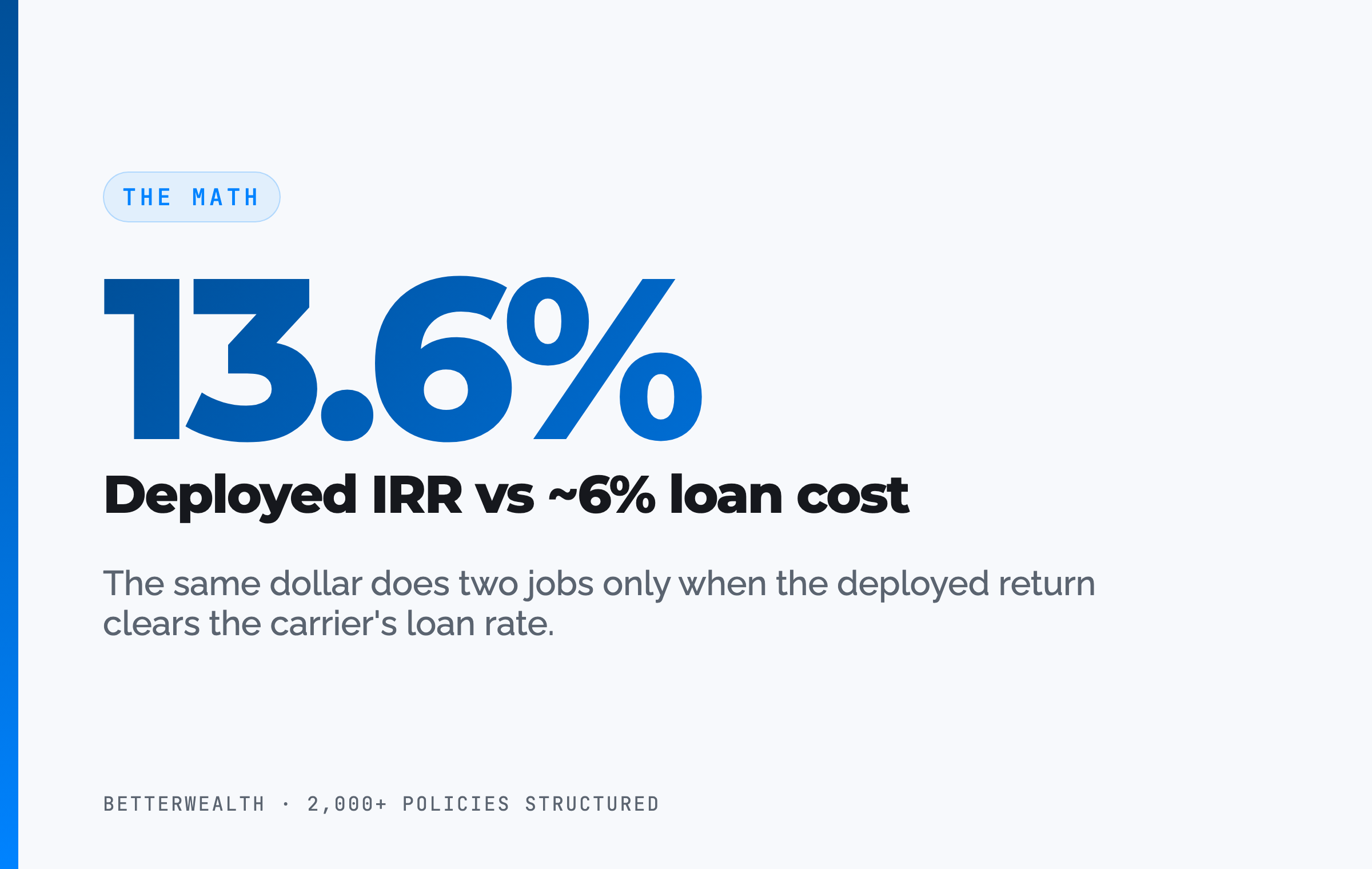

In this episode, we will be talking about all things loan rates, borrowing, when you should use your policy, what opportunities make sense to use it for, and when you should not. And with that being said, let's go ahead and dive in. Hey, Caleb, this episode came up and this content and idea came up mainly because we were actually having communications with a client and he has a policy with us, a significant amount of cash value, and he also has a line of credit with his bank. And he's in the midst of looking at opportunities and figuring out, should he borrow from his line of credit? Should he borrow from his policy? You know, looking at interest rates. And he just was kind of, you know, analysis by paralysis because he had options, which is actually a good place to be in. And so I thought it would make a lot of sense for us to today to talk about, you know, what should someone consider when it comes to an opportunity? to be able to borrow against using the strategy that we preach and talk about all the time, specifically using co-life insurance, designing for high liquidity purposes. So with that being said, I'd love to hear your perspective. I'd love to hear you kind of take it from here and just kind of jump into it. Yeah. I mean, we could, this is a great question. I think it's a classic oldie but goodie. I think a question we get a lot is, when when should i borrow against my policy and another way to say that is What should I invest in? And we're really clear that we don't give investment advice. And so the idea of giving someone advice around when they should borrow sometimes is predicated on the activity that they're doing. And so what we're going to do in this episode is we're going to walk you through the mindset and the framework. And hopefully you can take this information and better apply it. to your life from a paradigm standpoint. And it's just like, it's really important. I know when I first met our Nelson Nash, I would ask him like direct questions. I was like, I was like the person in the comments being like, you know, tell me exactly, like, don't give me analogies. And, and I was always, I always got frustrated with him. Cause I'm like, I don't, I didn't ask about the story of Exodus. I wanted to know like about non-direct versus direct. And he's like giving me this Bible passage and the stories. But then... As I reflected back, I'm like, there's really power in helping people rethink their thinking and helping them think for themselves. And a lot of times when you just say, do this, do that, it's the same reason why AI could make us way dumber is now we just outsource all of our thinking, all of our creativity to Google or to AI. And so, Dom, it's very, very simple at the end of the day when it comes to when I should borrow. And it's very similar to the same question of if my money was in a high yield savings account, when I should use my money. And we're especially talking about investing, but we should also talk about, you know, liabilities, buying cars and all. And it really comes down to two things. It comes down to the activity that my dollar is going to be doing and what is it worth to squeeze. And it comes down to the... risk that I'm taking by doing that activity. And very few of us do a good job showing or like thinking about risk in any outside activity that we do. And then the first one is, is this worth it financially? Really easy to measure, which we'll break down how we do that. But the second one can be tricky. And then if you want to add the third part, if for like the A students, it's factoring in opportunity cost. and saying, okay, maybe it's worth it financially, even when you factor in risk, but is the opportunity cost of me saying yes to this, meaning I'm not able to say yes to the thousand other things I could be doing, is by me saying yes to this, what am I saying no to? And are those no's ultimately more valuable than that yes? That's it. And we'll obviously spend the majority of our time together talking more through that. My hope would be, and I would love if someone commented this, to be like, this episode helped me have a better framework of how to think about my life insurance when it comes to when I should borrow. I love it. And what I'd love to do is find a way throughout this episode to maybe talk about a real life example of some sort of nature. It doesn't have to be like exactly to the T, but at least give a case study where we can talk about generalizations. um, from either a, an opportunity that I've heard about or something that you've heard about and be able to give ideation around like the framework to do so. So I think a case study along the way would probably hit the home. Yep. You know, Joel, Joel's going to get really excited. He's our producer. He's going to get really excited for me to publicly say this. Um, yeah, he's, he's showing his face behind the scenes. You can't see him, but he's, he's excited. What I'm going to do this next year is we're going to have a mini series of me using my policy for random things and document the journey. And so this might, who knows what this is, what this is going to look like, but I've realized that how cool that be for me to show in real time, make hopefully making money. I don't want to, or I lose money at your guys's fun expense, but it's showing people real time how, how you go through the process and how the math works. And. That's one thing that has kind of been on the idea panel, but it's something that I think is going to be fun pieces of content to make. And people will firsthand be able to see how we analyze deals and how we go about things. Amazing. I love it. I think that's going to pay dividends. All pun intended. All right. Let's go ahead and get after it. You got some fun drawing for us, Caleb? Yeah. So before I get into my fun drawing, let me just share with you a. part of a presentation I'm working on. And I'm going to share my entire screen here. And this is a, you know, as we're thinking about life insurance, there's different type of people that will use life insurance. There's people that will use it for retirement. There's people that will use it for inheritance and maximizing their legacy. We're going to be talking to the person that identifies as an entrepreneurial investor. And... How I define an entrepreneurial investor is someone that's either an entrepreneur or a business owner or is investing or wanting to utilize their time and money through the mindset of how would an entrepreneur, you know, invest. So that's what we mean by an entrepreneur investor. And so before we get into when does borrowing make sense, let me just lay this out. So you have somebody who's making money, who if they're an entrepreneurial investor, they're probably saving their money in some type of account to be able to then deploy. into businesses, investments, maybe real estate, or whatever they want. There's a lot of creative areas that you could use your money. And so the pros of a savings account is it's safe, it's liquid, it's convenient, and has some growth. I put that as a yellow because it's got more growth in a checking account, but it's like savings accounts historically have not done super great. And then the cons is low growth. It's not tax deductible. It doesn't grow. with tax deferred growth and you have no credit protection. So there's pros to a savings account, but then there's cons. Now, when we look at life insurance, you do the same equation. You're making money, you're putting into an overfunded life insurance policy, which is maximizing the living benefits, minimizing the death benefit and all, and really trying to optimize the cash in the policy. And as it grows and can be used, and you utilize that to do the same thing, buy businesses, invest in whatever you want to invest in, acquire real estate. do whatever you want. And when you look at the pros of life insurance, there's a couple more pros. And this is for anyone that follows us or watched our videos, you know, like when set up and used properly, life insurance can be a very valuable tool to have. And there's a lot of pros. And then there's cons. Like everything, you don't get a tax deduction, just like a savings account. It takes a couple of years to have more money than what you put in. And this is a... this could be a problem for some people. Some people want access to every single dollar and they don't like the fact that you don't have dollar for dollar access immediately. So the fact that you put in $100,000 and you only have access to 90 or 85,000 year one could be a turnoff for somebody. And so that is a con. And then the last thing is not everyone qualifies health-wise. And we know we have people that haven't qualified health-wise but have gotten life insurance on their... spouse, their business partner, their kids, their grandchildren, but that still can be a con because not everyone can actually get this. So, you know, when we look at the benefits, we first of all, one of the big questions that we constantly get is why does it make sense to use life insurance? Why does it make sense to borrow from my life insurance? I want to address this first and then we're going to talk about how borrowing works is like a lot of times people are like, well, the rate of return, like my borrowing rate is higher. than the rate of return I'm going to make in my life insurance policy, which for the most part is accurate. If your loan is, let's say, 6% and you're earning less than 6%, if you just look at those two scenarios, it would not make sense for you to do borrowing. I don't care. Even the people that say compounding versus amortized interest, like factor in opportunity costs to that. If you're only earning 4.5% in one bucket and you're paying 6%, no matter how much gymnastics you do, That scenario does not make sense mathematically. And so someone might be watching this and being like, well, Caleb, aren't you just contradicting life insurance? And the answer is no, because we're just looking at competitive growth. We're not looking at all these other benefits. And so the question is, if all the other benefits still make life insurance less valuable than the borrowing rate. then you shouldn't do this strategy. But if life insurance with all the benefits are greater than the cost of borrowing, then you can say that you have beneficial arbitrage or benefit arbitrage. And so, and Dom, you interrupt me anytime. I'm just gonna keep going. Yeah, so the one thing that I'll just add to that is I think the arbitrage conversation really is only valid when you're trying to be like, oh 4% four to 5% growth, 6% borrowing. It's like, why would I do that? When you're talking about max loaning in a consistent basis, because yeah, if you're taking the full buckets on each side, the full growth is only getting four and the full loan amount is getting six. Of course, like mathematically doesn't make sense. But if you're only borrowing like a quarter of the money at a point in time, give you at a hundred grand and you're only borrowing $20,000 and you're only getting you know six percent on that that 20 grand is only like 1800 but your 100 grand is still getting the full four percent so you're actually making money in arbitrage you're actually making four grand when you're only spending 1800 so i think if you're looking at how to use this responsibly as a tool there is still some arbitrage that could be had when borrowing if you're not borrowing the full max amount yeah but on a basis yeah i i hear what you're saying but i feel like i i don't necessarily agree with that that logical connection because well no it's not just math you have to factor in opportunity cost because you're you're essentially saying well if you don't borrow at all you should be you still get arbitrage well it's like no just because i didn't say that if you didn't borrow it all you didn't get arbitrage i just you make i'm just saying you're that's that i i don't i don't endorse what you just said because you if you're saying if you have a hundred thousand dollars in an account and it earns let's say four percent but you're only borrowing a portion of that So there's almost like those two buckets that you're separating it in. But it still goes back to like if you have even if I had $10,000 in something and only it was earning four, and then like let's say this is a savings account that we didn't have to borrow. And I had $100,000 in a savings account that's earning a tax-free 4%. And I could borrow against that for six, 6%. Or I could just withdraw it. Some people would say, well You should still borrow against that. You earn 4% in your savings account. You pay 6%. And then you could even say, well, most of your money is earning 4%, so you're actually getting ahead. Whereas I would just say, withdraw that money at 4%. You're missing out on 4% instead of paying 6% and then put that money back. So the matter of if you're only taking a $10,000 loan, it doesn't matter if I have $100,000 or $1 million. I still want to be efficient with it. the activity that I'm doing. Does that make sense? To some degree, yes. I'm just cheerily talking about looking at a net profit number with the tool you already have and saying, well, we already have this tool. We're already utilizing it. You get these benefits. And if I were to want to make sure that I wasn't negative per year in the quote-unquote arbitrage game, I wouldn't be max funding it or max loaning it. And I would still be able to receive a positive net profit in my policy relative. the growth versus the loan interest. This is all I'm saying. We're probably missing each other, but we're talking about probably two different things because I'm just looking at it. This is the same language that a lot of people use that I dislike when it comes to infinite banking. They're almost making it sound like, hey, you can purchase that car because you're actually interested in earning on your entire policies greater. So they're almost combining the interest in your policy with a decision. And this is good that we're having this conversation because it just goes to show that there's different ways to do this and and communicate this. But I yeah, I we can. I'd also understand that. But then you're also now factoring a whole nother cost that is like an expense from that perspective, because in theory that that is technically, quote unquote, correct. It's like, well, if I'm only borrowing 20 grand from for my car. Right. Well then... Yeah. And I have a hundred grand in the policy. That 20 grand is quote unquote costing me an interest rate. I'm getting positive profit in my policy. That is true. But then you're not factoring now in like this negative interest that's coming back for that. You're actually a 6% over here, like negative wise. I'm just saying now, like, well, if we used it for an investment, you were using it in a equitable way for the policy relatively, and also a relative equitable way in the way that we should use it from borrowing. Versus if you use the full amount, like the full, full, full amount, your policy net profit will actually go down if you're using the max amount on both sides of the equation. Yeah. You're not always going to be taking max loans when you have a policy as well. You're right. But what a lot of people say, going back to the $100,000 example, if you take a $10,000 loan, you can say on the macro sense, your policy earned X and so it's earned more than what you had to pay in interest and all. And that could be true when it comes to the policy, but that's not true when it comes to the activity. And that's where I think there's so much confusion as people combine the internal value of a policy and the external decision. And I think those should, by definition, be separated. I agree with that. Okay, we're going to continue, but this is good. And we'll see. This is why there's a lot of questions about this. Because even in our company, we have different. ways of explaining things, which is a blessing in disguise. So when it comes to an internal rate return, going back to my statement that I made, if my policy, the only value that it did was earn 4%, let's just say, or 4.5%, and it cost me 6%, math would say it's dumb for me to take a loan, I should just withdraw that money. But if there's other benefits that I'm getting that increase that 4.5% to be greater. then you can say that there is actual beneficial arbitrage. And so if you take a look at just a policy, I've shown this a lot on the channel, this is just a $50,000 policy just to address the questions. This can work with $5,000 a year, this can work with $500,000 a year. We're just using 50,000 as like the unit price when it comes to this example. You can see that this is your cash value, this is the cash that you would actually have available to borrow against, and then this is the internal rate of return, which means this is the actual rate of return. So once it starts getting green, That's representing the growth on every single year, even including the red years. And so just to show a friend of our channel, Todd Langford, Truth Concepts, you put $50,000 in for the next 30 years at 4.58%. You're going to get a future value of $3.2 million. You look at a life insurance policy, it's $3.2 million. It's the exact same number, which proves to you that this life insurance policy is growing at 4.58% every single year. So. what we do is if we take all the benefits that you get in life insurance and we just say, okay, well, we're going to check the box and say, this is a competitive growth. And so we're, we're checking this, meaning like in this calculator, we're showing that this is getting four and a half percent. And what we're going to do is we're going to compare versus the 30 year picture of a high yield saves account at two and a half percent. And we're also going to look at the last 30 years bonds, which, you know, let's say average 4.75%, just 105%. So you can see that, you know, Right away, life insurance outgrows a savings account but is a little under a bond. But the thing that we're going to try to do is we're going to try to factor in some of these other benefits and see if the rate of return increases if we factor some of these benefits. Because right now, we can list off these benefits, but sometimes it's hard to quantify when it comes to how these work. And so if you just factor in the fact that life insurance grows tax-deferred and you can use it tax-free. you can put some type of rate of return on that. Now, some people might not be paying any taxes at all. Well, this would be zero for you. Some people are in states that don't have state income tax. Well, that might be beneficial. Some people are in California and are paying 40% to 50% tax on their dollars. And so just like a savings account, you have to pay ordinary income tax. If we're comparing this to a savings account, essentially, and you're factoring in a 30% tax, now you need to earn 6.5%. every single year, just when you factor in the tax rate. And when you include the cost of insurance, which just to be simple, we're just including a 30-year term. So we're not including a permanent life insurance policy for life. We're just including a term insurance that drops off after 30 years. Now you have to earn over 7%. If you include a fee, which probably you wouldn't include a fee if you're talking about a savings account. So if we just go back, Now on this list, if you just include taxes and a one-tenth of the insurance costs representing what you would pay for term, now you're getting an equivalent value of life insurance of over 7%. And we're not valuing all the other benefits here, the creditor protection, the contribution limits, the chronic and terminal illness rider. And so all these other things, now we're showing that this equivalent value. could be closer to eight maybe nine percent and i'm not saying that life insurance is getting you seven to nine percent I'm just saying that it's a lot more valuable than what it shows on the illustration because a lot of people are just comparing the cash rate of return and they're assuming that's the only benefit you get. Whereas actually life insurance, you get a lot of other benefits, including a permanent death benefit that will last your entire life and be super efficient when you pass on money. Dom, I want to get your take before I go into the borrowing aspect. No, I think this is the, you know, we were just talking for 10 minutes in regards to the policy, the loan rates, the functions, how it worked, arbitrage. And I think that this is the key piece to it all when it comes to just looking at life insurance relative to any other asset class. We can look at other asset classes for borrowing functionalities such as a business, real estate, lines of credits, whatever we want to compare it to. But this specifically here, where the way that it operates with the external value, and the internal values combined is what makes this policy and the overfunded, quote unquote, whole life insurance policy so powerful. So yeah, I have really nothing else to add except like, amen. And this is why we do what we do. Love it. Okay. So now this is the slide and full transparency. We got to improve our graphics at Better Wealth. So if you're a graphic designer and you're like, hey, Caleb, I love your concepts, but your slides look terrible. call me, text me. Email me. We may have a side job for you. You're putting your cell phone number out there right now? Yeah, email me. But what this picture represents is we have all the benefits that you get internally in your policy. Plus, for those of you that identify as entrepreneurial investors, now you have external activities as well that you could get, but they're not free. So let me break down what that means. So you have your internal benefits and this is you have your cash value and the more you fund your policy the greater your cash value is going to build which is think of it as available equity that you can borrow against if you use like a house example this cash value is available to borrow against and you get all these benefits so what happens is if you want to take a take a loan you can use a you can go to the insurance company or a third party lender and what you can do is you use your cash value as collateral Meaning you can't loan more than what your cash value is, and usually you can get 95% of your cash value as collateral. So you can't loan dollar for dollar all the money that you have, but you can loan out the majority of it. Your insurance company is actually going to give you the loan. They're using your cash value as collateral, so your money is staying in your policy, and you're getting all the benefits with your life insurance policy. And then you get an unstructured loan, and that unstructured loan means... It's unstructured. You don't have to pay the interest if you don't want. It's recommended that you always at least pay the interest. Obviously, Arnelson Nash would say not only do you pay the interest, but you're an honest banker. You pay yourself more the same or more interest than you would pay somebody else because you need to fund your bank. So regardless of what you do, it's an unstructured loan. And then you can buy anything you like with that. Now, you'll see this dotted line. Because this dotted line, a lot of times people combine internally and externally together. I don't know. I think I'm just making up words. They take the internal benefit and they combine it with the external benefit and almost make it into one thing. And I think it's like you're getting the internal benefit regardless of what you do. So you don't have to borrow, which is great. You can borrow, which is great. But you have to make sure that the activity that you borrow. is actually worth it. And don't include the life insurance benefits into this equation, because it's, you're already going to get it. So an example of this, Don, would be like, someone, someone buys something at 0%. Or let's just say someone buys something that's a negative, like they actually lose money. But they're able to say, well, I lost money over here, but my policy still did over well. So I actually washed myself out. And I'm like, okay, mathematically you're not wrong. If you take a Zoom out, you wash yourself out. But actually, if you didn't do that activity, you would be that much more ahead. And so you took an L on one side, but your policy didn't take an L. Instead of combining that, separate that. That's what I'm trying to say on this. And I think that's where when people practice infinite banking or talk about this, they just need to separate that. And so then the real question comes down to, when does it make sense for me to borrow? And the answer to that is when your activity is greater than the cost of borrowing, which is another way to say that is control cost. So banks do this all the time. When you go to a bank, and this slide needs maybe to be updated a little bit, when you go to the bank and get 1%. for them to give you your money and they loan it out to someone out at 4% who would love to get 4% loan I would but they do that their ROI in this equation is actually 300% because the bank is using your money they're paying you 1% which is an example if you deposited $100 they're giving you $1 thank you for your $100 Dom I'm going to give you a dollar they're going to loan your money out to me. I'm going to pay them $4 and over that one year they made a 300% spread on that money because they put $1 in are getting four back, which is a 300%. We got to think of the same way when it comes to how our policies work. So if our loan's at 5% and we're going to buy an asset of 2%, the ROI is negative 60, not great. You could do a wash and... But or you could actually earn greater. So if you if you hypothetically get a 12 percent investment, then your your ROI is going to be on that activity is going to be, you know, greater because it's costing you five dollars and you're making 12. So you're taking the concept of banking. But the point point that I'm making is just because your policy is super, super efficient doesn't give you the free grace to or, you know. mercy or whatever the word I'm trying to use to just go and make a dumb decision. They're two separate decisions. And when you combine them, they can be really powerful because it unlocks your dollars doing more than one job for you. And so that's what I would say. And then the last thing I would say is you might have a 7% opportunity. And in this equation, mathematically, even if you factor in risk, you feel really good about the 7% activity. And so the question could be, should I get a loan to... take 7%. And for some of you watching this in this scenario, the answer should be yes. But others of you, if you put your money into a 7% opportunity, you're unable to say yes to a 12% or 15% or 20% opportunity. And that's where it's hard to factor in opportunity costs. It's because some people want their money moving, but the definition of having their money tied up in deals potentially will make them not able to take advantage of... other opportunities that come along. And so just because you're taking a loan against your cash value doesn't mean you're losing some liquidity because you have less cash to actually loan against. And so anytime you say yes to a loan, you're not just taking on the cost, you're not just taking on the risk, you're also taking on the opportunity cost of saying yes to that decision. And there's my TED Talk, Dom. Most people have no idea where to start or how to really evaluate whole life insurance. That's why we've built the vault. It's all of our best life insurance resources and educational tools all in one place, all for free. We have calculators, handbooks, crash course, deep dive videos on numbers. If you want to learn more, click the link in the description or tag comment below to unlock the vault. All right, back to the video. No, and I think that's why we are not a massive proponent of using your policy for liabilities. just from the sheer lost opportunity cost of what you're missing out on, right? You know, in the book, you know, Infinite Bank with B. R. O. Nelson Nash, he talks about using it for cars and other things like that. And I know people who practice infinite banking, that's what they preach. I'm not necessarily saying that like it's the worst financial strategy on the planet. I think somewhere along the way, you can make sense of it depending on certain, you know, environments and, you know, certain rates and how you choose to practice it, et cetera. But what happens when you do borrow against your policy and you use up the cash value for that opportunity, quote unquote, your vehicle, you now miss out on opportunities to actually go build real wealth. Asset classes that can produce wealth that have tax advantages, appreciation, cash flow, like all the things to having your dollars do more than one thing. Now we really only have our dollars doing one thing, which is essentially like paying back your car. So that's really the reasons why that we push. If we're wanting to... And then if you find the asset that's actually producing real cash flow, you can then take that asset to pay for your liability. So now you have both, right? You have the funneling of this cash flowing asset, appreciating, getting the tax advantages, growing. You have that there as a hard... Whatever the asset is. And then you still have your vehicle and you still have your policy. So this is where I think people sometimes think that we're this like negative infinite banking a lot of the times. I know there's obviously some marketing or some way we don't approve of the way that people speak about it. But I think at the end of the day, we just want to try to find the best way to help people grow, protect, and keep more of their wealth. Yep. Well said. Well said. And hopefully... Hopefully this helps answers questions. And I would be very curious and I would love to hear your thoughts in the comments. Like how else can we say this? Or what are other ways that we can say or other examples we can use? Because understanding the math, understanding risk and understanding opportunity cost are like the three factors that go into making a decision on should I take a loan against my policy? Amen, amen. Is this the time where we go into a drawing? I don't know if there's much to draw. I could draw, but it would be the same thing. So maybe we go into real-life examples. Yeah, I have one pulled up. What an example it could look like when you're shifting through. So let me start by coming back full circle to the beginning of this episode. and I talked about, we have a client who has um, opportunity funds, right? One from a line of credit from a business, um, and one from a line of credit from the policy. Uh, the original policy design that we did for them was $600,000 front load and then $50,000 per year going forth. Okay. So just can kind of keep that in mind. There's on both sides of the equation, there could be the opportunity to borrow on the line of credit or from the policy around like 500 K. Okay. Now, The question then comes down to which line of credit should I use? Because you're going to come across this if you're somebody who's actively looking for opportunities. You may have a HELOC that's producing a specific loan amount, excuse me, loan rate. You may have business. You may have your equities that you technically can borrow. There may be things that you have to compare against. What I'll start by saying is if all things are created equal, where the interest rates are exactly the same. So with the company that he's with right now, the interest is right around six and a half percent. And then if the line of credit with the bank is also six and a half percent, you are going to be better off using your line of credit from the life insurance policy, first and foremost, because of what Caleb said earlier, is it's unstructured. It gives you flexibility in case something happens, in case you have to wait an extra year or you know they have to It falls apart. Whatever the situation is, you have the flexibility to pay it back at a different rate, specific amounts. You're not forced to do it. That's the first thing. Now, when you're looking at actual other rates, the odds of your life insurance policy being lower than all other things to borrow is likely very high. And that's one of the amazing things about life insurance specifically is that it goes off the moody bond in a lot of ways when it comes to loan rates. And it's always, I'm going to say always, but it's usually a whole lot lower. If you go look at like equity line of credits and money that you want to go get in the marketplace, it's always like one or 2% cheaper. That's even if you go to a third party lender in instances that Caleb was talking about, where you could get like 95% from the quote unquote specialist for the bank, you can get 95%, but you're probably going to be paying an extra one, one and a half extra basis points. to get access to the ease of capital, to be able to document it for business purposes, so you could get interest write-off, so that you can have the benefits that come with using a lender in situations like that. So that's why another reason why I'm such a big advocate for life insurance. And so what we're going to do is I'm going to share my screen and we're just going to specifically pretend that we're going to use our policy for this opportunity, like the life insurance only. and that the other lines of credits that the client has are not going to be the first option. And then that could be something later. If another opportunity come up and he's fully max loaned for this, then those things could be also things that could come at another point in time. So I'm a big proponent of just real estate in general. I think that when we're looking at asset classes that have benefits, We talk about this all the time. Life insurance gives you dollars in many multiple jobs. You could argue 15 to 50, depending on who you're talking about. You could be grassing for straws. But there's a lot. When you look at real estate, you can argue that there's probably five to maybe seven different jobs that your dollars can get as well. And so I think when you can combine the two together, it makes it very attractive because now you have your dollars doing, you know, 15 to... 20 extra jobs between the two asset classes and you can have velocity of money working extremely well for you. And so this is why they talk about that majority of the quote unquote millionaires that are actually created in the world are built off of using real estate. And then you hear like, these are what the wealthy people do. They use life insurance because you have all these benefits and it's a line of credit and then you can use them both together. All right. And so with that being said, that was my soapbox. You had yours. Now I use mine and we'll go ahead and share my screening will we'll talk about, um, this is Dom and my therapy session each week. We, uh, exactly. Uh, amazing. Okay. So. I have this opportunity here, okay? This is a multifamily investment opportunity that's in Phoenix, Arizona. And here's essentially the projected returns and summaries. Now, again, everything that we're talking about here, this isn't investment advice. This is sheerly just demonstrative purposes for examples of like, should I or shouldn't I not use my policy to invest into something like this? If you first and foremost understand what you're looking at, you understand the terminologies and language, you've vetted the people that have helped or are doing this with you, and you then have decided that this is a potential good opportunity, you now have to figure out mathematically does it make sense for your policy or is it better off to hold off and use your policy for something different, right? So first, you've got to start with how much available liquidity do you have? And this is why we are big advocates when we're starting policies. Like if you're starting a policy and you're at the age of like 50, 45, and you're like, Hey, I want to put $10,000 a year into a policy. It's like, well, you can do that, but your first year you're going to put in 10 grand and you're going to only have access to maybe eight grand, which means that there's not a whole lot of opportunities available for you for probably another five, six, seven years. And then when you get to that point, You now only have the bare minimum amounts to be able to invest into a lot of really great opportunities when it comes to other things that are outside of the market. And so most opportunities that I've seen in the real estate market, whether it's a syndications, whether it's funds, the minimums are usually around $50,000. OK, so just kind of keep that in mind. And that's kind of why if you're younger, I do think that putting money into something like this and you'd be able to put a lower amount. is perfectly okay because you have more time on your side. You have more time to keep learning. You're just setting money aside into this opportunity fund to let it grow and compound. And then when you get a little bit older and you've done the research and you become more sophisticated, you now have these massive opportunity fund bucket to be able to borrow against to use for something like this that we may be talking about. So first, when we're looking at this. You can see that there's three different buckets of names on here. There's cash flow, there's growth class, and there's platinum class. This really, again, comes down to the amount of money that one would contribute to it. Usually, when you're looking at these type of opportunities, the more money that you contribute, the more favorable that the terms will be when it comes to the total amount of returns that you're going to get. Okay, so when we're looking at the 50, 100, 250, you can look at the equity multiple. And the equity multiple is 2.5, 2.15, and 1.45. All it's essentially saying is the amount of dollars that I contribute, of that, what is the multiple that I'm getting back? So if I essentially contributed $100,000, it's pretty easy to math. I'm just going to use this. If I contribute $100,000, I'll get $154,000 back. So I get the $54,000 on top of the $100,000 that I contributed. So that'd be like the total of the entire thing. 54% over the lifetime of the opportunity. Okay, that's not per year. Okay, so if you divide that by five years, you could see it's more close to like 10-ish, 12-ish percent. All right, so that's the first and foremost thing to point out. Now, okay, did you want to say something? Nope. No? Okay, amazing. Now, what we're going to do is we're going to think about this from a conceptual perspective of I have my life insurance policy. Okay, and let's just, I even have an example that I have pulled up. um, here. Okay. I haven't had an example of a life insurance policy that we could use. Okay. We could have used the example that the client that we had is say $500,000, um, line of credit because he contributed 600,000, $50,000 a year. He has plenty of funds to use, but that we could have used that. But I think it could also be easier to kind of see what this could look like as well, just from a sheer cash value perspective. And we're, we're designing a policy. If you're somebody that's like, Hey, I have some extra cash flow. I want to be able to put it into something. Does this strategy make sense for myself? I want to start by saying that this strategy really only works if you have a large lump sum of money that is sitting around or you have a consistent way of creating cash flow that allows you to keep contributing to this policy over a specific period of time. So I would say bare minimum about seven years to contribute to something like this. is really where the line in the sand sticks. If you're like, hey, I have $50,000 and I can only do it for the first year, this strategy is not for you. You have to have a consistent way of income or cashflow from other investments, ways that you can save money. Saving money is the key to the strategy. If you're able to do that, you have to think about other ways to increase income, decrease expenses, and start with that from a foundational perspective. So we're just gonna pretend that We have contributed to our policy for two years, right? So you've started a policy, you've contributed 100 grand, you have a job that allows you to save a business that allows you to save 100 grand per year, okay? So you've put in 100 grand the first year and 100 grand the second year, okay? Cumulative premium. You now have a line of credit for $176,000 to be able to utilize for an investment opportunity. And we've talked about specifically, like we think that if you're going to borrow and use the strategy, the the delta on the other end needs to be more than what you're borrowing against the control cost. Right. That Caleb was mentioning. And so what we want to do is say, OK, I have one hundred and seventy six thousand dollars to be able to use for something. Should I now? be able to use that for an opportunity like this well you could say okay well maybe i want to start small and maybe go with the 50 000 because it's uh 25 20 of the the funds that i have available or maybe it's like hey like i i trust these people i really like the numbers maybe i want to go with a hundred thousand dollars uh instead um we're gonna use the hundred thousand dollar uh because i think from a math perspective it'll just make a whole lot more sense so currently right now the interest rates when it comes to life insurance policies, they're right around 6%. Okay. So we're going to go with the 6% control costs when it looks to using your life insurance policy. And then we have to then evaluate this deal and say, do I get a better, um, Delta? Do I get a better, uh, return than what my control costs actually is and doesn't make sense for myself. Uh, and am I missing out on other opportunities by giving up this a hundred thousand dollars to put into this because I know I'd be curious to ask Caleb is like, Hey, you know, after we kind of look at this, is this something that you'd even want to consider? And I would, I would imagine that Caleb would be like, no, probably not because I value control so much more in a lot of ways. Uh, so when it comes to this, um, I think the, the part that's a super important is the cashflow number, right? Because cashflow really at the end of the day is the thing that's going to drive home the ability for us to live the life that we want and we desire, right? We can have more cashflow, quote unquote, passive income that's above our expenses. That's when we know we have more options, more flexibility, more time freedom to do what we want, when we want. And that's kind of like the end goal. I think sometimes starting early on, maybe cashflow isn't the most important thing because you need to create a bucket of money that's large enough to then convert that to cashflow at some point in time. Same thing with retirement, right? You build this entire bucket of money into the S&P or 401k, et cetera. Well, it doesn't do you no good if it's just a big bucket of money. You have to figure out a way to turn that to cashflow no matter what. I think earlier on, we can strive for maybe more bigger buckets of money to eventually shoot for cashflow later on. But I still think looking at the cashflow number is super important because if we have a loan charge on our policy at 6%, well, we have to make sure if we want to not have the rule that we talked about of it being a good quote unquote opportunity that we can at least bare minimum. pay off the loan interest to our policy to make this thing work in a way that makes the most sense. And so, um, I think from an easy perspective, I can obviously pull up a calculator and be like, Hey, you know, if I take a hundred thousand dollar loan and I essentially, you know, times by 0.06, I'm going to get $6,000, uh, obviously. So this is my loan interest charge. Okay. That I'm on my policy. So the, the, this here, uh, talking about up here every year of, if I have um I don't know in fact that it went, uh, every year or the first year when I borrow a hundred thousand dollars, the insurance company is going to charge me 6% to be able to utilize that funds. Okay. So if it's out for 365 days, you're going to get 6% charge. You essentially have a $6,000 expense that goes to that. Now, if I have an investment where I can borrow against it and get something that's at a greater than $6,000 in this instance, I get 8%. Okay. So you could obviously do the math. The math is pretty simple. Uh, I put it in a hundred thousand dollars to this investment. This investment gives me 8% back. That's going to now give me $8,000. So then my Delta at this point in time is 2000. So what makes a lot of sense is to take that six grand. Okay. Take that and pay off your loan interest every single year. Okay. Then what you have to make sure, again, I talked about the beginning is you have cash flow from other places to be able to continue to do this strategy. So the following year, year three. You would then put in another $100,000, okay? Your net cash value would then grow to $277,000. Now you subtract probably about $100,000 of loan availability, right? Your cash value is still 277, but your actual line of credit that you can utilize is probably around 177 because your $100,000 is still inside of this opportunity, right? That $2,000, you could do whatever you want with. You could save it. You can go invest in a different asset class. You can go on a cool vacation. That's the cool part is when you find an opportunity, your 2,000 free-flowing dollars between the growth on your investment, the 8%, and the 6% in your policy charge, you now have the flexibility and freedom to make options and choices. And this is why it's so important that the investment that you're doing is actually gonna create you a positive delta. And so then you do that same strategy every single year for five years, okay? So you're one, you do the same thing. Boom, pay it off, 8%. pay it off. You're getting a $2,000 Delta every single year. Okay. You're not contributing any more money to the policy. Um, and then what happens at the end of this, you then get your return on the sale, $178,000. Okay. Then you take the Delta between the 178. Okay, which is just easy math, right? 178, well, 178. And then you subtract the 100,000 that you put in. Now you have a $78,000 delta. So what you'd want to do is take that $100,000, pay off your full policy loan. And now you're at, you know, your full loanable amount that you can then go use for other opportunities. And now you have your $78,000 that you can go do again with some flexibility with whatever you want to do. You could use it for, to pay for your car, for your, your mom, you could, you know, put a down payment on a house. You know, you could buy another investment property. You can go on a really cool vacation that you can go splurge with your entire family for generations. Like there's a lot of really cool things that you can do. And now every year you're putting in a hundred thousand dollars. You just imagine that you can do the same strategy. Every single year, you could add almost a new one to the repertoire. So after seven years, you could be doing this with like seven different properties, right? And you're doing the same strategy by taking the cashflow growth, paying off the interest. And when the sale of the property happens, you then go ahead and pay your policy loan. And you also probably want to save a little bit for taxes and things like that. And so this is how you think about would I or would I not use it is do I have a long enough time horizon where I can wait five years and be patient enough? Does my actual cash flow pay off my interest year after year? And if some of these answers are yes, and you find that at the end, you'll be way better off from a wealth perspective than you were if you didn't do any of these, then the answer is like, this is probably something that I should consider. And the more of these that you look at, and you're like, okay, well, I'm going to vet this person, this person, this person, this opportunity, this opportunity, this opportunity, you have options. That's the power behind it, right? the thing of, you know, Nelson Nash's book is like the one with the gold makes the rules or something like that. It's like, well, if you have this line of credit of their life insurance policy, you make the rules because you now have funds. You now have an opportunity. You now have decisions you can make. You don't have to say yes to the first thing and you can make better decisions clearly because you have this opportunity fund to think through. So that's just on a simplistic basis that I just wanted to share and talk about of like how to kind of think through should or should you not make some of these opportunities for yourself. Caleb, I'd love to hear from you if this is something that you would other consider or if there needs to be more from a return because, you know, from your perspective, it's 18, 21, you know, cash flow and the return. The one on the bottom, if it was vetted from a risk standpoint, which we all know that syndications have kind of gone through the ringer. But, I mean, 21% IRR. is a pretty, pretty great return. And so it just would factor into the risk, I would say that from an opportunity cost standpoint, I'd be totally fine tying up money if I was confident that I could get that type of rate of return. But that the big asterisk is real estate syndications don't always perform that way. And so that's that's like the the million dollar question when it comes to any type of investing is is do they have a good track record and what's the likelihood of success but uh the but yeah i think that that's a great it's a great way to explain just like you know in just using a calculator how how you go about this and i i want to want to just ask a question dom obviously we're talking a lot about entrepreneurs but for someone who's a w2 employee what is uh does anything change because the way it really nothing changes on my end Because it's like you got to save your money somewhere and you got to invest somewhere. So depending on how you make your money is not like some people make their money by running businesses. Some people make their money by working as leaders or within businesses. What you do with that money is your choice. And you can still be an entrepreneurial investor if you're a W-2. And actually, some of our best clients are high W-2. They have stability when it comes to their income. And then they invest using the entrepreneurial framework. And they actually get best of both worlds because a lot of times entrepreneurs are going up and down with income. They're creating stability. But instead of investing in typical ways, they're investing like entrepreneurs. That is a question that we get often because a lot of people say like, well, I'm not an entrepreneur. And so they almost like dismiss the things that we're talking about because they think it's only applies to entrepreneurs. Yeah, no, it's a great question. And I think that. When it comes to real wealth building and financial freedom, there's not a very high likelihood that you're ever going to do that, surely just off of your W-2 income. There's going to have to be a way where you're going to need equity in a company or upside for something relative to the ownership of a business, right? So if you're a W-2, it's going to be hard to achieve some of that same mindset or same abilities to build real wealth. And so the only way to do that is to go invest into assets. And I think that this is an incredible, incredible tool for a W-2 individual because they get to not have to think about the day-to-day of running businesses and they just focus on their job. And then they have this line of credit that every single year they can just focus on allowing this thing to compound and grow. And then whenever the opportunity presents itself to borrow, to use for an opportunity, they have that ability. So an entrepreneur may use it for their business, right? To invest into marketing, into people, into growth. Like that's, that's great. But most W2 people, if they're looking at true wealth building, they would use this for buying assets like this. So I actually think the example that I just showed is actually way more beneficial for a W2 employee than actually an entrepreneur, because the entrepreneur may want to go use their funds for business while the W2 employee, they may want to use it for this because they don't have the time and energy and headspace to think about. you know, investing, or they don't have the way to, uh, to go be the full-time real estate investor, because that's a lot of work. Like that's a full-time job in itself, right? When you're the, the general, the GP of deals, you're vetting, finding, doing the underwriting, networking, making sure everything's going well, raising the money. But when you're the LP, the limited partner, where you're just investing the funds, you just have to do probably spend an entire day vetting the people, the opportunity, you know, looking at the track records. And that's why I think that this strategy is actually even better for a W-2 person when we're looking at investing in opportunities like this. Well said. Well said. Anything else you want to say before we dive into the Q&A? No, I think I think that was 53 minutes of us talking about loans and life insurance. You know, it doesn't get much sexier than that. More exciting than that, you know. Yeah, exactly. That's where we're the fastest growing life insurance show on the. on the planet. We've helped people unlock millions of dollars in hidden value just by reviewing their old life insurance policies. Unfortunately, thousands of people do not have life insurance policies set up properly, which could be costing them a lot of money. If you have a policy, the few minutes it takes to fill out our form could be the difference between continuing to waste money or unlocking serious value. If you qualify, we'll review your policy 100% for free and give you the honest breakdown you deserve. Click the link in the description or take comment below to apply. Back to the video. Let's talk about, I'll take the first comment. This is Caleb. I'll take the first comment because it says my name. Hey, by the way, if you want me to answer questions, just say my name. Caleb, I'm unable to get a policy for my son because his incredible fear of needles. You said that there's a creative ways to get around this. Can you talk about that? The short answer is if your son is under 18. All insurance companies that do permanent life insurance policies don't require needles. And if your son's over 18, there are certain insurance companies out there that we can go through underwriting without blood and urine. And so that would be, and I just want for the record, competitive companies out there like Penn Mutual that you can get a really, really solid policy and potentially not have to do blood and needles. So that would be my answer to that. and um I think I, if I remember correctly, I shot you a comment and you can always email us and we would be more than happy to answer your individual questions. Sometimes it's hard to answer questions just, you know, because people are asking like, what should I do? And so we can speak generally, but the only way that we can really speak to your situation is if you reach out to our amazing team. Yeah. The cool part also about the space is it's becoming more competitive around these insurance companies. And there is, you know, Penn Mutual really has the... quote unquote, initial gold standard for underwriting without a needle, uh, at least with the companies that we use and every company is realizing like they need to do so as well if they're wanting to be competitive. So, you know, four of the companies that we use, Lafayette Life Now, Guardian and, uh, Mass Mutual all allow, uh, fluidless, um, needleless underwriting in a lot of instances, like there's certain parameters. So yeah, it's, it's, uh, it's cool. Um, amazing. All right. Next question. $500 per month for life insurance for a child? When they grow up, they have to borrow the money they put in it to pay for college just to have to still pay the money back. Does it make sense? Amazing. Well. If you're being serious about this statement, then I want to say I'm very empathetic to where at first it doesn't make a lot of sense. If you're being sarcastic, if it doesn't make sense, then this isn't for you. Now, if you're genuinely curious and you want to learn and you're trying to figure out like, well, how does this make sense? Well, you have to realize that this strategy has a borrowing function around it to allow you to get the tax advantages first and foremost. okay The policy will grow tax deferred. You could access the money tax free. And then this is what allows you to get the uninterrupted compounding for the rest of the policy's life as well. All right. And so that's the, that's the part about like, I have to borrow the money to utilize it. You actually technically do not have to borrow the money either. When you're utilizing this policy, you actually could take a withdrawal and then everything above your basis would also would then be taxable at that point in time. You could also take a withdrawal up to the basis and then loan everything so you don't pay taxes at all. So there are ways to avoid having to borrow if you want to. But the power behind this is the uninterrupted compounding that goes on where you're collateralizing it just like a HELOC, just like other things that allow you to get the tax benefits and grow indefinitely. Now, for college purposes, I do, and I'm sure Caleb, you would agree that relative to something like a 529 plan. This is an incredible strategy because it gives you options. It gives you flexibility. Your kid may not want to go to college when, you know, depending how old they are, if they're three, you know, 15 years from now, you have no idea what they're going to want to be, who they're going to become. And you also have no idea what the world's going to look like, right? So that's something to consider. And then with 529, you have to use it for, I mean, they're getting a little bit more broadened. You could use it for other things, but mainly you have to use it for, you know, college and college planning and things like that. And then for us, we just believe that. Um, having a death benefit on your children while they have the flexibility and options for the future, uh, just creates a better tool than something else like 529. Yep. I would say, uh, we just did a whole episode on, uh, borrowing. So you can go rewind and watch and you're right. It doesn't make sense if you don't value all the other benefits that you get with life insurance. The question is all the other benefits of life insurance. Is that more valuable? than having a loan feature. If the answer is no, then don't do it. If the answer is yes, then it makes a lot of sense. Next question. I'll take this one. I didn't know about convertible term. Can a convertible term policy be written to become an IBC-friendly whole life insurance policy? Short answer is maybe. There are certain companies that have competitive convertible term that give you the optionality to convert using any type of designs. A lot of insurance companies do convertible term, but they have restrictions on how you can convert them and like what type of policy you can design with that. And so to answer your question is you maybe, and if you work with companies like ours, for sure, yes, like we can get you a competitive term insurance policy that gives you the convert convertible option to do something very competitive on the backend. And so that's a great question. And, uh, it's, it's very thoughtful question. Uh, so thank you for asking. Amazing. All right. Next question. Um, is there an argument to first create a PUA whole life first as your foundation, uh, then for wait for a clear downturn in the market before considering additional IUL VUL? Uh, first and foremost, I want to say, uh, T Y slash Q J six W S you are a very sophisticated individual, uh, nonetheless for you to even understand whole life, the way that it's functions and then to even consider should I kind of quote unquote time the market for IUL, VUL is I can tell that you're a very sophisticated individual the way that you're thinking and being creative. I would say that why not consider that first and foremost? I don't think that that's necessarily like the wrong strategy. I do think that if you're looking at it from a death benefit perspective, then I think that you may be just, you know, missing out on the death benefit from the VUL, IUL, et cetera. And now you have to get very clear at the end of the day on why you'd even want an IUL or VUL. Because when you're looking at borrowing functionalities, we do believe that whole life is going to be the better strategy because of the fees, the upfront things that come with it and the risk relative to the whole life. But if you're wanting to look at this maybe like long term planning and you're wanting to look at this for a sheer death benefit play. and you want to have it in a wrapper that has some tax advantages that come even more with like a VUL, etc. Then I think that... We are probably getting close to seeing something relatively where the market may not investment advice turn. So considering something in the near term for this strategy, if you know somebody who's qualified, who's educated, who's a pro expert in these strategies is something to definitely consider. That's a tough question to answer at the end of the day, but I don't think that you're in the wrong for thinking of it that way because you have a down year, the odds of getting another down year. is very small. I think two down years in a row is probably the max that you really have seen in history. So you kind of just avoid some of the risks in the early years with something like that. So yeah, I think it's creative thinking. Yeah, I think it's creative thinking. And I would also just caution against thinking about life insurance as an investment. I don't know if that compounds well in the end. And so you're taking an investment, dollar cost averaging, buying dips, concept, applying it to insurance, which is creative. But I would just say that. I would caution caution that mentality because I think 20, 30 years out, you may or may not be happy with the overall long term performance of that asset versus actually investing directly. So but but great, great question. And appreciate your answer to that, Dom. All right, this next question is why does whole life require so much mindset shifting analogies, hypotheticals, false equivalences, just make sense of owning it dot dot dot, you guys are geniuses in your own mine. Yeah, I mean, here's what I would say. I think another way to ask this question would be, why do you have to come up with so many, again, analogies or hypotheticals when explaining something? And the answer to that is, this is nothing new. I mean, you go back in history and you look at Jesus himself. He talked in parables. He talked about it in examples. Some of the best communicators in the world use stories. and analogies and word pictures. And so we have plenty of videos that are showing directly math, like directly math, how numbers work. And those are great. I actually prefer looking just at the numbers. But there are other people that learn differently. And so what we're trying to do is we're trying to get into a space where life insurance is very misunderstood. It's very missold. It's very overhyped and in some cases over trashed. And so you're getting this thing that's really on one side overhyped and another side trashed. And I would say, you know, not not rightfully. And so you find us in the middle that are trying to show math examples. But then we also know that math doesn't always create light bulb moments. Sometimes you have to create the philosophy and hypotheticals to bridge the gap. And so that would be my answer to that. I know that this person's probably... asking it in a probably not a sincere way, but you know, I appreciate everyone that takes time to comment and to watch our videos and we are always getting better. And that's what I'm grateful for. So if there are better ways that we can communicate or better examples, I would love if you're sincere, I would love to hear what you would do. And we might apply that and make our videos better. So that's what I would say as relates to that comment. Amazing. Well said, sir. Well said. Love your genuine tonality. Love it. All right. Last question. So we know the growth on the cash value within the life insurance is tax-free, but is the growth within the PDF also tax-free before it hits the life insurance policy? So I'm going to break this question down into a couple of folds. So first and foremost, so we know the growth on the cash value within the life insurance is tax-free. So I'm going to start there. Technically, inside of a life insurance contract. your cash value does not grow tax-free. It actually grows tax-deferred. We are able to access it tax-free though, because of the policy loan function. So I just want to just share that and just be clear. I think mentally for the way that it feels, it kind of feels like it's growing tax-free anyway. So if it's easier for you to understand that, I'm very empathetic to that. So there's the first part, but is the growth within the PDF also tax-free? So for you that don't know what a PDI stands for. It stands for premium deposit fund. Also tax free before it hits the life insurance policy. So a premium deposit fund for individuals that don't know is essentially taking a large bucket of money and setting it into this side account with the insurance company. The insurance company is going to grow at a specific rate that's going to credit that and then that's that deposit fund, that side account, will then pay your premium payments over a specific period of time. Alden Armstrong, who's one of our wealth coaches, unbelievable, you guys have seen him probably on the show. He just did an episode on premium deposit funds with New York Life and how New York Life has this 12% first year premium deposit fund to get people enticed to want to put money in store with them to get policies, et cetera, et cetera. So the question is, is as that grows, is that tax free and work the same with life insurance policy is the answer is no, that the, any growth that happens on your premium deposit fund, you do have to pay taxes on that at ordinary income. So just keep that in mind is that it's not all a quote unquote tax free strategy. If you do use something like that, you do have to pay taxes on the growth within it. Okay, and I think that... Actually wraps us up with our last Q&A. An hour and six minutes of talking about life insurance. Caleb, we did it again. Never gets old. Never gets old. Appreciate the conversation. Appreciate the questions. And I look forward to reading more of your comments because definitely think we can do a better job as a profession industry answering this question about when does it make sense to borrow. And hopefully we can play a role in helping that conversation further. So good. and We'll always try to say at the end, from a CTA perspective, if you want somebody to design your policy with high liquidity cash value and you just want life insurance in general, we do believe that we are some of the best in the entire space. So we have a team of experts, both on the underwriting and on the life insurance design perspective, that if you want to have a conversation, if this makes sense for you, go ahead and click the links below and we'll be more than happy to serve you. And until next time, you guys have an amazing day. And we'll talk soon.